The stereotype of a computer scientist is someone who doesn’t understand people. For many, how people behave is exactly what they are experts in. Kavin Narasimhan is one. When a student at QMUL she studied how people move and form groups at parties, creating realistic computer models of what is going on.
We humans are very good at subtle behaviour, and do much of it without even realising it. One example is the way we stand when we form small groups to talk. We naturally adjust our positions and the way we face each other so we can see and hear clearly, while not making others feel uncomfortable by getting too close. The positions we take as we stand to talk are fairly universal. If we understand what is going on we can create computational models that behave the same way. Most previous models simulated the way we adjust positions as others arrive or leave by assuming everyone tries to both face, and keep the same distance from, the midpoint of the group. However, there is no evidence that that is what we actually do. There are several alternatives. Rather than pointing ourselves at some invisible centre point, we could be subconsciously maximising our view of the people around. We could be adjusting our positions and the direction we face based on the position only of the people next to us, or instead based on the positions of everyone in the group.
Kavin videoed real parties where lots of people formed small groups to find out more of the precise detail of how we position and reposition ourselves. This gave her a bird’s eye view of the positions people actually took. She also created simulations with virtual 2D characters that move around, forming groups then moving on to join other groups. This allowed her to try out different rules of how the characters behaved, and compare them to the real party situations.
She found that her alternate rules were more realistic than rules based on facing a central point. For example, the latter generates regular shapes like triangular and square formations, but the positions real humans take are less regular. They are better modelled by assuming people focus on getting the best view of others. The simulations showed that this was also a more accurate way to predict the sizes of groups that formed, how long they formed for, and how they were spread across the room. Kavin’s rules therefore appear to give a realistic way to describe how we form groups.
Being able to create models like this has all sorts of applications. It is useful for controlling the precise movement of avatars, whether in virtual worlds or teleconferencing. They can be used to control how computer-generated (CGI) characters in films behave, without needing to copy the movements from actors first. It can make the characters in computer games more realistic as they react to whatever movements the real people, and each other, make. In the future we are likely to interact more and more with robots in everyday life, and it will be important that they follow appropriate rules too, so as not to seem alien.
So you shouldn’t assume computer scientists don’t understand people. Many understand them far better than the average person. That is how they are able to create avatars, robots and CGI characters that behave exactly like real people. Virtual parties are set to be that little bit more realistic.
From the archive: This article by Dean Miller, is an edited version of one of the 2006 winning essays from the Queen Mary University of London, Department of Computer Science, first year essay competition.
May I ask you a question? When you think of the computer what names ring a bell? Bill Gates? Or for those more in touch with the history behind computers maybe Charles Babbage is a familiar name? May I ask you another question please? Do you know who Dr Mark Dean is? No, well you should. Do not worry yourself though, you are definitely not alone. I did not know of him either.
Allow me to enlighten you..
Mark Dean is in my opinion a very creative and inspirational black computer scientist. He is a vice-president at IBM and holds 3 of IBM’s first 9 patents on the personal computer. He has over 30 patents pending. He won the Black Engineer of the Year Presidents Award and was made an IBM fellow in 1995. An IBM fellow is IBM’s highest technical honor. Only 50 of IBM’s employee’s are fellows and Mark Dean was the first black one. Prior to joining IBM in 1980 he earned degrees in Electrical Engineering before going back to school to gain a PhD in the field from Stanford University. He was born in 1957 in Jefferson City, Tennessee and was one of the first black students to attend Jefferson City High School. He was an exceptional student and enjoyed athletics. Early manifestations of his desire to create were shown when he and his father built a tractor from scratch when he was just a boy.
Upon joining IBM Mark Dean and a partner led the team that developed the interior architecture (ISA systems bus) which allowed devices like the keyboard and printer to be connected to the motherboard making computers a part of our lives. It was that which earned him a spot in the National Inventors Hall of Fame. While at IBM he has been involved in numerous positions in computer system hardware architecture and design. He was responsible for IBM’s research laboratory in Austin, Texas where he focused on developing high performance microprocessors, software, systems and circuits. It is here where he made history by leading the team that built a gigahertz chip which did a billion calculations per second. In 2004, he was chosen as one of the 50 most important Blacks in Research Science.
He and his father built a tractor from scratch when he was just a boy
I think that such a man should be well recognized in computer science, especially to black computer science students because from what I can see we are rare. We as a minority need an inspirational figure like Mark Dean. He inspires me, I wanted to share that with you. Before this small article it is very probable you had no knowledge of this man. So if there comes a time where you are asked about important names in the field of computers, I hope Dr Mark Dean springs to mind and rings a bell for you to hear loud and clear.
The truth table for NOT P. A yellow brick represents P. Blue means True and Red means false. Read along the rows to get the meaning of NOT P when P is true or false. Image by CS4FN
We have seen how to represent truth tables in lego. Truth tables are a way of giving precise meaning to logical operations like AND, OR and NOT. They are also give a way to do logical reasoning following a simple algorithm.
That’s Not Not True
You may have been pulled up in English and told you just said the opposite of what you meant, after saying something like “There ain’t no way I’m doing that”. This is a “double negative” as the “n’t” in “ain’t” is really “not” so followed by “no way” you are actually saying “not not way” or overall: “I am doing that”. Perhaps the most famous double negative is in the Rolling Stones song “(I can’t get no) satisfaction”. English is very flexible though and double negatives like this don’t cancel out but just become a different way of saying the negative version. In logic two negations do cancel out, though. Let’s take a purer version to work with: the statement “I am not not happy”. What does this mean? In logic the basic proposition here is “I am not happy”. The logical statement is “NOT (NOT (I am happy))”.
We can prove what this means using truth tables. We can do more than just prove what this single statement means. We can prove what all double negatives mean, more generally. We do this by replacing the proposition “I am happy” with a variable P. It now becomes NOT (NOT P) or in our lego version where we use a yellow brick to mean a proposition, P:
Image by CS4FN
This is just syntax, just a sequence of symbols. It doesn’t give us any meaning on its own. We can build truth tables in Lego for that. We start from the variables that are at the inside of the logical expression which here is just the variable P. We list in a table column the possible values it can take (true or false).
Image by CS4FN
This shows P (yellow) can be either be TRUE (blue) or FALSE (red). Now we build up the logical expression of interest a column at a time. NOT is applied to P, so we add a new column for NOT P and use the truth table for the operator, NOT, to tell us what lego brick to put in each row based on the lego brick already there. The NOT truth table is at the top of the page. It says if you have a blue brick in a row, place a red brick there. If you have a red brick, put a blue brick there. This gives us a new filled out column for (NOT P) which is just a copy of the NOT truth table (but bare with us that was just a simple case). We get:
Image by CS4FN
Moving outwards in the expression NOT (NOT P)), we now look at the operator applied to (NOT P). It is NOT again. We add a new column to our truth table and again use the NOT truth table to work out the new values, but this time applied to the column before (the NOT P column). The NOT truth table says put a blue brick for a red brick, and a red brick for a blue brick in the column it is being applied to (the NOT P column). This gives:
Image by CS4FN
The result is a truth table with coloured bricks identical to that of the original column for P. Switching back from lego bricks to what the columns mean, we have shown that the NOT(NOT P) column is the same as the P column, or in other words that NOT(NOT P) EQUALS P (whatever value P has).
We can actually go a step further though, because equivalence is just a logical operation with its own truth table. It gives true if the two operands have the same value and false otherwise (or in lego terms if the bricks are the same colour the answer is a blue brick and if they are different colours the answer is a red brick. The truth table looks like this:
Image by CS4FN
We can use this truth table to calculate whether two lego truth table columns are equal or not just by looking up the combinations in this EQUALS truth table. Continuing our example we can carrying building our truth table about NOT(NOT P)). To make things clearer first add a column corresponding to P again. That means we will be applying the EQUALS operator to the last two columns. As before, for each row, look up the corresponding pattern for those last two columns in the EQUALS truth table to get the answer for that row. In the first row we have two blue bricks so that becomes a blue brick according tot he EQUALS truth table. In the next row we have two red bricks. That also becomes a blue brick. This gives:
Image by CS4FN
The thing to notice here is that all the entries in the final answer column are blue lego pieces. Switching back from the lego world to the logic world, what does this mean? Blue is true so all rows in the answer are true. That means whatever value of the proposition P the answer to NOT (NOT P) EQUALS P is true. We have proved a theorem that this is always true. We have shown by building with lego that a double negation cancels itself out.
Logical expressions like this that are always true (whatever the values of the variables) are called tautologies. We can tell something is a tautology, so we have proved a theorem, just by the simple manual check that its truth table values are true (or in lego all blue).
The important thing to realise about this is all the reasoning can be done without knowing what the symbols mean, and certainly not worrying about English words, once you have the truth tables. You do it mechanically. You do not need to think about what, for example, red and blue mean until the end. At that point you return to the logical world to see what you have found out. All blue means it is always true! You can also at that point substitute back in actual words of interest into the statements proved. P means “I am happy”. We started by asking what “I am not not happy” means. We converted this to “NOT (NOT (I am happy))”. By swapping in “I am happy” for P in our theorem gives us that NOT (NOT “I am happy”) EQUALS “I am happy”, or that “I am not not happy.” just means the same as “I am happy”
We have been reasoning about English statements, but this kind of reasoning is the basis of all logical reasoning and essentially the basis of formal verification where the meaning of programs and hardware is checked to see if it meets a specification. It tells you what a test in a program like “if (! temperature != 0) …) means so does for example, or what a circuit with two NOT gates does.
And lego logic has even given us a way to prove things just by building with lego.
Subscribe to be notified whenever we publish a new post to the CS4FN blog.
This blog is funded by EPSRC on research agreement EP/W033615/1.
The Lego Computer Science post was originally funded by UKRI, through grant EP/K040251/2 held by Professor Ursula Martin, and forms part of a broader project on the development and impact of computing.
Truth tables are a simple way of reason about logic that were popularised by the 20th century philosopher Ludwig Wittgenstein. They provide a very clear way to explain what logical operators like AND, OR and NOT mean (or in computational terms, what they do). They also give a simple way to do pure logical reasoning and so see if arguments follow logically. These logical operators crop up in logic circuits and in programs where decisions are being made so are vital to creating correct circuits and writing correct programs. Let’s see what a truth table is by making some from Lego.
Logic in Lego
First we need to represent the basic building blocks of logic in lego. We’ve seen in previous articles how to represent numbers, binary and even images in lego. We have seen that we do computation on symbols and we can use lego blocks as symbols. Logic can therefore be represented in lego symbols too.
We will look at a simple kind of logic called propositional logic (there isn’t actually just one kind of logic but lots of different kinds with different rules). Propositional logic is the simplest kind. It deals with propositions which are just statements that are either true or false (but we may not know which). For example, “Snoopy is a logician.” is a proposition. So are “The world is flat.”, “Water contains oxygen.” and “temperature > 0” as we might find in a program. For the purposes of logic itself, it doesn’t matter what the words actually mean or even what they are. We will therefore represent all propositions by square lego blocks of different colours.
Here we want the symbols to stand for logical things rather than numbers. There are lots of numerical values: things like 1, 5 and 77. There are only two logical values: TRUE and FALSE, often written just as T and F. We will use a blue lego block for the logical value TRUE, and a red block for the value FALSE. They are just symbols though so we could use any blocks and any colours, just as we could use other words for true and false as other languages do. We chose blue for true just because it rhymes so is easy to remember, and red more randomly because it is a common lego primary colour.
True and False lego. A square 2×2 blue block represents True. A square 2×2 red block is false.
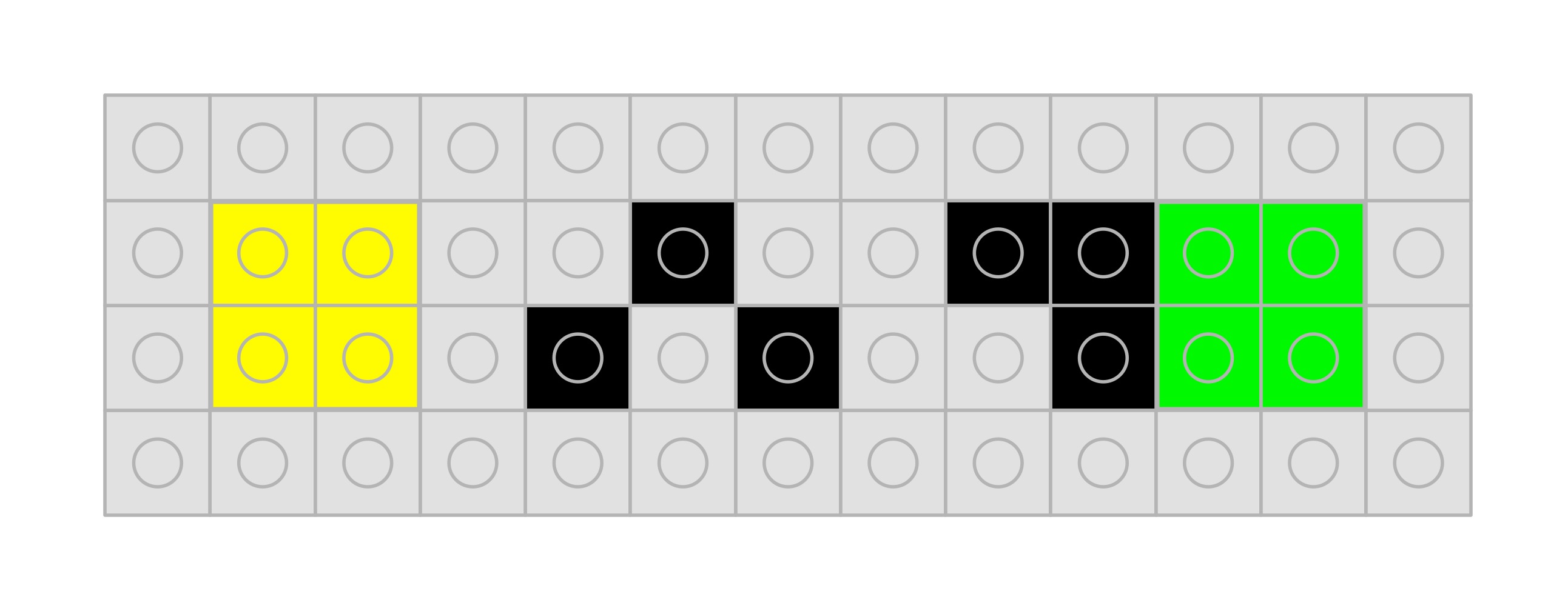
What about representing the actual sentences stating purported facts like “Messi is the best footballer ever”, or in a program “n == 1”? Statements like this are called propositions. As far as reasoning logically goes the precise words or even language they are in do not matter. This is something Wittgensteinrealised. When doing reasoning these basic propositions can be replaced by variables like P and Q and the logic won’t change. Rather than use letters we will just use different coloured lego blocks to stand for different propositions, emphasising that the words or even variable names do not matter. So we will use a yellow block for a variable P and a green block for a variable Q. Each of which could stand for absolutely any English proposition we like at any time (though if we want it to stand for a particular proposition then we should define which one clearly).
Propositional variables P and Q are represented by yellow and green blocks
Logical Symbols
What we are really interested in is not just true and false values but the logical operations on propositions. The core of these we use in everyday English: AND, OR and NOT, more technically known as conjunction, disjunction and negation in logic. There are several variations of the symbols used to represent these symbols just as there are for true and false. We will use the versions in lego as below.
The logical operators AND, OR and NOT as lego symbols
These lego symbols will allow us to write out logical expressions about propositions: like “The cat is thirsty AND NOT the cat is hungry” which we might write in English as “The cat is thirsty and not hungry”. If we use a yellow block to mean “The cat is thirsty” and a green block to mean “The cat is hungry” then in lego logic we can write it as follows:
The cat is thirsty AND NOT the cat is hungry P AND (NOT Q)
Of course the yellow and green brick are variables so by changing the propositions they represent it can stand for other things. It can also represent: ” The moon is blue AND NOT The moon is made of cheese.” where the yellow brick represents “The moon is blue” and the green brick represents “The moon is made of cheese”.
Think up some statements that involve AND, OR and NOT and then build representations of then in lego logic like the above.
The meaning of logical connectives
The above gives us symbols for the logical connectives, but so far they have no meaning: it is just syntax. Perhaps you think you know what the words mean. We use words like and, or and not in language rather imprecisely at times based on dictionary-style definitions. They essentially mean the same in English as in logic, but we need to define what they mean precisely. We do not want two different people to have two slightly different understandings of what they mean. This is where truth tables come in. A truth table tells us exactly, and without doubt, what the symbols for the operators mean. The give what is called by computer scientists a formal semantics to the logical connectives.
Let’s look at NOT first. A truth table is just a table that includes as rows all the combinations of true and false values of the variables in a logical expression together with an answer for those values. For example a truth table for the operator NOT, so telling us in all situations what (NOT a) means, is:
P
NOT P
TRUE
FALSE
FALSE
TRUE
A truth table for the NOT operator. Reading along the rows, IF P is TRUE THEN (NOT P) is FALSE; IF P is FALSE THEN (NOT P) is TRUE.
We can build this truth table in lego using our lego representation:
NOT only applies to one proposition, the one it negates, (it is a unary logical connective). That means we only need two rows in the table to cover the different possible values those propositions could stand for. AND (and OR) combine to two propositions (it is a binary logical connective). To cover all the possible combinations of the values of those propositions we need a table with four rows as there are four possibilities.
P
Q
P AND Q
TRUE
TRUE
TRUE
TRUE
FALSE
FALSE
FALSE
TRUE
FALSE
FALSE
FALSE
FALSE
A truth table for the logical AND operator.
We can build this in Lego as:
Reading along the rows this says that if both P and Q are blue (true) then the answer for P AND Q is true. Otherwise the answer is false (red). T
The following is the lego truth table for the logical OR operator
The columns for the two variables yellow/green (P/Q) are the same, setting out all the possibilities. Now the answer is true (blue) if either operand is true (blue) and false (red) when both are false (red).
We have now created lego truth tables that give the meaning of each of these three logical connectives. They aren’t the only logical operators – in fact there are 8 possible binary ones. Have a go at building lego truth tables for other binary logical connectives such as exclusive-or which is true if exactly one of the operands is true, and equivalence which is true if both operands are the same truth value.
Truth tables give precise meanings to logical operators and so to logic. That is useful, but even more usefully, they give a way to reason logically in a clear, price way. By following a simple algorithm to build new truth tables from existing ones, we can prove general facts, that are ultimately about propositions, in lego… as we will see next.
Subscribe to be notified whenever we publish a new post to the CS4FN blog.
This blog is funded by EPSRC on research agreement EP/W033615/1.
The Lego Computer Science post was originally funded by UKRI, through grant EP/K040251/2 held by Professor Ursula Martin, and forms part of a broader project on the development and impact of computing.
Ludwig Wittgenstein is one of the most important philosophers of the 20th century. His interest was in logic and truth, language, meaning and ethics. As an aside he made contributions to logical thinking that are a foundation of computing. He popularised truth tables, a way to evaluate logical expressions, and invented the modern idea of tautology. His life shows that you do not have to set out with your life planned out to ultimately do great things.
Wittgenstein was born in Austria, of three-quarters Jewish descent, and actually went to the same school as Hitler at the same time, as they were the same age to within a week. Had he still been in Austria at the time of World War II he would undoubtedly have been sent to a concentration camp. Hitler presumably would not have thought much of him had he known more about him at school. Not only did he have a Jewish background, he was bisexual: it is thought he fell in love four times, once with a woman and three times with men.
Interested, originally, in flying and so aeronautic engineering he studied how kites fly in the upper atmosphere for his PhD in Manchester: flying the kites in the Peak District. He moved on to the study of propellors and designed a very advanced propellor that included mini jet engines on the propellor blades themselves. Studying propellors led him to an interest in advanced mathematics and then ultimately to the foundations of mathematics – a course about which, years later, he taught at Cambridge University that Alan Turing attended. Turing was teaching a course with the same title but from a completely different point of view at the time. His interest in the foundations of maths led to him thinking about what facts are, how they relate to thoughts, language and logic and what truth really was. However, World War I then broke out. During the war he fought for the Austro-Hungarian army, originally safe behind the lines but at his own request he was sent to the Russian Front. He was ultimately awarded medals for bravery. While on military leave towards the end of the war he completed the philosophical work that made him famous, the Tractatus Logico-Philosophicus. After the war though he went to rural Austria and worked as a monastery gardener and then as a primary school teacher. His sister suggested this was “like using a precision instrument to open crates”, though as he got into trouble for being violent in his punishments of the children the metaphor probably isn’t very good as he doesn’t sound like a great teacher and as a teacher he was more like a very blunt instrument.
In his absence, his fame in academia grew, however, and so eventually he returned to Cambridge, finally gained a PhD and ultimately became a fellow and then a Professor of Philosophy. By the time World War II broke out he was teaching philosophy in Cambridge but felt this was the wrong thing to be doing during a war, so despite now being a world famous philosopher went to work as a porter in Guy’s hospital, London.
His philosophical work was ground breaking mainly because of his arguments about language and meaning with respect to truth. However, a small part of has work has a very concrete relevance to computing. His thinking about truth and logic had led him to introduce the really important idea of a tautology as a redundant statement in logic. The ancient Greeks used the word but in a completely different sense of something made “true” just because it was said more than once, so argued to be true in a rhetorical sense. In computational terms Wittgenstein’s idea of a tautology is a logical statement about propositions that can be simplified to true. Propositions are just basic statements that may or may not be true, such as “The moon is made of cheese”. An example of a tautology is (a OR NOT(a)) where (a) is a variable that stands for a proposition so something that is either true or false. Putting in the concrete propositions “The moon is made of cheese” we get:
“(The moon is made of cheese) OR NOT (The moon is made of cheese)”
or in other words the statement
“The moon is made of cheese OR The moon is NOT made of cheese”
Logically, this is always true, whatever the moon is made of. “The moon is made of cheese” can be either true or false. Either it is made of cheese or not but either way the whole statement is true whatever the truth of the moon as one side or other of the OR is bound to be true. The statement is equivalent to just saying
“TRUE”
In other words, the original statement always simplifies to truth. More than that, whatever proposition you substitute in place of the statement “The moon is made of cheese” it still simplifies to true eg if we use the statement instead “Snoopy fought the Red Baron” then we get
“Snoopy fought the Red Baron OR NOT (Snoopy fought the Red Baron)”
Again, whatever the truth about Snoopy, this is a true statement. It is true whatever statement we substitute for (a) and whether it is true or false: (a OR NOT(a)) is a tautology guaranteed to be true by its logical structure, not by the meaning of the words of the propositions substituted in for a.
As part of this work Wittgenstein used truth tables, and is often claimed to have invented them. He certainly popularised them as a result of his work becoming so famous. However, Charles Sanders Peirce used truth tables first, 30 years earlier. The latter was a philosopher too, know as the “Father of Pragmatism” (so hopefully that means he wouldn’t have minded Wittgenstein getting all the credit!)
A truth table is just a table that includes as rows all the combinations of true and false values of the variables in logical expressions together with an answer for those values. For example a truth table for the operator NOT, so telling us in all situations what (NOT a) means, is:
a
NOT a
TRUE
FALSE
FALSE
TRUE
A truth table for the NOT operator. Reading along the rows, IF a is TRUE then (NOT a) is FALSE; IF a is FALSE then (NOT a) is TRUE. Image by CS4FN
The first thing that is important about truth tables is that they give very clear and simple meaning (or “semantics”) to logical operators (like AND, OR and NOT) and so of statements asserting facts logically. Computationally, they make precise what the logical operators do, as the above table for NOT does. This of course matters a lot in programs where logical operators control what the program does. It also matters in hardware which is built up from circuits representing the logical operations. They provide the basis for understanding what both programs and hardware do.
The following is the truth table for the logical OR operator: again the last column gives the meaning of the operator so the answer of computing the logical or operation. This time there are two variables (a) and (b) so four rows to cover the combinations.
a
b
a OR b
TRUE
TRUE
TRUE
TRUE
FALSE
TRUE
FALSE
TRUE
TRUE
FALSE
FALSE
FALSE
A truth table for the logical OR operator. Reading along the rows, IF a is TRUE and b is TRUE then (a OR b) is TRUE; IF a is TRUE and b is FALSE then (a OR b) is TRUE; IF a is FALSE and b is TRUE then (a OR b) is TRUE; IF a is FALSE and b is FASLE then (a OR b) is FALSE; Image by CS4FN
Truth tables can be used to give more than just meaning to operators, they can be used for doing logical reasoning; to compute new truth tables for more complex logical expressions, including checking if they are tautologies. This is the basis of program verification (mathematically proving a program does the right thing) and similarly hardware verification. Let us look at (a OR (NOT a)). We make a column for (a) and then a second column gives the answer for (NOT a) from the NOT truth table. Adding a third column we then look up in the OR truth table the answers given the values for (a) and (NOT a) on each row. For example, if a is TRUE then NOT a is FALSE. Looking up the row for TRUE/FALSE in the OR table we see the answer is TRUE so that goes in the answer column for (a OR (NOT a)). The full table is then:
a
NOT a
a OR (NOT a)
TRUE
FALSE
TRUE
FALSE
TRUE
TRUE
A truth table for the a OR NOT a. Reading along the rows, IF a is TRUE then (a OR (NOT a)) is TRUE; IF a is FALSE then (a OR (NOT a)) is TRUE; Image by CS4FN
Truth tables therefore give us an easy way to see if a logical expression is a tautology. If the answer column has TRUE as the answer for every row, as here, then the expression is a tautology. Whatever the truth of the starting fact a, the expression is always true. It has the same truth table as the expression TRUE (a) where TRUE is an operator which gives answer true whatever its operand.
a
TRUE
TRUE
TRUE
FALSE
TRUE
A truth table for the TRUE operator. Whatever its operand it gives answer TRUE. Image by CS4FN
We can do a similar thing for (a AND (NOT a)). We need the truth table for AND to do this.
a
b
a AND b
TRUE
TRUE
TRUE
TRUE
FALSE
FALSE
FALSE
TRUE
FALSE
FALSE
FALSE
FALSE
A truth table for the logical AND operator. Image by CS4FN
We fill in the answer column based on the values from the (a) column and the (NOT a) column looking up the answer in the truth table for AND.
a
NOT a
a AND (NOT a)
TRUE
FALSE
FALSE
FALSE
TRUE
FALSE
A truth table for the a AND (NOT a). Reading along the rows, IF a is TRUE then a AND (NOT a) is FALSE; IF a is FALSE then a AND (NOT a) is FALSE; Image by CS4FN
This shows that it is not a tautology as not all rows have answer TRUE. In fact, we can see from the table that this actually simplifies to FALSE. It can never be true whatever the facts involved as both (a) and (NOT a) are never true about any proposition (a) at the same time.
Here is a slightly more complicated logical expression to consider: ((a AND b) IMPLIES a). Is this a tautology? We need the truth table for IMPLIES to work this out:
a
b
a IMPLIES b
TRUE
TRUE
TRUE
TRUE
FALSE
FALSE
FALSE
TRUE
TRUE
FALSE
FALSE
TRUE
A truth table for the logical IMPLIES logical operator. Image by CS4FN
When we look up the values from the (a AND b) column and the (a) column in the IMPLIES truth table, we get the answers for the full expression ((a AND b) IMPLIES a) and find that it is a tautology as the answer is always true:
a
b
a AND b
a
(a AND b) IMPLIES a
TRUE
TRUE
TRUE
TRUE
TRUE
TRUE
FALSE
FALSE
TRUE
TRUE
FALSE
TRUE
FALSE
FALSE
TRUE
FALSE
FALSE
FALSE
FALSE
TRUE
A truth table for the logical expression (a AND b) IMPLIES a. Image by CS4FN
Using the same kind of approach we can use truth tables to check if two expressions are equivalent. If they give the same final column of answers for the same inputs then they are interchangeable. Let’s look at (b OR (NOT a)).
a
b
NOT a
(b OR (NOT a))
TRUE
TRUE
FALSE
TRUE
TRUE
FALSE
FALSE
FALSE
FALSE
TRUE
TRUE
TRUE
FALSE
FALSE
TRUE
TRUE
A Truth table for the logical expression (b OR (NOT a)). Image by CS4FN
This gives exactly the same answers in the final column as the truth table for IMPLIES above, so we have just shown that:
(a IMPLIES b) IS EQUIVALENT TO (b OR (NOT a))
We have proved a theorem about logical implication. (a IMPLIES b) has the same meaning as, so is interchangeable with, (b OR (NOT a)). All tautologies are interchangeable of course as they are all equivalent in their answers to TRUE. If we give a truth table for IS EQUIVALENT TO we could even show equivalences like the above are tautologies!
Tautologies, and equivalences, once proved, can also be the basis of further reasoning. Any time we have in a logical expression (a IMPLES b), for example, we can swap it for (b OR (NOT a)) knowing they are equivalent.
Truth tables helped Wittgenstein think about arguments and deduction of facts using rules. In particular, he decided special rules that other philosophers suggested should be used in deduction, were not necessary, as such. Deduction instead works simply from the structure of logic that means logical statements follow from other logical statements. Truth tables gave a clear way to see the equivalences resulting from the logic. Deduction is not about meanings in language but about logic. Truth tables meant you could decide if something was true by looking at equivalences so ultimately tautologies. They showed that some statements were universally true just by inspection of the truth table. For computer scientists they gave a way to define what logical operations mean and then reason about digital circuits and programs they designed, both to help understand, so write them, and get them right.
Wittgenstein started off as an engineer interested in building flying machines, moved to become a mathematician, a soldier, a gardener and a teacher, as well as a hospital porter, but ultimately he is remembered as a great philosopher. Abstract though his philosophy was, along the way he provided computer scientists and electrical engineers useful tools that helped them build thinking machines.
Kimberly Bryant was born on 14 January 1967 in Memphis, Tennessee and was enthusiastic about maths and science in school, describing herself as a ‘nerdy girl’. She was awarded a scholarship to study Engineering at university but while there she switched to Electrical Engineering with Computer Science and Maths. During her career she has worked in several industries including pharmaceutical, biotechnology and energy.
She is most known though for founding Black Girls Code. In 2011 her daughter wanted to learn computer programming but nearly all the students on the nearest courses were boys and there were hardly any African American students enrolled. Kimberly didn’t want her daughter to feel isolated (as she herself had felt) so she created Black Girls Code (BGC) to provide after-school and summer school coding lessons for African American girls. BGC has a goal of teaching one million Black girls to code by 2040 and every year thousands of girls learn coding with their peers.
She has received recognition for her work and was given the Jefferson Award for Community Service for the support she offered to girls in her local community, and in 2013 Business Insider included her on its list of The 25 Most Influential African-Americans in Technology. When Barack Obama was the US President the White House website honoured her as one of its eleven Champions of Change in Tech Inclusion – Americans who are “doing extraordinary things to expand technology opportunities for young learners – especially minorities, women and girls, and others from communities historically underserved or underrepresented in tech fields.”
The first recorded music by a computer program was the result of a flamboyant flourish added on the end of a program that played draughts in the early 1950s. It played God Save the King.
The first computers were developed towards the end of the second world war to do the number crunching needed to break the German codes. After the War several groups set about manufacturing computers around the world: including three in the UK. This was still a time when computers filled whole rooms and it was widely believed that a whole country would only need a few. The uses envisioned tended to be to do lots of number crunching.
A small group of people could see that they could be much more fun than that, with one being school teacher Christopher Strachey. When he was introduced to the Pilot ACE computer on a visit to the National Physical Laboratories, in his spare time he set about writing a program that could play against humans at draughts. Unfortunately, the computer didn’t have enough memory for his program.
He knew Alan Turing, one of those war time pioneers, when they were both at university before the War. He luckily heard that Turing, now working at the University of Manchester, was working on the new Feranti Mark I computer which would have more memory, so wrote to him to see if he could get to play with it. Turing invited him to visit and on the second visit, having had a chance to write a version of the program for the new machine, he was given the chance to try to get his draughts program to work on the Mark I. He was left to get on with it that evening.
He astonished everyone the next morning by having the program working and ready to demonstrate. He had worked through the night to debug it. Not only that, as it finished running, to everyone’s surprise, the computer played the National Anthem, God Save the King. As Frank Cooper, one of those there at the time said: “We were all agog to know how this had been done.” Strachey’s reputation as one of the first wizard programmers was sealed.
The reason it was possible to play sounds on the computer at all, was nothing to do with music. A special command called ‘Hoot’ had been included in the set of instructions programmers could use (called the ‘order’ code at the time) when programming the Mark I computer. The computer was connected to a loud speaker and Hoot was used to signal things like the end of the program – alerting the operators. Apparently it hadn’t occurred to anyone there but Strachey that it was everything you needed to create the first computer music.
He also programmed it to play Baa Baa Black Sheep and went on to write a more general program that would allow any tune to be played. When a BBC Live Broadcast Unit visited the University in 1951 to see the computer for Children’s Hour the Mark I gave the first ever broadcast performance of computer music, playing Strachey’s music: the UK National Anthem, Baa Baa Black Sheep and also In the Mood.
While this was the first recorded computer music it is likely that Strachey was beaten to creating the first actual programmed computer music by a team in Australia who had similar ideas and did a similar thing probably slightly earlier. They used the equivalent hoot on the CSIRAC computer developed there by Trevor Pearcey and programmed by Geoff Hill. Both teams were years ahead of anyone else and it was a long time before anyone took the idea of computer music seriously.
Strachey went on to be a leading figure in the design of programming languages, responsible for many of the key advances that have led to programmers being able to write the vast and complex programs of today.
The recording made of the performance has recently been rediscovered and restored so you can now listen to the performance yourself (see below).
Paul Curzon, Queen Mary University of London (updated from the archive)
Happy, though surprised, sockets Photo taken by Jo Brodie in 2016 at Gladesmore School in London.
Some people have a neurological condition called face blindness (also known as ‘prosopagnosia’) which means that they are unable to recognise people, even those they know well – this can include their own face in the mirror! They only know who someone is once they start to speak but until then they can’t be sure who it is. They can certainly detect faces though, but they might struggle to classify them in terms of gender or ethnicity. In general though, most people actually have an exceptionally good ability to detect and recognise faces, so good in fact that we even detect faces when they’re not actually there – this is called pareidolia – perhaps you see a surprised face in this picture of USB sockets below.
How about computers? There is a lot of hype about face recognition technology as a simple solution to help police forces prevent crime, spot terrorists and catch criminals. What could be bad about being able to pick out wanted people automatically from CCTV images, so quickly catch them?
What if facial recognition technology isn’t as good at recognising faces as it has sometimes been claimed to be, though? If the technology is being used in the criminal justice system, and gets the identification wrong, this can cause serious problems for people (see Robert Williams’ story in “Facing up to the problems of recognising faces“).
“An audit of commercial facial-analysis tools found that dark-skinned faces are misclassified at a much higher rate than are faces from any other group. Four years on, the study is shaping research, regulation and commercial practices.”
In 2018 Joy Buolamwini and Timnit Gebru shared the results of research they’d done, testing three different commercial facial recognition systems. They found that these systems were much more likely to wrongly classify darker-skinned female faces compared to lighter- or darker-skinned male faces. In other words, the systems were not reliable. (Read more about their research in “The gender shades audit“).
“The findings raise questions about how today’s neural networks, which … (look for) patterns in huge data sets, are trained and evaluated.”
Their work has shown that face recognition systems do have biases and so are not currently at all fit for purpose. There is some good news though. The three companies whose products they studied made changes to improve their facial recognition systems and several US cities have already banned the use of this tech in criminal investigations. More cities are calling for it too and in Europe, the EU are moving closer to banning the use of live face recognition technology in public places. Others, however, are still rolling it out. It is important not just to believe the hype about new technology and make sure we do understand their limitations and risks.
Jo Brodie and Paul Curzon, Queen Mary University of London
In 2009 Desi Cryer, who is Black, shared a light-hearted video with a serious message. He’d bought a new computer with a face tracking camera… which didn’t track his face, at all. It did track his White colleague Wanda’s face though. In the video (below) he asked her to go in front of the camera and move from side to side and the camera obediently tracked her face – wherever she moved the camera followed. When Desi moved back in front of the camera it stopped again. He wondered if the computer might be racist…
Another video, this time from 2017, showed a dark-skinned man failing to get a soap to dispenser to give him some soap. Nothing happened when he put his hand underneath the sensor but as soon as his lighter-skinned friend put his hand under it – out popped some soap! The only way the first man could get any soap dispensed was to put a white tissue on his hand first. He wondered if the soap dispenser might be racist…
What’s going on?
Probably no-one set out to maliciously design a racist device but designers might need to check that their products work with a range of different people before putting them on the market. This can save the company embarrassment as well as creating something that more people want to buy.
Sensors working overtime
Both devices use a sensor that is activated (or in these cases isn’t) by a signal. Soap dispensers shine a beam of light which bounces off a hand placed below it and some of that light is reflected back. Paler skin reflects more light (and so triggers the sensor) than darker skin. Next to the light is a sensor which responds to the reflected light – but if the device was only tested on White people then the sensor wasn’t adjusted for the full range of skin tones and so won’t respond appropriately. Similarly cameras have historically been designed for White skin tones meaning darker tones are not picked up as well.
Things can be improved!
It’s a good idea, when designing something that will be used by lots of different people, to make sure that it will work correctly with everyone. Having a diverse design team and, importantly, making sure that everyone feels empowered to contribute is a good way to start. Another is to test the design with different target audiences early in the design process so that changes can be made before it’s too late. How a company responds to feedback when they’ve made an oversight is also important. In the case of the computer company they acknowledged the problem and went to work to improve the camera’s sensitivity.
During the coronavirus pandemic many people bought a ‘pulse oximeter’, a device which clips painlessly onto a finger and measures how much oxygen is circulating in your blood (and your pulse). If the oxygen reading became too low people were advised to go to hospital. Oximeters shine red and infrared light from the top clip through the finger and the light is absorbed diferently depending on how much oxygen is present in the blood. A sensor on the lower clip measures how much light has got through but the reading can be affected by skin colour (and coloured nail polish). People were concerned that pulse oximeters would overestimate the oxygen reading for someone with darker skin (that is, tell them they had more oxygen than they actually had) and that the devices might not detect a drop in oxygen quickly enough to warn them.
In response the UK Government announced in August 2022 that it would investigate this bias in a range of medical devices to ensure that future devices work effectively for everyone.
NASA Langley was the birthplace of the U.S. space program where astronauts like Neil Armstrong learned to land on the moon. Everyone knows the names of astronauts, but behind the scenes a group of African-American women were vital to the space program: Katherine Johnson, Mary Jackson and Dorothy Vaughan. Before electronic computers were invented ‘computers’ were just people who did calculations and that’s where they started out, as part of a segregated team of mathematicians. Dorothy Vaughan became the first African-American woman to supervise staff there and helped make the transition from human to electronic computers by teaching herself and her staff how to program in the early programming language, FORTRAN.
The women switched from being the computers to programming them. These hidden women helped put the first American, John Glenn, in orbit, and over many years worked on calculations like the trajectories of spacecraft and their launch windows (the small period of time when a rocket must be launched if it is to get to its target). These complex calculations had to be correct. If they got them wrong, the mistakes could ruin a mission, putting the lives of the astronauts at risk. Get them right, as they did, and the result was a giant leap for humankind.
See the film ‘Hidden Figures’ for more of their story.














 cs4fn
cs4fn 
#/media/File:Kimberly_Bryant,_Black_Girls_Code_@_SXSW_2016_(cropped).jpg)