Pepper’s Ghost: an 1860s illusion used in ‘head-up displays’

A ghostly illustration including a woman in historic garb, an ornate candlestick, a grand chair and a mirror with grey curtains pulled back.
Ghostly stage Image by NoName_13 from Pixabay

When Pepper’s Ghost first appeared on the stage as part of one of Professor Pepper’s shows on Christmas Eve, 1862 it stunned the audiences. This was more than just magic: it was miraculous. It was so amazing that some spiritualists were convinced Pepper had discovered a way of really summoning spirits. A ghostly figure appeared on the stage out of thin air, interacted with the other characters on the stage and then disappeared in an instant. This was no dark seance where ghostly effects happen in a darkened room: who knows what tricks are then being pulled in the dark to cause the effects. Neither was it modern day special effects where it is all done on film or in the virtual world of a computer. This was on a brightly lit stage in front of everyone’s eyes…

Stage setup for Pepper’s Ghost, from Wikipedia, Public Domain

Switch to the modern day and similar ghostly magic is now being used by fighter pilots. Have the military been funding X-files research? Well maybe, but there is nothing supernatural about Pepper’s Ghost. It is just an illusion. The show it first appeared in was a Science show, though it went on to amaze audiences as part of magic shows for years to come, and can still be found, for example in Disney Theme Parks, and onstage to make virtual band Gorillaz come to life.

Today’s “supernatural” often becomes tomorrow’s reality, thanks to technology. With Pepper’s ghost, 19th century magic has in fact become enormously useful 21st century hi-tech. 19th century magicians were more than just showmen, they were inventors, precision engineers and scientists, making use of the latest scientific results, frequently pushing technology forward themselves. People often think of magicians as being secretive, but they were also businessmen, often patenting the inventions behind their tricks, making them available for all to see but also ensuring their rivals could not use them without permission. The magic behind Pepper’s ghost was patented by Henry Dircks, a Liverpudlian engineer, in 1863 as a theatrical effect though it was probably originally invented much earlier – it was described in an Italian book back in 1558 by Baptista Porta.

Through the looking glass

So what was Pepper’s ghost? It’s a cliche to say that “it’s all done with mirrors”, but it is quite amazing what you can do with them if you both understand their physics and are innovative enough to think up extraordinary ways to use old ideas. Pepper’s ghost worked in a completely different way to the normal way mirrors are used in tricks though. It was done using a normal sheet of glass, not a silvered mirror at all. If you have ever looked at your image reflected in a window on a dark night you have seen a weak version of Pepper’s Ghost. The trick was to place a large, spotlessly clean sheet of glass at an angle in front of the stage between the actors and the audience. By using the stage lights in just the right way, it becomes a half mirror. Not only can the stage be seen through the glass, but so can anything placed at the right position off the stage where the glass is pointing. Better still, because of the physics of reflection, the reflected images don’t seem to be on the surface of the glass at all, but the same distance behind as the objects are in front. The actor playing the ghost would perform in a hidden black area so that he or she was the only thing that reflected light from that area. When the ghost was to appear a very strong light was shone on the actor. Suddenly the reflection would appear – and as long as they were standing the right distance from the mirror, they could appear anywhere desired on the stage. To make them disappear in an instant the light was just switched off.

Jump to the 21st century and a similar technique has reappeared. Now the ghosts are instrument panels. A problem with controlling a fighter plane is you don’t have time to look down. You really want the data you need to keep control of your plane wherever you are looking outside the plane. It needs not just to be in the right position on the screen but at the right depth so you don’t need to refocus your eyes. Most importantly you must also be able to see out of the plane in an unrestricted way…You need the Peppers Ghost effect. That is all “Head-up” displays display do, though the precise technology used varies.

Satnav systems in cars are very dangerous if you have to keep looking down to see where the thing atually means you to turn. “What? This left turn or the next one?” Use a Head-up display and the instructions can hover in front of you, out on the road where your eyes are focussed. Better still you can project a yellow line (say) as though it was on the road, showing you the way off into the distance: Follow the Yellow Brick Road … Oh and wasn’t the Wizard of Oz another great magician who used science and engineering rather than magic dust.

Paul Curzon, Queen Mary University of London (first published in 2007)

Make…

Watch…

You can download ALL of our free material here.

Subscribe to be notified whenever we publish a new post to the CS4FN blog.


This blog is funded by EPSRC on research agreement EP/W033615/1.

QMUL CS4FN EPSRC logos

Making sense of squishiness – 3D modelling the natural world

Look out the window at the human-made world. It’s full of hard, geometric shapes – our buildings, the roads, our cars. They are made of solid things like tarmac, brick and metal that are designed to be rigid and stay that way. The natural world is nothing like that though. Things bend, stretch and squish in response to the forces around them. That provides a whole bunch of fascinating problems for computer scientists like Lourdes Agapito of Queen Mary, University of London to solve.

Computer scientists interested in creating 3-dimensional models of the world have so far mainly concentrated on modelling the hard things. Why? Because they are easier! You can see the results in computer-animated films like Toy Story, and the 3D worlds like Second Life your avatar inhabits. Even the soft things tend to be rigid.

Lourdes works in this general area creating 3D computer models, but she wants to solve the problems of creating them automatically just from the flat images in videos and is specifically interested in things that deform – the squishy things.

Look out the window and watch the world go by. As you watch a woman walk past you have no problem knowing that you are looking at the same person as you were a second ago – even if she becomes partially hidden as she walks behind the post box and turns to post a letter. The sun goes behind a cloud and the scene is suddenly darker. It starts to rain and she opens an umbrella. You can still recognise her as the same object. Your brain is pulling some amazing tricks to make this seem so mundane. Essentially it is creating a model of the world – identifying all the 3-dimensional objects that you see and tracking them over time. If we can do it, why can’t a computer?

Unlike hard surfaces, deformable ones don’t look the same from one still to the next. You don’t have to just worry about changes in lighting, them being partially hidden, and that they appear different from a different angle. The object itself will be a different shape from one still to the next. That makes it far harder to work out which bits of one image are actually the same as the ones in the next. Lourdes has taken on a seriously hard problem.

Existing vision systems that create 3D objects have made things easier for themselves by using existing models. If a computer already has a model of a cube to compare what it sees with, then spotting a cube in the image stream is much easier than working it out from scratch. That doesn’t really generalise to deformable objects though because they vary too much. Another approach, used by the film industry, is to put highly visible markers on objects so that those markers can be tracked. That doesn’t help if you just want to point a camera out the window at whatever passes by though.

Lourdes aim is to be able to point a camera at a deformable object and have a computer vision system be able to create a 3D model simply by analysing the images. No markers, no existing models of what might be there, not even previous films to train it with, just the video itself. So far her team have created a system that can do this in some situations such as with faces as a person changes their expression. Their next goal is to be able to make their system work for a whole person as they are filmed doing arbitrary things. It’s the technical challenge that inspires Lourdes the most, though once the problems of deformable objects are solved there are applications of course. One immediately obvious area is in operating theatres. Keyhole surgery is now very common. It involves a surgeon operating remotely, seeing what they are doing by looking at flat video images from a fibre optic probe inside the body of the person being operated on. The image is flat but the inside of the person that the surgeon is trying to make cuts in is 3-dimensional. It would be far less error prone if what the surgeon was looking at was an accurate 3D model of the video feed rather than just a flat picture. Of course the inside of your body is made of exactly the kind of squishy deformable surfaces that Lourdes is interested in. Get the computer science right and technologies like this will save lives.

At the same time as tackling seriously hard if squishy computer science problems, Lourdes is also a mother of three. A major reason she can fit it all in, as she points out, is that she has a very supportive partner who shares in the childcare. Without him it would be impossible to balance all the work involved in leading a top European research team. It’s also important to get away from work sometimes. Running regularly helps Lourdes cope with the pressures and as we write she is about to run her first half marathon.

Lourdes may or may not be the person who turns her team’s solutions into the applications that in the future save lives in operating theatres, spot suspicious behaviour in CCTV footage or allow film-makers to quickly animate the actions of actors. Whoever does create the applications, we still need people like Lourdes who are just excited about solving the fundamental problems in the first place.

Paul Curzon, Queen Mary University of London

More on …

Subscribe to be notified whenever we publish a new post to the CS4FN blog.


This blog is funded by EPSRC on research agreement EP/W033615/1.

QMUL CS4FN EPSRC logos

Watching whales well – the travelling salesman problem

Sasha owns a new tour company and her first tours are to the Azores, a group of volcanic islands in the Atlantic Ocean, off the coast of Portugal. They are one of the best places in the world to see whales and dolphins, so lots of people are signing up to go.

Sasha’s tour as advertised is to visit all nine islands in the Azores: São Miguel, Terceira, Faial, Pico, São Jorge, Santa Maria, Graciosa, Flores and Corvo. The holidaymakers go whale watching as well as visiting the attractions on each island, like swimming in the lava pools. Sasha’s first problem, though, is to sort out the itinerary. She has to work out the best order to visit the islands so her customers spend as little time as possible travelling, leaving more for watching whales and visiting volcanos. She also doesn’t want the tour to go back to the same island twice – and she needs it to end up back at the starting island, São Miguel, for the return flight back home.

Trouble in paradise

It sounds like it should be easy, but it’s actually an example of a computer science problem that dates back at least to the 1800s. It’s known as ‘The Travelling Salesman Problem’ because it is the same problem a salesman has who wants to visit a series of cities and get back to base at the end of the trip. It is surprisingly difficult.

It’s not that hard to come up with any old answer (just join the dots!), but it’s much tougher to come up with the best answer. Of course a computer scientist doesn’t want to just solve one-off problems like Sasha’s but to come up with a way of solving any variant of the problem. Sasha, of course, agrees – once she’s sorted out the Azores itinerary, she then needs to solve similar problems, like the day trip round São Miguel. Her customers will visit the lakes, the tea factory, the hot spring-fed swimming pool in the botanic gardens and so on. Not only that, once Sasha’s done with the Azores, she then needs to plan a wildlife tour of Florida. Knowing a quick way to do it would help her a lot.

The long way round

No one has yet come up with a good way to solve the Travelling Salesman problem though and it is generally believed to be impossible. You can find the best solution in theory of course: just try all the alternatives. Sasha could first work out how long it is if you go São Miguel, Terceira, Faial, Pico, São Jorge, Santa Maria, Graciosa, Flores, Corvo and back to São Miguel, then work out the time for a different order, swapping Corvo and Flores, say. Then she could try a different route, and keep on till she knew the length of every variation. She would then just pick the best. Trouble is, that takes forever.

Even this small problem with only 9 islands has over 20 000 solutions to check. Go up to a tour of 15 destinations and you have 43 billion calculations to do. Add a few more and it would take centuries for a fast computer running flat out to solve it. Bigger still and you find the computer would have to run for longer than the time left before the end of the universe. Hmmm. It’s a problem then.

Be greedy

The solution is not to be such a perfectionist and accept that a good solution will have to be good enough even though it may not be the absolute best. One way to get a good solution is called using a ‘greedy’ algorithm. You start at São Miguel and just go from there to the nearest island, from there to the nearest island not yet visited, and so on till you have done them all. That would probably work well for the Azores as they are in groups, so visiting the close ones in each group together makes sense. It doesn’t guarantee the best answer in all cases though.

Or just go climb a hill

Another way is to use a version of ‘hill climbing’. Here you take any old route and then try and optimise it, by just making small changes – swapping pairs of legs over, say: instead of going Faial to Pico and later Corvo to Flores try substituting Pico to Flores and Faial to Corvo, with the rest the same but in the opposite order. If the change is an improvement keep it and make later changes to that. Otherwise stick with the original. Either way keep trying changes on the best solution you’ve found so far, until you run out of time.

So Sasha may want to run a great tour company but there may not be enough time in the universe for her tours to be guaranteed perfect…unless of course she keeps them very small. After all, just visiting São Miguel and Terceira makes a great holiday anyway.

Paul Curzon, Queen Mary University of London


Related Magazine …


Subscribe to be notified whenever we publish a new post to the CS4FN blog.


This blog is funded by EPSRC on research agreement EP/W033615/1.

QMUL CS4FN EPSRC logos

Recognising (and addressing) bias in facial recognition tech

A unit containing four sockets, 2 USB and 2 for a microphone and speakers.
Happy, though surprised, sockets Photo taken by Jo Brodie in 2016 at Gladesmore School in London.

Some people have a neurological condition called face blindness (also known as ‘prosopagnosia’) which means that they are unable to recognise people, even those they know well – this can include their own face in the mirror! They only know who someone is once they start to speak but until then they can’t be sure who it is. They can certainly detect faces though, but they might struggle to classify them in terms of gender or ethnicity. In general though, most people actually have an exceptionally good ability to detect and recognise faces, so good in fact that we even detect faces when they’re not actually there – this is called pareidolia – perhaps you see a surprised face in this picture of USB sockets below.

How about computers? There is a lot of hype about face recognition technology as a simple solution to help police forces prevent crime, spot terrorists and catch criminals. What could be bad about being able to pick out wanted people automatically from CCTV images, so quickly catch them?

What if facial recognition technology isn’t as good at recognising faces as it has sometimes been claimed to be, though? If the technology is being used in the criminal justice system, and gets the identification wrong, this can cause serious problems for people (see Robert Williams’ story in “Facing up to the problems of recognising faces“).

“An audit of commercial facial-analysis tools
found that dark-skinned faces are misclassified
at a much higher rate than are faces from any
other group. Four years on, the study is shaping
research, regulation and commercial practices.”

The unseen Black faces of AI algorithms
(19 October 2022) Nature

In 2018 Joy Buolamwini and Timnit Gebru shared the results of research they’d done, testing three different commercial facial recognition systems. They found that these systems were much more likely to wrongly classify darker-skinned female faces compared to lighter- or darker-skinned male faces. In other words, the systems were not reliable. (Read more about their research in “The gender shades audit“).

“The findings raise questions about
how today’s neural networks, which …
(look for) patterns in huge data sets,
are trained and evaluated.”

Study finds gender and skin-type bias
in commercial artificial-intelligence systems
(11 February 2018) MIT News

Their work has shown that face recognition systems do have biases and so are not currently at all fit for purpose. There is some good news though. The three companies whose products they studied made changes to improve their facial recognition systems and several US cities have already banned the use of this tech in criminal investigations. More cities are calling for it too and in Europe, the EU are moving closer to banning the use of live face recognition technology in public places. Others, however, are still rolling it out. It is important not just to believe the hype about new technology and make sure we do understand their limitations and risks.

Jo Brodie and Paul Curzon, Queen Mary University of London

More on

Further reading

More technical articles

• Joy Buolamwini and Timnit Gebru (2018) Gender Shades: Intersectional Accuracy Disparities in Commercial Gender Classification, Proceedings of Machine Learning Research 81:1-15. [EXTERNAL]
The unseen Black faces of AI algorithms (19 October 2022) Nature News & Views [EXTERNAL]


Subscribe to be notified whenever we publish a new post to the CS4FN blog.


This blog is funded by EPSRC on research agreement EP/W033615/1.
QMUL CS4FN EPSRC logos

Happy Hallowe’en

Free spooky puzzles and activities

Visit our sister site, Teaching London Computing’s, Halloween puzzle area to access our free colouring-in puzzles and activities linked to Halloween.

It includes computational thinking-linked puzzles for Halloween to download and print:

  • “Maggot” logic puzzles: Place 10 Maggots, one in each of the 10 separately coloured areas of the pumpkin picture so that …
  • Colour by number Pixel Puzzles: Colour each square (pixel) according to its number. See our pixel puzzle page for lots more pixel puzzles.
  • Halloween Kriss-Kross: Given a list of words of different lengths, you must fit them all in to the grid
  • Make a Halloween “Useless Machine” coffin. Switch it on and the occupant reaches out of the coffin and switches it off again.
  • Program a pumpkin: Create a programmable paper face light up pumpkin

More on …


Subscribe to be notified whenever we publish a new post to the CS4FN blog.


This blog is funded by EPSRC on research agreement EP/W033615/1.

QMUL CS4FN EPSRC logos

Devices that work for everyone

Cartoon of the invisible man - only the clothes are visible

Invisible man Image by OpenClipart-Vectors from Pixabay

In 2009 Desi Cryer, who is Black, shared a light-hearted video with a serious message. He’d bought a new computer with a face tracking camera… which didn’t track his face, at all. It did track his White colleague Wanda’s face though. In the video (below) he asked her to go in front of the camera and move from side to side and the camera obediently tracked her face – wherever she moved the camera followed. When Desi moved back in front of the camera it stopped again. He wondered if the computer might be racist…

Another video, this time from 2017, showed a dark-skinned man failing to get a soap to dispenser to give him some soap. Nothing happened when he put his hand underneath the sensor but as soon as his lighter-skinned friend put his hand under it – out popped some soap! The only way the first man could get any soap dispensed was to put a white tissue on his hand first. He wondered if the soap dispenser might be racist…

What’s going on?

Probably no-one set out to maliciously design a racist device but designers might need to check that their products work with a range of different people before putting them on the market. This can save the company embarrassment as well as creating something that more people want to buy. 

Sensors working overtime

Both devices use a sensor that is activated (or in these cases isn’t) by a signal. Soap dispensers shine a beam of light which bounces off a hand placed below it and some of that light is reflected back. Paler skin reflects more light (and so triggers the sensor) than darker skin. Next to the light is a sensor which responds to the reflected light – but if the device was only tested on White people then the sensor wasn’t adjusted for the full range of skin tones and so won’t respond appropriately. Similarly cameras have historically been designed for White skin tones meaning darker tones are not picked up as well.

Things can be improved!

It’s a good idea, when designing something that will be used by lots of different people, to make sure that it will work correctly with everyone. Having a diverse design team and, importantly, making sure that everyone feels empowered to contribute is a good way to start. Another is to test the design with different target audiences early in the design process so that changes can be made before it’s too late. How a company responds to feedback when they’ve made an oversight is also important. In the case of the computer company they acknowledged the problem and went to work to improve the camera’s sensitivity. 

A problem with pulse oximeters

During the coronavirus pandemic many people bought a ‘pulse oximeter’, a device which clips painlessly onto a finger and measures how much oxygen is circulating in your blood (and your pulse). If the oxygen reading became too low people were advised to go to hospital. Oximeters shine red and infrared light from the top clip through the finger and the light is absorbed diferently depending on how much oxygen is present in the blood. A sensor on the lower clip measures how much light has got through but the reading can be affected by skin colour (and coloured nail polish). People were concerned that pulse oximeters would overestimate the oxygen reading for someone with darker skin (that is, tell them they had more oxygen than they actually had) and that the devices might not detect a drop in oxygen quickly enough to warn them.

In response the UK Government announced in August 2022 that it would investigate this bias in a range of medical devices to ensure that future devices work effectively for everyone.

Jo Brodie, Queen Mary University of London

Watch …

More on …

Magazines …

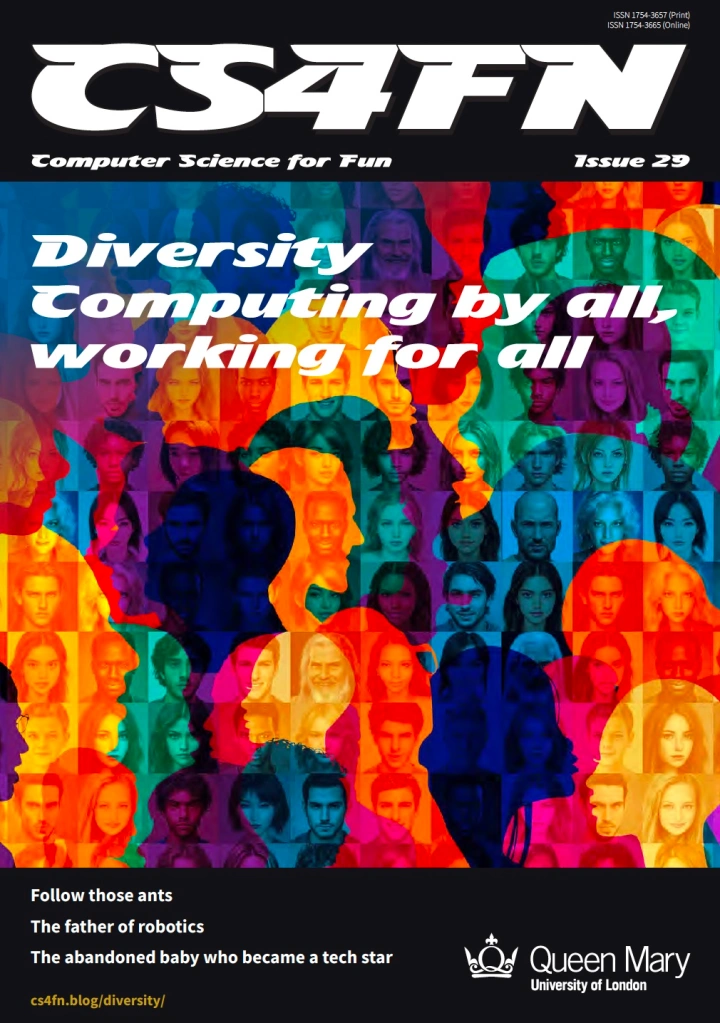
Front cover of CS4FN issue 29 - Diversity in Computing


Subscribe to be notified whenever we publish a new post to the CS4FN blog.


This blog is funded by EPSRC on research agreement EP/W033615/1.

QMUL CS4FN EPSRC logos

Facing up to ALL faces

The problems of recognising faces

How face recognition technology caused the wrong Black man to be arrested.

The police were waiting for Robert Williams when he returned home from work in Detroit, Michigan. They arrested him for robbery in front of his wife and terrified daughters aged two and five and took him to a detention centre where he was kept overnight. During his interview an officer showed him two grainy CCTV photos of a suspect alongside a photo of Williams from his driving licence. All the photos showed a large Black man, but that’s where the similarity ended – it wasn’t Williams on CCTV but a completely different man. Williams held up the photos to his face and said “I hope you don’t think all Black people look alike”, the officer replied that “the computer must have got it wrong.”

William’s problems began several months before his arrest when video clips and images of the robbery from the CCTV camera were run through face recognition software used by the Detroit Police Department. The system has access to the photos from everyone’s driving licence and can compare different faces until it finds a potential match and in this case it falsely identified Robert Williams. No system is ever perfect but studies have shown that face recognition technology is often better at correctly matching lighter skinned faces than darker skinned ones.

Check the signature

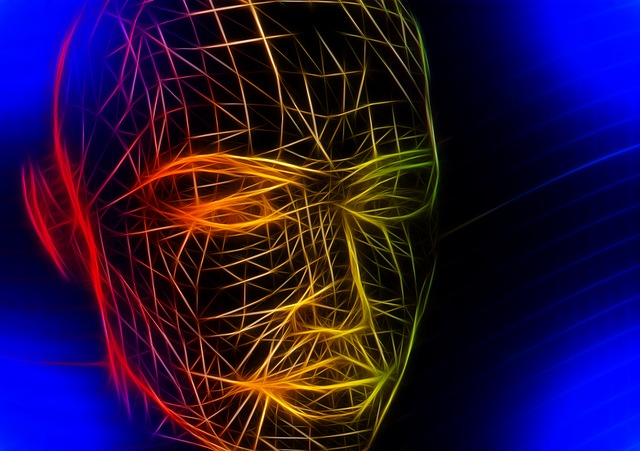
The way face recognition works is not actually by comparing pictures but by comparing data. When a picture of a face is added to the system, essentially lots of measurements are taken such as how far apart the eyes are, or what the shape of the nose is. This gives a signature for each face made up of all the numbers. That signature is added to the database. When looking for a match from say a CCTV image, the signature of the new image is first determined. Then algorithms look for the signature in the database “nearest” to the new one. How well it works depends on the particular features chosen, amongst many other things. If the features chosen are a poor way to distinguish particular groups of people then there will be lots of bad matches. But how does it decide what is “nearest” anyway given in essence it is just comparing groups of numbers? Many algorithms are based on machine learning. The system might be trained on lots of faces and told which match and which don’t, allowing it to look for patterns that are good ways to predict matches. If, however, it is trained on mainly light skinned faces it is likely to be bad at spotting matches for faces of other ethnic backgrounds. It may actually decide that “all black people look alike”.

Biasing the investigation

However, face recognition is only part of the story. A potential match is only a pointer towards someone who might be a suspect and it’s certainly not a ‘case closed’ conclusion – there’s still work to be done to check and confirm. But as Williams’ lawyer, Victoria Burton-Harris, pointed out once the computer had suggested Williams as a suspect that “framed and informed everything that officers did subsequently”. The man in the CCTV image wore a red baseball cap. It was for a team that Williams didn’t support (he’s not even a baseball fan) but no-one asked him about it. They also didn’t ask if he was in the area at the time (he wasn’t) or had an alibi (he did). Instead the investigators asked a security guard at the shop where the theft took place to look at some photos of possible suspects and he picked Williams from the line-up of images. Unfortunately the guard hadn’t been on duty on the day of the theft and had only seen the CCTV footage.

Robert Williams spent 30 hours in custody for a crime he didn’t commit after his face was mistakenly selected from a database. He was eventually released and the case dropped but his arrest is still on record along with his ‘mugshot’, fingerprints and a DNA sample. In other words he was wrongly picked from one database and has now been unfairly added to another. The experience for his whole family has been very traumatic and sadly his children’s first encounter with the police has been a distressing rather than a helpful one.

Remove the links

The American Civil Liberties Union (ACLU) has filed a lawsuit against the Detroit Police Department on Williams’ behalf for his wrongful arrest. It is not known how many people have been arrested because of face recognition technology but given how widely it is used it’s likely that others will have been misidentified too. The ACLU and Williams have asked for a public apology, for his police record to be cleared and for his images to be removed from any face recognition database. They have also asked that the Detroit Police Department stop using face recognition in their investigations. If Robert Williams had lived in New Hampshire he’d never have been arrested as there is a law there which prevents face recognition software from being linked with driving license databases.

In June 2020 Amazon, Microsoft and IBM denied the police any further access to their face recognition technology and IBM has also said that it will no longer work in this area because of concerns about racial profiling (targeting a person based on assumptions about their race instead of their individual actions) and violation of privacy and human rights. Campaigners are asking for a new law that protects people if this technology is used in future. But the ACLU and Robert Williams are asking for people to just stop using it – “I don’t want my daughters’ faces to be part of some government database. I don’t want cops showing up at their door because they were recorded at a protest the government didn’t like.”

Technology is only as good as the data and the algorithms it is based on. However, that isn’t the whole story. Even if very accurate, it is only as good as the way it is used. If as a society we want to protect people from bad things happening, perhaps some technologies should not be used at all.

Jo Brodie and Paul Curzon,Queen Mary University of London

More on

Related Magazines …


An earlier version of this article was originally published on the Teaching London Computing website where you can find references and further reading.


Subscribe to be notified whenever we publish a new post to the CS4FN blog.


This blog is funded by EPSRC on research agreement EP/W033615/1.

QMUL CS4FN EPSRC logos

Hidden Figures: NASA’s brilliant calculators

Full Moon with a blue filter
Full Moon image by PIRO from Pixabay

NASA Langley was the birthplace of the U.S. space program where astronauts like Neil Armstrong learned to land on the moon. Everyone knows the names of astronauts, but behind the scenes a group of African-American women were vital to the space program: Katherine Johnson, Mary Jackson and Dorothy Vaughan. Before electronic computers were invented ‘computers’ were just people who did calculations and that’s where they started out, as part of a segregated team of mathematicians. Dorothy Vaughan became the first African-American woman to supervise staff there and helped make the transition from human to electronic computers by teaching herself and her staff how to program in the early programming language, FORTRAN.

The women switched from being the computers to programming them. These hidden women helped put the first American, John Glenn, in orbit, and over many years worked on calculations like the trajectories of spacecraft and their launch windows (the small period of time when a rocket must be launched if it is to get to its target). These complex calculations had to be correct. If they got them wrong, the mistakes could ruin a mission, putting the lives of the astronauts at risk. Get them right, as they did, and the result was a giant leap for humankind.

See the film ‘Hidden Figures’ for more of their story.

Paul Curzon, Queen Mary University of London

from the archive

More on …

Magazines …

Front cover of CS4FN issue 29 - Diversity in Computing

Subscribe to be notified whenever we publish a new post to the CS4FN blog.


This blog is funded by EPSRC on research agreement EP/W033615/1.

QMUL CS4FN EPSRC logos

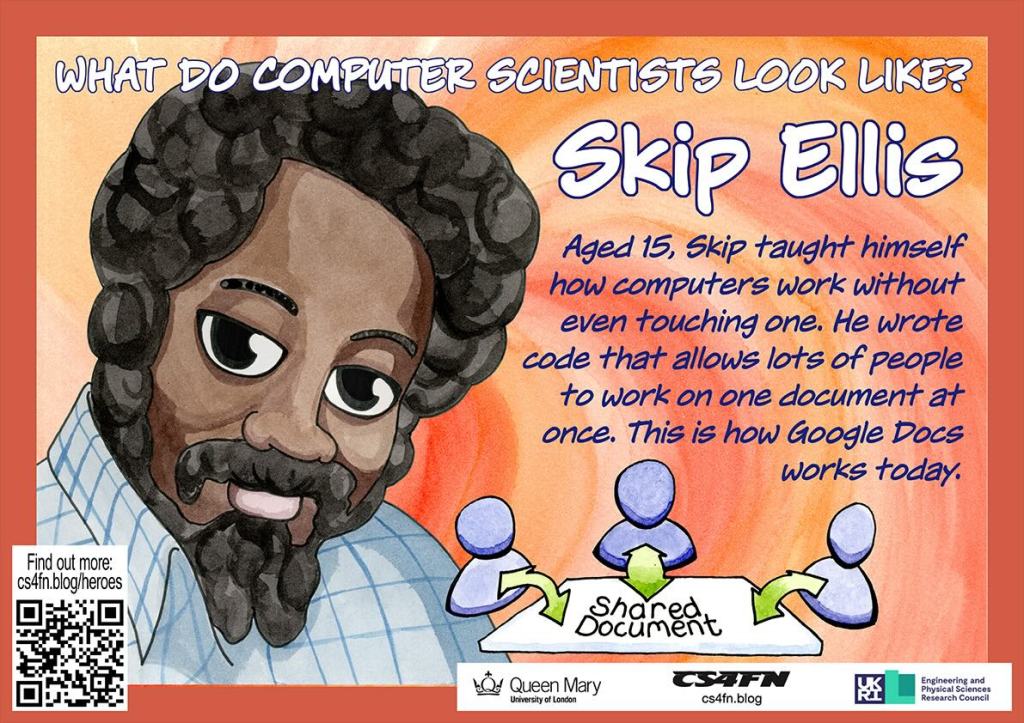
Writing together: Clarence ‘Skip’ Ellis

Poster of Skip Ellis showing people working on a shared document
Poster by Richard Butterworth for CS4FN

Back in 1956, Clarence Ellis started his career at the very bottom of the computer industry. He was given a job, at the age of 15, as a “computer operator” … because he was the only applicant. He was also told that under no circumstances should he touch the computer! Its lucky for all of us he got the job, though! He went on to develop ideas that have made computers easier for everyone to use. Working at a computer was once a lonely endeavour: one person, on one computer, doing one job. Clarence Ellis changed that. He pioneered ways for people to use computers together effectively.

The graveyard shift

The company Clarence first worked for had a new computer. Just like all computers back then, it was the size of a room. He worked the graveyard shift and his duties were more those of a nightwatchman than a computer operator. It could have been a dead-end job, but it gave him lots of spare time and, more importantly, access to all the computer’s manuals … so he read them … over and over again. He didn’t need to touch the computer to learn how to use it!

Saving the day

His studying paid dividends. Only a few months after he started, the company had a potential disaster on its hands. They ran out of punch cards. Back then punch cards were used to store both data. They used patterns of holes and non-holes as a way to store numbers as binary in a away a computer could read them. Without punchcards the computer could not work!

It had to though, because the payroll program had to run before the night was out. If it didn’t then no-one would be paid that month. Because he had studied the manuals in detail, and more so than anyone else, Clarence was the only person who could work out how to reuse old punch cards. The problem was that the computer used a system called ‘parity checking’ to spot mistakes. In its simplest form parity checking of a punch card involves adding an extra binary digit (an extra hole or no-hole) on the end of each number. This is done in a way that ensures that the number of holes is even. If there is an even number of holes already, the extra digit is left as a non-hole. If, on the other hand there is an odd number of holes, a hole is punched as the extra digit. That extra binary digit isn’t part of the number. It’s just there so the computer can check if the number has been corrupted. If a hole was accidentally or otherwise turned into a non-hole (or vice versa), then this would show up. It would mean there was now an odd number of holes. Special circuitry in the computer would spot this and spit out the card, rejecting it. Clarence knew how to switch that circuitry off. That meant they could change the numbers on the cards by adding new holes without them being rejected.

After that success he was allowed to become a real operator and was relied on to troubleshoot whenever there were problems. His career was up and running.

Clicking icons

He later worked at Xerox Parc, a massively influential research centre. He was part of the team that invented graphical user interfaces (GUIs). With GUIs Xerox Parc completely transformed the way we used computers. Instead of typing obscure and hard to remember commands, they introduced the now standard ideas, of windows, icons, dragging and dropping, using a mouse, and more. Clarence, himself, has been credited with inventing the idea of clicking on an icon to run a program.

Writing Together

As if that wasn’t enough of an impact, he went on to help make groupware a reality: software that supports people working together. His focus was on software that let people write a document together. With Simon Gibbs he developed a crucial algorithm called Operational Transformation. It allows people to edit the same document at the same time without it becoming hopelessly muddled. This is actually very challenging. You have to ensure that two (or more) people can change the text at exactly the same time, and even at the same place, without each ending up with a different version of the document.

The actual document sits on a server computer. It must make sure that its copy is always the same as the ones everyone is individually editing. When people type changes into their local copy, the master is sent messages informing it of the actions they performed. The trouble is the order that those messages arrive can change what happens. Clarence’s operational transformation algorithm solved this by changing the commands from each person into ones that work consistently whatever order they are applied. It is the transformed operation that is the one that is applied to the master. That master version is the version everyone then sees as their local copy. Ultimately everyone sees the same version. This algorithm is at the core of programs like Google Docs that have ensured collaborative editing of documents is now commonplace.

Clarence Ellis started his career with a lonely job. By the end of his career he had helped ensure that writing on a computer at least no longer needs to be a lonely affair.

Paul Curzon, Queen Mary University of London


More on …

Posters

  • Skip Ellis
  • Computer Science Hero Posters
    • One of the aims of our Diversity in Computing posters is to help a classroom of young people see the range of computer scientists which includes people who look like them and people who don’t look like them. You can download our posters free from the link above.

Magazines …

Front cover of CS4FN issue 29 - Diversity in Computing

Subscribe to be notified whenever we publish a new post to the CS4FN blog.


This blog is funded by EPSRC on research agreement EP/W033615/1.

QMUL CS4FN EPSRC logos

The original version of this article was funded by the Institute of Coding.

Mark Dean: An Inspiration

This article is an edited version of one of the 2006 winning essays from the Queen Mary University of London, Department of Computer Science, first year essay competition.

May I ask you a question? When you think of the computer what names ring a bell? Bill Gates? Or for those more in touch with the history behind computers maybe Charles Babbage is a familiar name? May I ask you another question please? Do you know who Dr Mark Dean is? No, well you should. Do not worry yourself though, you are definitely not alone. I did not know of him either.

Allow me to enlighten you..

Mark Dean is in my opinion a very creative and inspirational black computer scientist. He is a vice-president at IBM and holds 3 of IBM’s first 9 patents on the personal computer. He has over 30 patents pending. He won the Black Engineer of the Year Presidents Award and was made an IBM fellow in 1995. An IBM fellow is IBM’s highest technical honor. Only 50 of IBM’s employee’s are fellows and Mark Dean was the first black one. Prior to joining IBM in 1980 he earned degrees in Electrical Engineering before going back to school to gain a PhD in the field from Stanford University. He was born in 1957 in Jefferson City, Tennessee and was one of the first black students to attend Jefferson City High School. He was an exceptional student and enjoyed athletics. Early manifestations of his desire to create were shown when he and his father built a tractor from scratch when he was just a boy.

Upon joining IBM Mark Dean and a partner led the team that developed the interior architecture (ISA systems bus) which allowed devices like the keyboard and printer to be connected to the motherboard making computers a part of our lives. It was that which earned him a spot in the National Inventors Hall of Fame. While at IBM he has been involved in numerous positions in computer system hardware architecture and design. He was responsible for IBM’s research laboratory in Austin, Texas where he focused on developing high performance microprocessors, software, systems and circuits. It is here where he made history by leading the team that built a gigahertz chip which did a billion calculations per second. In 2004, he was chosen as one of the 50 most important Blacks in Research Science.

I think that such a man should be well recognized in computer science, especially to black computer science students because from what I can see we are rare. We as a minority need an inspirational figure like Mark Dean. He inspires me, I wanted to share that with you. Before this small article it is very probable you had no knowledge of this man. So if there comes a time where you are asked about important names in the field of computers, I hope Dr Mark Dean springs to mind and rings a bell for you to hear loud and clear.

Dean Miller, Queen Mary University of London

More on …

Magazines …

Front cover of CS4FN issue 29 - Diversity in Computing


Subscribe to be notified whenever we publish a new post to the CS4FN blog.


This blog is funded by EPSRC on research agreement EP/W033615/1.
QMUL CS4FN EPSRC logos