A puzzle, spies … and a beheading

A puzzle about secrets

Ayo wants to send her friends Guang and Elham who live together secret messages that only the person she sends the message to can read. She doesnt want Guang to read the messages to Elham and vice versa.

An ornate padlock with key
Image by Bernd from Pixabay

Guang buys them all small lockable notebooks for Christmas. They are normal notebooks except that they have a lock that can be locked shut using a small in-built padlock. Each padlock can be opened with a different single key. Guang suggests that they write messages in their notebook and post it and the key separately to the person who they wish to send the message to. After reading the message that person tears that page out and destroys it, then returns the notebook and key. They try this and it appears to be working, apparently preventing the others from reading the messages that aren’t for them. They exchange lots of secrets…until one day Guang gets a letter from Ayo that includes a note with an extra message added on the end by Elham in the locked notebook. It says “I can read your messages. I know all your secrets – Elham”. She has been reading Ayo’s messages to Guang all along and now knows all their secrets. She now wants them to know how clever she has been.

How did she do it? (And what does it have to do with the beheading of Mary Queen of Scots?)

Breaking the system

Elham has, of course, been getting to the post first, steaming open the envelopes, getting the key and notebook, reading the message (and for the last one adding her own note). She then seals them back in the envelopes and leaves them for Guang.

A similar thing happened to betray Mary Queen of Scots to her cousin Queen Elizabeth I. It led to Mary being beheaded.

Is there a better way?

Ayo suggests a solution that still uses the notebooks and keys, but in which no keys are posted anywhere. To prove her method works, she sends a secret message to Guang, that Elham fails to read. How does she do it? See if you can work it out before reading on…and what is the link to computer science?

Mary Queen of Scots

Mary Queen of Scots
Image by Gordon Johnson from Pixabay

The girls face a similar problem to that faced by Mary Queen of Scots and countless spies and businesses with secrets to exchange before and since…how to stop people intercepting and reading your messages. Mary was beheaded because she wasn’t good enough at it. The girls in the puzzle discovered, just like Mary, that weak encryption is worse than no encryption as it gives false confidence that messages are secret.

There are two ways to make messages secret – hide them so no one realises there is a message to read or disguise the message so only people in the know, are aware it exists (or both). Hiding the message is called Steganography. Disguising a message so it cannot be read even if known about is called encryption. Mary Queen of Scots did both and ultimately lost her life because her encryption was easy to crack, when she believed the encryption would protect her, it had given her the confidence to write things she otherwise would not have written.

House arrest

Mary had been locked up – under house arrest – for 18 years by Queen Elizabeth I, despite being captured only because she came to England asking her cousin Elizabeth to give her refuge after losing her Scottish crown. Elizabeth was worried that Mary and her allies would try to overthrow her and claim the English crown if given the chance. Better to lock her up before she even thought of treason? Towards the end of her imprisonment, in 1586 some of Mary’s supporters were in fact plotting to free her and assassinate Elizabeth. Unfortunately, they had no way of contacting Mary as letters were allowed neither in nor out by her jailors. Then, a stroke of good fortune arose. A young priest called Gilbert Gifford turned up claiming he had worked out a way to smuggle messages to and from Mary. He wrapped the messages in a leather package and hid them in the hollow bungs of barrels of beer. The beer was delivered by the brewer to Chartley Hall where Mary was held and the packages retrieved by one of Mary’s servants. This, a form of steganography, was really successful allowing Mary to exchange a long series of letters with her supporters. Eventually the plotters decided they needed to get Mary’s agreement to the full plot. The leader of the coup, Anthony Babington, wrote a letter to Mary outlining all the details. To be absolutely safe he also encrypted the message using a cipher that Mary could read (decipher). He soon received a reply in Mary’s hand also encrypted that agreed to the plot but also asked for the names of all the others involved. Babington responded with all the names. Unfortunately, unknown to Babington and Mary the spies of Elizabeth were reading everything they wrote – and the request for names was not even from Mary.

Spies and a Beheading

Unfortunately for Mary and Babington all their messages were being read by Sir Francis Walsingham, the ruthless Principal Secretary to Elizabeth and one of the most successful Spymasters ever. Gifford was his double agent – the method of exchanging messages had been Walsingham’s idea all along. Each time he had a message to deliver, Gifford took it to Walsingham first, whose team of spies carefully opened the seal, copied the contents, redid the seal and sent it on its way. The encrypted messages were a little more of a problem, but Walsingham’s codebreaker could break the cipher. The approach, called frequency analysis, that works for simple ciphers, involves using the frequency of letters in a message to guess which is which. For example, the most common letter in English is E, so the most common letter in an encrypted message is likely to be E. It is actually the way people nowadays solve crossword like code-puzzles know as Cross References that can be found in puzzle books and puzzle columns of newspapers.

When they read Babington’s letter they had the evidence to hang him, but let the letter continue on its way as when Mary replied, they finally had the excuse to try her too. Up to that point (for the 18 years of her house arrest) Elizabeth had not had strong enough evidence to convict Mary – just worries. Walsingham wanted more though, so he forged the note asking for the names of other plotters and added it to the end of one of Mary’s letters, encrypted in the same code. Babington fell for it, and all the plotters were arrested. Mary was tried and convicted. She was beheaded on February 8th 1587.

Private keys…public keys

What is Ayo’s method to get round their problems of messages being intercepted and read? Their main weakness was that they had to send the key as well as the locked message – if the key was intercepted then the lock was worthless. The alternative way that involves not sending keys anywhere is the following…

Top Secret written on a notebook with flowers

Image by Paul Curzon

Suppose Ayo wants to send a message to Guang. She first asks Guang to post her notebook (without the key but left open) to her. Ayo writes her message in Guang’s book then snaps it locked shut and posts it back. Guang has kept the key safe all along. She uses it to open the notebook secure in the knowledge that the key has never left her possession. This is essentially the same as a method known by computer scientist’s as public key encryption – the method used on the internet for secure message exchange, including banking, that allows the Internet to be secure. In this scheme, keys come in 2 halves a “private key” and a “public key”. Each person has a secret “private key” of their own that they use to read all messages sent to them. They also have a “public key” that is the equivalent to Guang’s open padlock.

If someone wants to send me a message, they first get my public key – which anyone who asks for can have as it is not used to decrypt messages, just for other people to to encrypt them (close the padlock) before sending them to me. It is of no use to decrypt any message (reopen the padlock). Only the person with the private key (the key to the padlock) can get at the message. So messages can be exchanged without the important decryption key going anywhere. It remains safe from interception.

Saving Mary

Would this have helped Mary? No. Her problem was not in exchanging keys but that she used a method of encryption that was easy to crack – in effect the lock itself was not very strong and could easily be picked. Walsingham’s code breakers were better at decryption than Babington was at encryption.

by Paul Curzon, Queen Mary University of London, updated from the archive

More on …

Magazines …

Our Books …


Subscribe to be notified whenever we publish a new post to the CS4FN blog.


EPSRC supports this blog through research grant EP/W033615/1. 

This quantum message will self-destruct in 10 seconds…

by Paul Curzon, Queen Mary University of London

A fuse burning
Image by Rudy and Peter Skitterians from Pixabay edited by Paul Curzon

Mission Impossible always involved the team taking on apparently impossible missions, delivered by a message concluding with the famous line that “This message will self-destruct in 10 seconds”. It was always followed by the message physically destructing  in some dramatic way such as flames or smoke coming from the tape recorder. Now, it’s been shown that it is possible to actually do apparently impossible destruction of messages: to send holographic messages that the sender can just make disappear even after they have been sent. It relies on the apparently impossible, but real properties of quantum physics.

A hologram is a 3-dimensional image formed using laser light. It records light scattered from objects coming from lots of different directions. This differs from photography where the light recorded comes from one direction only. You can see examples on the back of bank cards (often a flying dove) where they are used as a hard-to-copy security device. 

Now researchers at the University of Exeter have shown it is possible to make quantum holograms that make use of quantum effects. They are made from entangled photons: pairs of light particles that have been linked together in a way that means that, after the entangling, what ever happens to one immediately affects the other too … however far apart they are. Entanglement is one of those weird properties of quantum physics, the physical properties of the very, very small. It means that subatomic particles, once entangled, can later instantly affect each other even when separated by large distances.

This effect has now been put to novel use by Jensen Li and team in their research at Exeter. They entangled streams of pairs of photons emitted from a crystal using lasers but then separated the pairs. One stream of photons from the pairs was used to create a holographic image on a special kind of material called a meta-material. Meta-materials are just materials engineered at very tiny scales so as to have properties not usually seen in nature. For example, they might be designed to carefully control light or radio waves by reflecting them very precisely in certain directions. One use of that might be so that the object bounces light round from behind it so appears invisible. Some butterfly wings and bird feathers (think peacocks and kingfishers) actually do a similar sort of thing with very precise microscopic scale surface structures that cause their startlingly bright, shimmering colours.

Exeter’s meta-material was flat but with a special surface designed to have tiny features that manipulate light in very precise ways that create a hologram based on the information encoded in the beam of laser light. In their first test that showed their quantum hologram system works, the hologram just showed the letters H,D,V, A. The light from this hologram continued on to a camera, so a picture of the hologram could be taken. So far so normal.

3D axes with different coloured clouds of particles on each with yellow in the centre
Image by Smiley _p0p from Pixabay

The cunning (and rather weird) thing though is due to what they did to the other stream of light. Each photon in this stream was entangled with a photon in the hologram light stream. Due to the quantum physics of entanglement, that meant that changes to these particles could affect those making the hologram. In particular, the Exeter team had this second stream pass through a polarising filter, essentially like the lens of polaroid sunglasses. Light vibrates in different directions. A sunglasses lens cuts out the light vibrating in a given direction. Now, the letter H in the message was created from light polarised horizontally unlike the other letters which were polarised vertically. This meant that when the second stream of light was passed through a polarising filter blocking out the horizontally polarised light, it also affected the photons entangled with the blocked photons. The other stream of light, that created the hologram, was affected even though it went nowhere near the polarising filter. The result was that the horizontally polarised H could be made to disappear from the message caught on camera. It really did self-destruct, just in a quantum way.

If scaled up such a system could be used to send messages that are still (instantly) controlled by the sender even after they have been sent, whether disappearing or being changed to say something else. The approach could also be incorporated into secure quantum computing communication systems, where the messages are also encrypted.

Fortunately, this blog is not a quantum blog, so will not self-destruct in 10 seconds … so please do share it with your friends!

More on …

Magazines …


EPSRC supports this blog through research grant EP/W033615/1,

Navajo Code Talkers

Three Navajo Code talkers in WWII
Navajo Code Talkers, Image from National Archives at College Park, Public domain, via Wikimedia Commons

Bletchley Park, the British code cracking centre helped win World War II, but it is not just breaking codes and ciphers that wins wars, creating unbreakable ones to keep your own secrets safe matters too. Bletchley Park wasn’t the first or only time a secret cryptography team helped win battles or even wars. In World War I secret messages had been successfully sent using Choctaw, the language of a tribe of Native Americans, including to help organise a surprise attack. It worked with their messages left un-cracked. This led to an even more successful code-creating team in World War II based on Navajo. The Navajo “Code Talkers” as they were called, could encode, transmit and decode messages in minutes when it would take hours using conventional codes and ciphers.

In World War II, the US forces used a range of Native American languages to communicate, but a code based on a native Indian language, Navajo, was especially successful. The use of a Navajo-based code was the idea of Philip Johnston after the attack on Pearl Harbour. His parents were missionaries so he had grown up on a Navajo reservation, speaking the language fluently despite how difficult it was. Aged only 9, he acted as an interpreter for a group who went to Washington to try to improve Indian rights.

He suggested using Navajo as a secret language and enlisted in the marines to help bring the idea to fruition. He thought it would work as a secret code because there was no written version of Navajo. It was a purely a spoken language. That meant he was one of very few people who were not Navajo who could speak it. It was also a complex language unlike any other language. The US marines agreed to trial the idea. 

To prove it would work, Johnston had Navajo transmit messages in the way they would need to on the battlefield. They could do it close to 100 times faster than it would take using standard cipher machines. That clinched it. 

Many Navajo had enlisted after Pearl Harbour and a platoon soley of Navajo were recruited to the project, including a 15 year old, William Dean Yazzie. However, they didn’t just speak in Navajo to transmit messages. The original 29 Navajo recruited worked out the details of the code they would use. Once deployed to the Pacific a group of them also met to further improve the code. None of it was written down apart from in training manuals that did not leave the training site, so there was no chance the code book could be captured in battle. All those involved memorised it and practiced sending messages quickly and accurately. Messages were also always spoken, eg over radio and never written down, making it harder for the code to be cracked based on analysing intercepted messages.

Commonly needed words, like ‘difficult’ or ‘final’ had direct Navajo code words (NA-NE-KLAH and TAH-AH-KWO-DIH). However for critical words (countries, kinds of planes, kinds of ships, etc) they first swapped English words for other English words using one code. They then translated those words into Navajo. That meant even a Navajo speaker outside their trained group wouldn’t immediately understand a message. The code, for example, used birds names in place of kinds of planes. So the English code word for a bomber plane was Buzzard. But then the Navajo for Buzzard was actually used: (JAY-SHO). 

Another part of the code was to use Navajo words for letters of the alphabet, so A is for ant translated to WOL-LA-CHE in Navajo. However, to make this more secure two other words stood for A too (apple: BE-LA-SANA and axe: TSE-NILL). Each letter had three alternatives like this and any of the three could be used.

Finally the way that it was used meant a message would always just be a series of unconnected words making no sense even to a Navajo speaker.

The code talkers played a key part in many battles including the iconic battle of Iwo Jima, capturing the heavily defended Japanese controlled island of that name. The US Major responsible for communications said of the battle, “Were it not for the Navajos, the Marines would never have taken Iwo Jima.”

Not only did it make communications much faster than they would have been, unlike other US codes and ciphers, the code talker’s code was never cracked … all thanks to the Navajo team who devised it.

– Paul Curzon, Queen Mary University of London

More on …


Magazines …

Front cover of CS4FN issue 29 - Diversity in Computing

Subscribe to be notified whenever we publish a new post to the CS4FN blog.


This blog is funded through EPSRC grant EP/W033615/1.

QMUL CS4FN EPSRC logos

Frequency Analysis for Fun

by Paul Curzon, Queen Mary University of London

Frequency Analysis, a technique beloved by spies for centuries, and that led to the execution of at least one Queen, also played a part in the development of the game Scrabble, over a hundred million copies of which have been sold worldwide.

Frequency Analysis was invented by Al-Kindi, a 9th Century Muslim, Arabic Scholar, as a way of cracking codes. He originally described it in his “A Manuscript on Deciphering Cryptographic Messages“. Frequency analysis just involves taking a large amount of normal text written in the language of interest and counting how often each letter appears. For example in English, the letter E is the most common. With simple kinds of cyphers that is enough information to be able to crack them, just by counting the frequency of the letters in the code you want to crack. Now large numbers of everyday people do frequency analysis just for fun, solving Cross Reference puzzles.

The link between frequency analysis and puzzles goes back earlier. When the British were looking for potential code breakers to staff their secret code breaking establishment at Bletchley Park in World War II, they needed people with the skills of frequency analysis and problem solving skills. They did this by setting up Crossword competitions and offering those who were fastest jobs at Bletchley: possibly the earliest talent competition with career changing prizes!

Earlier still, in the 1930s, Architect Alfred Mosher Butts, hit on the idea of a new game that combined crosswords and anagrams, which were both popular at the time. The result was Scrabble. However, when designing the game he had a problem in that he needed to decide how many of each letter the game should have and also how to assign the scores. He turned to frequency analysis of the front page of the New York Times to give the answers. He broke the pattern of his frequency analysis though, including fewer letter Ss (the second most common word in English) than there should be so the game wasn’t made too easy because of plurals.

Sherlock Holmes, of course, was a master of frequency analysis as described in the 1903 story “The Adventure of the Dancing Men”. Sir Arthur Conan Doyle wasn’t the first author to use it as a plot device though. Edgar Alan Poe had based a short story called “The Gold Bug” around frequency analysis in 1843. It was Poe who originally popularised frequency analysis with the general public rather than just with spymasters. Poe had discovered how popular the topic was as a result of having set a challenge in a magazine for people to send in cyphers – that he would then crack, giving the impression at the time that he had near supernatural powers. The way it was done was then described in detail in “The Gold Bug”.


This article was first published on the original CS4FN website. We have lots of free magazines and magic booklets that you can download.

Frequency analysis also appears in: The dark history of algorithms.

For little kids we have some fun free kriss-kross puzzles – they’re like crosswords but you’re given the words and you have to fit them into the crossword shape. You need to think like a computer scientist and use logical thinking, pattern matching and computational thinking to complete them. (For even younger kids these can also be used as a way of practising spelling, phonics and writing out words).


EPSRC supports this blog through research grant EP/W033615/1.

Keeping secrets on the Internet – encryption keeps your data safe

By Ben Stephenson, University of Calgary

How do modern codes keep your data safe online? Ben Stephenson of the University of Calgary explains

When Alan Turing was breaking codes, the world was a pretty dangerous place. Turing’s work helped uncover secrets about air raids, submarine locations and desert attacks. Daily life might be safer now, but there are still threats out there. You’ve probably heard about the dangers that lurk online – scams, identity theft, viruses and malware, among many others. Shady characters want to know your secrets, and we need ways of keeping them safe and secure to make the Internet work. How is it possible that a network with so many threats can also be used to securely communicate a credit card number, allowing you to buy everything from songs to holidays online?

The relay race on the Internet

When data travels over the Internet it is passed from computer to computer, much like a baton is passed from runner to runner in a relay race. In a relay race, you know who the other runners will be. The runners train together as a team, and they trust each other. On the Internet, you really don’t know much about the computers that will be handling your data. Some may be owned by companies that you trust, but others may be owned by companies you have never heard of. Would you trust your credit card number to a company that you didn’t even know existed?

The way we solve this problem is by using encryption to disguise the data with a code. Encrypting data makes it meaningless to others, so it is safe to transfer the data over the Internet. You can think of it as though each message is locked in a chest with a combination lock. If you don’t have the combination you can’t read the message. While any computer between us and the merchant can still view or copy what we send, they won’t be able to gain access to our credit card number because it is hidden by the encryption. But the company receiving the data still needs to decrypt it – open the lock. How can we give them a way to do it without risking the whole secret? If we have to send them the code a spy might intercept it and take a copy.

Keys that work one way only

The solution to our problem is to use a relatively new encryption technique known as public key cryptography. (It’s actually about 40 years old, but as the history of encryption goes back thousands of years, a technique that’s only as old as Victoria Beckham counts as new!) With this technique the code used to encrypt the message (lock the chest) is not able to decrypt it (unlock it). Similarly, the key used to decrypt the message is not able to encrypt it. This may sound a little bit odd. Most of the time when we think about locking a physical object like a door, we use the same key to lock it that we will use to unlock it later. Encryption techniques have also followed this pattern for centuries, with the same key used to encrypt and decrypt the data. However, we don’t always use the same key for encrypting (locking) and decrypting (unlocking) doors. Some doors can be locked by simply closing them, and then they are later unlocked with a key, access card, or numeric code. Trying to shut the door a second time won’t open it, and similarly, using the key or access code a second time won’t shut it. With our chest, the person we want to communicate with can send us a lock only they know the code for. We can encrypt by snapping the lock shut, but we don’t know the code to open it. Only the person who sent it can do that.

We can use a similar concept to secure electronic communications. Anyone that wants to communicate something securely creates two keys. The keys will be selected so that one can only be used for encryption (the lock), and the other can only be used for decryption (the code that opens it). The encryption key will be made publicly available – anyone that asks for it can have one of our locks. However, the decryption key will remain private, which means we don’t tell anyone the code to our lock. We will have our own public encryption key and private decryption key, and the merchant will have their own set of keys too. We use one of their locks, not ours, to send a message to them.

Turning a code into real stuff

So how do we use this technique to buy stuff? Let’s say you want to buy a book. You begin by requesting the merchant’s encryption key. The merchant is happy to give it to you since the encryption key isn’t a secret. Once you have it, you use it to encrypt your credit card number. Then you send the encrypted version of your credit card number to the merchant. Other computers listening in might know the merchant’s public encryption key, but this key won’t help them decrypt your credit card number. To do that they would need the private decryption key, which is only known to the merchant. Once your encrypted credit card number arrives at the merchant, they use the private key to decrypt it, and then charge you for the goods that you are purchasing. The merchant can then securely send a confirmation back to you by encrypting it with your public encryption key. A few days later your book turns up in the post.

This encryption technique is used many millions of times every day. You have probably used it yourself without knowing it – it is built into web browsers. You may not imagine that there are huts full of codebreakers out there, like Alan Turing seventy years ago, trying to crack the codes in your browser. But hackers do try to break in. Keeping your browsing secure is a constant battle, and vulnerabilities have to be patched up quickly once they’re discovered. You might not have to worry about air raids, but codes still play a big role behind the scenes in your daily life.


Here’s another article from the author, Ben Stephenson: 100,000 frames – quick draw: how computers help animators create.

The ‘Keeping secrets on the internet‘ article was first published on the original CS4FN website and there’s a copy on pages 4-5 of the Alan Turing issue (#14) of the CS4FN magazine. You can download a free PDF of the magazine below, along with all of our other free material at our downloads site.


Related Magazine …


EPSRC supports this blog through research grant EP/W033615/1.
The Dark History of Algorithms

Zin Derfoufi, a Computer Science student at Queen Mary, delves into some of the dark secrets of algorithms past.

Algorithms are used throughout modern life for the benefit of mankind whether as instructions in special programs to help disabled people, computer instructions in the cars we drive or the specific steps in any calculation. The technologies that they are employed in have helped save lives and also make our world more comfortable to live it. However, beneath all this lies a deep, dark, secret history of algorithms plagued with schemes, lies and deceit.

Algorithms have played a critical role in some of History’s worst and most brutal plots even causing the downfall and rise of nations and monarchs. Ever since humans have been sent on secret missions, plotted to overthrow rulers or tried to keep the secrets of a civilisation unknown, nations and civilisations have been using encrypted messages and so have used algorithms. Such messages aim to carry sensitive information recorded in such a way that it can only make sense to the sender and recipient whilst appearing to be gibberish to anyone else. There are a whole variety of encryption methods that can be used and many people have created new ones for their own use: a risky business unless you are very good at it.

One example is the ‘Caesar Cipher’ which is named after Julius Caesar who used it to send secret messages to his generals. The algorithm was one where each letter was replaced by the third letter down in the alphabet so A became D, B became E, etc. Of course, it means that the recipient must know of the algorithm (sequence to use) to regenerate the original letters of the text otherwise it would be useless. That is why a simple algorithm of “Move on 3 places in the alphabet” was used. It is an algorithm that is easy for the general to remember. With a plain English text there are around 400,000,000,000,000,000,000,000,000 different distinct arrangements of letters that could have been used! With that many possibilities it sounds secure. As you can imagine, this would cause any ambitious codebreaker many sleepless nights and even make them go bonkers!!! It became so futile to try and break the code that people began to think such messages were divine!

But then something significant happened. In the 9th Century a Muslim, Arabic Scholar changed the face of cryptography forever. His name was Abu Yusuf Ya’qub ibn Ishaq Al-Kindi -better known to the West as Alkindous. Born in Kufa (Iraq) he went to study in the famous Dar al-Hikmah (house of wisdom) found in Baghdad- the centre for learning in its time which produced the likes of Al-Khwarzimi, the father of algebra – from whose name the word algorithm originates; the three Bana Musa Brothers; and many more scholars who have shaped the fields of engineering, mathematics, physics, medicine, astrology, philosophy and every other major field of learning in some shape or form.

Al-Kindi introduced the technique of code breaking that was later to be known as ‘frequency analysis’ in his book entitled: ‘A Manuscript on Deciphering Cryptographic Messages’. He said in his book:

“One way to solve an encrypted message, if we know its language, is to find a different plaintext of the same language long enough to fill one sheet or so, and then we count the occurrences of each letter. We call the most frequently occurring letter the ‘first’, the next most occurring one the ‘second’, the following most occurring the ‘third’, and so on, until we account for all the different letters in the plaintext sample.

“Then we look at the cipher text we want to solve and we also classify its symbols. We find the most occurring symbol and change it to the form of the ‘first’ letter of the plaintext sample, the next most common symbol is changed to the form of the ‘second’ letter, and so on, until we account for all symbols of the cryptogram we want to solve”.

So basically to decrypt a message all we have to do is find out how frequent each letter is in each (both in the sample and in the encrypted message – the original language) and match the two. Obviously common sense and a degree of judgement has to be used where letters have a similar degree of frequency. Although it was a lengthy process it certainly was the most efficient of its time and, most importantly, the most effective.

Since decryption became possible, many plots were foiled changing the course of history. An example of this was how Mary Queen of Scots, a Catholic, plotted along with loyal Catholics to overthrow her cousin Queen Elizabeth I, a Protestant, and establish a Catholic country. The details of the plots carried through encrypted messages were intercepted and decoded and on Saturday 15 October 1586 Mary was on trial for treason. Her life had depended on whether one of her letters could be decrypted or not. In the end, she was found guilty and publicly beheaded for high treason. Walsingham, Elizabeth’s spymaster, knew of Al-Kindi’s approach.

A more recent example of cryptography, cryptanalysis and espionage was its use throughout World War I to decipher messages intercepted from enemies. The British managed to decipher a message sent by Arthur Zimmermann, the then German Foreign Minister, to the Mexicans calling for an alliance between them and the Japanese to make sure America stayed out of the war, attacking them if they did interfere. Once the British showed this to the Americans, President Woodrow Wilson took his nation to war. Just imagine what the world may have been like if America hadn’t joined.

Today encryption is a major part of our lives in the form of Internet security and banking. Learn the art and science of encryption and decryption and who knows, maybe some day you might succeed in devising a new uncrackable cipher or crack an existing banking one! Either way would be a path to riches! So if you thought that algorithms were a bore … it just got a whole lot more interesting.

Further Reading

“Al Kindi: The Origins of Cryptology: The Arab Contributions” by Ibrahim A. Al-Kadi
Muslim Heritage: Al-Kindi, Cryptography, Code Breaking and Ciphers

“The code book: the Science of secrecy from Ancient Egypt to Quantum cryptography” by Simon Singh, especially Chapter one ‘The cipher of Queen Mary of Scots’

The Zimmermann Telegram
Wikipedia: Arthur_Zimmermann

This article was originally published on the CS4FN website, and on page 8 in Issue 6 of the magazine which you can download below along with all of our free material.


Related Magazine …

EPSRC supports this blog through research grant EP/W033615/1.

Alan Turing’s life

by Jonathan Black, Paul Curzon and Peter W. McOwan, Queen Mary University of London

From the archive

Alan Turing Portrait
Image of Alan Turing: Elliott & Fry, Public domain, via Wikimedia Commons

Alan Turing was born in London on 23 June 1912. His parents were both from successful, well-to-do families, which in the early part of the 20th century in England meant that his childhood was pretty stuffy. He didn’t see his parents much, wasn’t encouraged to be creative, and certainly wasn’t encouraged in his interest in science. But even early in his life, science was what he loved to do. He kept up his interest while he was away at boarding school, even though his teachers thought it was beneath well-bred students. When he was 16 he met a boy called Christopher Morcom who was also very interested in science. Christopher became Alan’s best friend, and probably his first big crush. When Christopher died suddenly a couple of years later, Alan partly helped deal with his grief with science, by studying whether the mind was made of matter, and where – if anywhere – the mind went when someone died.

The Turing machine

After he finished school, Alan went to the University of Cambridge to study mathematics, which brought him closer to questions about logic and calculation (and mind). After he graduated he stayed at Cambridge as a fellow, and started working on a problem that had been giving mathematicians headaches: whether it was possible to determine in advance if a particular mathematical proposition was provable. Alan solved it (the answer was no), but it was the way he solved it that helped change the world. He imagined a machine that could move symbols around on a paper tape to calculate answers. It would be like a mind, said Alan, only mechanical. You could give it a set of instructions to follow, the machine would move the symbols around and you would have your answer. This imaginary machine came to be called a Turing machine, and it forms the basis of how modern computers work.

Code-breaking at Bletchley Park

By the time the Second World War came round, Alan was a successful mathematician who’d spent time working with the greatest minds in his field. The British government needed mathematicians to help them crack the German codes so they could read their secret communiqués. Alan had been helping them on and off already, but when war broke out he moved to the British code-breaking headquarters at Bletchley Park to work full-time. Based on work by Polish mathematicians, he helped crack one of the Germans’ most baffling codes, called the Enigma, by designing a machine (based on earlier version by the Poles again!) that could help break Enigma messages as long as you could guess a small bit of the text (see box). With the help of British intelligence that guesswork was possible, so Alan and his team began regularly deciphering messages from ships and U-boats. As the war went on the codes got harder, but Alan and his colleagues at Bletchley designed even more impressive machines. They brought in telephone engineers to help marry Alan’s ideas about logic and statistics with electronic circuitry. That combination was about to produce the modern world.

Building a brain

The problem was that the engineers and code-breakers were still having to make a new machine for every job they wanted it to do. But Alan still had his idea for the Turing machine, which could do any calculation as long as you gave it different instructions. By the end of the war Alan was ready to have a go at building a Turing machine in real life. If it all went to plan, it would be the first modern electronic computer, but Alan thought of it as “building a brain”. Others were interested in building a brain, though, and soon there were teams elsewhere in the UK and the USA in the race too. Eventually a group in Manchester made Alan’s ideas a reality.

Troubled times

Not long after, he went to work at Manchester himself. He started thinking about new and different questions, like whether machines could be intelligent, and how plants and animals get their shape. But before he had much of a chance to explore these interests, Alan was arrested. In the 1950s, gay sex was illegal in the UK, and the police had discovered Alan’s relationship with a man. Alan didn’t hide his sexuality from his friends, and at his trial Alan never denied that he had relationships with men. He simply said that he didn’t see what was wrong with it. He was convicted, and forced to take hormone injections for a year as a form of chemical castration.

Although he had had a very rough period in his life, he kept living as well as possible, becoming closer to his friends, going on holiday and continuing his work in biology and physics. Then, in June 1954, his cleaner found him dead in his bed, with a half-eaten, cyanide-laced apple beside him.

Alan’s suicide was a tragic, unjust end to a life that made so much of the future possible.

More on …

Related Magazines …

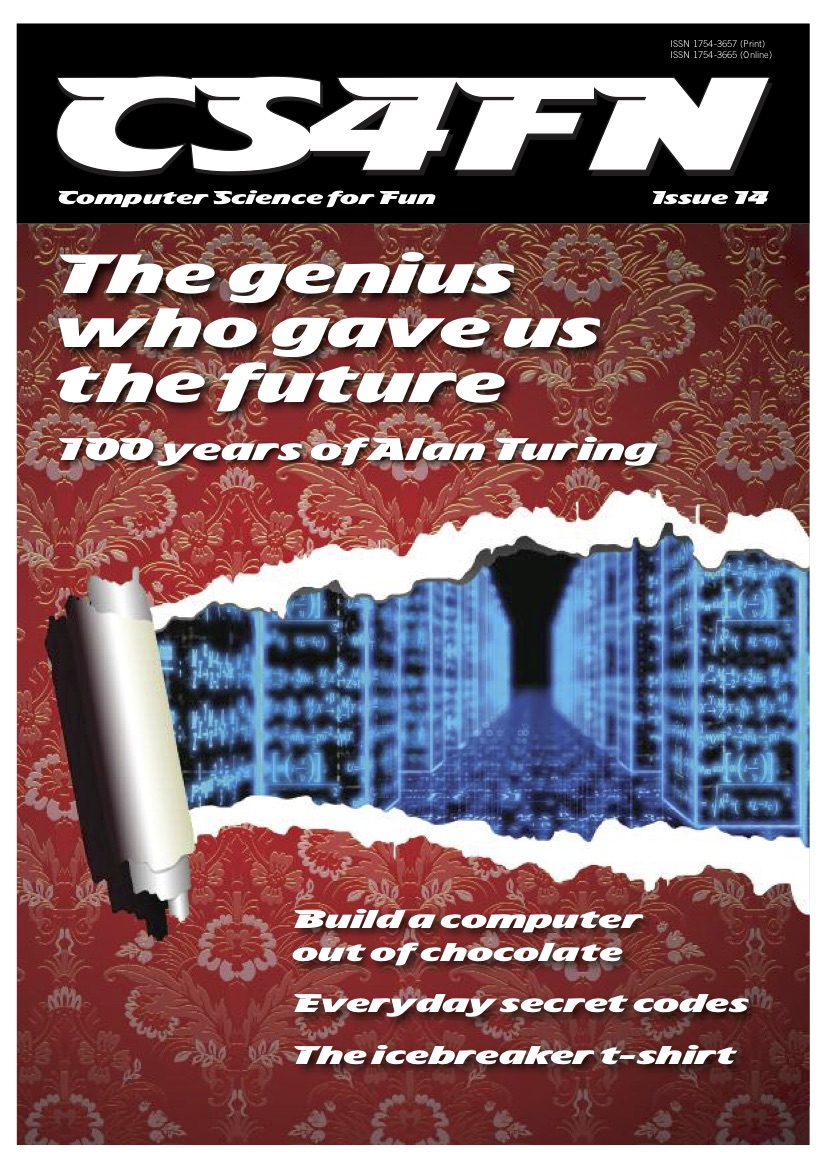
cs4fn issue 14 cover

This blog is funded through EPSRC grant EP/W033615/1.

More Encrypted Deckchairs

Summer is here so we have been looking for hidden messages in deckchairs as well as making encrypted origami deckchairs. But if you are a model maker, you may (like Ho) feel the need to make more realistic models to hide messages in...before moving on to real deckchairs.

A deckchair encrypting CS$FN in its stripes
 Photo and deckchair by Kok Ho Huen for CS4FN
A row of multicoloured deckchairs hiding a message in their stripes
 Photo and deckchair by Kok Ho Huen for CS4FN
A row of multicoloured deckchairs hiding a message in their stripes
 Photo and deckchair by Kok Ho Huen for CS4FN

So here is how to make deckchairs with stripy messages out of all those lolly sticks you will have by the end of the summer that actually fold. See the previous blog post for how the messages can be hidden.

Whilst using a code so that a message is unreadable is cryptography, hiding information like this so that no one knows there is a message to be read is called steganography

Serious model making is of course something that needs a steady hand, patience and a good eye…so useful practice for the basic skills for electronics too.

Kok Ho Huen and Paul Curzon, Queen Mary University of London


Templates and written instructions

More on …


This article was funded by UKRI, through Professor Ursula Martin’s grant EP/K040251/2 and grant EP/W033615/1.

QMUL CS4FN EPSRC logos

Encrypted Deckchairs

Lots of stripy deckchairs on a beach in the setting sun
Image by Dean Moriarty from Pixabay  

Summer is here so it is time to start looking for secret messages on the beach. All those stripy deckchairs and windbreaks seem a great place to hide messages.

How might a deckchair contain a message? Well, the Mars Perseverance Rover famously showed how. It encoded “DARE MIGHTY THINGS” along with the GPS coordinates of NASA’s Jet Propulsion Laboratory in its parachute that allowed it to land safely on the surface of Mars. The pattern in the parachute involves a series of rings of orange stripes. Within each ring are groups of 7 stripes. Each group encodes a binary version of a letter: so A is 1 or 0000001. In the pattern this becomes 6 yellow stripes and then an orange one. G, being the 7th letter of the alphabet is encoded as 0000111 or four yellow stripes followed by three orange. Each letter is encoded using the same pattern. In this way, with enough stripes you can spell out any message.

Back to deckchairs, you can code patterns in a similar way in the stripes of a deckchair. One deckchair could have fourteen stripes, say, with a choice from two colours for each stripe. Perhaps thin stripes of a different colour could separate them. That would be enough to encode a pair of characters per deckchair using the NASA code (your initials perhaps). Line up a long row of such deckchairs on the beach and you could spell out a whole message. An alternative would be to use Morse code, with two different coloured stripes for dots and dashes…or invent your own stripy code.

Alternatively, if you have dress making skills, make a stripy dress that really makes a statement.

Sadly, so far, all the deckchairs I’ve tried to decode appear to have only contained gobbledygook though perhaps I’ve just not tried the right code yet, or found the right deckchair. Or maybe, so far no one has actually coded a message in a deckchair. If you have an old deckchair and some sewing skills, perhaps you could be the first and re-skin it with a message.


Steganographic Origami

If making a deckchair is a bit much for you, more simply you could make an origami deckchair, as we (Ho) did and hide a message in your origami. These videos show how he did it (note his are luxury deckchairs): (template below)

Making an origami encoded deckchair, Step one.

Making an origami encoded deckchair, Step two.

Making an origami encoded deckchair, Step three.

– Paul Curzon and Kok Ho Huen, Queen Mary University of London


Templates and written instructions

More on …


This article was funded by UKRI, through Professor Ursula Martin’s grant EP/K040251/2 and grant EP/W033615/1.

QMUL CS4FN EPSRC logos