Edie Schlain Windsor was a senior systems programmer at IBM. There is more to life than computing though. Just like anyone else, Computer Scientists can do massively important things aside from being very good at computing. Civil rights and over-turning unjust laws are as important as anything. She led the landmark Supreme Court Case (United States versus Windsor) that was a milestone for the rights of same-sex couples in the US.
Born to a Jewish immigrant family, Edie worked her way up from an early data entry job at New York University to ultimately become a senior programmer at IBM and then President of her own software consultancy where she helped LGBTQ+ organisations become computerised.
Having already worked as a programmer at an energy company called Combustion Engineering, she joined IBM on completing her degree in 1958 so was one of the early generation of female programmers, before the later idea of the male programmer stereotype took hold. Within ten years she had been promoted to the highest technical position in IBM, that of a Senior Systems Programmer: so one of their top programmers lauded as a wizard debugger. She had started out programming mainframe computers, the room size computers that were IBM ‘s core business at the time. They both designed and built the computers as well as the operating system and other software that ran on them. Edie became an operating systems expert, and a pioneer computer scientist also working on natural language processing programs, aiming to improve the interactivity of computes. Natural Language Processing was then a nascent area but that by 2011 IBM led spectacularly with its program Watson winning the quiz show Jeopardy! answering general knowledge questions playing against human champions.
Before her Supreme Court case overturned it, a law introduced in 1996 banned US federal recognition of same-sex marriages. It made it federal law that marriage could only exist between a man and a woman. Individual states in the US had introduced same-sex marriage but this new law meant that such marriages were not recognised in general in the US. Importantly, for those involved it meant a whole raft of benefits including tax, immigration and healthcare benefits that came with marriage were denied to same-sex couples.
Edie had fallen in love with psychologist Thea Spyer in 1965, and two years later they became engaged, but actually getting married was still illegal. They had to wait almost 30 years before they were even allowed to make their partnership legal, though still at that point not marry. They were the 80th couple to register on the day such partnerships were finally allowed. By this time Thea had been diagnosed with multiple sclerosis, a disease that gradually leads to the central nervous system breaking down, with movement becoming ever harder. Edie was looking after her as a full time carer, having given up her career to do so. They both loved dancing and did so throughout their life together even once Thea was struggling to walk, using sticks to get on to the dance floor and later dancing in a wheelchair. As Thea’s condition grew worse it became clear she had little time to live. Marriage was still illegal in New York, however, so before it was too late, they travelled to Canada and married there instead.
When Thea died she left everything to Edie in her will. Had Edie been a man married to Thea, she would not have been required to pay tax on this inheritance, but as a woman and because same-sex marriages were deemed illegal she was handed a tax bill of hundreds of thousands of dollars. She sued the government claiming the way different couples were treated was unfair. The case went all the way to the highest court, the Supreme Court, who ruled that the 1996 law was itself unlawful. Laws in the US have as foundation a written constitution that dates back to 1789. The creation of the constitution was a key part of the founding of the United States of America itself. Without it, the union could easily have fallen apart, and as such is the ultimate law of the land that new laws cannot overturn. The problem with the law banning same sex marriage was that it broke the 5th amendment of the constitution added in 1791, one of several amendments made to ensure people’s rights and justice was protected by the constitution.
The Supreme Court decision was far more seismic than just refunding a tax bill, however. It overturned the law that actively banned same-sex marriage, as it fell foul of the constitution, and this paved the way for such marriages to be made actively legal. In 2014 federal employees were finally told they should perform same-sex marriages across the US, and those marriages gave the couple all the same rights as mixed-sex marriages. Because Edie took on the government, the US constitution, and so justice for many, many couples prevailed.
Ada Lovelace, the ‘first programmer’ thought the possibilities of computer science might cover a far wider breadth than anyone else of her time. For example, she mused that one day we might be able to create mathematical models of the human nervous system, essentially describing how electrical signals move around the body. University of Oxford’s Blanca Rodriguez is interested in matters of the heart. She’s a bioengineer creating accurate computer models of human organs.
How do you model a heart? Well you first have to create a 3D model of its structure. You start with MRI scans. They give you a series of pictures of slices through the heart. To turn that into a 3D model takes some serious computer science: image processing that works out, from the pictures, what is tissue and what isn’t. Next you do something called mesh generation. That involves breaking up the model into smaller parts. What you get is more than just a picture of the surface of the organ but an accurate model of its internal structure.
So far so good, but it’s still just the structure. The heart is a working, beating thing not just a sculpture. To understand it you need to see how it works. Blanca and her team are interested in simulating the electrical activity in the heart – how electrical pulses move through it. To do this they create models of the way individual cells propagate an electrical system. Once you have this you can combine it with the model of the heart’s structure to give one of how it works. You essentially have a lot of equations. Solving the equations gives a simulation of how electrical signals propagate from cell to cell.
The models Blanca’s team have created are based on a healthy rabbit heart. Now they have it they can simulate it working and see if it corresponds to the results from lab experiments. If it does then that suggests their understanding of how cells work together is correct. When the results don’t match, then that is still good as it gives new questions to research. It would mean something about their initial understanding was wrong, so would drive new work to fix the problem and so the models.
Once the models have been validated in this way – shown it is an accurate description of the way a rabbit’s heart works – they can use them to explore things you just can’t do with experiments – exploring what happens when changes are made to the structure of the virtual heart or how drugs change the way it works, for example. That can lead to new drugs.
They can also use it to explore how the human heart works. For example, early work has looked at the heart’s response to an electric shock. Essentially the heart reboots! That’s why when someone’s heart stops in hospital, the emergency team give it a big electric shock to get it going again. The model predicts in detail what actually happens to the heart when that is done. One of the surprising things is it suggests that how well an electric shock works depends on the particular structure of the person’s heart! That might mean treatment could be more effective if tailored for the person.
Computer modelling is changing the way science is done. It doesn’t replace experiments. Instead clinical work, modelling and experiments combine to give us a much deeper understanding of the way the world, and that includes our own hearts, work.
Paul Curzon, Queen Mary University of London
The charity Cardiac Risk in the Young raises awareness of cardiac electrical rhythm abnormalities and supports testing (electrocardiograms and echocardiograms) for all young people aged 14-35.
Subscribe to be notified whenever we publish a new post to the CS4FN blog.
This blog is funded by EPSRC on research agreement EP/W033615/1.
Zin Derfoufi, a Computer Science student at Queen Mary, delves into some of the dark secrets of algorithms past.
Algorithms are used throughout modern life for the benefit of mankind whether as instructions in special programs to help disabled people, computer instructions in the cars we drive or the specific steps in any calculation. The technologies that they are employed in have helped save lives and also make our world more comfortable to live it. However, beneath all this lies a deep, dark, secret history of algorithms plagued with schemes, lies and deceit.
Algorithms have played a critical role in some of History’s worst and most brutal plots even causing the downfall and rise of nations and monarchs. Ever since humans have been sent on secret missions, plotted to overthrow rulers or tried to keep the secrets of a civilisation unknown, nations and civilisations have been using encrypted messages and so have used algorithms. Such messages aim to carry sensitive information recorded in such a way that it can only make sense to the sender and recipient whilst appearing to be gibberish to anyone else. There are a whole variety of encryption methods that can be used and many people have created new ones for their own use: a risky business unless you are very good at it.
One example is the ‘Caesar Cipher’ which is named after Julius Caesar who used it to send secret messages to his generals. The algorithm was one where each letter was replaced by the third letter down in the alphabet so A became D, B became E, etc. Of course, it means that the recipient must know of the algorithm (sequence to use) to regenerate the original letters of the text otherwise it would be useless. That is why a simple algorithm of “Move on 3 places in the alphabet” was used. It is an algorithm that is easy for the general to remember. With a plain English text there are around 400,000,000,000,000,000,000,000,000 different distinct arrangements of letters that could have been used! With that many possibilities it sounds secure. As you can imagine, this would cause any ambitious codebreaker many sleepless nights and even make them go bonkers!!! It became so futile to try and break the code that people began to think such messages were divine!
But then something significant happened. In the 9th Century a Muslim, Arabic Scholar changed the face of cryptography forever. His name was Abu Yusuf Ya’qub ibn Ishaq Al-Kindi -better known to the West as Alkindous. Born in Kufa (Iraq) he went to study in the famous Dar al-Hikmah (house of wisdom) found in Baghdad- the centre for learning in its time which produced the likes of Al-Khwarzimi, the father of algebra – from whose name the word algorithm originates; the three Bana Musa Brothers; and many more scholars who have shaped the fields of engineering, mathematics, physics, medicine, astrology, philosophy and every other major field of learning in some shape or form.
Al-Kindi introduced the technique of code breaking that was later to be known as ‘frequency analysis’ in his book entitled: ‘A Manuscript on Deciphering Cryptographic Messages’. He said in his book:
“One way to solve an encrypted message, if we know its language, is to find a different plaintext of the same language long enough to fill one sheet or so, and then we count the occurrences of each letter. We call the most frequently occurring letter the ‘first’, the next most occurring one the ‘second’, the following most occurring the ‘third’, and so on, until we account for all the different letters in the plaintext sample.
“Then we look at the cipher text we want to solve and we also classify its symbols. We find the most occurring symbol and change it to the form of the ‘first’ letter of the plaintext sample, the next most common symbol is changed to the form of the ‘second’ letter, and so on, until we account for all symbols of the cryptogram we want to solve”.
So basically to decrypt a message all we have to do is find out how frequent each letter is in each (both in the sample and in the encrypted message – the original language) and match the two. Obviously common sense and a degree of judgement has to be used where letters have a similar degree of frequency. Although it was a lengthy process it certainly was the most efficient of its time and, most importantly, the most effective.
Since decryption became possible, many plots were foiled changing the course of history. An example of this was how Mary Queen of Scots, a Catholic, plotted along with loyal Catholics to overthrow her cousin Queen Elizabeth I, a Protestant, and establish a Catholic country. The details of the plots carried through encrypted messages were intercepted and decoded and on Saturday 15 October 1586 Mary was on trial for treason. Her life had depended on whether one of her letters could be decrypted or not. In the end, she was found guilty and publicly beheaded for high treason. Walsingham, Elizabeth’s spymaster, knew of Al-Kindi’s approach.
A more recent example of cryptography, cryptanalysis and espionage was its use throughout World War I to decipher messages intercepted from enemies. The British managed to decipher a message sent by Arthur Zimmermann, the then German Foreign Minister, to the Mexicans calling for an alliance between them and the Japanese to make sure America stayed out of the war, attacking them if they did interfere. Once the British showed this to the Americans, President Woodrow Wilson took his nation to war. Just imagine what the world may have been like if America hadn’t joined.
Today encryption is a major part of our lives in the form of Internet security and banking. Learn the art and science of encryption and decryption and who knows, maybe some day you might succeed in devising a new uncrackable cipher or crack an existing banking one! Either way would be a path to riches! So if you thought that algorithms were a bore … it just got a whole lot more interesting.
Zin Derfoufi, Queen Mary University of London
More on…
“Al Kindi: The Origins of Cryptology: The Arab Contributions” by Ibrahim A. Al-Kadi
“The code book: the Science of secrecy from Ancient Egypt to Quantum cryptography” by Simon Singh, especially Chapter one ‘The cipher of Queen Mary of Scots’
The truth table for NOT P. A yellow brick represents P. Blue means True and Red means false. Read along the rows to get the meaning of NOT P when P is true or false. Image by CS4FN
We have seen how to represent truth tables in lego. Truth tables are a way of giving precise meaning to logical operations like AND, OR and NOT. They are also give a way to do logical reasoning following a simple algorithm.
That’s Not Not True
You may have been pulled up in English and told you just said the opposite of what you meant, after saying something like “There ain’t no way I’m doing that”. This is a “double negative” as the “n’t” in “ain’t” is really “not” so followed by “no way” you are actually saying “not not way” or overall: “I am doing that”. Perhaps the most famous double negative is in the Rolling Stones song “(I can’t get no) satisfaction”. English is very flexible though and double negatives like this don’t cancel out but just become a different way of saying the negative version. In logic two negations do cancel out, though. Let’s take a purer version to work with: the statement “I am not not happy”. What does this mean? In logic the basic proposition here is “I am not happy”. The logical statement is “NOT (NOT (I am happy))”.
We can prove what this means using truth tables. We can do more than just prove what this single statement means. We can prove what all double negatives mean, more generally. We do this by replacing the proposition “I am happy” with a variable P. It now becomes NOT (NOT P) or in our lego version where we use a yellow brick to mean a proposition, P:
Image by CS4FN
This is just syntax, just a sequence of symbols. It doesn’t give us any meaning on its own. We can build truth tables in Lego for that. We start from the variables that are at the inside of the logical expression which here is just the variable P. We list in a table column the possible values it can take (true or false).
Image by CS4FN
This shows P (yellow) can be either be TRUE (blue) or FALSE (red). Now we build up the logical expression of interest a column at a time. NOT is applied to P, so we add a new column for NOT P and use the truth table for the operator, NOT, to tell us what lego brick to put in each row based on the lego brick already there. The NOT truth table is at the top of the page. It says if you have a blue brick in a row, place a red brick there. If you have a red brick, put a blue brick there. This gives us a new filled out column for (NOT P) which is just a copy of the NOT truth table (but bare with us that was just a simple case). We get:
Image by CS4FN
Moving outwards in the expression NOT (NOT P)), we now look at the operator applied to (NOT P). It is NOT again. We add a new column to our truth table and again use the NOT truth table to work out the new values, but this time applied to the column before (the NOT P column). The NOT truth table says put a blue brick for a red brick, and a red brick for a blue brick in the column it is being applied to (the NOT P column). This gives:
Image by CS4FN
The result is a truth table with coloured bricks identical to that of the original column for P. Switching back from lego bricks to what the columns mean, we have shown that the NOT(NOT P) column is the same as the P column, or in other words that NOT(NOT P) EQUALS P (whatever value P has).
We can actually go a step further though, because equivalence is just a logical operation with its own truth table. It gives true if the two operands have the same value and false otherwise (or in lego terms if the bricks are the same colour the answer is a blue brick and if they are different colours the answer is a red brick. The truth table looks like this:
Image by CS4FN
We can use this truth table to calculate whether two lego truth table columns are equal or not just by looking up the combinations in this EQUALS truth table. Continuing our example we can carrying building our truth table about NOT(NOT P)). To make things clearer first add a column corresponding to P again. That means we will be applying the EQUALS operator to the last two columns. As before, for each row, look up the corresponding pattern for those last two columns in the EQUALS truth table to get the answer for that row. In the first row we have two blue bricks so that becomes a blue brick according tot he EQUALS truth table. In the next row we have two red bricks. That also becomes a blue brick. This gives:
Image by CS4FN
The thing to notice here is that all the entries in the final answer column are blue lego pieces. Switching back from the lego world to the logic world, what does this mean? Blue is true so all rows in the answer are true. That means whatever value of the proposition P the answer to NOT (NOT P) EQUALS P is true. We have proved a theorem that this is always true. We have shown by building with lego that a double negation cancels itself out.
Logical expressions like this that are always true (whatever the values of the variables) are called tautologies. We can tell something is a tautology, so we have proved a theorem, just by the simple manual check that its truth table values are true (or in lego all blue).
The important thing to realise about this is all the reasoning can be done without knowing what the symbols mean, and certainly not worrying about English words, once you have the truth tables. You do it mechanically. You do not need to think about what, for example, red and blue mean until the end. At that point you return to the logical world to see what you have found out. All blue means it is always true! You can also at that point substitute back in actual words of interest into the statements proved. P means “I am happy”. We started by asking what “I am not not happy” means. We converted this to “NOT (NOT (I am happy))”. By swapping in “I am happy” for P in our theorem gives us that NOT (NOT “I am happy”) EQUALS “I am happy”, or that “I am not not happy.” just means the same as “I am happy”
We have been reasoning about English statements, but this kind of reasoning is the basis of all logical reasoning and essentially the basis of formal verification where the meaning of programs and hardware is checked to see if it meets a specification. It tells you what a test in a program like “if (! temperature != 0) …) means so does for example, or what a circuit with two NOT gates does.
And lego logic has even given us a way to prove things just by building with lego.
Subscribe to be notified whenever we publish a new post to the CS4FN blog.
This blog is funded by EPSRC on research agreement EP/W033615/1.
The Lego Computer Science post was originally funded by UKRI, through grant EP/K040251/2 held by Professor Ursula Martin, and forms part of a broader project on the development and impact of computing.
Truth tables are a simple way of reason about logic that were popularised by the 20th century philosopher Ludwig Wittgenstein. They provide a very clear way to explain what logical operators like AND, OR and NOT mean (or in computational terms, what they do). They also give a simple way to do pure logical reasoning and so see if arguments follow logically. These logical operators crop up in logic circuits and in programs where decisions are being made so are vital to creating correct circuits and writing correct programs. Let’s see what a truth table is by making some from Lego.
Logic in Lego
First we need to represent the basic building blocks of logic in lego. We’ve seen in previous articles how to represent numbers, binary and even images in lego. We have seen that we do computation on symbols and we can use lego blocks as symbols. Logic can therefore be represented in lego symbols too.
We will look at a simple kind of logic called propositional logic (there isn’t actually just one kind of logic but lots of different kinds with different rules). Propositional logic is the simplest kind. It deals with propositions which are just statements that are either true or false (but we may not know which). For example, “Snoopy is a logician.” is a proposition. So are “The world is flat.”, “Water contains oxygen.” and “temperature > 0” as we might find in a program. For the purposes of logic itself, it doesn’t matter what the words actually mean or even what they are. We will therefore represent all propositions by square lego blocks of different colours.
Here we want the symbols to stand for logical things rather than numbers. There are lots of numerical values: things like 1, 5 and 77. There are only two logical values: TRUE and FALSE, often written just as T and F. We will use a blue lego block for the logical value TRUE, and a red block for the value FALSE. They are just symbols though so we could use any blocks and any colours, just as we could use other words for true and false as other languages do. We chose blue for true just because it rhymes so is easy to remember, and red more randomly because it is a common lego primary colour.
True and False lego. A square 2×2 blue block represents True. A square 2×2 red block is false.
What about representing the actual sentences stating purported facts like “Messi is the best footballer ever”, or in a program “n == 1”? Statements like this are called propositions. As far as reasoning logically goes the precise words or even language they are in do not matter. This is something Wittgensteinrealised. When doing reasoning these basic propositions can be replaced by variables like P and Q and the logic won’t change. Rather than use letters we will just use different coloured lego blocks to stand for different propositions, emphasising that the words or even variable names do not matter. So we will use a yellow block for a variable P and a green block for a variable Q. Each of which could stand for absolutely any English proposition we like at any time (though if we want it to stand for a particular proposition then we should define which one clearly).
Propositional variables P and Q are represented by yellow and green blocks
Logical Symbols
What we are really interested in is not just true and false values but the logical operations on propositions. The core of these we use in everyday English: AND, OR and NOT, more technically known as conjunction, disjunction and negation in logic. There are several variations of the symbols used to represent these symbols just as there are for true and false. We will use the versions in lego as below.
The logical operators AND, OR and NOT as lego symbols
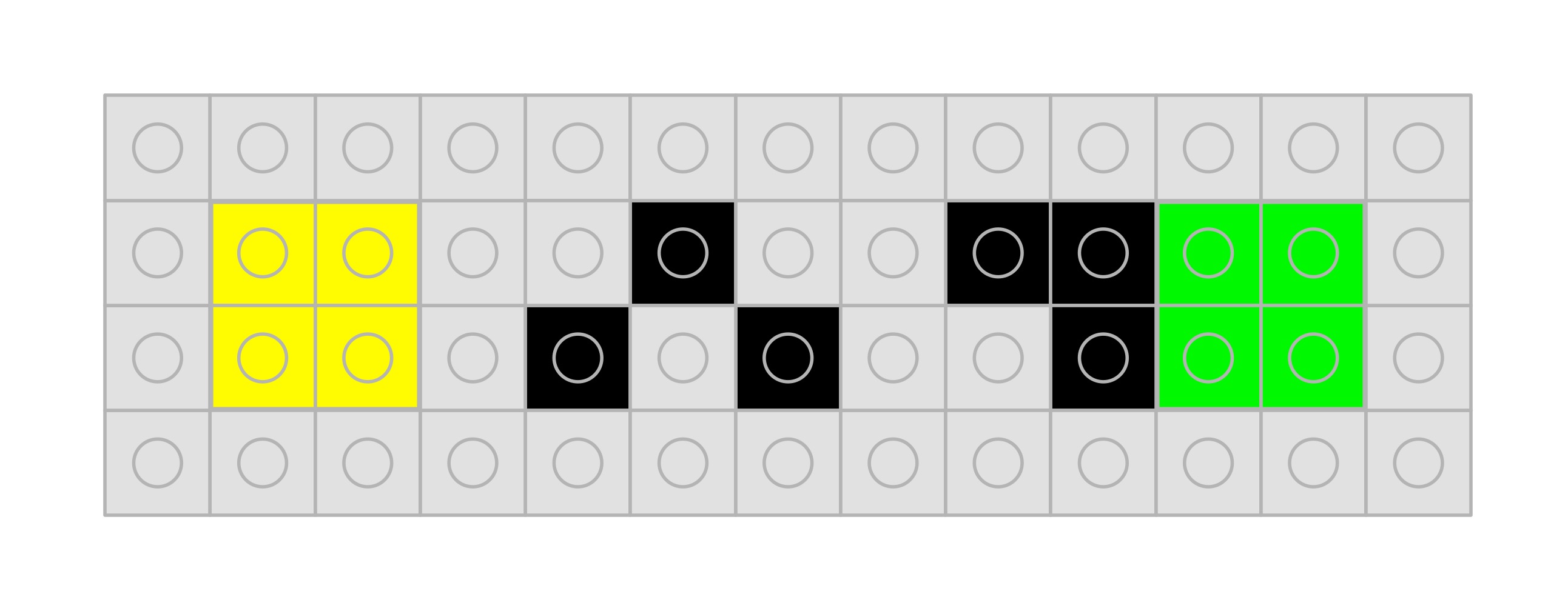
These lego symbols will allow us to write out logical expressions about propositions: like “The cat is thirsty AND NOT the cat is hungry” which we might write in English as “The cat is thirsty and not hungry”. If we use a yellow block to mean “The cat is thirsty” and a green block to mean “The cat is hungry” then in lego logic we can write it as follows:
The cat is thirsty AND NOT the cat is hungry P AND (NOT Q)
Of course the yellow and green brick are variables so by changing the propositions they represent it can stand for other things. It can also represent: ” The moon is blue AND NOT The moon is made of cheese.” where the yellow brick represents “The moon is blue” and the green brick represents “The moon is made of cheese”.
Think up some statements that involve AND, OR and NOT and then build representations of then in lego logic like the above.
The meaning of logical connectives
The above gives us symbols for the logical connectives, but so far they have no meaning: it is just syntax. Perhaps you think you know what the words mean. We use words like and, or and not in language rather imprecisely at times based on dictionary-style definitions. They essentially mean the same in English as in logic, but we need to define what they mean precisely. We do not want two different people to have two slightly different understandings of what they mean. This is where truth tables come in. A truth table tells us exactly, and without doubt, what the symbols for the operators mean. The give what is called by computer scientists a formal semantics to the logical connectives.
Let’s look at NOT first. A truth table is just a table that includes as rows all the combinations of true and false values of the variables in a logical expression together with an answer for those values. For example a truth table for the operator NOT, so telling us in all situations what (NOT a) means, is:
P
NOT P
TRUE
FALSE
FALSE
TRUE
A truth table for the NOT operator. Reading along the rows, IF P is TRUE THEN (NOT P) is FALSE; IF P is FALSE THEN (NOT P) is TRUE.
We can build this truth table in lego using our lego representation:
NOT only applies to one proposition, the one it negates, (it is a unary logical connective). That means we only need two rows in the table to cover the different possible values those propositions could stand for. AND (and OR) combine to two propositions (it is a binary logical connective). To cover all the possible combinations of the values of those propositions we need a table with four rows as there are four possibilities.
P
Q
P AND Q
TRUE
TRUE
TRUE
TRUE
FALSE
FALSE
FALSE
TRUE
FALSE
FALSE
FALSE
FALSE
A truth table for the logical AND operator.
We can build this in Lego as:
Reading along the rows this says that if both P and Q are blue (true) then the answer for P AND Q is true. Otherwise the answer is false (red). T
The following is the lego truth table for the logical OR operator
The columns for the two variables yellow/green (P/Q) are the same, setting out all the possibilities. Now the answer is true (blue) if either operand is true (blue) and false (red) when both are false (red).
We have now created lego truth tables that give the meaning of each of these three logical connectives. They aren’t the only logical operators – in fact there are 8 possible binary ones. Have a go at building lego truth tables for other binary logical connectives such as exclusive-or which is true if exactly one of the operands is true, and equivalence which is true if both operands are the same truth value.
Truth tables give precise meanings to logical operators and so to logic. That is useful, but even more usefully, they give a way to reason logically in a clear, price way. By following a simple algorithm to build new truth tables from existing ones, we can prove general facts, that are ultimately about propositions, in lego… as we will see next.
Subscribe to be notified whenever we publish a new post to the CS4FN blog.
This blog is funded by EPSRC on research agreement EP/W033615/1.
The Lego Computer Science post was originally funded by UKRI, through grant EP/K040251/2 held by Professor Ursula Martin, and forms part of a broader project on the development and impact of computing.
There is real money to be made out there in the virtual world – if you are willing to put in the effort to develop appropriate skills.
You don’t have to be young or a geek either. At the age of 62, grandmother Jacquie Lawson turned a hobby into a multi-million pound business. She is a trained illustrator having originally studied art at St Martins School of Art in London. She bought her first computer in 1998. Despite struggling at the start she taught herself to draw computer animations using Macromedia Flash.
Just for fun she made an animated Christmas e-card and sent it to friends. Her skill as an illustrator combined with her artistic flair meant that suddenly she was inundated with people wanting them from around the world – a wonderful example of viral marketing.
“The Internet is such a fantastic medium. It ought to be better.”
She set up a business, launched the http://www.jacquielawson.com e-card website and is now the market leader – with double the visitors of its nearest rival. As Jacquie says about the Internet: “It’s such a fantastic medium. It ought to be better”.
She believes there is a lot of rubbish on the Internet – which means there is scope for skilled, creative people to make a difference by focusing on detail in what they do. Quality can stand out.
So develop the basic skills, have a great idea, throw in some business savvy…but most of all do it for fun, if you want to end up with a successful business.
Paul Curzon, Queen Mary University of London (from the cs4fn women are here special issue)
Activity
Be inspired by Jacquie Lawson. Make your own computer greeting card for some special occasion (whether Valentine’s day, a birthday, Mothers day or Fathers Day…). It might be a still drawing or an animation. Perhaps it could even be a program. Use a technology you are familiar with, or learn one you haven’t used before for the occasion – Scratch perhaps or a drawing program. Learning new skills can be very rewarding and sometimes can lead to new opportunities.
Ludwig Wittgenstein is one of the most important philosophers of the 20th century. His interest was in logic and truth, language, meaning and ethics. As an aside he made contributions to logical thinking that are a foundation of computing. He popularised truth tables, a way to evaluate logical expressions, and invented the modern idea of tautology. His life shows that you do not have to set out with your life planned out to ultimately do great things.
Wittgenstein was born in Austria, of three-quarters Jewish descent, and actually went to the same school as Hitler at the same time, as they were the same age to within a week. Had he still been in Austria at the time of World War II he would undoubtedly have been sent to a concentration camp. Hitler presumably would not have thought much of him had he known more about him at school. Not only did he have a Jewish background, he was bisexual: it is thought he fell in love four times, once with a woman and three times with men.
Interested, originally, in flying and so aeronautic engineering he studied how kites fly in the upper atmosphere for his PhD in Manchester: flying the kites in the Peak District. He moved on to the study of propellors and designed a very advanced propellor that included mini jet engines on the propellor blades themselves. Studying propellors led him to an interest in advanced mathematics and then ultimately to the foundations of mathematics – a course about which, years later, he taught at Cambridge University that Alan Turing attended. Turing was teaching a course with the same title but from a completely different point of view at the time. His interest in the foundations of maths led to him thinking about what facts are, how they relate to thoughts, language and logic and what truth really was. However, World War I then broke out. During the war he fought for the Austro-Hungarian army, originally safe behind the lines but at his own request he was sent to the Russian Front. He was ultimately awarded medals for bravery. While on military leave towards the end of the war he completed the philosophical work that made him famous, the Tractatus Logico-Philosophicus. After the war though he went to rural Austria and worked as a monastery gardener and then as a primary school teacher. His sister suggested this was “like using a precision instrument to open crates”, though as he got into trouble for being violent in his punishments of the children the metaphor probably isn’t very good as he doesn’t sound like a great teacher and as a teacher he was more like a very blunt instrument.
In his absence, his fame in academia grew, however, and so eventually he returned to Cambridge, finally gained a PhD and ultimately became a fellow and then a Professor of Philosophy. By the time World War II broke out he was teaching philosophy in Cambridge but felt this was the wrong thing to be doing during a war, so despite now being a world famous philosopher went to work as a porter in Guy’s hospital, London.
His philosophical work was ground breaking mainly because of his arguments about language and meaning with respect to truth. However, a small part of has work has a very concrete relevance to computing. His thinking about truth and logic had led him to introduce the really important idea of a tautology as a redundant statement in logic. The ancient Greeks used the word but in a completely different sense of something made “true” just because it was said more than once, so argued to be true in a rhetorical sense. In computational terms Wittgenstein’s idea of a tautology is a logical statement about propositions that can be simplified to true. Propositions are just basic statements that may or may not be true, such as “The moon is made of cheese”. An example of a tautology is (a OR NOT(a)) where (a) is a variable that stands for a proposition so something that is either true or false. Putting in the concrete propositions “The moon is made of cheese” we get:
“(The moon is made of cheese) OR NOT (The moon is made of cheese)”
or in other words the statement
“The moon is made of cheese OR The moon is NOT made of cheese”
Logically, this is always true, whatever the moon is made of. “The moon is made of cheese” can be either true or false. Either it is made of cheese or not but either way the whole statement is true whatever the truth of the moon as one side or other of the OR is bound to be true. The statement is equivalent to just saying
“TRUE”
In other words, the original statement always simplifies to truth. More than that, whatever proposition you substitute in place of the statement “The moon is made of cheese” it still simplifies to true eg if we use the statement instead “Snoopy fought the Red Baron” then we get
“Snoopy fought the Red Baron OR NOT (Snoopy fought the Red Baron)”
Again, whatever the truth about Snoopy, this is a true statement. It is true whatever statement we substitute for (a) and whether it is true or false: (a OR NOT(a)) is a tautology guaranteed to be true by its logical structure, not by the meaning of the words of the propositions substituted in for a.
As part of this work Wittgenstein used truth tables, and is often claimed to have invented them. He certainly popularised them as a result of his work becoming so famous. However, Charles Sanders Peirce used truth tables first, 30 years earlier. The latter was a philosopher too, know as the “Father of Pragmatism” (so hopefully that means he wouldn’t have minded Wittgenstein getting all the credit!)
A truth table is just a table that includes as rows all the combinations of true and false values of the variables in logical expressions together with an answer for those values. For example a truth table for the operator NOT, so telling us in all situations what (NOT a) means, is:
a
NOT a
TRUE
FALSE
FALSE
TRUE
A truth table for the NOT operator. Reading along the rows, IF a is TRUE then (NOT a) is FALSE; IF a is FALSE then (NOT a) is TRUE. Image by CS4FN
The first thing that is important about truth tables is that they give very clear and simple meaning (or “semantics”) to logical operators (like AND, OR and NOT) and so of statements asserting facts logically. Computationally, they make precise what the logical operators do, as the above table for NOT does. This of course matters a lot in programs where logical operators control what the program does. It also matters in hardware which is built up from circuits representing the logical operations. They provide the basis for understanding what both programs and hardware do.
The following is the truth table for the logical OR operator: again the last column gives the meaning of the operator so the answer of computing the logical or operation. This time there are two variables (a) and (b) so four rows to cover the combinations.
a
b
a OR b
TRUE
TRUE
TRUE
TRUE
FALSE
TRUE
FALSE
TRUE
TRUE
FALSE
FALSE
FALSE
A truth table for the logical OR operator. Reading along the rows, IF a is TRUE and b is TRUE then (a OR b) is TRUE; IF a is TRUE and b is FALSE then (a OR b) is TRUE; IF a is FALSE and b is TRUE then (a OR b) is TRUE; IF a is FALSE and b is FASLE then (a OR b) is FALSE; Image by CS4FN
Truth tables can be used to give more than just meaning to operators, they can be used for doing logical reasoning; to compute new truth tables for more complex logical expressions, including checking if they are tautologies. This is the basis of program verification (mathematically proving a program does the right thing) and similarly hardware verification. Let us look at (a OR (NOT a)). We make a column for (a) and then a second column gives the answer for (NOT a) from the NOT truth table. Adding a third column we then look up in the OR truth table the answers given the values for (a) and (NOT a) on each row. For example, if a is TRUE then NOT a is FALSE. Looking up the row for TRUE/FALSE in the OR table we see the answer is TRUE so that goes in the answer column for (a OR (NOT a)). The full table is then:
a
NOT a
a OR (NOT a)
TRUE
FALSE
TRUE
FALSE
TRUE
TRUE
A truth table for the a OR NOT a. Reading along the rows, IF a is TRUE then (a OR (NOT a)) is TRUE; IF a is FALSE then (a OR (NOT a)) is TRUE; Image by CS4FN
Truth tables therefore give us an easy way to see if a logical expression is a tautology. If the answer column has TRUE as the answer for every row, as here, then the expression is a tautology. Whatever the truth of the starting fact a, the expression is always true. It has the same truth table as the expression TRUE (a) where TRUE is an operator which gives answer true whatever its operand.
a
TRUE
TRUE
TRUE
FALSE
TRUE
A truth table for the TRUE operator. Whatever its operand it gives answer TRUE. Image by CS4FN
We can do a similar thing for (a AND (NOT a)). We need the truth table for AND to do this.
a
b
a AND b
TRUE
TRUE
TRUE
TRUE
FALSE
FALSE
FALSE
TRUE
FALSE
FALSE
FALSE
FALSE
A truth table for the logical AND operator. Image by CS4FN
We fill in the answer column based on the values from the (a) column and the (NOT a) column looking up the answer in the truth table for AND.
a
NOT a
a AND (NOT a)
TRUE
FALSE
FALSE
FALSE
TRUE
FALSE
A truth table for the a AND (NOT a). Reading along the rows, IF a is TRUE then a AND (NOT a) is FALSE; IF a is FALSE then a AND (NOT a) is FALSE; Image by CS4FN
This shows that it is not a tautology as not all rows have answer TRUE. In fact, we can see from the table that this actually simplifies to FALSE. It can never be true whatever the facts involved as both (a) and (NOT a) are never true about any proposition (a) at the same time.
Here is a slightly more complicated logical expression to consider: ((a AND b) IMPLIES a). Is this a tautology? We need the truth table for IMPLIES to work this out:
a
b
a IMPLIES b
TRUE
TRUE
TRUE
TRUE
FALSE
FALSE
FALSE
TRUE
TRUE
FALSE
FALSE
TRUE
A truth table for the logical IMPLIES logical operator. Image by CS4FN
When we look up the values from the (a AND b) column and the (a) column in the IMPLIES truth table, we get the answers for the full expression ((a AND b) IMPLIES a) and find that it is a tautology as the answer is always true:
a
b
a AND b
a
(a AND b) IMPLIES a
TRUE
TRUE
TRUE
TRUE
TRUE
TRUE
FALSE
FALSE
TRUE
TRUE
FALSE
TRUE
FALSE
FALSE
TRUE
FALSE
FALSE
FALSE
FALSE
TRUE
A truth table for the logical expression (a AND b) IMPLIES a. Image by CS4FN
Using the same kind of approach we can use truth tables to check if two expressions are equivalent. If they give the same final column of answers for the same inputs then they are interchangeable. Let’s look at (b OR (NOT a)).
a
b
NOT a
(b OR (NOT a))
TRUE
TRUE
FALSE
TRUE
TRUE
FALSE
FALSE
FALSE
FALSE
TRUE
TRUE
TRUE
FALSE
FALSE
TRUE
TRUE
A Truth table for the logical expression (b OR (NOT a)). Image by CS4FN
This gives exactly the same answers in the final column as the truth table for IMPLIES above, so we have just shown that:
(a IMPLIES b) IS EQUIVALENT TO (b OR (NOT a))
We have proved a theorem about logical implication. (a IMPLIES b) has the same meaning as, so is interchangeable with, (b OR (NOT a)). All tautologies are interchangeable of course as they are all equivalent in their answers to TRUE. If we give a truth table for IS EQUIVALENT TO we could even show equivalences like the above are tautologies!
Tautologies, and equivalences, once proved, can also be the basis of further reasoning. Any time we have in a logical expression (a IMPLES b), for example, we can swap it for (b OR (NOT a)) knowing they are equivalent.
Truth tables helped Wittgenstein think about arguments and deduction of facts using rules. In particular, he decided special rules that other philosophers suggested should be used in deduction, were not necessary, as such. Deduction instead works simply from the structure of logic that means logical statements follow from other logical statements. Truth tables gave a clear way to see the equivalences resulting from the logic. Deduction is not about meanings in language but about logic. Truth tables meant you could decide if something was true by looking at equivalences so ultimately tautologies. They showed that some statements were universally true just by inspection of the truth table. For computer scientists they gave a way to define what logical operations mean and then reason about digital circuits and programs they designed, both to help understand, so write them, and get them right.
Wittgenstein started off as an engineer interested in building flying machines, moved to become a mathematician, a soldier, a gardener and a teacher, as well as a hospital porter, but ultimately he is remembered as a great philosopher. Abstract though his philosophy was, along the way he provided computer scientists and electrical engineers useful tools that helped them build thinking machines.
Alan Turing was born in London on 23 June 1912. His parents were both from successful, well-to-do families, which in the early part of the 20th century in England meant that his childhood was pretty stuffy. He didn’t see his parents much, wasn’t encouraged to be creative, and certainly wasn’t encouraged in his interest in science. But even early in his life, science was what he loved to do. He kept up his interest while he was away at boarding school, even though his teachers thought it was beneath well-bred students. When he was 16 he met a boy called Christopher Morcom who was also very interested in science. Christopher became Alan’s best friend, and probably his first big crush. When Christopher died suddenly a couple of years later, Alan partly helped deal with his grief with science, by studying whether the mind was made of matter, and where – if anywhere – the mind went when someone died.
The Turing machine
After he finished school, Alan went to the University of Cambridge to study mathematics, which brought him closer to questions about logic and calculation (and mind). After he graduated he stayed at Cambridge as a fellow, and started working on a problem that had been giving mathematicians headaches: whether it was possible to determine in advance if a particular mathematical proposition was provable. Alan solved it (the answer was no), but it was the way he solved it that helped change the world. He imagined a machine that could move symbols around on a paper tape to calculate answers. It would be like a mind, said Alan, only mechanical. You could give it a set of instructions to follow, the machine would move the symbols around and you would have your answer. This imaginary machine came to be called a Turing machine, and it forms the basis of how modern computers work.
Code-breaking at Bletchley Park
By the time the Second World War came round, Alan was a successful mathematician who’d spent time working with the greatest minds in his field. The British government needed mathematicians to help them crack the German codes so they could read their secret communiqués. Alan had been helping them on and off already, but when war broke out he moved to the British code-breaking headquarters at Bletchley Park to work full-time. Based on work by Polish mathematicians, he helped crack one of the Germans’ most baffling codes, called the Enigma, by designing a machine (based on earlier version by the Poles again!) that could help break Enigma messages as long as you could guess a small bit of the text (see box). With the help of British intelligence that guesswork was possible, so Alan and his team began regularly deciphering messages from ships and U-boats. As the war went on the codes got harder, but Alan and his colleagues at Bletchley designed even more impressive machines. They brought in telephone engineers to help marry Alan’s ideas about logic and statistics with electronic circuitry. That combination was about to produce the modern world.
Building a brain
The problem was that the engineers and code-breakers were still having to make a new machine for every job they wanted it to do. But Alan still had his idea for the Turing machine, which could do any calculation as long as you gave it different instructions. By the end of the war Alan was ready to have a go at building a Turing machine in real life. If it all went to plan, it would be the first modern electronic computer, but Alan thought of it as “building a brain”. Others were interested in building a brain, though, and soon there were teams elsewhere in the UK and the USA in the race too. Eventually a group in Manchester made Alan’s ideas a reality.
Troubled times
Not long after, he went to work at Manchester himself. He started thinking about new and different questions, like whether machines could be intelligent, and how plants and animals get their shape. But before he had much of a chance to explore these interests, Alan was arrested. In the 1950s, gay sex was illegal in the UK, and the police had discovered Alan’s relationship with a man. Alan didn’t hide his sexuality from his friends, and at his trial Alan never denied that he had relationships with men. He simply said that he didn’t see what was wrong with it. He was convicted, and forced to take hormone injections for a year as a form of chemical castration.
Although he had had a very rough period in his life, he kept living as well as possible, becoming closer to his friends, going on holiday and continuing his work in biology and physics. Then, in June 1954, his cleaner found him dead in his bed, with a half-eaten, cyanide-laced apple beside him.
Alan’s suicide was a tragic, unjust end to a life that made so much of the future possible.
Jonathan Black, Paul Curzon and Peter W. McOwan, Queen Mary University of London(from the archive)
The world is heading for catastrophe. We’re hooked on power hungry devices: our mobile phones and iPods, our Playstations and laptops. Wherever you turn people are using gadgets, and those gadgets are guzzling energy – energy that we desperately need to save. We are all doomed, doomed…unless of course a hero rides in on a white charger to save us from ourselves.
Don’t worry, the cognitive crash dummies are coming!
Actually the saviours may be people like professor of human-computer interaction, Bonnie John, and her then grad student, Annie Lu Luo: people who design cognitive crash dummies. When working at Carnegie Mellon University it was their job to figure out ways for deciding how well gadgets are designed.
If you’re designing a bridge you don’t want to have to build it before finding out if it stays up in an earthquake. If you’re designing a car, you don’t want to find out it isn’t safe by having people die in crashes. Engineers use models – sometimes physical ones, sometimes mathematical ones – that show in advance what will happen. How big an earthquake can the bridge cope with? The mathematical model tells you. How slow must the car go to avoid killing the baby in the back? A crash test dummy will show you.
Even when safety isn’t the issue, engineers want models that can predict how well their designs perform. So what about designers of computer gadgets? Do they have any models to do predictions with? As it happens, they do. Their models are called ‘human behavioural models’, but think of them as ‘cognitive crash dummies’. They are mathematical models of the way people behave, and the idea is you can use them to predict how easy computer interfaces are to use.
There are lots of different kind of human behavioural model. One such ‘cognitive crash dummies’ is called ‘GOMS’. When designers want to predict which of a few suggested interfaces will be the quickest to use, they can use GOMS to do it.
Suppose you are designing a new phone interface. There are loads of little decisions you’ll have to make that affect how easy the phone is to use. You can fit a certain number of buttons on the phone or touch screen, but what should you make the buttons do? How big should they be? Should you use gestures? You can use menus, but how many levels of menus should a user have to navigate before they actually get to the thing they are trying to do? More to the point, with the different variations you have thought up, how quickly will the person be able to do things like send a text message or reply to a missed call? These are questions GOMS answers.
To do a GOMS prediction you first think up a task you want to know about – sending a text message perhaps. You then write a list of all the steps that are needed to do it. Not just the button presses, but hand movements from one button to another, thinking time, time for the machine to react, and so on. In GOMS, your imaginary user already knows how to do the task, so you don’t have to worry about spending time fiddling around or making mistakes. That means that once you’ve listed all your separate actions GOMS can work out how long the task will take just by adding up the times for all the separate actions. Those basic times have been worked out from lots and lots of experiments on a wide range of devices. The have shown, on average, how long it takes to press a button and how long users are likely to think about it first.
GOMS in 60 seconds?
GOMS has been around since the 1980s, but wasn’t being used much by industrial designers. The problem is that it is very frustrating and time-consuming to work out all those steps for all the different tasks for a new gadget. Bonnie John’s team developed a tool called CogTool to help. You make a mock-up of your phone design in it, and tell it which buttons to press to do each task. CogTool then worked out where the other actions, like hand movements and thinking time, are needed and makes predictions.
Bonnie John came up with an easier way to figure out how much human time and effort a new design uses, but what about the device itself? How about predicting which interface design uses less energy? That is where Annie Lu Luo, came in. She had the great idea that you could take a GOMS list of actions and instead of linking actions to times you could work out how much energy the device uses for each action instead. By using GOMS together with a tool like CogTools, a designer can find out whether their design is the most energy efficient too.
So it turns out you don’t need a white knight to help your battery usage, just Annie Lu Luo and her version of GOMS. Mobile phone makers saw the benefit of course. That’s why Annie walked straight into a great job on finishing university.
The chatbots have suddenly got everyone talking, though about them as much as with them. Why? Because one, chatGPT has (amongst other things) reached the level of being able to fool us into thinking that it is a pretty good student.
It’s not exactly what Alan Turing was thinking about when he broached his idea of a test for intelligence for machines: if we cannot tell them apart from a human then we must accept they are intelligent. His test involved having a conversation with them over an extended period before making the decision, and that is subtly different to asking questions.
ChatGPT may be pretty close to passing an actual Turing Test but it probably still isn’t there yet. Ask the right questions and it behaves differently to a human. For example, ask it to prove that the square root of 2 is irrational and it can do it easily, and looks amazingly smart, – there are lots of versions of the proof out there that it has absorbed. It isn’t actually good at maths though. Ask it to simply count or add things and it can get it wrong. Essentially, it is just good at determining the right information from the vast store of information it has been trained on and then presenting it in a human-like way. It is arguably the way it can present it “in its own words” that makes it seem especially impressive.
Will we accept that it is “intelligent”? Once it was said that if a machine could beat humans at chess it would be intelligent. When one beat the best human, we just said “it’s not really intelligent – it can only play chess””. Perhaps chatGPT is just good at answering questions (amongst other things) but we won’t accept that as “intelligent” even if it is how we judge humans. What it can do is impressive and a step forward, though. Also, it is worth noting other AIs are better at some of the things it is weak at – logical thinking, counting, doing arithmetic, and so on. It likely won’t be long before the different AIs’ mistakes and weaknesses are ironed out and we have ones that can do it all.
Rather than asking whether it is intelligent, what has got everyone talking though (in universities and schools at least) is that chatGPT has shown that it can answer all sorts of questions we traditionally use for tests well enough to pass exams. The issue is that students can now use it instead of their own brains. The cry is out that we must abandon setting humans essays, we should no longer ask them to explain things, nor for that matter write (small) programs. These are all things chatGPT can now do well enough to pass such tests for any student unable to do them themselves. Others say we should be preparing students for the future so its ok, from now on, we just only test what human and chatGPT can do together.
It certainly means assessment needs to be rethought to some extent, and of course this is just the start: the chatbots are only going to get better, so we had better do the thinking fast. The situation is very like the advent of calculators, though. Yes, we need everyone to learn to use calculators. But calculators didn’t mean we had to stop learning how to do maths ourselves. Essay writing, explaining, writing simple programs, analytical skills, etc, just like arithmetic, are all about core skill development, building the skills to then build on. The fact that a chatbot can do it too doesn’t mean we should stop learning and practicing those skills (and assessing them as an inducement to learn as well as a check on whether the learning has been successful). So the question should not be about what we should stop doing, but more about how we make sure students do carry on learning. A big, bad thing about cheating (aside from unfairness) is that the person who decides to cheat loses the opportunity to learn. Chatbots should not stop humans learning either.
The biggest gain we can give a student is to teach them how to learn, so now we have to work out how to make sure they continue to learn in this new world, rather than just hand over all their learning tasks to the chatbot to do. As many people have pointed out, there are not just bad ways to use a chatbot, there are also ways we can use chatbots as teaching tools. Used well by an autonomous learner they can act as a personal tutor, explaining things they realise they don’t understand immediately, so becoming a basis for that student doing very effective deliberate learning, fixing understanding before moving on.
Of course, a bigger problem, if a chatbot can do things at least as well as we can then why would a company employ a person rather than just hire an AI? The AIs can now a lot of jobs we assumed were ours to do. It could be yet another way of technology focussing vast wealth on the few and taking from the many. Unless our intent is a distopian science fiction future where most humans have no role and no point, (see for example, CS Forester’s classic, The Machine Stops) then we still in any case ought to learn skills. If we are to keep ahead of the AIs and use them as a tool not be replaced by them, we need the basic skills to build on to gain the more advanced ones needed for the future. Learning skills is also, of course, a powerful way for humans (if not yet chatbots) to gain self-fulfilment and so happiness.
Right now, an issue is that the current generation of chatbots are still very capable of being wrong. chatGPT is like an over confident student. It will answer anything you ask, but it gives wrong answers just as confidently as right ones. Tell it it is wrong and it will give you a new answer just as confidently and possibly just as wrong. If people are to use it in place of thinking for themselves then, in the short term at least, they still need the skill it doesn’t have of judging when it is right or wrong.
So what should we do about assessment. Formal exams come back to the fore so that conditions are controlled. They make it clear you have to be able to do it yourself. Open book online tests that become popular in the pandemic, are unlikely to be fair assessments any more, but arguably they never were. Chatbots or not they were always too easy to cheat in. They may well be good still for learning. Perhaps in future if the chatbots are so clever then we could turn the Turing test around: we just ask an artificial intelligence to decide whether particular humans (our students) are “intelligent” or not…
Alternatively, if we don’t like the solutions being suggesting about the problems these new chatbots are raising, there is now another way forward. If they are so clever, we could just ask a chatbot to tell us what we should do about chatbots…












 cs4fn
cs4fn 