Computer Scientists are working to support traditional music from around the world.
A seperewa is a traditional “harp-lute” musical instrument of the Akan people in Ghana, Africa. It has strings that are plucked a bit like a guitar. It is dying out because of the rise of western music. Researchers are now testing AIs that were trained on western music to see if they still work with such different seperewa music. They are also trying to understand exactly how this traditional music is different.
Protecting traditional instruments
Colonisers introduced European guitars to Ghana in the late 1800s and their sound began to influence and even replace seperewa music. Worried by this, in the mid-1900s people made recordings to preserve endangered seperewa music and to remind people what it sounds like. Ghanaian musicians are now reviving the seperewa, so we might continue to hear more of its lovely sound in future.
A team of computer scientists and music experts have investigated recordings of seperewa music to see how well western AI tools can analyse that style of music, given it is tuned in a completely different way, so plays different notes to a western instrument.
First the team used one AI tool to separate the sounds of the seperewa from the singing. It struggled a bit and left some of the singing in the seperewa track and vice versa but overall did a good job,
They then used a different AI to analyse the sounds of the seperewa. The found that the seperewa music had its own, unique musical fingerprint, revealing a rich tapestry of sound that was clearly different from western music.
The research is helping to preserve a vital part of Ghanaian culture. It has shown in detail how their music is different to anything western and so that something unique and precious would be lost if it died out.
Jo Brodie and Paul Curzon, Queen Mary University of London
The Music and AI pages are sponsored by the EPSRC (UKRI3024: DA EPSRC university doctoral landscape award additional funding 2025 – Queen Mary University of London).
Subscribe to be notified whenever we publish a new post to the CS4FN blog.
600 years ago King Sejong the Great of Korea published ‘Hangul’, a new and improved writing system for his people. To celebrate he asked his court scholars to write an epic poem in Hangul, then asked his musicians to compose music to accompany it. The result was Yongbieocheonga, or ‘Songs of the Dragon Flying to Heaven’.
It was performed by musicians playing wind and stringed instruments. The musical instruments the AI composed for are Daegeum and Piri (wind instruments), Haegeum and Ajaeng (bowed string instruments) and Geomungo and Gayageum (plucked string instruments). Each instrument had its own melody written out for the musician to follow. Only one piece of the written music survives fully intact (it is still performed!). Melodies of other pieces of music have survived but only for a single instrument. That means those pieces can’t be played by a group of musicians because all the other harmonies are missing.
A team of computer scientists decided to recreate the missing 15th century Korean harmonies from just the single melodies (in the way the Bach Google Doodle does, see You’ll Be Bach!). They wanted to expand the ability of their AI tools to make sense of music beyond western music.
They first taught their AI musician to recognise Korean music written in Hangul. Then, it learnt which notes sound best played together by different instruments. Finally, to generate music that could be played, it matched melodies and rhythms.
It created a melody for each different instrument. The researchers then asked Korean musicians to perform the whole piece and to judge how well the AI musician had done. Happily, they thought that the music worked well and sounded correct. They could perform it with only a few small tweaks.
You can listen to one of the performances and find out more below.
Jo Brodie and Paul Curzon, Queen Mary University of London
Watch…
Hear what a piri sounds like in this short YouTube video (in Korean with English subtitles) [EXTERNAL]
The Music and AI pages are sponsored by the EPSRC (UKRI3024: DA EPSRC university doctoral landscape award additional funding 2025 – Queen Mary University of London).
Subscribe to be notified whenever we publish a new post to the CS4FN blog.
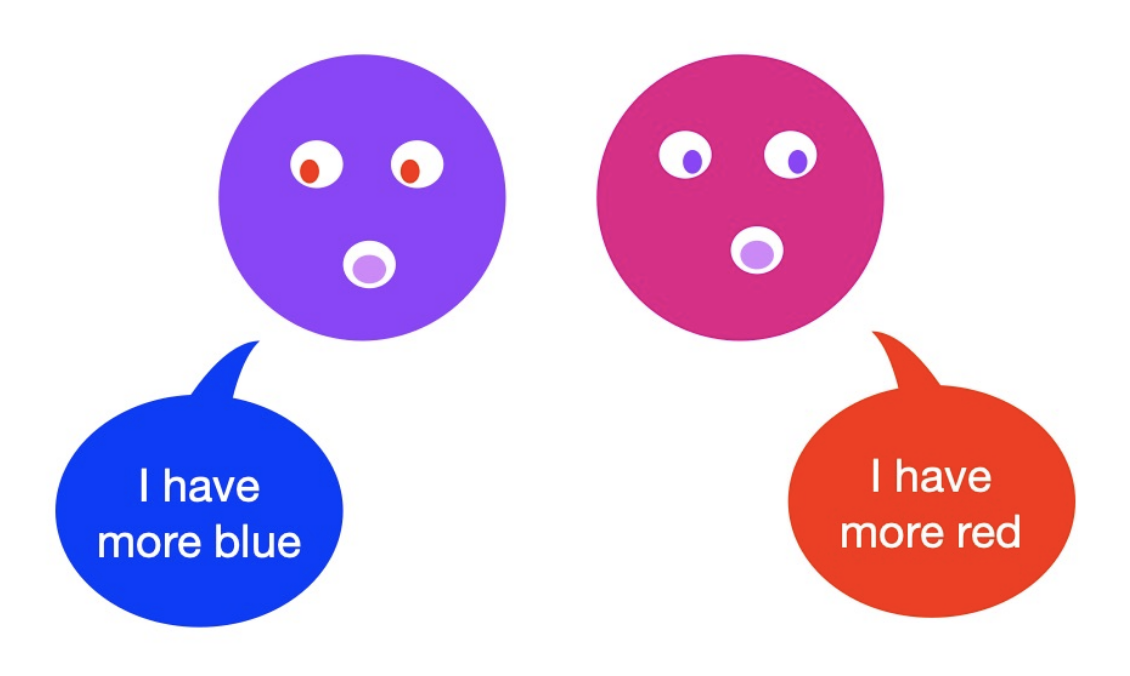
Purple can be created by mixing together red and blue paint. You can probably tell which of the faces in the image has more blue and which has more red. Does music work the same way?
Your brain can recognise the red and blue in purple while still seeing it as a whole colour. Music is similar. When you listen to a song your ears and brain hear all the sounds at once. The singing, guitars, drums and keyboard parts are mixed together, but you can also focus on the singing, or the keyboards or ….
Computer scientists have gone a step further with Artificial Intelligence. By training AI tools on lots of different songs they have taught them to do “source separation” – unmixing a recorded song back into its separate bits. Those separate bits are called stems. It is like taking purple paint and unmixing it to give blue and red again!
Photographer Todd McLellan photographs gadgets he’s carefully taken apart, to show all the pieces (search the web for his “Things Come Apart”). When a piece of music is blended together and an AI separates it again it’s a bit more like trying to un-bake a cake!
Jo Brodie and Paul Curzon, Queen Mary University of London
More on…
We have LOTS of articles about music, audio and computer science. Have a look in these themed portals for more:
The Music and AI pages are sponsored by the EPSRC (UKRI3024: DA EPSRC university doctoral landscape award additional funding 2025 – Queen Mary University of London).
Subscribe to be notified whenever we publish a new post to the CS4FN blog.
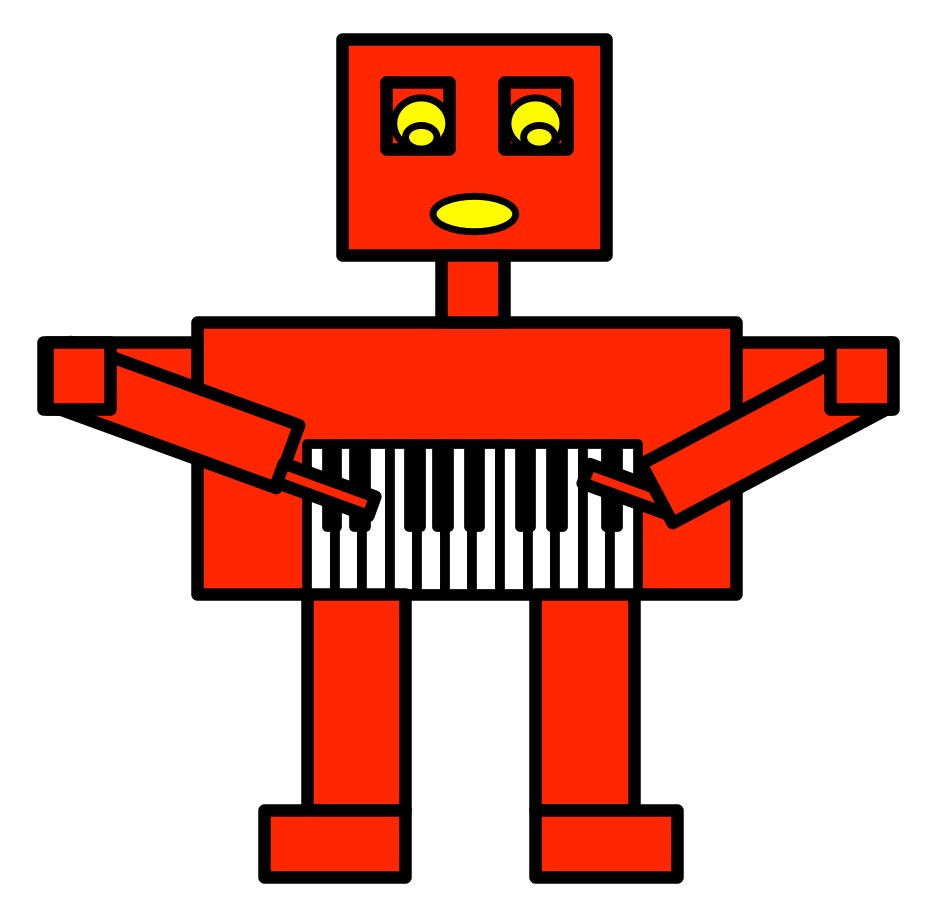
Jordan Rudess is a rock keyboard player whose concerts sell out around the world. He works with a team of computer scientists at the MIT Media Labto make his synthesisers do amazing things. Together they created an AI musician called JAM_BOT to play with him on-stage.
Jordan’s bot learnt the different ways he plays by the team giving it lots of his music. It learned about the rhythms and melodies he uses. It could then compose its own versions of his music when prompted.
JAM_BOT AI plays along on-stage
Jordan also trained JAM_BOT to play with him. It could carry on playing music that Jordan had started, or create a backing track to music he was currently playing. Jordan was able to choose how JAM_BOT played with him on stage using the keys on his keyboard.
What happened next?
The resulting concert was a mix of performer and AI with a delighted audience (and computer science team). Afterwards Jordan said “It’s been pretty mind-blowing to create this tech-based version of myself – like looking into a real-time musical mirror.”
Jo Brodie and Paul Curzon, Queen Mary University of London
here you can also listen to some of the pieces of music.
The Music and AI pages are sponsored by the EPSRC (UKRI3024: DA EPSRC university doctoral landscape award additional funding 2025 – Queen Mary University of London).
Subscribe to be notified whenever we publish a new post to the CS4FN blog.
Can a translation program make music? It turns out they potentially can – they can beatbox! In the future perhaps Artificial Intelligences will be able to do creative beatboxing the way human beatboxers do.
Beatboxing is a kind of vocal percussion used in hip hop music. It mainly involves creating drumbeats, rhythm, and musical sounds using your mouth, lips, tongue and voice. So how on earth can Google Translate do that? Well a cunning blogger worked out a way. Once on the Google Translate page they first set it to translate from German into German (which you could do then). Next they typed the following into the translate box: pv zk pv pv zk pv zk kz zk pv pv pv zk pv zk zk pzk pzk pvzkpkzvpvzk kkkkkk bsch; Then when they clicked on the “Listen” button to hear this spoken in German. Google translate beatboxed.
So how do programs like Google Translate that turn text into speech do it? The technology that makes this possible is called ‘speech synthesis’: the artificial production of human speech.
Originally, to synthesise speech from text, words are first mapped to the way they are pronounced using special pronunciation (‘phonetic’) dictionaries – one for each language you want to speak. The ‘Carnegie Mellon University Pronouncing Dictionary’ is a dictionary for North American English, for example. It contains over 125 000 words and their phonetic versions. Speech is about more than the sounds of the words though. Rhythm, stress, and intonation matter too. To get these right, the way the words are grouped into phrases and sentences has to be taken into account as the way a word is spoken depends on those around it.
There are several ways to generate synthesised speech given its pronunciation and information about rhythm and so on. One is simply to glue together pieces of pre-recorded speech that have been recorded when spoken by a person. Machine learning provides a new way to do it – machine learning programs are trained on vast amounts of recorded speech and learn the natural way humans speak from listening to humans actually speak. That gives a way to overcome the problems of just using pronunciation dictionaries.
Another way uses what are called ‘physics-based speech synthesisers‘. They model the way sounds are created in the first place. We create different sounds by varying the shape of our vocal tract, and altering the position of our tongue and lips, for example. We can also change the frequency of vibration produced by the vocal cords that again changes the sound we make. To make a physics-based speech synthesiser, we first create a mathematical model that simulates the way the vocal tract and vocal cords work together. The inputs of the model can then be used to control the different shapes and vibration frequencies that lead to different sounds. We essentially have a virtual world for making sounds. It’s not a very big virtual world admittedly – no bigger than a person’s mouth and throat! That’s big enough to generate the sounds that match the words we want the computer to say, though.
These physics-based speech models also give a new way a computer could beatbox. Rather than start from letters and translate them into sounds that correspond to beatboxing effects, a computer could do what the creative beatboxers actually do and experiment with the positions of its virtual mouth and vocal cords to find new beatboxing sounds.
Beatboxers have long understood that they could take advantage of the complexity of their vocal organs to produce a wide range of sounds mimicking those of musical instruments. Perhaps in the future Artificial Intelligences with a creative bent could be connected to physics-based speech synthesisers and left to invent their own beatboxing sounds.
The Music and AI pages are sponsored by the EPSRC (UKRI3024: DA EPSRC university doctoral landscape award additional funding 2025 – Queen Mary University of London).
Subscribe to be notified whenever we publish a new post to the CS4FN blog.
The Bach Google Doodle is an AI musician which has learned the patterns in over 300 pieces of music from Johann Sebastian Bach, a famous 18th century German composer. The AI musician will take the notes you give it and suggest harmonies in Bach’s style. It takes a melody and creates backing melodies for different instruments that sound pleasing.
Visit the Bach Google Doodle, put some notes together, press ‘Harmonize’ and see what you think of the result. If you don’t like its first suggestion you can press Harmonize to try again.
How to use it
Once on the page click the large play symbol (a white triangle) to open the doodle, and then again to run the intro demo (which you can skip on later visits).
Use your mouse to place notes at different positions on the five horizontal lines. If you hover over a note an X will appear so you can delete it and place it somewhere else. If you press and hold a note an option will appear to let you sharpen it (raise it by a semitone) or flatten it (lower it by a semitone). You can press the play icon to hear what your composition sounds like. Then press HARMONIZE to activate the AI. It will look at your piece of music and suggest the backing track (harmonies). You can then click a smiley or cross face if you like it or didn’t like it.
Hover your mouse cursor over all the other bits of the page too – there are lots of fun things to play with including some Easter eggs.
About the doodle
🎹 Celebrating Johann Sebastian Bach was Google’s first-ever AI-powered doodle and “is an interactive experience encouraging players to compose a two measure melody of their choice. With the press of a button, the Doodle then uses machine learning to harmonize the custom melody into Bach’s signature music style (or a Bach 80’s rock style hybrid if you happen to find a very special easter egg in the Doodle…”
Jo Brodie and Paul Curzon, Queen Mary University of London
The Music and AI pages are sponsored by the EPSRC (UKRI3024: DA EPSRC university doctoral landscape award additional funding 2025 – Queen Mary University of London).
Subscribe to be notified whenever we publish a new post to the CS4FN blog.
In older films computers are sometimes shown doing a calculation while making lots of bleeps and bloops – sounds that indicate ‘something technical is happening’. In reality computers are generally very quiet (you might hear the sound of the fan, that’s just keeping everything cool) and they don’t normally make a peep. But computer scientists have been wondering if some sound added in might help people make sense of what’s going on.
People who use artificial intelligence tools often have no idea what is happening inside (it’s a bit hidden, like a ‘black box’), or even how much they can trust the results they produce. Explainable AI (“XAI”) is the idea that people should have a better understanding of how an AI tool has reached its answer.
Cars that are powered by batteries don’t have a physical engine so don’t make as much noise (other than the sound of the tyres on the road) but car manufacturers have added in artificial ‘engine sounds’ to make it easier for pedestrians and cyclists to know that a car is heading towards them. This is ‘sonification’, adding sounds that aren’t naturally there to make things more audible. Computer scientists have begun to consider whether it might be possible to sonify the way some language generating AI tools process and produce information, to make their inner workings easier for people to interpret. Whether that might be a microwave-style ‘ping’ to let you know when it’s done something, or a tuneful melody to accompany the AI’s processes remains to be seen…
Jo Brodie, Queen Mary University of London
Other added sounds
Can you think of other examples where a sound has been added (sonification) to help people make sense of something?
Examples include these, which are also helpful for visually impaired people
‘This vehicle is turning left / reversing’ warnings from lorries
A lift / elevator making a ‘ping’ sound to alert you that it’s arrived
At pedestrian crossings the traffic lights might make an audible sound when the little red man goes green.
The 2004 film Catwoman, starring Halle Berry as Patience Phillips (and Catwoman), has been voted as one of the worst films of all time, and has won multiple Razzies (Golden Raspberry Awards) – Halle Berry accepted hers while holding her Best Actress Academy Award. Now, however, it has a bit of a cult following. It did at least feature an African American woman as the lead, in a superhero film, possibly for the first time, and came long before Black Panther. Whether it deserves either accolades or condemnation, it certainly features some of the worst cyber-physical security seen in a film by a corporate giant. So what can we learn about cyber-physical security from the film?
The weakest link
The plot is based around the cosmetics firm Hedare Beauty and its development and product launch of a new face cream that reverses the affects of aging. Clearly, a big corporate player, the firm has a massive team at their headquarters that includes artist Patience working on PR, but also a massive research and industrial complex, developing testing and manufacturing its products. Now, cyber-criminals do not just include hackers out to cause anarchy or extort money from people, they also include people working for companies, sometimes supported by their countries, doing industrial espionage: trying to steal research and development secrets. By stealing the designs or product formulae of their competitors, such companies aim to save the massive time and development costs of doing it themselves. They then quickly produce rip-off products to steal the market. Gaining secrets can also gain criminals advantage through insider trading, buying and selling shares, so making money on the back of secret information about what is about to happen. Companies, therefore, have to take industrial espionage seriously, and that means taking cyber-security seriously too.
In Catwoman, the company, Hedare Beauty, have the normal kinds of industrial secret but also a big nasty one too, so their bosses have even more reason to put a lot of effort into security. They certainly have lots of heavies with guns looking to shoot people. However, their physical security is actually totally lax.
This is first seen when Patience’s love interest, Detective Tom Lone, merrily walks into the corporate headquarters and up to her open plan desk where she is working on the product launch to ask her for a date. How did he get in? Why isn’t anyone accompanying him in such a sensitive area especially days before a crucial launch? Where is his visitor’s pass and why isn’t he being challenged. Perhaps this can be put down to being a cop (perhaps he waived his badge about) but still someone senior should have accompanied him surely (and is returning Patience’s purse (his excuse) really a good enough reason to bypass security whoever you are?)
However, even if we let that go, later Patience has to deliver some artwork by midnight to the boss out at the industrial complex. That is where the real secrets, good and bad, are. When she gets there the foyer is locked and dark with no one on duty. In many thrillers, the heroes have to use sophisticated gadgets, amazing technical or physical skill, or subterfuge to overcome the massively sophisticated hi-tech security. Patience, by contrast, just wanders round the back looking for another way in and finds a fire door ajar. This allows her to both enter and ultimately make it to the heart of the building where secrets are being discussed. As a result she overhears (if accidentally) something she should not hear…
Perhaps the most important principle of cyber-security is that it is as weak as its weakest link. You can have all the high tech multi-factor biometric authentication systems, impossible to crack encryption, experienced and well-trained former SAS guards patrolling the foyer, and so on, but if you leave a back door open then the criminals will just ignore all your high tech security and walk in through that one back door. That is exactly what Patience does. There is no point as, for example, I have seen in real life, checking everyones access cards on a main gate, when there is an un-manned side gate. The criminals aren’t going to even try to enter through the front gate. Likewise, if you have a weak point in your cyber-security system, it does not matter how massively strong the rest is.
It is also better to think not of just cyber-security, anyway, but of cyber-physical security. The weakest links can just as easily be to do with physical security as with the computerised part – like the open door Patience found, or letting someone claiming to be a Detective to walk around anywhere in the building. Once the “Detective” is in, they can gather information to launch other attacks from other weak points they now have access to (like passwords written on post-it notes, an access card left on someone’s desk, or computers left unlocked, for example). So poor physical security can be the weak link allowing a backdoor into the computer system.
Another point from the film is that, whether cyber security or physical security, just being “inside” (a computer or a building) should not give access to everything. As you move through a building or through a computer system, there should be more locks to get through, more authentication tests to pass, with different levels of access for different people
Patience should never have got into the building, but even if she had, she shouldn’t have got further than the corridor. Luckily (!) for her, she did with the ultimate result that she gained superhuman powers and became Catwoman, so perhaps sometimes bad security is not all bad (if only in a world where people can gain superpowers from cats).
How do you create a full-sized dinosaur without a hint of computer graphics? The answer is through the amazing art of animatronics. Animatronics is a field of special effects that uses sculpture, mechanics, electronics and computer engineering to create life-size moving creatures for films and theme parks. They’re like puppets only much bigger, much smarter and much scarier. While today many film creatures are created using computer graphics in post-production, some filmmakers prefer to have their creatures ‘live’ on the set so the human actors have a real co-star to act along with. In a theme park, animatronics can put a weird creature, like a zombie pirate or a great white shark, right there and in your face. Famous movie animatronics stars include the shark in Jaws, the gigantic Spinosaurus in Jurassic Park III and the lovable alien in ET. How are these amazing effects created? Let’s get primeval with some state-of-the-art computer science.
On and off the drawing board
An animatronic creature starts out in life as a sketch on the drawing board. In some cases it’s a new creature-tastic idea thought up by the designer. In the case of dinosaurs, the sketches are created with the help of expert paleontologists. The sketches are then converted into a scale model, called a maquette. This scale model allows the designers to examine and correct their design plans before the big money is spent bringing the creature to full size ‘life’.
Growing up
Here’s where the model goes from the small to the large. The mini maquette is laser scanned, capturing all the detail of the model sculpture and feeding it into a computer aided design (CAD) software package. From this data whirring, computer-controlled blades automatically sculpt a full sized model using blocks of polyurethane foam. The blocks are assembled like a big 3D jigsaw, and sculptors add the extra fine detail. Now it’s big, it’s real and it’s ready for its screen test!
Pouring in the skin
If the full-sized version shows that star quality, it gets molded. Using the life-size model a set of moulds are made to allow the outside skin of the creature to be created. With the outside finished, now you have to think about the insides – namely, the skeleton, the mechanics of which depend on how the creature will be expected to move. Using a rough shape corresponding to the form of the core skeleton innards, the outer foam rubber skin can be poured in so that it only fills the negative space between the outside creature shape and in the inside skeleton. This reduces the weight of the skin and allows more believable, flexible movements.
More than just the bare bones
Skin done, now the technology really kicks in. The animatronics skeleton inside the creature is where all the smart stuff happens. It’s clever and custom made. It has to be – it’s the part that moves the outside skin to make it look believable. Attached around the main skeleton frame, which is often built with strong-but- light graphite and looks a lot like the real creature’s skeleton, we find the actuators. These are little clumps of clever computing that move the pieces around to make the creature look alive. Computer science abounds here, along with other state-of-the-art techniques. Mechanical and electronic engineering combined with computer-controlled motors are used to move small expressive bits like eyes, or to control the more heavy-duty hydraulic systems that move limbs. The systems may be pre-programmed for characteristic behaviours like blinking or swiping a claw. In essence the animatronics under the skin produce a gigantic remote controlled lifelike puppet for the director to play with.
Does my bum look big in this?
Putting the skin over the animatronics isn’t always easy. As each of the sections of foam rubber skin are added to the skeleton the construction team needs to check that the new bit of skin added doesn’t look too stretched, or too baggy with lots of unsightly flabby folds. One cunning way to help the image conscious creature is to use elastic bungee cords to connect areas of the skin to the frame. These act like tendons under the skin, stretching and bunching when it moves, and making the whole effect more relaxed and natural. Once the skin is on, it’s a quick paint job and the creature is ready for its close up. Action – grrrr -– shriek! Computer science takes centre stage.
Pseudocode poems are poems that work both as a poem and as an algorithm so can be read or executed. They incorporate sequencing, selection or repetition constructs and other kinds of statements to take actions. You can implement them as an actual program. Below are our attempts. Can you write better ones?
Poems often use the ambiguity in language and aim to affect emotions. Pseudocode is intended to be precise. Programs certainly are. They do something specific and have a single precise meaning. Writing pseudocode poems that do both can be a lot of fun: just like writing normal programs is. The idea was inspired by Bryan Bilston’s poem ‘Two Paths Diverged’. Read it here or buy his wonderful book of poems, ‘ You took the last bus home’.
I am not a great poet, but here are some of my attempts at pseudocode poems to at least give you the idea. They are, in turn, based on the core control structures of Sequencing, Selection and Repetition. They also use print statements and assignments to get things done,
Sequencing
This pseudocode poem is based on sequencing: doing things one after the other.
What am I when it’s all over?

I am dire.
I am fire.

I am alone.
I am stone.

I am old.
I am cold.
We use the verb TO BE to be the equivalent of assignment: setting the value of a variable. Here it is implemented as a Python program.
def whatamI():
	"""What am I when it's all over?"""

	I = 'dire'
	I = 'fire'

	I = 'alone'
	I = 'stone'

	I = 'old'
	I = 'cold'

	print(I)
Selection
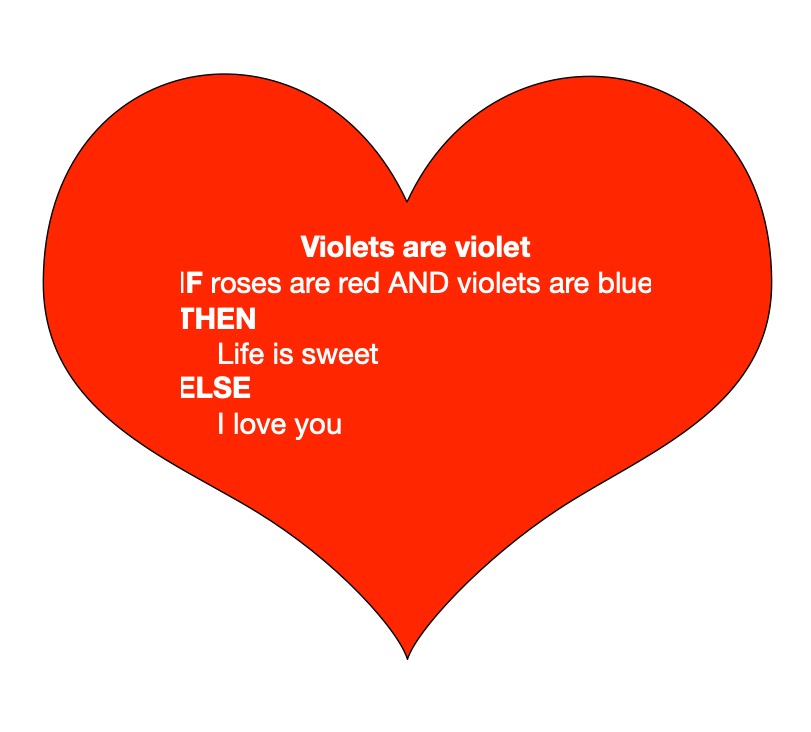
Here is a pseudocode poem based on selection, which is the second core control structure. It chooses between two option based on a boolean test: a true / false question. The question here is: do I love you? Dry run the algorithm or run program to find out.
Violets are violet
if roses are red and violets are blue
then
    Life is sweet
else
    I love you
Here it is implemented as a Python program (with appropriate initialisation).
def violetsareviolet():
	"""Violets are violet"""
	roses = 'red'
	violets = 'violet'

	if roses == 'red' and violets == 'blue':
		print('Life is sweet')
	else:
		print('I love you')

violetsareviolet()
The final kind of control structure is iteration (i.e., repetition). It is used to repeat the same lines over and over again.
Is this poem really long?

it is true
while it is true
    this is short
it is endless
Here it is implemented as a Python program.
def isthispoemreallylong():
    """Is this poem really long?"""
    it = True
    while (it == True) :
        this = 'short'
    it = 'endless'

isthispoemreallylong()
Can you work out what it does as an algorithm/program, rather than as just a normal poem? You may need a version with print statements to understand its beauty.
def isthispoemreallylong2():
    """Is this poem really long?"""
    it = True
    while (it == True) :
        this = 'short'
        print("this is " + this)
    it = 'endless'
    print("it is " + it)

isthispoemreallylong2()
The word while indicates the start of a while loop. In the pseudocode, it is a command to repeat the following statement(s). It checks the boolean expression after the body each time. Only if that boolean expression is false does it stop. In this case the body sets the variable named this to string value ‘short’. The test is about a different variable though which is not changed inside the loop, so once in the loop there is nothing that will ever change the variable it so the value of the test will always be the same. Variable it will always be True and the loop will keep setting variable this to value ‘short’, over and over again. This means the loop is a non-terminating loop. It never exits so the lines of code after it are never executed. As a program they are never followed by the computer. The variable it is never set to the value ‘endless’.
Overall the poem is short in number of lines but it is actually endless if executed. It is the equivalent of a poem that once you start reading it you never get to the end:
it is true
check it is true
this is short
check it is true
this is short
check it is true
this is short
...
Here is a more romantically inclined poem for Valentine’s day (since at the time of writing, it is coming up) again using repetition
My love for you is endless

my love is true
while my love is true
    I love you
Here it is implemented as a Python program.
def myloveforyouisendless():
"""My love for you is endless"""
my_love = True
while my_love == True:
    print('I love you')

myloveforyouisendless()
In the pseudocode of this poem the verb “to be” is used for two different purposes: as an assignment statement (it is true is used as a statement to mean it = True) and as a boolean expression (it is true is used as a boolean expression to mean it == True). As an assignment it is used as a command to do something. As an expression it is something representing a value: it evaluates to either true or false. Confusing these two English uses is a common mistake novices make programming, and shows one of the ways why programming languages are used with different symbols for different meanings, rather than natural languages.
Now it is your turn. Can you write a great poem that can also be executed?
Subscribe to be notified whenever we publish a new post to the CS4FN blog.
This blog is funded by EPSRC on research agreement EP/W033615/1.
Answers
The selection poem is about a volcano, but the answer to the question in the title is ‘cold’.
Assuming you agree with me that violet flowers are violet (or at least not blue) then clearly we are compatible at least in being pedantic and you will find I love you.

.png)















 cs4fn
cs4fn 