How much should we change the world to make it easier for our machines to work?
Plant scientists have spotted a problem they can solve. Weeding robots are finding it difficult to weed. It is a hard problem for them. All those weeds look just like the real crop which they aren’t supposed to destroy. So the robots are pulling up the wrong things. What is a robot to do? Should we make it easy for them?
Plant Scientists have seen a need for their technology which is looking for solutions any where it can. Robots are good at distinguishing colour. That is easy. So why not just genetically modify weeds to be blue. This is possible as there are already lots of genes causing blueness in plants (think blueberries). Problem solved. The robots then won’t get it wrong again and the crops are safe.
What could possibly go wrong? Well, to work the genes will need to be spread wildly and perhaps they could escape and get into our crops or other plants that are just there to be plants, or just plants in the food chain, We could end up with a blue planet a bit like the red one the martians brought int he War of the Worlds. Alternatively, evolution might step up and continually produce mutant weeds that subverted that gene, given that gene killed them. Perhaps all the problems can guarantee to be avoided, though the wise person does not bet against natural selection finding a way round problems presented to it in the long term.
Isn’t it time we learnt our lesson and stopped changing the planet to make our machines lives easier? Of course we have been doing that for a long time – think of all the roads scarring the countryside so cars work or rails so trains work. Perhaps we should think more about the needs of the planet as well as of people, rather than the needs of our machines when innovating, especially when undoubtedly eventually (if we don’t destroy ourselves first) we will have machines clever enough to work it out.
There are always lots of ways of solving problems and it is important to think about the planet now not just our machines. Perhaps robots should just not weed until they can do it without us having to change the problem (and the planet) for them so they can!
Becoming a successful entrepreneur often starts with seeing a need: a problem someone has that needs to be fixed. For David Ronan, the need was for anyone to mix and master music but the problem was that of how hard it is to do this. Now his company RoEx is fixing that problem by combining signal processing ans artificial intelligence tools applied to music. It is based on his research originally as a PhD student
Musicians want to make music, though by “make music” they likely mean playing or composing music. The task of fiddling with buttons, sliders and dials on a mixing desk to balance the different tracks of music may not be a musician’s idea of what making music is really about, even though it is “making music” to a sound engineer or producer. However, mixing is now an important part of the modern process of creating professional standard music.
This is in part a result of the multitrack record revolution of the 1960s. Multitrack involves recording different parts of the music as different tracks, then combining them later, adding effects, combining them some more … George Martin with the Beatles pioneered its use for mainstream pop music in the 1960s and the Beach Boys created their unique “Pet Sounds” through this kind of multitrack recording too. Now, it is totally standard. Originally, though, recording music involved running a recording machine while a band, orchestra and/or singers did their thing together. If it wasn’t good enough they would do it all again from the beginning (and again, and again…). This is similar to the way that actors will act the same scene over and over dozens of times until the director is happy. Once happy with the take (or recording) that was basically it and they moved on to the next song to record.
With the advent of multitracking, each musician could instead play or sing their part on their own. They didn’t have to record at the same time or even be in the same place as the separate parts could be mixed together into a single whole later. Then it became the job of engineers and the producer to put it all together into a single whole. Part of this is to adjust the levels of each track so they are balanced. You want to hear the vocals, for example, and not have them drowned out by the drums. At this point the engineer can also fix mistakes, cutting in a rerecording of one small part to replace something that wasn’t played quite right. Different special effects can also be applied to different tracks (playing one track at a different speed or even backwards, with reverb or auto-tuned, for example). You can also take one singer and allow them to sing with multiple versions of themselves so that they are their own backing group, and are singing layered harmonies with themselves. One person can even play all the separate instruments as, for example, Prince often did on his recordings. The engineers and producer also put it all together and create the final sound, making the final master recording. Some musicians, like Madonna, Ariana Grande and Taylor Swift do take part in the production and engineering parts of making their records or even take over completely, so they have total control of their sound. It takes experience though and why shouldn’t everyone have that amount of creative control?
Doing all the mixing, correction and overdubbing can be laborious and takes a lot of skill, though. It can be very creative in itself too, which is why producers are often as famous as the artists they produce (think Quincy Jones or Nile Rogers, for example). However, not everyone wanting to make their own music is interested in spending their time doing laborious mixing, but if you don’t yet have the skill yourself and cant afford to pay a producer what do you do?
That was the need that David spotted. He wanted to do for music what instagram filters did for images, and make it easy for anyone to make and publish their own professional standard music. Based in part on his PhD research he developed tools that could do the mixing, leaving a musician to focus on experimenting with the sound itself.
David had spent several years leading the research team of an earlier startup he helped found called AI Music. It worked on adaptive music: music that changes based on what is happening around it, whether in the world or in a video game being played. It was later bought by Apple. This was the highlight of his career to that point and it helped cement his desire to continue to be an innovator and entrepreneur.
With the help of Queen Mary, where he did his PhD, he therefore decided to set up his new company RoEx. It provides an AI driven mixing and mastering service. You choose basic mixing options as well as have the ability to experiment with different results, so still have creative control. However, you no longer need expensive equipment, nor need to build the skills to use it. The process becomes far faster too. Mixing your music becomes much more about experimenting with the sound: the machine having taken over the laborious parts, working out the optimum way to mix different tracks and produce a professional quality master recording at the end.
David didn’t just see a need and have an idea of how to solve it, he turned it into something that people want to use by not only developing the technology, but also making sure he really understood the need. He worked with musicians and producers through a long research and development process to ensure his product really works for any musician.
University has always been a place where you make great friends for life. Social media means everyone can easily make as many online friends as they like, and ever more students go to university, meaning more potential friends to make. So surely things now are better than ever. And yet many students suffer from loneliness while at university. We somehow seem to have ever greater disconnection the more connections we make. Klara Brodahl realised there was a novel need here that no one was addressing well and decided to try to solve it for the final year project of her computer science degree. Her solution was StudyBuddy and with the support of an angel investor she has now set up a startup company and is rolling it out for real.
A loneliness epidemic
In the digital age, university students face an unexpected challenge—loneliness. Although they’re more “connected” than ever through social media and virtual interactions, the quality of these connections is often shallow. A 2023 study, for example, found that 92% of students in the UK feel lonely at some point during their university life. This “loneliness epidemic” has profound effects, contributing to issues like anxiety, depression, and struggling with their programme.
During her own university years, Klara Brodahl had experienced first hand the challenge of forming meaningful friends in an environment where everyone seemed socially engaged online but weren’t always connected in real life. She soon discovered that it wasn’t just her but a shared struggle by students across the country. Inspired by this, she set out to write a program that would fill the void in student’s lives and bridge the gap between studying and social life.
She realised that technology does have the potential to strengthen social bonds, but how it’s designed and used makes all the difference. The social neuroscientist John Cacioppo has pointed out that using social media primarily as a destination in its own right often leaves people feeling distant and dissatisfied. However, when technology is designed to serve as a bridge to offline human engagement, it can reduce loneliness and improve well-being. StudyBuddy embodies this approach by encouraging students to connect in person rather than trying to replace meeting face-to-face.
Study together in the real world
Part of making this work is in having reasons to meet for real. Klara realised that the need to study, and the fact that doing this in groups rather than alone can help everyone do better, could provide the excuse for this. StudyBuddy, therefore, integrates study goals with social interaction, allowing friendships to form around shared academic interests—an ideal icebreaker for those who feel nervous in traditional social settings.
The app uses location-based technology to connect students for co-study sessions, making in-person meetings easy and natural. Through a live map, students can see where others are checked in nearby at study spots like libraries, cafes, or student common areas. They can join existing study groups or start their own. The app uses university ID verification to help ensure connections are built on a trusted network.
From idea to startup company
Klara didn’t originally plan for StudyBuddy to become a real company. Like many graduates, she thought starting a business was something to perhaps try later, once she had some professional experience from a more ‘normal’ graduate job. However, when the graduate scheme she won a place on after graduating was unexpectedly delayed, she found herself with time on her hands. Rather than do nothing she decided to keep working on the app as a side project. It was at this point that StudyBuddy caught the attention of an angel investor, whose enthusiasm for the app gave Klara the confidence to keep going.
When her graduate scheme finally began, she was therefore already deeply invested in StudyBuddy. Trying to manage both roles, she quickly realised she preferred the challenge and creativity of her startup work over the graduate scheme. And when it became impossible to balance both, she took a leap of faith, quitting her graduate job to focus on StudyBuddy full-time—a decision that has since paid off. She gained early positive feedback, ran a pilot at Queen Mary University of London, and won early funding for investors willing to invest in what was essentially still an idea, rather than a product with a known market. As a result StudyBuddy has gradually turned into a useful mission-driven platform, providing students with a safe, real-world way to connect.
Making a difference
StudyBuddy has the potential to transform the university experience by reducing loneliness and fostering authentic, in-person friendships. By rethinking what engagement in the digital age means, the app also serves as a model for how technology can promote meaningful social interaction more generally. Klara has shown that with thoughtful design, technology can be a powerful tool for bridging digital and physical divides, creating a campus environment where students thrive both academically and socially. Her experience also shows how the secret to being a great entrepreneur is to be able to see a human need that no one else has seen or solved well. Then, if you can come up with a creative solution that really solves that need, your ideas can become reality and really make a difference to people’s lives.
– Klara Brodahl, StudyBuddy and Paul Curzon, Queen Mary University of London
The Internet is now so much a part of life that, unless you are over 50, it’s hard to remember what the world was like without it. Sometimes we enjoy really fast Internet access, and yet at other times it’s frustratingly slow! So the question is why, and what does this have to do with posting a letter, or cars on a motorway? And how did electronic engineers turn the problem into a business opportunity?.
The communication technology that powers the Internet is built of electronics. The building blocks are called routers, and these convert the light-streams of information that pass down the fibre-optic cables into streams of electrons, so that electronics can be used to switch and re-route the information inside the routers.
Enormously high capacities are achievable, which is necessary because the performance of your Internet connection is really important, especially if you enjoy online gaming or do a lot of video streaming. Anyone who plays online games would be familiar with the problem: opponents apparently popping out of nowhere, or stuttery character movement.
So the question is – why is communicating over a modern network like the Internet so prone to odd lapses of performance when traditional land-line telephone services were (and still are) so reliable? The answer is that traditional telephone networks send data as a constant stream of information, while over the Internet, data is transmitted as “packets”. Each packet is a large group of data bits stuck inside a sort of package, with a header attached giving the address of where the data is going. This is why it is like posting a letter: a packet is like a parcel of data sent via an electronic “postal service”.
But this still doesn’t really answer the question of why Internet performance can be so prone to slow down, sometimes seeming almost to stop completely. To see this we can use another analogy: the flow of packet data is also like the flow of cars on a motorway. When there is no congestion the cars flow freely and all reach their destination with little delay, so that good, consistent performance is enjoyed by the car’s users. But when there is overload and there are too many cars for the road’s capacity, then congestion results. Cars keep slowing down then speeding up, and journey times become horribly delayed and unpredictable. This is like having too many packets for the capacity in the network: congestion builds up, and bad delays – poor performance – are the result.
Typically, Internet performance is assessed using broadband speed tests, where lots of test data is sent out and received by the computer being tested and the average speed of sending data and of receiving it is measured. Unfortunately, speed tests don’t help anyone – not even an expert – understand what people will experience when using real applications like an online game.
Electronic engineering researchers at Queen Mary, University of London have been studying these congestion effects in networks for a long time, mainly by using probability theory, which was originally developed in attempts to analyse games of chance and gambling. In the past ten years, they have been evaluating the impact of congestion on actual applications (like web browsing, gaming and Skype) and expressing this in terms of real human experience (rather than speed, or other technical metrics). This research has been so successful that one of the Professors at Queen Mary, Jonathan Pitts, co-founded a spinout company called Actual Experience Ltd so the research could make a real difference to industry and so ultimately to everyday users.
For businesses that rely heavily on IT, the human experience of corporate applications directly affects how efficiently staff can work. In the consumer Internet, human experience directly affects brand perception and customer loyalty. Actual Experience’s technology enables companies to manage their networks and servers from the perspective of human experience – it helps them fix the problems that their staff and customers notice, and invest their limited resources to get the greatest economic benefit.
So Internet gaming, posting letters, probability theory and cars stuck on motorways are all connected. But to make the connection you first need to study electronic engineering.
Global Entrepreneurship Week is in November each year and to celebrate we’ve put together a portal resource page on Tech Entrepreneurs to inspire you. It features, for example, Jacquie Lawson (who created a digital greetings card enterprise), Freddie Figgers (who runs the first Black-owned telecoms company in the US), Dragonfly AI (a computer vision company founded at QMUL) and Sophie Wilson (who designed the chip for the BBC Micro). We will keep adding more people and companies. There are also links to careers resources.
Want to make sure your life turns out the way you want? Want to trade this life for fortune and fame? If you believe post-grunge rock band Nickelback’s 2005 hit single, then ‘you wanna be a Rockstar’! Love or hate the song, are they right, or do you really wanna be a tech entrepreneur?
Some people want a hedonistic life. Some want to be famous. Others just want to be stinking rich. Some want all three. Some want to really make a positive difference to people’s lives.
So are Nickelback right? What is the best way to get all three and maybe even the fourth too – and quickly – say before the age of 35? In fact, let’s not set our sights too low. Let’s aim to be one of the richest people in the world. Let’s think multi-billionaire. Let’s assume too that we have to do it without relying on accidents of birth – no inheritance of billions from Mummy and Daddy’s money to look forward to. Winning the lottery wouldn’t even get you close so, while luck matters, don’t rely on your luck alone either. How you actually gonna do it?
From the queues of people wanting to be on reality TV programmes whether X-factor, the Voice or Love Island most people seem to agree with Nickelback’s solution: the way to early riches is to become famous, whether a Rock Star or maybe a footballer, or a film star, or these days just famous for being famous. It’s people like that that fill the super-rich but young and self-made lists isn’t it. Well isn’t it?
Nice idea, but no.
Some of those people do make a lot of money in a short time. They have to though as for most their career is likely to be very short. They don’t stay famous or in the rich lists for long and are unlikely to make super-rich.
They are all Techno Stars.
There is one very obvious pattern to Forbes’ self-made super-rich list of the top billionaires on the planet. Almost a quarter of the top super rich, at around the time that Nickleback wrote their hit song, made their money in a similar way. They aren’t film stars, rock stars or sports stars. They are all techno stars. They are also all self-made billionaires. That contrasts with the other people in the same league. With one exception, the rest are all there because of family wealth or are old: they took their time to extreme wealth. Contrast that with the Google guys, say, who made the top 30 by their 30s.
Number one – the richest person on Earth with 56 billion dollars – iin 2007 was not surprisingly Bill Gates, who with Paul Allen (Number 19) set up Microsoft. Paul Allen went on to found Dreamworks, a company working on the boundaries of film-making and computer science. They went on to use much of their personal wealth (and time) solving humanitarian problems, focussing on things like health and education. Yes, many rock stars do charity gigs (think Live Aid) occasionally, so if saving the Earth is your aim then becoming a Rock star may be one way to give you some clout to make a difference. It’s nothing compared to what someone as rich as the Microsoft pair have personally achieved though.
Not far behind was Lawrence Ellison, worth 21.5 billion dollars at the time. He made his name by creating the company Oracle that was largely responsible for pushing the database revolution – not just using databases of course but creating the software that allows other people to use databases. As he’s said “Money is just a method of keeping score now.”
There are then the Google pair Sergey Brin and Larry Page sharing position 26. They only had 16 billion dollars each, but, hey, they only founded Google in 1986. They planned to “do no evil” with their riches and also wanted to plough money into charity. What else do you do when you have that kind of silly money?
At positions and 30 and 31 in the 2007 rich list came Michael Dell and Steven Ballmer. Ballmer is ‘just’ another Microsoft man. Dell of course is responsible for Dell computers. He had the ear of a President as he was on the United States President’s Council of Advisors on Science and Technology. Want to make a difference? He could.
Have things changed? Well, yes. Forbes now use tech themselves to keep a real-time rich list. Now of the top ten richest people in the world as I write this, 8 are tech entrepreneurs, now with hundreds of billions of worth each. Elon Musk (Tesla, X etc), Jeff Bezos (Amazon), Larry Ellison (Oracle), Mark Zuckerberg (FaceBook), Larry Page (Google), Sergey Brin (Google), Jensen Huang (Nvidia) and Steve Ballmer (Microsoft – now richer than Bill Gates but he is still filthy rich too) .
In short, programming/computer science/electronic engineering and inheritance are the most likely source of riches for the richest people in the world. Programming is the only way to reach the top without inheriting money (or perhaps being a Russian president’s protege).
The other advantage of the technology route to riches over the Rock Star way of course is you can aim higher still. Don’t wind up dead at 40 from the drug-induced lifestyle of rock stars – why not aim to still be enjoying being filthy rich at 100 too. If you are wise you may make the world a far better place, though you may also gain the power to make it far worse too.
When disasters involving technology occur, human error is often given as the reason, but even experts make mistakes using poor technology. Rather than blame the person, human error should be seen as a design failure. Bad design can make mistakes more likely and good design can often eliminate them. Optical illusions and magic tricks show how we can design things that cause everyone to make the same systematic mistake, and we need to use the same understanding of the brain when designing software and hardware. This is especially important if the gadgets are medical devices where mistakes can have terrible consequences. The best computer scientists and programmers don’t just understand technology, they understand people too, and especially our brain’s fallibilities. If they don’t, then mistakes using their software and gadgets are more likely. If people make mistakes, don’t blame the person, fix the design and save lives.
Illusions
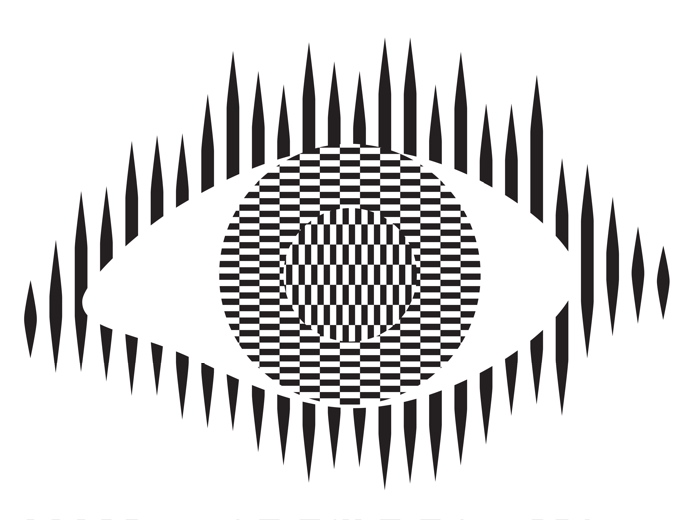
Optical illusions and magic tricks give a mirror on the limits of our brains. Even when you know an optical illusion is an illusion you cannot stop seeing the effect. For example, this image of an eye is completely flat and stationary: nothing is moving. And yet if you move your head very slightly from side to side the centre pops out and seems to be moving separately to the rest of the eye.
Illusions occur because our brains have limited resources and take short cuts in processing the vast amount of information that our senses deliver. These short cuts allow us to understand what we see faster and do so with less resources. Illusions happen when the short cuts are applied in a way where they do not apply.
What this means is that we do not see the world as it really is but see a simplified version constructed by our subconscious brain and provided to our conscious brain. It is very much like in the film, the Matrix, except it is our own brains providing the fake version of the world we experience rather than alien computers.
Attention
The way we focus our attention is one example of this. You may think that you see the world as it is, but you only directly see the things you focus on, your brain fills out the rest rather than constantly feeding the actual information to you constantly. It does this based on what it last saw there but also on the basis of just completing patterns. The following illusion shows this in action. There are 12 black dots and as you move your attention from one to the next you can see and count them all. However, you cannot see them all at once. The ones in your peripheral vision disappear as you look away as the powerful pattern of grey lines takes over. You are not seeing everything that is there to be seen!
Our brains also have very limited working memory and limited attention. Magicians also exploit this to design “magical systems” where a whole audience make the same mistake at the same time. Design the magic well so that these limitations are triggered and people miss things that are there to be seen, forget things they knew a few moments before, and so on. For example, by distracting their attention they make them miss something that was there to be seen.
What does this mean to computer scientists?
When we design the way we interact with a computer system, whether software and hardware, it is also possible to trigger the same limitations a magician or optical illusion does. A good interaction designer therefore does the opposite to a magician and, for example: draws a user’s attention to things that must not be missed at a critical time; they ensure they do not forget things that are important, they help them keep track of the state of the system, they give good feedback so they know what has happened.
Most software is poorly designed leading to people making mistakes, not all the time, but some of the time. The best designs will help people avoid making mistakes and also help them spot and fix mistakes as soon as they do make them.
Examples of poor medical device design
The following are examples of the interfaces of actual medical devices found in a day of exploration by one researcher (Paolo Masci) at a single very good hospital (in the US).
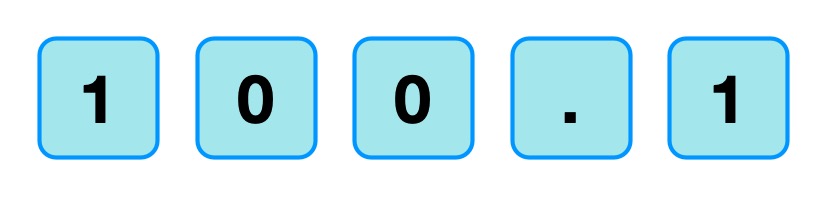
When the nurse or doctor types the following key sequence as a drug dose rate:
Image by CS4FN
one infusion pump, without any explicit warning, other than the number being displayed, registered the number entered as 1001.
Probably, the programmer had been told that when doses are as large as 100, then fractional doses are so relatively small that they make no difference. A user typing in such fractional amounts, is likely making an error as such a dose is unlikely to be prescribed. The typing of the decimal point is therefore just ignored as a mistake by the infusion pump. Separately, (perhaps coded by a different programmer in the team, or at a different time) until the ENTER key is pressed the code treats the number as incomplete. Any further digits typed are therefore just accepted as part of the number.
A different design by a different manufacturer also treats the key sequence as 1001 (though in the case shown 1001 is rejected as it exceeds the maximum allowable rate, caused by the same issue of the device silently ignoring a decimal point).
This suggests two different coding teams indipendently coded in the same design flaw that led to the same user error.
What is wrong with that?
Devices should never silently ignore and/or correct input if bad mistakes are to be avoided. Here, that original design flaw, could lead to a dose 10x too big being infused into a patient and that could kill. It relies on the person typing the number noticing that the decimal point has been ignored (with no help from the device). Decimal points are small and easily missed of course. Also, their attention cannot be guaranteed to be on the machine and, in fact, with a digit keypad for entering numbers that attnetion is likely to be on the keys. Alarms or other distractions elsewhere could easily mean they do not notice the missing decimal point (which is a tiny thing to see).
An everyday example of the same kind of problem, showing how easily mistakes are missed is in auto-completion / auto-correction of spelling mistakes in texts and word processors. Goofs where an auto-corrected word are missed are very common. Anything that common needs to be designed away in a safety critical system.
Design Rules
One of the ways that such problems can be avoided is by programmers following interaction design rules. The machine (and the programmer writing the code) does not know what a user is trying to input when they make a mistake. One design rule is therefore that a program should therefore NEVER correct any user error silently. Here perhaps the mistake was pressing 0 twice rather than pressing the decimal point. In the case of user errors, the program should raise awareness of the error, and not allow further input until the error is corrected. The program should explicitly draw the person’s attention to the problem (eg changing colour, flashing, beeping, etc). This involves using the same understanding of cognitive psychology as a magician, to control their attention. Whereas a magician would be taking their attention away from the thing that matters, the programmer draws theur attention to it.
It should make clear in an easily understandable error message what the problem is (eg here “Doses over 99 should not include decimal fractions. Please delete the decimal point.”) It should then leave the user to make the correction (eg deleting the decimal point) not do it itself.
By following a design rule such as this programmers can avoid user errors, which are bound to happen, from causing a big problem.
Avoiding errors
Sometimes the way we design software interfaces and their interaction design we can do even better than this, though. We are letting people make mistakes and then telling them to help them pick up the pieces afterward. Sometimes we can do better than this and with better design help them avoid making the mistake in the first place or spot the mistake themselves as soon as they make it.
Doing this is again about controlling user attention as a magician does. An interaction designer needs to do this again in the opposite wayto the magician though, directing the users attention to the place it needs to be to see what is really happening as they take actions rather than away from it.
To use a digit keypad, the users attention has to be on their fingers so they can see where to put their fingers to press a given digit. They look at the keypad, not the screen. The design of the digit keypad draws their attention to the wrong place. However, there are lots of ways to enter numbers and the digit keypad is only one. One other way is to use cursor keys (left, right, up and down) and have a cursor on the screen move to the position where a digit will be changed. Now, once the person’s finger is on say the up arrow, attention naturally moves to the screen as that button is just pressed repeatedly until the correct digit is reached. The user is watching what is happening, watching the program’s output, rather than their input, so is now less likely to make a mistake. If they do overshoot, their attention is in the right place to see it and immediately correct it. Experiments showed that this design did lead to fewer large errors though is slower. With numbers though accuracy is more likely to matter than absolute speed, especially in medical situations.
There are still subtleties to the design though – should a digit roll over from 9 back to 0, for example? If it does should the next digit increase by 1 automatically? Probably not, as these are the things that lead to other errors (out by a factor of 10). Instead going up from 9 should lead to a warning.
Learn from magicians
Magicians are expert at making people make mistakes without them even realising they have. The delight in magic comes from being so easily fooled so that the impossible seems to have happened. When writing software we need to using the same understanding of our cognitive resources and how to manipulate them to prevent our users making mistakes. There are many ways to do this, but we should certainly never write software that silently corrects user errors. We should control the users attention from the outset using similar techniques to a magician so that their attention is in the right place to avoid problems. Ideally a number entry system such as using cursor keys to enter the number rather than a digit keypad should be used as then the attention of the user is more likely to be on the number entered in the first place.
Responsible for the design of not just the interface but how a device or software is used. Applying creativity and applying existing design rules to come up with solutions. Has a deep understanding both of technical issues and of the limitations of human cognition (how our brains work).
Usability consultant
Give advice on making software and gadgets generally easier to use, evaluate designs for features that will make them hard to use or increase the likelihood of errors, finding problems at an early stage.
User experience (UX) consultant
Give advice on ensuring users of software have a good positive experience and that using it is not for example, frustrating.
Medical device developer
Develop software or hardware for medical devices used in hospitals or increasingly in the home by patients. Could be improvements to existing devices or completely novel devices based on medical or biomedical breakthroughs, or on computer science breakthroughs, such as in artificial intelligence.
Research and Development Scientist
Do experiments to learn more about the way our brains work, and/or apply it to give computers and robots a way to see the world like we do. Use it to develop and improve products for a spin-off company.
What do a Nintendo games console and the films Jurassic Park, Beauty and the Beast and Terminator II have in common? They all used Marc Hannah’s chips and linked programs for their amazing computer effects..It is important that we celebrate the work of Black Computer Scientists and Marc is one who deserves the plaudits as much as anyone as his work has had a massive effect on the leisure time of everyone who watches movies with special effects or plays video games – and that is just about all of us.
In the early 1980s, with six others, Marc founded Silicon Graphics, becoming its principal scientist. Silicon Graphics was a revolutionary company, pioneering fast computers capable of running the kind of graphics programs on special graphics chips that suddenly allowed the film industry to do amazing special effects. Those chips and linked programs were designed by Marc.
Now computers and games consoles have special graphics chips that do fast graphics processing as standard, but it is Marc and his fellow innovators at Silicon Graphics who originally made it happen.
It all started with his work with James Clark on a system called the Geometry Engine while they were at Stanford. Their idea was to create chips that do all the maths needed to do sophisticated manipulation of imagery. VLSI (Very Large scale Integration), whereby computers were getting smaller and fitting on a chip was revolutionising computer design. Suddenly a whole microprocessor could be put on a single chip because tens of thousands (now billions) of transistors could be put on a single slice of silicon. They pioneered the idea of using VLSI for creating 3-D computer imagery, rather than just general-purpose computers, and with Silicon Graphics they turned their ideas into an industrial reality that changed both film and games industries for ever.
Silicon Graphics was the first company to create a VLSI chip in this way, not to be a general-purpose computer, but just to manipulate 3-D computer images.
A simple 3D image in a computer might be implemented as the vertices (corners) of a series of polygons. To turn that into an image on a flat screen needs a series of mathematical manipulations of those points’ coordinates to find out where they end up in that flat image. What is in the image depends on the position of the viewer and where light is coming from, for example. If the object is solid you also need to work out what is in front, so seen, and what behind, so not. Each time the object, viewer or light source moves, the calculations need to be redone. It is done as a series of passes doing different geometric manipulations in what is called a geometry pipeline and it is these calculations they focussed on. They started by working out which computations had to be really fast: the ones in the inner most loops of the code that did this image processing, so was executed over and over again. This was the complex code that meant processing images took hours or days because it was doing lots of really complex calculation. Instead of trying to write faster code though, they instead created hardware, ie a VLSI chip, to do the job. Their geometry pipeline did the computation in a lightening fast way as it was avoiding all the overhead of executing programs and instead implementing the calculations that slowed things down directly in logic gates that did all that crucial maths very directly and so really quickly.
The result was that their graphic pipeline chips and programs that worked with them became the way that CGI (computer generated imagery) was done in films allowing realistic imagery, and were incorporated into games consoles too, allowing for ever more realistic looking games.
So if some amazing special effects make some monster appear totally realistic this Halloween, or you get lost in the world of a totally realistic computer game, thank Marc Hannah, as his graphics processing chips originally made it happen.
Claude Shannon, inventor of the rocket powered Frisbee, gasoline powered pogo stick, a calculator that worked using roman numerals, and discoverer of the fundamental equation of juggling! Oh yeah, and founder of the most important theory underpinning all digital communication: information theory.
Claude Shannon is perhaps one of the most important engineers of the 20th century, but he did it for fun. Though his work changed the world, he was always playing with and designing things, simply because it amused him. Like his contemporary Richard Feynman, he did it for ‘the pleasure of finding things out.’
As a boy, Claude liked to build model planes and radio-controlled boats. He once built a telegraph system to a friend’s house half a mile away, though he got in trouble for using the barbed wires around a nearby pasture. He earned pocket money delivering telegrams and repairing radios.
He went to the University of Michigan, and then worked on his Masters at MIT. While there, he thought that the logic he learned in his maths classes could be applied to the electronic circuits he studied in engineering. This became his Masters thesis, published in 1938. It was described as ‘one of the most important Master’s theses ever written… helped to change digital circuit design from an art to a science.’
Claude Shannon is known for his serious research, but a lot of his work was whimsical. He invented a calculator called THROBAC (Thrifty Roman numerical BACkward looking computer), that performs all its operations in the Roman numeral system. His home was full of mechanical turtles that would wander around, turning at obstacles; a gasoline-powered pogostick and rocket-powered Frisbee; a machine that juggled three balls with two mechanical hands; a machine to solve the Rubik’s cube; and the ‘Ultimate Machine’, which was just a box that when turned on, would make an angry, annoyed sound, reach out a hand and turn itself off. As Claude once explained with a smile, ‘I’ve spent lots of time on totally useless things.’
A lot of the early psychology experiments used to involve getting a mouse to run through a maze to reach some food at the end. By performing these experiments over and over in different ways, they could figure out how a mouse learns. So Claude built a mouse-shaped robot called Theseus. Theseus could search a maze until he solved it, and then use this knowledge to find its way through the maze from any starting point.
Oh, and there’s one other paper of his that needs mentioning. No, not the one on the science of juggling, or even the one describing his ‘mind reading’ machine. In 1948 he published ‘A mathematical theory of communication.’ Quite simply, this changed the world, and changed how we think about information. It laid the groundwork for a lot of important theory used in developing modern cryptography, satellite navigation, mobile phone networks… and the internet.
Queens is a fairly simple kind of logic puzzle found for example on LinkedIn as a way to draw you back to the site. Doing daily logic puzzles is good both for mental health and to build logical thinking skills. As with programming, solving logic puzzles is mostly about pattern matching (also a useful skill to practice daily) rather than logic per se. The logic mainly comes in working out the patterns.
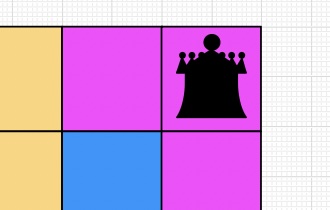
Let’s explore this with Queens. The puzzle has simple rules. The board is divided into coloured territories and you must place a Queen in each territory. However, no two Queens can be in the same row or column. Also no two Queens can be adjacent, horizontally, vertically or diagonally.
If we were just to use pure logic on these puzzles we would perhaps return to the rules themselves constantly to try and deduce where Queens go. That is perhaps how novices try to solve puzzles (and possibly get frustrated and give up). Instead, those who are good at puzzles create higher level rules that are derived from the basic rules. Then they apply (ie pattern match against) the new rules whenever the situation applies. As an aside this is exactly how I worked when using machine-assisted proof to prove that programs and hardware correctly met their specification, doing research into better ways to ensure the critical devices we create are correct.
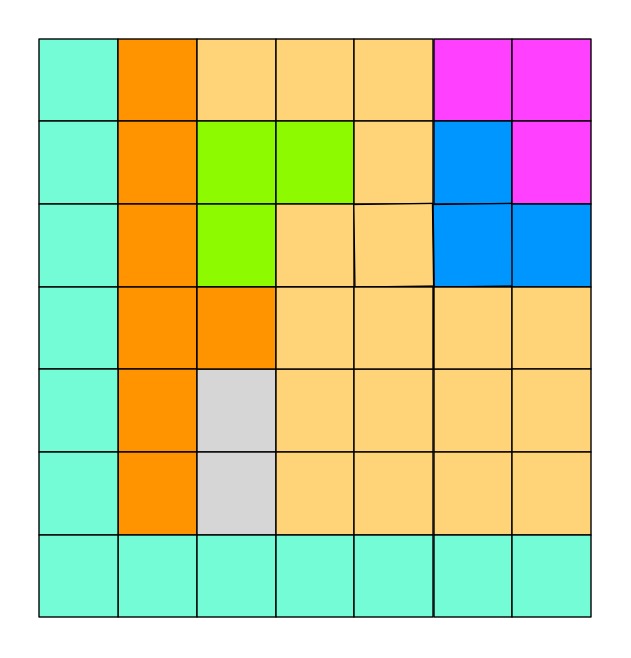
Let’s look at an example from Queens. Here is a puzzle to work on. Can you place the 8 Queens?
mage by Paul Curzon
mage by Paul Curzon
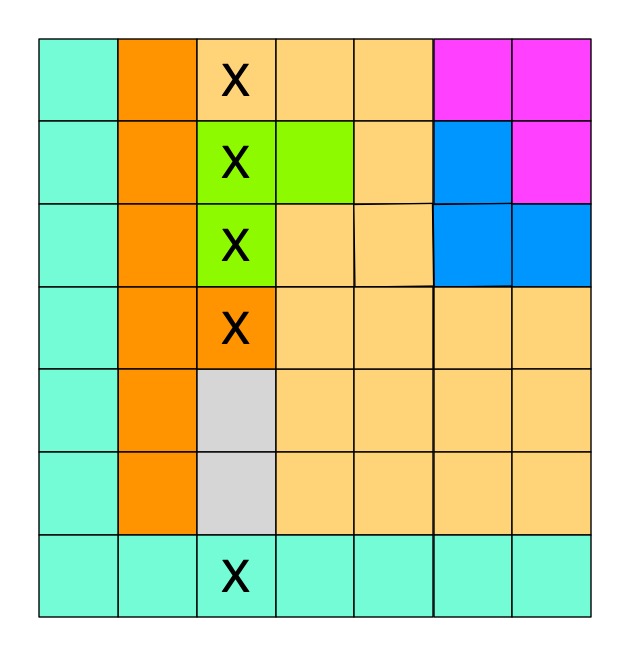
Where to start? Well notice the grey territory near the bottom. It is a territory that lives totally in one column. If we go to the rules of Queens we know that there must be a Queen in this territory. That means that Queen must be in that column. We also know that only one Queen can be in a column. That means none of the other territories in that column can possibly hold a Queen there. We can cross them all out as shown.
In effect we have created a new derived inference rule.
IF a territory only has squares available in one column

THEN cross out all squares of other territories in that column
By similar logic we can create a similar rule for rows.
Now we can just pattern match against the situation described in that rule. If ever you see a territory contained completely in a row or column, you can cross out everything else in that row/column.
In our case in doing that it creates new situations that match the rule. You may also be able to work out other rules. One obvious new rule is the following:
IF a territory only has one free space left and no Queens

THEN put a Queen in that free space
mage by Paul Curzon
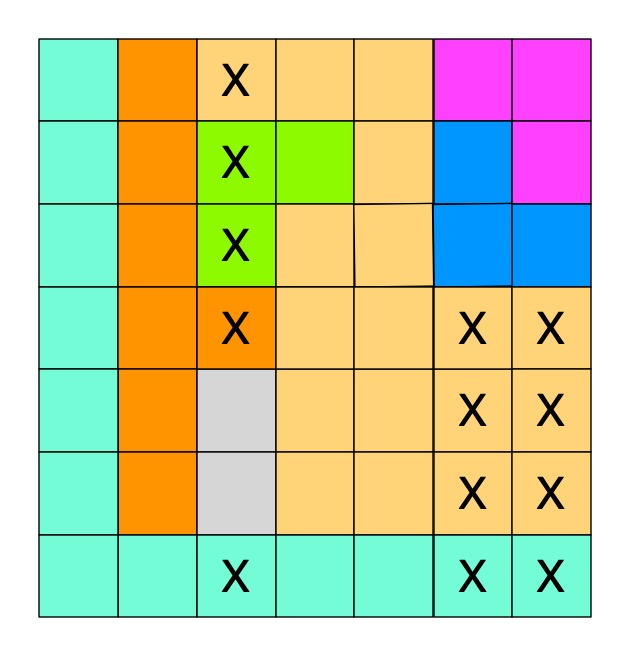
We can derive more complicated rules too. For example, we can generalise our first rule to two columns. Can you find a pair of territories that reside in the same two columns only? There is such a pair in the top right corner of our puzzle. If there is such a situation then as both must have a Queen, between them they must be the territories that provide the Queens for both those two columns. That means we can cross out all the squares from other territories in those two columns. We get the rule:
IF two territories only have squares available in two columns

THEN cross out all squares of other territories in both columns
Becoming good at Queens puzzles is all about creating more of these rules that quickly allow you to make progress in all situations. As you apply rules, new rules become applicable until the puzzle is solved.
Can you both apply these rules and if need be derive some more to pattern match your way to solving this puzzle?
It turns out that programming is a lot like this too. For a novice, writing code is a battle with the details of the semantics (the underlying logical meaning) of the language finding a construct that does what is needed. The more expert you become the more you see patterns where you have a rule you can apply to provide the code solution: IF I need to do this repeatedly counting from 1 to some number THEN I use a for loop like this… IF I have to process a 2 dimensional matrix of possibilities THEN I need a pair of nested for loops that traverse it by rows and columns… IF I need to do input validation THEN I need this particular structure involving a while loop… and so on.
Perhaps more surprisingly, research into expert behaviour suggests that is what all expert behaviour boils down to. Expert intuition is all about subconscious pattern matching for situations seen before turned into subconscious rules whether expert fire fighters or expert chess players. Now machine learning AIs are becoming experts at things we are good at. Not suprisingly, what machine learning algorithms are good at is spotting patterns to drive their behaviour.


















 cs4fn
cs4fn 