Byte Queens

Women have made vital contributions to computer science ever since Ada Lovelace debugged the first algorithm for an actual computer (written by Charles Babbage) almost 200 years ago (more on CS4FN’s Women Portal). Despite this, women make up only a fraction (25%) of the STEM workforce: only about a fifth of senior tech roles and only a fifth of computer science students are women. The problem starts early: research by the National Centre for Computing Education suggests that female student’s intension to study computing drops off between the ages of 8 and 13. Ilenia Maietta, a computer science student at Queen Mary, talks about her experiences of studying in a male-dominated field and how she is helping to build a network for other women in tech.

Ilenia’s love for science hasn’t wavered since childhood and she is now studying for a master’s degree in computer science – but back in sixth form, the decision was between computer science and chemistry:

“I have always loved science, and growing up my dream was to become a scientist in a lab. However, in year 12, I dreaded doing the practical experiments and all the preparation and calculations needed in chemistry. At the same time, I was working on my computer science programming project, and I was enjoying it a lot more. I thought about myself 10 years in the future and asked myself ‘Where do I see myself enjoying my work more? In a lab, handling chemicals, or in an office, programming?’ I fortunately have a cousin who is a biologist, and her partner is a software engineer. I asked them about their day-to-day work, their teams, the projects they worked on, and I realised I would not enjoy working in a science lab. At the same time I realised I could definitely see myself as a computer scientist, so maybe child me knew she wanted to be scientist, just a different kind.”

The low numbers of female students in computer science classrooms can have the knock-on effect of making girls feel like they don’t belong. These faulty stereotypes that women don’t belong in computer science, together with the behaviour of male peers, continue to have an impact on Ilenia’s education:

“Ever since I moved to the UK, I have been studying STEM subjects. My school was a STEM school and it was male-dominated. At GCSEs, I was the only girl in my computer science class, and at A-levels only one of two. Most of the time it does not affect me whatsoever, but there were times it was (and is) incredibly frustrating because I am not taken seriously or treated differently because I am a woman, especially when I am equally knowledgeable or skilled. It is also equally annoying when guys start explaining to me something I know well, when they clearly do not (i.e. mansplaining): on a few occasions I have had men explain to me – badly and incorrectly – what my degree was to me, how to write code or explain tech concepts they clearly knew nothing about. 80% of the time it makes no difference, but that 20% of the time feels heavy.”

Many students choose computer science because of the huge variety of topics that you can go on to study. This was the case for Ilenia, especially being able to apply her new-found knowledge to lots of different projects:

“Definitely getting to explore different languages and trying new projects: building a variety of them, all different from each other has been fun. I really enjoyed learning about web development, especially last semester when I got to explore React.js: I then used it to make my own portfolio website! Also the variety of topics: I am learning about so many aspects of technology that I didn’t know about, and I think that is the fun part.”

“I worked on [the portfolio website] after I learnt about React.js and Next.js, and it was the very first time I built a big project by myself, not because I was assigned it. It is not yet complete, but I’m loving it. I also loved working on my EPQ [A-Level research project] when I was in school: I was researching how AI can be used in digital forensics, and I enjoyed writing up my research.”

Like many university students, Ilenia has had her fair share of challenges. She discussed the biggest of them all: imposter syndrome, as well as how she overcame it. 

“I know [imposter syndrome is] very common at university, where we wonder if we fit in, if we can do our degree well. When I am struggling with a topic, but I am seeing others around me appear to understand it much faster, or I hear about these amazing projects other people are working on, I sometimes feel out of place, questioning if I can actually make it in tech. But at the end of the day, I know we all have different strengths and interests, so because I am not building games in my spare time, or I take longer to figure out something does not mean I am less worthy of being where I am: I got to where I am right now by working hard and achieving my goals, and anything I accomplish is an improvement from the previous step.”

Alongside her degree, Ilenia also supports a small organisation called Byte Queens, which aims to connect girls and women in technology with community support.

“I am one of the awardees for the Amazon Future Engineer Award by the Royal Academy of Engineering and Amazon, and one of my friends, Aurelia Brzezowska, in the programme started a community for girls and women in technology to help and support each other, called Byte Queens. She has a great vision for Byte Queens, and I asked her if there was anything I could do to help, because I love seeing girls going into technology. If I can do anything to remove any barriers for them, I will do it immediately. I am now the content manager, so I manage all the content that Byte Queens releases as I have experience in working with social media. Our aim is to create a network of girls and women who love tech and want to go into it, and support each other to grow, to get opportunities, to upskill. At the Academy of Engineering we have something similar provided for us, but we wanted this for every girl in tech. We are going to have mentoring programs with women who have a career in tech, help with applications, CVs, etc. Once we have grown enough we will run events, hackathons and workshops. It would be amazing if any girl or woman studying computer science or a technology related degree could join our community and share their experiences with other women!”

For women and girls looking to excel in computer science, Ilenia has this advice:

“I would say don’t doubt yourself: you got to where you are because you worked for it, and you deserve it. Do the best you can in that moment (our best doesn’t always look the same at different times of our lives), but also take care of yourself: you can’t achieve much if you are not taking care of yourself properly, just like you can’t do much with your laptop if you don’t charge it. And finally, take space: our generation has the possibility to reframe so much wrongdoing of the past generations, so don’t be afraid to make yourself, your knowledge, your skills heard and valued. Any opportunities you get, any goals you achieve are because you did it and worked for it, so take the space and recognition you deserve.”

Ilenia also highlighted the importance of taking opportunities to grow professionally and personally throughout her degree, “taking time to experiment with careers, hobbies, sports to discover what I like and who I want to become” mattered enormously. Following her degree, she wants to work in software development or cyber security. Once the stress of coursework and exams is gone, Ilenia intends to “try living in different countries for some time too”, though she thinks that “London is a special place for me, so I know I will always come back.”

Ilenia encourages all women in tech who are looking for a community and support, to join the Byte Queens community and share with others: “the more, the merrier!”

– lenia Maietta and Daniel Gill, Queen Mary University of London

Visit the Byte Queens website for more details. Interested women can apply here.

More on …

Magazines …

Front cover of CS4FN issue 29 - Diversity in Computing
Cover of Issue 20 of CS4FN, celebrating Ada Lovelace

Subscribe to be notified whenever we publish a new post to the CS4FN blog.


This blog is funded by EPSRC on research agreement EP/W033615/1.

QMUL CS4FN EPSRC logos

Navajo Code Talkers

Three Navajo Code talkers in WWII
Navajo Code Talkers, Image from National Archives at College Park, Public domain, via Wikimedia Commons

Bletchley Park, the British code cracking centre helped win World War II, but it is not just breaking codes and ciphers that wins wars, creating unbreakable ones to keep your own secrets safe matters too. Bletchley Park wasn’t the first or only time a secret cryptography team helped win battles or even wars. In World War I secret messages had been successfully sent using Choctaw, the language of a tribe of Native Americans, including to help organise a surprise attack. It worked with their messages left un-cracked. This led to an even more successful code-creating team in World War II based on Navajo. The Navajo “Code Talkers” as they were called, could encode, transmit and decode messages in minutes when it would take hours using conventional codes and ciphers.

In World War II, the US forces used a range of Native American languages to communicate, but a code based on a native Indian language, Navajo, was especially successful. The use of a Navajo-based code was the idea of Philip Johnston after the attack on Pearl Harbour. His parents were missionaries so he had grown up on a Navajo reservation, speaking the language fluently despite how difficult it was. Aged only 9, he acted as an interpreter for a group who went to Washington to try to improve Indian rights.

He suggested using Navajo as a secret language and enlisted in the marines to help bring the idea to fruition. He thought it would work as a secret code because there was no written version of Navajo. It was a purely a spoken language. That meant he was one of very few people who were not Navajo who could speak it. It was also a complex language unlike any other language. The US marines agreed to trial the idea. 

To prove it would work, Johnston had Navajo transmit messages in the way they would need to on the battlefield. They could do it close to 100 times faster than it would take using standard cipher machines. That clinched it. 

Many Navajo had enlisted after Pearl Harbour and a platoon soley of Navajo were recruited to the project, including a 15 year old, William Dean Yazzie. However, they didn’t just speak in Navajo to transmit messages. The original 29 Navajo recruited worked out the details of the code they would use. Once deployed to the Pacific a group of them also met to further improve the code. None of it was written down apart from in training manuals that did not leave the training site, so there was no chance the code book could be captured in battle. All those involved memorised it and practiced sending messages quickly and accurately. Messages were also always spoken, eg over radio and never written down, making it harder for the code to be cracked based on analysing intercepted messages.

Commonly needed words, like ‘difficult’ or ‘final’ had direct Navajo code words (NA-NE-KLAH and TAH-AH-KWO-DIH). However for critical words (countries, kinds of planes, kinds of ships, etc) they first swapped English words for other English words using one code. They then translated those words into Navajo. That meant even a Navajo speaker outside their trained group wouldn’t immediately understand a message. The code, for example, used birds names in place of kinds of planes. So the English code word for a bomber plane was Buzzard. But then the Navajo for Buzzard was actually used: (JAY-SHO). 

Another part of the code was to use Navajo words for letters of the alphabet, so A is for ant translated to WOL-LA-CHE in Navajo. However, to make this more secure two other words stood for A too (apple: BE-LA-SANA and axe: TSE-NILL). Each letter had three alternatives like this and any of the three could be used.

Finally the way that it was used meant a message would always just be a series of unconnected words making no sense even to a Navajo speaker.

The code talkers played a key part in many battles including the iconic battle of Iwo Jima, capturing the heavily defended Japanese controlled island of that name. The US Major responsible for communications said of the battle, “Were it not for the Navajos, the Marines would never have taken Iwo Jima.”

Not only did it make communications much faster than they would have been, unlike other US codes and ciphers, the code talker’s code was never cracked … all thanks to the Navajo team who devised it.

– Paul Curzon, Queen Mary University of London

More on …


Magazines …

Front cover of CS4FN issue 29 - Diversity in Computing

Subscribe to be notified whenever we publish a new post to the CS4FN blog.


This blog is funded through EPSRC grant EP/W033615/1.

QMUL CS4FN EPSRC logos

Cyber Security at the movies: Rogue one (Part II: Authentication)

A Stormtrooper looking the other way
Image by nalik25390 from Pixabay

SPOILER ALERT

In a galaxy far, far away cyber security matters. So much so, that the whole film Rogue One is about it. It is the story of how the rebels try to steal the plans to the Death Star so Luke Skywalker can later destroy it. Protecting information is everything. The key is good authentication. The Empire screws up!

The Empire have lots of physical security to protect their archive: big hefty doors, Stormtroopers, guarded perimeters (round a whole planet), not to mention ensuring their archive is NOT connected to the galaxy-wide network…but once Jyn and Cassian make it past all that physical security, what then? They need to prove they are allowed to access the data. They need to authenticate! Authentication is about how you tell who a person is and so what they are, and are not, allowed to do. The Empire have a high-tech authentication system. To gain access you have to have the right handprint. Luckily, for the rest of the series, Jyn easily subverts it.

Sharing a secret

Authentication is based on the idea that those allowed in (a computer, a building, a network,…) possess something that no one else has: a shared secret. That is all a password is: a secret known to only you and the computer. The PIN you use to lock your phone is a secret shared between you and your phone. The trouble is that secrets are hard to remember and if we write them down or tell them to someone else they no longer work as a secret.

A secure token

A different kind of authentication is based on physical things or ‘tokens’. You only get in if you have one. Your door key provides this kind of check on your identity. Your bank card provides it too. Tokens work as long as only people allowed them actually do possess them. They have to be impossibly hard to copy to be secure. They can also be stolen or lost (and you can forget to take them with you when you set off to save the Galaxy).

Biometrics

Biometrics, as used by the Empire, avoids these problems. They rely on a feature unique to each person like their fingerprint. Others rely on the uniqueness of the pattern in your iris or your voice print. They have the advantage that you can’t lose them or forget them. They can’t be stolen or inadvertently given to someone else. Of course for each galactic species, from Ewok to Wookie, you need a feature unique to each member of that species.

Just because Biometrics are high-tech, doesn’t mean they are foolproof, as the Empire found out. If a biometric can be copied, and a copy can fool the system, then it can be broken. The rebels didn’t even need to copy the hand print. They just killed a person who had access and put their hand against the reader. If it works when the person is dead they are just a token that someone else can possess. In real life 21st century Japan, at least one unfortunate driver had his finger cut off by thieves stealing his car as it used his fingerprint as the key! Biometric readers need to be able to tell whether the thing being read is part of a living person.

The right side of the door

Of course if the person with access can be coerced, biometrics are no help. Perhaps all Cassian needed to do was hold a blaster to the archivist’s head to get in. If a person with access is willing to help it may not matter whether they have to be alive or not (except of course to them). Part of the flaw in the Empire’s system is that the archivist was outside the security perimeter. You could get to him and his console without any authentication. Better to have him working on the other side of the door, the other side of the authentication system.

Anything one can do …

The Empire could have used ‘Multi-factor authentication’: ask for several pieces of evidence. Your bank cashpoint asks for a shared secret (something you know – your PIN) and a physical token (something you possess – your bank card). Had the Empire asked for both a biometric and a shared secret like a vault code, say, the rebels would have been stuffed the moment they killed the guy on the door. You have to be careful in your choice of factors too. Had the two things been a key and handprint, the archive would have been no more secure than with the handprint alone. Kill the guard and you have both.

We’re in!

A bigger problem is once in they had access to everything. Individual items, including the index, should have been separately protected. Once the rebels find the file containing the schematics for the Death Star and beam it across the Galaxy, anyone can then read it without any authentication. If each file had been separately protected then the Empire could still have foiled the rebel plot. Even your computer can do that. You can set individual passwords on individual files. The risk here is that if you require more passwords than a person can remember, legitimate people could lose access.

Level up!

Levels help. Rather than require lots of passwords, you put documents and people into clearance levels. When you authenticate you are given access to documents of your clearance level or lower. Only if you have “Top Secret” clearance are you able to access “Top Secret” documents. The Empire would still need a way to ensure information can never be leaked to a lower clearance level area though (like beaming it across the galaxy).

So if you ever invent something as important to your plans as a Death Star, don’t rely on physical security and a simple authentication system. For that matter, don’t put your trust in your mastery of the Force alone either, as Darth Vader discovered to his cost. Instead of a rebel planet, your planet-destroying-planet may just be destroyed itself, along with your plans for galactic domination.

– Paul Curzon, Queen Mary University of London,

More on …

Magazines …


Subscribe to be notified whenever we publish a new post to the CS4FN blog.


This blog is funded by EPSRC on research agreement EP/W033615/1.

QMUL CS4FN EPSRC logos

Cyber Security at the movies: Rogue one (Part I: Physical Security)

Stormtroopers standing to attention
Image by Paul Curzon

SPOILER ALERT

In a galaxy far, far away cyber security matters quite a lot. So much so, in fact, that the whole film Rogue One is about it. The plot is all about the bad guys trying to keep their plans secret, and the good guys trying to steal them.

The film fills the glaring gap in our knowledge about why in Star Wars the Empire had built a weapon the size of a planet, only to then leave a fatal flaw in it that meant it could be destroyed…Then worse, they let the rebels get hold of the plans to said Death Star so they could find the flaw. Protecting information is everything.

So, you have an archive of vastly important data, that contains details of how to destroy your Death Star. What do you do with it to keep the information secure? Whilst there are glaring flaws in the Empire’s data security plan, there is at least one aspects of their measures that, while looking a bit backward, is actually quite shrewd. They use physical security. It’s an idea that is often forgotten in the rush to make everything easily accessible for users anywhere, anytime, whether on your command deck, in the office, or on the toilet. That of course applies to hackers too. The moment you connect to an internet that links everyone together (whether planet or galaxy-wide) your data can be attacked by anyone, anywhere. Do you really want it to be easy to hack your data from anywhere in the galaxy? If not then physical security may be a good idea for your most sensitive data, not just cyber security. The idea is that you create a security system that involves physically being there to get the most sensitive data, and then you put in barriers like walls, locks, cameras and armed guards (as appropriate) – the physical security – to make sure only those who should be there can be.

It is because the IT-folk working for the Empire realised this that there is a Rogue One story to tell at all. Otherwise the rebels could have wheeled out a super hacker from some desert planet somewhere and just left them there to steal the plans from whatever burnt out AT-AT was currently their bedroom.

Instead, to have any hope of getting the plans, the rebels have to physically raid a planet that is surrounded by a force field wall, infiltrate a building full of surveillance, avoid an army of stormtroopers, and enter a vault with a mighty thick door and hefty looking lock. That’s quite a lot of physical security!

It gets worse for the rebels though. Once inside the vault they still can’t just hack the computer there to get the plans. It is stored in a tower with a big gap and massive drop between you and it. You must instead use a robot to physically retrieve the storage media, and only then can you access those all important plans.

Pretty good security on paper. Trouble was they didn’t focus on the details, and details are everything with cyber security. Security is only as strong as the weakest link. Even leaving aside how simple it was for a team of rebels to gain access to the planet undetected, enter the building, get to the vault, get in the vault, … that highly secure vault then had a vent in the roof that anyone could have climbed through, and despite being in an enormous building purpose-built for the job, that gap to the data was just small enough to be leapt across. Oh well. As we said detail is what matters with security. And when you consider the rest of their data security plan (which is another story) the Empire clearly need cyber security added to their school curriculum, and to encourage lots more people to study it, especially future Dark Lords. Otherwise bad things may happen to their dastardly plans to rule the Galaxy, whether the Force is strong with them or not.

– Paul Curzon, Queen Mary University of London,

More on …

Magazines …


Subscribe to be notified whenever we publish a new post to the CS4FN blog.


This blog is funded by EPSRC on research agreement EP/W033615/1.

QMUL CS4FN EPSRC logos

Alan Turing’s life

by Jonathan Black, Paul Curzon and Peter W. McOwan, Queen Mary University of London

From the archive

Alan Turing Portrait
Image of Alan Turing: Elliott & Fry, Public domain, via Wikimedia Commons

Alan Turing was born in London on 23 June 1912. His parents were both from successful, well-to-do families, which in the early part of the 20th century in England meant that his childhood was pretty stuffy. He didn’t see his parents much, wasn’t encouraged to be creative, and certainly wasn’t encouraged in his interest in science. But even early in his life, science was what he loved to do. He kept up his interest while he was away at boarding school, even though his teachers thought it was beneath well-bred students. When he was 16 he met a boy called Christopher Morcom who was also very interested in science. Christopher became Alan’s best friend, and probably his first big crush. When Christopher died suddenly a couple of years later, Alan partly helped deal with his grief with science, by studying whether the mind was made of matter, and where – if anywhere – the mind went when someone died.

The Turing machine

After he finished school, Alan went to the University of Cambridge to study mathematics, which brought him closer to questions about logic and calculation (and mind). After he graduated he stayed at Cambridge as a fellow, and started working on a problem that had been giving mathematicians headaches: whether it was possible to determine in advance if a particular mathematical proposition was provable. Alan solved it (the answer was no), but it was the way he solved it that helped change the world. He imagined a machine that could move symbols around on a paper tape to calculate answers. It would be like a mind, said Alan, only mechanical. You could give it a set of instructions to follow, the machine would move the symbols around and you would have your answer. This imaginary machine came to be called a Turing machine, and it forms the basis of how modern computers work.

Code-breaking at Bletchley Park

By the time the Second World War came round, Alan was a successful mathematician who’d spent time working with the greatest minds in his field. The British government needed mathematicians to help them crack the German codes so they could read their secret communiqués. Alan had been helping them on and off already, but when war broke out he moved to the British code-breaking headquarters at Bletchley Park to work full-time. Based on work by Polish mathematicians, he helped crack one of the Germans’ most baffling codes, called the Enigma, by designing a machine (based on earlier version by the Poles again!) that could help break Enigma messages as long as you could guess a small bit of the text (see box). With the help of British intelligence that guesswork was possible, so Alan and his team began regularly deciphering messages from ships and U-boats. As the war went on the codes got harder, but Alan and his colleagues at Bletchley designed even more impressive machines. They brought in telephone engineers to help marry Alan’s ideas about logic and statistics with electronic circuitry. That combination was about to produce the modern world.

Building a brain

The problem was that the engineers and code-breakers were still having to make a new machine for every job they wanted it to do. But Alan still had his idea for the Turing machine, which could do any calculation as long as you gave it different instructions. By the end of the war Alan was ready to have a go at building a Turing machine in real life. If it all went to plan, it would be the first modern electronic computer, but Alan thought of it as “building a brain”. Others were interested in building a brain, though, and soon there were teams elsewhere in the UK and the USA in the race too. Eventually a group in Manchester made Alan’s ideas a reality.

Troubled times

Not long after, he went to work at Manchester himself. He started thinking about new and different questions, like whether machines could be intelligent, and how plants and animals get their shape. But before he had much of a chance to explore these interests, Alan was arrested. In the 1950s, gay sex was illegal in the UK, and the police had discovered Alan’s relationship with a man. Alan didn’t hide his sexuality from his friends, and at his trial Alan never denied that he had relationships with men. He simply said that he didn’t see what was wrong with it. He was convicted, and forced to take hormone injections for a year as a form of chemical castration.

Although he had had a very rough period in his life, he kept living as well as possible, becoming closer to his friends, going on holiday and continuing his work in biology and physics. Then, in June 1954, his cleaner found him dead in his bed, with a half-eaten, cyanide-laced apple beside him.

Alan’s suicide was a tragic, unjust end to a life that made so much of the future possible.

More on …

Related Magazines …

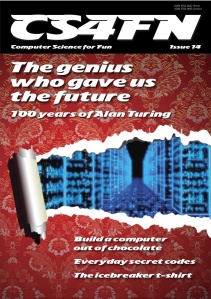
cs4fn issue 14 cover

This blog is funded through EPSRC grant EP/W033615/1.

Die another Day? Or How Madonna crashed the Internet

From the cs4fn archive …

When pop star Madonna took to the stage at Brixton Academy in 2001 for a rare appearance she made Internet history and caused more that a little Internet misery. Her concert performance was webcast; that is it was broadcast real time over the Internet. A record-breaking audience of 9 million tuned in, and that’s where the trouble started…

A lone mike in front of stage lights
Image by Pexels from Pixabay

The Internet’s early career

The Internet started its career as a way of sending text messages between military bases. What was important was that the message got through, even if parts of the network were damaged say, during times of war. The vision was to build a communications system that could not fail; even if individual computers did, the Internet would never crash. The text messages were split up into tiny packets of information and each of these was sent with an address and their position in the message over the wire. Going via a series of computer links it reached its destination a bit like someone sending a car home bit by bit through the post and then rebuilding it. Because it’s split up the different bits can go by different routes.

Express yourself (but be polite please)

To send all these bits of information a set of protocols (ways of communicating between the computers making up the Internet) were devised. When passing on a packet of information the sending machine first asks the receiving machine if it is both there and ready. If it replies yes then the packet is sent. Then, being a polite protocol, the sender asks the receiver if the packets all arrived safely. This way, with the right address, the packets can find the best way to go from A to B. If on the way some of the links in the chain are damaged and don’t reply, the messages can be sent by a different route. Similarly if some of the packets gets lost in transit between links and need to be resent, or packets are delayed in being sent because they have to go by a round about route, the protocol can work round it. It’s just a matter of time before all the packets arrive at the final destination and can be put back in order. With text the time taken to get there doesn’t really matter that much.

The Internet gets into the groove

The problem with live pop videos, like a Madonna concert, is that it’s no use if the last part of the song arrives first, or you have to wait half an hour for the middle chorus to turn up, or the last word in a sentence vanishes. It needs to all arrive in real time. After all, that is how it’s being sung. So to make web casting work there needs to be something different, a new way of sending the packets. It needs to be fast and it needs to deal with lots more packets as video images carry a gigantic amount of data. The solution is to add something new to the Internet, called an overlay network. This sits on top of the normal wiring but behaves very differently.

The Internet turns rock and roll rebel

So the new real time transmission protocol gets a bit rock and roll, and stops being quite so polite. It takes the packets and throws them quickly onto the Internet. If the receiver catches them, fine. If it doesn’t, then so what? The sender is too busy to check like in the old days. It has to keep up with the music! If the packets are kept small, an odd one lost won’t be missed. This overlay network called the Mbone, lets people tune into the transmissions like a TV station. All these packages are being thrown around and if you want to you can join in and pick them up.

Crazy for you

Like dozens of cars
all racing to get through
a tunnel there were traffic jams.
It was Internet gridlock.

The Madonna webcast was one of the first real tests of this new type of approach. She had millions of eager fans, but it was early days for the technology. Most people watching had slow dial-up modems rather than broadband. Also the number of computers making up the links in the Internet were small and of limited power. As more and more people tuned in to watch, more and more packets needed to be sent and more and more of the links started to clog up. Like dozens of cars all racing to get through a tunnel there were traffic jams. Packets that couldn’t get through tried to find other routes to their destination … which also ended up blocked. If they did finally arrive they couldn’t get through onto the viewers PC as the connection was slow, and if they did, very many were too late to be of any use. It was Internet gridlock.

Who’s that girl?

Viewers suffered as the pictures and sound cut in and out. Pictures froze then jumped. Packets arrived well after their use by date, meaning earlier images had been shown missing bits and looking fuzzy. You couldn’t even recognise Madonna on stage. Some researchers found that packets had, for example, passed over seven different networks to reach a PC in a hotel just four miles away. The packets had taken the scenic route round the world, and arrived too late for the party. It wasn’t only the Madonna fans who suffered. The broadcast made use of the underlying wiring of the Internet and it had filled up with millions of frantic Madonna packets. Anyone else trying to use the Internet at the time discovered that it had virtually ground to a halt and was useless. Madonna’s fans had effectively crashed the Internet!

Webcasts in Vogue

Today’s webcasts have moved on tremendously using the lessons learned from the early days of the Madonna Internet crash. Today video is very much a part of the Internet’s day-to-day duties: the speed of the computer links of the Internet and their processing power has increased massively; more homes have broadband so the packets can get to your PC faster; satellite uplinks now allow the network to identify where the traffic jams are and route the data up and over them; extra links are put into the Internet to switch on at busy times; there are now techniques to unnoticeably compress videos down to small numbers of packets, and intelligent algorithms have been developed to reroute data effectively round blocks. We can also now combine the information flowing to the viewers with information coming back from them so allowing interactive webcasts. With the advent of digital television this service is now in our homes and not just on our PC’s.

Living in a material world

It’s because of thousands of scientists working on new and improved technology and software that we can now watch as the housemate’s antics stream live from the Big Brother house, vote from our armchair for our favourite talent show contestant or ‘press red’ and listen to the director’s commentary as we watch our favourite TV show. Like water and electricity the Internet is now an accepted part of our lives. However, as we come up with even more popular TV shows and concerts, strive to improve the quality of sound and pictures, more people upgrade to broadband and more and more video information floods the Internet … will the Internet Die another Day?

– Peter W. McOwan and Paul Curzon, Queen Mary University of London, 2006

More on …

Read more about women in computing in the cs4fn special issue “The Woman are Here”.

Hiding in Elizabethan Binary

The great Tudor and Stuart philosopher Sir Francis Bacon was a scientist, a statesman and an author. He was also a pretty decent computer scientist. He published* a new form of cipher, now called Bacon’s Cipher, invented when he was a teenager. Its core idea is the foundation for the way all messages are stored in computers today.

Old writing
Image by Michal Jarmoluk from Pixabay

The Tudor and Stuart eras were a time of plot and intrigue. Perhaps the most famous is the 1605 Gunpowder plot where Guy Fawkes tried to assassinate King James I by blowing up the Houses of Parliament. Secrets mattered! In his youth Bacon had worked as a secret agent for Elizabeth I’s spy chief, Walsingham, so knew all about ciphers. Not content with using those that existed he invented his own. The one he is best remembered for was actually both a cipher and a form of steganography. While a cipher aims to make a message unreadable, steganography is the science of secret writing: disguising messages so no one but the recipient knows there is a message there at all.

A Cipher …

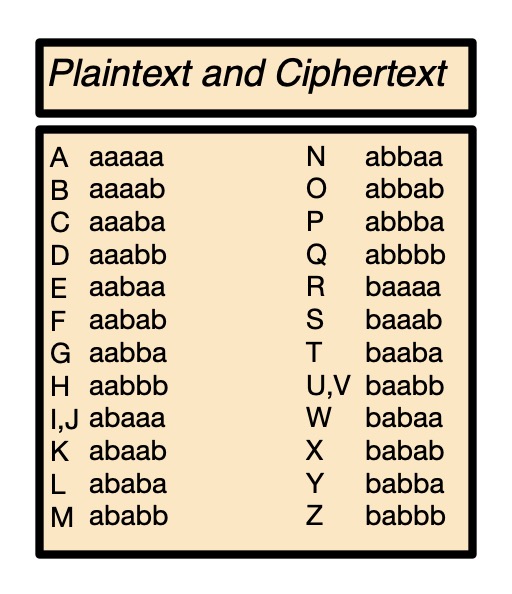
Bacon’s method came in two parts. The first was a substitution cipher, where different symbols are substituted for each letter of the alphabet in the message. This idea dates back to Roman times. Julius Caesar used a version, substituting each letter for a letter from a fixed number of places down the alphabet (so A becomes E, B becomes F, and so on). Bacon’s key idea was to replace each letter of the alphabet with, not a number or letter, but it’s own series of a’s and b’s (see the cipher table). The Elizabethan alphabet actually had only 24 letters so I and J have the same code as do U and V as they were interchangeable (J was the capital letter version of i and similarly for U and v).

In Bacon’s cipher everything is encoded in two symbols, so it is a binary encoding. The letters a and b are arbitrary. Today we would use 0 and 1. This is the first use of binary as a way to encode letters (in the West at least). Today all text stored in computers is represented in this way – though the codes are different – it is all Unicode is. It allocates each character in the alphabet with a binary pattern used to represent it in the computer. When the characters are to be displayed, the computer program just looks up which graphic pattern (the actual symbol as drawn) is linked to that binary pattern in the code being used. Unicode gives a binary pattern for every symbol in every human language (and some alien ones like Klingon).

Plaintext and ciphertext for alphabt using Bacon's code
Image by CS4FN

Steganography

The second part of Bacon’s cipher system was Steganography. Steganography dates back to at least the Greeks, who supposedly tattooed messages on the shaved heads of slaves, then let their hair grow back before sending them as both messenger and message. The binary encoding of Bacon’s cipher was vital to make his steganography algorithm possible. However, the message was not actually written as a’s and b’s. Bacon realised that two symbols could stand for any two things. If you could make the difference hard to spot, you could hide the messages. Bacon invented two ways of handwriting each letter of the alphabet – two fonts. An ‘a’ in the encoded message meant use one font and a ‘b’ meant use the other. The secret message could then be hidden inside an innocent one. The letters written were no longer the message, the message was in the font used. As Bacon noted, once you have the message in binary you could think of other ways to hide it. One way used was with capital and lower-case letters, though only using the first letter of words to make it less obvious.

Suppose you wanted to hide the message “no” in the innocuous message ‘hello world’. The message ‘no’ becomes ‘abbaa abbab’. So far this is just a substitution cipher. Next we hide it in, ‘hello world’. Two different kinds of fonts are those with curls on the tails of letters known as serif fonts and like this one and those without curls known as sans serif fonts and like this one. We can use a sans serif font to represent an ‘a’ in the coded message, and a serif font to represent ‘b’. We just alternate the fonts following the pattern of the a’s and b’s: ‘abbaa abbab’. The message becomes

hello world in different fonts
Image by CS4FN

sans serif, serif, serif, sans serif, sans serif,
sans serif, serif, serif, sans serif, serif.

Using those fonts for our message we get the final mixed font message to send:

Bacon the polymath

Bacon is perhaps best known as one of the principal advocates for rigorous science as a way of building up knowledge. He argued that scientists needed to do more than just come up with theories of how the world worked, and also guard against just seeing the results that matched their theories. He argued knowledge should be based on careful, repeated observation. This approach is the basis of the Scientific Method and one of the foundation stones of modern science.

Bacon was also a famous writer of the time, and one of many authors who has since been suggested as the person who wrote William Shakespeare’s plays. In his case it is because they claim to have found secret messages hidden in the plays in Bacon’s code. The idea that someone else wrote Shakespeare’s plays actually started just because some upper class folk with a lack of imagination couldn’t believe a person from a humble background could turn themselves into a genius. How wrong they were!

– Paul Curzon, Queen Mary University of London, Autumn 2017

*Thanks to Pete Langman, whose PhD was on Francis Bacon, for pointing out a mistake in the original version of this blog where I suggested the cipher was published in, 1605, the year of the Gun Powder plot. It was actually first published in 1623 in De augmentis which was a translation/enlargement of his 1605 Advancement of Learning.

He also pointed out that Bacon conceived the idea while working with Elizabethan spymaster, Walsingham’s cipher expert at the time of the Babington plot to assasinate Elizabeth I, Thomas Phileppes, and Mary, Queen of Scots’ jailer, Amias paulet. Bacon also claimed the cipher was never broken!

i-pickpocket

Credit cards in a back pocket.
Image by Kris from Pixabay

Contactless payments seem magical. But don’t get caught out by someone magically scanning your card without you knowing. Almost £7 million was stolen by contactless card fraud in 2016 alone…

Victorian Hi-Tech

Contactless cards talk to the scanner by electromagnetic induction, discovered by Michael Faraday back in 1831. Changes in the current in a coil of wire, which for a contactless card is just an antenna in the form of a loop, creates a changing magnetic field. If a loop antenna on another device is placed inside that magnetic field, then a voltage is created in its circuit. As the current in the first circuit changes, that in the other circuit copies it, and information is passed from one to the other. This works up to about 10cm away.

Picking pockets at a distance

Contactless cards don’t require authentication like a PIN, to prove who is using them, for small amounts. Anyone with the card and a reader can charge small amounts to it. Worse, if someone gets a reader within 10cm of the bag holding your card, they could even take money from it without your knowledge. That might seem unlikely but then traditional pickpockets are easily capable of taking your wallet without you noticing, so just getting close isn’t hard by comparison! For that kind of fraud the crook has to have a legitimate reader to charge money. Even without doing that they can read the number and expiry date from the card and use them to make online purchases though.

A man in the middle

Security researchers have also shown that ‘relay’ attacks are possible, where a fake device passes messages between the shop and a card that is somewhere else. An attacker places a relay device near to someone’s actual card. It communicates with a fake card an accomplice is using in the shop. The shop’s reader queries the fake card which talks to its paired device. The paired device talks to the real card as though it were the one in the shop. It passes the answers from the real card back to the fake card which relays it on to the shop. Real reader and card get exactly the messages they would if the card was in the shop, just via the fake devices in between. Both shop and card think they are talking to each other even though they are a long way apart, and the owner of the real card knows nothing about it.

Block the field

How do you guard against contactless attacks? Never hand over your card, always ask for a receipt and check your statements. You can also keep your card in a blocking sleeve: a metal case that protects the card from electromagnetic fields (even using a homemade sleeve from tin foil should work). Then at least you force the pickpockets back to the Victorian, Artful Dodger style, method of actually stealing your wallet.

Of course Faraday was a Victorian, so a contactless attack is actually a Victorian way of stealing too!

Jane Waite and Paul Curzon, Queen Mary University of London

More on…

Subscribe to be notified whenever we publish a new post to the CS4FN blog.


This blog is funded by EPSRC on research agreement EP/W033615/1.

QMUL CS4FN EPSRC logos

Every Breath You Take: Reclaim the Internet

Image by Adam from Pixabay

The 1983 hit song by the Police “Every breath you take” is up there in the top 100 pop songs ever. It seems a charming love song, and some couples even treat it as “their” song, playing it for the first dance at their wedding. Some of the lyrics “Every single day…I’ll be watching you”, if in a loving relationship, might be a good and positive thing. As the Police’s Sting has said though, the lyrics are about exactly the opposite.

It is being sung by a man obsessed with his former girlfriend. He is singing a threat. It is about sinister stalking and surveillance, about nasty use of power by a deranged man over a woman who once loved him.

Reclaim the Internet

Back in 1983 the web barely existed, but what the song describes is now happening every day, with online stalking, trolling and other abuse a big problem. What starts in the virtual world, we now see, spills over into the real world, too. This is one reason why we need to Reclaim the Internet and why online privacy is important. We must all call out online abuse. Prosecuters need to treat it seriously. Social media companies need to find ways to prevent abusive content being posted and remove it quickly. They need easier ways for us to protect our privacy and to know it is protected. They need to be up for the challenge.

Reclaim your privacy

The lyrics fit our lives in another way too, about another kind of relationship. When we click those unreadable consent forms for using a new app, we give permission for the technology companies that we love so much to watch over us. They follow the song as a matter of course (in a loving way they say). They are “watching you” as you keep your gadgets on you “every single day”; “every night you stay” online you are recorded along with anyone you are with online; they watch “every move you make” (physically with location aware devices and virtually, noting every click, every site visited, everything you are interested in they know from your searches); “every step you take” (recorded by your fitness tracker); and “every breath you take” (by your healthcare app); “every bond you break” is logged (as you unlike friends and as you leave websites never to go back); “every game you play” (of course), “every word you say” (everything you type is noted, but the likes of Alexa also record every sound too, shipping your words off to be processed by distant company servers). They really are watching you.

Let’s hope the companies really are loving and don’t turn out to have an ugly underside, changing personality and becoming abusive once they have us snared. Remember their actual aim is to make money for shareholders. They don’t actually love us back. We may fall out of love with them, but by then they will already know everything about us, and will still be watching every move we make. Perhaps you should not be giving up your privacy so freely.

You belong to me?

We probably can’t break our love affair, anyway. We’ve already sold them our souls (for nothing much at all). As the lyrics say: “You belong to me.”

More on…

Magazines …

Front cover of CS4FN issue 29 - Diversity in Computing

Subscribe to be notified whenever we publish a new post to the CS4FN blog.


This blog is funded by EPSRC on research agreement EP/W033615/1.

QMUL CS4FN EPSRC logos