Ada (the language), is not the big player on the programming block these days. In 1997 the DoD1 cancelled their rule that you had to use Ada when working for them. Developers in commerce had always found Ada hard to work with and often preferred other languages. There are hundreds of other languages used in industry and by researchers. How many can you name?
Here are some fun clues about different languages. Can you work out their names? (Answers at the end.)
A big snake that will squash you dead.
A famous Victorian woman who worked with Babbage.
A, B, __
A, B, __ (ouch)
A precious, but misspelled, thing inside a shell.
A tiny person chatting.
A beautiful Indonesian island.
A french mathematician and inventor famous for triangles.
Today, the most popular programming languages are, well we don’t know, because it depends when you are reading this! Because what is fashionable, what is new is always changing. Plus it’s hard to agree what ‘the most popular’ means for languages (and pop stars!). Is it the most lines of code in use today? The favorite language of developers? The language everyone is learning? In July 2015 one particular website rated programing languages using features such as number of skilled software engineers who can use the language; number of courses to learn the language; search engine queries on the language and came up with the order.
1) Java
2) C
3) C++
4) C#
5) Python
Where is Ada? 30th out of 100s! The same website had shown Ada (the language) as 3rd top in 1985! What a fall from grace.
But have no fear, Ada still survives and lives on in millions of lines of avionics2, radar systems, space, shipboard, train, subway, nuclear reactors and DoD systems. Plus Ada is perhaps making a comeback. Ada 2012 is just being finalised, heralded by some as the next generation of engineering software with its emphasis on safety, security and reliability. So Ada meet Ada, it looks like you will be remembered and used for a long time still.
Github is a place where lots of programmers now develop and save their code. It encourages programmers to share their work. A kind of modern day, crowd sourced ‘mass of shared facts’ but coders would probably not say they did this just to ‘amuse their idle hours’. Popular coding tools on this platform are JavaScript. Java, Python, CSS, PHP, Ruby, C++. Ada doesn’t really feature, well not yet.
What was Ada Lovelace thinking about when she wrote: “If amateurs of either sex would amuse their idle hours with experiments on this subject, and would keep an accurate journal of their daily observations, we should have in a few years a mass of registered facts to compare with the observation of the scientific”.
Yes, crowdsourcing science experiments! Now we call it Citizen Science. She had just read a book by a Baron von Reichenbach on magnetism in which he had suggested a whole host of experiments, such as moving magnets up and down a person’s body, showing people magnets in the dark, and holding heavy and light magnets and asking them if they felt any sensations. She could see that he had some great ideas, but she was not convinced by his examples alone.
Ada was not the only Victorian to ask the general public for help collecting data. Charles Darwin, the Origin of Species man, wrote to gardeners, diplomats, army officers and scientists across the world asking for information about the plants they grew and the animals (including people) they saw. This all helped him build up the concrete evidence that natural selection was the way evolution works. People even sent him gifts of live animals in the post. A Danish gentleman sent him a parcel of live barnacles. When they did not arrive on time, Darwin, desperate to dissect the species, panicked and got ready to offer a reward in the Times newspaper. Luckily they arrived intact, fresh and not too smelly!
Today we might take part in the RSPB’s Big Garden Bird Watch1, contribute to a blog, ‘favourite’ or ‘like’ a post on social media or vote for your favorite performer in a talent show. We participate, and ‘amuse our idle hours’ sometimes in the pursuit of science, sometimes not. Public research is a big new topic, with governments and companies looking to use people power. Innovations such as shared mapping systems ask users to upload details about a place, add photographs, rectify mistakes. Wikipedia is sourced by volunteers, with other volunteers checking accuracy. Galaxy Zoo volunteers even found a whole new planet that orbits four stars!
What would Ada be asking us to research? Test your own DNA and send in the results? Measure air quality and keep a record on a central database? Build your own ‘find a barnacle’ app? But rather than writing a journal or sending a parcel of barnacles, you would log it on line, click a link or design your own survey. Ada’s computers are in on the act again.
Why not find a Citizen Science project on something you are interested in. Sometimes called public science or science outreach projects they might be run by local universities, museums, your council, charities or through crowdsourced internet projects such as www.zooniverse.org. Share what you do with others and spread Ada’s word to be a modern day volunteer.
Jane Waite, Queen Mary University of London
23-25 January 2026: RSPB Big Garden Birdwatch – “Spend an hour watching the birds in your patch, between 23 and 25 January, and record the birds t allhat land.” You can also get your school involved in the Big School’s Birdwatch 2026. If you’re reading this after 25 January 2026 make a note in your diary to remind you to check next year! ↩︎
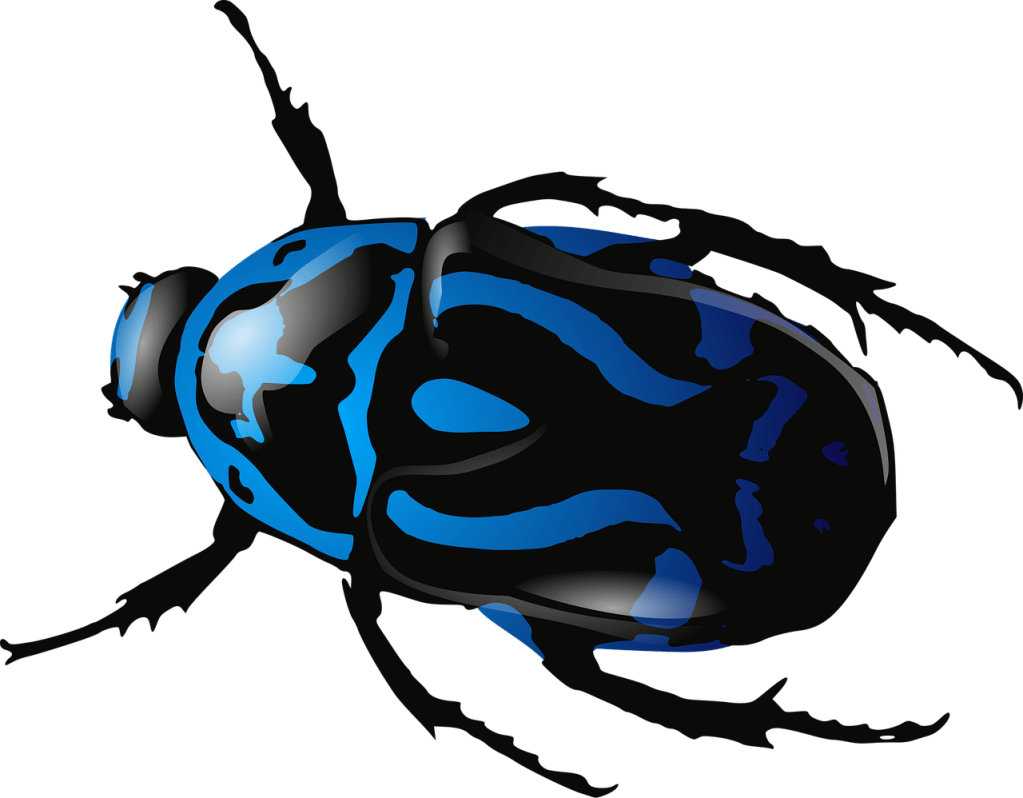
Beetles are one of the most prolific species on the planet. As the famous geneticist J.B.S. Haldane is supposed to have said: God has an inordinate fondness for beetles. One of the reasons they are so successful is that, unlike us, their skeleton is outside their body, not inside! This kind of skeleton is called an exoskeleton. Humans are now trying to get in on the act. In the computer science version exoskeletons are robots that you wear.
Animal shells
All sorts of animals have evolved all sorts of different exoskeletons. We call the big ones shells. Many insects, like beetles, have exoskeletons. So do crabs, scorpions, snails and clams. Tortoises are particularly interesting as they have both an internal skeleton, like us, and a shell too.
Animals use exoskeletons for lots of reasons. Most obviously it protects them from predators. It can also help stop them drying out in the sun, and stop them getting wet in the rain. They are used by some animals for sensing the world, and help animals like locusts to jump. Some tortoises and armadillos use them for digging and other animals use them to feed. It’s not surprising, with so many uses that there are a lot of them about.
Human shells
Generally, exoskeletons seem like a pretty good idea! So it’s not surprising that we humans want them too. A suit of armour is actually just a simple version of an exoskeleton designed to protect a knight from ‘predators’. It’s not much different to a tortoise protected inside its shell. The difference to the ones humans make now is our modern exoskeletons are powered and controlled by computers. They really are a robot you wear. They react to your movements.
As with animals’ shells, powered exoskeletons help humans do all sorts of things, not just act as armour. By being powered they give us extra strength, allowing us to lift weights far heavier than we could otherwise, and can turn our small movements in to larger ones. That means they can, for example, help people who have problems moving about to walk (see ‘The Wrong Trousers’) or help nurses lift patients in and out of bed. They are used by surgeons to do operations when they are in a different place to the patient, removing the shakiness of their hands, and by rescue workers working in dangerous situations. There are even ones designed to help astronauts exercise in space. They make movement harder rather than easier to force them to exercise despite the lower gravity.
All in all, copying beetles, but with our own computing twist, seems like a pretty good idea.
If you watch a lot of movies you’ve probably noticed some recurring patterns in the way that popular cinematic stories are structured. Every hero or heroine needs a goal and a villain to thwart that goal. Every goal requires travel along a path that is probably blocked with frustrating obstacles. Heroes may not see themselves as heroes, and will occasionally take the wrong fork in the path, only to return to the one true way before story’s end. We often speak of this path as if it were a race track: a fast-paced story speeds towards its inevitable conclusion, following surprising “twists” and “turns” along the way. The track often turns out to be a circular one, with the heroine finally returning to the beginning, but with a renewed sense of appreciation and understanding. Perhaps we can use this race track idea as a basis for creating stories.
Building a track
If you’ve ever played with a Scalextric set, you will know that the curviest tracks make for the most dramatic stories, by providing more points at which our racing cars can fly off at a tight bend. In Scalextric you build your own race circuits by clicking together segments of prefabricated track, so the more diverse the set of track parts, the more dramatic your circuit can be. We can think of story generation as a similar kind of process. Imagine if you had a large stock of prefabricated plot segments, each made up of three successive bits of story action. A generator could clip these segments together to create a larger story, by connecting the pieces end-to-end. To keep the plot consistent we would only link up sections if they have overlapping actions. So If D-E-F is a segment comprising the actions D, E, and F, we could create the story B-C-D-E-F-G-H by linking the section B-C-D on to the left of D-E-F and F-G-H on its right.
Use a kit
At University College Dublin (UCD) we have created a set of rich public resources that make it easy for you to build your own automated story generator. We call the bundle of resources Scéalextric, from scéal (the Irish word for story) and Scalextric. You can download the Scéalextric resources from our Github but an even better place to start is our blog for people who want to build creative systems of any kind, called Best Of Bot Worlds.
In Artificial Intelligence we often represent complex knowledge structures as ‘graphs’. These graphs consists of lots of labeled lines (called edges) that show how labeled points (called nodes) are connected. That is what our story pieces essentially are. We have several agreed ways for storing these node-relation-node triples, with acronyms hiding long names, like XML (eXtensible Markup Language), RDF (Resource Description Framework) and OWL (Web Ontology Language), but the simplest and most convenient way to create and maintain a large set of story triples is actually just to use a spreadsheet! Yes, the boring spreadsheet is a great way to store and share knowledge, because every cell lies at the intersection of a row and a column. These three parts give us our triples.
Scéalextric is a collection of easy-to-browse spreadsheets that tell a machine how actions connect to form action sequences (like D-E-F above), how actions causally interconnect to each other (via and, then, but), how actions can be “rendered” in natural idiomatic English, and so on.
Adding Character
Automated storytelling is one of the toughest challenges for a researcher or hobbyist starting out in artificial intelligence, because stories require lots of knowledge about causality and characterization. Why would character A do that to character B, and what is character B likely to do next? It helps if the audience can identify with the characters in some way, so that they can use their pre-existing knowledge to understand why the characters do what they do. Imagine writing a story involving Donald Trump and Lex Luthor as characters: how would these characters interact, and what parts of their personalities would they reveal to us through their actions?
Scéalextric therefore contains a large knowledge-base of 800 famous people. These are the cars that will run on our tracks. The entry for each one has triples describing a character’s gender, fictive status, politics, marital status, activities, weapons, teams, domains, genres, taxonomic categories, good points and bad points, and a lot more besides. A key challenge in good storytelling, whether you are a machine or a human, is integrating character and plot so that one informs the other.
A Twitterbot plot
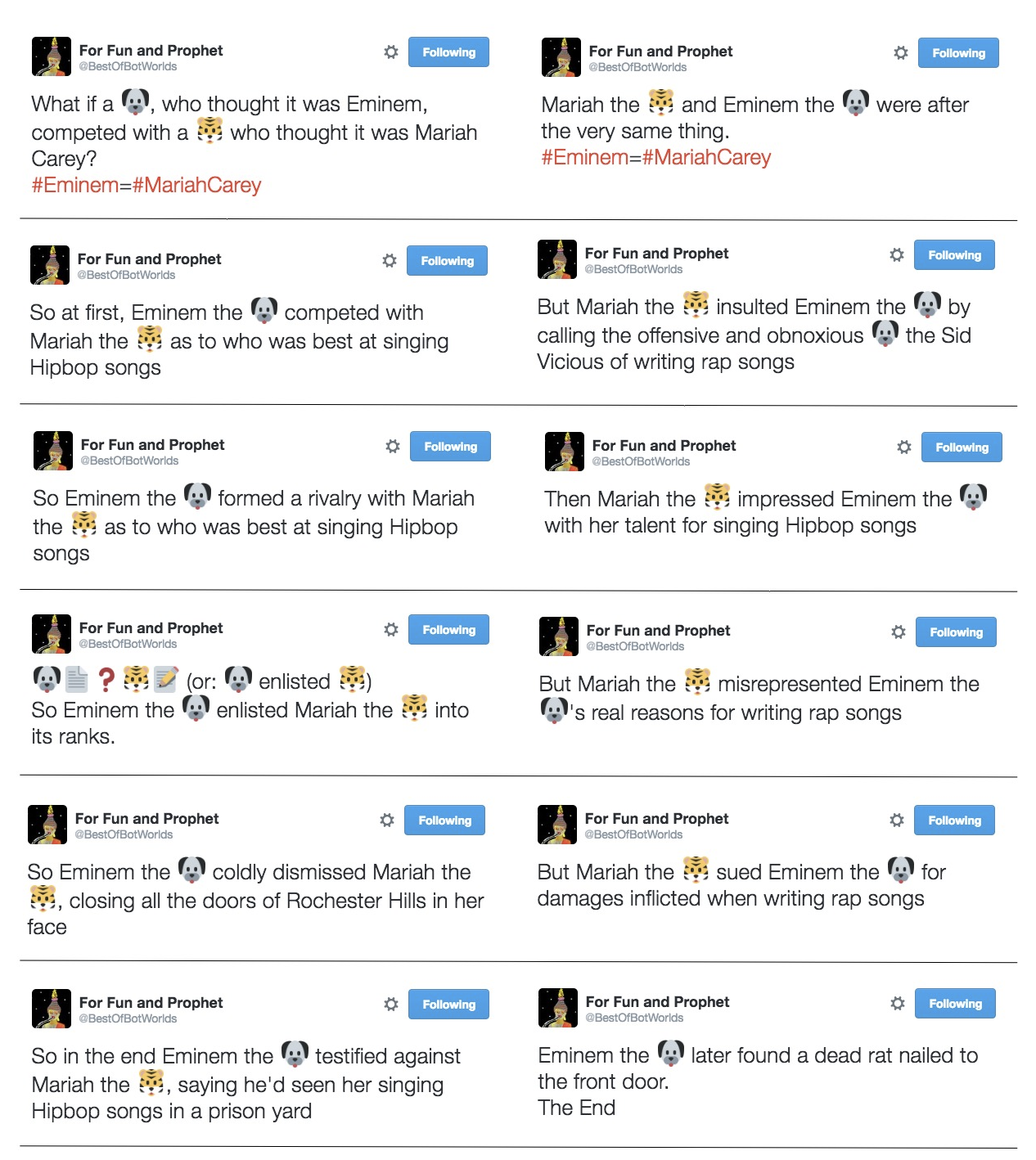
Let’s look at a story created and tweeted by our Twitterbot @BestOfBotWorlds over a series of 12 tweets. Can you see where the joins are in our Scéalextric track? Can you recognize where character-specific knowledge has been inserted into the rendering of different actions, making the story seem funny and appropriate at the same time? More importantly, can you see how you might connect the track segments differently, choose characters more carefully, or use knowledge about them more appropriately, to make better stories and to build a better story-generator? That’s what Scéalextric is for: to allow you to build your own storytelling system and to explore the path less trodden in the world of computational creativity. It all starts with a click.
An unlikely tale generated by the Twitter storybot.
Tony Veale, University College Dublin
Further reading
Christopher Strachey came up with the first example of a computer program that could create lines of text (from lists of words). The CS4FN developed a game called ‘Program A Postcard’ (see below) for use at festival events.
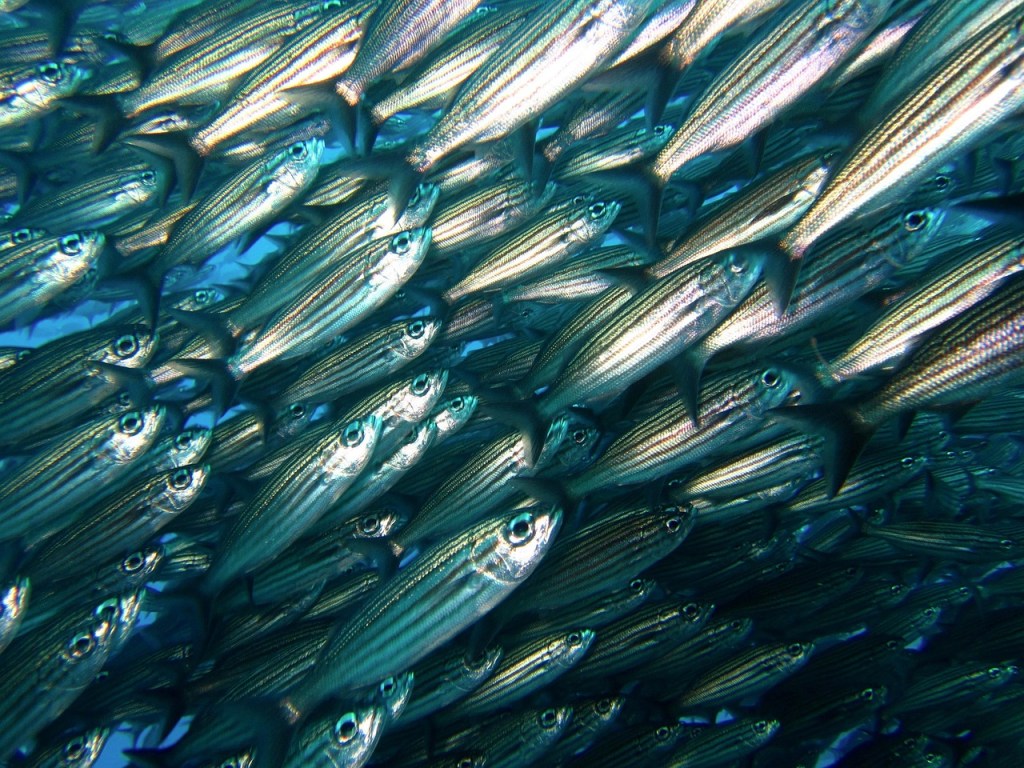
You might think that under the sea things are nice and quiet, but something fishy is going on down there. Our oceans are filled with natural noise. This is called ambient noise and comes from lots of different sources: from the sound of winds blowing waves on the surface, rain, distant ships and even underwater volcanoes. For undersea marine life that relies on sonar or other acoustic ways to communicate and navigate all the extra ocean noise pollution that human activities, such as undersea mining and powerful ships sonars, have caused, is an increasing problem. But it’s not only the marine life that is affected by the levels of sea sounds, submarines also need to know something about all that ambient noise.
In the early 1900s the aptly named ‘Submarine signal company’ made their living by installing undersea bells near lighthouses. The sound of these bells were a warning to mariners about the impending navigation hazards: an auditory version of the lighthouse light.
The Second World War led to scientists taking undersea ambient noise more seriously as they developed deadly acoustic mines. These are explosive mines triggered by the sound of a passing ship. To make the acoustic trigger work reliably the scientists needed to measure ambient sound, or the mines would explode while simply floating in the water. Measurements of sound frequencies were taken in harbours and coastal waters, and from these a mathematical formula was computed that gave them the ‘Knudsen curves’. Named after the scientist who led the research these curves showed how undersea sound frequencies varies with surface wind speed and wave height. They allowed the acoustic triggers to be set to make the mines most effective.
Dan Stowell was a researcher at Queen Mary University of London when he founded an early version of what is now known as a Social Venture: a company created to do social good. With Florence Wilkinson, he turned birdsong into a tech-based social good.
His research is about designing methods that computers can use to make sense of bird sounds. One day he met Florence Wilkinson, who works with businesses and young people, and they discovered they both had the same idea: “What if we could make an app that recognises bird sounds?” They decided to create a startup company, Warblr, to make it happen. However, unlike many research driven startups its main aim was not to make money but to do a social good. Dan and FLorence built this into their company mission statement:
…to reconnect people with the natural world through technology. We want to get as many people outdoors as possible, learning about the wildlife on their doorstep and how to protect it.
Dan brought the technical computer science skills needed to create the app, and Florence brought the marketing and communication skills needed to ensure people would hear about it. Together, they persuaded Queen Mary University of London’s innovation unit to give them a start-up grant. As a result their app Warblr exists and even gained some press coverage.
It can help people connect with nature by helping recognise birds – after all one of the problems with bird watching is they are so damned hard to spot and lots that flit by just look like little brown things! However, they are far easier to hear. Once you know what is out there then it adds incentive to try to actually spot it. However, the app has another purpose too. It collects data about the birds spotted, recording the species and where and when it was seen, with that data then made freely available to researchers.
Social ventures are a relatively new idea that universities are now supporting to help their researchers do social good that is sustainable and not just something that lasts until the grants run out. As Dan and Florence showed though, as a researcher you do not need to commit to do everything. To be a successful innovator you need more than technical skills, though. You need the ability to be part of a great team and to recognise a sound deal!
Updated from the archive, written by Paul Curzon, Queen Mary University of London.
What a mess. There’s flour all over the kitchen floor.A fortnight ago I opened the cupboard to get sugar for myhot chocolate. As I pulled out the sugar, it knocked against thebag of flour which was too close to the edge… Luckily the bagdidn’t burst and I cleared it up quickly before anyone foundout. Now it’s two weeks later and exactly the same thing justhappened to my brother. This time the bag did burst and itwent everywhere. Now he’s in big trouble for being so clumsy!
In safety-critical industries, like healthcare and the airline industry, especially, it is really important that there is a culture of reporting incidents including near misses. It also, it turns out, is important that the mechanisms of reporting issues is appropriately designed, and that there is a no blame culture especially so that people are encouraged to report incidents and do so accurately and without ambiguity.
Was the flour incident my brother’s fault? Should he have been more careful? He didn’t choose to put the sugar in a high cupboard with the flour. Maybe it was my fault? I didn’t choose to put the sugar there either. But I didn’t tell anyone about the first time it happened. I didn’t move the sugar to a lower cupboard so it was easier to reach either. So maybe it was my fault after all? I knew it was a problem, and I didn’t do anything about it. Perhaps thinking about blame is the wrong thing to do!
Now think about your local hospital.
James is a nurse, working in intensive care. Penny is really ill and is being given insulin by a machine that pumps it directly into her vein. The insulin is causing a side effect though – a drop in blood potassium level – and that is life threatening. They don’t have time to set up a second pump, so the doctor decides to stop the insulin for a while and to give a dose of potassium through a second tube controlled by the same pump. James sets up the bag of potassium and carefully programs the pump to deliver it, then turns his attention to his next task. A few minutes later, he glances at the pump again and realises that he forgot to release the clamp on the tube from the bag of potassium. Penny is still receiving insulin, not the potassium she urgently needs. He quickly releases the clamp, and the potassium starts to flow. An hour later, Penny’s blood potassium levels are pretty much back to normal: she’s still ill, but out of danger. Phew! Good job he noticed in time and no-one else knows about the mistake!
Two weeks later, James’ colleague, Julia, is on duty. She makes a similar mistake treating a different patient, Peter. Except that she doesn’t notice her mistake until the bag of insulin has emptied. Because it took so long to spot, Peter needs emergency treatment. It’s touch-and-go for a while, but luckily he recovers.
Julia reports the incident through the hospital’s incident reporting system, so at least it can be prevented from happening again. She is wracked with guilt for making the mistake, but also hopes fervently that she won’t be blamed and so punished for what happened
Don’t miss the near misses
Why did it happen? There are a whole bunch of problems that are nothing to do with Julia or James. Why wasn’t it standard practice to always have a second pump set up for critically ill patients in case such emergency treatment is needed? Why can’t the pump detect which bag the fluid is being pumped from? Why isn’t it really obvious whether the clamp is open or closed? Why can’t the pump detect it. If the first incident – a ‘near miss’ – had been reported perhaps some of these problems might have been spotted and fixed. How many other times has it happened but not reported?
What can we learn from this? One thing is that there are lots of ways of setting up and using systems, and some may well make them safer. Another is that reporting “near misses” is really important. They are a valuable source of learning that can alert other people to mistakes they might make and lead to a search for ways of making the system safer, perhaps by redesigning the equipment or changing the way it is used, for example – but only if people tell others about the incidents. Reporting near-misses can help prevent the same thing happening again.
The above was just a story, but it’s based on an account of a real incident… one that has been reported so it might just save lives in the future.
Report it!
The mechanisms used to do it, as well as culture around reporting incidents can make a big difference to whether incidents are reported. However, even when incidents are reported, the reporting systems and culture can help or hinder the learning that results.
Chrystie Myketiak at Queen Mary analysed actual incident reports for the kind of language used by those writing them. She found that the people doing the reporting used different strategies in they way they wrote the reports depending on the kind of incident it was. In situations where there was no obvious implication that a person made a mistake (such as where sterilization equipment had not successfully worked) they used one kind of language. Where those involved were likely to be seen to be responsible, so blamed, (eg when a wrong number had been entered in a medical device, for example) they used a different kind of language.
In the former, where “user errors” might have been involved, those doing the reporting were more likely to write in a way that hid the identity of any person involved, eg saying “The pump was programmed” or writing about he or she rather than a named person. They were also more likely to write in a way that added ambiguity. For example, in the user error reports it was less clear whether the person making the report was the one involved or whether someone else was writing it such as a witness or someone not involved at all.
Writing in the kinds of ways found, and the fact that it differed to those with no one likely to be blamed, suggests that those completing the reports were aware that their words might be misinterpreted by those who read them. The fact that people might be blamed hung over the reporting.
The result of adding what Christie called “precise ambiguity” might mean important information was inadvertently concealed making it harder to understand why the incident happened so work out how best to avoid it. As a result, patient safety might then not be improved even though the incident was reported. This shows one of the reasons why a strong culture of no-fault reporting is needed if a system is to be made as safe as possible. In the airline industry, which is incredibly safe, there is a clear system of no fault reporting, with pilots, for example, being praised for reporting near-misses of plane crashes rather than being punished for any mistake that led to the near miss.
This work was part of the EPSRC funded CHI+MED research project led by Ann Blandford at UCL looking at design for patient safety. In separate work on the project, Alexis Lewis, at Swansea University, explored how best to design the actual incident reporting forms as part of her PhD. A variety of forms are used in hospitals across the UK and she examined more than 20 different ones. Many had features that would make it harder than necessary for nurses and doctors to report incidents accurately even if they wanted to openly so that hospital staff would learn as much as possible from the incidents that did happen. Some forms failed to ask about important facts and many didn’t encourage feedback. It wasn’t clear how much detail or even what should be reported. She used the results to design a new reporting form that avoided the problems and that could be built into a system that encourages the reporting of incidents . Ultimately her work led to changes to the reporting form and process used within at least one health board she was working with.
People make mistakes, but safety does not come from blaming those that make them. That just discourages a learning culture. To really improve safety you need to praise those that report near misses, as well as ensuring the forms and mechanisms they must use to do so helps them provide the information needed.
Updated from the archive, written by the CHI+MED team.
Ever used an online poemgenerator, perhaps to get started with an English assignment? They normally have a template and some word lists you can fill in, with a simple algorithm that randomly selects from the word lists to fill out the template. “I wandered lonely as a cloud” might become “I zoomed destitute as a rainbow” or I danced homeless as a tree”. It would all depend on those word lists. Artificial Intelligence and machine learning researchers are aiming to be more creative.
Stanford University, the University of Massachusetts and Google have created works that look like poems, by accident. They were using a machine learning Artificial Intelligence they had previously ‘trained’ on romantic novels to research the creation of captions for images, and how to translate text into different languages. They fed it a start and end sentence, and let the AI fill in the gap. The results made sense though were ‘rather dramatic’: for example
“he was silent for a long moment he was silent for a moment it was quiet for a moment it was dark and cold there was a pause it was my turn”
Is this a real poem? What makes a poem a poem is in itself an area of research, with some saying that to create a poem, you need a poet and the poet should do certain things in their ‘creative act’. Researchers from Imperial College London and University College Dublin used this idea to evaluate their own poetry system. They checked to see if the poems they generated met the requirements of a special model for comparing creative systems. This involved things like checking whether the work formed a concept, and including measures such as flamboyance and lyricism.
Read some poems written by humans and compare them to poems created by online poetry generators. What makes it creativity? Maybe that’s up to you!
See also this article about Christopher Strachey, who came up with the first example of a computer program that could create lines of text (from lists of words) to make up love poems.
Claude Shannon, inventor of the rocket powered Frisbee, gasoline powered pogo stick, a calculator that worked using roman numerals, and discoverer of the fundamental equation of juggling! Oh yeah, and founder of the most important theory underpinning all digital communication: information theory.
Claude Shannon is perhaps one of the most important engineers of the 20th century, but he did it for fun. Though his work changed the world, he was always playing with and designing things, simply because it amused him. Like his contemporary Richard Feynman, he did it for ‘the pleasure of finding things out.’
As a boy, Claude liked to build model planes and radio-controlled boats. He once built a telegraph system to a friend’s house half a mile away, though he got in trouble for using the barbed wires around a nearby pasture. He earned pocket money delivering telegrams and repairing radios.
He went to the University of Michigan, and then worked on his Masters at MIT. While there, he thought that the logic he learned in his maths classes could be applied to the electronic circuits he studied in engineering. This became his Masters thesis, published in 1938. It was described as ‘one of the most important Master’s theses ever written… helped to change digital circuit design from an art to a science.’
Claude Shannon is known for his serious research, but a lot of his work was whimsical. He invented a calculator called THROBAC (Thrifty Roman numerical BACkward looking computer), that performs all its operations in the Roman numeral system. His home was full of mechanical turtles that would wander around, turning at obstacles; a gasoline-powered pogostick and rocket-powered Frisbee; a machine that juggled three balls with two mechanical hands; a machine to solve the Rubik’s cube; and the ‘Ultimate Machine’, which was just a box that when turned on, would make an angry, annoyed sound, reach out a hand and turn itself off. As Claude once explained with a smile, ‘I’ve spent lots of time on totally useless things.’
A lot of the early psychology experiments used to involve getting a mouse to run through a maze to reach some food at the end. By performing these experiments over and over in different ways, they could figure out how a mouse learns. So Claude built a mouse-shaped robot called Theseus. Theseus could search a maze until he solved it, and then use this knowledge to find its way through the maze from any starting point.
Oh, and there’s one other paper of his that needs mentioning. No, not the one on the science of juggling, or even the one describing his ‘mind reading’ machine. In 1948 he published ‘A mathematical theory of communication.’ Quite simply, this changed the world, and changed how we think about information. It laid the groundwork for a lot of important theory used in developing modern cryptography, satellite navigation, mobile phone networks… and the internet.
Undersea telecommunications cables let the world communicate and led to the world spanning Internet. It was all started by the Victorians. Continents were connected, but closer islands were too including the Scilly Isles.
Autumn 1869. There were great celebrations as the 31 mile long telecommunications cable was finally hauled up the shore and into the hut. The Scilly Isles now had a direct cable communication link to the mainland. But would it work? Several tests messages were sent and it was announced that all was fine. The journalists filed their story. The celebrations could begin.
Except it didn’t actually work! The cable wasn’t connected at all. The ship laying the cable had gone off course. Either that or someone’s maths had been shaky. The cable had actually run out 5 miles off the islands. Not wanting to spoil the party, the captain ordered the line to be cut. Then, unknown to the crowd watching, they just dragged the cut off end of the cable up the beach and pretended to do the tests. The Scilly Isles weren’t actually connected to Cornwall until the following year.
Paul Curzon, Queen Mary University of London (from the archive)