Join the crowd with swarm intelligence

A shoal of fish crammed into a cylindrical tank.
Image by Paul Sloane from Pixabay

Next time you are in a large crowd, look around you: all those people moving together, and mostly not bumping into each other. How does it happen? Flocks of birds and schools of fish are also examples of this ‘swarm intelligence’. Computer Scientists have been inspired by this behaviour to come up with new solutions to really difficult problems.

Swarming behaviour requires the individuals (birds, fish or people) to have a set of rules about how to interact with the individuals nearest to them. These so-called ‘local’ rules are all that’s needed to give rise to the overall or ‘global’ behaviour of the swarm. We adjust our individual behaviour according to our current state but also the current state of those around us. If I want to turn left then I do it slowly so that others in the crowd can be aware of it and also start to turn. I know what I am doing and I know what they are doing. This is how information makes its way from the edges of the crowd to the centre and vice versa.

A swarm is born

The way a crowd or swarm interacts can be explained with simple maths. This maths is a way of approximating the complex psychological behaviour of all the individuals on the basis of local and global rules. Back in 1995 James Kennedy, a research psychologist, and Computer Scientist Russ Eberhart, having been inspired by the study of bird flocking behaviour by biologist Frank Heppner, realised that this swarm intelligence could be used to solve difficult computer problems. The result was a technique called Particle Swarm Optimisation (PSO).

Travel broadens the mind

An optimisation problem is one where you have a range of options to choose from and you want to know the best solution. One of the classic problems is called ‘The travelling salesperson’ problem. You work for a company and have to deliver packages to say 12 towns. You look at the map. There are many different routes to take, but which is the one that will let you visit all 12 towns using the least petrol? Here the choices are the order in which you visit the towns, and the constraint is that you want to do the least driving. You could have a guess, select the towns in a random order and work out how far you’d have to travel to visit them in this order. You then try another route through all 12 and see if it takes less mileage, and so on. Phew! It could take a long time to work out all the possible routes for 12 towns to see which was best. Now imagine your company grows and you have to deliver to 120 towns or 1200 towns. You would spend all your time with the maps trying to come up with the cheapest solutions. There must be a better way? Well actually simple as this problem seems it’s an example of a set of computational problems known as NP-Complete problems and it’s not easy to solve! You need some guidance to help you through and that’s where swarm optimisation come in. It’s an example of a so-called metaheuristic algorithm: a sort of ‘general rule of thumb’ to help solve these types of problem. It won’t always work unless you have infinite time but it’s better than just trying random solutions. So how does swarm optimisation work here?

State space: the final frontier

First we need to turn the problem into something called a state space. You probably use state spaces all the time but just don’t know it. Think about yourself. What are the characteristic you would use to tell people about your current state: age, height, weight and so on. You can identify yourself by a list of say 3 numbers – one for age, one for height, one for weight. It’s not everything about you of course but it does define your state to some extent. Your numbers will be different to other people’s numbers, if you take all the numbers for your friends you would have a state space. It would be a 3-dimensional space with axes: age, height and weight, and each person would be a point in that space at some coordinate (X, Y, Z).

So state spaces are just a way of representing the possible variations in some problem. With the 12 towns problem, however, you couldn’t draw this space: it would be 12 dimensional! It would have one axis for each town, with the position on the axis an indication of where in the route it was. Every point in that space would be a different route through the 12 towns, so each point in the space would have coordinates (x1, x2, x3, … x11, x12). For each point there would also be a mileage associated with the route, and the task is to find the coordinate point (route) with the lowest mileage.

Where no particle has swarmed before

Enter swarm optimisation. We create a set of ‘particles’ that will be like birds or fish, and will fly and swarm through our state space. Each particle starts with a random starting location in the state space and calculates the mileages involved for the coordinates (route) they are at. The particles remember (store) this coordinate and also the value of the mileage at that position. Each particle therefore has it’s own known ‘local’ best value (where the lowest mileage was) but can compare this with other neighbouring particles to see if they have found any even better solutions. The particles then move onwards randomly in a direction that tends to move them towards their own local best and the best value found by their neighbours. The particles ‘fly’ around the state space in a swarm homing in on even better solutions until they all converge on the best they can find: the answer.

It may be that somewhere in a part of the space where no particle has been there is an even better solution, perhaps even the best solution possible. Our swarm will have missed it! That’s why this algorithm is a heuristic, a best guess to a tough problem. We can always add some more particles at the start to fill more of the state space and reduce the chance of missing a good solution, but we cant ever be 100% sure.

Swarm optimisation has been applied to a whole range of tough problems in computing, electronic engineering, medicinal chemistry and economics. All it needs is for you to create an appropriate state space for your problem and let the particles fly and swarm to a good solution.

It’s yet another example of clever computing based on behaviours found in the natural world. So next time you’re in a crowd, look around and appreciate all that collective interacting swarm intelligence…but make sure you remember to watch where you are stepping.

by Peter W. McOwan, Queen Mary University of London. From the archive.

More on …

Related Magazines …

cs4fn issue 4 cover
A hoverfly on a leaf

Our Books …


Subscribe to be notified whenever we publish a new post to the CS4FN blog.


This page is funded by EPSRC on research agreement EP/W033615/1.

QMUL CS4FN EPSRC logos

Double or nothing: an extra copy of your software, just in case

by Paul Curzon, Queen Mary University of London

Ariane 5 on the launchpad
Ariane 5 on the launch pad. Photo Credit: (NASA/Chris Gunn) Public Domain via Wikimedia Commons.

If you spent billions of dollars on a gadget you’d probably like it to last more than a minute before it blows up. That’s what happened to a European Space Agency rocket. How do you make sure the worst doesn’t happen to you? How do you make machines reliable?

A powerful way to improve reliability is to use redundancy: double things up. A plane with four engines can keep flying if one fails. Worried about a flat tyre? You carry a spare in the boot. These situations are about making physical parts reliable. Most machines are a combination of hardware and software though. What about software redundancy?

You can have spare copies of software too. Rather than a single version of a program you can have several copies running on different machines. If one program goes wrong another can take over. It would be nice if it was that simple, but software is different to hardware. Two identical programs will fail in the same way at the same time: they are both following the same instructions so if one goes wrong the other will too. That was vividly shown by the maiden flight of the Ariane 5 rocket. Less than 40 seconds from launch things went wrong. The problem was to do with a big number that needed 64 bits of storage space to hold it. The program’s instructions moved it to a storage place with only 16 bits. With not enough space, the number was mangled to fit. That led to calculations by its guidance system going wrong. The rocket veered off course and exploded. The program was duplicated, but both versions were the same so both agreed on the same wrong answers. Seven billion dollars went up in smoke.

Can you get round this? One solution is to get different teams to write programs to do the same thing. The separate teams may make mistakes but surely they won’t all get the same thing wrong! Run them on different machines and let them vote on what to do. Then as long as more than half agree on the right answer the system as a whole will do the right thing. That’s the theory anyway. Unfortunately in practice it doesn’t always work. Nancy Leveson, an expert in software safety from MIT, ran an experiment where different programmers were given programs to write. She found they wrote code that gave the same wrong answers. Even if it had used independently written redundant code it’s still possible Ariane 5 would have exploded.

Redundancy is a big help but it can’t guarantee software works correctly. When designing systems to be highly reliable you have to assume things will still go wrong. You must still have ways to check for problems and to deal with them so that a mistake (whether by human or machine) won’t turn into a disaster.


Related Magazine …


Further reading


Subscribe to be notified whenever we publish a new post to the CS4FN blog.


This page is funded by EPSRC on research agreement EP/W033615/1.

QMUL CS4FN EPSRC logos

Watching whales well – the travelling salesman problem

by Paul Curzon, Queen Mary University of London

Sasha owns a new tour company and her first tours are to the Azores, a group of volcanic islands in the Atlantic Ocean, off the coast of Portugal. They are one of the best places in the world to see whales and dolphins, so lots of people are signing up to go.

Sasha’s tour as advertised is to visit all nine islands in the Azores: São Miguel, Terceira, Faial, Pico, São Jorge, Santa Maria, Graciosa, Flores and Corvo. The holidaymakers go whale watching as well as visiting the attractions on each island, like swimming in the lava pools. Sasha’s first problem, though, is to sort out the itinerary. She has to work out the best order to visit the islands so her customers spend as little time as possible travelling, leaving more for watching whales and visiting volcanos. She also doesn’t want the tour to go back to the same island twice – and she needs it to end up back at the starting island, São Miguel, for the return flight back home.

Trouble in paradise

It sounds like it should be easy, but it’s actually an example of a computer science problem that dates back at least to the 1800s. It’s known as ‘The Travelling Salesman Problem’ because it is the same problem a salesman has who wants to visit a series of cities and get back to base at the end of the trip. It is surprisingly difficult.

It’s not that hard to come up with any old answer (just join the dots!), but it’s much tougher to come up with the best answer. Of course a computer scientist doesn’t want to just solve one-off problems like Sasha’s but to come up with a way of solving any variant of the problem. Sasha, of course, agrees – once she’s sorted out the Azores itinerary, she then needs to solve similar problems, like the day trip round São Miguel. Her customers will visit the lakes, the tea factory, the hot spring-fed swimming pool in the botanic gardens and so on. Not only that, once Sasha’s done with the Azores, she then needs to plan a wildlife tour of Florida. Knowing a quick way to do it would help her a lot.

The long way round

No one has yet come up with a good way to solve the Travelling Salesman problem though and it is generally believed to be impossible. You can find the best solution in theory of course: just try all the alternatives. Sasha could first work out how long it is if you go São Miguel, Terceira, Faial, Pico, São Jorge, Santa Maria, Graciosa, Flores, Corvo and back to São Miguel, then work out the time for a different order, swapping Corvo and Flores, say. Then she could try a different route, and keep on till she knew the length of every variation. She would then just pick the best. Trouble is, that takes forever.

Even this small problem with only 9 islands has over 20 000 solutions to check. Go up to a tour of 15 destinations and you have 43 billion calculations to do. Add a few more and it would take centuries for a fast computer running flat out to solve it. Bigger still and you find the computer would have to run for longer than the time left before the end of the universe. Hmmm. It’s a problem then.

Be greedy

The solution is not to be such a perfectionist and accept that a good solution will have to be good enough even though it may not be the absolute best. One way to get a good solution is called using a ‘greedy’ algorithm. You start at São Miguel and just go from there to the nearest island, from there to the nearest island not yet visited, and so on till you have done them all. That would probably work well for the Azores as they are in groups, so visiting the close ones in each group together makes sense. It doesn’t guarantee the best answer in all cases though.

Or just go climb a hill

Another way is to use a version of ‘hill climbing’. Here you take any old route and then try and optimise it, by just making small changes – swapping pairs of legs over, say: instead of going Faial to Pico and later Corvo to Flores try substituting Pico to Flores and Faial to Corvo, with the rest the same but in the opposite order. If the change is an improvement keep it and make later changes to that. Otherwise stick with the original. Either way keep trying changes on the best solution you’ve found so far, until you run out of time.

So Sasha may want to run a great tour company but there may not be enough time in the universe for her tours to be guaranteed perfect…unless of course she keeps them very small. After all, just visiting São Miguel and Terceira makes a great holiday anyway.


This article was originally published on the CS4FN website and a copy can also be found on pages 14-15 of issue 10 of the CS4FN magazine, which you can downloads as a PDF below. All of our free material can be downloaded here.


Related Magazine …


EPSRC supports this blog through research grant EP/W033615/1.

Playing Tantrix: P=NP?

You can find computer science everywhere – even in popular Solitaire games and puzzles. Most people have played games like Tetris, Battleships, Mastermind, Tantrix and Minesweeper at some point. In fact, all these games have a link to one of the deepest, fundamental problems remaining in Computer Science. They are all linked to a famous equation that is to do with the ultimate limitations of computers.

A 5 tile Tantrix puzzle to solve
Image by CS4FN

The sciences have many iconic equations that represent something fundamental about the world. The most famous is of course Einstein’s E=mc², which even non-scientists have heard of. The most famous equation in computer science is ‘P=NP’. The only trouble is no one has yet proved whether it is true or not! There is even a million dollar prize up for grabs for anyone who does, not to mention great fame!

P=NP boils down to the difference between checking if someone’s answer to a puzzle is correct, as against having to come up with the answer in the first place.

You are so NP!

Computer Scientists call problems where it is easy to check answers ‘NP problems’. Ones where it’s also easy to come up with solutions are ‘P problems’. So P=NP, if it were true, would just mean that all problems that are easy to check are also easy to solve.

Let’s take Tantrix rotation puzzles to see what it is all about. Tantrix is a popular domino-type game using coloured hexagonal pieces like the ones in the image. The idea of a Tantrix rotation puzzle is that you place some tiles randomly on the table in a connected pattern. You are then not allowed to move the position of any piece. All you can do is rotate them on the spot. The problem is to rotate the pieces so that all the coloured lines match where tiles meet – red to red lines, blue to blue lines and so on.

Have a go at the Tantrix rotation puzzle above before you read on.

Easy to check?

A solution is at the end if you want to check it. In fact you can quickly check any claimed rotation puzzle ‘solution’. All you do (the checking ‘algorithm’) is look at each tile in turn and check each of its edges does match the edge of the tile it touches, if any. If you find a tile edge that doesn’t match then the ‘solution’ isn’t a solution after all. How long would that take to check? With say a 10 piece puzzle there are 10 pieces to check each with 6 edges so in total that is 10×6 = 60 things to check. That wouldn’t take too long. Even with 100 pieces it would be only 600 things to check – 10 minutes if you could check an edge a second. So Tantrix rotation puzzles are NP puzzles – they can be checked quickly.

But can you solve it?

The question is: “Are rotation puzzles P puzzles too?” Can they always be solved quickly if you or a computer were clever enough? You may have found that puzzle easy to solve. It is much harder to come up with a quick way that is guaranteed to solve any rotation puzzle I give you. One way would be to methodically work through every combination of tile rotations to see if it worked. That would take a long time though.

There are 6 positions for the first piece (ways to rotate it), but for each of those 6 positions the second piece could be in 6 positions too … and so on for each other piece. Altogether for a 10-tile puzzle there are 6x6x6x6x6x6x6x6x6x6 (i.e., over 60 million) positions to check looking for a solution (and we might have to check them all). If you could check one position a second, it would take you around 700 days non-stop (no eating or sleeping). That is just for a 10-tile puzzle…now for a 100-tile puzzle – I’ll leave you to work out how long that would take.

It is not what computer scientists call “quick”.

How clever do you have to be?

If P=NP is true it would mean there is a quick way of solving all Tantrix rotation puzzles out there, if only someone were clever enough to think of it. If P=NP is not true then it might just not be possible however clever you are. Trouble is no-one knows if it’s true or not…

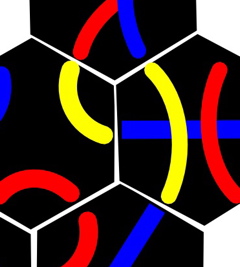
Tantrix: Solve one, solve them all

Image by CS4FN

We’ve seen how Tantrix rotation puzzles can show what we mean by the question “Is P=NP?” It turns out Tantrix rotation puzzles are also something called ‘NP-complete’. That means it is one of a special kind of problem.

NP-complete problems are the really hard ones. Some are also really important to be able to solve quickly. For example, suppose you are a taxi driver and wanted your SatNav to be able to quickly work out the fastest circular route that went via a whole series of places you wanted to visit (in any order), getting you back home. Simple as it sounds, it is an NP-complete problem. It can’t be done quickly even by a fast computer. The best that can be done is to come up with a good answer not a perfect one – using what’s known as a ‘heuristic’. There are lots of ways of coming up with such good answers – using Swarm Intelligence is one way, for example. The point is none can guarantee the best answer every time.

NP-completeness is important because if you could come up with a quick algorithm for solving one NP-complete problem, computer scientists know how to convert such an algorithm into one that solves all the other NP problems…P would equal NP…Trouble is no one has so far done it…

Paul Curzon, Queen Mary University of London, 2007

More on

Magazines …


Our Books …


Subscribe to be notified whenever we publish a new post to the CS4FN blog.


This blog is funded by EPSRC on grant EP/W033615/1.

Solution

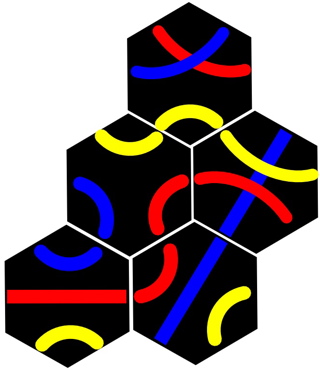
Here’s an answer to the Tantrix Rotation puzzle we set. Of course you already knew that as you had worked it out yourself and once you’d found it it was easy for you to see it was an answer.

Image by CS4FN