Bank holiday bunting appears automatically on the GOV.UK website thanks to a little program! If you’re reading this post today (Monday 21 April 2025) it’s Easter Monday which is a Bank Holiday in England & Wales and in Northern Ireland you have a chance to see it.
The UK Government’s website has a UK Bank Holidays page which lists all the upcoming dates for the next two years’ worth of bank holidays (so people can put them in the diaries) for England & Wales, Northern Ireland and Scotland (the different UK nations share many but not all bank holidays).
But… if you visit the page on a Bank Holiday then you may be met with some bunting, which doesn’t appear if you visit the page on a non-bank holiday day. People who look after the website added in this little Easter egg* over a decade ago and people have been discovering it ever since. They use an Application Program Interface (API) which connects the bank holiday website to a database which lets the website check, whenever there’s a bank holiday, whether it should display bunting. For example Easter Monday is a celebratory day in the Christian calendar but Good Friday isn’t. Both are holidays but it wouldn’t be appropriate for bunting on Good Friday so it gets the instruction “bunting: false” whereas Easter Monday is “bunting: true”. You can see the API’s instructions here.
If you’re reading this post after Easter Monday 2025 you still have more chances to catch the bunting on the Early May bank holiday, the Spring bank holiday, though then you’ll need to wait until August for the Summer bank holiday then a few more weeks before Christmas Day, Boxing Day and New Year’s Day and New Year’s Day – on those days the bunting changes to tinsel!
*it’s not called an Easter egg because it’s there at Easter, the bunting is there at other times too but because it’s something to discover (like Easter Egg Hunts – find ours at The CS4FN Easter Egg Hunt).
– Jo Brodie, Queen Mary University of London
This is an updated version of a snippet that appeared previously on this blog.
Part of a series of ‘whimsical fun in computing’ to celebrate April Fool’s (all month long!).
Subscribe to be notified whenever we publish a new post to the CS4FN blog.
This blog is funded by EPSRC on research agreement EP/W033615/1.
Easter eggs can be chocolate but they are also hidden treasures to be found in games, websites, other software (and now even Lego sets). Especially for Easter we have hidden an Easter Egg in one of our diversity linked pages. Can you find it? Enjoy the hunt! (But if you do find it don’t give it away and spoil the fun for others. Just be quietly pleased at how clever you are!)
The term Easter Egg was coined after Warren Robinett hid the message “Created by Warren Robinett” in the Atari game, Adventure, that he created. He did it as part of a plan he hatched to protest against the Atari policy of the time of not crediting the developers of their games – supposedly so their best people wouldn’t get poached by rivals!! The real purpose of the game was to find a hidden chalice, but the hidden message could be found if the player’s avatar (a square block) stopped over one specific pixel (“the gray dot”) in one specific place in the game.
It was only found (by a player) after Warren had left the company (he hadn’t let on to the management what he had done even when he resigned). Originally the company scrambled to try to re-release the game without the message, but given how expensive that would have been to do, instead they turned it into a feature to whip up more excitement around their games and started to hide similar surprises in other games from then on, calling them Easter Eggs.
As an aside, the wonderful book, Ready Player One by Ernest Cline is based on a plot around finding Easter Eggs. It is a must read for anyone interested in 1980s technology, easter eggs and what a metaverse might one day be actually like to live in. All computer scientists should read it (and only then watch the film which is good, but not as good.)
Subscribe to be notified whenever we publish a new post to the CS4FN blog.
This blog is funded by EPSRC on research agreement EP/W033615/1.
Hint – we think you will never see it without some help.
Mark Rober, an engineer and YouTuber who worked for NASA, has created a dartboard that jumps in front of your dart to land you the best score. Throw a dart at his board and infra-red motion capture cameras track its path, and, software (and some maths) predicts where it will land. Motors then move the dartboard into a better position to up the score in real time!
To track the dart Mark used a motion-capture system with six cameras that respond to infrared instead of light (this let the cameras follow the movement of just the dart, which had a special infrared reflecting surface, and not all the other stuff in the room that would distract a light-sensing camera). He used Matlab to program the maths needed to calculate (very quickly!), from the parabolic path the dart was flying in, where it was about to land, so that the dart board could be moved into place and meet it. The movement of the darts board was controlled by fishing wire (literally) and small motors to pull the board left, right, up or down under the control of an Arduino.
Possibly the most ridiculously over-engineered thing but a lot of fun, even if a bullseye isn’t the highest possible score on a dart board (hitting the bullseye gives you 50 points but landing your dart in the triple 20 segment gives you 60!)
An earlier version of this post originally appeared both on this blog and on the back page of issue 28 of the CS4FN magazine, Cunning Computational Contraptions, a fun look at the history of computational devices which you can download as a PDF from the link below.
This issue of the magazine contains articles about automata, core rope memory (used by NASA in the Moon landings), Charles Babbage’s Analytical Engine (never built) and Difference Engine made of cog wheels and levers, mercury delay lines, standardising the size of machine parts, Mary Coombs and the Lyons tea shop computer, computers made of marbles, i-Ching and binary, Ada Lovelace and music, a computer made of custard, a way of sorting wood samples with index cards and how to work out your own programming origin story….
Part of a series of ‘whimsical fun in computing’ to celebrate April Fool’s (all month long!).
Subscribe to be notified whenever we publish a new post to the CS4FN blog.
This blog is funded by EPSRC on research agreement EP/W033615/1.
Do you know how to make a sandwich? More importantly do you know how to write down a set of precise, detailed instructions that could tell someone else how to make a sandwich? I’m sure you think you could, but after watching this video below you might feel less sure.
This video has been used in some classrooms as a fun way of talking about how precise and correct an algorithm needs to be in order to run a program correctly. Josh, the dad in the video, asks his children (Johnna and Evan) to write out some instructions to make a peanut butter and jelly (jam) sandwich. They all speak the same language (English) so the instructions don’t have to be converted into machine language for the computer (dad) to run the program and make the sandwich, but as you’ll soon see, it’s harder than his children think. They do get there in the end though… kind of.
See if you can write your own set of instructions and then get someone to follow them exactly.
Incidentally, the image used to illustrate this article has been “…assessed under the valued image criteria and is considered the most valued image on Commons within the scope: peanut butter and jelly sandwiches. You can see its nomination here.” Only the best peanut pics on this site! You can see all the images that didn’t win here.
Kew Gardens‘ 404 error page (click here to see it) says “Oops! 404 error. We’ve been doing a bit of website weeding. The content on this page has been uprooted and planted elsewhere. Please keep digging.” The page helpfully links to other pages on their site. Flowers Image by 👀 Mabel Amber, who will one day from Pixabay with writing added by CS4FN.
Have you ever seen a website say “404 – page not found” or something very similar? This can happen if a page has since been moved or deleted, or if you’ve typed the address wrongly so the page can’t be loaded. Most of the time the error messages are fairly dull – some of them might even be slightly useful and point you to the homepage or let you search the website to try and find the page you were looking for.
Sometimes organisations make a bit of an effort and produce an error message that is also entertaining, though, adding delight to the user experience design. For example Kew Gardens keeps the ‘garden’ theme going in its message, and Innocent Drinks has a whole page describing previous errors that the company has made. Lego‘s 404 not found page has a picture of a minifigure dressed as a construction worker who’s looking a bit worried and the page says “We’ll try not to lose our head over this, but if we do… we’ll put it back on.”
‘404’ has become the universal language of ‘something that is not found or cannot be found’. If you are ever in a computer science department that happens to have a Room 404 there’s a very high chance that someone will have jokingly added a post-it note saying “Room not found”.
Incidentally if you were to search on Google Maps for CS4FN’s building (the Peter Landin teaching rooms, originally called the Bancroft Road Teaching Rooms) you’d find that someone has changed our address to 404 Bancroft Road (click the link to see if it hasn’t been changed back since). We’re not sure who did it or why but we’re fairly sure a computer scientist in the department was behind it.
Why “404”?
There may be different reasons that a website can’t load a page and sometimes it can be helpful to know why. You might be reassured to know that the problem isn’t anything to do with you, and to be told that the server that is hosting the pages is busy or down for maintenance and you should come back later. Rather helpfully there is a list of agreed “server response codes” so that whenever a page won’t load a differently numbered message appears depending on the reason.
There are quite a lot of these messages and they all have three digits. If the digit starts with the number 4 then it means that the problem may have come from the user (such as you typing in a web address wrongly so being given the 404 message). If it starts with the number 5 it means a problem on the server’s side and it’s not probably going to be able to show you pages because of a fault. You might also have seen “Error 503 – Service unavailable” – that’s usually a temporary fault just try again later.
Making 404 pages more useful
In 2012 a group of organisations that helps raise awareness about missing children encouraged companies to add some helpful information to their 404 pages so that every time someone landed on their ‘wrong’ page they’d be shown a name and photograph and any relevant information about someone the police and emergency services were trying to locate, and who to call if they knew who they were. What a great idea!
– Jo Brodie, Queen Mary University of London
Part of a series of ‘whimsical fun in computing’ to celebrate April Fool’s (all month long!).
Subscribe to be notified whenever we publish a new post to the CS4FN blog.
This blog is funded by EPSRC on research agreement EP/W033615/1.
Wheel Barometer, also known as Banjo Barometer, Barnasconi, Leeds, c. 1810 – Museum of Science and Industry (Chicago), via Wikimedia Commons under a CC0 licence.
There’s an old science joke about a physics professor who gives, as weekend homework, the task to use a barometer* to measure the height of the physics building. Back in class on Monday the professor invites the students to share their working. The class discuss how they measured the pressure at the base of the building, climbed to the top and measured it again then used a mathematical formula to work out the height. One of the students admitted that he’d saved a bit of time, measurements and calculations by simply knocking on the door of the janitor’s office and saying “If you will tell me the height of this building, I will give you this beautiful barometer.“
Social engineering
One of the simplest and often quickest ways to ‘hack’ into someone’s account doesn’t involve any hacking (or cracking) at all. People lose lots of money, time and anxious sleep to mistakes made because they were distracted and fell for something which was cleverly designed to fool them. Most cyberattacks happen not because someone guessed a password but because someone willingly handed it over.
Phishing attempts can involve little more than making a fake website look like a real one and hoping people don’t notice that the address doesn’t look right. Someone clicks on the link, perhaps in an email or a text message telling them that there’s something wrong with their account that they need to deal with urgently, and enters their email address and password – handing their account details to the scammer. Worse, when people re-use an email address with the same password on multiple sites the scammers suddenly have access to a great deal more of their private information and perhaps even access to their money (e.g. if they have stored payment details with their account).
Back in the 1980s ‘Claire’ managed to hack into a computer network with incredible ease as her son explained in a series of posts. Claire, known as someone who was ‘good with computers’, was invited to a meeting by the CEO of a company that made security systems. She visited his office, taking the lift all the way up to the penthouse office, where he offered her “an eye-watering sum” if she was able to break into his system within a week.
Offer accepted she took the lift all the way down to the building’s basement where the computer lab was. She found a stack of papers and stood outside the lab door looking busy and needing to get on with her work but struggling to get in with all the papers. One of the lab technicians helps her into the room (how kind! she’s ever so grateful!) where she makes her way to an unused computer, sits down and calls out “What’s today’s password?”. And someone tells her. It took her less than 20 minutes!
It is easy to be tricked
I (PC) was at a workshop about security. As part of it we were shown a website that could tell you how safe your password was. It gave an estimate of how long any password could be cracked in. If you typed in 1234 then it would tell you that was cracked in fractions of seconds. A word in any dictionary (even a Tolkien one) likewise. Longer passwords would take longer than shorter ones. Mix in capitals and it would take longer still, and so on. Everyone was told to type in their passwords to find out how good they were at thinking up a password. Virtually everyone did so and many found out that their passwords were not very good… others celebrated the fact that they were good at choosing a password. However, perhaps it didn’t matter either way! Everyone who typed in an actual password had just given away their password to a website that may or may not have been secure…
Never give up your password to anyone and certainly not to a computer program. Don’t even tell others the rules you use to create one!
How do you decide a website is safe? You do not judge it by looking at the website itself. You look elsewhere to a trusted source and find information that way! Either way do not ever enter personal data and passwords into a source unless you are absolutely sure.
You can also try Take Five‘s quiz to see how ‘Scamsceptible’ (susceptible to scams) you are based on how well you slept last night and if you have lots of things on your mind distracting you. Take Five is a campaign to encourage people to pause (and take five minutes) when they get a message they’re not sure about and double-check that it’s genuine.
– Jo Brodie and Paul Curzon, Queen Mary University of London
Part of a series of ‘whimsical fun in computing’ to celebrate April Fool’s (all month long!).
Subscribe to be notified whenever we publish a new post to the CS4FN blog.
This blog is funded by EPSRC on research agreement EP/W033615/1.
One of our tasks here at CS4FN is to proofread our magazines before we put them in the post and send them out to our subscribers. We’re not just checking for spelling (although obviously we check for that too) but we need to make sure that any links will be clickable for the online version of the magazine, that images don’t hide any text, that the text makes sense and that we’ve not used a long complicated word or phrase when a more quotidian* one would do. In short we want you to be able to read, understand and interact with the magazine whether you’re holding it in your hands or turning the pages with a finger-press or mouse-click. And hopefully enjoy it!
Last week we posted about That Time When I Did Not Proofread a change I made to the list of names and addresses to post the magazine to. Today’s post involves a couple of ridiculous examples where people haven’t paid much attention to what a computer is sending to a printer.
Our first example is this pair of probably counterfeit jeans spotted at a market in Thailand. The label is supposed to have a logo on it and it’s likely that the stallholder has an Excel spreadsheet or similar with information about the logos and which labels to print them on.
Unfortunately a bug has meant that instead of printing the actual logo the printer has instead printed the instructions and so the logo, in red at the bottom, is now just this line of code
=IIf(Label="","RMA","?")
Most people’s favourite example of this sort of thing is the cake baked to wish someone’s Aunt Elsa a happy birthday. It didn’t quite go to plan.
But before we meet the cake let’s have a brief detour into how text on a computer can be formatted. If I want to make a word italicised or have it stand out in bold I can do this very easily by selecting the word and pressing an i for italic or b for bold button. On a web page this puts a tiny invisible bit of code on either side of the word, it’s not difficult to see how it works.
One way to write this is to put an < em > code around a word I want to italicise (’em’ for emphasise). Note that I have to write it as < space em space > because if I write it without the spaces then your browser will assume that I want to italicise whatever comes next. I can write it correctly in the display box below though as the browser now knows that I just want to show the bit of code and not run it.
<em>italic</em>
The first < em > means “make everything after this italic” and the final < em > means “end the italic command”.
Ditto for bold.
<strong>bold</strong>
This is HTML or HyperText Markup Language and is one of the tools web designers use to make text on web pages work. HTML code can also be used to add non-standard characters like é or ç to the text too.
This cake takes the biscuit
There are printers that use edible-ink to print text or photographs onto icing to decorate a cake. The intended birthday-cake message was written using Microsoft Word and had a variety of headings, bold words, non-standard characters and so on. Word ‘coded’ these using its own proprietary add-ons for HTML (these are normally invisible and you’d never notice) but unfortunately the printer struggled to make sense of the instructions, as you can see in this image of the cake. Presumably the cake tasted just as delicious either way.
It might seem quite surprising that the bakery didn’t check the message before printing or, once they’d seen the output, consider re-printing and covering up the odd message. However, as the (probably slightly stressed) owner said “We just cut and paste from the email to the program we use for printing the edible images, we are usually in such a hurry that we really don’t have time to check. And if we do the customers yell at us for bothering them.“
But sometimes it can be really, really important to check and double-check before pressing that OK button. Here’s a story about how a full stop (when used as a decimal point) could be the difference between getting the right dose of medicine versus a dangerous overdose.
If you’re in London on Tuesday 6th May you can come to Queen Mary University of London to hear its author (and CS4FN’s co-founder) Paul Curzon give a lecture on The illusion of Good Software Design at CS4FN’s 20th birthday celebration – free! The event is aimed at 11+ (and adults) and features some table magic too. Get yourself a ticket and come along.
There will be cake but we promise to proofread any printed icing first!
What we have here on the right is a water butt also known as a rainwater tank. These are large containers which collect rainwater so are an environmentally friendly way for people to save water so that they can water the plants in their garden during a dryer season. A very clever idea and totally inoffensive.
Context is everything
However… the word ‘butt’ can also refer to your bottom. Well not your bottom of course, I wouldn’t be so rude as to make any comment about your own bottom, I mean bottoms in general.
In the United States a less polite word for bottom is ‘ass’ (which also means ‘donkey’ in the UK) but there are times when saying or writing the word ‘ass’ wouldn’t be so polite and for those situations you might use another word, like butt.
Well that’s probably just making it worse
In an effort to make online communications politer people have tried a variety of tactics. Sometimes a word is on a banned list so if you were to type it into your message it wouldn’t send and you have to come up with a different way of saying it. Or your system could use regular expressions (‘regex’) to find all instances of a word or phrase in published text and replace it with something deemed more appropriate and less offensive.
If you were to replace all instances of ‘ass’ with ‘butt’ in a piece of text you’d increase the politeness of your communication, but you wouldn’t necessarily increase its readability. It’s a clbuttic mistake, produce by a software filter that’s a little too broad in its reach. In that last sentence you can see what happens when I replace the ‘ass’ in classic with ‘butt’ – absolute gibberish.
Of course, people noticed
If you had to write, politely, about clothing you might prefer to put ‘trousers’ rather than ‘pants’ (in the US meaning, rather than underwear) but you might be a bit irritated if your other article on housing referenced ‘occutrousers’ rather than ‘occupants’…
My favourite (real-world) example of this silliness was when a newspaper article referenced the fact that a historical American president had been ‘buttbuttinated’ instead of ‘assassinated’.
Although that really happened and a few other pages on the internet were filled with nonsense words* people did notice pretty quickly (I mean you would, wouldn’t you?!) and rapidly solved it by tweaking their filters to make sure that unwanted words that are found within a word were left alone, and perhaps they did a bit of proofreading to double-check too.
[*mostly it’s now articles like this drawing attention to the problem!]
I’ve made this mistake too
I wish I’d done a bit of proofreading when I did what I thought was a clever ‘find and replace’. A couple of thousand schools and home educators in the UK receive free copies of our printed CS4FN magazine (if your school would like to sign up…) and I keep all the addresses stored in a password-protected spreadsheet with different columns for the name, lines of the address, post code etc.
One day I had the brilliant idea of tidying up the ‘Country’ column in my database so that if someone had typed ‘UK’ it would now say ‘United Kingdom’.
Unfortunately I did this as a ‘global’ (across the entire spreadsheet) find and replace instead of specifying more clearly what should be changed. I didn’t realise until a few magazines came back as undeliverable because the address made absolutely no sense. If your teacher’s name was Luke or your school name or address had a ‘Duke’ in it I had now managed to turn these into “LUnited Kingdome” or “DUnited Kingdome”.
Oops!
The makers of Trivial Pursuit apparently globally replaced all occurrences of “km” to “kilometres” leading to, for example, a question about film star Hugh Jackilometresan.
On April Fool’s Day in 2002 Google ‘admitted’ to its users that the reason their web search results appeared so quickly and were so accurate was because, rather than using automated processes to grab the best result, Google was actually using a bank of pigeons to select the best results. Millions of pigeons viewing web pages and pecking picking the best one for you when you type in your search question. Pretty unlikely, right?
In a rather surprising non-April Fool twist some researchers decided to test out how well pigeons can distinguish different types of information in hospital photographs.
Letting the pigeons learn from training data They trained pigeons by getting them to view medical pictures of tissue samples taken from healthy people as well as pictures taken from people who were ill. The pigeons had to peck one of two coloured buttons and in doing so learned which pictures were of healthy tissue and which were diseased. If they pecked the correct button they got an extra food reward.
Seeing if their new knowledge is ‘generalisable’ (can be applied to unfamiliar images) The researchers then tested the pigeons with a fresh set of pictures, to see if they could apply their learning to pictures they’d not seen before. Incredibly the pigeons were pretty good at separating the pictures into healthy and unhealthy, with an 80 per cent hit rate. Doctors and pathologists* probably don’t have to worry too much about pigeons stealing their jobs though as the pigeons weren’t very good at the more complex cases. However this is still useful information. Researchers think that they might be able to learn something, about how humans learn to distinguish images, by understanding the ways in which pigeons’ brains and memory works (or don’t work). There are some similarities between pigeons’ and people’s visual systems (the ways our eyes and brains help us understand an image).
[*pathology means the study of diseases. A pathologist is a medical doctor or clinical scientist who might examine tissue samples (or images of tissue samples) to help doctors diagnose and treat diseases.]
How well can you categorise?
This is similar to a way that some artificial intelligences work. A type of machine learning called supervised learning gives an artificial intelligence system a batch of photographs labelled ‘A’, e.g. cats, and a different batch of photographs labelled ‘B’, e.g. dogs. The system makes lots of measurements of all the pictures within the two categories and can use this information to decide if a new picture is ‘CAT’ or ‘DOG’ and also how confident it is in saying which one.
Can pigeons tell art apart?
Pigeons were also given a button to peck and shown artworks by Picasso or Monet. At first they’d peck the button randomly but soon learned that they’d get a treat if they pecked at the same time they were shown a Picasso. When a Monet appeared they got no treat. After a while they learned to peck when they saw the Picasso artworks and not peck when shown a Monet. But what happened if they were shown a Monet or Picasso painting that they hadn’t seen before? Amazingly they were pretty good, pecking for rewards when the new art was by Picasso and ignoring the button when it was a new Monet. Art critics can breathe a sigh of relief though. If the paintings were turned upside down the pigeons were back to square one and couldn’t tell them apart.
‘Smithfield Utah’ teapot created by Alan Butler, 2021, photographed by John Flanagan and made available under a CC 4.0 licence, via Wikipedia’s page on the Utah teapot.
My friends and I had just left the cinema after seeing Jurassic Park (in 1993, so a long time ago!) when one of the group pointed out that it was a shame the film didn’t have any dinosaurs in. We all argued that it was full of dinosaurs… until the penny dropped. Of course, obviously, the film couldn’t have contained any real dinosaurs, it was all done with animatronics* and (the relatively new at that time) CGI or computer-generated imagery.
The artist Rene Magritte had the same idea with his famous painting called ‘The treachery of images‘ but mostly known as ‘This is not a pipe’ (or ‘Ceci n’est pas une pipe’ in French). His creation represents a pipe but as Magritte said – “could you stuff my pipe? No, it’s just a representation, is it not? So if I had written on my picture “This is a pipe”, I’d have been lying!”
How do you represent something on a computer screen (that’s not actually real) but make it look real?
[*animatronics = models of creatures (puppets) with hidden motors and electronic controls that allow the creatures to move or be moved]
Let’s talk teapots
Computers now assist film and television show makers to add incredible scenes into their productions, that audiences usually can’t tell apart from what’s actually ‘real’ (recorded directly by the camera from live scenes). All these amazing graphics are created by numbers and algorithms inside a computer that encode the instructions for what the computer should display, describing the precise geometry of the item to create. A mathematical formula takes data points and creates what’s known as a series of ‘Bezier curves‘ from them, forming a fluid 3D shape on-screen.
In the 1970s Martin Newell, a computer graphics researcher studying at the University of Utah, was working on algorithms that could display 3D shapes on a screen. He’d already used these to render in 3D the five simple geometric shapes known as the Platonic solids** and he wanted to test his algorithms further with a slightly more complex (but not too much!) familiar object. Over a cup of tea his wife Sandra Newell suggested using their teapot – an easily recognisable object with curved surfaces, a hole formed by the handle and, depending on where you put the light, parts of it can be lit or in shadow.
Martin created on graph paper a representation of the co-ordinates of his teapot (you can see the original here). He then entered those co-ordinates into the computer and a 3D virtual teapot appeared on his screen. Importantly he shared his ‘Utah teapot’ co-ordinates with other researchers so that they could also use the information to test and refine their computer graphic systems.
[**the teapot is also jokingly referred to as the sixth Platonic solid and given the name ‘teapotahedron’]
Bet you’ve seen the Utah teapot before
Over time the teapot became a bit of an in-joke among computer graphic artists and versions of it have appeared in films and TV shows you might have seen. In a Hallowe’en episode of The Simpsons***, Homer Simpson (usually just a 2D drawing) is shown as a 3D character with a small Utah teapot in the background. In Toy Story Buzz Lightyear and Woody pour a cup of tea from a Utah teapot and a teapot template is included in many graphics software packages (sometimes to the surprise of graphic designers who might not know its history!)
[***”The Simpsons Halloween Special VI”, Series 7 Episode 6]
Here’s one I made earlier
Image by Jo Brodie
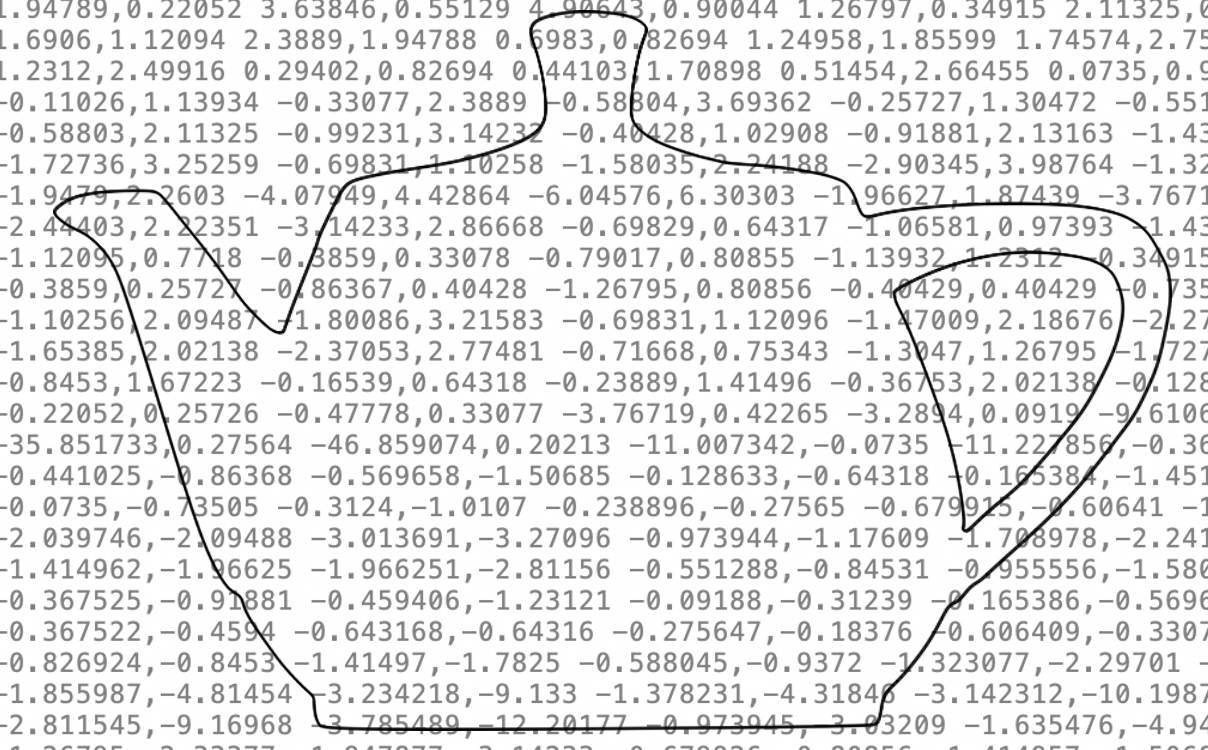
On the left is a tracing I made, of this photograph of a Utah teapot, using Inkscape’s pen tool (which lets me draw Bezier curves). Behind it in grey text is the ‘under the bonnet’ information about the co-ordinates. Those tell my computer screen about the position of the teapot on the page but will also let me resize (scale) the teapot to any size while always keeping the precise shape the same.
Create your own teapot, or other graphics
Why not have a go yourself, Inkscape is free to download (and there are lots of instructional videos on YouTube to show you how to use it). Find out more about Vector Graphics with our Coordinate conundrum puzzles and Vector dot-to-dot puzzles.








_-_DSC06346.JPG)




 cs4fn
cs4fn 


