Successful interactive systems design is often based on detecting a need that really good solutions do not yet exist for, then coming up with a realistic solution others haven’t thought of. The real key is then having the technical and design skill and perseverance to actually build it, as well as the perseverance to go through lots of rounds of prototyping to get it right. Even then it is still a long haul needing different people and business skills to end up with a successful product. Kamal Ali showed how its done with the development of My Salah Mat, an interactive prayer mat to help young children learn to pray.
He realised there was a need watching his 4-year old struggling to get his feet and hands, forehead and nose in the right place to pray: correctly bowing low to God in the direction of Mecca. Instead he kept lying on his tummy. Kamal’s first thought was to try and buy something that would help.
He searched for something suitable: perhaps a mat with the positions marked on in some child friendly way, and was surprised when he could find nothing. Thinking it was a good idea anyway, and with a background in product design, he set about creating a Photoshop prototype himself. One of the advantages of prototyping is that it encourages “design-by-doing” and just in doing that he had new ideas – children need help with the words of prayers too, so why not write them on the mat in child friendly ways. From there realising it could be interactive with buttons to press so it could read out instructions was the next step. After all young children may struggle with reading themselves: it is important to really know your users and what will and will not work for them!
As he was already running a company, he knew how to get a physical prototype made so after working on the idea with a friend he created the first one. From there there were lots more rounds of prototyping to get the look and feel right for young kids, for example, and to ensure it would fill their need really, really well.
He also focussed on the one clear group: of young children and designed for their need. Once that design was successful the company then developed a very different design based on the same idea for adult / reverts. That is an important interaction design lesson. Different groups of potential users may need different designs and trying to design one product for everyone may not end up working for anyone. Find a specific group and design really well for them!
In the process of creating the design Kamal started to wonder why he was doing it. He realised it was not to make money – he was really thinking of it as a social venture. It was not about profit but all about doing social good: as he has said:
” I finally realised that my motivation was to create a high quality product that could help children learn how to pray Salah. Most importantly, children would want to pray and interact with the different aspects of Salah. This was my true motivation and the most important thing to me.”
Great interactive system product design takes inspiration, skill and a lot of perseverance, but the real key is to be able to identify a real unfulfilled need, and come up with realistic solutions that both fill the need and people want. That is not just about having an idea, it is about doing rounds and rounds of prototyping and trial and error with people who will be the users to get the design right. If you do get it right and you can do all sorts of good.
Dan Stowell was a researcher at Queen Mary University of London when he founded an early version of what is now known as a Social Venture: a company created to do social good. With Florence Wilkinson, he turned birdsong into a tech-based social good.
His research is about designing methods that computers can use to make sense of bird sounds. One day he met Florence Wilkinson, who works with businesses and young people, and they discovered they both had the same idea: “What if we could make an app that recognises bird sounds?” They decided to create a startup company, Warblr, to make it happen. However, unlike many research driven startups its main aim was not to make money but to do a social good. Dan and FLorence built this into their company mission statement:
…to reconnect people with the natural world through technology. We want to get as many people outdoors as possible, learning about the wildlife on their doorstep and how to protect it.
Dan brought the technical computer science skills needed to create the app, and Florence brought the marketing and communication skills needed to ensure people would hear about it. Together, they persuaded Queen Mary University of London’s innovation unit to give them a start-up grant. As a result their app Warblr exists and even gained some press coverage.
It can help people connect with nature by helping recognise birds – after all one of the problems with bird watching is they are so damned hard to spot and lots that flit by just look like little brown things! However, they are far easier to hear. Once you know what is out there then it adds incentive to try to actually spot it. However, the app has another purpose too. It collects data about the birds spotted, recording the species and where and when it was seen, with that data then made freely available to researchers.
Social ventures are a relatively new idea that universities are now supporting to help their researchers do social good that is sustainable and not just something that lasts until the grants run out. As Dan and Florence showed though, as a researcher you do not need to commit to do everything. To be a successful innovator you need more than technical skills, though. You need the ability to be part of a great team and to recognise a sound deal!
Updated from the archive, written by Paul Curzon, Queen Mary University of London.
What a mess. There’s flour all over the kitchen floor.A fortnight ago I opened the cupboard to get sugar for myhot chocolate. As I pulled out the sugar, it knocked against thebag of flour which was too close to the edge… Luckily the bagdidn’t burst and I cleared it up quickly before anyone foundout. Now it’s two weeks later and exactly the same thing justhappened to my brother. This time the bag did burst and itwent everywhere. Now he’s in big trouble for being so clumsy!
In safety-critical industries, like healthcare and the airline industry, especially, it is really important that there is a culture of reporting incidents including near misses. It also, it turns out, is important that the mechanisms of reporting issues is appropriately designed, and that there is a no blame culture especially so that people are encouraged to report incidents and do so accurately and without ambiguity.
Was the flour incident my brother’s fault? Should he have been more careful? He didn’t choose to put the sugar in a high cupboard with the flour. Maybe it was my fault? I didn’t choose to put the sugar there either. But I didn’t tell anyone about the first time it happened. I didn’t move the sugar to a lower cupboard so it was easier to reach either. So maybe it was my fault after all? I knew it was a problem, and I didn’t do anything about it. Perhaps thinking about blame is the wrong thing to do!
Now think about your local hospital.
James is a nurse, working in intensive care. Penny is really ill and is being given insulin by a machine that pumps it directly into her vein. The insulin is causing a side effect though – a drop in blood potassium level – and that is life threatening. They don’t have time to set up a second pump, so the doctor decides to stop the insulin for a while and to give a dose of potassium through a second tube controlled by the same pump. James sets up the bag of potassium and carefully programs the pump to deliver it, then turns his attention to his next task. A few minutes later, he glances at the pump again and realises that he forgot to release the clamp on the tube from the bag of potassium. Penny is still receiving insulin, not the potassium she urgently needs. He quickly releases the clamp, and the potassium starts to flow. An hour later, Penny’s blood potassium levels are pretty much back to normal: she’s still ill, but out of danger. Phew! Good job he noticed in time and no-one else knows about the mistake!
Two weeks later, James’ colleague, Julia, is on duty. She makes a similar mistake treating a different patient, Peter. Except that she doesn’t notice her mistake until the bag of insulin has emptied. Because it took so long to spot, Peter needs emergency treatment. It’s touch-and-go for a while, but luckily he recovers.
Julia reports the incident through the hospital’s incident reporting system, so at least it can be prevented from happening again. She is wracked with guilt for making the mistake, but also hopes fervently that she won’t be blamed and so punished for what happened
Don’t miss the near misses
Why did it happen? There are a whole bunch of problems that are nothing to do with Julia or James. Why wasn’t it standard practice to always have a second pump set up for critically ill patients in case such emergency treatment is needed? Why can’t the pump detect which bag the fluid is being pumped from? Why isn’t it really obvious whether the clamp is open or closed? Why can’t the pump detect it. If the first incident – a ‘near miss’ – had been reported perhaps some of these problems might have been spotted and fixed. How many other times has it happened but not reported?
What can we learn from this? One thing is that there are lots of ways of setting up and using systems, and some may well make them safer. Another is that reporting “near misses” is really important. They are a valuable source of learning that can alert other people to mistakes they might make and lead to a search for ways of making the system safer, perhaps by redesigning the equipment or changing the way it is used, for example – but only if people tell others about the incidents. Reporting near-misses can help prevent the same thing happening again.
The above was just a story, but it’s based on an account of a real incident… one that has been reported so it might just save lives in the future.
Report it!
The mechanisms used to do it, as well as culture around reporting incidents can make a big difference to whether incidents are reported. However, even when incidents are reported, the reporting systems and culture can help or hinder the learning that results.
Chrystie Myketiak at Queen Mary analysed actual incident reports for the kind of language used by those writing them. She found that the people doing the reporting used different strategies in they way they wrote the reports depending on the kind of incident it was. In situations where there was no obvious implication that a person made a mistake (such as where sterilization equipment had not successfully worked) they used one kind of language. Where those involved were likely to be seen to be responsible, so blamed, (eg when a wrong number had been entered in a medical device, for example) they used a different kind of language.
In the former, where “user errors” might have been involved, those doing the reporting were more likely to write in a way that hid the identity of any person involved, eg saying “The pump was programmed” or writing about he or she rather than a named person. They were also more likely to write in a way that added ambiguity. For example, in the user error reports it was less clear whether the person making the report was the one involved or whether someone else was writing it such as a witness or someone not involved at all.
Writing in the kinds of ways found, and the fact that it differed to those with no one likely to be blamed, suggests that those completing the reports were aware that their words might be misinterpreted by those who read them. The fact that people might be blamed hung over the reporting.
The result of adding what Christie called “precise ambiguity” might mean important information was inadvertently concealed making it harder to understand why the incident happened so work out how best to avoid it. As a result, patient safety might then not be improved even though the incident was reported. This shows one of the reasons why a strong culture of no-fault reporting is needed if a system is to be made as safe as possible. In the airline industry, which is incredibly safe, there is a clear system of no fault reporting, with pilots, for example, being praised for reporting near-misses of plane crashes rather than being punished for any mistake that led to the near miss.
This work was part of the EPSRC funded CHI+MED research project led by Ann Blandford at UCL looking at design for patient safety. In separate work on the project, Alexis Lewis, at Swansea University, explored how best to design the actual incident reporting forms as part of her PhD. A variety of forms are used in hospitals across the UK and she examined more than 20 different ones. Many had features that would make it harder than necessary for nurses and doctors to report incidents accurately even if they wanted to openly so that hospital staff would learn as much as possible from the incidents that did happen. Some forms failed to ask about important facts and many didn’t encourage feedback. It wasn’t clear how much detail or even what should be reported. She used the results to design a new reporting form that avoided the problems and that could be built into a system that encourages the reporting of incidents . Ultimately her work led to changes to the reporting form and process used within at least one health board she was working with.
People make mistakes, but safety does not come from blaming those that make them. That just discourages a learning culture. To really improve safety you need to praise those that report near misses, as well as ensuring the forms and mechanisms they must use to do so helps them provide the information needed.
Updated from the archive, written by the CHI+MED team.
Magic tricks are just algorithms – they involve a magician following the steps of the trick precisely. But how can a magician be sure a trick will definitely work when they do it in front of an audience? Just like computer scientists who can prove their algorithms always work, a magician can use logic and deduction to be sure their tricks always work too.
Image from Pixabay
Try the following trick on your own first, before reading about how it works or trying it with a volunteer. Take the role of both the magician and volunteer. I will do my best to remote-control the magic via my own mind-meld with you as you read my words, to try and make sure it works for you!
The magical effect
Take a full pack of playing cards and give them a good shuffle. Fan the cards face down. Now ask a volunteer to think of the colour RED and point to a card. Cut the pack at that point and count the top eight cards into a pile face down. Now ask them to think BLACK and touch another card. Cut the pack there and count out 7 cards onto the pile. Repeat this with 6 cards and then 5 cards having them think RED and then BLACK. Have the volunteer shuffle the selected cards then turn the pile face up.
Image by Paul Curzon
You take the cards that are left and shuffle them, keeping them face down. Have the volunteer now run through their cards taking out groups of cards that are together and of the same colour. They should put them either in a “RED” pile in front of them if they are a group of red cards, or in a “BLACK” pile if they are black, telling you how many cards they have placed in that pile. As they take each group of cards, you, focussing hard on your cards, but without looking at what they are, pick out the same number of cards from points through the pack as the volunteer put down, and put them in your own corresponding “RED” or “BLACK” pile in front of you, Place your cards face down. In this way, they end up with a pile of red cards and a pile of black cards, both face up in front of them. You end up with two corresponding face down piles in front of you. They have seen their cards but yours contain cards that you have not seen. Once they have run out of cards and you have placed your matching cards, stop and think for a moment, then go through your two piles and swap two cards without looking at them, saying you believe you made a couple of mistakes and those two ended up in the wrong piles.
Now, looking happy, tell the volunteer that through a mind-meld between you, them and the red and black cards you have, you believe, succeeded in your aim. Remind them that the piles were shuffled, they were responsible for the way the cards were split which was at random, and you haven’t seen any of your cards. One card out at any point and the trick would not have worked. Despite this, announce that you have managed to place the same number of red cards in your red pile as you have placed black cards in your black pile. Pass them the two piles in turn and ask them to check by first counting the red cards in your face down “RED” pile onto the table, and then do the same with the black cards that are in your “BLACK” pile.
Amazingly you have succeeded, the number of red cards in the red pile is the same as the number of black cards in the black pile.
Proving it always works
Did I mind meld with you to make it work? Or is something else going on? We can actually use logic and deduction (with some algebra) to show it works.
First we need to make a mathematical model of the situation – essentially describe the situation, or at least the parts of it that matter, in maths. That sounds a bit scary but it isn’t really. Its just giving names to some piles of cards! Let’s go through it…
In the trick, we end up with four piles of cards. A RED pile and a BLACK pile, both face up, in front of the volunteer and a RED pile and a BLACK pile, both face down, in front of the magician (see the picture above). We do not know how many cards are in each pile and it will be different each time we do the trick anyway because of all the shuffling. Luckily the actual numbers don’t matter. In the trick we care about the numbers of red cards and the numbers of black cards, Let us therefore use mathematical variables to represent these different numbers (that just means give them names!). Mathematicians often use names like x and y for variables, but to help us remember what they stand for we will use variations on R and B to mean numbers of red and black cards respectively.
So, we will use R to stand for the number of red cards in the volunteer’s face up “RED” pile (which are all red) and B to mean the number of black cards in the volunteers face up “BLACK” pile (which are all black).
Now for the magician’s face down piles. They have both red and black cards in each pile so we will write R1 to mean the number of red cards in the magician’s face down “RED” pile and B1 to mean the number of black cards in the magician’s face down “RED” pile. Similarly, we will write R2 to mean the number of red cards in the magician’s face down “BLACK” pile and B2 to mean the number of black cards in the magician’s face down “BLACK” pile. We have the situation as shown below in the picture..
Image by Paul Curzon
In doing this we are doing a form of abstraction – hiding of detail – we have hidden the actual numbers of red and black cards in each pile within our description, describing them with variables as the precise numbers do not matter (and are different every time we do the trick anyway).
So far so good. Now, we want to try and prove that the trick always works. But how to start? First, just think of any facts you know about the situation (and especially anything you know about red and black cards). It may not be obvious how it can help, but write it down anyway!
Well the first thing we know is that a full pack of cards was used, and there are 52 cards in a pack, half (26) red and half (26) black. All these cards ended up on the table in one pile or another. So that means if we add up all the red cards in the four piles it will equal 26. How can we write this in terms of our variables? It is just:
R + R1 + R2 = 26
We add the three variables that stand for numbers of red cards and it equals 26. There are only three things to add for the four piles as one pile is all black. We can say a similar thing about the black cards:
B + B1 + B2 = 26
Now we have two different sums that equal the same thing (26) so we can put them together as equalling each other to get a combined equation which we will call EQUATION 1.
R + R1 + R2 = B + B1 + B2 (EQUATION 1)
That doesn’t seem to tell us much useful, but don’t worry, we are just gathering facts for now. What else do we know about how the trick worked? Well, every time the volunteer put some number of cards in their “RED” pile, the magician puts the same number of cards in their “RED” pile (though those cards may be red or black). That means that, throughout the two “RED” piles hold the same number of cards. The number of cards in one “RED” pile is R and the number of cards in the other “RED” pile is R1 + B1 (the reds plus the blacks in that pile). We can write this out as an equation:
R = R1 + B1
Now, this tells us that R is exactly the same as R1 + B1 so anywhere we see R we can replace it with R1 + B1. In particular, we can make this switch in EQUATION 1 to give:
(R1 + B1) + R1 + R2 = B + B1 + B2 (EQUATION 2)
With the same logical reasoning, we can deduce an equation for the “BLACK” piles too. The number of cards in one “BLACK” pile is B and the number of cards in the other “BLACK” pile is R2 + B2 (the reds plus the blacks in that pile). We can write this out as an equation:
B = R2 + B2
Substituting R2 + B2 for B into EQUATION 2 we get EQUATION 3
Now, this seems to have just made things more complicated and not got us anywhere much, but we can now simplify it. Notice that there are two R1s on one side and two B2s on the other, each added, so we can group them together to get:
2R1 + B1 + R2 = R2 + 2B2 + B1
Also, on each side there is a B1 and that pair can cancel out (just subtract B1 from both sides and the equality holds but it is simpler), and on each side there is an R2 which can cancel in the same way. This leaves us with:
2R1 = 2B2
Of course the multiplication by 2 on both sides cancels too (just divide both sides by 2 and they will still be equal). We get:
R1 = B2
That is a very simple equation. It basically tells us that if you follow the steps of this trick that, whatever numbers of reds and blacks end up in each pile, R1 is guaranteed at the end to be the same number as B2. So what does that mean back in the real world? R1 just stands for the number of red cards in the magician’s “RED” pile. B2 just stands for the number of black cards in the magician’s “BLACK” pile. The equation we are left with just tells us that as long as we follow the steps (actually as long as we make the number of cards in each pair of piles match) then at the end the number of red cards in the magician’s “RED” pile will be the same as the number of black cards in the magician’s “BLACK” pile…and that is the “magical” result we predicted!
The trick will always work if you follow the steps!
Proving software and hardware always works
A magic trick involves the magician following steps precisely – following an algorithm. That is all computer hardware and software do – they follow algorithms to achieve some desired result (a magical effect). Just as we proved the trick always works, we can prove that other algorithms (whether implemented as a program or hardware) work using logical deduction too. That is one of the reasons why logic and deduction are so important to computer scientists. You do not want a trick to go wrong in front of an audience, so it is worth proving it always works. How much more important is it that all that software we now rely on for everyday life is error free. And what about a medical device keeping someone alive, or the software flying a plane. We want to be sure they always work. If they contain mistakes, people die. Logic and proof can therefore save lives, not just magic shows.
We take the Internet for granted now, but it is not that long ago that it did not exist at all. Disabled from birth with spina bifida, Adrian Stokes, OBE was one of the people who helped build it: a celebrated “Internet pioneer”. He was, for example, responsible for setting up the first email service in the UK and so the first transatlantic email system, as well as providing the service linking other universities in the UK to the network making it work as a network of networks in different countries.
He worked on ARPANET, the precursor to the Internet. It was a research project funded by the US department of defence exploring the future of communication networks. Up to that point there were global networks but they were based on what is called circuit switching. Think of an old fashioned telephone exchange, Each person had a direct line – an electrical circuit – connecting them to the operator. When you talked to the operator and asked to talk to someone over the phone, the operator would plug a wire that connected your line to theirs, making a new direct circuit from you to them. When you talked, your voice was converted to an analogue signal (a changing electrical signal) which passed down that wire – along the circuit. Transatlantic telephone cables even allowed circuits, so phone calls, to be set up between countries. Early computers connected to each other, sending data over phone lines in this way by converting them into sounds.
ARPANET worked differently to a circuit-based system. It was a packet switched network. It worked by treating data sent over a network as binary, just as the computer itself does internally. This contrasted with the analogue system then used to send sound over early phones. Importantly, the binary data being sent was divided up into fixed size groups of bits called packets. Each packet was then sent separately over the network. In this system there is no fixed circuit from source to destination that the data travels down, just lots of different computers connected to each other, On receiving packets of data each computer or node of the network passes it on to another until eventually it arrives at the target computer. A key advantage to this is that each of those packets can go by a different route, travelling between different computers. They can even arrive out of order, The data no longer travels along a single circuit. The packets are put back together (in the right order) on reaching the destination, reconstructing the original so that the fact it was ever split up is invisible to the person receiving the data. Extra information is added to the packets beyond the actual data to make the system work: such as a destination address to indicate where it is going to and the number of the packet so the order can be reconstructed if they do arrive out of order. Managing the packets and their journey to the destination is done by software implementing a protocol (a set of communication rules agreed between the computers on the network, that allows them to interpret the streams of bits arriving from other computers).
So ARPANET consisted of a series of computers that acted as nodes of the network. Each had to be programmed with software to run the protocol, passing packets on in their journey to the destination and pulling the original data out and reconstructing it if that computer was their destination. UCL were working with the ARPANET team, exploring how to make it work across continents, so had to program one of their computers to make it an ARPANET node. Once done it could connect to the ARPANET via a satellite link in Norway.
At first, the ARPANET was set up as a way just to access data on other computers as though it was on your own local computer. However, other services could be provided on top of the basic protocols. It just amounts to writing code for your node’s computer to turn data into packets and interpret the data in packets arriving in the way needed for the new application. For example, a way to access files on other computers as though they were on yours were added. Much, much later of course code to allow communication through a web page service was written and the world wide web was born to sit on top of the Internet.
This was one of the jobs Adrian Stokes did. He wrote code for the UCL computers that could treat packets of data as email messages rather than just files. Users could write messages and send them to people on other computers on ARPANET without them needing to know where they actually were. It was the first UK email service.
Once UCL had a link to the ARPANET, they could also extend ARPANET. One of Adrian’s other jobs was in managing onward links around the UK, creating a UK ARPANET network. Researchers in other UK universities could set up their own computers as ARPANET nodes (write and run the software on their computer) and then connect their computers to the UCL one. Networks their computers were linked to could then also connect to the ARPANET. In doing so they created a UK ARPANET network but one that was also connected to the full ARPANET via the UCL computer. It meant, for example, that anyone on the ARPANET in the US could (with permission as UCL added password protection to their node – the first on the ARPANET!) access the powerful IBM System 360/195 computer at the Rutherford and Appleton Labs in Oxfordshire. ARPANET became a transatlantic network of connected networks. Any of those UK universities could also then connect to any computer anywhere on the ARPANET. Their packets just went to the UCL one and then to the US via the satellite link, before being forwarded onwards to other US computers. If these UK university computers had the programs for the file transfer or email services, for example, then they could seamlessly use them to access files anywhere else or send messages to anyone else connected to the ARPANET anywhere.
ARPANET ultimately turned into what we now call the Internet. No single person invented the Internet, it was a massive team effort with lots of people involved each responsible for getting some part of it to work. Those like Adrian who played a critical part in making it work, however, have been recognised as “Internet pioneers”: those who can justifiably claim they were part of the team that invented the Internet, and transformed all our lives as a result.
Herman Hollerith (Image from wikimedia, Public Domain)
Herman Hollerith, the son of immigrants, struggled early on at school and then later in bookkeeping at college but it didn’t stop him inventing machines that used punch cards to store data. He founded a company to make and sell his machines. It turned into the company now called IBM, which of course helped propel us into the computer age.
Hollerith had worked as a census clerk for a while, and the experience led to his innovation. The United States has been running a national census every 10 years since the American Revolution, aiming to record the details of every person, for tax and national planning purposes. It is not just a count but has recorded information about each person such as male/female, married or not, ethnicity, whether they can read, disabilities, and so on.
As the population expanded it of course became harder to do. It was also made harder as more data about each person was being collected over time. For the 1890 census a competition was held to try and find better ways to compile the data collected. Herman Holerith won it with his punch card based machine. It could process data up to twice as fast as his competitors and with his system data could be prepared 10 times faster.
To use the machine, the census information for each person was recorded by punching holes in special cards at specific positions. It was a binary system with a hole essentially meaning the specific feature was present (eg they were married) and no hole meaning it wasn’t (eg they were single). Holes against numbers could also mean one of several options.
Hollerith punched card (Image from wikimedia, Public Domain)
The machine could read the holes because they allowed a wire to make an electrical connection to a pool of mercury below so the holes just acted as switches. Data could therefore be counted automatically, with each hole adding one to a different counter. It was the first time that a system of machine-readable data had been used and of course binary went on to be the way all computers store information. In processing the census his machines counted the data on around 100 million cards (an early example of Big Data processing!). This contributed to reducing the time it took to compile the data from the whole country by two years. It also saved about $5 million
Holerith patented the machine and was also awarded a PhD for his work on it. He set up a company to sell it called the Tabulating Machine Company. Over time it merged with other companies until eventually in 1924 the resulting company changed its name to International Business Machines or is it is now known, IBM. it is of course one of the most important companies driving the computer age, building early mainframe computers the size of rooms that revolutionised business computing, but later also responsible for the personal computer, leading to the idea that everyone could own a computer.
Not a bad entrepreneurship legacy for someone who early on at school apparently struggled with, and certainly hated, spelling – he jumped out of a window at school to avoid doing it. He also did badly at bookkeeping in college. He was undeterred by what he was poor at though and focussed on what he was good at, He was hard working and developed his idea for a mechanical tabulating machine for 8 years before his first machine went to work. Patience and determination was certainly a strength that paid off for him!
By Przemysław Wałęga, Queen Mary University of London
Logical reasoning and proof, whether done using math notation or informally in your head, is an important tool of computer scientists. The idea of proving, however, is often daunting for beginners and it takes a lot of practice to master this skill. Here we look at a simple puzzle to get you started.
Computer Scientists use logical reasoning and proofs a lot. They can be used to ensure correctness of algorithms. Researchers doing theoretical computer science use proofs all the time, working out theories about computation.
Proving mathematical statements can be very challenging, though. Coming up with a proof often requires making observations about a problem and exploiting a variety of different proof methods. Making sure that the proof is correct, concise, and easy to follow matters too, but that in itself needs skill and a lot of practice. As a result, proving can be seen as a real art of mathematics.
Let’s think about a simple puzzle to show how logical thinking can be used when solving a problem. The puzzle can be solved without knowing any specific maths, so anyone can attempt it, but it will probably look very hard to start with.
Before you start working on it though, let me recommend that first you try to solve it entirely in your mind, that is, with no pen and paper (and definitely no computer!).
The Puzzle
Here is the puzzle, which I heard at a New Year’s party from a friend Marcin:
Mrs. and Mr. Taylor hosted a party and invited four other couples. After the party, everyone gathered in the hallway to say their goodbyes with handshakes. No one shook hands with themselves (of course!) or their partner, and no one shook hands with the same person more than once. Each person kept track of how many people they had shaken hands with. At one point, Mr. Taylor shouted “STOP” and asked everyone to say how many people they had shaken hands with. He received nine different answers.
How many people did Mrs Taylor shake hands with?
I will give you some hints to help solving the puzzle, but first try to solve it on you own, and see how far you get. Maybe you will be solve the puzzle on your own?
Why did I recommend solving the puzzle without pen and paper? Because, our goal is to use logical and critical thinking instead of finding a solution in a “brute force” manner, that is, blindly listing all the possibilities and checking each of them to find a solution to the puzzle. As an example of a brute force way of solving a problem, take a crossword puzzle where you have all but one of the letters of a word. You have no idea what the clue is about, so instead you just try the 26 possible letters for the missing one and see which make a word and then check which that do fit the clue!
Notice that the setting of our puzzle is finite: there are 10 people shaking hands, so the number of ways they shake hands is also finite if bigger than say checking 26 different letters of the crossword problem. That means you could potentially list all the possible ways people might shake hands to solve the puzzle. This is, however, not what we are aiming for. We would like to solve the puzzle by analysing the structure of the problem instead of performing brute force computation.
Also, it is important to realise that often mathematicians solve puzzles (or prove theorems) about situations in which the number of possibilities is infinite so the brute force approach of listing them all is not possible at all. There are also many situations where the brute force approach is applicable in theory, but in practice it would require considering too many cases: so many that even the most powerful computers would not be able to provide us with an answer in our lifetimes.
For our puzzle, you may be tempted to list all possible handshake situations between 10 people. Before you do start listing them, let’s check how much time you would need for that. You have to consider every pair that can be formed from 10 people. A mathematician refers to that as “10 choose 2”, the answer to which is that there are 45 possible pairs among 10 people (the first person pairs with 9 others, the next has 8 others to pair with having been paired with the first already, and so on and 9+8+….+1 = 45). However, 45 is not the number that we are looking for. Each of these pairs can either shake hands or not, and we need to consider all those different possibilities. There are 245 such handshake combinations. How big is this number? The number 210 is 1024, so it is approximately 1000. Hence 240=(210)4 (which is clearly smaller than our 245) is approximately 10004 = 1,000,000,000,000 that is, a trillion. Listing a trillion combinations should sound scary to you. Indeed, if you can be quick enough to write each of the trillion combinations in one second, you will spend 31 688 years. Let’s not try this!
Of course, we can look more closely at the description of the puzzle to decrease the number of combinations. For example, we know that nobody shakes hands with their partner, which will already massively reduce the number. However, let’s try to solve the puzzle without using any external memory aids or computational power. Only our minds.
Can you solve it? A key trick that mathematicians and computer scientists use is to break down problems into simpler problems first (decomposition). You may not be able to solve this puzzle straight away, so instead think about what facts you can deduce about the situation instead.
If you need help, start by considering Hint 1 below. If you are still stuck, maybe Hint 2 will help? Answer these questions and you will be a long way to solving the puzzle.
Hints
Mr. Taylor received nine different answers. What are these answers?
Knowing the numbers above, can you work out who is a partner of whom?
No luck in solving the puzzle? Try to spend some more time before giving up! Then read on. If you managed to solve it you can compare your way of thinking with the full solution below.
Solution
First we will answer Hint 1. We can show that the answers received by Mr. Taylor are 0, 1, 2, 3, 4, 5, 6, 7, and 8. There are 5 couples, meaning that there are 10 people at the party (Mr. and Mrs. Taylor + 4 other couples). Each person can shake hands with at least 0 people and at most 8 other people (since there are 10 people, and they cannot shake hands with themselves or their partner). Since Mr. Taylor received nine different answers from the other 9 people, they need to be 0, 1, 2, 3, 4, 5, 6, 7, and 8. This is an important observation which we will use in the second part of the solution.
Next, we will answer Hint 2. Let’s call P0 the person who answered 0, P1 the person who answered 1, …, P8 the person who answered 8. The person with the highest (or the lowest) number of handshakes is a good one to look at first.
Who is the partner of P8? P8 did not shake hands with themselves and with P0 (as P0 did not shake hands with anybody). So P8 had to shake hands with all the other 8 people. Since no one shakes hands with their partner, it follows that P0 is the partner of P8!
Who is the partner of P7? They did not shake hands with themselves, with P0 and with P1, because we already know that P1 shook hands with P8, and they shook hands with only one person. So the partner of P7 can be either P8, P0, or P1. Since P8 and P0 are partners, P7 needs to be the partner of P1.
Following through with this analysis for P6 and P5, we can show that the following are partners: P8 and P0, P7 and P1, P6 and P2, P5 and P3. The only person among P0, … , P8 who is left without a partner is P4. So P4 needs to be Mrs. Taylor, the partner of Mr. Taylor, the one person left who didn’t give a number.
Consequently, we have also showed that Mr Taylor shook hands with 4 people.
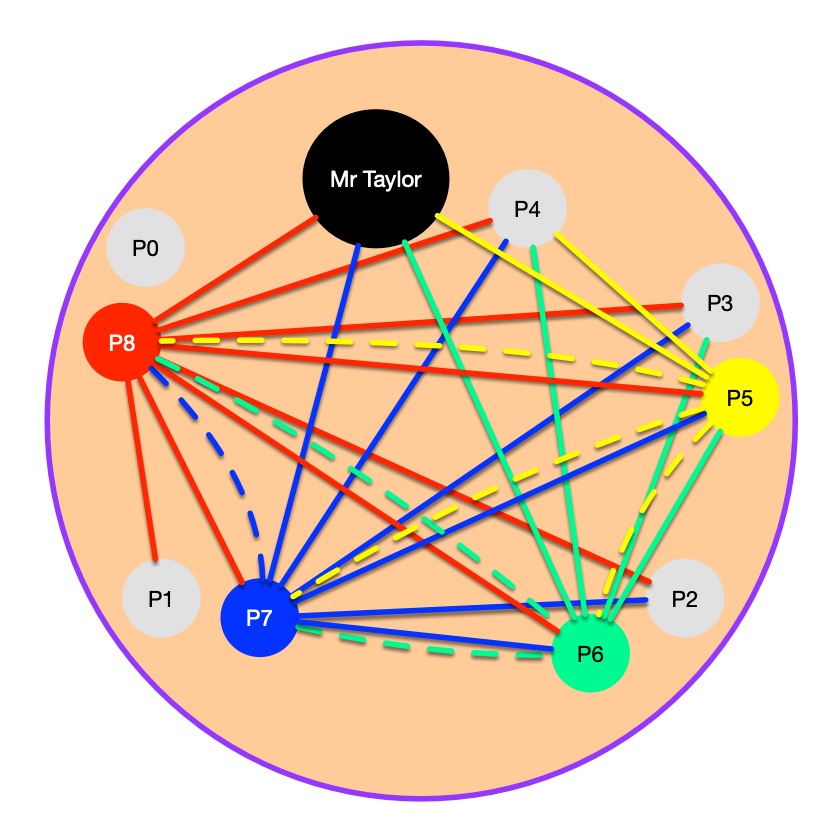
Observe that the analysis above does not only provide us an answer to the puzzle, but it also allows us to uniquely determine the handshake setting as presented in the picture below (called a graph by Computer Scientists). Here, people are nodes (circles) and handshakes are represented as edges (lines) in the graph. Red edges correspond to handshakes with P8, blue edges are handshakes with P7, green with P6 and yellow with P5. Partners are located next to each other, for example, Mr. Taylor is a partner with P4.
Image by CS4FN
Large Language Models
Although this article is about logical thinking, and not about tools to solve logic puzzles, it is interesting to see if current AI models are capable of solving the puzzle. As puzzles go it is relatively easy and occurs on the Internet in different settings and languages, so large language models (LLMs) trained on the Internet should be good at solving it. Let’s test them!
I asked ChatGPT-4o and Gemini 1.5 Flash to solve the puzzle. To my surprise, both of them did struggle. They had problems with understanding some parts of the problem formulation and made mathematical mistakes.
ChatGPT seems to wrongly assume that Mr. Taylor answered his own question about the number of handshakes, and so, that each of 10 people announced a different number of handshakes. As follows from our solution of the puzzle, there exists exactly one graph representing the handshake situation. In this graph, the number of handshakes of Mr. and Mrs. Taylor is the same, namely 4. Hence, the additional assumption made by ChatGPT (that each of 10 people had a different number of handshakes) makes the situation described in the puzzle impossible. Interestingly, ChatGPT was able to solve such an impossible puzzle providing a correct answer… Does it mean that ChatGPT has solved the puzzle?
Gemini, in contrast, states that the puzzle cannot be solved without more information such as the order of arrivals. This is clearly wrong. We know how to solve the puzzle and the order of arrivals is actually completely irrelevant to the puzzle!
This small experiment uses basic LLMs and does not aim to draw any conclusions about their capabilities. I am quite certain that one can find an LLM that can solve this simple puzzle without mistakes. However, this experiment aims to emphasise the need for checking AI solutions yourself. To do that you need to gain the skills of doing proof yourself!
In what follows I provide answers obtained from AI models and highlight as bold parts which are wrong assumptions or reasoning.
Solution by ChatGPT:
Key Observations:
There are 10 people in total at the party (5 couples: Mr. and Mrs. Taylor and 4 other couples).
No one shakes hands with their own partner.
No one shakes hands with themselves or the same person more than once.
The handshake answers must be unique and range from 0 to 9 (since there are 10 people, including Mr. and Mrs. Taylor).
Solution:
Since there are 10 people total, the number of handshakes any one person could have ranges from 0 to 9.
If everyone gives a unique answer, it means:
One person shook hands with 0 people.
Another shook hands with 1 person.
Another with 2, and so on, up to 9.
Steps:
The person who shook hands with 9 people: This person shook hands with everyone else, meaning their partner (who doesn’t shake hands with them) must have shaken hands with 0 people.
The person who shook hands with 8 people: This person shook hands with everyone except their partner and the person who shook hands with 0.
By continuing this pattern, we see that for every unique count of handshakes k, the person with k handshakes corresponds to a partner with 9−k handshakes.
Mrs. Taylor’s Handshakes:
Mr. Taylor shouted “STOP” after collecting answers from all 10 people. Since there are 9 different handshake counts, one of those counts must belong to Mrs. Taylor.
Let’s assume Mr. Taylor is among the group and is the one with the maximum or minimum handshakes.
The pairing pattern ensures Mrs. Taylor’s number of handshakes must fall within the range, but based on symmetry of couples logic !
The key is to match couples symmetrically:
If Mr. Taylor gets answers (0, 1, 2,…
Let’s refine the solution:
The possible handshake counts are 0,1,2,…,9, ensuring each number is unique.
The pairing works such that if one person shakes k hands, their partner shakes 9-k hands.
This logic means:
The person who shook 9 hands paired with the person who shook 0.
The person who shook 8 hands paired with the person who shook 1, and so on.
Mrs. Taylor’s Count:
If there are nine unique handshake counts (from 0 to 9), Mrs. Taylor must have shaken 4 hands because her partner, Mr. Taylor, who controls the setup, must fall at the midpoint to allow symmetrical pairing logic.
Solution by Gemini:
Certainly, let’s solve the handshake puzzle!
Understanding the Problem:
We have 10 people at the party (Mr. and Mrs. Taylor, plus 4 other couples).
No one shakes hands with themselves or their partner.
No one shakes hands with the same person more than once.
Each person keeps track of how many handshakes they’ve done.
Mr. Taylor asks everyone how many handshakes they’ve done, and gets 9 different answers.
We need to figure out how many handshakes Mrs. Taylor did.
Let’s Analyze:
The key to solving this is to consider the possible range of handshakes each person could have.
Lowest Possible Handshakes: If someone is the first to arrive and doesn’t shake hands with anyone else, they’ll have 0 handshakes.
Highest Possible Handshakes: The maximum number of handshakes depends on the order of arrivals and who shakes hands with whom. In the most efficient scenario, everyone could shake hands with everyone else except their partner. This would lead to a maximum of 8 handshakes for each person.
Now, let’s consider the 9 different answers:
Since there are 9 different answers, and the minimum is 0, the maximum number of handshakes someone could have is 8.
Let’s think about Mrs. Taylor:
She can’t have 0 handshakes because she would have to shake hands with someone eventually.
She can’t have 8 handshakes because Mr. Taylor would have to have the same number (since they are the only couple).
Therefore, Mrs. Taylor must have shaken hands with a number between 1 and 7.
Unfortunately, without more information about the order of arrivals and who shook hands with whom, we can’t pinpoint the exact number of handshakes Mrs. Taylor did.
Let me know if you’d like to explore a specific scenario with a particular order of arrivals and handshakes to determine Mrs. Taylor’s exact number!
Wearable computing is now increasingly common whether wearing smart watches or clothes that light up. The pioneer of the latter was Japanese artist, Tanaka Atsuko, with her 1950s art work, Electric Dress. It was anything but light though, weighing 50-60kg, clothing her head to foot in a mixture of fluorescent and normal light bulbs.
She was a member of the influential Gutai (meaning concrete as opposed to abstract) Art Association and Zero Society of Japanese artists who pioneered highly experimental performance and conceptual art, that often included the artist’s actual body. The Electric Dress was an example of this, and she experimented with combining art and electronics in other work too.
Atsuko had studied dress-making as well as art, and did dress making as a hobby, so fashion was perhaps a likely way for her to express her artistic ideas, but Electric Dress was much more than just fashion as a medium for art. She had the idea of the dress when surrounded by the fluorescent lights in Osaka city centre. She set about designing and making the dress and ultimately walked around the gallery wearing it when it was exhibited at the 2nd Gutai Art Exhibition in Tokyo. Once on it flashed the lights randomly, bathing her in multicoloured light. Wearing it was potentially dangerous. It was incredibly hot and the light was dazzling. There was also a risk of electrocution if anything went wrong! She is quoted as saying after wearing it: “I had the fleeting thought: Is this how a death-row inmate would feel?”
It wasn’t the first time, electric lights had been worn, since as early as 1884 you could hire women, wearing lights on their heads powered by batteries hidden in their clothes, to light up a cocktail party, for example. However, Tanaka Atsuko’s was certainly the most extreme and influential version of a light dress, and shows how art and artists can inspire new ideas in technology. Up to then, what constituted wearable computing was more about watch like gadgets than adding electronics or computing to clothes.
Now, of course, with LEDs, and conductive thread that can be sewn into clothes and special micro-controllers, an electric dress is both much easier to make, and with programming skill you can program the lights in all sorts of creative ways. One example is a dress created for a BBC educational special of Strictly Come Dancing promoting the BBC micro:bit and showing what it was capable of with creativity. Worn by professional dancer, Karen Hauer, in a special dance to show it off, the micro:bit’s accelerometer was used to control the way the LEDs covering the dress in place of sequins, lit up in patterns. The faster she spun while dancing the more furious the patterns of the lights flashing.
Now you can easily buy kits to create your own computer-controlled clothes with online guides to get you started, so if interested in fashion and computer science why not start experimenting. Unlike Tanaka Atsuko you won’t have to put your life at risk for your art and wearable computing, overlapping with soft robotics is now a major research area, so it could be the start of a great research career.
Electric Dreams covers artists use of machines to create art over the second half of the 20th century, covering a wide range of styles and ideas often involving light and motion in thought-provoking ways. The exhibition ranges from the early wearable art of Atsuko Tanaka – a 1956 Electric Dress that coated the wearer in lights (before the age of LEDs so it was a weighty 60 kg) through the first computer choreography of dance; Hirosho Karano’s program that painted like Mondrian; the Art of Harold Cohen’s program Aaron, the first AI artist creating physical art, to Rebecca Allen’s early use of motion capture in art from 1982 and beyond.
While there you should visit Anthony McCall’s Solid Light exhibition. Using just 35 mm film projected in dark smoky rooms he creates an amazing immersive experience that is fun for toddlers and adults alike. It consists of changing sculptures made of slowly moving, curved walls of light that the viewer walks, around, in and through. Sit and watch or interact yourself and become part of the art. It is playful, awe-inspiring and thought-provoking all at once. Exactly what I think the best art should be.
If you want a first experience of an art gallery for a three-year old then you would struggle to do better than a visit to the Tate Modern. Start with Solid Light, followed by visiting the room in Electric Dreams containing Carlos Cruz-Diez’s work where you play with large white balloons in a space full of continuously moving lines of light.
If you thought that machines were replacing artists then think again. The best artists may be using technology, but they go way beyond anything technology itself can do alone and I imagine will be for a long time to come. Combine Computer Science or Electronic Engineering with Creative, Media Art skills, and perhaps you could be one of the future pioneer artists using the new technology of the future in exciting ways.
Alexander Graham Bell was inspired by the deafness of his mother to develop new technologies to help. Lila Harrar, then a computer science student at Queen Mary, University of London was also inspired by a deaf person to do something to make a difference. Her chance came when she had to think of something to do for her undergraduate project.
Sign language relief sculpture on a stone wall: “Life is beautiful, be happy and love each other”, by Czech sculptor Zuzana Čížková on Holečkova Street in Prague–Smíchov, by a school for the deaf Image (cropped) ŠJů, Wikimedia Commons, CC BY-SA 3.0 https://creativecommons.org/licenses/by-sa/3.0, via Wikimedia Commons
Her inspiration came from working with a deaf colleague in a part-time job on the shop floor at Harrods. The colleague often struggled to communicate to customers so Lila decided to do something to encourage hearing as well as deaf people to learn Sign Language. She developed an interactive tutor program that teaches both deaf and non-deaf users Sign Language. Her software included games and quizzes along with the learning sections- and she caught the attention of the company Microbooks. They were so impressed that they decided to commercialise it. As Lila discovered you need both creativity and logical thinking skills to do well at Computer Science – with both, together with a bit of business savvy, perhaps you could become the country’s next great innovator.
– Peter W. McOwan and Paul Curzon, Queen Mary University of London














 cs4fn
cs4fn 