A Godlike Heart

A short story by Rafael Pérez y Pérez of the Universidad Autónoma Metropolitana, México translated from the original Spanish by Paul Curzon, Queen Mary University of London

(From the archive)

Mexican deity Quetzalcoatl
Image by Alexa from Pixabay

Divinity, all the gods and all the forces that man fails to understand, are sources of inspiration, a supreme gift which can be introduced in the heart or movement of men to make them a yoltéotl, a “heart deified”. (Miguel León-Portilla, The Old Mexican, Mexico: FCE, 1995 page 180)

Part I

Allow me a moment, Your Excellency. Now that I’m older, it’s hard to remember. But don’t worry, I will tell the whole story so that your priests can record it.

It all started that afternoon, on the day of Huey Tozoztli, just before the celebration to the maize goddess Centéotl. On the horizon you could see large pools of blood – the result of the endless struggle of the gods maintaining order in the cosmos – which, when mixed with the clouds and rays of sunshine on the background blue of the universe, drenched the sky with reddish, orange and yellow. As usual, I spent most of my free time watching everything that went on in Tlatelolco market.

What most caught my attention amongst that huge convergence of smells, sounds and forms were grasshoppers; not only lovely to eat roasted on a tortilla, but also alive and full of dynamism, sometimes in the air and sometimes on the floor, sometimes in flight and sometimes sluggishly bound to the Earth – watching me. I was mesmerised for hours. I would line them up in rows of three insects, each row identified by a symbol and each grasshopper with its own number. I then watched the various patterns that arose when some reacted and tried to flee, “grasshoppers 1 and 3 in the first row jumped, while grasshopper 2 did not move.” Sometimes they were impossible to control!

That afternoon I came across Donají, the daughter of a famous Jaguar Knight. She wore a shawl across her shoulders so that you could barely see the long necklace of seashells hanging from her neck that, all tangled up, reached to just above her ankles. To see her made my heart begin to beat so, so fast! Although it was not the first time I had seen her, I had never had the opportunity to introduce myself. I stood beside her, but my mouth failed to produce a sound. No doubt she noticed my nervousness. I spent anxious moments just stuttering, until I said, ‘I’m Tizoc’. A grin spread across her face and she continued on her way without a word. She had ignored me! I felt humiliated. Who was Donají to treat me that way! I wanted to run and hide. Despite her arrogance, I felt a great attraction to her; I promised that one day I would show her who Tizoc really was and how wrong she was to treat me that way.

Part II

Several moons passed when one morning I woke up to hear a terrifying story: Donají had been kidnapped by a thug who was sentenced to death! A search was immediately organised, directed by her father, the great Jaguar Knight, which everyone joined. Eight units were formed. I was assigned to the group that went to Coyoacan. Once there, the warrior commanded us to spread out throughout the area in pairs to speed the search of the area. Because of my youth and inexperience I was appointed as an assistant to Sayil, a retired warrior of the Mexican army. We spent the first night by a stream. While looking for some dry branches to make a fire, I kept wondering how Donají would be feeling. After eating some fruit and roasted snake, I decided to distract myself and I started to enjoy my favourite pastime: watching the world! I was absorbed by a group of fireflies: while flying they would disappear without a trace only to then appear from nowhere. They formed groups of flying dancers in the darkness, following the rhythm of imaginary drums with lit torches plugged into their bodies. It seemed like a ceremony executed by priests in honour of some deity. I was completely immersed in my thoughts, admiring the ritual, when I discovered something surprising: fireflies and crickets share an essence! Grasshoppers jump or stand still on the ground; the flying fireflies were lit or unlit. In both cases, part of their behaviour can be described in terms of two states: jumping or landing; lit or unlit. It was what the priests called the divine essence! I was completely absorbed in my thoughts, when a voice interrupted me:

– ‘Tizoc, are you all right?’, asked Sayil.

– ‘I’m watching the fireflies: I want to see what they can communicate to me’, I replied.

– ‘Communicate?’

– ‘See how some fireflies are lit and others are off. Imagine that if two fireflies flying next to each other are on. We are receiving the message: ‘We are happy’. Now, imagine that we have three fireflies, one lit, then another lit but the third not lit. They are wanting to confess to us: “Walk to the lake and you will find a basket full of cocoa”. We both laughed. I continued: ‘We should call this “the behaviour of the two states.”‘

– ‘I once saw a fortune-teller use the same method’, commented Sayil yawning. I listened intently. ‘He had three figurines made of opossum bones representing Tlahuizcalpantecuhtli, the malevolent God of Venus, who fires darts both at people and at other objects, causing bad things to happen. People asked the fortune-teller questions like “Will the harvest be good this year?” Then he put the figurines in a jar and tossed them: he predicted the future based on how many landed on their back and how many fell on their front – or in terms of fireflies, how many were lit and how many unlit – together with the order in which they fell.’

Sayil’s words left me paralysed for a moment: the priests communicated with the deities through messages made of patterns represented as two states! I was excited and shouted:

– ‘I knew that the grasshoppers and fireflies were connected with the gods!’

Sayil didn’t really understand what I was saying, and he was too tired to ask. A few minutes later he fell asleep, though I only went to sleep late in to the night.

Very early the next morning we continued the search. In some thickets we found the necklace of seashells that I had seen Donají wearing in the market. After a while we came to a crossroads; Sayil, despite all his experience, was not sure which way to turn. So I suggested:

– ‘Let’s ask the gods which path is the right one’.

– ‘What do you mean?’

I pulled out a small leather pouch containing three round stones, which the night before I had painted on one side with green dye made from vegetable plants. I had left the other side its natural grey colour. I put them into a jar and threw them so they landed in a line and said:

– ‘If the green painted side is facing up, it is equivalent to a firefly turned on. If the grey side is exposed it is equivalent to an off’.

– ‘You want to play the soothsayer? We don’t know how to interpret the gods!’

– ‘But we can ask them to guide us’, I said.

– ‘How?’ The warrior asked impatiently.

– ‘Assign to each of the five directions of the universe, a pattern in the stones. Implore the gods for their advice and throw them. I am sure the pattern representing the direction that arises will give us the correct way to go. It is the same as it was when the soothsayer asked about the harvest.’ Sayil didn’t seem to understand my idea, so I continued saying: ‘the combination of stones grey-grey-grey represents the centre, that is, stay where we are. Grey-grey-green means walking towards where the nomadic people are, to the north. Grey-green-grey means walk towards the Zapotec lands in the South. Grey-green-green, means walk to where Tonatiuh, the Sun God emerges, and green-grey-grey means walk in the opposite direction.

I clearly remember that Sayil thought this seemed a silly idea. However, time was short and we didn’t have another way to decide which road to take. So, rather than do nothing he decided to go with my idea:

– ‘How will we know how many steps to go?’ He asked now even more impatiently.

– ‘Once we know the direction we go back to throwing stones. There are eight possible patterns.’

– ‘How do you know?’

– ‘Believe me. I spent a long time watching the grasshoppers jumping! Each pattern represents a number from zero to seven. Then, if we get the pattern 0 we move 20 steps; if pattern 1 appears move 40 steps; if 2 appears we move 80 steps, and so on.

– ‘Tizoc, I think you’ve lost your mind’, Sayil said desperately.

– ‘Trust me. So the first throw will be a statement that tells us where to walk. The second will tell us the number of steps forward. We continue doing this until the instruction appears as the green-green-green pattern, which will mean we have received all the directions.

I put the pebbles in a jar, prayed to the gods for help and threw:

– ‘Grey-green-grey. We have to move towards the land of the Zapotecs! Now, let’s see how many steps: green-green-green, it means …2,560 steps’. I went back to throwing the stones: ‘then we head towards where Tonatiuh rises and walk … 640 steps’.

– ‘Tizoc, are you going to spend all morning throwing stones while Donají is about to die? When are you going to finish this?’

– ‘When the gods tell me to.’

I threw the stones again and to Sayil’s surprise the green-green-green combination appeared: end of the message! We followed the instructions sent by our gods and even though I hadn’t been able to make Sayil believe, we did finally find the hideout of the kidnapper.

Donají was inside a small cave whose entrance was blocked; on seeing her my heart began to pound! Unfortunately, a surprise awaited us, we saw that the kidnapper had two accomplices: this complicated things greatly as we would need support for the rescue. We decided Sayil would go for help while I stayed to monitor the situation, so without wasting more time my partner set off.

Near dark I tried to get as close as possible to let Donají know that she would soon be rescued; I was sure she would be glad of my presence. Unfortunately, one of the thugs discovered me. I was immediately thrown into the cave:

– ‘What are you doing here?’ She asked, shocked to see me.

– ‘Donají! Don’t worry; help will be here soon’, I replied, stuttering again! She immediately realised that there was no else out there to rescue us. Her face contorted in anger and she shouted:

– ‘Why didn’t you go in search of my father instead of getting caught!’

She burst into a flood of tears, weeping and weeping for a long time until she finally fell asleep. I felt a failure. But I swore by the gods to get her out of there!

I tried to stay calm when the three thugs approached: first the leader, who was very young; then a burly one, who seemed a bit of an idiot; and finally a slave who, I suppose, had simply taken the opportunity to get away. The idiot and slave dragged me out of the cave and tied me by my wrists to a tree branch. The noise woke up Donají. I was very scared. The leader began to punch me in the stomach. He wanted to know how many people knew the hiding place. I will never give him the information he wants I told myself. He repeatedly punched me until he grew bored. Then he took a leg of venison, clutching the hoof tightly with both hands he crashed it into my nose! I thought I would die! Donají screamed desperately until finally they took me back to the cave.

From the twisted material of her shawl she made presses and bandages. She wiped my face carefully and all my wounds trying to stem the bleeding. She spent the whole night giving me water to drink and mopping my brow. I will never forget her courage and fortitude! Unfortunately, the next morning, things got worse:

– ‘Tizoc, we have to get up.’

– ‘Are we leaving? Where are we going?’

– ‘I overheard them say that we will go to a valley that is a half-day along the path to Totolhuacalco. The sky is cloudy, so surely it will rain later. If we start today, there is no way anyone will work out where we have gone.’

The situation was critical and I had to come up with something before we left …

Part III

The next day, we were already installed in the new hideout, watching our new surroundings when Donají asked:

– ‘What are your thinking about, Tizoc’?

– ‘The gods have sent me a vision’, I answered.

– ‘A vision? What do you mean?’

– ‘Listen: today, at dawn, Sayil arrived with reinforcements to our former hideout, but was surprised to find it abandoned. Now how could he find us? The rain had washed away all traces of our departure. How would he explain to the great Jaguar Knight that he had lost the trail of his daughter? Sayil and the others, now desperate, reviewed the surroundings and, entering the cave where we had stopped, discovered some strange signs.’

– ‘Do you mean the symbols you drew on the wall?’

– ‘That’s right! One of the soldiers said “It looks like a big fly”. Sayil immediately understood the meaning of the drawings and shouted “No, it’s a firefly!”‘

– ‘What are you talking about?’ Donají asked confused.

At that moment we heard loud cries and Sayil, along with a group of Mexica warriors, began the attack on the new hideout. The slave tried to flee, but was captured immediately; the idiot resisted, but the warriors took a stone and split his head in two; the leader tried to attack Donají, but Sayil grabbed him and strangled him. In just a few moments it had all ended for the trio! Donají wept with happiness. My plan had worked! I was ecstatic! I had finally shown to Donají my worth! It was an unforgettable day for me.

How did they find us? Let me explain, Your Excellency, just let me drink a little water … thank you. It all happened as follows. That day I had to devise a way to communicate to Sayil where we were being taken. I was well aware that our lives depended on it, but was paralysed. Unexpectedly, I heard what I thought was a message from the gods: grasshoppers singing! Two states! That was the solution! I estimated the number of steps required to travel half a day along the Totolhuacalco path and using the same code that Sayil and I had used to find Donají, I left the approximate position of our new location on the cave wall! The kidnappers never suspected that those drawings were instructions of how to find us. So Sayil was given the key to finding us! … Thank you, Your Excellency! I know it was ingenious. Thank you very much. Am I sorry? … What do you mean? “What happened to Donají?”… Your question opens old wounds. I think that you and your brothers would never understand what I mean when I say that, although I never saw her again, my heart was forever linked to hers. I’m tired. With your permission, I would like to go to sleep now.

Two states: divine essence! What can they teach us? What wonders can man create with them? Because while enduring the fifth sun, hearts will be deified. (Tizoc)

The End.

More on …

Related Magazines …


EPSRC supports this blog through research grant EP/W033615/1. 

Mary Clem: getting it right

by Paul Curzon, Queen Mary University of London

Mary Clem was a pioneer of dependable computing long before the first computers existed. She was a computer herself, but became more like a programmer.

A tick on a target of red concentric zeros
Image by Paul Curzon

Back before there were computers there were human computers: people who did the calculations that machines now do. Victorian inventor, Charles Babbage, worked as one. It was the inspiration for him to try to build a steam-powered computer. Often, however, it was women who worked as human computers especially in the first half of the 20th century. One was Mary Clem in the 1930s. She worked for Iowa State University’s statistical lab. Despite having no mathematical training and finding maths difficult at school, she found the work fascinating and rose to become the Chief Statistical Clerk. Along the way she devised a simple way to make sure her team didn’t make mistakes.

The start of stats

Big Data, the idea of processing lots of data to turn that data into useful information, is all the rage now, but its origins lie at the start of the 20th century, driven by human computers using early calculating machines. The 1920s marked the birth of statistics as a practical mathematical science. A key idea was that of calculating whether there were correlations between different data sets such as rainfall and crop growth, or holding agricultural fairs and improved farm output. Correlation is the the first step to working out what causes what. it allows scientists to make progress in working out how the world works, and that can then be turned into improved profits by business, or into positive change by governments. It became big business between the wars, with lots of work for statistical labs.

Calculations and cards

Originally, in and before the 19th century, human computers did all the calculations by hand. Then simple calculating machines were invented, so could be used by the human computers to do the basic calculations needed. In 1890 Herman Hollerith invented his Tabulator machine (his company later became computing powerhouse, IBM). The Tabulator machine was originally just a counting machine created for the US census, though later versions could do arithmetic too. The human computers started to use them in their work. The tabulator worked using punch cards, cards that held data in patterns of holes punched in to them. A card representing a person in the census might have a hole punched in one place if they were male, and in a different place if they were female. Then you could count the total number of any property of a person by counting the appropriate holes.

Mary was being more than a computer,
and becoming more like a programmer

Mary’s job ultimately didn’t just involve doing calculations but also involved preparing punch cards for input into the machines (so representing data as different holes on a card). She also had to develop the formulae needed for doing calculations about different tasks. Essentially she was creating simple algorithms for the human computers using the machines to follow, including preparing their input. Her work was therefore moving closer to that of a computer operator and then programmer’s job.

Zero check

She was also responsible for checking calculations to make sure mistakes were not being made in the calculations. If the calculations were wrong the results were worse than useless. Human computers could easily make mistakes in calculations, but even with machines doing calculations it was also possible for the formulae to be wrong or mistakes to be made preparing the punch cards. Today we call this kind of checking of the correctness of programs verification and validation. Since accuracy mattered, this part of he job also mattered. Even today professional programming teams spend far more time checking their code and testing it than writing it.

Mary took the role of checking for mistakes very seriously, and like any modern computational thinker, started to work out better ways of doing it that was more likely to catch mistakes. She was a pioneer in the area of dependable computing. What she came up with was what she called the Zero Check. She realised that the best way to check for mistakes was to do more calculations. For the calculations she was responsible for, she noticed that it was possible to devise an extra calculation, whereby if the other answers (the ones actually needed) have been correctly calculated then the answer to this new calculation is 0. This meant, instead of checking lots of individual calculations with different answers (which is slow and in itself error prone), she could just do this extra calculation. Then, if the answer was not zero she had found a mistake.

A trivial version of this general idea when you are doing a single calculation is to just do it a second time, but in a different way. Rather than checking manually if answers are the same, though, if you have a computer it can subtract the two answers. If there are no mistakes, the answer to this extra check calculation should be 0. All you have to do is to look for zero answers to the extra subtractions. If you are checking lots of answers then, spotting zeros amongst non-zeros is easier for a human than looking for two numbers being the same.

Defensive Programming

This idea of doing extra calculations to help detect errors is a part of defensive programming. Programmers add in extra checking code or “assertions” to their programs to check that values calculated at different points in the program meet expected properties automatically. If they don’t then the program itself can do something about it (issue a warning, or apply a recovery procedure, for example).

A similar idea is also used now to catch errors whenever data is sent over networks. An extra calculation is done on the 1s and 0s being sent and the answer is added on to the end of the message. When the data is received a similar calculation is performed with the answer indicating if the data has been corrupted in transmission. 

A pioneering human computer

Mary Clem was a pioneer as a human computer, realising there could be more to the job than just doing computations. She realised that what mattered was that those computations were correct. Charles Babbages answer to the problem was to try to build a computing machine. Mary’s was to think about how to validate the computation done (whether by a human or a machine).

More on …

Related Magazines …


EPSRC supports this blog through research grant EP/W033615/1. 

Black in Data

by Paul Curzon, Queen Mary University of London

Careers do not have to be decided on from day one. You can end up in a good place in a roundabout way. That is what happened to Sadiqah Musa, and now she is helping make the paths easier for others to follow.

Lightbulb in a black circle surrounded by circles of colour representing data

Image based on ones by Gerd Altmann from Pixabay

Sadiqah went to university at QMUL expecting to become an environmental scientist. Her first job was as a geophysicist analysing seismic data. It was a job she thought she loved and would do forever. Unfortunately, she wasn’t happy, not least about the lack of job security. It was all about data though which was a part she did still enjoy, and the computer science job of Data Analyst was now a sought-after role. She retrained and started on a whole new exciting career. She currently works at the Guardian Newspapers where she met Devina Nembhard … who was the first Black woman she had ever worked with throughout her career.

Together they decided that was just wrong, but also set out to change it. They created “Black in Data” to support people of colour in the industry, mentoring them, training them in the computer science skills they might be short of: like programming and databases; helping them thrive. More than that they also confront industry to try and take down the barriers that block diversity in the first place.

More on …

Related Magazines …


EPSRC supports this blog through research grant EP/W033615/1. 

Reclaim your name

by Jo Brodie and Paul Curzon, Queen Mary University of London

Canadian Passport
Image by tookapic from Pixabay

In June 2021 the Canadian government announced that Indigenous people would be allowed to use their ancestral family names on government-issued identity and travel documents. This meant that, for the first time, they could use the names that are part of their heritage and culture rather than the westernised names that are often used instead. Because of computers, it wasn’t quite as easy as that though …

Some Indigenous people take on a Western name to make things easier, to simplify things for official forms, to save having to spell the name, even to avoid teasing. If it is a real choice then perhaps that is fine, though surely we should be able to make it easy for people to use their actual names. For many it was certainly not a choice, their Indigenous names were taken from them. From the 19th century, hundreds of thousands of Indigenous children in Canada were sent to Western schools and made to take on Western names as part of an attempt to force them to “assimilate” into Western society. Some were even beaten if they did not use their new name. Because their family names had been “officially” changed, they and their descendants had to use these new names on official documents. Names matter. It is your identity, and in some cultures family names are also sacred. Being able to use them matters.

The change to allow ancestral names to be used was part of a reconciliation process to correct this injustice. After the announcement, Ta7talíya Nahanee, an indigenous woman from the Squamish community in Vancouver, was delighted to learn that she would be able to use her real name on her official documents, rather than ‘Michelle’ which she had previously used.

Unfortunately, she was frustrated to learn that travel documents could still only include the Latin alphabet (ABCDEFG etc) with French accents (À, Á, È, É etc). That excluded her name (pronounced Ta-taliya, the 7 is silent) as it contains a number and the letter í. Why? Because the computer said so!

Modern machine-readable passports have a specific area, called the Machine Readable Zone which can be read by a computer scanner at immigration. It has a very limited number of permitted characters. Names which don’t fit need to be “transliterated”, so Å would be written as AA, Ü as UE and the German letter ß (which looks like a B but sounds like a double S) is transliterated as SS. Names are completely rewritten to fit, so Müller becomes MUELLER, Gößmann becomes GOESSMANN, and Hämäläinen becomes HAEMAELAEINEN. If you’ve spent your life having your name adapted to fit someone else’s system this is another reminder of that.

While there are very sensible reasons for ensuring that a passport from one part of the world can be read by computers anywhere else, this choice of characters highlights that, in order to make things work, everyone else has been made to fall in line with the English-speaking population, another example of an unintentional bias. It isn’t, after all, remotely beyond our ability to design a system that meets the needs of everyone, it just needs the will. Designing computer systems isn’t just about machines. It’s about designing them for people.

More on …

Related Magazines …


EPSRC supports this blog through research grant EP/W033615/1. 

Al-Jazari: the father of robotics

by Paul Curzon, Queen Mary University of London

Al Jazari's hand washing automaton
Image by user:Grenavitar, Public domain, via Wikimedia Commons

Science fiction films are full of humanoid robots acting as servants, workers, friends or colleagues. The first were created during the Islamic Golden Age, a thousand years ago. 

Robots and automata have been the subject of science fiction for over a century, but their history in myth goes back millennia, but so does the actual building of lifelike animated machines. The Ancient Greeks and Egyptians built Automata, animal or human-like contraptions that seemed to come to life. The early automata were illusions that did not have a practical use, though, aside from entertainment or just to amaze people. 

It was the great inventor of mechanical gadgets Ismail Al-Jazari from the Islamic Golden Age of science, engineering and art in the 12th century, who first built robot-like machines with actual purposes. Powered by water, his automata acted as servants doing specific tasks. One machine was a humanoid automaton that acted as a servant during the ritual purification of hand washing before saying prayers. It poured water into a basin from a jug and then handed over a towel, mirror and comb. It used a toilet style flushing mechanism to deliver the water from a tank. Other inventions included a waitress automaton that served drinks and robotic musicians that played instruments from a boat. It may even have been programmable. 

We know about Al-Jazari’s machines because he not only created mechanical gadgets and automata, he also wrote a book about them: The Book of Knowledge of Ingenious Mechanical Devices. It’s possible that it inspired Leonardo Da Vinci who, in addition to being a famous painter of the Italian Renaissance, was a prolific inventor of machines. 

Such “robots” were not everyday machines. The hand washing automata was made for the King. Al-Jazari’s book, however, didn’t just describe the machines, it explained how to build them: possibly the first text book to cover Automata. If you weren’t a King, then perhaps you could, at least, have a go at making your own servants. 

More on …

Related Magazines …


EPSRC supports this blog through research grant EP/W033615/1. 

A PC Success

by Paul Curzon, Queen Mary University of London

An outline of a head showing the brain and spinal column on a digital background of binary and circuitry

Image by Gerd Altmann from Pixabay

We have moved on to smartphones, tablets and smartwatches, but for 30 years the desktop computer ruled, and originally not just any desktop computer, the IBM PC. A key person behind its success was African American computer scientist, Mark Dean.

IBM is synonymous with computers. It became the computing industry powerhouse as a result of building large, room-sized computers for businesses. The original model of how computers would be used followed IBM’s president, Thomas J Watson’s, supposed quote that “there is a world market for about five computers.” They produced gigantic computers that could be dialled into by those needed computing time. That prediction was very quickly shown to be wrong, though, as computer sales boomed.

Becoming more personal

Mark Dean was the first African American
to receive IBM’s highest honour.

By the end of the 1970s the computing world was starting to change. Small, but powerful, mini-computers had taken off and some companies were pushing the idea of computers for the desktop. IBM was at risk of being badly left behind… until they suddenly roared back into the lead with the IBM personal computer and almost overnight became the world leaders once more, revolutionising the way computers were seen, sold and used. Their predictions were still a little off with initial sales of the IBM PC 8 times more than they expected! Within a few years they were selling many hundreds of thousands a year and making billions of dollars. Soon every office desk had one and PC had become an everyday word used to mean computer.

Get on the bus

So who was behind this remarkable success? One of the design team who created the IBM PC was Mark Dean. As a consequence of his work on the PC, he became the first African American to be made an IBM fellow (IBM’s highest honour). One of his important contributions was in leading the development of the PC’s bus. Despite the name, a computer bus is more like a road than a vehicle, so its other name of data highway is perhaps better. It is the way the computer chip communicates with the outside world. A computer on its own is not really that useful to have on your desktop. It needs a screen, keyboard and so on. A computer bus is a bit like your nervous system used to send messages from your brain around your body. Just as your brain interacts with the world receiving messages from your senses, and allowing you to take action by sending messages to your muscles, all using your nervous system, a computer chip sends signals to its peripherals using the bus. Those peripherals include things like mouse, keyboard, printers, monitors, modems, external memory devices and more; the equivalents of its way of sensing the world and interacting with it. The bus is in essence just a set of connectors into the chip so wires out with different allocated uses and a set of rules about how they are used. All peripherals then follow the same set of rules to communicate to the computer. It means you can easily swap peripherals in and out (unlike your body!) Later versions of the PC bus, that Mark designed, ultimately became an industry standard for desktop computers.

Mark can fairly be called a key member of that PC development team, given he was responsible for a third of the patents behind the PC. He didn’t stop there though. He has continued to be awarded patents, most recently related to artificial neural networks inspired by neuroscience. He has moved on from making computer equivalents of the nervous system to computer equivalents of the brain itself.

More on …

Related Magazines …


EPSRC supports this blog through research grant EP/W033615/1. 

In space no one can hear you …

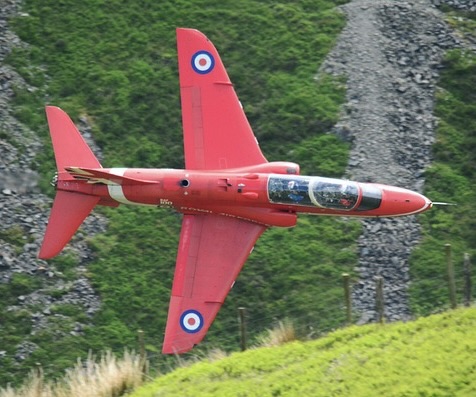
Red arrows aircraft flying close to the ground.
Image by Bruno Albino from Pixabay 

Johanna Lucht could do maths before she learned language. Why? Because she was born deaf and there was little support for deaf people where she lived. Despite, or perhaps because of, that she became a computer scientist and works for NASA. 

Being deaf can be very, very disabling if you don’t get the right help. As a child, Johanna had no one to help her to communicate apart from her mother. She tried to teach Johanna sign language from a book. Throughout most of her primary school years she couldn’t have any real conversations with anyone, never mind learn. She got the lifeline she needed, when the school finally took on an interpreter, Keith Wann, to help her. She quickly learned American Sign Language working with him. Learning your first language is crucial to learning other things and suddenly she was able to learn in school like other children. She caught up remarkably quickly, showing that an intelligent girl had been locked in that silent, shy child. More than anything though, from Keith, she learned never to give up. 

Her early ability in maths, now her favourite subject, came to the fore as she excelled at science and technology. By this point her family had moved from Germany where she grew up to Alaska where there was much more support, an active deaf community for her to join and lots more opportunities that she started to take. She signed up for a special summer school on computing specifically for deaf people at the University of Washington, learning the programming skills that became the foundation for her future career at NASA. At only 17 she even returned to help teach the course. From there, she signed up to do Computer Science at university and applied for an internship at NASA. To her shock and delight she was given a place. 

Hitting the ground running 

A big problem for pilots especially of fighter aircraft is that of “controlled flight into terrain”: a technical sounding phrase that just means flying the plane into the ground for no good reason other than how difficult flying a fighter aircraft as low as possible in hazardous terrain is. The solution is a ground collision avoidance system: basically the pilots need a computer to warn them when hazardous terrain is coming up and when they are too close for comfort, and so should take evasive action. Johanna helped work on the interface design, so the part that pilots see and interact with. To be of any use in such high-pressure situations this communication has to be slick and very clear. 

She impressed those she was working with so much that she was offered a full time job and so became an engineer at NASA Armstrong working with a team designing, testing and integrating new research technology into experimental aircraft. She had to run tests with other technicians, the first problem being how to communicate effectively with the rest of the team. She succeeded twice as fast as her bosses expected, taking only a couple of days before the team were all working well together. Her experience from the challenges she had faced as a child were now providing her with the skills to do brilliantly in a job where teamwork and communication skills are vital. 

Mission control 

Eventually, she gained a place in Mission Control. There, slick comms are vital too. The engineers have to monitor the flight including all the communication as it happens, and be able to react to any developing situation. Johanna worked with an interpreter who listened directly to all the flight communications, signing it all for her to see on a second monitor. Working with interpreters in a situation like this is in itself a difficult task and Johanna had to make sure not only that they could communicate effectively but that the interpreter knew all the technical language that might come up in the flight. Johanna had plenty of experience dealing with issues like that though, and they worked together well, with the result that in April 2017 Johanna became the first deaf person to work in NASA mission control on a live mission … where of course she did not just survive the job, she excelled. 

As Johanna has pointed out it is not deafness itself that disables people, but the world deaf people live in that does. When in a world that wasn’t set up for deaf people, she struggled, but as soon as she started to get the basic help she needed that all changed. Change the environment to one that does not put up obstacles and deaf people can excel like anyone else. In space no one can hear anyone scream or for that matter speak. We don’t let it stop our space missions though. We just invent appropriate technology and make the problems go away. 

– Paul Curzon, Queen Mary University of London

More on …

Read more about Johanna Lucht:

Related Magazines …

Subscribe to be notified whenever we publish a new post to the CS4FN blog.


This page is funded by EPSRC on research agreement EP/W033615/1.

QMUL CS4FN EPSRC logos

The last piece of the continental drift puzzle

by Paul Curzon, Queen Mary University of London

Image by Gerd Altmann from Pixabay 

A computer helped provide the final piece in the puzzle of how the continents formed and moved around. It gave a convincing demonstration that the Americas, Europe and Africa had once been one giant continent, Pangea, the pieces of which had drifted apart.

Plate tectonics is the science behind how the different continents are both moving apart and crashing together in different parts of the world driven by the motion of molten rock below the Earths crust. It created the continents and mountain ranges, is causing oceans to expand and to sink, and leads to earthquakes in places like California. The earth’s hard outer shell is made up of a series of plates that sit above hotter molten rock and those plates slowly move around (up to 10cm a year) as, for example, rock pushes up between the gaps and solidifies. or pushes down and down under an adjacent plate. The continents as we see them are sitting on top of these plates.

The idea of continental drift had existed in different forms since the early 19th century. The idea was partly driven by an observation that on maps, South America and Africa seemed almost like two jigsaw pieces that fit together. On its own an observation like this isn’t enough as it could just be a coincidence, not least because the fit is not exact. Good science needs to combine theory with observation, predictions that prove correct with data that provides the evidence, but also clear mechanisms that explain what is going on. All of this came together to show that continental drift and ultimately plate tectonics describe what is really going on.

Very many people gathered the evidence, made the predictions and built the theories over many decades. For example, different people came up with a variety of models of what was happening but in the 19th and early 20th centuries there just wasn’t enough data available to test them. One theory was that the continents themselves were floating through the layer of rock below a bit like ice bergs floating in the ocean. Eventually evidence was gathered and this and other suggestions for how continents were moving did not stand up to the data collected. It wasn’t until the 1960s that the full story was tied down. The main reason that it took so long was that it needed new developments in both science and technology, most notably understanding of radioactivity, magnetism and not least ways to survey the ocean beds as developed during World War II to hunt for submarines. Science is a team game, always building on the advances of others, despite the way individuals are singled out.

By the early 1960s there was lots of strong evidence, but sometimes it is not just a mass of evidence that is needed to persuade scientists en-masse to agree a theory is correct, but compelling evidence that is hard to ignore. It turned out that was ultimately provided by a computer program.

Geophysicist, Edward Bullard, and his team in Cambridge were responsible for this last step. He had previously filled in early pieces of the puzzle working at the National Physical Laboratory on how the magnetism in the Earth’s core worked like a dynamo. He used their computer (one of the earliest) to do simulations to demonstrate this. This understanding led to studies of the magnetism in rock. This showed there were stripes where the magnetism in rock was in opposite directions. This was a result of rock solidifying either in different places or at different times and freezing the magnetic direction of the Earth at that time and place. Mapping of this “fossil” magnetism could be used to explore the ideas of continental drift. One such prediction suggested the patterns should be identical on either side of undersea ridges where new rock was being formed and pushing the plates apart. When checked they were exactly symmetrical as predicted.

	Jacques Kornprobst (redesigned after Bullard, E., Everett, J.E. and Smith, A.G., 1965. The fit of the continents around the Atlantic. Phil. Trans. Royal Soc., A 258, 1088, 41-51)

Image reconstruction of Bullard’s map by Jacques Kornprobst
from Wikipedia  CC BY-SA 4.0

In the 1960s, Bullard organised a meeting at the Royal Society to review all the evidence about continental drift. There was plenty of evidence to see that continental drift was fact. However, he unveiled a special map at the meeting showing how the continents on either side of the Atlantic really did fit together. It turned out to be the clincher.

The early suggestion that Africa and South America fit together has a flaw in that they are similar shapes, but do not fit exactly. With the advent of undersea mapping it was realised the coastline as shown on maps is not the right thing to be looking at. Those shapes depend on the current level of the sea which rises and falls. As it does so the apparent shape of the continents changes. In terms of geophysics, the real edge of the continents is much lower. That is where the continental shelf ends and the sea floor plummets. Bullard therefore based the shape of the continents on a line about a kilometre below sea level which was now known accurately because of that undersea mapping.

Maps like this had been created before but they hadn’t been quite as convincing. After all a human just drawing shapes as matching because they thought they did could introduce bias. More objective evidence was needed.

We see the Earth as flat on maps, but it is of course a sphere, and maps distort shapes to make things fit on the flat surface. What matters for continents is whether the shapes fit when placed and then moved around on the surface of a sphere, not on a flat piece of paper. This was done using some 18th century maths by Leonhard Euler. At school we learn Euclidean Geometry – the geometry of lines and shapes on a flat surface. The maths is different on a sphere though leading to what is called Spherical Geometry. For example, on a flat surface a straight line disappears in both directions to infinity. On a sphere a straight line disappearing in one direction can of course meet itself in the other. Similarly, we are taught that the angles of a triangle on a flat surface add up to 180 degrees, but the angles of a triangle drawn on a sphere add up to more than 180 degrees… Euler, usefully for Bullard’s team, had worked out theorems for how to move shapes around on a sphere.

This maths of spherical geometry and specifically Euler’s theorems form the basis of an algorithm that the team coded as a program. The program then created a plot following the maths. It showed the continents moved together in a picture (see above). As it was computer created, based on solid maths, it had a much greater claim to be objective, but on top of that it did also just look so convincing. The shapes of the continents based on that submerged continental line fit near perfectly all the way from the tip of South America to the northern-most point of North America. The plot became known as the ‘Bullard Fit’ and went down in history as the evidence that sealed the case.

The story of continental drift is an early example of how computers have helped change the way science is done. Computer models and simulations can provide more objective ways to test ideas, and computers can also visualise data in ways that help see patterns and stories emerge in ways that are both easy to understand and very convincing. Now computer modelling is a standard approach used to test theories. Back then the use of computers was much more novel, but science provided a key early use. Bullard and his team deserve credit not just for helping seal the idea of continental drift as fact, but also providing a new piece to the puzzle of how to use computers to do convincing science.

More on …

  • Read the book: Science: a history by John Gribbin for one of the best books on the full history of Science including plate techtonics.

Related Magazines …


EPSRC supports this blog through research grant EP/W033615/1. 

Digital lollipop: no calories, just electronics!

by Jane Waite, Queen Mary University of London

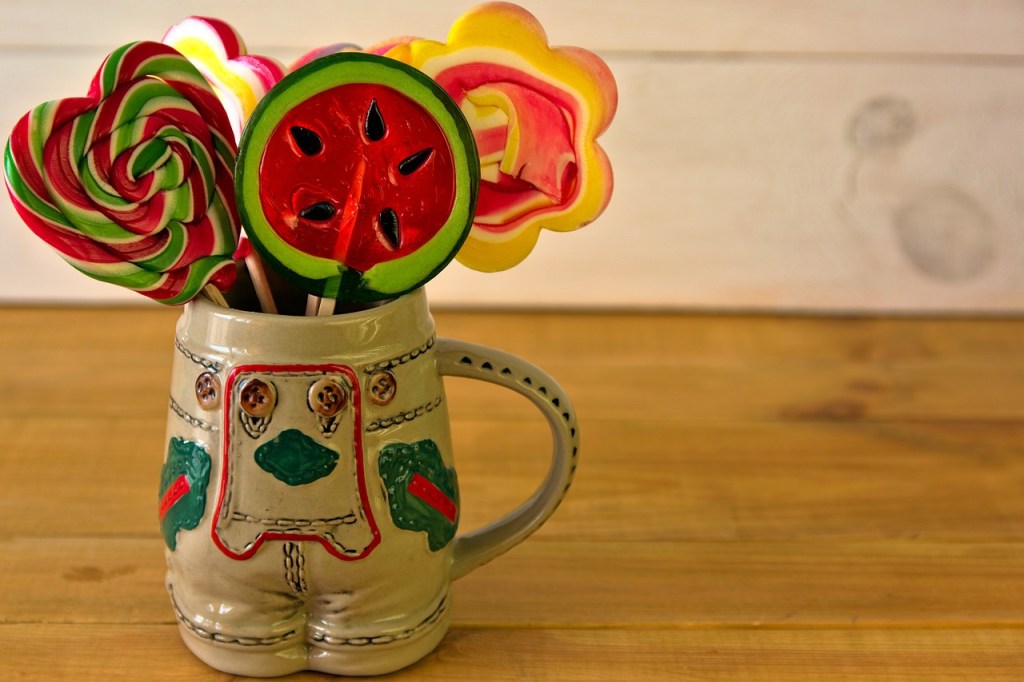
Can a computer create a taste in your mouth? Imagine scrolling down a list of flavours and then savouring your sweet choice from a digital lollipop. Not keen on that flavour, just click and choose a different one, and another and another. No calories, just the taste.

Nimesha Ranasinghe, a researcher at the National University of Singapore is developing a Tongue Mounted Digital Taste Interface, or digital lollipop. It sends tiny electrical signals to the very tip of your tongue to stimulate your taste buds and create a virtual taste!

One of UNESCO’s 2014 ’10 best innovations in the world’, the prototype doesn’t quite look like a lollipop (yet). There are two parts to this sweet sensation, the wearable tongue interface and the control system. The bit you put in your mouth, the tongue interface, has two small silver electrodes. You touch them to the tip of your tongue to get the taste hit. The control system creates a tiny electrical current and a minuscule temperature change, creating a taste as it activates your taste buds.

The prototype lollipop can create sour, salty, bitter, sweet, minty, and spicy sensations but it’s not just a bit of food fun. What if you had to avoid sweet foods or had a limited sense of taste? Perhaps the lollipop can help people with food addictions, just like the e-cigarette has helped those trying to give up smoking?
Perhaps the lollipop can help people with food addictions

But eating is more than just a flavour on your tongue, it is a multi-modal experience, you see the red of a ripe strawberry, hear the crunch of a carrot, feel sticky salt on chippy fingers, smell the Sunday roast, anticipate that satisfied snooze afterwards. How might computers simulate all that? Does it start with a digital lollipop? We will have to wait and see, hear, taste, smell, touch and feel!

Taste over the Internet

The Singapore team are exploring how to send tastes over the Internet. They have suggested rules to send ‘taste’ messages between computers, called the Taste Over Internet Protocol, including a messaging format called TasteXML They’ve also outlined the design for a mobile phone with electrodes to deliver the flavour! Sweet or salt anyone?

More on


Related Magazine …


This article was originally published on the CS4FN website and also appears on page 14 of Issue 19 of the CS4FN magazine “Touch it, feel it, hear it” which you can download as a PDF below, along with all of our other free material here.


EPSRC supports this blog through research grant EP/W033615/1.

The tale of the mote and the petrel

by Paul Curzon, Queen Mary University of London
(Updated from the archive)

Giant petrel flying over ice and rock
Image by Eduardo Ruiz from Pixabay
Image by Eduardo Ruiz from Pixabay 

Biology and computer science can meet in some unexpected, not to mention inhospitable, places. Who would have thought that the chemical soup in the nests of Petrels studied by field biologists might help in the development of futuristic dust-sized computers, for example?

Just Keep Doubling

One of the most successful predictions in Computer Science was made by Gordon Moore, co-founder of Intel. Back in 1965 he suggested that the number of transistors that can be squeezed onto an integrated circuit – the hardware computer processors are made of – doubled every few years: computers get ever more powerful and ever smaller. In the 60 or so years since Moore’s paper it has remained an amazingly accurate prediction. Will it continue to hold though or are we reaching some fundamental limit? Researchers at chip makers are confident that Moore’s Law can be relied on for the foreseeable future. The challenge will be met by the material scientists, the physicists and the chemists. Computer scientists must then be ready for the Law’s challenge too: delivering the software advances so that its trends are translated into changes in our everyday lives. It will lead to ever more complex systems on a single chip and so ever smaller computers that will truly disappear into the environment.

Dusting computers

Motes are one technology developed on the back of this trend. The aim is to create dust-sized computers. For example, the worlds smallest computer as of 2015 was the Michigan Micro Mote. It was only a few milimetres big but was a fully working computer system able to power itself, sense the world, process the data it collects and communicate data collected to other computers. In 2018 IBM announced a computer with sides a millimetre long. Rising to the challenge, the Michigan team soon announced their new mote with sides a third of a millimetre! The shrinking of motes will is not likely to stop!

Scatter motes around the environment and they form unobservable webs of intelligent sensors. Scatter them on a battlefield to detect troop movements or on or near roads to monitor traffic flow or pollution. Mix them in concrete and monitor the state of a bridge. Embed them in the home to support the elderly or in toys to interact with the kids. They are a technology that drives the idea of the Internet of Things where everyday objects become smart computers.

Battery technology has long been
the only big problem that remains.

What barriers must be overcome to make dust sized motes a ubiquitous reality? Much of the area of a computer is taken up by its connections to the outside world – all those pins allowing things to be plugged in. They can now be replaced by wireless communications. Computers contain multiple chips each housing separate processors. It is not the transistors that are the problem but the packaging – the chip casings are both bulky and expensive. Now we have “multicore” chips: large numbers of processors on a single small chip courtesy of Moore’s Law. This gives computer scientists significant challenges over how to develop software to run on such complicated hardware and use the resources well. Power can come from solar panels to allow them to constantly recharge even from indoor light. Even then, though, they still need batteries to store the energy. Battery technology is the only big problem that remains.

Enter the Petrels

But how do you test a device like that? Enter the Petrels. Intel’s approach is not to test futuristic technology on average users but to look for extreme ones who believe a technology will deliver them massive benefits. In the case of Motes, their early extreme users were field biologists who want to keep tabs on birds in extremely harsh field conditions. Not only is it physically difficult for humans to observe sea birds’ nests on inhospitable cliffs but human presence disturbs the birds. The solution: scatter motes in the nests to detect heat, humidity and the like from which the state and behaviour of the birds can be deduced. A nest is an extremely harsh environment for a computer though, both physically and chemically. A whole bunch of significant problems, overlooked by normal lab testing, must be overcome. The challenge of deploying Motes in such a harsh environment led to major improvements in the technology.


Moore’s Law is with us for a while yet, and with the efforts of material scientists, physicists, chemists, computer scientists and even field biologists and the sea birds they study it will continue to revolutionise our lives.

More on …

Related Magazines …


EPSRC supports this blog through research grant EP/W033615/1.