Annie Easley. NASA, Public domain, via Wikimedia Commons
Annie Easley was a pioneer both as a computer programmer but also as a champion of women and minorities into computer science. She went from being a human computer doing calculations for the rocket scientists (in the days before computers were machines), to becoming a programmer whose programs were integral to many NASA projects. Here work has helped us explore the planets and beyond, to put satellites into space and help humans leave the Earth. She also contributed to early battery technology as well as the alternative energy sources we now need to transition away from oil and gas. Throughout her career, despite being repeatedly discriminated against herself as an African-american woman, she encouraged, supported and mentored others like her.
Annie was a maths graduate so when she saw that computers were needed by NACA, the predecessor of NASA, she jumped at the chance. At the time a computer was a human who did calculations, as no machine at that point had been created to take over the job. She was one of only four African-american employees out of several thousand. Her job was to do the calculations researchers needed for their work. However, as digital computers started to be introduced – machines were now able to do large numbers of tedious calculations much more quickly than humans so took over the job…but now needed people who could program them for each task. To do so still needed mathematical ability to understand the task, as well as the ability to write code. She learnt both low level assembly language and the high level language, Fortran, invented for such scientific programming work and transitioned to being a programmer mathematician.
Much of her work involved or supported simulation, so writing programs that model aspects of the real world to test whether scientists predictions are correct, or to help make new predictions. Ultimately, this work would help provide the data to make choices of which technologies to use. Today computer simulation is a completely standard way of doing both engineering and science and has actually provided a completely new way to do science complementing theory and experiment. It allows us to probe everyday science questions but also big questions like exploring the origins of the universe or probing the long term consequences of our actions on the climate. Back then it was totally novel though, as computers were completely new. She was involved in simulation work that prefigured important work today around the environment, investigating systems to convert energy between different forms and so hybrid battery technology. It allows vehicles (whether a rocket, satellite, car or planetary rover) to switch between electric power and other sources of energy – an idea that has provided an important bridge from petrol to electric cars. She was also part of teams exploring alternative fuel sources like wind power and solar power (important of course now in space for satellites and planetary rovers, as well as a fossil fuel alternatives on Earth).
An Atlas rocket with centaur final stage. NASA, Public domain, via Wikimedia Commons
One of her major areas of work, that has had a lasting impact, was on the Centaur rocket. Rocket launches involve multiple fuel tanks to get the payload (eg a satellite) into space. The tanks of each stage are ejected when their fuel runs out with the next stage taking over. Centaur was the final upper stage which used the then novel fuel of liquid hydrogen and liquid oxygen to propel the payload in the final step into space. Centaur became a mainstay for satellite launches as well as for probes sent to visit other planets – like Voyager (which visited the outer planets and is now in interstellar space heading away from the solar system having visited ) and Cassini–Huygens (which sent back stunning images of Saturn’s rings). Newer versions of Centaur are still used today,
At the same time as doing all this work she was also heavily involved in NASAs public engagement with science programmes, visiting schools and giving talks about the work, inspiring girls and those from ethnic minorities that STEM careers were for them. She also worked as equal employment opportunity counselor. This involved her helping sort out discrimination complaints (whether over age or race or gender) in a positive and cooperative way.
Space travel has opened up not only a new ability to explore our solar system, but made lots of other technologies from SatNav to remote monitoring possible as well has helped in the development of other technology such as battery technology and alternative energy sources. We all owe a lot to the pioneers like Annie Easley, and none more so than the private companies now aiming to further commercialise space.
In 1977 NASA scientists at the Jet Propulsion Laboratory launched the interstellar probe Voyager 1 into space – and it just keeps going. It has now travelled 15 BILLION miles (24 billion kilometres), which is the furthest any human-made thing has ever travelled from Earth. It communicates with us here on Earth via radiowaves which can easily cross that massive distance between us. But even travelling at the speed* of light (all radiowaves travel at that speed) each radio transmission takes 22.5 hours, so if NASA scientists send a command they have to wait nearly two days for a response. (The Sun is ‘only’ 93 million miles away from Earth and its light takes about 8 minutes to reach us.)
FDS – The Flight Data System
The Voyager 1 probe has sensors to detect things like temperature or changes in magnetic fields, a camera to take pictures and a transmitter to send all this data back to the scientists on Earth. One of its three onboard computers (the Flight Data System, or FDS) takes that data, packages it up and transmits it as a stream of 1s and 0s to the waiting scientists back home who decode it. Voyager 1 is where it is because NASA wanted to send a probe out beyond the limits of our Solar System, into ‘interstellar space’ far away from the influence of our Sun to see what the environment is like there. It regularly sends back data updates which include information about its own health (how well its batteries are doing etc) along with the scientific data, packaged together into that radio transmission. NASA can also send up commands to its onboard computers too. Computers that were built in 1977!
The pale blue dot
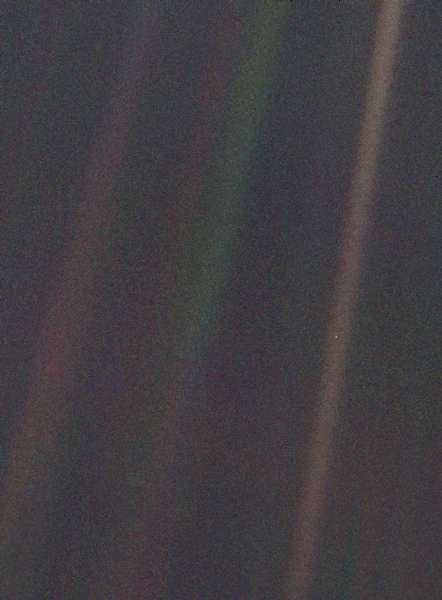
‘The Pale Blue Dot’. In the thicker apricot-coloured band on the right you might be able to see a tiny dot about halfway down. That’s the Earth! Full details of this famous 1990 photo here.
Although its camera is no longer working its most famous photograph is this one, the Pale Blue Dot, a snapshot of every single person alive on the 14th of February 1990. However as Voyager 1 was 6 billion miles from home by then when it looked back at the Earth to take that photograph you might have some difficulty in spotting anyone! But they’re somewhere in there, inside that single pixel (actually less than a pixel!) which is our home.
As Voyager 1 moved further and further away from our own planet, visiting Jupiter and Saturn before travelling to our outer Solar System and then beyond, the probe continued to send data and receive commands from Earth.
The messages stopped making sense
All was going well, with the scientists and Voyager 1 ‘talking’ to one another, until November 2023 when the binary 1s and 0s it normally transmitted no longer had any meaningful pattern to them, it was gibberish. The scientists knew Voyager 1 was still ‘alive’ as it was able to send that signal but they didn’t know why its signal no longer made any sense. Given that the probe is nearly 50 years old and operating in a pretty harsh environment people wondered if that was the natural end of the project, but they were determined to try and re-establish normal contact with the probe if they could.
Searching for a solution
They pored over almost-50 year old paper instruction manuals and blueprints to try and work out what was wrong and it seemed that the problem lay in the FDS. Any scientific data being collected was not being correctly stored in the ‘parcel’ that was transmitted back to Earth, and so was lost – Voyager 1 was sending empty boxes. At that distance it’s too far to send an engineer up to switch it off and on again so instead they sent a command to try and restart things. The next message from Voyager 1 was a different string of 1s and 0s. Not quite the normal data they were hoping for, but also not entirely gibberish. A NASA scientist decoded it and found that Voyager 1 had sent a readout of the FDS’ memory. That told them where the problem was and that a damaged chip meant that part of its memory couldn’t be properly accessed. They had to move the memory from the damaged chip.
That’s easier said than done. There’s not much available space as the computers can only store 68 kilobytes of data in total (absolutely tiny compared to today’s computers and devices). There wasn’t one single place where NASA scientists could move the memory as a single block, instead they had to break it up into pieces and store it in different places. In order to do that they had to rewrite some of the code so that each separated piece contained information about how to find the next piece. Imagine if a library didn’t keep a record of where each book was, it would make it very hard to find and read the sequel!
Earlier this year NASA sent up a new command to Voyager 1, giving it instructions on how to move a portion of its memory from the damaged area to its new home(s) and waited to hear back. Two days later they got a response. It had worked! They were now receiving sensible data from the probe.
Voyager team celebrates engineering data return, 20 April 2024 (NASA/JPL-Caltech). “Shown are Voyager team members Kareem Badaruddin, Joey Jefferson, Jeff Mellstrom, Nshan Kazaryan, Todd Barber, Dave Cummings, Jennifer Herman, Suzanne Dodd, Armen Arslanian, Lu Yang, Linda Spilker, Bruce Waggoner, Sun Matsumoto, and Jim Donaldson.”
For a while they it was just basic ‘engineering data’ (about the probe’s status) but they knew their method worked and didn’t harm the distant traveller. They also knew they’d need to do a bit more work to get Voyager 1 to move more memory around in order for the probe to start sending back useful scientific data, and…
Success!
… …in May, NASA announced that scientific data from two of Voyager 1’s instruments was finally being sent back to Earth and in June the probe was fully operational. You can follow Voyager 1’s updates on Twitter / X via @NASAVoyager.
Did you know?
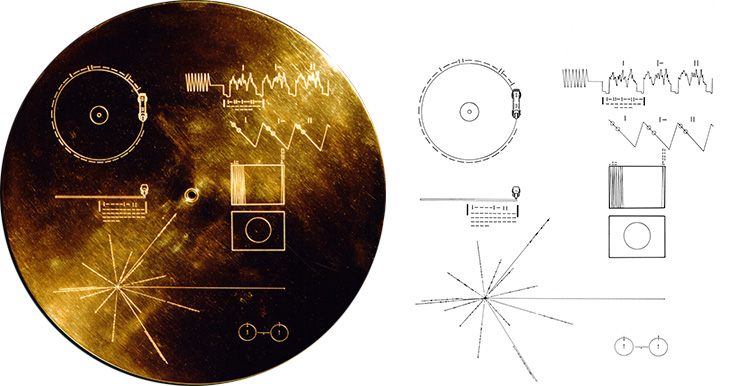
Both Voyager 1 and Voyager 2 carry with them a gold-plated record called ‘The Sounds of Earth‘ containing “sounds and images selected to portray the diversity of life and culture on Earth”. Hopefully any aliens encountering it will have a record player (but the Voyager craft do carry a spare needle!) Credit: NASA/JPL
References
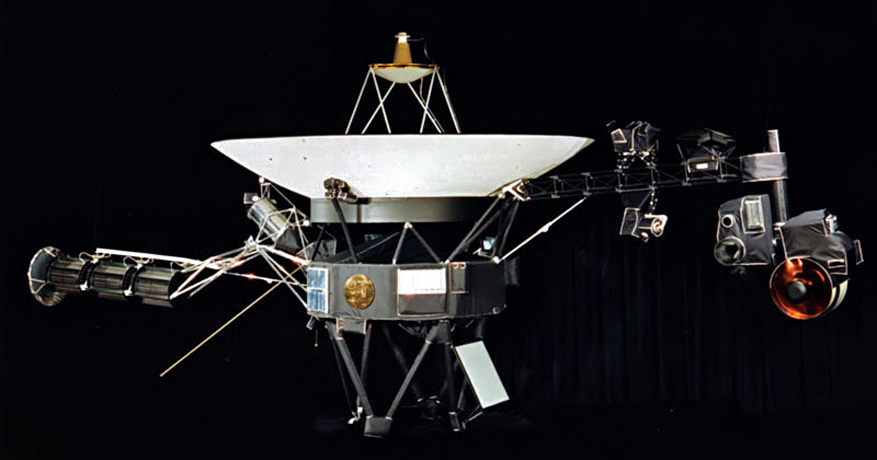
Lots of articles helped in the writing of this one and you can download a PDF of them here. Featured image credit showing the Voyager spacecraft: NASA/JPL.
*radiowaves and light are part of the electromagnetic or ‘EM’ spectrum along with microwaves, gamma rays, X-rays, ultraviolet and infra red. All these waves travel at the same speed in a vacuum, the speed of light (300,000,000 metres per second, sometimes written as 3 x 10⁸ m/s or (m s-1)), but the waves differ by their frequency and wavelength.
Subscribe to be notified whenever we publish a new post to the CS4FN blog.
EPSRC supports this blog through research grant EP/W033615/1.
Each day throughout December (until Christmas Day) we’ll be publishing a computing-themed blog post suggested by the picture on the front of our Advent Calendar. Today’s image on the door of the CS4FN Christmas Computing Advent Calendar is a Christmas wreath which made me think of wires and of weaving.
A Christmas wreath. Image drawn and digitised by Jo Brodie.
You might remember that our first advent calendar post was about the links between coding and knitting. Today’s post looks at an even more literal version of that: core rope memory.
1. Core rope memory: the Apollo space mission’s woven computer memory
by Jo Brodie, QMUL.
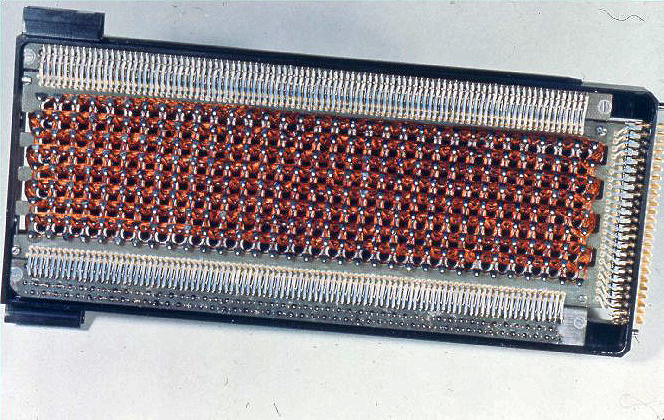
Firstly it looks like this.
Rope memory from the Apollo Guidance Computer. Image by NASA from Wikipedia, in the Public Domain.
Secondly it got us to the Moon!
Probably the world’s first portable computer
Core rope memory was made up of small ‘eyelets’ or beads of metal called ferrite that can be magnetised (these ring-shaped magnets were known as cores) and copper wire which was woven through some of the eyelets but not others. An electrical current passing through the wires made the whole thing work. A wire that passed through an eyelet would be read as a binary 1 when the current was on but if it passed around one then it would be read as 0. This meant that a computer program, made up of sequences of 1s and 0s, could be permanently stored by the pattern that was woven. This formed the ‘fixed’ read-only memory in the Apollo guidance computer system; a different configuration (using smaller cores) made up its erasable magnetic-core memory.
This type of memory was woven in the 1960s for NASA’s Apollo moon mission by women who were skilled textile workers. They would work in pairs and use a special hollow needle to thread the copper wire through one magnetic core and then the other person would thread it back through a different one, following instructions from another program which indicated which of the eyelets to use.
That program was first developed on a computer (the sort that took up a whole room back then) and then translated into instructions for a machine which helped the weavers get the wire threads into the correct position. It was very difficult to undo a mistake so a great deal of care was taken to get things right the first time, especially as it could take up to two months to complete one block of memory. Some of the rope weavers were overseen by Margaret Hamilton, one of the women who developed the software used on board the spacecraft.
Margaret Hamilton standing next to listings of the software that she and her MIT team produced for the Apollo Project. Image from Wikipedia (in the public domain).
Several of these pre-programmed core rope memory units were combined and installed in the guidance computers of the Apollo mission spacecraft, to fly astronauts safely to the Moon and back.
NASA needed on-board guidance systems to control the spacecraft independently of Mission Control back on Earth. They needed something that didn’t take up too much room or weigh too much, that could survive the shaking and juddering of take-off and background radiation – core rope memory fitted the bill perfectly.
It packed a lot* of information into a small space and was very robust as it could only break if a wire came loose or one of the ferrite eyelets was damaged (which didn’t happen). To make sure though, the guidance computer’s electronics were protected by being sealed from the atmosphere. They survived and worked well, guiding the Landing Modules safely onto the Moon.
*well, not by modern standards! The guidance computer contained only around 70 kilobytes of read only memory.
2. A brief history of the digital revolution, part 1: from birth to the moon
by Lewis Dartnell. This post is from 2008.
The Royal Institution Christmas Lectures 2008 invited you on a high tech trek to build the ultimate computer. The Christmas Lectures talk a lot about the current cutting-edge of computer technology, but what were things like in the early days of the digital revolution? The researcher for the 2008 Christmas Lectures, Lewis Dartnell, takes us through the story.
Electronic computers have come a long way since their birth only 50 years ago. One of the very first digital computers was built at the University of Manchester, a prototype called Manchester Mark I. The machine was revolutionary, with its complex processing circuits and storage memory to hold both the program being run and the data it was working on. The Mark I was first run on 21 June 1948 and paved the way as a universal computer that is truly versatile and can be reprogrammed at will, rather than being hard-wired for a single particular task.
A vacuum-tube (specifically a voltage-regulator tube) in use. Image by VA7IS from Wikipedia (released into the public domain).
These earliest computers used technology called vacuum tubes, which were essentially just like filament light bulbs. Because they get so hot, such vacuum tubes were really power hungry and not very reliable. Typically, computers like the Manchester Mark I, processing using vacuum tubes, could only be run for a few hours at a time before one of the vacuum tubes broke and had to be replaced. The biggest break-through in modern computing came with the invention of the transistor, a small electronic component that can perform the same function as a vacuum tube, but is much more energy efficient and reliable. The beauty of the transistor is that computer scientists found ways of making them smaller and smaller, and to connect a number of them together into a single miniaturized processing board called an integrated circuit. These came to be known as microchips, and form the basis of all the computers made today.
A major drive for the development of microchip technology was the Apollo programme, begun in 1961 to land humans on the Moon. Although the vast majority of the complex calculations to do with plotting the trajectory and navigating to the moon were performed by enormous banks of computers back on Earth, it was crucial for the spacecraft to have their own on-board computer system. This was called the Apollo Guidance Computer (AGC), and both the command module and the lunar module, which actually made the descent to the surface of the moon, had one each. These ground-breaking computers provided the astronauts with crucial flight information, helped them make course corrections and to touch-down gently on the moon’s surface. Because it’s absolutely crucial to reduce the amount of mass and power usage on a spacecraft as far as possible, developing these guidance computers really pushed the technology in miniaturising integrated circuits.
The Display and Keyboard Interface (known as DSKY and pronounced Disky) of the Apollo mission’s guidance computer. Image by Brandrodungswanderfeldhackbau from Wikipedia (released into the public domain).
The Apollo Guidance Computer not only helped drive the early development of microchips, but it also suffered one of the most infamous computer crashes in history. During the descent down to the Moon’s surface the AGC started displaying two error messages that the two astronauts, Neil Armstrong and Buzz Aldrin, weren’t familiar with. Engineers back at mission control on Earth quickly tried to identify the error code, and what it might mean for the lunar landing. Something that had never happened in any of the training simulations was now overloading the flow of data into the computer, the first time it had ever been used for real. Time was running out with only a limited amount of rocket fuel on-board and the Moon rushing up towards them. Luckily the computer entered a fail-safe mode, aborting low-priority calculations but able to continue with the critical tasks for the landing.
It wasn’t until the investigation afterwards that it was realized just how lucky Neil Armstrong and Buzz Aldrin had really been. The root of the problem was that the real attempt at the Moon landing was the first time an important radar system had been plugged into the computer, sending data into the AGC that wasn’t needed for the landing. This almost totally overloaded the computer, but by amazing luck, the amount of spare processing power built into the system for safety was almost exactly the amount being wasted by the un-needed radar, and the AGC didn’t crash completely.
3. Activity 1 – make your own core rope memory
A nice craft activity is to create a cut-down version with beads and coloured threads. You string 8 beads (with a gap between them) on one thread to form a single ‘byte’ (of 8 binary bits). Then think of a short word or name. Using one piece of thread for each letter (easier to see if threads are coloured but not essential) you can weave it through or around each bead according to the binary code for each letter. If the thread goes through the bead that’s a 1, around the bead is 0.
To make the capital letter A (01000001, according to the conversion from binary to letters table) you’d go around the first bead, through the second, then around all the other beads until going through the eighth bead.
My name’s JO so mine would have only three threads (one to hold the 8 beads and two to spell my name). One of my threads would go around, through, around, around, through, around, through, around to ‘spell’ the capital letter J (01001010). Let’s hope you have a slightly longer name!
4. Activity 2 – create an origami laurel wreath
Not only do we have a wreath-themed activity in our back catalogue (!) but in a delightful coincidence this story also relates to Apollo (the Greek god). If you’re wondering what origami might have to do with computing it’s just another way of looking at algorithms and instructions. Also, decomposition (breaking a problem into smaller parts) because you can re-use the instructions needed for the laurel wreath to make other origami items. We like using ‘unplugged’ activities like this to demonstrate computing concepts.
Create an origami laurel wreath from nested triangles of paper. Image by Paul Curzon / CS4FN.
The creation of this post was funded by UKRI, through grant EP/K040251/2 held by Professor Ursula Martin, and forms part of a broader project on the development and impact of computing.
Johanna Lucht could do maths before she learned language. Why? Because she was born deaf and there was little support for deaf people where she lived. Despite, or perhaps because of, that she became a computer scientist and works for NASA.
Being deaf can be very, very disabling if you don’t get the right help. As a child, Johanna had no one to help her to communicate apart from her mother. She tried to teach Johanna sign language from a book. Throughout most of her primary school years she couldn’t have any real conversations with anyone, never mind learn. She got the lifeline she needed, when the school finally took on an interpreter, Keith Wann, to help her. She quickly learned American Sign Language working with him. Learning your first language is crucial to learning other things and suddenly she was able to learn in school like other children. She caught up remarkably quickly, showing that an intelligent girl had been locked in that silent, shy child. More than anything though, from Keith, she learned never to give up.
Her early ability in maths, now her favourite subject, came to the fore as she excelled at science and technology. By this point her family had moved from Germany where she grew up to Alaska where there was much more support, an active deaf community for her to join and lots more opportunities that she started to take. She signed up for a special summer school on computing specifically for deaf people at the University of Washington, learning the programming skills that became the foundation for her future career at NASA. At only 17 she even returned to help teach the course. From there, she signed up to do Computer Science at university and applied for an internship at NASA. To her shock and delight she was given a place.
Hitting the ground running
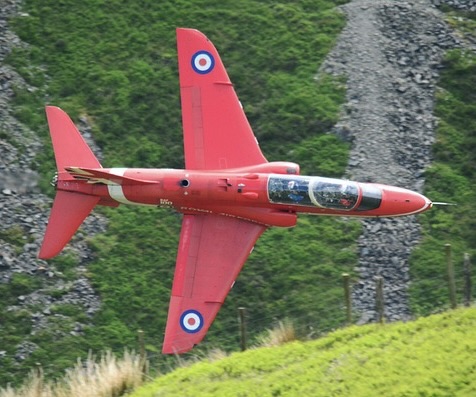
A big problem for pilots especially of fighter aircraft is that of “controlled flight into terrain”: a technical sounding phrase that just means flying the plane into the ground for no good reason other than how difficult flying a fighter aircraft as low as possible in hazardous terrain is. The solution is a ground collision avoidance system: basically the pilots need a computer to warn them when hazardous terrain is coming up and when they are too close for comfort, and so should take evasive action. Johanna helped work on the interface design, so the part that pilots see and interact with. To be of any use in such high-pressure situations this communication has to be slick and very clear.
She impressed those she was working with so much that she was offered a full time job and so became an engineer at NASA Armstrong working with a team designing, testing and integrating new research technology into experimental aircraft. She had to run tests with other technicians, the first problem being how to communicate effectively with the rest of the team. She succeeded twice as fast as her bosses expected, taking only a couple of days before the team were all working well together. Her experience from the challenges she had faced as a child were now providing her with the skills to do brilliantly in a job where teamwork and communication skills are vital.
Mission control
Eventually, she gained a place in Mission Control. There, slick comms are vital too. The engineers have to monitor the flight including all the communication as it happens, and be able to react to any developing situation. Johanna worked with an interpreter who listened directly to all the flight communications, signing it all for her to see on a second monitor. Working with interpreters in a situation like this is in itself a difficult task and Johanna had to make sure not only that they could communicate effectively but that the interpreter knew all the technical language that might come up in the flight. Johanna had plenty of experience dealing with issues like that though, and they worked together well, with the result that in April 2017 Johanna became the first deaf person to work in NASA mission control on a live mission … where of course she did not just survive the job, she excelled.
As Johanna has pointed out it is not deafness itself that disables people, but the world deaf people live in that does. When in a world that wasn’t set up for deaf people, she struggled, but as soon as she started to get the basic help she needed that all changed. Change the environment to one that does not put up obstacles and deaf people can excel like anyone else. In space no one can hear anyone scream or for that matter speak. We don’t let it stop our space missions though. We just invent appropriate technology and make the problems go away.
NASA Langley was the birthplace of the U.S. space program where astronauts like Neil Armstrong learned to land on the moon. Everyone knows the names of astronauts, but behind the scenes a group of African-American women were vital to the space program: Katherine Johnson, Mary Jackson and Dorothy Vaughan. Before electronic computers were invented ‘computers’ were just people who did calculations and that’s where they started out, as part of a segregated team of mathematicians. Dorothy Vaughan became the first African-American woman to supervise staff there and helped make the transition from human to electronic computers by teaching herself and her staff how to program in the early programming language, FORTRAN.
The women switched from being the computers to programming them. These hidden women helped put the first American, John Glenn, in orbit, and over many years worked on calculations like the trajectories of spacecraft and their launch windows (the small period of time when a rocket must be launched if it is to get to its target). These complex calculations had to be correct. If they got them wrong, the mistakes could ruin a mission, putting the lives of the astronauts at risk. Get them right, as they did, and the result was a giant leap for humankind.
See the film ‘Hidden Figures’ for more of their story.

#/media/File:Surveyor_1_launch.jpg)











 cs4fn
cs4fn 