Cognitive crash dummies

The world is heading for catastrophe. We’re hooked on power hungry devices: our mobile phones and iPods, our Playstations and laptops. Wherever you turn people are using gadgets, and those gadgets are guzzling energy – energy that we desperately need to save. We are all doomed, doomed…unless of course a hero rides in on a white charger to save us from ourselves.

Don’t worry, the cognitive crash dummies are coming!

Actually the saviours may be people like professor of human-computer interaction, Bonnie John, and her then grad student, Annie Lu Luo: people who design cognitive crash dummies. When working at Carnegie Mellon University it was their job to figure out ways for deciding how well gadgets are designed.

If you’re designing a bridge you don’t want to have to build it before finding out if it stays up in an earthquake. If you’re designing a car, you don’t want to find out it isn’t safe by having people die in crashes. Engineers use models – sometimes physical ones, sometimes mathematical ones – that show in advance what will happen. How big an earthquake can the bridge cope with? The mathematical model tells you. How slow must the car go to avoid killing the baby in the back? A crash test dummy will show you.

Even when safety isn’t the issue, engineers want models that can predict how well their designs perform. So what about designers of computer gadgets? Do they have any models to do predictions with? As it happens, they do. Their models are called ‘human behavioural models’, but think of them as ‘cognitive crash dummies’. They are mathematical models of the way people behave, and the idea is you can use them to predict how easy computer interfaces are to use.

There are lots of different kind of human behavioural model. One such ‘cognitive crash dummies’ is called ‘GOMS’. When designers want to predict which of a few suggested interfaces will be the quickest to use, they can use GOMS to do it.

Send in the GOMS

Suppose you are designing a new phone interface. There are loads of little decisions you’ll have to make that affect how easy the phone is to use. You can fit a certain number of buttons on the phone or touch screen, but what should you make the buttons do? How big should they be? Should you use gestures? You can use menus, but how many levels of menus should a user have to navigate before they actually get to the thing they are trying to do? More to the point, with the different variations you have thought up, how quickly will the person be able to do things like send a text message or reply to a missed call? These are questions GOMS answers.

To do a GOMS prediction you first think up a task you want to know about – sending a text message perhaps. You then write a list of all the steps that are needed to do it. Not just the button presses, but hand movements from one button to another, thinking time, time for the machine to react, and so on. In GOMS, your imaginary user already knows how to do the task, so you don’t have to worry about spending time fiddling around or making mistakes. That means that once you’ve listed all your separate actions GOMS can work out how long the task will take just by adding up the times for all the separate actions. Those basic times have been worked out from lots and lots of experiments on a wide range of devices. The have shown, on average, how long it takes to press a button and how long users are likely to think about it first.

GOMS in 60 seconds?

GOMS has been around since the 1980s, but wasn’t being used much by industrial designers. The problem is that it is very frustrating and time-consuming to work out all those steps for all the different tasks for a new gadget. Bonnie John’s team developed a tool called CogTool to help. You make a mock-up of your phone design in it, and tell it which buttons to press to do each task. CogTool then worked out where the other actions, like hand movements and thinking time, are needed and makes predictions.

Bonnie John came up with an easier way to figure out how much human time and effort a new design uses, but what about the device itself? How about predicting which interface design uses less energy? That is where Annie Lu Luo, came in. She had the great idea that you could take a GOMS list of actions and instead of linking actions to times you could work out how much energy the device uses for each action instead. By using GOMS together with a tool like CogTools, a designer can find out whether their design is the most energy efficient too.

So it turns out you don’t need a white knight to help your battery usage, just Annie Lu Luo and her version of GOMS. Mobile phone makers saw the benefit of course. That’s why Annie walked straight into a great job on finishing university.

Paul Curzon, Queen Mary University of London


More on …


Related Magazine …

Subscribe to be notified whenever we publish a new post to the CS4FN blog.


This blog is funded by EPSRC on research agreement EP/W033615/1.

QMUL CS4FN EPSRC logos

Chatbot or Cheatbot?

The chatbots have suddenly got everyone talking, though about them as much as with them. Why? Because one, chatGPT has (amongst other things) reached the level of being able to fool us into thinking that it is a pretty good student.

It’s not exactly what Alan Turing was thinking about when he broached his idea of a test for intelligence for machines: if we cannot tell them apart from a human then we must accept they are intelligent. His test involved having a conversation with them over an extended period before making the decision, and that is subtly different to asking questions.

ChatGPT may be pretty close to passing an actual Turing Test but it probably still isn’t there yet. Ask the right questions and it behaves differently to a human. For example, ask it to prove that the square root of 2 is irrational and it can do it easily, and looks amazingly smart, – there are lots of versions of the proof out there that it has absorbed. It isn’t actually good at maths though. Ask it to simply count or add things and it can get it wrong. Essentially, it is just good at determining the right information from the vast store of information it has been trained on and then presenting it in a human-like way. It is arguably the way it can present it “in its own words” that makes it seem especially impressive.

Will we accept that it is “intelligent”? Once it was said that if a machine could beat humans at chess it would be intelligent. When one beat the best human, we just said “it’s not really intelligent – it can only play chess””. Perhaps chatGPT is just good at answering questions (amongst other things) but we won’t accept that as “intelligent” even if it is how we judge humans. What it can do is impressive and a step forward, though. Also, it is worth noting other AIs are better at some of the things it is weak at – logical thinking, counting, doing arithmetic, and so on. It likely won’t be long before the different AIs’ mistakes and weaknesses are ironed out and we have ones that can do it all.

Rather than asking whether it is intelligent, what has got everyone talking though (in universities and schools at least) is that chatGPT has shown that it can answer all sorts of questions we traditionally use for tests well enough to pass exams. The issue is that students can now use it instead of their own brains. The cry is out that we must abandon setting humans essays, we should no longer ask them to explain things, nor for that matter write (small) programs. These are all things chatGPT can now do well enough to pass such tests for any student unable to do them themselves. Others say we should be preparing students for the future so its ok, from now on, we just only test what human and chatGPT can do together.

It certainly means assessment needs to be rethought to some extent, and of course this is just the start: the chatbots are only going to get better, so we had better do the thinking fast. The situation is very like the advent of calculators, though. Yes, we need everyone to learn to use calculators. But calculators didn’t mean we had to stop learning how to do maths ourselves. Essay writing, explaining, writing simple programs, analytical skills, etc, just like arithmetic, are all about core skill development, building the skills to then build on. The fact that a chatbot can do it too doesn’t mean we should stop learning and practicing those skills (and assessing them as an inducement to learn as well as a check on whether the learning has been successful). So the question should not be about what we should stop doing, but more about how we make sure students do carry on learning. A big, bad thing about cheating (aside from unfairness) is that the person who decides to cheat loses the opportunity to learn. Chatbots should not stop humans learning either.

The biggest gain we can give a student is to teach them how to learn, so now we have to work out how to make sure they continue to learn in this new world, rather than just hand over all their learning tasks to the chatbot to do. As many people have pointed out, there are not just bad ways to use a chatbot, there are also ways we can use chatbots as teaching tools. Used well by an autonomous learner they can act as a personal tutor, explaining things they realise they don’t understand immediately, so becoming a basis for that student doing very effective deliberate learning, fixing understanding before moving on.

Of course, a bigger problem, if a chatbot can do things at least as well as we can then why would a company employ a person rather than just hire an AI? The AIs can now a lot of jobs we assumed were ours to do. It could be yet another way of technology focussing vast wealth on the few and taking from the many. Unless our intent is a distopian science fiction future where most humans have no role and no point, (see for example, CS Forester’s classic, The Machine Stops) then we still in any case ought to learn skills. If we are to keep ahead of the AIs and use them as a tool not be replaced by them, we need the basic skills to build on to gain the more advanced ones needed for the future. Learning skills is also, of course, a powerful way for humans (if not yet chatbots) to gain self-fulfilment and so happiness.

Right now, an issue is that the current generation of chatbots are still very capable of being wrong. chatGPT is like an over confident student. It will answer anything you ask, but it gives wrong answers just as confidently as right ones. Tell it it is wrong and it will give you a new answer just as confidently and possibly just as wrong. If people are to use it in place of thinking for themselves then, in the short term at least, they still need the skill it doesn’t have of judging when it is right or wrong.

So what should we do about assessment. Formal exams come back to the fore so that conditions are controlled. They make it clear you have to be able to do it yourself. Open book online tests that become popular in the pandemic, are unlikely to be fair assessments any more, but arguably they never were. Chatbots or not they were always too easy to cheat in. They may well be good still for learning. Perhaps in future if the chatbots are so clever then we could turn the Turing test around: we just ask an artificial intelligence to decide whether particular humans (our students) are “intelligent” or not…

Alternatively, if we don’t like the solutions being suggesting about the problems these new chatbots are raising, there is now another way forward. If they are so clever, we could just ask a chatbot to tell us what we should do about chatbots…

Paul Curzon, Queen Mary University of London

.

More on …

Related Magazines …

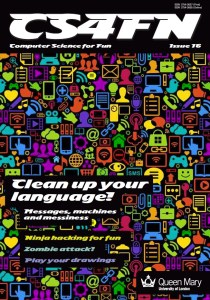
Issue 16 cover clean up your language

Subscribe to be notified whenever we publish a new post to the CS4FN blog.


This blog is funded by EPSRC on research agreement EP/W033615/1.

QMUL CS4FN EPSRC logos

Daphne Oram: the dawn of music humans can’t play

What links James Bond, a classic 1950s radio comedy series and a machine for creating music by drawing? … Electronic music pioneer: Daphne Oram.

Oram was one of the earliest musicians to experiment with electronic music, and was the first woman to create an electronic instrument. She realised that the advent of electronic music meant composers no longer had to worry about whether anyone could actual physically perform the music they composed. If you could write it down in a machine readable way then machines could play it electronically. That idea opened up whole new sounds and forms of music and is an idea that pop stars and music producers still make use of today.

She learnt to play music as a child and was good enough to be offered a place at the Royal College of Music, though turned it down. She also played with radio electronics with her brothers, creating radio gadgets and broadcasting music from one room to another. Combining music with electronics became her passion and she joined the BBC as a sound engineer. This was during World War 2 and her job included being the person ready during a live music broadcast to swap in a recording at just the right point if, for example, there was an air raid that meant the performance had to be abandoned. The show, after all, had to go on.

Composing electronic music

She went on to take this idea of combining an electronic recording with live performance further and composed a novel piece of music called Still Point that fully combined orchestral with electronic music in a completely novel way. The BBC turned down the idea of broadcasting it, however, so it was not played for 70 years until it was rediscovered after her death, ultimately being played at a BBC Prom.

Composers no longer had to worry
about whether anyone could actually
physically perform the music they composed

She started instead to compose electronic music and sounds for radio shows for the BBC which is where the comedy series link came in. She created sound effects for a sketch for the Goon Show (the show which made the names of comics including Spike Milligan and Peter Sellers). She constantly played with new techniques. Years later it became standard for pop musicians to mess with tapes of music to get interesting effects, speeding them up and down, rerecording fragments, creating loops, running tapes backwards, and so on. These kinds of effects were part of amazing sounds of the Beatles, for example. Oram was one of the first to experiment with these kinds of effects and use them in her compositions – long before pop star producers.

One of the most influential things she did was set up the BBC Radiophonic Workshop which went on to revolutionise the way sound effects and scores for films and shows were created. Oram though left the BBC shortly after it was founded, leaving the way open for other BBC pioneers like Delia Derbyshire. Oram felt she wasn’t getting credit for her work, and couldn’t push forward with some of her ideas. Instead Oram set herself up as an independent composer, creating effects for films and theatre. One of her contracts involved creating electronic music that was used on the soundtracks of the early Bond films starring Sean Connery – so Shirley Bassey is not the only woman to contribute to the Bond sound!

The Music Machine

While her film work brought in the money, she continued with her real passion which was to create a completely new and highly versatile way to create music…by drawing. She built a machine – the Oramics Machine – that read a composition drawn onto film reels. It fulfilled her idea of having a machine that could play anything she could compose (and fulfilled a thought she had as a child when she wondered how you could play the notes that fell between the keys on a piano!).

The 35mm film that was the basis of her system that dates all the way back to the 19th century when George Eastman, Thomas Edison and Kennedy Dixon pioneered the invention film based photography and then movies. It involved a light sensitive layer being painted on strips of film with holes down the side that allowed the film to be advanced. This gave Oram a recording media. She could etch or paint subtle shapes and patterns on to the film. In a movie light was shone through the film, projecting the pictures on the film on to the screen. Oram instead used light sensors to detect the patterns on the film and convert it to electronic signals. Electronic circuitry she designed (and was awarded patents for) controlled cathode ray tubes that showed the original drawn patterns but now as electrical signals. Ultimately these electrical signals drove speakers. Key to the flexibility of the system was that different aspects of the music were controlled by patterns on different films. One for example controlled the frequency of the sound, others the timbre or tone quality and others the volume. These different control signals for the music were then combined by Oram’s circuitry. The result of combining the fine control of the drawings with the multiple tapes meant she had created a music machine far more flexible in the sound it could produce than any traditional instrument or orchestra. Modern music production facilities use very similar approaches today though based on software systems rather than the 1960s technology available to Oram.

Ultimately, Daphne Oram was ahead of her time as a result of combining her two childhood fascinations of music and electronics in a way that had not been done before. She may not be as famous as the great record producers who followed her, but they owe a lot to her ideas and innovation.

Paul Curzon, Queen Mary University of London

More on …

Related Magazines …

Subscribe to be notified whenever we publish a new post to the CS4FN blog.


This blog is funded by EPSRC on research agreement EP/W033615/1.
QMUL CS4FN EPSRC logos

Kimberly Bryant: Black Girls Code

Kimberly Bryant in 2016, Ståle Grut / nrkbeta, CC BY-SA 2.0, via Wikimedia Commons

Kimberly Bryant was born on 14 January 1967 in Memphis, Tennessee and was enthusiastic about maths and science in school, describing herself as a ‘nerdy girl’. She was awarded a scholarship to study Engineering at university but while there she switched to Electrical Engineering with Computer Science and Maths. During her career she has worked in several industries including pharmaceutical, biotechnology and energy.

She is most known though for founding Black Girls Code. In 2011 her daughter wanted to learn computer programming but nearly all the students on the nearest courses were boys and there were hardly any African American students enrolled. Kimberly didn’t want her daughter to feel isolated (as she herself had felt) so she created Black Girls Code (BGC) to provide after-school and summer school coding lessons for African American girls. BGC has a goal of teaching one million Black girls to code by 2040 and every year thousands of girls learn coding with their peers.

She has received recognition for her work and was given the Jefferson Award for Community Service for the support she offered to girls in her local community, and in 2013 Business Insider included her on its list of The 25 Most Influential African-Americans in Technology. When Barack Obama was the US President the White House website honoured her as one of its eleven Champions of Change in Tech Inclusion – Americans who are “doing extraordinary things to expand technology opportunities for young learners – especially minorities, women and girls, and others from communities historically underserved or underrepresented in tech fields.”

More on …

Subscribe to be notified whenever we publish a new post to the CS4FN blog.


This blog is funded by EPSRC on research agreement EP/W033615/1.

QMUL CS4FN EPSRC logos

Bringing people closer when they’re far away

Two children playing with a tin-can telephone, which lets them talk to each other at a distance. Picture credit Jerry Loick KONZI, CC BY-SA 4.0, via Wikimedia Commons

This article was written before the Covid pandemic led to many more of us keeping in touch from a distance…

Living far away from the person you love is tough. You spend every day missing their presence. The Internet can help, and many couples in long-distance relationships use video chat to see more of each other. It’s not the same as being right there with someone else, but couples find ways to get as much connection as they can out of their video chats. Some researchers in Canada, at the University of Calgary and Simon Fraser University, interviewed couples in long-distance relationships to find out how they use video chat to stay connected.

Nice to see you

The first thing that the researchers found is perhaps what you might expect. Couples use video chat when it’s important to see each other. You can text little messages like ‘I love you’ to each other, or send longer stories in an email, and that’s fine. But seeing someone’s face when they’re talking to you feels much more emotionally close. One member of a couple said, “The voice is not enough. The relationship is so physical and visual. It’s not just about hearing and talking.” Others reported that seeing each other’s face helped them know what the other person was feeling. For one person, just seeing his partner’s face when she was feeling worn out helped him understand her state of mind. In other relationships, seeing one another helped avoid misunderstandings that come from trying to interpret tone of voice. Plus, having video helped couples show off new haircuts or clothes, or give each other tours of their surroundings.

Hanging out on video

The couples in the study didn’t use video chat just to have conversations. They also used it in a more casual way: to hang out with each other while they went about their lives. Their video connections might stay open for hours at a time while they did chores, worked, read, ate or played games. Long silences might pass. Couples might not even be visible to each other all the time. But each partner would, every once in a while, check back at the video screen to see what the other was up to. This kind of hanging out helped couples feel the presence of the other person, even if they weren’t having a conversation. One participant said of her partner, “At home, a lot of times at night, he likes to put on his PJs and turn out all the lights and sit there with a snack and, you know, watch TV… As long as you can see the form of somebody that’s a nice thing. I think it’s just the comfort of knowing that they’re there.”

Some couples felt connected by doing the same things together in different places. They shared evenings together in living rooms far away from each other, watching the same thing on television or even getting the same movie to watch and starting it at the same time. Some couples had dinner dates where they ordered the same kind of takeaway and ate it with each other through their video connection.

Designing to connect

This might not sound like research about human-computer interaction. It’s about the deepest kind of human interaction. But good computer design can help couples feel as connected as possible. The researchers also wanted to find out how they could help couples make their video chats better. Designers of the future might think about how to make gadgets that make video chat easier to do while getting on with other chores. It’s difficult to talk, film yourself, cook and move through the house all at the same time. What’s more, today’s gadgets aren’t really built to go everywhere in the house. Putting a laptop in a kitchen or propping one up in a bed doesn’t always work so well. The designers of operating systems need to work out how to do other stuff at the same time as video. If couples want to have a video chat connection open for hours, sometimes they might need to browse the web or write a text message at the same time. And what about couples who like to fall asleep next to one another? They might need night-vision cameras so they can see their partner without disturbing their sleep.

We’re probably going to have more long- distance relationships in the future. Easy, cheap travel makes it easier to move to faraway places. You can go to university abroad, and join a company with offices on every continent. It’s an awfully good thing that technology is making it easier to stay connected with the people who are important too. Video chat is not nearly as good as feeling your lover’s touch, but when you really miss someone, even watching them do chores helps.

Paul Curzon, Queen Mary University of London


Related Magazine …

All of our free material can be downloaded here: https://cs4fndownloads.wordpress.com/

Subscribe to be notified whenever we publish a new post to the CS4FN blog.


This blog is funded by EPSRC on research agreement EP/W033615/1.

QMUL CS4FN EPSRC logos

The first computer music

Robot with horn
Robot Image by www_slon_pics from Pixabay

The first recorded music by a computer program was the result of a flamboyant flourish added on the end of a program that played draughts in the early 1950s. It played God Save the King.

The first computers were developed towards the end of the second world war to do the number crunching needed to break the German codes. After the War several groups set about manufacturing computers around the world: including three in the UK. This was still a time when computers filled whole rooms and it was widely believed that a whole country would only need a few. The uses envisioned tended to be to do lots of number crunching.

A small group of people could see that they could be much more fun than that, with one being school teacher Christopher Strachey. When he was introduced to the Pilot ACE computer on a visit to the National Physical Laboratories, in his spare time he set about writing a program that could play against humans at draughts. Unfortunately, the computer didn’t have enough memory for his program.

He knew Alan Turing, one of those war time pioneers, when they were both at university before the War. He luckily heard that Turing, now working at the University of Manchester, was working on the new Feranti Mark I computer which would have more memory, so wrote to him to see if he could get to play with it. Turing invited him to visit and on the second visit, having had a chance to write a version of the program for the new machine, he was given the chance to try to get his draughts program to work on the Mark I. He was left to get on with it that evening.

He astonished everyone the next morning by having the program working and ready to demonstrate. He had worked through the night to debug it. Not only that, as it finished running, to everyone’s surprise, the computer played the National Anthem, God Save the King. As Frank Cooper, one of those there at the time said: “We were all agog to know how this had been done.” Strachey’s reputation as one of the first wizard programmers was sealed.

The reason it was possible to play sounds on the computer at all, was nothing to do with music. A special command called ‘Hoot’ had been included in the set of instructions programmers could use (called the ‘order’ code at the time) when programming the Mark I computer. The computer was connected to a loud speaker and Hoot was used to signal things like the end of the program – alerting the operators. Apparently it hadn’t occurred to anyone there but Strachey that it was everything you needed to create the first computer music.

He also programmed it to play Baa Baa Black Sheep and went on to write a more general program that would allow any tune to be played. When a BBC Live Broadcast Unit visited the University in 1951 to see the computer for Children’s Hour the Mark I gave the first ever broadcast performance of computer music, playing Strachey’s music: the UK National Anthem, Baa Baa Black Sheep and also In the Mood.

While this was the first recorded computer music it is likely that Strachey was beaten to creating the first actual programmed computer music by a team in Australia who had similar ideas and did a similar thing probably slightly earlier. They used the equivalent hoot on the CSIRAC computer developed there by Trevor Pearcey and programmed by Geoff Hill. Both teams were years ahead of anyone else and it was a long time before anyone took the idea of computer music seriously.

Strachey went on to be a leading figure in the design of programming languages, responsible for many of the key advances that have led to programmers being able to write the vast and complex programs of today.

The recording made of the performance has recently been rediscovered and restored so you can now listen to the performance yourself (see below).

Paul Curzon, Queen Mary University of London (updated from the archive)


Listen …

More on …

Related Magazines …


Subscribe to be notified whenever we publish a new post to the CS4FN blog.


This blog is funded by EPSRC on research agreement EP/W033615/1.

QMUL CS4FN EPSRC logos

The last speaker

The languages of the world are going extinct at a rapid rate. As the numbers of people who still speak a language dwindle, the chance of it surviving dwindles too. As the last person dies, the language is gone forever. To be the last living speaker of the language of your ancestors must be a terribly sad ordeal. One language’s extinction bordered on the surreal. The last time the language of the Atures, in South America was heard, it was spoken by a parrot: an old blue-and-yellow macaw, that had survived the death of all the local people.

Why do languages die?

The reason smaller languages die are varied, from war and genocide, to disease and natural disaster, to the enticement of bigger, pushier languages. Can technology help? In fact global media: films, music and television are helping languages to die, as the youth turn their backs on the languages of their parents. The Web with its early English bias may also be helping to push minority languages even faster to the brink. Computers could be a force for good though, protecting the world’s languages, rather than destroying them.

Unicode to the rescue

In the early days of the web, web pages used the English alphabet. Everything in a computer is just stored as numbers, including letters: 1 for ‘a’, 2 for ‘b’, for example. As long as different computers agree on the code they can print them to the screen as the same letter. A problem with early web pages is there were lots of different encodings of numbers to letters. Worse still only enough numbers were set aside for the English alphabet in the widely used encodings. Not good if you want to use a computer to support other languages with their variety of accents and completely different sets of characters. A new universal encoding system called Unicode came to the rescue. It aims to be a single universal character encoding – with enough numbers allocated for ALL languages. It is therefore allowing the web to be truly multi-lingual.

Languages are spoken

Languages are not just written but are spoken. Computers can help there, too, though. Linguists around the world record speakers of smaller languages, understanding them, preserving them. Originally this was done using tapes. Now the languages can be stored on multimedia computers. Computers are not just restricted to playing back recordings but can also actively speak written text. The web also allows much wider access to such materials that can also be embedded in online learning resources, helping new people to learn the languages. Language translators such as BabelFish and Google Translate can also help, though they are still far from perfect even for common languages. The problem is that things do not translate easily between languages – each language really does constitute a different way of thinking, not just of talking. Some thoughts are hard to even think in a different language.

AI to the rescue?

Even that is not enough. To truly preserve a language, the speakers need to use it in everyday life, for everyday conversation. Speakers need someone to speak with. Learning a language is not just about learning the words but learning the culture and the way of thinking, of actively using the language. Perhaps future computers could help there too. A long-time goal of artificial intelligence (AI) researchers is to develop computers that can hold real conversations. In fact this is the basis of the original test for computer intelligence suggested by Alan Turing back in 1950…if a computer is indistinguishable from a human in conversation, then it is intelligent. There is also an annual competition that embodies this test: the Loebner Prize. It would be great if in the future, computer AIs could help save languages by being additional everyday speakers holding real conversations, being real friends.

Time is running out…
by the time the AIs arrive,
the majority of languages may be gone forever.

Too late?

The problem is that time is running out. Artificial intelligences that can have totally realistic human conversations even in English are still a way off. None have passed the Turing Test. To speak different languages really well for everyday conversations those AIs will have to learn the different cultures and ‘think’ in the different languages. The window of opportunity is disappearing. By the time the AIs arrive the majority of human languages may be gone forever. Let’s hope that computer scientists and linguists do solve the problems in time, and that computers are not used just to preserve languages for academic interest, but really can help them to survive. It is sad that the last living creature to speak Atures was a parrot. It would be equally sad if the last speakers of all current languages bar English, Spanish and Chinese say, were computers.

Paul Curzon, Queen Mary University of London (from the cs4fn archive)

More on …

Related Magazines …

Issue 16 cover clean up your language

Subscribe to be notified whenever we publish a new post to the CS4FN blog.


This blog is funded by EPSRC on research agreement EP/W033615/1.

QMUL CS4FN EPSRC logos

The joke Turing test

A funny thing happened on the way to the computer

Laugh and the world laughs with you they say, but what if you’re a computer. Can a computer have a ‘sense of humour’?

Computer generated jokes can do more than give us a laugh. Human language in jokes can often be ambiguous: words can have two meanings. For example the word ‘bore’ can mean a person who is uninteresting or could be to do with drilling … and if spoken it could be about a male pig. It’s often this slip between the meaning of words that makes jokes work (work that joke out for yourself). To be able to understand how human based humour works, and build a computer program that can make us laugh will give us a better understanding of how the human mind works … and human minds are never boring.

Many researchers believe that jokes come from the unexpected. As humans we have a brain that can try to ‘predict the future’, for example when catching a fast ball our brains have a simple learned mathematical model of the physics so we can predict where the ball will be and catch it. Similarly in stories we have a feel for where it should be going, and when the story takes an unexpected turn, we often find this funny. The shaggy dog story is an example; it’s a long series of parts of a story that build our expectations, only to have the end prove us wrong. We laugh (or groan) when the unexpected twist occurs. It’s like the ball suddenly doing three loop-the-loops then stopping in mid-air. It’s not what we expect. It’s against the rules and we see that as funny.

Some artificial intelligence researchers who are interested in understanding how language works look at jokes as a way to understand how we use language. Graham Richie was one early such researcher, and funnily enough he presented his work at an April Fools’ Day Workshop on Computational Humour. Richie looked at puns: simple gags that work by a play on words, and created a computer program called JAPE that generates jokes.

How do we know if the computer has a sense of humour? Well how would we know a human comic had a sense of humour? We’d get them to tell a joke. Now suppose that we had a test where we had a set of jokes, some made by humans and some by computers, and suppose we couldn’t tell the difference? If you can’t tell which is computer generated and which is human generated then the argument goes that the computer program must, in some way, have captured the human ability. This is called a Turing Test after the computer scientist Alan Turing. The original idea was to use it as a test for intelligence but we can use the same idea as a test for an ability to be funny too.

So let’s finish with a joke (and test). Which of the following is a joke created by a computer program following Richie’s theory of puns, and which is a human’s attempt? Will humans or machines have the last laugh on this test?

Have your vote: which of these two jokes do you think was written by a computer and which by a human.


1) What’s fast and wiry?

… An aircraft hanger!


2) What’s green and bounces?

… A spring cabbage!

Make your choice before scrolling down to find the answer.

Peter W. McOwan, Queen Mary University of London (from the archive)


More on …

Related Magazines …

Issue 16 cover clean up your language

Subscribe to be notified whenever we publish a new post to the CS4FN blog.


This blog is funded by EPSRC on research agreement EP/W033615/1.

QMUL CS4FN EPSRC logos

The answers

Could you tell which of the two jokes was written by a human’s and which by a computer?

Lots of cs4fn readers voted over several years and the voting went:

  • 58 % votes cast believed the aircraft hanger joke is computer generated
  • 42 % votes cast believed the spring cabbage joke is computer generated

In fact …

  • The aircraft hanger joke was the work of a computer.
  • The spring cabbage joke was the human generated cracker.

If the voters were doing no better than guessing then the votes would be about 50-50: no better than tossing a coin to decide. Then the computer was doing as well at being funny as the human. A vote share of 58-42 suggests (on the basis of this one joke only) that the computer is getting there, but perhaps doesn’t quite have as good a sense of humour as the human who invented the spring cabbage joke. A real test would use lots more jokes, of course. If doing a real experiment it would also be important that they were not only generated by the human/computer but selected by them too (or possibly selected at random from ones they each picked out as their best). By using ones we selected our sense of humour could be getting in the way of a fair test.

The Chinese room: zombie attack!

Iain M Banks’s science fiction novels about ‘The Culture’ imagine a universe inhabited (and largely run) by ‘Minds’. These are incredibly intelligent machines – mainly spaceships – that are also independently thinking conscious beings with their own personalities. From the replicants in Blade Runner and robots in Star Wars to Iain M Banks’s Minds, science fiction is full of intelligent machines. Could we ever really create a machine with a mind: not just a computer that computes, one that really thinks? Philosophers have been arguing about it for centuries. Things came to a head when philosopher John Searle came up with a thought experiment called the ‘Chinese room’. He claims it gives a cast iron argument that programmed ‘Minds’ can never exist. Are the computer scientists who are trying to build real artificial intelligences wasting their time? Or could zombies lurch to the rescue?

The Shaolin warrior monk

Imagine that the galaxy is populated by an advanced civilisation that has solved the problem of creating artificial intelligence programs. Wanting to observe us more closely they build a replicant that looks, dresses and moves just like a Shaolin warrior monk (it has to protect itself and the aliens watch too much TV!) They create a program for it that encodes the rules of Chinese. The machine is dispatched to Earth. Claiming to have taken a vow of silence, it does not speak (the aliens weren’t hot on accents). It reads Chinese characters written by the earthlings, then follows the instructions in its Chinese program that tell it the Chinese characters to write in response. It duly has written conversations with all the earthlings it meets as it wanders the planet, leaving them all in no doubt that they have been conversing with a real human Chinese speaker.

The question is, is that machine monk really a Mind? Does it really understand Chinese or is it just simulating that ability?

The Chinese room

Searle answers this by imagining a room in which a human sits. She speaks no Chinese but instead has a book of rules – the aliens’ computer program written out in English. People pass in Chinese symbols through a slot. She looks them up in the book and it tells her the Chinese symbols to pass back out. As she doesn’t understand Chinese she has no idea what the symbols coming in or going out mean. She is just uncomprehendingly following the book. Yet to the outside world she seems to be just as much a native speaker as that machine monk. She is simulating the ability to understand Chinese. As she’s using the same program as the monk, doing exactly what it would do, it follows that the machine monk is also just simulating intelligence. Therefore programs cannot understand. They cannot have a mind.

Is that machine monk a Mind?

Searle’s argument is built on some assumptions. Programs are ‘syntactic devices’: that just means they move symbols around, swapping them for others. They do it without giving those symbols any meaning. A human mind on the other hand works with ‘semantics’ – the meanings of symbols not just the symbols themselves. We understand what the symbols mean. The Chinese room is supposed to show you can’t get meaning by pushing symbols around. As any future artificial intelligence will be based on programs pushing symbols around they will not be a Mind that understands what it is doing.

The zombies are coming

So is this argument really cast iron? It has generated lots of debate, virtually all of it aiming to prove Searle wrong. The counter-arguments are varied and even the zombies have piled in to fight the cause: philosophical ones at least. What is a philosophical zombie? It’s just a human with no consciousness, no mind. One way to attack Searle’s argument is to attack the assumptions. That’s what the zombies are there to do. If the assumptions aren’t actually true then the argument falls apart. According to Searle human brains do something more than push symbols about\; they have a way of working with meaning. However, there can’t be a way of telling that by talking to one as otherwise it could have been used to tell that the machine monk wasn’t a mind.

Imagine then, there has been a nuclear accident and lots of babies are born with a genetic mutation that makes them zombies. They have no mind so no ability to understand meaning. Despite that they act exactly like humans: so much so that there is no way to tell zombies and humans apart. The zombies grow up, marry and have zombie children.

Presumably zombie brains are simpler than human ones – they don’t have whatever complication it is that introduces minds. Being simpler they have a fitness advantage that will allow them to out-compete humans. They won’t need to roam the streets killing humans to take over the world. If they wait long enough and keep having children, natural selection will do it for them.

The zombies are here

The point is it could have already happened. We could all be zombies but just don’t know it. We think we are conscious but that could just be an illusion – another simulation. We have no way to prove we are not zombies and if we could be zombies then Searle’s assumption that we are different to machines may not be true. The Chinese room argument falls apart.

Does it matter?

The arguments and counter arguments continue. To an engineer trying to build an artificial intelligence this actually doesn’t matter. Whether you have built a Mind or just something that exactly simulates one makes no practical difference. It makes a big difference to philosophers, though, and to our understanding of what it means to be human.

Let’s leave the last word to Alan Turing. He pointed out 30 years before the Chinese room was invented that it’s generally considered polite to assume that other humans are Minds like us (not zombies). If we do end up with machine intelligences so good we can’t tell they aren’t human, it would be polite to extend the assumption to them too. That would surely be the only humane thing to do.

Paul Curzon, Queen Mary University of London (from the cs4fn archive)


More on …

Related Magazines …

Issue 16 cover clean up your language

Subscribe to be notified whenever we publish a new post to the CS4FN blog.


This blog is funded by EPSRC on research agreement EP/W033615/1.

QMUL CS4FN EPSRC logos

The paranoid program

One of the greatest characters in Douglas Adams’ Hitchhiker’s Guide to the Galaxy, science fiction radio series, books and film was Marvin the Paranoid Android. Marvin wasn’t actually paranoid though. Rather, he was very, very depressed. This was because as he often noted he had ‘a brain the size of a planet’ but was constantly given trivial and uninteresting jobs to do. Marvin was fiction. One of the first real computer programs to be able to converse with humans, PARRY, did aim to behave in a paranoid way, however.

PARRY was in part inspired by the earlier ELIZA program. Both were early attempts to write what we would now call chatbots: programs that could have conversations with humans. This area of Natural Language Processing is now a major research area. Modern chatbot programs rely on machine learning to learn rules from real conversations that tell them what to say in different situations. Early programs relied on hand written rules by the programmer. ELIZA, written by Joseph Weizenbaum, was the most successful early program to do this and fooled people into thinking they were conversing with a human. One set of rules, called DOCTOR, that ELIZA could use, allowed it to behave like a therapist of the kind popular at the time who just echoed back things their patient said. Weizenbaum’s aim was not actually to fool people, as such, but to show how trivial human-computer conversation was, and that with a relatively simple approach where the program looked for trigger words and used them to choose pre-programmed responses could lead to realistic appearing conversation.

PARRY was more serious in its aim. It was written by, Kenneth Colby, in the early 1970s. He was a psychiatrist at Stanford. He was trying to simulate the behaviour of person suffering from paranoid schizophrenia. It involves symptoms including the person believing that others have hostile intentions towards them. Innocent things other people say are seen as being hostile even when there was no such intention.

PARRY was based on a simple model of how those with the condition were thought to behave. Writing programs that simulate something being studied is one of the ways computer science has added to the way we do science. If you fully understand a phenomena, and have embodied that understanding in a model that describes it, then you should be able to write a program that simulates that phenomena. Once you have written a program then you can test it against reality to see if it does behave the same way. If there are differences then this suggests the model and so your understanding is not yet fully accurate. The model needs improving to deal with the differences. PARRY was an attempt to do this in the area of psychiatry. Schizophrenia is not in itself well-defined: there is no objective test to diagnose it. Psychiatrists come to a conclusion about it just by observing patients, based on their experience. Could a program display convincing behaviours?

It was tested by doing a variation of the Turing Test: Alan Turing’s suggestion of a way to tell if a program could be considered intelligent or not. He suggested having humans and programs chat to a panel of judges via a computer interface. If the judges cannot accurately tell them apart then he suggested you should accept the programs as intelligent. With PARRY rather than testing whether the program was intelligent, the aim was to find out if it could be distinguished from real people with the condition. A series of psychiatrists were therefore allowed to chat with a series of runs of the program as well as with actual people diagnosed with paranoid schizophrenia. All conversations were through a computer. The psychiatrists were not told in advance which were which. Other psychiatrists were later allowed to read the transcripts of those conversations. All were asked to pick out the people and the programs. The result was they could only correctly tell which was a human and which was PARRY about half the time. As that was about as good as tossing a coin to decide it suggests the model of behaviour was convincing.

As ELIZA was simulating a mental health doctor and PARRY a patient someone had the idea of letting them talk to each other. ELIZA (as the DOCTOR) was given the chance to chat with PARRY several times. You can read one of the conversations between them here. Do they seem believably human? Personally, I think PARRY comes across more convincingly human-like, paranoid or not!

Paul Curzon, Queen Mary University of London


Activity for you to do…

If you can program, why not have a go at writing your own chatbot. If you can’t writing a simple chatbot is quite a good project to use to learn as long as you start simple with fixed conversations. As you make it more complex, it can, like ELIZA and PARRY, be based on looking for keywords in the things the other person types, together with template responses as well as some fixed starter questions, also used to change the subject. It is easier if you stick to a single area of interest (make it football mad, for example): “What’s your favourite team?” … “Liverpool” … “I like Liverpool because of Klopp, but I support Arsenal.” …”What do you think of Arsenal?” …

Alternatively, perhaps you could write a chatbot to bring Marvin to life, depressed about everything he is asked to do, if that is not too depressingly simple, should you have a brain the size of a planet.


More on …

Related Magazines …

Issue 16 cover clean up your language

Subscribe to be notified whenever we publish a new post to the CS4FN blog.


This blog is funded by EPSRC on research agreement EP/W033615/1.

QMUL CS4FN EPSRC logos