Barbara Liskov: Byzantine birthdays

The scroll of a cello
Image by HeungSoon from Pixabay
Image by HeungSoon from Pixabay 

The ACM Turing Award, which Barbara won, is the computing equivalent of a Nobel Prize. She was awarded it for more than 40 years’ work. Her early work on programming languages has been used in every significant new language that has been invented since. More recently she has moved on to problems about ‘distributed systems’: computer systems involving lots of separate computers that have to work together. That’s where the arguing comes in.

You may not think of computers as argumentative, but some of them do actually bicker quite a lot, and for good reason. Many hi-tech systems we depend on rely on the right computers getting their way, and the problems involved are surprisingly tricky to get right. Barbara Liskov’s contributions to this fiendishly difficult problem of making sure the right computers win their arguments helped her scoop the world’s top computing prize in 2009.

Barbara has been working on an area of distributed computing called ‘Byzantine fault tolerance’. It’s all about providing a good service despite the fact that just about anything can go wrong to the computers or the network connecting them. It’s so important because those computers could be doing anything from running an ecommerce site over the Internet to keeping an airliner in the air.

Happy birthday

Here’s a thought experiment to show you how tricky distributed computing problems can be. Alice is a cellist in an orchestra and it turns out that the birthday of the conductor, Cassie, is on the day they are playing a concert. Jo, the conductor’s partner, has asked Alice to arrange for the orchestra to play Happy Birthday mid-concert as a surprise. The rest of the orchestra were enthusiastic. The only trouble is they didn’t have the chance to agree which break to do it in. In fact, no one’s sure they’re definitely doing it at all, and now they are now all sitting in their places ready to start.

For it to work they all have to start precisely together or it will just sound horrible. If anyone starts on their own they will just look and sound silly. Can it be done, or should they all just forget the whole thing?

Alice decides to go ahead. She can tell the others it’s on by whispering to those next to her and telling them to pass the message on. As long as her message gets to enough people across the different sections it will be ok. Won’t it?

Actually no.

The problem is: how will she know enough people did get the message? It has to be passed when people aren’t playing, so some could presumably not get it in time. How will she know? If the whispers didn’t get through and she starts to play, she will be the embarrassed one.

Are you in?

That seems an easy thing to solve though – when each person gets the message they just send one back saying, “I’m in”. If she gets enough back, she knows it’s on, doesn’t she? Ahh! There the problem lies. She knows, but no one else can be sure she knows. If any are in doubt they won’t play and it will still go horribly wrong. How does she let everyone know that enough people are willing to go for it? Alice is in the same situation she was at the start! She doesn’t know it will happen for sure and neither does anyone else.

She can start whispering messages again saying that enough people have agreed but that won’t help in the end either. How does she know all the new messages get through?

Change the problem

A computer scientist might have a solution for Alice – change the problem. Following this advice, she starts by whispering to everyone that she will stand up and conduct at an appointed time. Are they in? Now all she needs to be sure of is that when she stands up, enough people have agreed to play so that she won’t look silly. The others send back their message saying ‘I’m in’, but no one else needs to know in advance whether the song is definitely going ahead. If she doesn’t stand up they won’t play. If she does, they go ahead.

Delivering a good service

General knowledge
It’s called Byzantine Fault Tolerance after some imaginary generals in the ancient days of the Eastern Roman Empire, whose capital was Byzantium. The original problem was about how two generals could know to attack a city at the same time.

Byzantine fault tolerance is about designing this kind of system: one that involves lots of ‘agents’ (people or computers) that have to come to an agreement about what they know and will do. The aim is for them to work together to deliver a service. That service might be for an orchestra to play Happy Birthday, but is more likely to be something like taking airline bookings over the Internet, or even deciding on action to take to keep the airliner they are flying in the air. The separate computers have to agree as a group even when some could stop working, make mistakes due to software bugs or even behave maliciously due to a virus at any point. Can a way be engineered that allows the system as a whole to still behave correctly and deliver that service? This is the problem Barbara Liskov has been working on with Miguel Castro at MIT. Of course they weren’t thinking of birthdays and orchestras. They were interested in providing the service of looking after documents so they can be accessed anytime, anywhere. A simple computer does this with a file system. It keeps track of the names of your documents and where it has stored them in its memory. When you open a document it uses the records it has kept to go and fetch it from wherever it was put. With this kind of file system, though, if something goes wrong with your machine you could lose your documents forever.

Spread it around

A way to guard against this is to create a file system that distributes copies of each file to different computers around the Internet. When you make changes, those changes are also sent to all the other computers with copies. Then if the copy on one machine is corrupted, perhaps by a hacker or just by a disk crash, the file system as a whole can still give you the correct document. That is where the computers need to start arguing. When you ask for your document back how do all the computers with (possibly different) copies decide which is the correct, uncorrupted version? That sounds easy, but as the orchestra example shows, as soon as you create a situation where the different agents (whether human or computer) are distributed, and worse you can’t trust anyone or anything for sure, there are lots of subtle ways it can all go horribly wrong.

The way Barbara and Miguel’s solution to this problem works is similar to what Alice was doing. One computer acts as what is called the ‘primary’ (Alice played this role). It is where the request from the client (Jo) goes. The primary sends out a request to all the backup machines for the document, just like Alice’s whispered messages. All the backups reply with their copy of the document. As soon as more than some predetermined number come back with the same document, then that is the good copy.

Not so simple

Of course the detail of Barbara and Miguel’s method is a lot trickier than that. They’ve had to figure out how to cope if something goes wrong with the primary (Alice herself) to ensure that the client still gets their document. Their version also works without any synchronisation to make things happen in lockstep (suppose Alice is at the back so can’t stand up and conduct to keep things in time). There are lots of other details in Barbara and Miguel’s version too. Messages are timestamped, for example, so that the recipients can tell if a message is new or just a copy of an old one.

Practically perfect

The particularly special thing about Barbara and Miguel’s way of providing fault tolerance, though, is that it doesn’t take an excessively long time. Various people had come up with solutions before, but they were so slow no one could really use them. The new method is so fast it’s almost as if you weren’t bothering about fault tolerance at all. Better still, the fact that it doesn’t need synchronisation – no conducting – means it also works when the replicated services are on the Internet where the computers act independently and there is no way to keep them in lockstep.

Barbara’s work might never actually help with an orchestral surprise like Alice’s, However, because of it future computers will be in a better position to shrug off their own kind turning rogue due to hackers, cosmic rays or even just plain old breakdowns. Not a bad reason to have a byzantine argument.

Paul Curzon, Queen Mary University of London

(from the archive, originally in our special issue “The women are here”)

More on …

Related Magazines …


Subscribe to be notified whenever we publish a new post to the CS4FN blog.


This blog is funded by EPSRC on research agreement EP/W033615/1.

QMUL CS4FN EPSRC logos

Opinions, Opinions, Opinions

Multicoloured speech bubbles with a colourful cross-hairs target in the centre
Image by CS4FN

Social media is full of people’s opinions, whether about politics, movies, things they bought, celebrities or just something in the news. However, sometimes there is just too much of it. Sometimes, you just want an overview without having to read all the separate comments yourself. That is where programs that can summarise text come in. The idea is that they take lots of separate opinions about a topic and automatically give you a summary. It is not an easy problem, however, and while systems exist, researchers continue to look for better ways.

That is what Queen Mary PhD student Jiayu Song is working on with her supervisor, Professor Maria Liakata. Some sources of opinions are easier to work with than others. For example reviews, whether of movies, restaurants or gadgets, tend to be more structured so more alike in the way they are written. Social media posts on the other hand are unlikely to have any common structure. What is written is much more ‘noisy’ and that makes it harder to summarise different opinions. Jiayu is particularly interested in summarising these noisy social media posts, so has set herself the harder problem of the two. 

What does distance of meaning mean?

Think of posts to be summarised as points scattered on a piece of paper. Her work is based on the idea that there is a hypothetical point (so hypothetical social media post) that is in the middle of those other points (a kind of average point) and the task is to find that point so summary post. If they were points on paper then we could use geometry to find a central point that minimises the total distance to all of them. For written text we need first to decide what we actually mean by ‘distance’ as it is no longer something we can measure with a ruler! For text we want some idea of  distance in meaning – we want a post that is as close as possible to those it is summarising but by “close” here we mean close in meaning. What does distance of meaning mean? King and Queen for example might be the same distance apart as boy and girl in meaning whereas tree is further away in meaning.

King and Queen for example might be
the same distance apart as boy and girl in meaning

Jiayu’s approach is based on finding a middle point for posts using a novel (for this purpose) way of determining distance called the Wasserstein distance. It gives a way of calculating distances between distributions of probabilities. Imagine you collected the marks people scored in a test and plotted a graph of how many got each mark. That would give a distribution of marks (likely it would give a hump-like curve known as normal distribution.). This could be used to estimate the distribution of marks you would get from a different class. If we did that for lots of different classes each would actually have a slightly different distribution (so curve when plotted). A summary of the different distributions would be a curve as similar (so as “close”) as possible  to all of them so a better predictor of what new classes might score.

From distance to distribution

You could do a similar thing to find the distribution of words in a book, counting how often each word arises and then plotting a curve of how common the different words are. That distribution gives the probability of different words appearing so could be used to predict how likely a given word was in some new book. For summarising, though it’s not words that are of interest but the meanings of words or phrases, as we want to summarise the meaning whatever the words that were actually used.  If the same thing is expressed using different words, then it should count as the same thing. “The Queen of the UK died today.” and “Today, the British monarch passed away.” are both expressing the same meaning.  It is not the distance apart of individual word meanings we want though, but of distributions of those meanings. Jiayu’s method is therefore first based on extracting the meanings of the words and working out the distribution of those meanings in the posts. However, it turns out it is useful to create two separate representations, one of these distributions of meanings but also another representing the syntax, so the structure of the words actually used too, to help put together the actual final written summary.

Once that decoding stage has been done, creating new versions of the texts to be summarised as distributions, Jiayu’s system uses that special Wasserstein distance to calculate a new distribution of meanings that represents the central point of all those that are being summarised. Even given a way to calculate distances there are different versions of what is meant by “central” point and Jiayu uses a version that helps with the next stage. That involves, a neural network based system, like those used for machine learning systems more generally, is used  to convert the summary distributions back into readable text. That summary is the final output of the program.

Does it work?

She has run experiments to compare the summaries from her approach to existing systems. To do this she took three existing datasets of opinions, one from Twitter combining opinions about politics and covid, a second containing posts from Reddit about covid, and a final one of reviews posted on Amazon. A panel of three experts then individually rated the summaries from Jiayu’s system with those from two existing summarising systems. The experts were also given “gold standard” summaries written by humans to judge all the summaries against. They had to rate which system produced the best and worst summary for each of a long series of summaries produced from the datasets. The expert’s ratings suggested that Jiayu’s system preserved meaning better than the others, though did less well in other categories such as how fluent the output was. Jiayu also found that there was a difference when rating the more structured Amazon reviews compared to the other more noisy social media posts and in these two cases a different approach was needed to decode the summary generated back into actual text based on the extra syntax representation created.

Systems like Jiayu’s, once perfected, could have lots of uses: they could help journalists quickly get on top of opinions being posted of a breaking story, help politicians judge the mood of the people about their policies or just help the rest of us decide which movie to watch or whether we should buy some new gadget or not.

Perhaps you have an opinion of whether that would be useful or not?

Paul Curzon, Queen Mary University of London (based on a talk by Jiayu Song at QMUL, March 2023)

More on …

Related Magazines …


Subscribe to be notified whenever we publish a new post to the CS4FN blog.


This blog is funded by EPSRC on research agreement EP/W033615/1.

QMUL CS4FN EPSRC logos

The Devil is in the Detail: Lessons from Animal Welfare? (Temple Grandin)

What can Computer Scientists learn from a remarkable woman and the improvements she made to animal welfare and the meat processing industry?

Temple Grandin is an animal scientist – an animal welfare specialist and a remarkable innovator on top. She has extraordinary abilities that allow her to understand animals in ways others can’t. As a result her work has reduced the suffering of countless farm animals. She has designed equipment, for example, to restrain animals. It makes it easier to give them shots because, in contrast to the equipment it replaces, it does not discomfort the animals as they enter. By being able to see the detail that an animal perceives she is able to design to overcome the problems. Paradoxically perhaps for someone who cares so much about animals, she works with slaughter houses – Meat Processing factories like those of McDonalds.

Her aim, given people do eat meat, is to ensure the animals are treated humanely throughout the process of rearing an animal until its death. Her work has been close to miraculous in the changes she has brought about to ensure that farm animals do not suffer. She is good for business too. If cattle are spooked by something as they enter the processing factory (also known as a ‘plant’), whether by the glint of metal or a deep shadow, the plant’s efficiency drops. Fewer animals are processed per hour and that is a big problem for managers.

As a result of her work she has turned round plants, both in welfare terms and in terms of rescuing plants that might otherwise have been shut down. Suddenly plants she audits are treating their livestock humanely.

See the Bigger Picture

Where do Temple’s extraordinary abilities come from? In fact she was originally labelled as being mentally disabled. She is actually autistic. As a result her brain doesn’t quite work the way most people’s do. Autistic people as a result of these brain differences often have difficulties socialising with others. They can find it very hard to understand the nuances of human-human communication that the rest of us take for granted. This is in part because autistic people perceive the world differently. A non-autistic person misses vast amounts of the detail in front of their eyes. Instead just a bigger picture of what they are seeing is passed to their conscious selves. An autistic person doesn’t have that sub-conscious ability to filter out detail, but instead perceives every small thing all at once. That is why autistics can sometimes be overcome by their surroundings, finding the world too much to cope with. They think in terms of a series of pictures full of detail, not abstractly in words.

Temple Grandin argues that that is what makes her special when it comes to understanding farm animals. In some ways they see the world very much like she does. Just as a cow does, she notices the shadows and the glint of metal, the bright patch on the floor from the overhead lights or the jacket laid over the fence that is spooking it. The plant managers and animal handlers don’t even register them never mind see them as a problem.

Who ya gonna call?

Because of this ability to quickly spot the problems everyone else has missed, Temple gained a reputation for being the person to call when a problem seemed intractable. She has also turned it into a career as an animal welfare auditor, checking processing plants to ensure their standards are sufficiently high. This is where she has helped force through the biggest improvements, and it all boils down to checklists.


Tick that box

Checking that lists of guidelines are being adhered to is a common way to audit quality in many areas of life. Checklists are used in a computer science context as checks for usability (for example that a new version of some application is easy to use) and accessibility (could a blind person, or for that matter someone who was autistic, successfully use a website say). Checklists tend to be very long. After all it must be the case that the more you are checking, the higher the quality of the result, mustn’t it? Surprisingly that turns out not always to be true! That is why Temple Grandin has been so successful. Rather than have a checklist with hundreds of things to check she boiled her own set of questions to ask down to just 10.

Traditional animal welfare audits have checklist questions such as “Is the flooring slippery?” and “Is the electric prod used as little as possible?”. Even apart from the number to work through this kind of checklist can be very hard to follow, not least due to the vagueness.

Ouch!

Temple’s checklist includes questions like: “Do all animals remain unconscious after being stunned?”, “Do no more than 3% of animals vocalise during handling or stunning?” (a “Moo” in this situation means “Ouch”) They are precise, with little room for dispute – it isn’t left to the inspectors judgement. That also means everyone knows the target they are working towards. The fact that there are only 10 also means it is easy for everyone involved to know them all well. Perhaps most importantly they do not focus on the state of the factory, or the way things are done. Instead, they focus on the end results – that animals are humanely treated. The point is that one item covers a multitude of sins that could be causing it. If too many animals are crying out in pain then you have to fix ALL the causes, even if it is something new that no-one thought of putting on a checklist before.

Temple’s 10 point approach to checklists can apply to more than just animal welfare of course. The principles behind it could just as well apply to other areas like usability and accessibility of websites.

Some usability evaluation techniques do follow similar principles. Cognitive Walkthrough, a method of auditing that systems are easy to use on first encounter, has some of the features of this kind of approach. The original version involved a longish set of questions that an expert was to ask him/herself about a system under evaluation. After early trials the developers of the method Cathleen Wharton, John Rieman, Clayton Lewis and Peter Polson quickly realised this wasn’t very practical and replaced it by a 4 question version. It has since then even been replaced by a 3-question walkthrough. One of the questions, to be asked of each step in achieving a task, is: “Will a user know what to try and do at this point?” This has some of the flavour of the Grandin approach – it is about the end result not about some specific thing going wrong.

Let’s look at accessibility. Currently, where web designers think about it at all (UK law requires them to) the long checklist approach tends to be followed. Typical items to check are things like “Ensure that all information conveyed with colour is also available without colour”. Automatic systems are often used to do audits. That is good in one sense as the criteria have then to be very precise for a mere computer to make the decision. On the other hand it encourages items in the checklist to just be things a computer can check. It also encourages the long list of fine detail approach that Temple rejected. Worse, it also can lead to people conforming to the checklist without deeply understanding what the point actually is. A classic example is a web designer adding as the last item on a web page “If you are partially sighted click here”. As far as an automatic checker is concerned they may have done everything right – even providing alternative facilities that are clearly available (if you can see them). A partially sighted person however would only get to that instruction on the screen after they have struggled through the rest of the page. The designer got the right idea but missed the point.

Temple Grandin’s approach would suggest instead having checklists that ask about the outcomes of using the page: “Do 97% of partially-sighted people successfully complete their objective in using the site?” for example. That is why “user testing” is so important, at least as one of the evaluation approaches you follow. User testing involves people from a wide variety of backgrounds actually trying using your prototype software or web pages before they are released. It allows you to focus on the big picture. Of course if you are trying to ensure a web page is accessible your users must include people with different kinds of disabilities.


The Big Picture

One of Temple Grandin’s main messages is that the big advantage that arises as a result of her autism is that she thinks in concrete pictures not in abstract words. Whilst thinking verbally is good in some situations it seems to make us treat small things as though they were just as important as the big issues.

So whatever you are doing, whether looking after animals or designing accessible websites, don’t get lost in the detail. Focus on the point of it all.

Paul Curzon, Queen Mary University of London


More on …


EPSRC supports this blog through research grant EP/W033615/1.

Ingrid Daubechies: Wiggly lines help catching crime

A pulse signal on a spherical monitor surface
Image by Gerd Altmann from Pixabay 

Computer scientists rely on maths a lot. As mathematicians devise new mathematical theories and tools, computer scientists turn them into useful programs. Mathematicians who are interested in computing and how to make practical use of their maths are incredibly valuable. Ingrid Daubechies is like that. Her work has transformed the way we store images and much besides. She works on the maths behind digital signal processing – how best to manipulate things like music and images in computers. It boils down to wiggly lines.

Pixel pictures

The digital age is founded on the idea that you can represent signals: whether sound or images, radio waves, or electrical signals, as sequences of numbers. We digitise things by breaking them into lots of small pieces, then represent each piece with a number. As I look out my window, I see a bare winter tree, with a robin singing. If I take a picture with a digital camera, the camera divides the scene into small squares (or pixels) and records the colour for each square as a number. The real world I’m looking at isn’t broken into squares, of course. Reality is continuous and the switch to numbers means some of the detail of the real thing is lost. The more pieces you break it into the more detail you record, but when you blow up a digital image too much, eventually it goes blurry. Reality isn’t fuzzy like that. Zoom in on the real thing and you see ever more detail. The advantage of going digital is that, as numbers, the images can be much more quickly and easily stored, transmitted and manipulated by Photoshop-like programs. Digital signal processing is all about how you store and manipulate real-world things, those signals, with numbers.

Curvy components

There are different ways to split signals up when digitising them. One of the bedrocks of digital signal processing is called Fourier Analysis. It’s based on the idea that any signal can be built out of a set of basic building blocks added together. It’s a bit like the way you can mix any colour of paint from the three primary colours: red, blue and yellow. By mixing them in the right proportions you can get any colour. That means you can record colours by just remembering the amounts of each component. For signals, the building blocks are the pure frequencies in the signal. The line showing a heartbeat as seen on a hospital monitor, say, or a piece of music in a sound editing program, can be broken down into a set of smooth curves that go up and down with a given frequency, and which when added together give you the original line – the original signal. The negative parts of one wave can cancel out positive parts of another just as two ripples meeting on a pond combine to give a different pattern to the originals.

This means you can store signals by recording the collection and strength of frequencies needed to build them. For images the frequencies might be about how rapidly the colours change across the image. An image of say a hazy sunset, where the colours are all similar and change gradually, will then be made of low frequencies with rolling wave components. An image with lots of abrupt changes will need lots of high frequency, more spiky, waves to represent all those sudden changes.

Blurry bits

Now suppose you have taken a picture and it is all a bit blurry. In the set of frequencies that blurriness will be represented by the long rolling waves across the image: the low frequencies. By filtering out those low frequencies, making them less important and making the high frequency building blocks stronger, we can sharpen the image up.

more like keyhole surgery on a signal
than butchering the whole thing.

By filtering in different ways we can have different effects on the image. Some of the most important help compress images. If a digital camera divides the image into fewer pixels it saves memory by storing less data, but you end up with blocky looking pictures. If you instead throw away information by losing some of the frequencies of a Fourier version, the change may be barely noticeable. In fact, drawing on our understanding of how our brains process the world to choose what frequencies to drop we might not see a change in the image at all.

The power of Fourier Analysis is that it allows you to manipulate the whole image in a consistent way, editing a signal by editing its frequency building blocks. However, that power is also a disadvantage. Sometimes you want to have effects that are more local – doing something that’s more like keyhole surgery on a signal than butchering the whole thing.

Wiggly wavelets

That is where wavelets come in. They give a way of focussing on small areas of the signal. The building blocks used with wavelets are not the smooth, forever undulating curves of Fourier analysis, but specially designed functions, ie wiggly lines, that undulate just in a small area – a bit like a single heart beat signal. A ‘mother’ wavelet is combined with variations of it (child wavelets) to make the full set of building blocks: a wavelet family.

Wavelets were perhaps more a curiosity than of practical use to computer scientists, until Ingrid Daubechies came up with compact wavelets that needed only a fixed time to process. The result was a versatile and very practical tool that others have been able to use in all sorts of ways. For example, they give a way to compress images without losing information that matters. This has made a big difference with the FBI’s fingerprint archive, for example. A family of wavelets allows each fingerprint to be represented by just a few wavelets, so a few numbers, rather than the many numbers needed if pixels were stored. The size of the collection takes up 20 times less storage space as wavelets without corrupting the images. That also means it can be sent to others who need it more easily. It matters when each fingerprint would otherwise involve storing or sending 10 Megabytes of data.

People have come up with many more practical uses of Wavelets, from cleaning up old music to classifying stars and detecting earthquakes. Not bad for a wiggly line.

Paul Curzon, Queen Mary University of London

More on …

Related Magazines …


EPSRC supports this blog through research grant EP/W033615/1. 

Mark Dean: An Inspiration

From the archive: This article by Dean Miller, is an edited version of one of the 2006 winning essays from the Queen Mary University of London, Department of Computer Science, first year essay competition.

May I ask you a question? When you think of the computer what names ring a bell? Bill Gates? Or for those more in touch with the history behind computers maybe Charles Babbage is a familiar name? May I ask you another question please? Do you know who Dr Mark Dean is? No, well you should. Do not worry yourself though, you are definitely not alone. I did not know of him either.

Allow me to enlighten you..

Mark Dean is in my opinion a very creative and inspirational black computer scientist. He is a vice-president at IBM and holds 3 of IBM’s first 9 patents on the personal computer. He has over 30 patents pending. He won the Black Engineer of the Year Presidents Award and was made an IBM fellow in 1995. An IBM fellow is IBM’s highest technical honor. Only 50 of IBM’s employee’s are fellows and Mark Dean was the first black one. Prior to joining IBM in 1980 he earned degrees in Electrical Engineering before going back to school to gain a PhD in the field from Stanford University. He was born in 1957 in Jefferson City, Tennessee and was one of the first black students to attend Jefferson City High School. He was an exceptional student and enjoyed athletics. Early manifestations of his desire to create were shown when he and his father built a tractor from scratch when he was just a boy.

Upon joining IBM Mark Dean and a partner led the team that developed the interior architecture (ISA systems bus) which allowed devices like the keyboard and printer to be connected to the motherboard making computers a part of our lives. It was that which earned him a spot in the National Inventors Hall of Fame. While at IBM he has been involved in numerous positions in computer system hardware architecture and design. He was responsible for IBM’s research laboratory in Austin, Texas where he focused on developing high performance microprocessors, software, systems and circuits. It is here where he made history by leading the team that built a gigahertz chip which did a billion calculations per second. In 2004, he was chosen as one of the 50 most important Blacks in Research Science.

He and his father built a tractor
from scratch when he was just a boy

I think that such a man should be well recognized in computer science, especially to black computer science students because from what I can see we are rare. We as a minority need an inspirational figure like Mark Dean. He inspires me, I wanted to share that with you. Before this small article it is very probable you had no knowledge of this man. So if there comes a time where you are asked about important names in the field of computers, I hope Dr Mark Dean springs to mind and rings a bell for you to hear loud and clear.

More on …


EPSRC supports this blog through research grant EP/W033615/1.

Edie Schlain Windsor and same sex marriage

US Supreme court building
Image by Mark Thomas from Pixabay
US Supreme court building Image by Mark Thomas from Pixabay

Edie Schlain Windsor was a senior systems programmer at IBM. There is more to life than computing though. Just like anyone else, Computer Scientists can do massively important things aside from being very good at computing. Civil rights and over-turning unjust laws are as important as anything. She led the landmark Supreme Court Case (United States versus Windsor) that was a milestone for the rights of same-sex couples in the US.

Born to a Jewish immigrant family, Edie worked her way up from an early data entry job at New York University to ultimately become a senior programmer at IBM and then President of her own software consultancy where she helped LGBTQ+ organisations become computerised.

Having already worked as a programmer at an energy company called Combustion Engineering, she joined IBM on completing her degree in 1958 so was one of the early generation of female programmers, before the later idea of the male programmer stereotype took hold. Within ten years she had been promoted to the highest technical position in IBM, that of a Senior Systems Programmer: so one of their top programmers lauded as a wizard debugger. She had started out programming mainframe computers, the room size computers that were IBM ‘s core business at the time. They both designed and built the computers as well as the operating system and other software that ran on them. Edie became an operating systems expert, and a pioneer computer scientist also working on natural language processing programs, aiming to improve the interactivity of computes. Natural Language Processing was then a nascent area but that by 2011 IBM led spectacularly with its program Watson winning the quiz show Jeopardy! answering general knowledge questions playing against human champions.

Before her Supreme Court case overturned it, a law introduced in 1996 banned US federal recognition of same-sex marriages. It made it federal law that marriage could only exist between a man and a woman. Individual states in the US had introduced same-sex marriage but this new law meant that such marriages were not recognised in general in the US. Importantly, for those involved it meant a whole raft of benefits including tax, immigration and healthcare benefits that came with marriage were denied to same-sex couples.

Edie had fallen in love with psychologist Thea Spyer in 1965, and two years later they became engaged, but actually getting married was still illegal. They had to wait almost 30 years before they were even allowed to make their partnership legal, though still at that point not marry. They were the 80th couple to register on the day such partnerships were finally allowed. By this time Thea had been diagnosed with multiple sclerosis, a disease that gradually leads to the central nervous system breaking down, with movement becoming ever harder. Edie was looking after her as a full time carer, having given up her career to do so. They both loved dancing and did so throughout their life together even once Thea was struggling to walk, using sticks to get on to the dance floor and later dancing in a wheelchair. As Thea’s condition grew worse it became clear she had little time to live. Marriage was still illegal in New York, however, so before it was too late, they travelled to Canada and married there instead.

When Thea died she left everything to Edie in her will. Had Edie been a man married to Thea, she would not have been required to pay tax on this inheritance, but as a woman and because same-sex marriages were deemed illegal she was handed a tax bill of hundreds of thousands of dollars. She sued the government claiming the way different couples were treated was unfair. The case went all the way to the highest court, the Supreme Court, who ruled that the 1996 law was itself unlawful. Laws in the US have as foundation a written constitution that dates back to 1789. The creation of the constitution was a key part of the founding of the United States of America itself. Without it, the union could easily have fallen apart, and as such is the ultimate law of the land that new laws cannot overturn. The problem with the law banning same sex marriage was that it broke the 5th amendment of the constitution added in 1791, one of several amendments made to ensure people’s rights and justice was protected by the constitution.

The Supreme Court decision was far more seismic than just refunding a tax bill, however. It overturned the law that actively banned same-sex marriage, as it fell foul of the constitution, and this paved the way for such marriages to be made actively legal. In 2014 federal employees were finally told they should perform same-sex marriages across the US, and those marriages gave the couple all the same rights as mixed-sex marriages. Because Edie took on the government, the US constitution, and so justice for many, many couples prevailed.

Paul Curzon, Queen Mary University of London

More on …

Related Magazines …

cs4fn issue 14 cover

Subscribe to be notified whenever we publish a new post to the CS4FN blog.


This blog is funded by EPSRC on research agreement EP/W033615/1.

QMUL CS4FN EPSRC logos

Lego Computer Science: Logic with Truth Tables

Lego of a truth table for NOT P
The truth table for NOT P. A yellow brick represents P. Blue means True and Red means false. Read along the rows to get the meaning of NOT P when P is true or false. Image by CS4FN

We have seen how to represent truth tables in lego. Truth tables are a way of giving precise meaning to logical operations like AND, OR and NOT. They are also give a way to do logical reasoning following a simple algorithm.

That’s Not Not True

You may have been pulled up in English and told you just said the opposite of what you meant, after saying something like “There ain’t no way I’m doing that”. This is a “double negative” as the “n’t” in “ain’t” is really “not” so followed by “no way” you are actually saying “not not way” or overall: “I am doing that”. Perhaps the most famous double negative is in the Rolling Stones song “(I can’t get no) satisfaction”. English is very flexible though and double negatives like this don’t cancel out but just become a different way of saying the negative version. In logic two negations do cancel out, though. Let’s take a purer version to work with: the statement “I am not not happy”. What does this mean? In logic the basic proposition here is “I am not happy”. The logical statement is “NOT (NOT (I am happy))”.

We can prove what this means using truth tables. We can do more than just prove what this single statement means. We can prove what all double negatives mean, more generally. We do this by replacing the proposition “I am happy” with a variable P. It now becomes NOT (NOT P) or in our lego version where we use a yellow brick to mean a proposition, P:

NOT NOT P
Image by CS4FN

This is just syntax, just a sequence of symbols. It doesn’t give us any meaning on its own. We can build truth tables in Lego for that. We start from the variables that are at the inside of the logical expression which here is just the variable P. We list in a table column the possible values it can take (true or false).

Image by CS4FN

This shows P (yellow) can be either be TRUE (blue) or FALSE (red). Now we build up the logical expression of interest a column at a time. NOT is applied to P, so we add a new column for NOT P and use the truth table for the operator, NOT, to tell us what lego brick to put in each row based on the lego brick already there. The NOT truth table is at the top of the page. It says if you have a blue brick in a row, place a red brick there. If you have a red brick, put a blue brick there. This gives us a new filled out column for (NOT P) which is just a copy of the NOT truth table (but bare with us that was just a simple case). We get:

Image by CS4FN

Moving outwards in the expression NOT (NOT P)), we now look at the operator applied to (NOT P). It is NOT again. We add a new column to our truth table and again use the NOT truth table to work out the new values, but this time applied to the column before (the NOT P column). The NOT truth table says put a blue brick for a red brick, and a red brick for a blue brick in the column it is being applied to (the NOT P column). This gives:

NOT (NOT P) lego truth table
Image by CS4FN

The result is a truth table with coloured bricks identical to that of the original column for P. Switching back from lego bricks to what the columns mean, we have shown that the NOT(NOT P) column is the same as the P column, or in other words that NOT(NOT P) EQUALS P (whatever value P has).

We can actually go a step further though, because equivalence is just a logical operation with its own truth table. It gives true if the two operands have the same value and false otherwise (or in lego terms if the bricks are the same colour the answer is a blue brick and if they are different colours the answer is a red brick. The truth table looks like this:

P EQULAS Q lego truth table
Image by CS4FN

We can use this truth table to calculate whether two lego truth table columns are equal or not just by looking up the combinations in this EQUALS truth table. Continuing our example we can carrying building our truth table about NOT(NOT P)). To make things clearer first add a column corresponding to P again. That means we will be applying the EQUALS operator to the last two columns. As before, for each row, look up the corresponding pattern for those last two columns in the EQUALS truth table to get the answer for that row. In the first row we have two blue bricks so that becomes a blue brick according tot he EQUALS truth table. In the next row we have two red bricks. That also becomes a blue brick. This gives:

Lego truth table for 
NOT (NOT P) EQUALS P
Image by CS4FN

The thing to notice here is that all the entries in the final answer column are blue lego pieces. Switching back from the lego world to the logic world, what does this mean? Blue is true so all rows in the answer are true. That means whatever value of the proposition P the answer to NOT (NOT P) EQUALS P is true. We have proved a theorem that this is always true. We have shown by building with lego that a double negation cancels itself out.

Logical expressions like this that are always true (whatever the values of the variables) are called tautologies. We can tell something is a tautology, so we have proved a theorem, just by the simple manual check that its truth table values are true (or in lego all blue).

The important thing to realise about this is all the reasoning can be done without knowing what the symbols mean, and certainly not worrying about English words, once you have the truth tables. You do it mechanically. You do not need to think about what, for example, red and blue mean until the end. At that point you return to the logical world to see what you have found out. All blue means it is always true! You can also at that point substitute back in actual words of interest into the statements proved. P means “I am happy”. We started by asking what “I am not not happy” means. We converted this to “NOT (NOT (I am happy))”. By swapping in “I am happy” for P in our theorem gives us that NOT (NOT “I am happy”) EQUALS “I am happy”, or that “I am not not happy.” just means the same as “I am happy”

We have been reasoning about English statements, but this kind of reasoning is the basis of all logical reasoning and essentially the basis of formal verification where the meaning of programs and hardware is checked to see if it meets a specification. It tells you what a test in a program like “if (! temperature != 0) …) means so does for example, or what a circuit with two NOT gates does.

And lego logic has even given us a way to prove things just by building with lego.

Paul Curzon, Queen Mary University of London

More on …

Subscribe to be notified whenever we publish a new post to the CS4FN blog.


This blog is funded by EPSRC on research agreement EP/W033615/1.

QMUL CS4FN EPSRC logos

The Lego Computer Science post was originally funded by UKRI, through grant EP/K040251/2 held by Professor Ursula Martin, and forms part of a broader project on the development and impact of computing.

Lego Computer Science: Truth Tables

Lego of a truth table for NOT P

Truth tables are a simple way of reason about logic that were popularised by the 20th century philosopher Ludwig Wittgenstein. They provide a very clear way to explain what logical operators like AND, OR and NOT mean (or in computational terms, what they do). They also give a simple way to do pure logical reasoning and so see if arguments follow logically. These logical operators crop up in logic circuits and in programs where decisions are being made so are vital to creating correct circuits and writing correct programs. Let’s see what a truth table is by making some from Lego.

Logic in Lego

First we need to represent the basic building blocks of logic in lego. We’ve seen in previous articles how to represent numbers, binary and even images in lego. We have seen that we do computation on symbols and we can use lego blocks as symbols. Logic can therefore be represented in lego symbols too.

We will look at a simple kind of logic called propositional logic (there isn’t actually just one kind of logic but lots of different kinds with different rules). Propositional logic is the simplest kind. It deals with propositions which are just statements that are either true or false (but we may not know which). For example, “Snoopy is a logician.” is a proposition. So are “The world is flat.”, “Water contains oxygen.” and “temperature > 0” as we might find in a program. For the purposes of logic itself, it doesn’t matter what the words actually mean or even what they are. We will therefore represent all propositions by square lego blocks of different colours.

Here we want the symbols to stand for logical things rather than numbers. There are lots of numerical values: things like 1, 5 and 77. There are only two logical values: TRUE and FALSE, often written just as T and F. We will use a blue lego block for the logical value TRUE, and a red block for the value FALSE. They are just symbols though so we could use any blocks and any colours, just as we could use other words for true and false as other languages do. We chose blue for true just because it rhymes so is easy to remember, and red more randomly because it is a common lego primary colour.

True and False lego. A square 2x2 blue block is True. A square 2x2 red block is false.
True and False lego. A square 2×2 blue block represents True. A square 2×2 red block is false.

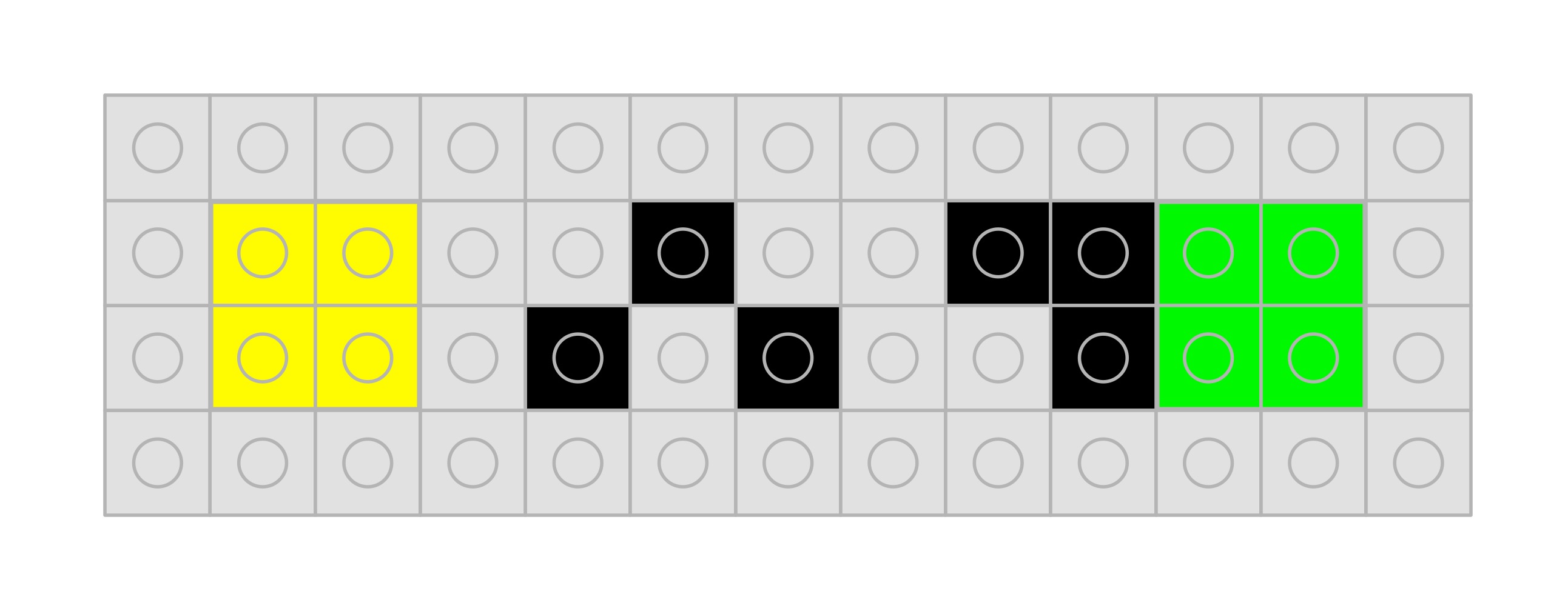
What about representing the actual sentences stating purported facts like “Messi is the best footballer ever”, or in a program “n == 1”? Statements like this are called propositions. As far as reasoning logically goes the precise words or even language they are in do not matter. This is something Wittgenstein realised. When doing reasoning these basic propositions can be replaced by variables like P and Q and the logic won’t change. Rather than use letters we will just use different coloured lego blocks to stand for different propositions, emphasising that the words or even variable names do not matter. So we will use a yellow block for a variable P and a green block for a variable Q. Each of which could stand for absolutely any English proposition we like at any time (though if we want it to stand for a particular proposition then we should define which one clearly).

Yellow block for P and green block for Q
Propositional variables P and Q are represented by yellow and green blocks

Logical Symbols

What we are really interested in is not just true and false values but the logical operations on propositions. The core of these we use in everyday English: AND, OR and NOT, more technically known as conjunction, disjunction and negation in logic. There are several variations of the symbols used to represent these symbols just as there are for true and false. We will use the versions in lego as below.

Symbols for AND, OR and NOT in Lego
The logical operators AND, OR and NOT as lego symbols

These lego symbols will allow us to write out logical expressions about propositions: like “The cat is thirsty AND NOT the cat is hungry” which we might write in English as “The cat is thirsty and not hungry”. If we use a yellow block to mean “The cat is thirsty” and a green block to mean “The cat is hungry” then in lego logic we can write it as follows:

P AND (NOT Q) in Lego symbols
The cat is thirsty AND NOT the cat is hungry
P AND (NOT Q)

Of course the yellow and green brick are variables so by changing the propositions they represent it can stand for other things. It can also represent: ” The moon is blue AND NOT The moon is made of cheese.” where the yellow brick represents “The moon is blue” and the green brick represents “The moon is made of cheese”.

Think up some statements that involve AND, OR and NOT and then build representations of then in lego logic like the above.

The meaning of logical connectives

The above gives us symbols for the logical connectives, but so far they have no meaning: it is just syntax. Perhaps you think you know what the words mean. We use words like and, or and not in language rather imprecisely at times based on dictionary-style definitions. They essentially mean the same in English as in logic, but we need to define what they mean precisely. We do not want two different people to have two slightly different understandings of what they mean. This is where truth tables come in. A truth table tells us exactly, and without doubt, what the symbols for the operators mean. The give what is called by computer scientists a formal semantics to the logical connectives.

Let’s look at NOT first. A truth table is just a table that includes as rows all the combinations of true and false values of the variables in a logical expression together with an answer for those values. For example a truth table for the operator NOT, so telling us in all situations what (NOT a) means, is:

PNOT P
TRUEFALSE
FALSETRUE
A truth table for the NOT operator. Reading along the rows,
IF P is TRUE THEN (NOT P) is FALSE;
IF P is FALSE THEN (NOT P) is TRUE.

We can build this truth table in lego using our lego representation:

Lego of a truth table for NOT P

NOT only applies to one proposition, the one it negates, (it is a unary logical connective). That means we only need two rows in the table to cover the different possible values those propositions could stand for. AND (and OR) combine to two propositions (it is a binary logical connective). To cover all the possible combinations of the values of those propositions we need a table with four rows as there are four possibilities.

PQ P AND Q
TRUETRUETRUE
TRUEFALSEFALSE
FALSETRUEFALSE
FALSEFALSEFALSE
A truth table for the logical AND operator.

We can build this in Lego as:

Lego of a truth table for P AND Q

Reading along the rows this says that if both P and Q are blue (true) then the answer for P AND Q is true. Otherwise the answer is false (red). T

The following is the lego truth table for the logical OR operator

Lego of a truth table for P AND Q

The columns for the two variables yellow/green (P/Q) are the same, setting out all the possibilities. Now the answer is true (blue) if either operand is true (blue) and false (red) when both are false (red).

We have now created lego truth tables that give the meaning of each of these three logical connectives. They aren’t the only logical operators – in fact there are 8 possible binary ones. Have a go at building lego truth tables for other binary logical connectives such as exclusive-or which is true if exactly one of the operands is true, and equivalence which is true if both operands are the same truth value.

Truth tables give precise meanings to logical operators and so to logic. That is useful, but even more usefully, they give a way to reason logically in a clear, price way. By following a simple algorithm to build new truth tables from existing ones, we can prove general facts, that are ultimately about propositions, in lego… as we will see next.

Paul Curzon, Queen Mary University of London


More on …


Subscribe to be notified whenever we publish a new post to the CS4FN blog.


This blog is funded by EPSRC on research agreement EP/W033615/1.

QMUL CS4FN EPSRC logos

The Lego Computer Science post was originally funded by UKRI, through grant EP/K040251/2 held by Professor Ursula Martin, and forms part of a broader project on the development and impact of computing.

Jacquie Lawson: the multi-million pound greeting

Happy Birthday in a circle of hearts
Image adapted from Pixabay

There is real money to be made out there in the virtual world – if you are willing to put in the effort to develop appropriate skills.

You don’t have to be young or a geek either. At the age of 62, grandmother Jacquie Lawson turned a hobby into a multi-million pound business. She is a trained illustrator having originally studied art at St Martins School of Art in London. She bought her first computer in 1998. Despite struggling at the start she taught herself to draw computer animations using Macromedia Flash.

Just for fun she made an animated Christmas e-card and sent it to friends. Her skill as an illustrator combined with her artistic flair meant that suddenly she was inundated with people wanting them from around the world – a wonderful example of viral marketing.

“The Internet is such a fantastic medium.
It ought to be better.”

She set up a business, launched the http://www.jacquielawson.com e-card website and is now the market leader – with double the visitors of its nearest rival. As Jacquie says about the Internet: “It’s such a fantastic medium. It ought to be better”.

She believes there is a lot of rubbish on the Internet – which means there is scope for skilled, creative people to make a difference by focusing on detail in what they do. Quality can stand out.

So develop the basic skills, have a great idea, throw in some business savvy…but most of all do it for fun, if you want to end up with a successful business.

Paul Curzon, Queen Mary University of London (from the cs4fn women are here special issue)

Activity

Be inspired by Jacquie Lawson. Make your own computer greeting card for some special occasion (whether Valentine’s day, a birthday, Mothers day or Fathers Day…). It might be a still drawing or an animation. Perhaps it could even be a program. Use a technology you are familiar with, or learn one you haven’t used before for the occasion – Scratch perhaps or a drawing program. Learning new skills can be very rewarding and sometimes can lead to new opportunities.

More on …

Related Magazines …


Subscribe to be notified whenever we publish a new post to the CS4FN blog.


This blog is funded by EPSRC on research agreement EP/W033615/1.
QMUL CS4FN EPSRC logos

Alan Turing’s life

Alan Turing Portrait
Image of Alan Turing: Elliott & Fry, Public domain, via Wikimedia Commons

Alan Turing was born in London on 23 June 1912. His parents were both from successful, well-to-do families, which in the early part of the 20th century in England meant that his childhood was pretty stuffy. He didn’t see his parents much, wasn’t encouraged to be creative, and certainly wasn’t encouraged in his interest in science. But even early in his life, science was what he loved to do. He kept up his interest while he was away at boarding school, even though his teachers thought it was beneath well-bred students. When he was 16 he met a boy called Christopher Morcom who was also very interested in science. Christopher became Alan’s best friend, and probably his first big crush. When Christopher died suddenly a couple of years later, Alan partly helped deal with his grief with science, by studying whether the mind was made of matter, and where – if anywhere – the mind went when someone died.

The Turing machine

After he finished school, Alan went to the University of Cambridge to study mathematics, which brought him closer to questions about logic and calculation (and mind). After he graduated he stayed at Cambridge as a fellow, and started working on a problem that had been giving mathematicians headaches: whether it was possible to determine in advance if a particular mathematical proposition was provable. Alan solved it (the answer was no), but it was the way he solved it that helped change the world. He imagined a machine that could move symbols around on a paper tape to calculate answers. It would be like a mind, said Alan, only mechanical. You could give it a set of instructions to follow, the machine would move the symbols around and you would have your answer. This imaginary machine came to be called a Turing machine, and it forms the basis of how modern computers work.

Code-breaking at Bletchley Park

By the time the Second World War came round, Alan was a successful mathematician who’d spent time working with the greatest minds in his field. The British government needed mathematicians to help them crack the German codes so they could read their secret communiqués. Alan had been helping them on and off already, but when war broke out he moved to the British code-breaking headquarters at Bletchley Park to work full-time. Based on work by Polish mathematicians, he helped crack one of the Germans’ most baffling codes, called the Enigma, by designing a machine (based on earlier version by the Poles again!) that could help break Enigma messages as long as you could guess a small bit of the text (see box). With the help of British intelligence that guesswork was possible, so Alan and his team began regularly deciphering messages from ships and U-boats. As the war went on the codes got harder, but Alan and his colleagues at Bletchley designed even more impressive machines. They brought in telephone engineers to help marry Alan’s ideas about logic and statistics with electronic circuitry. That combination was about to produce the modern world.

Building a brain

The problem was that the engineers and code-breakers were still having to make a new machine for every job they wanted it to do. But Alan still had his idea for the Turing machine, which could do any calculation as long as you gave it different instructions. By the end of the war Alan was ready to have a go at building a Turing machine in real life. If it all went to plan, it would be the first modern electronic computer, but Alan thought of it as “building a brain”. Others were interested in building a brain, though, and soon there were teams elsewhere in the UK and the USA in the race too. Eventually a group in Manchester made Alan’s ideas a reality.

Troubled times

Not long after, he went to work at Manchester himself. He started thinking about new and different questions, like whether machines could be intelligent, and how plants and animals get their shape. But before he had much of a chance to explore these interests, Alan was arrested. In the 1950s, gay sex was illegal in the UK, and the police had discovered Alan’s relationship with a man. Alan didn’t hide his sexuality from his friends, and at his trial Alan never denied that he had relationships with men. He simply said that he didn’t see what was wrong with it. He was convicted, and forced to take hormone injections for a year as a form of chemical castration.

Although he had had a very rough period in his life, he kept living as well as possible, becoming closer to his friends, going on holiday and continuing his work in biology and physics. Then, in June 1954, his cleaner found him dead in his bed, with a half-eaten, cyanide-laced apple beside him.

Alan’s suicide was a tragic, unjust end to a life that made so much of the future possible.

Jonathan Black, Paul Curzon and Peter W. McOwan, Queen Mary University of London (from the archive)

More on …

Related Magazines …

cs4fn issue 14 cover

Subscribe to be notified whenever we publish a new post to the CS4FN blog.


This blog is funded by EPSRC on research agreement EP/W033615/1.

QMUL CS4FN EPSRC logos