Welcome to Day 6 of the CS4FN Christmas Computing Advent Calendar – every day until Christmas we’ll post a little something about computer science. Some of it will even relate (…vaguely) to the picture on the advent calendar’s door.
Today’s picture is of a festive bauble with a pattern engraved on it. That obviously made us think of printed circuit boards. Read on to see why.
A brightly coloured (pink!) Christmas bauble, ready to go on a tree. Image drawn and digitised by Jo Brodie.
Printed Circuit Boards
Yesterday we looked at computers made of water, in which the flow of water (and where it ends up) let people do some quite advanced calculations. Today it’s the electrons that are doing the flowing… through tiny little copper channels.
At first sight nothing could be more different than textiles and electronics. Put opposites together and you can maybe even bring historical yarns to life. That’s what Queen Mary’s G.Hack team helped do. They are an all-woman group of electronic engineering and computer science research students and they helped build an interactive art installation combining textiles and personal stories about health.
In June 2011 the G.Hack team was asked by Jo Morrison and Rebecca Hoyes from Central Saint Martins College of Art and Design to help make their ‘Threads & Yarns‘ artwork interactive. It was commissioned by the Wellcome Trust as a part of their 75th Anniversary celebrations. They wanted to present personal accounts about the changes that have taken place in health and well-being over the 75 years since they were founded.
Flowers powered
Jo and Rebecca had been working on the ‘Threads & Yarns’ artwork for 6 months. It was inspired by the floor tiling at the London Victoria and Albert Museum and was made up of 125 individually created material flowers spread over a 5 meter long white perspex table. They wanted some of the flowers to be interactive, lighting up and playing sounds linked to stories about health and well-being at the touch of a button.
Central Saint Martins College Textile students worked with senior citizens from the Euston and Camden area, recording the stories they told as they made the flowers. G.Hack then ran a workshop with the students to show them how physical computing could be built into textiles and so create interactive flowers. Short sound bites from the recorded stories were eventually included in nine of the flowers.
The interactive part was built using an open source (i.e., free and available for anyone to use) hardware platform called Arduino. It makes physical computing accessible to anyone giving an easy way to create programs that control lights, buttons and other sensors.
The audio stories of the senior citizens were edited down into 1-minute sound bites and stored on a memory card like those used in digital cameras. Each of the nine flowers were lit by eight Light Emitting Diodes (LEDs). They are low energy lights so they don’t heat up, which is important if they are going to be built into fabrics. They are found in most household electronics, such as to show whether a gadget is turned on or off. When a button is pressed on the ‘Threads & Yarns’ artwork, it triggers the audio of a story to be played and simultaneously lights the LEDs on the linked flower, switching off again when the audio story finishes.
Smooth operators
The artwork had to work without problems throughout the day so the G.Hack team had to make sure everything would definitely go smoothly. The day before the opening of the exhibition they did final testing of the interactive flowers in their electronics workshop. They then worked with Central Saint Martins and museum staff to install the electronics into the artwork. They designed the system to be modular. This was both to allow the electronics to be separate from the artwork itself as well as to ease combining the two. On the day of the exhibition, the team arrived early to test everything one more time before the opening. They also stayed throughout the day to be on call in case of any problems.
Leading up to the opening of the exhibition were a busy few weeks for G.Hack with lots of late nights spent testing, troubleshooting and soldering in the workshop but it was all worth it as the final artwork looked fantastic and received a lot of positive feedback from people visiting the exhibition. It was a really positive experience all round! G.Hack and Central Saint Martins formed a bond that will likely extend into future partnerships. ‘Threads & Yarns’ meanwhile is off on a UK ‘tour’.
Art may have brought the textiles, history and health stories together as embodied in the flowers. It’s the electronics that brought the yarn to life though.
Paul Curzon, Queen Mary University of London, June 2011
G.Hack
G.Hack was a supportive and friendly space for women to do hands-on experimental production fusing art and technology at Queen Mary University of London. As a group they aimed to strengthen each other’s confidence and ability in using a wide range of different technologies. They supported each other’s research and helped each other extend their expertise in science and technology through public engagement, collaborating with other universities and commercial companies.
The members of G.Hack involved in ‘Threads & Yarns’ were Nela Brown, Pollie Barden, Nicola Plant, Nanda Khaorapapong, Alice Clifford, Ilze Black and Kavin Preethi Narasimhan.
Related Magazines
The Women Are Here annualCS4FN Issue 23EE4FN magazine
Subscribe to be notified whenever we publish a new post to the CS4FN blog.
This blog is funded by EPSRC on research agreement EP/W033615/1.
A naive way of using two different symbols (red and blue blocks) to represent numbers. Image by CS4FN
Continuing a series of blogs on what to do with all that lego scattered over the floor: learn some computer science…how might we represent numbers using only two symbols?
We build numbers out of 10 different symbols: our digits 0-9. Charles Babbage’s victorian computer design represented numbers using the same decimal system (see Part 4: Lego Computer Science: representing numbers using position). That was probably an obvious choice for Babbage, but as we have already seen, there are lots of different ways numbers could be represented.
Modern computers use a different representation. The reason is they are based on a technology of electrical signals that are either there or not, switches that are on or off. Those two choices are used as two symbols to represent data. It is as though all data will be built of two lego coloured blocks: red and blue, say.
How might that then be done? There are still lots of ways that could be chosen.
Count the red blocks
One really obvious way would be to just pick one of the two coloured bricks (say red) to mean 1 and then to represent a number like 2 say you would have 2 of that colour block, filling the other spaces allocated for the number with the other colour. So if you were representing numbers with storage space for three blocks, two of them would be red and one would be blue for the number 2. All would be red for the number 3.
This is actually just a variation of unary, that we have seen earlier, just with a fixed amount of storage. It isn’t a very good representation as you need lots of storage space to represent large numbers because it is not using all possible combinations of the two symbols. In particular, far more numbers can be represented with a better representation. In the above example, 3 places are available on the lego base to put the blocks we are using and we have been able to represent 4 different numbers (0 to 3). However, information theory tells us we should be able to store up to 8 different numbers in the space, given two symbols and using them the right way, with the right representation.
A random code for numbers
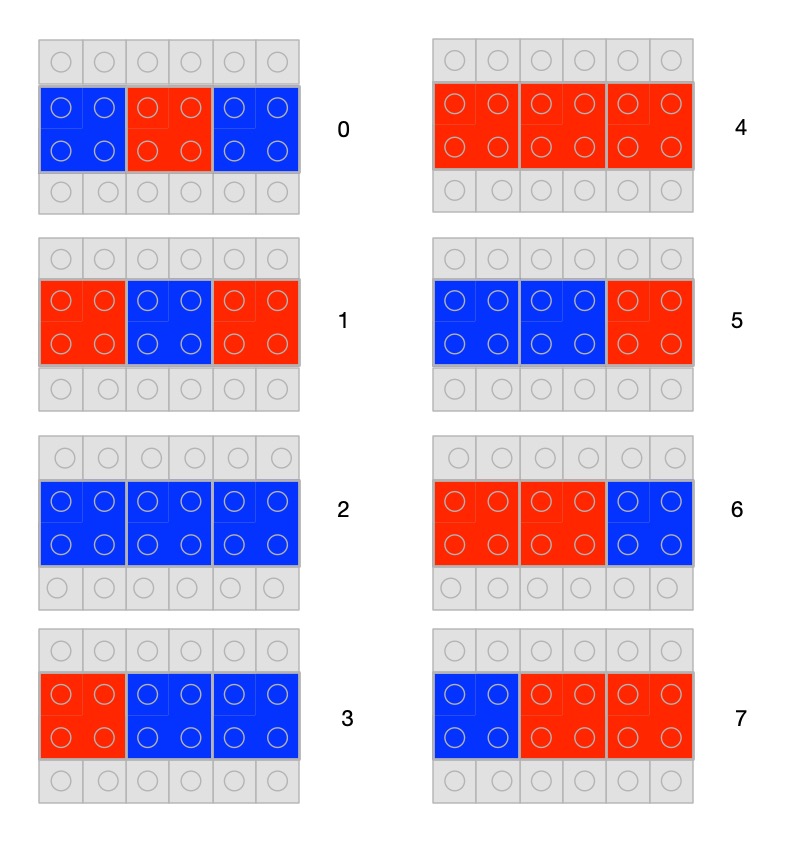
How do we use all 8 possibilities? Just allocate a different combination to each pattern with blocks either red or blue, and allocate a different number to each pattern. Here is one random way of doing it.
A code for numbers chosen at random Image byCS4FN
Having a random allocation of patterns to numbers isn’t a very good representation though as it doesn’t even let us count easily. There is no natural order. There is no simple way to know what comes next other than learning the sequence. It also doesn’t easily expand to larger numbers. A good representation is one that makes the operations we are trying to do easy. This doesn’t.
Gray Code
Before we get to the actual binary representation computers use, another representation of numbers has been used in the past that isn’t just random. Called Gray code it is a good example of choosing a representation to make a specific task easier. In particular, it is really good if you want to create an electronic gadget that counts through a sequence.
Also called a a reflected binary code, Gray code is a sequence where you change only one bit (so the colour of one lego block) at a time as you move to the next number.
If you are creating an electronic circuit to count, perhaps as an actual counter or just to step through different states of a device (eg cycling through different modes like stopwatch, countdown timer, normal watch), then numbers would essentially be represented by electronic switches being on or off. A difficulty with this is that it is highly unlikely that two switches would change at exactly the same time. If you have a representation like our random one above, or actual binary, to move between some numbers you have to change lots of digits.
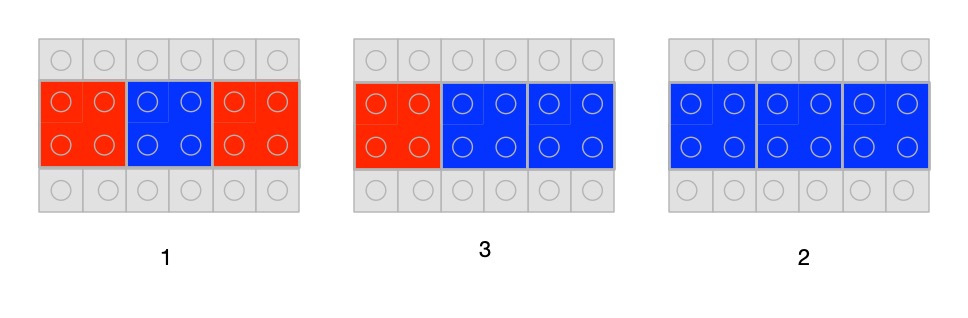
You can see the problem with lego. For example, to move from 0 to 1 in our sequence above you have to change all three lego blocks for new ones of the other colour. Similarly, to go from 1 to 2 you need to change two blocks. Now, if you swap one block from the number first and then the other, there is a point in time when you actually have a different (so wrong) number! To change the number 1 to 2, for example, we must swap the first and third bricks. Suppose we swap the first brick first and then the third brick. For a short time we are actually holding the number 3. Only when we change the last brick do we get to the real next number 2. We have actually counted 1, 3, 2, not 1, 2 as we wanted to. We have briefly been in the wrong state, which could trigger the electronics to do things associated with that state we do not want (like display the wrong number in a counter).
Mistaken counting using our random representation. To get from 1 to 2 we need to swap the first and third brick. If we change the first brick first, there is a brief time when our number has become three, before the third brick is changed. We have counted 1, 3, 2 by mistake. Image by CS4FN
Just as it is hard to swap several blocks at precisely the same time, electronic switches do not switch at exactly the same time, meaning that our gadget could end up doing the wrong thing, because it briefly jumps to the wrong state. This led to the idea of having a representation that used a sequence of numbers where only one bit of the number needs to be changed to get to the next number.
A Gray code in lego bricks. To move from one number in the sequence to the next, you only need to change one lego brick. Image by CS4FN
There are lots of ways to do this and the version above is the one introduced by physicist Frank Gray. Gray codes of this kind have been used in all sorts of situations: a Gray code sequence was used to represent characters in Émile Baudot’s telegraph communication system, for example. More recently they have been used to make it easier to correct errors in streams of data in digital TV.
Computers do not need to worry about this timing problem of when things change as they use clocks to determine when values are valid. Data is only read when the tick of the clock signal says it is safe too. This is slower, but gives time for all the digital switches to settle into their final state before the values are read, meaning faulty intermediate values are ignored. That means computers are free to use other representations of numbers and in particular use a binary system equivalent to our decimal system. That is important as while Gray code is good for counting, and stepping through states, amongst other things, it is not very convenient for doing more complicated arithmetic.
Part of a series featuring featuring pixel puzzles, compression algorithms, number representation, gray code, binary, logic and computation.
Subscribe to be notified whenever we publish a new post to the CS4FN blog.
This blog is funded by EPSRC on research agreement EP/W033615/1.
This post was funded by UKRI, through grant EP/K040251/2 held by Professor Ursula Martin, and forms part of a broader project on the development and impact of computing.








 cs4fn
cs4fn 