Video games can be a very successful way to do citizen science, getting ordinary people involved in research. Sea Hero Quest is an extremely successful example. It involves a boy setting out on a sea quest to recover his father’s memories, lost when he suffers from dementia. The hundreds of thousands of people joining the quest have helped researchers better understand our ability to navigate.
The Sea Hero Quest project was led by Deutsche Telecom, working with both universities and Alzheimer’s Research UK. The first mass-market game of its kind, it has allowed researchers to explore navigation and related cognitive abilities of people throughout their lives. The game has 75 levels, each with different kinds of task in different environments, and has been played by millions of people around the world for over a 100 years of combined game time. The amount of data collected is vast and would have taken researchers centuries to collect by traditional means, if possible at all.
For example, an international team including researchers from UCL, the University of Lyon and the University of Münster used the game to explore how the place people grew up affects their ability to navigate. As well as more general data from around 400,000 people across the world, they also used the data specifically from people who had completed all levels of the game. This amounted to around ten thousand adults of all ages.
They found that people are best at navigating in situations similar to where they grew up (where they lived at the time of playing the game had no effect). So, for example, people who grew up in an American grid-like city such as Chicago, were better at navigating in grid-based levels. Those who grew up in cities such as Prague in Europe, where the streets are more wiggly and chaotically laid out, were better at levels needing similar navigation skills. Throughout, the researchers found that those that grew up in the countryside were better at navigating overall as well as specifically in more unstructured environments.
Sea Hero Quest shows that games designers, if they can create fun but serious games, can help us all help researchers…It is often said that playing video games is bad for growing brains but it also shows that the way we design our cities affects the way we think and can be bad for our brains!
Could your smartphone automatically tell you what species of bird is singing outside your window? If so how?
Mobile phones contain microphones to pick up your voice. That means they should be able to pick up the sound of birds singing too, right? And maybe even decide which bird is which?
Smartphone apps exist that promise to do just this. They record a sound, analyse it, and tell you which species of bird they think it is most likely to be. But a smartphone doesn’t have the sophisticated brain that we have, evolved over millions of years to understand the world around us. A smartphone has to be programmed by someone to do everything it does. So if you had to program an app to recognise bird sounds, how would you do it? There are two very different ways computer scientists have devised to do this kind of decision making and they are used by researchers for all sorts of applications from diagnosing medical problems to recognising suspicious behaviour in CCTV images. Both ways are used by phone apps to recognise bird song that you can already buy.
The sound of the European robin (Erithacus rubecula) better known as robin redbreast, Recorded by Vladimir Yu. Arkhipov, Arkhivov CC BY-SA 3.0 via wikimedia
If you ask a birdwatcher how to identify a blackbird’s sound, they will tell you specific rules. “It’s high-pitched, not low-pitched.” “It lasts a few seconds and then there’s a silent gap before it does it again.” “It’s twittery and complex, not just a single note.” So if we wrote down all those rules in a recipe for the machine to follow, each rule a little program that could say “Yes, I’m true for that sound”, an app combining them could decide when a sound matches all the rules and when it doesn’t.
This is called an ‘expert system’ approach. One difficulty is that it can take a lot of time and effort to actually write down enough rules for enough birds: there are hundreds of bird species in the UK alone! Each would need lots of rules to be hand crafted. It also needs lots of input from bird experts to get the rules exactly right. Even then it’s not always possible for people to put into words what makes a sound special. Could you write down exactly what makes you recognise your friends’ voices, and what makes them different from everyone else’s? Probably not! However, this approach can be good because you know exactly what reasons the computer is using when it makes decisions.
This is very different from the other approach which is…
Show it lots of examples
A lot of modern systems use the idea of ‘machine learning’, which means that instead of writing rules down, we create a system that can somehow ‘learn’ what the correct answer should be. We just give it lots of different examples to learn from, telling it what each one is. Once it has seen enough examples to get it right often enough, we let it loose on things we don’t know in advance. This approach is inspired by how the brain works. We know that brains are good at learning, so why not do what they do!
One difficulty with this is that you can’t always be sure how the machine comes up with its decisions. Often the software is a ‘black box’ that gives you an answer but doesn’t tell you what justifies that answer. Is it really listening to the same aspects of the sound as we do? How would we know?
On the other hand, perhaps that’s the great thing about this approach: a computer might be able to give you the right answer without you having to tell it exactly how to do that!
It means we don’t need to write down a ‘recipe’ for every sound we want to detect. If it can learn from examples, and get the answer right when it hears new examples, isn’t that all we need?
Which way is best?
There are hundreds of bird species that you might hear in the UK alone, and many more in tropical countries. Human experts take many years to learn which sound means which bird. It’s a difficult thing to do!
So which approach should your smartphone use if you want it to help identify birds around you? You can find phone apps that use one approach or another. It’s very hard to measure exactly which approach is best, because the conditions change so much. Which one works best when there’s noisy traffic in the background? Which one works best when lots of birds sing together? Which one works best if the bird is singing in a different ‘dialect’ from the examples we used when we created the system?
One way to answer the question is to provide phone apps to people and to see which apps they find most useful. So companies and researchers are creating apps using the ways they hope will work best. The market may well then make the decision. How would you decide?
This article was originally published on the CS4FN website and can also be found on pages 10 and 11 of Issue 21 of the CS4FN magazine ‘Computing sounds wild’. You can download a free PDF copy of the magazine (below), or any of our other free material at our downloads site.
Understanding protein folding to tackle diseases, and how computers (and people) can help
HIV-1 protease – an illustrationshowing the folded shape of a protein used by HIV, created by ‘Boghog’ in 2008, via Wikipedia.
Biologists want you to play games in the name of science. A group of researchers at the University of Washington have invented a computer game, Foldit, in which you have to pack what looks like a 3D nest of noodles and elastics into the smallest possible space. You drag, turn and squeeze the noodles until they’re packed in tight. You compete against others, and as you get better you can rise through the ranks of competitors around the world. How can that help science? It’s because the big 3D jumbles represent models of proteins, and figuring out how proteins fold themselves up is one of the biggest problems in biology. Knowing more about how they do it could help researchers design cures for some of the world’s deadliest diseases.
The perfect fit
Proteins are in every cell in your body. They help you digest your food, send signals through your brain, and fight infection. They’re made of small molecules called amino acids. It’s easy for scientists to figure out what amino acids go together to make up a protein, but it’s incredibly difficult to figure out the shape they make when they do it. That’s a shame, because the shape of a protein is what makes it able to do its job. Proteins act by binding on to other molecules – for example, a protein called haemoglobin carries oxygen around our blood. The shape of the haemoglobin molecule has to fit the shape of the oxygen molecule like a lock and key. The close tie between form and function means that if you could figure out the shape that a particular protein folds into, you would know a lot about the jobs it can do.
Completely complex
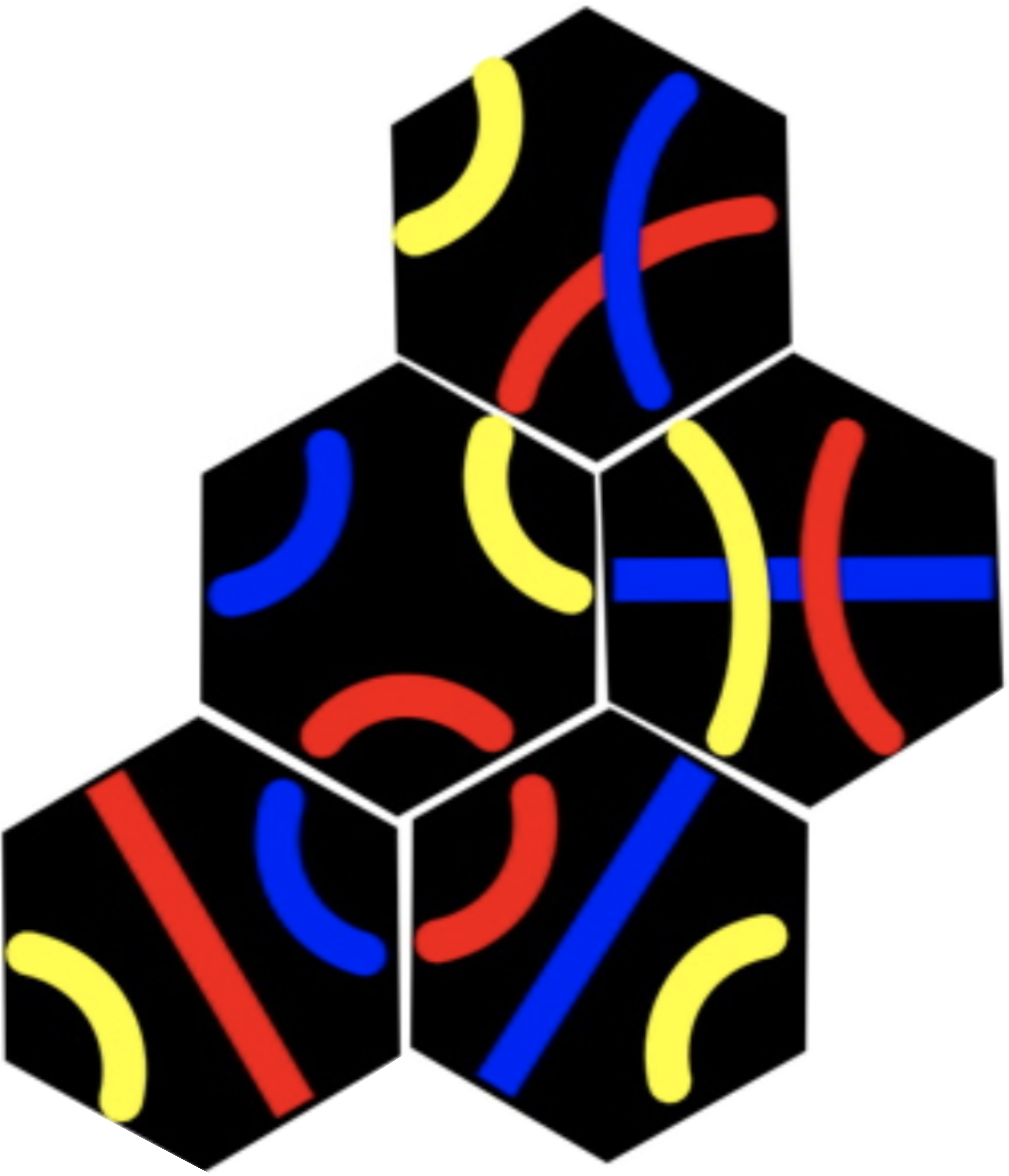
Tantrix rotation puzzle Image by CS4FN.
Protein folding is part of a group of problems that are an old nemesis of computer scientists. It’s what’s known as an NP-complete problem. That’s a mathematical term that means it appears there’s no shortcut to calculating the answer to a problem. You just have to try every different possible answer before you arrive at the right one. There are other problems like this, like the Tantrix rotation puzzle. Because a computer would have to check through every possible answer, the more complex the problem is the longer it will take. Protein folding is particularly complex – an average-sized protein contains about 100 amino acids, which means it would take a computer a billion billion billion years to figure out. So a shortcut would be nice then.
Puzzling out a cure
Obviously the proteins themselves have found a shortcut. They fold up all the time without having to have computers figure it out for them. In order to get to the bottom of how they do it, though, scientists are hoping that human beings might provide a shortcut. Humans love puzzles, and we’re awfully good at visual ones. Our good visual sense means we see patterns everywhere, and we can easily develop a ‘feel’ for how to use those patterns to solve problems. We use that sense when we play games like chess or Go. The scientists behind Foldit reckon that if it turns out that humans really are more efficient at solving protein folding problems, we can teach some of our tricks to computers.
If there were an efficient way to work out protein structure, it could be a huge boon to medicine. Diseases depend on proteins too, and lots of drugs work by targeting the business end of those proteins. HIV uses two proteins to infect people and replicate itself, so drugs disrupt the workings of those proteins. Cancer, on the other hand, damages helpful proteins. If scientists understood how proteins fold, they could design new proteins to counteract the effects of disease. So getting to the top of the tables in Foldit could hold even more glory for you than you bargained for – if your protein folding efforts help cure a dreaded disease, hey, maybe it’s the Nobel Prize you’ll end up winning.
The coloured diagram of the enzyme above is a 3D representation to help people see how the protein folds. These are called ribbon diagrams and were invented by Jane S Richardson, find out more here.