CS4FN Advent 2023 – Day 25: Merry Christmas! Today’s post is about the ‘wood computer’

Today is the final post in our CS4FN Christmas Computing Advent Calendar – it’s been a lot of fun rummaging in the CS4FN back catalogue, and also finding out about some new things to write about.

Advert for our Advent calendar
Image drawn and digitised by Jo Brodie.

Each day we’ve published a blog post about computing with the theme suggested by the picture on the advent calendar’s ‘door’. Our first picture was a woolly jumper so the accompanying post was about the links between knitting and coding, the door with a picture of a ‘pair of mittens’ on led to a post about pair programming and gestural gloves, a patterned bauble to an article about printed circuit boards, and so on. It was fun coming up with ideas and links and we hope it was fun to read too.

We hope you enjoyed the series of posts (click on any of the Christmas trees in this post to see them all) and that you are already having a very Merry Christmas.

And on to today’s post which is inspired by the picture of a Christmas Tree, so it’ll be a fairly botanically-themed post. The suggestion for this post came from Prof Ursula Martin of Oxford University, who told us about the ‘wood computer’.

It’s a Christmas tree! Image drawn and digitised by Jo Brodie.

The Wood Computer

by Jo Brodie, QMUL.

Other than asking someone “do you know what tree this is?” as you’re out enjoying a nice walk and coming across an unfamiliar tree, the way of working out what that tree is would usually involve some sort of key, with a set of questions that help you distinguish between the different possibilities. You can see an example of the sorts of features you might want to consider in the Woodland Trust’s page on “How to identify trees“.

Depending on the time of year you might consider its leaves – do they have stalks or not, do they sit opposite from each other on a twig or are they diagonally placed etc. You can work your way through leaf colour, shape, number of lobes on the leaf and also answer questions about the bark and other features of your tree. Eventually you narrow things down to a handful of possibilities.

What happens if the tree is cut up into timber and your job is to check if you’re buying the right wood for your project. If you’re not a botanist the job is a little harder and you’d need to consider things like the pattern of the grain, the hardness, the colour and any scent from the tree’s oils.

Wooden bridge image by Peter H from Pixabay

Historically, one way of working out which piece of timber was in front of you was to use a ‘wood computer’ or wood identification kit. This was prepared (programmed!) from a series of index cards with various wood features printed on all the cards – there might be over 60 different features.

Every card had the same set of features on it and a hole punched next to every feature. You can see an example of a ‘blank’ card below, which has a row of regularly placed holes around the edge. This one happens to be being used as a library card rather than a wood computer (though if we consider what books are made of…).

Image of an edge-notched card (actually being used as a library card though), from Wikipedia. Edge-notched Card (without the edges notched) by Daniel MacKay, image has been released into the public domain (CC0).

I bet you can imagine inserting a thin knitting needle into any of those holes and lifting that card up – in fact that’s exactly how you’d use the wood computer. In the tweet below you can see several cards that made up the wood computer.

One card was for one tree or type of wood and the programmer would add notch the hole next to features that particularly defined that type. For example you’d notch ‘has apples’ for the apple tree card but leave it as an intact hole on the pear tree card.  If a particular type of timber had fine grained wood they’d add the notch to the hole next to “fine-grained”. The cards were known, not too surprisingly, as edge-notched cards.

You can see what one looks like here with some notches cut into it. You might have spotted how knitting needles can help you in telling different woods apart.

Holes and notches

Edge-notched card overlaid on black background, with two rows of holes. On the top a hole in the first row is notched, on the right hand side two holes are notched. Image from Wikipedia. Randlochkarte mit zwei Schlitzungen (handgemalt) [Perforated card with two slots (hand-painted)] by Peter Frankfurt, image has been released into the public domain (CC0).

Each card would end up with a slightly different pattern of notched holes, and you’d end up with lots of cards that are slightly different from each other.

Example ‘wood computer’. At the end of your search (to find out which tree your piece of wood came from) you are left with two cards for fine-grained wood. If your sample has a strong scent then it’s likely it’s the tree in the card on the right (though you could arrive at the same conclusion by using the differences in colour too). The card at the top is the blank un-notched card.

How it works

Your wood computer is basically a stack of cards, all lined up and that knitting needle. You pick a feature that your tree or piece of wood has and put your needle through that hole, and lift. All of the cards that don’t have that feature notched will have an un-notched hole and will continue to hang from your knitting needle. All of the cards that contain wood that do have that feature have now been sorted from your pile of cards and are sitting on the table.

You can repeat the process several times to whittle (sorry!) your cards down by choosing a different feature to sort them on.

The advantage of the cards is that they are incredibly low tech, requiring no electricity or phone signal and they’re very easy to use without needing specialist botanical knowledge.

You can see a diagram of one on page 8 of the 20 page PDF “Indian Standard: Key for identification of commercial timbers”, from 1974.

The word ‘card’ features over 30 times on this page and the word Christmas over 10 times but this post isn’t actually about Christmas cards! We hope you had plenty of those 🙂 Merry Christmas.

Teachers: we have a classroom sorting activity that uses the same principles as the wood computer. Download our Punched Card Searching PDF from our activity page.

The creation of this post was funded by UKRI, through grant EP/K040251/2 held by Professor Ursula Martin, and forms part of a broader project on the development and impact of computing.


Advert for our Advent calendar
Click the tree to visit our CS4FN Christmas Computing Advent Calendar

EPSRC supports this blog through research grant EP/W033615/1.

CS4FN Advent 2023 – Day 24: Santa’s Sleigh – track its progress through the skies

We are nearly coming to the end of our CS4FN Christmas Computing Advent Calendar with one more post to come tomorrow. If you’ve missed any you can catch up by scrolling to the end and click on the Christmas Tree in the panel for the complete list so far.

Today’s advent calendar window shows Father Christmas’ sleigh with a sack full of presents ready for delivery. Today’s theme is about the many different online ways that you can now ‘track’ his movements around the world. You may be able to see (cloud permitting) his sleigh ‘in person’ as it flies over. In reality it’s International Space Station (ISS) whizzing past – but other interpretations are available 🙂

Visit this page https://www.astroviewer.net/iss/en/observation.php and type in your city to see when and where you might spot the ISS. On Christmas Day 2025 the ISS will pass over the South of England from around 6.17am to 6.22am, reaching its highest point at around 6.19am, so you’ll have to get up early!

You can track Father Christmas as he dashes through the sky, delivering presents. Image drawn and digitised by Jo Brodie.

1. NORAD Santa tracker

https://www.noradsanta.org/en/ for games
https://www.noradsanta.org/en/map (you can also track him on NORAD’s apps too)

Vintage photo image by Alexa from Pixabay

In 1955, so the story goes, an American department store published a newspaper advert with a phone number for children to call so that they could speak to Father Christmas. Unfortunately a misprint meant that the wrong number was given and instead people found they were talking to the US military’s Air Defense Command (now called North America Air Defense Command or NORAD).

Realising the mistake, but also spotting a great public relations opportunity, the team capitalised on this and began to make an annual event of it.

NORAD uses radar and geosynchronous* satellites to monitor Father Christmas. The satellites are able to detect infrared (heat) radiation and apparently Rudolph’s red nose gives quite a strong signal. This data is then shared with everyone via their website, though they don’t know in advance what route he’ll take.

If you’re visiting the website hover over the different bits of the picture as there are linked activities and extra information too.

*geo = Earth, synchronous = matching / following (like when you sync devices), the satellite follows the Earth’s orbit and is always above the same spot, so effectively (from the Earth’s point of view) the satellite appears not to move (it is moving but it follows the Earth’s rotation).

2. FlightRadar24 Santa tracker

https://www.flightradar24.com/R3DN053/335a9682

FlightRadar24 is a great website for telling you the answer to “what was that aircraft that’s just flown by?” It tracks the flight of aircraft all over the globe in real time, using a signal transmitted by the aircraft’s beacon (called a transponder) which announces where it is. Father Christmas’ sleigh has its own transponder too which is transmitting its location to receivers around the world.

An aircraft, or Santa’s sleigh, gets information about where it is from a GPS satellite (very similar to using a maps app on a smartphone and it telling you where you are and whether you should go left or right) and it then transmits this location info, along with other data, through its transponder.

There are thousands of receivers here on Earth, many of them in people’s homes and gardens (you can even apply to host a receiver antenna, or build your own with a Raspberry Pi) and whenever Santa’s sleigh passes over one of these ‘ground stations’ its signal is picked up and collected by FlightRadar24. The receivers are in different places so they are receiving the same signal at slightly different times and this information can be used to work out (by triangulation) how fast the sleigh is moving and in what direction.

Apparently Santa has been “able to extend the reach of his transponder by using the reindeer antlers as additional antenna” so the tracking should be fairly accurate.

3. Google Santa tracker

https://santatracker.google.com/

Google’s Santa Tracker has lots of games to play while you wait for Santa and his sleigh to take flight, including Code Boogie where you can try and program some dancing elves. You move little blocks (a bit like Scratch) to copy the dance moves and, if you get it right, it will show you the underlying JavaScript code.

Dave Holmes, a developer who works at Google and who works on the Santa Tracker project says “Santa Tracker launched in 2004, and has been an important project at Google ever since. While there’s a small core team dedicated to Santa, up to 20 or so Googlers volunteer to help make it happen every year, and it’s become a true community effort. It’s also a way for our developers to try things and see what Google products can do … I like to say that everything I’ve learned at Google, I learned from Santa.”

Google has also added some ‘Easter eggs‘ to its search page – try typing in Christmas or where is Santa to https://www.google.com/. You can also colour in some images online at their Christmas-themed Art Coloring Book, from Google’s Arts and Culture.

Further reading

The Googlers who help track Santa each Christmas (22 December 2021) Google Blog

4. Early internet Santa-themed humour

Image by Jo Brodie for CS4FN.

Back in the early 1990s email was very new but right from the start people used it to send each other amusing things. One of them was a rather literal consideration of the physics of a sleigh that is laden with gifts and a traditionally overweight Santa, led by a team of reindeer moving at unlikely speeds (after all Father Christmas has to get around the entire world to deliver presents, in just one day). The author (unknown) began –

No known species of reindeer can fly. BUT there are 300,000 species of living organisms yet to be classified, and while most of these are insects and germs, this does not COMPLETELY rule out flying reindeer which only Santa has ever seen.”

But then goes on to point out that such a gift-delivery system would be working far beyond normal levels and would probably end in disaster, suggesting that –

In short, they will burst into flame almost instantaneously, exposing the reindeer behind them, and create deafening sonic booms in their wake. The entire reindeer team will be vaporized within 4.26 thousandths of a second. Santa, meanwhile, will be subjected to centrifugal forces 17,500.06 times greater than gravity. A 250-pound Santa (which seems ludicrously slim) would be pinned to the back of his sleigh by 4,315,015 pounds of force.”

Fortunately Father Christmas has his own magic, meaning that we don’t need to worry too much about him disobeying the laws of physics. But he and his reindeer really deserve those cookies, milk and carrots!

You can read the full post here: The Physics of Santa and His Reindeer Snopes.com

The creation of this post was funded by UKRI, through grant EP/K040251/2 held by Professor Ursula Martin, and forms part of a broader project on the development and impact of computing.


Advert for our Advent calendar
Click the tree to visit our CS4FN Christmas Computing Advent Calendar

EPSRC supports this blog through research grant EP/W033615/1.
CS4FN Advent 2023 – Day 1: Woolly jumpers, knitting and coding

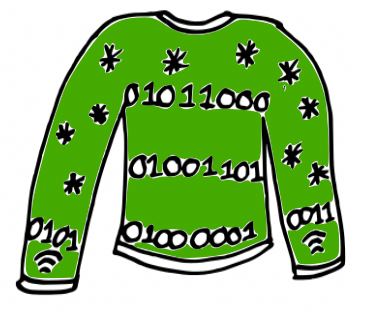
Welcome to the first ‘window’ of the CS4FN Christmas Computing Advent Calendar. The picture on the ‘box’ was a woolly jumper with a message in binary, three letters on the jumper itself and another letter split across the arms. Can you work out what it says? (Answer at the end).

Come back tomorrow for the next instalment in our Advent series.

Cartoon of a green woolly Christmas jumper with some knitted stars and a message “knitted” in binary (zeroes and ones). Also the symbol for wifi on the cuffs. Image drawn and digitised by Jo Brodie.

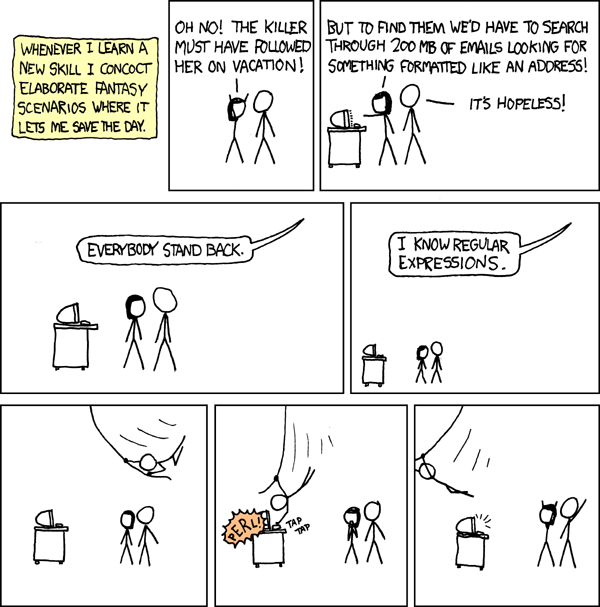
Wrap up warmly with our first festive CS4FN article, from Karen Shoop, which is all about the links between knitting patterns and computer code. Find out about regular expressions in her article: Knitters and Coders: separated at birth?

Click above to read Karen’s article

Image credit: Regular Expressions by xkcd

Further reading

Dickens Knitting in Code – this CS4FN article, by Paul Curzon, is about Charles Dickens’ book A Tale of Two Cities. One of the characters, Madame Defarge, takes coding to the next level by encoding hidden information into her knitting, something known as steganography (basically hiding information in plain sight). We have some more information on the history of steganography and how it is used in computing in this CS4FN article: Hiding in Elizabethan binary.

In Craft, Culture, and Code Shuchi Grover also considers the links between coding and knitting, writing that “few non-programming activities have such a close parallels to coding as knitting/crocheting” (see section 4 in particular, which talks about syntax, decomposition, subroutines, debugging and algorithms).

Something to print and colour in

This is a Christmas-themed thing you might enjoy eating, if you’ve any room left of course. Puzzle solution tomorrow. This was designed by Elaine Huen.

Solving the Christmas jumper code

The jumper’s binary reads

01011000

01001101

01000001

01010011

What four letters might be being spelled out here? Each binary number represents one letter and you can find out what each letter is by looking at this binary-to-letters translator. Have a go at working out the word using the translator (but the answer is at the end of this post).

Keep scrolling

Bit more

The Christmas jumper says… XMAS


Advert for our Advent calendar
Click the tree to visit our CS4FN Christmas Computing Advent Calendar

EPSRC supports this blog through research grant EP/W033615/1.

How does Santa do it?

Fast yuletide algorithms to visit all those chimneys in time

by Paul Curzon, Queen Mary University of London

Lots of Santas in a line
Image by Thomas Ulrich from Pixabay 

How does Santa do it? How does he visit all those children, all those chimneys, in just one night? My theory is he combines a special Scandinavian super-power with some computational wizardry.

There are about 2 billion children in the world and Santa visits them all. Clearly he has magic (flying reindeer remember) to help him do it but what kind of magic (beyond the reindeer)? And is it all about magic? Some have suggested he stops time, or moves through other dimensions, others that he just travels at an amazingly fast speed (Speedy Gonzales or The Flash style). Perhaps though he uses computer science too (though by that I don’t mean computer technology, just the power of computation).

The problem can be thought of as a computational one. The task is to visit, let’s say a billion homes (assuming an average of 2 children per household), as fast as possible. The standard solution assumes Santa visits them one at a time in order. This is what is called a linear algorithm and linear algorithms are slow. If there are n pieces of data to process (here, chimneys to descend) then we write this as having efficiency O(n). This way of writing about efficiency is called Big-O notation. O(n) just means as n increases the amount of work increases proportionately. Double the number of children and you double the workload for Santa. Currently the population doubles every 60 or 70 years or so, so clearly Santa needs to think in this way or he will eventually fail keep up, whatever magic he uses.

Perhaps, Santa uses teams of Elves as in the film Arthur Christmas, so that at each location he can deliver say presents to 1000 homes at once (though then it is the 1000 Elf helpers doing the delivering not Santa which goes against all current wisdom that Santa does it himself). It would speed things up apparently enormously to 1000 times faster. However, in computational terms that barely makes a difference. It is still a linear order of efficiency: it is still O(n) as the work still goes up proportionately with n. Double the population and Santa is in trouble still as his one night workload doubles too. O(2n) and O(1000n) both simplify to mean exactly the same as O(n). Computationally it makes little difference, and if their algorithms are to solve big problems computer scientists have to think in terms of dealing with data doubling, doubling and doubling again, just like Santa has had to over the centuries.

Divide and Conquer problem solving

When a computer scientist has a problem like this to solve, one of the first tools to reach for is called Divide and Conquer problem solving. It is a way of inventing lightening fast algorithms, that barely increase in work needed as the size of the problem doubles. The secret is to find a way to convert the problem into one that is half the size of the original, but (and this is key) that is otherwise exactly the same problem. If it is the same problem (just smaller) then that means you can solve those resulting smaller problems in the same way. You keep splitting the problem until the problems are so small they are trivial. That turns out to be a massively fast way to get a job done. It does not have to be computers doing the divide and conquer: I’ve used the approach for sorting piles of hundreds and hundreds of exam scripts into sorted order quickly, for example.

My theory is that divide and conquer is what Santa does, though it requires a particular superhero power too to work in his context, but then he is magical, so why not. How do I think it works? I think Santa is capable of duplicating himself. There is a precedent for this in the superhero world. Norse god Loki is able to copy himself to get out of scrapes, and since Santa is from the same part of the world it seems likely he could have a similar power.

If he copied himself twice then one of him could do the Northern Hemisphere and the other the Southern hemisphere. The problem has been split into an identical problem (delivering presents to lots of children) but that is half the size for each Santa (each has only half the world so half as many children to cover). That would allow him to cover the world twice as fast. However that is really no different to getting a couple of Elves to do the work. It is still O(n) in terms of the efficiency the work is done. As the population doubles he quickly ends up back in the same situation as before: too much work for each Santa. Likewise if he made a fixed number of 1000 copies of himself it would be similar to having 1000 Elves doing the deliveries. The work still increases proportional to the number of deliveries. Double the population and you still double the time it takes.

Double Santa and double again (and keep doubling)

So Santa needs to do better than that if he is to keep up with the population explosion. But divide and conquer doesn’t say halve the problem once, it says solve the new problem in the same way. So each new Santa has to copy themselves too! As they are identical copies to the original surely they can do that as easily as the first one could. Those new Santas have to do the same, and so on. They all split again and again until each has a simple problem to solve that they can just do. That might be having a single village to cover, or perhaps a single house. At that point the copying can stop and the job of delivering presents actually done. Each drops down a chimney and leaves the presents. (Now you can see how he manages to eat all those mince pies too!)

An important thing to remember is that that is not the end of it. The world is now full of Santas. Before the night is over and the job done, each Santa has to merge back with the one they split from, recursively all the way back to the original Santa. Otherwise come Christmas Day we wouldn’t be able to move for Santas. Better leave 30 minutes for that at the end!

Does this make a big difference? Well, yes (as long as all the copying can be done quickly and there is an organised way to split up the world). It makes a massive difference. The key is in thinking about how often the Santas double in number, so how often the problem is halved in size.

We start with 1 Santa who duplicates to 2, but now both can duplicate to 4, then to 8, 16, and after only 5 splittings there are already 32 Santas, then 64, 128, 256, 512 Santas, and after only 10 splittings we have over a 1000 Santas (1024 to be precise). As we saw that isn’t enough so they keep splitting. Following the same pattern, after 20 splittings we have over a million Santas to do the job. After only 30 rounds of splittings we have a billion Santas, so each can deal with a single family: a trivial problem for each.

So if a Santa can duplicate himself (along with the sleigh and reindeer) in a minute or so (Loki does it in a fraction of a second so probably this is a massive over-estimate and Santa can too), we have enough Santas to do the job in about half an hour, leaving each plenty of time to do the delivery to their destination. The splitting can also be done on the way so each Santa travels only as far as needed. Importantly this splitting process is NOT linear. It is O(log2 n) rather than O(n) and log2 n is massively smaller than n for large n. It means if we double the population of households to visit due to population explosion, the number of rounds of splitting does not need to double, the Santas just have to do one more round of splitting to cover it. The calculation log2 n (the logarithm to base 2 of n) is just a mathematicians way of saying how many times you can halve the number n before you get to 1 (or equivalently how many times you double from 1 before you get up to n). 1024 can be halved 10 times so (log2 1024) is 10. A billion can be halved about 30 times so (log2 1 billion) is about 30. Instead of a billion pieces of work we do only 30 for the splitting. Double the chimneys to 2 billion and you need only one more for a total of 31 splittings.

In computer terms divide and conquer algorithms involve methods (ie functions / procedures) calling themselves multiple times. Each call of the method, works on eg half the problem. So a method to sort data might first divide the data in half. One half is passed to one new call (copy) of the same method to sort in the same way, the other half is passed to the other call (copy). They do the same calling more copies to work on half of their part of the data, until eventually each has only one piece of data to sort (which is trivial). Work then has to be done merging the sorted halves back into sorted wholes. A billion pieces of data are sorted in only 30 rounds of recursive splitting. Double to 2 billion pieces of data and you need just 1 more round of splitting to get the sorting done.

Living in a simulation

If this mechanism for Santa to do deliveries all still seems improbable then consider that for all we know the reality of our universe may actually be a simulation (Matrix-like) in some other-dimensional computer. If so we are each just software in that simulation, each of us a method executing to make decisions about what we do in our virtual world. If that is the nature of reality, then Santa is also just a (special yuletide) software routine, and his duplicating feat is just a method calling itself recursively (as with the sort algorithm). Then the whole Christmas delivery done this way is just a simple divide and conquer algorithm running in a computer…

Given the other ways suggested for Santa to do his Christmas miracle seem even more improbable, that suggests to me that the existence of Santa provides strong evidence that we are all just software in a simulation. Not that that would make our reality, or Christmas, any less special.


More on …


This blog is funded through EPSRC grant EP/W033615/1.