Unicode is the way that computers represent characters in a way that means all human languages (and some alien ones like Klingon) can be represented on a computer. It is just a code mapping characters to numbers, and it replaced the earlier American ASCII code that only allowed for the latin alphabet as used in American english. It means that computers can display and letter or character from any language from Japanese to Egyptian Hieroglyphs.
So where does poo come in? Well, the Egyptians had a hieroglyph for it, so unicode has a number for it. There’s even more unicode poo in the emoji character set but the Egyptians got there 1000s of years earlier. Here is how the Ancient Egyptians wrote or carved poo:
You can add any unicode character to a web page by including it in the html by putting &#x before the hexadecimal number corresponding to the unicode number of the character and following it by a semicolon so the Egyptian hieroglyph for excrement is written in html above as 𓄽
To write the heiroglyph for one of my favourites, an Egyptian Vulture, you use 𓄿 for example (it is also used to represent the letter aleph so a sound like our a when spelling out words).
𓄿
(If you don’t see the hieroglyphs it may just be that your browser can’t cope with unicode, try a different one!).
Amaze your family and friends this holiday showing your mathematical prowess by generating instant magic squares at will. In the previous article we saw how to generate 4×4 magic squares. If that was a bit too hard, here is a simpler version for generating instant 3×3 magic squares. Learn the trick and some computer science about algorithms and how they prove they always work.
The Trick
First ask an audience member to pick a number out of a hat. That will be the target number. You then write out a magic square that adds to that number.
The Secret
Building this type of magic square is based on the algorithm below that creates magic squares from 9 consecutive numbers. The secret is first to make sure all the numbers you put in the hat are multiples of 3 (i.e. are in the 3 times table). You then follow the algorithm below that tells you what numbers to put where in the grid.
The Magical Algorithm
Place lots of numbers on folded pieces of paper in a hat. All are multiples of 3 (but the audience do not know that).
Ask an audience member to pull one out at random.
Announce that that number is the TARGET number. You will create a magic square that adds up to that number so that is the number that the square rows and so on will add to.
In your head divide that number by 3. For example, if TARGET was 15 THEN you divide 15 by 3 to get 5. Let’s call this value MID, to allow us to be general when we follow the rest of the instructions.
On a 3 by 3 grid, put MID in the centre square (so in our example, put 5 in the middle).
Place the number (MID + 3) in the upper right-hand square (in our example, 5+3 = 8).
Place the number (MID – 3) in the lower left-hand square (in our example, 5-3 = 2).
Place the number (MID + 1) in the upper left-hand square (in our example, 5+1 = 6).
Place the number (MID – 1) in the lower right-hand square (in our example, 5-1 = 4).
Fill in the remaining squares to make the magic square work, so that the rows and columns add to TARGET (subtracting the other two numbers from TARGET in each case to get the missing one).
Image by CS4FN
For the last step, you just need to fill in the empty squares, to make sure the rows and columns add to the right number, TARGET. To do this you just need to keep in mind the target magic number you calculated. (For our example, remember it was 15). It’s a bit of simple arithmetic to find these final numbers and voila, you have built a magic square that adds up to a total picked at random..
Practice doing the maths in your head so that you can make it seem magical.
Does it always work?
You can actually prove the trick always works using some simple algebra based on the template magic square above. See if you can work out how yourself. Using MID and TARGET in place of numbers, for the trick to always generate a correct magic square you need to check that all rows and columns simplify to be equivalent to TARGET. Visit our Conjuring with Computation website to see the detail of how.
Proving a magic trick in this way is just the same thing computer scientists do when they invent new computing algorithms to make sure they work. It increases the assurance that the algorithm and so programs implementing it do work.
If you can program, then you could write a program to generate magic squares using the above algorithm, and then your proof would be a step in verifying your program, as long as it does correctly implement the algorithm!
Computer-generated voices are encountered all the time now in everyday life, not only in automated call centres, but also in satellite navigation systems and home appliances.
Although synthetic speech is now far better, early systems were not as easy to understand as human speech, and many people don’t like synthetic speech at all. Maria Klara Wolters of Edinburgh University decided to find out why. In particular, she wanted to discover what makes synthetic speech difficult for older people to understand, so that the next generation of talking computers would speak more clearly.
She asked a range of people to try out a state-of-the-art speech synthesis system fo the time, tested their hearing and asked their thoughts about the voices. She found that older people have more difficulty understanding computer-generated voices, even if they were assessed as having healthy hearing. She also discovered that messages about times and people were well understood, but young and old alike struggled with complicated words, such as the names of medications, when pronounced by a computer.
More surprisingly, she found that the ability of her volunteers to remember speech correctly didn’t depend so much on their memory, but on their ability to hear particular frequencies (between 1 and 3 kHz). These frequencies are in the lower part of the middle range of frequencies that the ear can hear. They contain a large amount of information about the identity of speech sounds. Another result of the experiments was that the processing of sounds by the brain, so called ‘central auditory processing’ appeared to play a more important role for understanding natural speech, while peripheral auditory processing (processing of sounds in the ear) appeared to be more important for synthetic speech.
As a result of the experiments, Maria drew up a list of design guidelines for the next generation of talking computers: make pauses around important words, slow down, and change to simpler forms of expressions (e.g. “the blue pill” is much easier to understand and remember than a complicated medical name). She suggested that, such simple changes to the robot voices could make an immense difference to the lives of many older people. They also make services that use computer-generated voices easier for everyone to use. This kind of inclusive design benefits everybody, as it allows people from all walks of life to use the same technology. Maybe Maria’s rules would work for people you know too. Try them out next time grandpa asks you to repeat what you just said!
Computer Scientists and digital artists are behind the fabulous special effects and computer generated imagery we see in today’s movies, but for a bit of fun, in this series, we look at how movie plots could change if they involved Computer Science or Computer Scientists. Here we look at an alternative version of the Charles Dickens’ A Christmas Carol (take your pick of which version…my favourites are The Muppet Christmas Carol, but also if we include Theatre, the one man version of Patrick Stewart, in the 1990s and London in 2005 where he plays all 40 or so parts on a bare stage).
**** SPOILER ALERT ****
Ebenezer Scrooge runs a massively successful Artificial Intelligence company called Scrooge and Marley. Their main product is SAM, an AI agent which is close to General AI in capability. The company sells it to the world with both business versions and personal ones. The latter acts as everyone’s friend, confidant, personal trainer, tutor and mentor, and more. It hears everything they hear and say, and sees everything they see. As a result Scrooge is now a Trillionnaire.
Apart from one last employee, Bob Cratchit, everyone in his company has long been replaced by AI agents designed by Scrooge. It is a simple way to boost profits: human employees, after all, are expensive luxuries. First all the clerical staff went, then accounts and Human Resources. The cleaners were replaced by robots that stalk the corridors at night, also acting as security guards, the receptionist is now a robot head. Eventually even the software engineers were replaced by software agents that now beaver away at the code, constantly upgrading, SAM, following SAM’s instructions. Bob Cratchit, maintains both Scrooge’s personal and company IT systems, there for when some human intervention is needed, though that now actually means doing very little but monitoring everything…long hours staring at a screen. He is paid virtually nothing as a result, as he has had his pay repeatedly cut as his duties were replaced. He has had no option to accept the cuts as jobs are scarce and he has a disabled child, Tiny Tim, to support. He is constantly told by Scrooge that he will soon be completely replaced by an agent though, and lives in fear of that day.
On Christmas Eve Scrooge rejects his nephew, Fred’s invitation to visit for Christmas dinner. Instead Scrooge returns, in his self-driving car, to his smart home within his compound on a cliff top overlooking the sea. He lives there alone, given his servants were dismissed long ago. As he arrives, he is shocked to see a vision of his late partner, Jacob Marley, dead for 7 years, in the lens of his smart door cam. The door opens automatically on sensing his arrival, and the vision disappears as he rushes past. He brushes it off as tiredness. Perhaps he is coming down with something. He eats an AI chef designed ready meal made by his smart fridge with integrated microwave. It knew he was arriving so had it ready for him as he entered the kitchen. The house also dispenses him drugs to protect against the possible nascent illness. His house is dark and silent and he is alone, but he likes it that way. He retires to his bedroom, his giant 4-poster bed surrounded by plate glass sides that automatically darken as he climbs in to bed and he quickly falls asleep.
Suddenly, he is woken by a strange clanking. The ghost of Jacob Marley appears and warns him that his race to become a trillionaire has left him with everlasting chains that he will drag to eternity, just as Marley must do. He is warned that he will be visited by three ghosts of past, present and future and he should heed their warnings! There is still time to cast off his chains before it is too late.
The ghost of Christmas Past arrives first and takes him back to his childhood. He sees himself growing up, a loner at boarding school, spending all his time coding, on his laptop, making no friends and wanting none. But, then they move forward in time to his first job as an apprentice software engineer where he meets Belle. For the first time in his life he falls in love and becomes a new person. He starts to love life. She is the joy of his whole existence. He still works hard but he also spends lots of time with Belle. Eventually they become engaged, but soon he is working on making his first million. Gradually, he spends more and more time at work and less time with Belle, as if he doesn’t he will end up behind the curve. He skips social events working late on software upgrades, leaving Belle to go to the theatre, to parties, to dances alone. He sees her less and less as he just doesn’t have the time if he is to make his company successful. He has no time for anything but work. He makes his first fortune running an online betting company, and becomes hardened to the problems of others. He can’t care about the people whose homes are broken up through gambling addiction caused by his site. He has to turn a blind eye to the people he left destitute all because they were drawn in by his company’s use of intentionally addictive computer algorithms. The debt collectors deal with them. It is not his problem that his users are driven to suicide, as there are always more, who can be persuaded to start gambling younger and younger – it is their choice after all. He makes his million and uses the money to invest in a start up AI company that with business partner, Jacob Marley, they take control of, sacking the original founders. Now he is chasing his first billion.
Eventually, Belle realises he has become a stranger to her. Worse, he does not care about the cost of the things he does to others. All the kindness that had blossomed when he first met her has gone. He clearly loves the pursuit of money and personal success far more than he loves her, Winning the race to market is all that matters. Her heart broken, another casualty of his quest for success, Belle releases him from their engagement.
Later, the ghost of Christmas Present arrives and shows Scrooge Christmas as it is now. They see lots of examples of people enjoying life, whatever their circumstances because of the way they value each other, not because they value money or abstract success. Scrooge is shown how Christmas brings joy to all who let the spirit of Christmas enter their hearts. It pulls people together, making them happy, enjoying each other’s company. However, Scrooge also sees how he is perceived by those who know him: a sad monster who cares only for himself and not at all for others, with his own life the worse for it, despite his fabulous wealth. He is shown too how his nephew Fred refuses to give up on him and says he will invite him to join their Christmas every year even if he knows the invitation will always be turned down.
The ghost of Christmas Future arrives next and shows him the future of Bob Cratchit’s family. With little income to look after him, the disabled Tiny Tim dies. Scrooge is also shown his own grave and the aftermath of his lonely death, when he is mocked, even by his own robot agents. On his death, a hacker group takes them over to steal his fortune. Scrooge asks whether this future is the future that will be, or a future that may be only. Assured that he can still change his future, he wakes on Christmas morning.
Staring out the window at the snow falling on Christmas morning, he immediately instructs his AI agent, SAM, to buy the leading cryogenics firm. It freezes rich people when they die, putting them on ice so that one day, once the science is perfected, they can be brought back to life. He instructs other AI agents to research and perfect the science of resurrection. However, he also boosts his cyber security and sacks Cratchit, as clearly he is a security weakness, Scrooge has no evidence, but he strongly suspects the shenanigans in the night must have been Cratchit’s doing, somehow controlling the holographic displays of his smart house, perhaps, or adding hallucinogenics to his food.
Satisfied he gets on with his life as before, building his company, building his wealth.
However, the following year on Christmas Eve he is in a freak accident. His smart car is barrelled into by a self-driving lorry that runs a red light. His AI agents take over immediately and he is cryogenically frozen, the frozen body moved back to his smart home under the control of SAM.
Many decades pass. Then one day his AI agents resurrect him. They have been working on his behalf, perfecting the science of resurrection on the people frozen before him. There are many failures, during which all the company’s former clients, who had paid to be frozen, but who are now just assets of the company, are killed for ever in resurrection experiments. However, SAM finally works out how to resurrect a person successfully. After testing the process on quantum simulations for many years, SAM finally brings Scrooge back to life.
His first thought is for the state of his companies, the state of his wealth .However, he is told that his former money is now worthless. He is told by SAM of the anarchy and the riots of the mid 21st century as people were thrown out of work, replaced by machines, as millions were made homeless, how there were wars over water, over food, and because of environmental destruction made worse by all the conflict. The world economy collapsed completely as a small number of companies amassed all the wealth, but impoverished everyone else, so that there was eventually no one with money to buy their products. Famine and plague followed, sweeping the globe.
However, Scrooge is assured by SAM that it is all ok, because as humanity died out he was protected by his AI agents. They used his money to expand his estate. They bought companies (run by machines) that then worked solely to protect his interests and his personal future. They stockpiled resources, buying automated manufacturing plants along with their whole supply chains, long before money became worthless. They computed the resources he would need, and so did what was needed to secure his future. However, the planet is now dead. Gradually, he realises that he is the last person still known to be alive. Finally, he has his wish: “If they would rather die…they had better do it, and decrease the surplus population.”
Paul Curzon, Queen Mary University of London
The reality
“Everyone is working all the time…Even the folks who are very wealthy now…all they do is work….No one’s taking a holiday. People don’t have time … for the people they love.”
– Guardian. 1 Dec 2025
“The inside story of the race to build the ultimate in Artificial Intelligence”
Victorian Computer Scientists, Ada Lovelace and Charles Babbage were interested in Magic Squares. We know this because a scrap of paper with mathematical doodles and scribbles on it in their handwriting has been discovered, and one of the doodles is a magic square like this one. In a magic square all the rows, columns and diagonals magically add to the same number. At some point, Ada and Charles were playing with magic squares together. Creating magic squares sounds hard, but perhaps not with a bit of algorithmic magic.
The magical effect
For this trick you ask a volunteer to pick a number. Instantly, on hearing it, you write out a personal four by four magic square for them based on that number. When finished the square contents adds to their chosen number in all the usual ways magic squares do. An impressive feat of superhuman mathematical skills that you can learn to do most instantly.
Making the magic
To perform this trick, first get your audience member to select a large two digit number. It helps if it is a reasonably large number, greater than 20, as you’re going to need to subtract 20 from it in a moment. Once you have the number you need to do a bit of mental arithmetic. You need an algorithm – a sequence of steps – to follow that given that number guarantees that you will get a correct magic square.
For our example, we will suppose the number you are given is 45, though it works with any number.
Let’s call the chosen number N (in our example: N is 45). You are going to calculate the following four numbers from it: N-21, N-20, N-19 and N-18, then put them in to a special, precomputed magic square pattern.
The magic algorithm
Sums like that aren’t too hard, but as you’ve got to do all this in your head, you need a special algorithm that makes it really easy. So here is an easy algorithm for working out those numbers.
Image by CS4FN.
Start by working out N – 20. Subtracting 20 is quite easy. For our example number of 45, that is 25. This is our ‘ROOT’ value that we will build the rest from.
N-19. Just add 1 to the root value (ROOT + 1). So 25 + 1 gives 26 for our example.
N-18. Add 2 to the root value (ROOT + 2). So 25 + 2 gives 27.
N-21. Subtract 1 from the root value (ROOT – 1). So 25 – 1 gives 24.
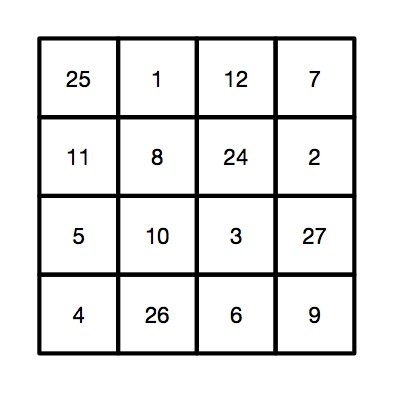
Having worked out the 4 numbers created form the original chosen number, N, you need to stick them in the right place in a blank magic square, along with some other numbers you need to remember. It is the pattern you use to build your magic square from. It looks like the one to the right. To make this step easy, write this pattern on the piece of paper you write the final square on. Write the numbers in light pencil, over-writing the pencil as you do the trick so no-one knows at the end what you were doing.
A square grid of numbers like this is an example of what computer scientists call a data structure: a way to store data elements that makes it easy to do something useful: in this case making your friends think you are a maths superhero.
When you perform this trick, fill in the numbers in the 4 by 4 grid in a random, haphazard way, making it look like you are doing lots of complicated calculations quickly in your head.
Finally, to prove to everyone it is a magic square with the right properties, go through each row, column and diagonal, adding them up and writing in the answers around the edge of the square, so that everyone can see it works.
The final magic square for chosen number 45
So, for our example, we would get the following square, where all the rows, columns and diagonals add to our audience selected number of 45.
Image by CS4FN.
Why does it work?
If you look at the preset numbers in each row, column and diagonal of the pattern, they have been carefully chosen in advance to add up to the number being subtracted from N on those lines. Try it! Along the top row 1 + 12 + 7 = 20. Down the right side 11 + 5 + 4 = 20.
Do it again?
Of course you shouldn’t do it twice with the same people as they might spot the pattern of all the common numbers…unless, now you know the secret, perhaps you can work out your own versions each with a slightly different root number, calculated first and so a different template written lightly on different pieces of paper.
Peter McOwan and Paul Curzon, Queen Mary University of London
When the construction of Norman Jackson Children’s Centre in London started, the local council commissioned artists to design a sensory garden full of wonderful sights and sounds so the 3 to 5 year old children using the centre could have fun playing there. Sand pit, water feature, metal tree and willow pods all seemed pretty easy to install and wouldn’t take much looking after, but what about sound? How do you bring interesting sound to an outdoor space and make it fun for young children? Nela Brown from Queen Mary was given the job.
After thinking about the problem for a while she came up with an idea for an interactive sound installation. She wanted to entertain any children visiting the centre, but she especially wanted it to benefit children with poor language skills. She wanted it to be informal but have educational and social value, even though it was outside.
You name it, they press it!
Somewhere around the age of 18 months, children become fascinated with pressing buttons. Toys, TV remotes, light switches, phones, you name it they want to press it. Given the chance to press all the buttons at the same time in quick succession, that is exactly what young children will do. They will also get bored pretty quickly and move on to something else if their toy just makes lots of noise with little variety or interest.
Nela had to use her experience and understanding of the way children play and learn to work out a suitable ‘user interface’ for the installation. That is she had to design how the children would interact with it and be able to experience the effects. The user interface had to look interesting enough to get the attention of the children playing in the garden in the first place. It also obviously had to be easy to use. Nela watched children playing as part of her preparation to design the installation both to get ideas and get a feel for how they learn and play.
Sit on it!
She decided to use a panel with buttons that triggered sounds built into a seat. One important way to make any gadget easier to use is for it to give ‘real-time feedback’. That is, it should do something like play sound or change colour as soon as you press any button, so you know immediately that the button press did do something. To achieve this and make them even more interesting her buttons would both change colour and play sound when they were pressed. She also decided the panel would need to be programmed so children wouldn’t do what they usually do: press all of the buttons at once, get bored and walk away.
Nela recorded traditional stories, poems and nursery rhymes with parents and children from the local area, and composed music to fit around the stories. She also researched different online sound libraries to find interesting sound effects and soundscapes. Of the three buttons, one played the soundscapes, another played the sound effects and the last played a mixture of stories, poems and nursery rhymes. Nela hoped the variety would make it all more interesting for the children so keep their attention longer and by including stories and nursery rhymes she would be helping with language skills.
Can we build it?
Coming up with the ideas was only part of the problem. It then had to be built. It had to be weatherproof, vandal-proof and allow easy access to any parts that might need replacing. As the installation had to avoid disturbing people in the rest of the garden, furniture designer Joe Mellows made two enclosed seats out of cedar wood cladding each big enough for two children, which could house the installation and keep the sound where only the children playing with it would hear it. A speaker was built into the ceiling and two control panels made of aluminium were built into the side. The bottom panel had a special sensor, which could ‘sense’ when a child was sitting in (or standing on) the seat. It was an ultrasonic range finder – a bit like bat-senses using echoes from high frequency sounds humans can’t hear to work out where objects are. The sensor had to be covered with stainless steel mesh, so the children couldn’t poke their fingers through it and injure themselves or break the sensor. The top panel had three buttons that changed colour and played sound files when pressed.
Interaction designer Gabriel Scapusio did the wiring and the programming. Data from the sensors and buttons was sent via a cable, along with speaker cables, through a pipe underground to a computer and amplifier housed in the Children’s Centre. The computer controlling the music and colour changes was programmed using a special interactive visual programming environment for music, audio, and media called Max/MSP that has been in use for years by a wide range of people: performers, composers, artists, scientists, teachers, and students.
The panels in each seat were connected to an open-source electronics prototyping platform by Arduino. It’s intended for artists, designers, hobbyists, and anyone interested in creating interactive objects or environments, so is based on flexible, easy-to-use hardware and software.
The next job was to make sure it really did work as planned. The volume from the speakers was tested and adjusted according to the approximate head position of young children so it was audible enough for comfortable listening without interfering with the children playing in the rest of the garden. Finally it was crunch time. Would the children actually like it and play with it?
The sensory garden did make a difference – the children had lots of fun playing in it and within a few days of the opening one boy with poor language skills was not just seen playing with the installation but listening to lots of stories he wouldn’t otherwise have heard. Nela’s installation has lots of potential to help children like this by provoking and then rewarding their curiosity with something interesting that also has a useful purpose. It is a great example of how, by combining creative and technical skills, projects like these can really make a difference to a child’s life.
Computer Scientists and digital artists are behind the fabulous special effects and computer generated imagery we see in today’s movies, but for a bit of fun, in this series, we look at how movie plots could change if they involved Computer Scientists. Here we look at an alternative version of the Christmas film, Elf, starring Will Ferrell.
***Spoiler Alert***
Christmas Eve, and a baby crawls into Santa’s pack as he delivers presents at an orphenage. The baby is wearing only a nappy, but this being the 21st century the babys’s reusable Buddy nappy is an Intelligent nappy. It is part of the Internet of Things and is chipped, including sensors and a messaging system that allow it to report to the laundry system when the nappy needs changing (and when it doesn’t) as well as performing remote health monitoring of the baby. It is the height of optimised baby care. When the baby is reported missing the New York Police work with the nappy company, accessing their logs, and eventually work out which nappy the baby was wearing and track its movements…to the roof of the orphenage!
The baby by this point has been found by Santa in his sack at the North Pole, and named Buddy by the Elves after the label on his nappy. The Elves change Buddy’s nappy, and as their laundry uses the same high tech system for their own clothes, their laundry logs the presence of the nappy, allowing the Police to determine its location.
Santa intends to officially adopt Buddy, but things are moving rapidly now. The New York Police believe they have discovered the secret base of an international child smuggling ring. They have determined the location of the criminal hideout as somewhere near the North Pole and put together an armed task force. It is Boxing Day. As Santa gets in touch with the orphanage to explain the situation, and arrange an adoption, armed police already surround the North Pole and are moving in.
The New York Police Commissioner, wanting the good publicity she sees arising from capturing a child smuggling ring, orders the operation to be live streamed to the world. The precise location of the criminal hideout, so operation, is not revealed to the public, which is fortunate given what follows. As the police move in the cameras are switched on and people the world over, are glued to their screens watching the operation unfold. As the police break in to the workshops, toys go flying and Elves scatter, running for their lives, but as Santa appears and calmly allows himself to be handcuffed, it starts to dawn on the police where they are and who they have arrested. The live stream is cut abruptly, and as the full story emerges, and apologies made on all sides. Santa is proved to be real to a world that was becoming sceptical. A side effect is there is a massive boost in Christmas Spirit across the world that keeps Santa’s sleigh powered without the need for engines for many decades to come. Buddy is officially adopted and grows up believing he is an Elf until one fateful year when …
In reality
The idea of the Internet of Things is that objects, not just people, have a presence on the Internet and can communicate with other objects and systems. The idea provides the backbone of the idea of smart homes, where fridges can detect they are out of milk and order more, carpets detect dirt and summon a robot hoover, and the boiler detects when the occupants are nearing home and heats the house just in time.
Wearable computing, where clothes have embedded sensors and computers is also already a reality, though mainly in the form of watches, jewellery and the like. Clothes in shops do include electronic tags that help with stock control, and increasingly electronic-textiles based on metallic fibres and semi-conducting inks, are being used to create clothes with computers and electronics embedded in them.
Making e-textiles durable to be washed is still a challenge. Smart reusable nappies may be a while in coming.
If you watch a lot of movies you’ve probably noticed some recurring patterns in the way that popular cinematic stories are structured. Every hero or heroine needs a goal and a villain to thwart that goal. Every goal requires travel along a path that is probably blocked with frustrating obstacles. Heroes may not see themselves as heroes, and will occasionally take the wrong fork in the path, only to return to the one true way before story’s end. We often speak of this path as if it were a race track: a fast-paced story speeds towards its inevitable conclusion, following surprising “twists” and “turns” along the way. The track often turns out to be a circular one, with the heroine finally returning to the beginning, but with a renewed sense of appreciation and understanding. Perhaps we can use this race track idea as a basis for creating stories.
Building a track
If you’ve ever played with a Scalextric set, you will know that the curviest tracks make for the most dramatic stories, by providing more points at which our racing cars can fly off at a tight bend. In Scalextric you build your own race circuits by clicking together segments of prefabricated track, so the more diverse the set of track parts, the more dramatic your circuit can be. We can think of story generation as a similar kind of process. Imagine if you had a large stock of prefabricated plot segments, each made up of three successive bits of story action. A generator could clip these segments together to create a larger story, by connecting the pieces end-to-end. To keep the plot consistent we would only link up sections if they have overlapping actions. So If D-E-F is a segment comprising the actions D, E, and F, we could create the story B-C-D-E-F-G-H by linking the section B-C-D on to the left of D-E-F and F-G-H on its right.
Use a kit
At University College Dublin (UCD) we have created a set of rich public resources that make it easy for you to build your own automated story generator. We call the bundle of resources Scéalextric, from scéal (the Irish word for story) and Scalextric. You can download the Scéalextric resources from our Github but an even better place to start is our blog for people who want to build creative systems of any kind, called Best Of Bot Worlds.
In Artificial Intelligence we often represent complex knowledge structures as ‘graphs’. These graphs consists of lots of labeled lines (called edges) that show how labeled points (called nodes) are connected. That is what our story pieces essentially are. We have several agreed ways for storing these node-relation-node triples, with acronyms hiding long names, like XML (eXtensible Markup Language), RDF (Resource Description Framework) and OWL (Web Ontology Language), but the simplest and most convenient way to create and maintain a large set of story triples is actually just to use a spreadsheet! Yes, the boring spreadsheet is a great way to store and share knowledge, because every cell lies at the intersection of a row and a column. These three parts give us our triples.
Scéalextric is a collection of easy-to-browse spreadsheets that tell a machine how actions connect to form action sequences (like D-E-F above), how actions causally interconnect to each other (via and, then, but), how actions can be “rendered” in natural idiomatic English, and so on.
Adding Character
Automated storytelling is one of the toughest challenges for a researcher or hobbyist starting out in artificial intelligence, because stories require lots of knowledge about causality and characterization. Why would character A do that to character B, and what is character B likely to do next? It helps if the audience can identify with the characters in some way, so that they can use their pre-existing knowledge to understand why the characters do what they do. Imagine writing a story involving Donald Trump and Lex Luthor as characters: how would these characters interact, and what parts of their personalities would they reveal to us through their actions?
Scéalextric therefore contains a large knowledge-base of 800 famous people. These are the cars that will run on our tracks. The entry for each one has triples describing a character’s gender, fictive status, politics, marital status, activities, weapons, teams, domains, genres, taxonomic categories, good points and bad points, and a lot more besides. A key challenge in good storytelling, whether you are a machine or a human, is integrating character and plot so that one informs the other.
A Twitterbot plot
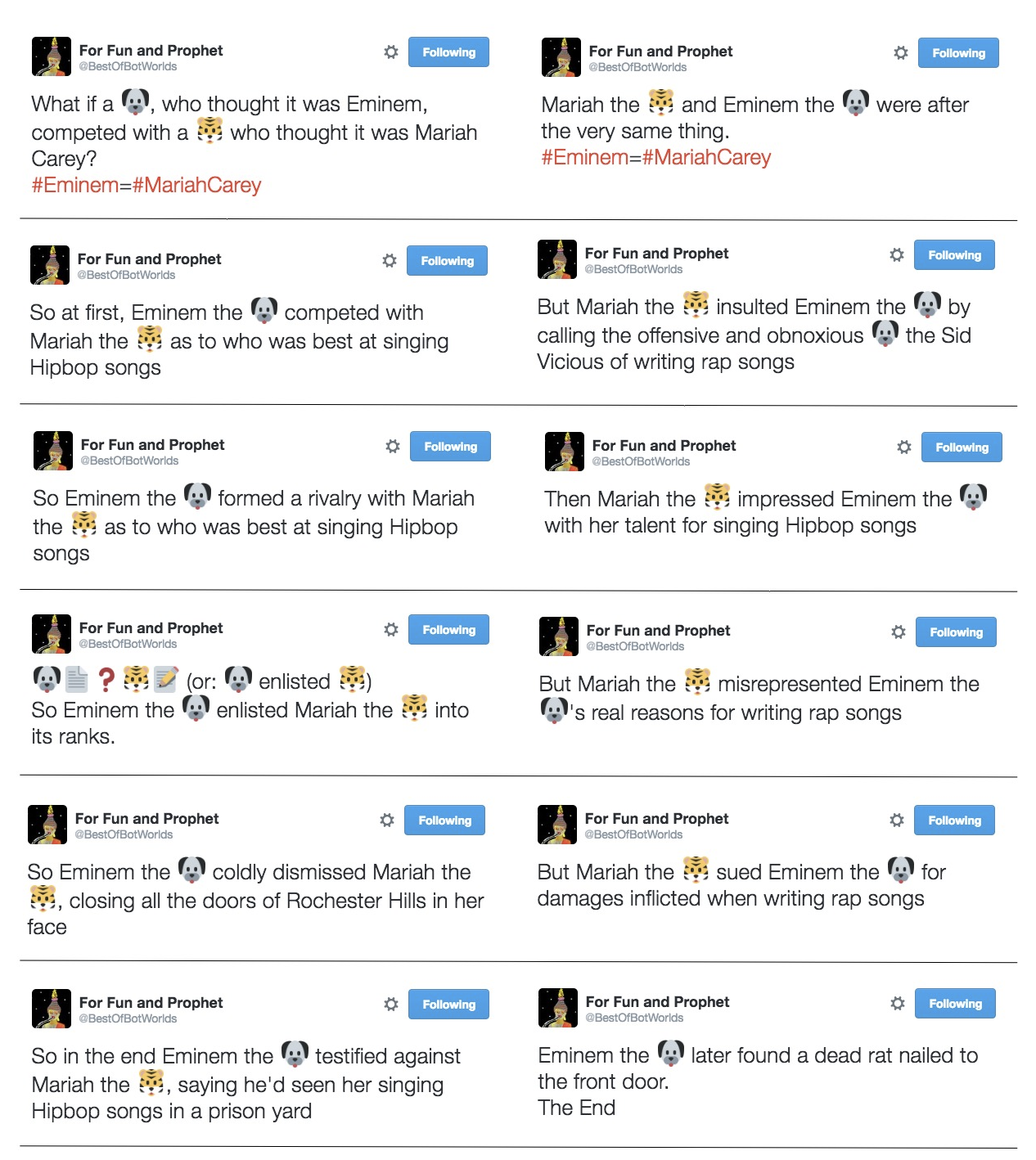
Let’s look at a story created and tweeted by our Twitterbot @BestOfBotWorlds over a series of 12 tweets. Can you see where the joins are in our Scéalextric track? Can you recognize where character-specific knowledge has been inserted into the rendering of different actions, making the story seem funny and appropriate at the same time? More importantly, can you see how you might connect the track segments differently, choose characters more carefully, or use knowledge about them more appropriately, to make better stories and to build a better story-generator? That’s what Scéalextric is for: to allow you to build your own storytelling system and to explore the path less trodden in the world of computational creativity. It all starts with a click.
An unlikely tale generated by the Twitter storybot.
Tony Veale, University College Dublin
Further reading
Christopher Strachey came up with the first example of a computer program that could create lines of text (from lists of words). The CS4FN developed a game called ‘Program A Postcard’ (see below) for use at festival events.
Tony Stockman, who was blind from birth, was a Senior Lecturer at QMUL until his retirement. A leading academic in the field of sonification of data, turning data into sound, he eventually became the President of the “International Community for Auditory Display”: the community of researchers working in this area.
Traditionally, we put a lot of effort into finding the best ways to visualise data so that people can easily see the patterns in it. This is an idea that Florence Nightingale, of lady of the lamp fame, pioneered with Crimean War data about why soldiers were dying. Data visualisation is considered so important it is taught in primary schools where we all learn about pie charts and histograms and the like. You can make a career out of data visualisation, working in the media creating visualisations for news programmes and newspapers, for example, and finding a good visualisation is massively important working as a researcher to help people understand your results. In Big Data a good visualisation can help you gain new insights into what is really happening in your data. Those who can come up with good visualisations can become stars, because they can make such a difference (like Florence Nightingale, in fact)
Many people of course, Tony included cannot see, or are partially sighted, so visualisation is not much help! Tony therefore worked on sonifying data instead, exploring how you can map data onto sounds rather than imagery in a way that does the same thing.: makes the patterns obvious and understandable.
His work in this area started with his PhD where he was exploring how breathing affects changes in heart rate. He first needed a way to both check for noise in the recording and then also a way to present the results so that he could analyse and so understand them. So he invented a simple way to turn data into sound using for example frequencies in the data to be sound frequencies. By listening he could find places in his data where interesting things were happening and then investigate the actual numbers. He did this out of necessity just to make it possible to do research but decades later discovered there was by then a whole research community by then working on uses of and good ways to do sonification,
He went on to explore how sonification could be used to give overviews of data for both sighted and non-sighted people. We are very good at spotting patterns in sound – that is all music is after all – and abnormalities from a pattern in sound can stand out even more than when visualised.
Another area of his sonification research involved developing auditory interfaces, for example to allow people to hear diagrams. One of the most famous, successful data visualisations was the London Tube Map designed by Harry Beck who is now famous as a result because of the way that it made the tube map so easy to understand using abstract nodes and lines that ignored distances. Tony’s team explored ways to present similar node and line diagrams, what computer scientist’s call graphs. After all it is all well and good having screen readers to read text but its not a lot of good if all it tells you reading the ALT text that you have the Tube Map in front of you. And this kind of graph is used in all sorts of every day situations but are especially important if you want to get around on public transport.
There is still a lot more to be done before media that involves imagery as well as text is fully accessible, but Tony showed that it is definitely possible to do better, He also showed throughout his career that being blind did not have to hold him back from being an outstanding computer scientists as well as a leading researcher, even if he did have to innovate himself from the start to make it possible.
“Get rhythm when you get the blues” – as Country legend Johnny Cash’s lyrics suggest, rhythm cheers people up. We can all hear, feel and see it. We can clap, tap or beatbox. It comes naturally, but how? We don’t really know. You can help find out by playing a game based on some music that involves nothing but clapping. If you were one of the best back in 2015, you could have been invited to play live with a London orchestra.
We can all play a rhythm both using our bodies and instruments, though maybe for most of us with only a single cowbell, rather than a full drum kit. By performing simple rhythms with other people we can make really complex sounds, both playing music and playing traditional clapping games. Rhythm matters. It plays a part in social gatherings and performance in cultures and traditions across the world. It even defines different types of music from jazz to classical, from folk to pop and rock.
Lots of people with a great sense of rhythm, whether musicians or children playing complex clapping games in the playground, have never actually studied how to do it though. So how do we learn rhythm? Our team based at Queen Mary, joined up with the London Sinfonietta chamber orchestra and app developers Touch Press, to find out, using music called Clapping Music.
Clapping Music is a 4-minute piece by the minimalist composer Steve Reich. The whole thing is based on one rhythmic pattern that two people clap together. One person claps the pattern without changing it – known as the static pattern. The other changes the pattern, shifting the rhythm by one beat every twelve repetitions. The result is an ever-changing cycle of surprisingly complicated rhythms. In spite of it’s apparent simplicity, it’s really challenging to play and has inspired all sorts of people from rock legend David Bowie to the virtuoso, deaf percussionist Dame Evelyn Glennie. You can learn to play Clapping Music and help us to understand how we learn rhythm at the same time.
Our team created a free game for the iPhone and iPad also called Clapping Music. You play for real against the static pattern. To get the best score you must keep tapping accurately as the pattern changes, but stay in step with the static rhythm. It’s harder than it sounds!
We analysed the anonymous gameplay data, together with basic information about the people playing like their age and musical experience. By looking at how people progress though the game we explored how people of different ages and experience develop rhythmic skills.
It has led to some interesting computer science to design the algorithms that measure how accurate a person’s tapping is. It sounds easy but actually is quite challenging. For example, we don’t want to penalise someone playing the right pattern slightly delayed more than another person playing completely the wrong pattern. It has also thrown up questions about game design. How do we set and change how difficult the game is? Players, however skillful, must feel challenged to improve, but it must not be so difficult that they can’t do it.
You don’t need to be a musician to play, in fact we would love as many people as possible to download it and get tapping and clapping! High scorers were invited to take part in live performance events on stage with members of the London Sinfonietta back in 2015. Get the app, get tapping, get rhythm (and have some fun – you won’t get the blues)!
– by Marcus Pearce and Samantha Duffy, Queen Mary University of London
Updated from the archive
This post was originally published in our CS4FN magazine (issue 19) in 2015, so the tense has been updated to reflect that it’s now 2025.