Threads & Yarns – textiles and electronics

At first sight nothing could be more different than textiles and electronics. Put opposites together and you can maybe even bring historical yarns to life. That’s what Queen Mary’s G.Hack team helped do. They are an all-woman group of electronic engineering and computer science research students and they helped build an interactive art installation combining textiles and personal stories about health.

In June 2011 the G.Hack team was asked by Jo Morrison and Rebecca Hoyes from Central Saint Martins College of Art and Design to help make their ‘Threads & Yarns‘ artwork interactive. It was commissioned by the Wellcome Trust as a part of their 75th Anniversary celebrations. They wanted to present personal accounts about the changes that have taken place in health and well-being over the 75 years since they were founded.

Flowers powered

Jo and Rebecca had been working on the ‘Threads & Yarns’ artwork for 6 months. It was inspired by the floor tiling at the London Victoria and Albert Museum and was made up of 125 individually created material flowers spread over a 5 meter long white perspex table. They wanted some of the flowers to be interactive, lighting up and playing sounds linked to stories about health and well-being at the touch of a button.

Central Saint Martins College Textile students worked with senior citizens from the Euston and Camden area, recording the stories they told as they made the flowers. G.Hack then ran a workshop with the students to show them how physical computing could be built into textiles and so create interactive flowers. Short sound bites from the recorded stories were eventually included in nine of the flowers.

The interactive part was built using an open source (i.e., free and available for anyone to use) hardware platform called Arduino. It makes physical computing accessible to anyone giving an easy way to create programs that control lights, buttons and other sensors.

The audio stories of the senior citizens were edited down into 1-minute sound bites and stored on a memory card like those used in digital cameras. Each of the nine flowers were lit by eight Light Emitting Diodes (LEDs). They are low energy lights so they don’t heat up, which is important if they are going to be built into fabrics. They are found in most household electronics, such as to show whether a gadget is turned on or off. When a button is pressed on the ‘Threads & Yarns’ artwork, it triggers the audio of a story to be played and simultaneously lights the LEDs on the linked flower, switching off again when the audio story finishes.

Smooth operators

The artwork had to work without problems throughout the day so the G.Hack team had to make sure everything would definitely go smoothly. The day before the opening of the exhibition they did final testing of the interactive flowers in their electronics workshop. They then worked with Central Saint Martins and museum staff to install the electronics into the artwork. They designed the system to be modular. This was both to allow the electronics to be separate from the artwork itself as well as to ease combining the two. On the day of the exhibition, the team arrived early to test everything one more time before the opening. They also stayed throughout the day to be on call in case of any problems.

Leading up to the opening of the exhibition were a busy few weeks for G.Hack with lots of late nights spent testing, troubleshooting and soldering in the workshop but it was all worth it as the final artwork looked fantastic and received a lot of positive feedback from people visiting the exhibition. It was a really positive experience all round! G.Hack and Central Saint Martins formed a bond that will likely extend into future partnerships. ‘Threads & Yarns’ meanwhile is off on a UK ‘tour’.

Art may have brought the textiles, history and health stories together as embodied in the flowers. It’s the electronics that brought the yarn to life though.

Paul Curzon, Queen Mary University of London, June 2011


G.Hack

G.Hack was a supportive and friendly space for women to do hands-on experimental production fusing art and technology at Queen Mary University of London. As a group they aimed to strengthen each other’s confidence and ability in using a wide range of different technologies. They supported each other’s research and helped each other extend their expertise in science and technology through public engagement, collaborating with other universities and commercial companies.

The members of G.Hack involved in ‘Threads & Yarns’ were Nela Brown, Pollie Barden, Nicola Plant, Nanda Khaorapapong, Alice Clifford, Ilze Black and Kavin Preethi Narasimhan.


Related Magazines


Subscribe to be notified whenever we publish a new post to the CS4FN blog.


This blog is funded by EPSRC on research agreement EP/W033615/1.

QMUL CS4FN EPSRC logos

3D models in motion

by Paul Curzon, Queen Mary University of London
based on a 2016 talk by Lourdes Agapito

The cave paintings in Lascaux, France are early examples of human culture from 15,000 BC. There are images of running animals and even primitive stop motion sequences – a single animal painted over and over as it moves. Even then, humans were intrigued with the idea of capturing the world in motion! Computer scientist Lourdes Agapito is also captivated by moving images. She is investigating whether it’s possible to create algorithms that allow machines to make sense of the moving world around them just like we do. Over the last 10 years her team have shown, rather spectacularly, that the answer is yes.

People have been working on this problem for years, not least because the techniques are behind the amazing realism of CGI characters in blockbuster movies. When we see the world, somehow our brain turns all that information about colour and intensity of light hitting our eyes into a scene we make sense of – we can pick out different objects and tell which are in front and which behind, for example. In the 1950s psychophysics* researcher Gunnar Johansson showed how our brain does this. He dressed people in black with lightbulbs fastened around their bodies. He then filmed them walking, cycling, doing press-ups, climbing a ladder, all in the dark … with only the lightbulbs visible. He found that people watching the films could still tell exactly what they were seeing, despite the limited information. They could even tell apart two people dancing together, including who was in front and who behind. This showed that we can reconstruct 3D objects from even the most limited of 2D information when it involves motion. We can keep track of a knee, and see it as the same point as it moves around. It also shows that we use lots of ‘prior’ information – knowledge of how the world works – to fill in the gaps.

Shortcuts

Film-makers already create 3D versions of actors, but they use shortcuts. The first shortcut makes it easier to track specific points on an actor over time. You fix highly visible stickers (equivalent to Johansson’s light bulbs) all over the actor. These give the algorithms clear points to track. This is a bit of a pain for the actors, though. It also could never be used to make sense of random YouTube or CCTV footage, or whatever a robot is looking at.

The second shortcut is to surround the action with cameras so it’s seen from lots of angles. That makes it easier to track motion in 3D space, by linking up the points. Again this is fine for a movie set, but in other situations it’s impractical.

A third shortcut is to create a computer model of an object in advance. If you are going to be filming an elephant, then hand-create a 3D model of a generic elephant first, giving the algorithms something to match. Need to track a banana? Then create a model of a banana instead. This is fine when you have time to create models for anything you might want your computer to spot.

It is all possible for big budget film studios, if a bit inconvenient, but it’s totally impractical anywhere else.

No Shortcuts

Lourdes took on a bigger challenge than the film industry. She decided to do it without the shortcuts: to create moving 3D models from single cameras, applied to any traditional 2D footage, with no pre-placed stickers or fixed models created in advance.

When she started, a dozen or so years ago, making any progress looked incredibly difficult. Now she has largely solved the problem. Her team’s algorithms are even close to doing it all in real time, so making sense of the world as it happens, just like us. They are able to make really accurate models down to details like the subtle movements of their face as a person talks and changes expression.

There are several secrets to their success, but Johansson’s revelation that we rely on prior knowledge is key. One of the first breakthroughs was to come up with ways that individual points in the scene like the tip of a person’s nose could be tracked from one frame of video to the next. Doing this well relies on making good use of prior information about the world. For example, points on a surface are usually well-behaved in that they move together. That can be used to guess where a point might be in the next frame, given where others are.

The next challenge was to reconstruct all the pixels rather than just a few easy to identify points like the tip of a nose. This takes more processing power but can be done by lots of processors working on different parts of the problem. Key to this was to take account of the smoothness of objects. Essentially a virtual fine 3D mesh is stuck over the object – like a mask over a face – and the mesh is tracked. You can then even stick new stuff on top of the mesh so they move together – adding a moustache, or painting the face with a flag, for example, in a way that changes naturally in the video as the face moves.

Once this could all be done, if slowly, the challenge was to increase the speed and accuracy. Using the right prior information was again what mattered. For example, rather than assuming points have constant brightness, taking account of the fact that brightness changes, especially on flexible things like mouths, mattered. Other innovations were to split off the effect of colour from light and shade.

There is lots more to do, but already the moving 3D models created from YouTube videos are very realistic, and being processed almost as they happen. This opens up amazing opportunities for robots; augmented reality that mixes reality with the virtual world; games, telemedicine; security applications, and lots more. It’s all been done a little at a time, taking an impossible-seeming problem and instead of tackling it all at once, solving simpler versions. All the small improvements, combined with using the right information about how the world works, have built over the years into something really special.

*psychophysics is the “subfield of psychology devoted to the study of physical stimuli and their interaction with sensory systems.”


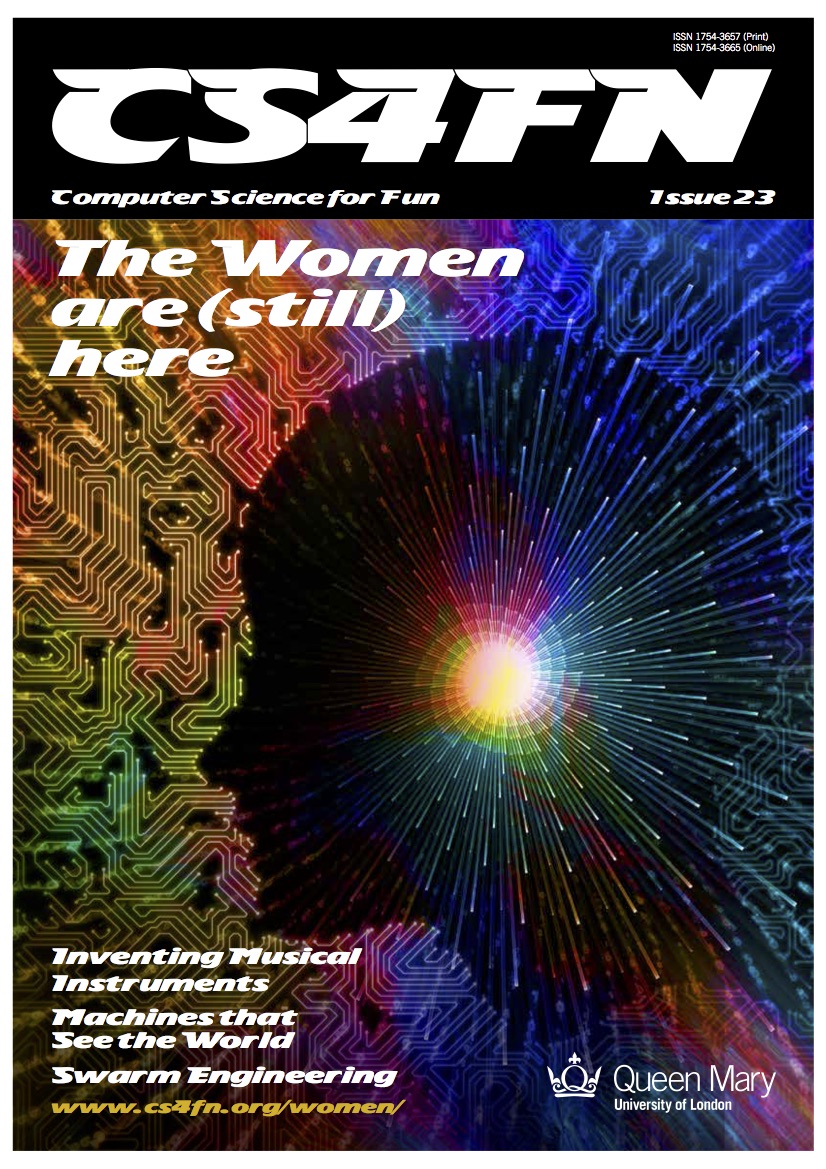
This article was first published on the original CS4FN website and a copy appears on pages 14 and 15 in “The women are (still) here”, the 23rd issue of the CS4FN magazine. You can download a free PDF copy by clicking on the magazine’s cover below, along with all of our free material.

Another article on 3D research is Making sense of squishiness – 3D modelling the natural world (21 November 2022).


Related Magazine …


EPSRC supports this blog through research grant EP/W033615/1.

Frequency Analysis for Fun

Frequency Analysis, a technique beloved by spies for centuries, and that led to the execution of at least one Queen, also played a part in the development of the game Scrabble, over a hundred million copies of which have been sold worldwide.

Frequency Analysis was invented by Al-Kindi, a 9th Century Muslim, Arabic Scholar, as a way of cracking codes. He originally described it in his “A Manuscript on Deciphering Cryptographic Messages“. Frequency analysis just involves taking a large amount of normal text written in the language of interest and counting how often each letter appears. For example in English, the letter E is the most common. With simple kinds of ciphers that is enough information to be able to crack them, just by counting the frequency of the letters in the code you want to crack. Now large numbers of everyday people do frequency analysis just for fun, solving Cross Reference puzzles.

The link between frequency analysis and puzzles goes back earlier. When the British were looking for potential code breakers to staff their secret code breaking establishment at Bletchley Park in World War II, they needed people with frequency analysis like skills and problem solving skills. They did this by setting up Crossword competitions and offering those who were fastest jobs at Bletchley: possibly the earliest talent competition with career changing prizes!

Earlier still, in the 1930s, Architect Alfred Mosher Butts, hit on the idea of a new game that combined crosswords and anagrams, which were both popular at the time. The result was Scrabble. However, when designing the game he had a problem in that he needed to decide how many of each letter the game should have and also how to assign the scores. He turned to frequency analysis of the front page of the New York Times to give the answers. He also did it an easy way – looking at how many of each letter the printers had – the more they had meant the more often the same letters were needed at once. He broke the pattern of his frequency analysis though, including fewer letter Ss (the second most common word in English) than there should be so the game wasn’t made too easy because of plurals.

Sherlock Holmes, of course, was a master of frequency analysis as described in the 1903 story “The Adventure of the Dancing Men”. Sir Arthur Conan Doyle wasn’t the first author to use it as a plot device though. Edgar Alan Poe had based a short story called “The Gold Bug” around frequency analysis in 1843. It was Poe who originally popularised frequency analysis with the general public rather than just with spymasters. Poe had discovered how popular the topic was as a result of having set a challenge in a magazine for people to send in ciphers – that he would then crack, giving the impression at the time that he had near supernatural powers. The way it was done was then described in detail in “The Gold Bug”.

Paul Curzon, Queen Mary University of London


More on ,,,

For younger kids we have some fun free kriss-kross puzzles – they’re like crosswords but you’re given the words and you have to fit them into the crossword shape. You need to think like a computer scientist and use logical thinking, pattern matching and computational thinking to complete them. (For even younger kids these can also be used as a way of practising spelling, phonics and writing out words).


EPSRC supports this blog through research grant EP/W033615/1.

Keeping secrets on the Internet – encryption keeps your data safe

How do modern codes keep your data safe online? Ben Stephenson of the University of Calgary explains

When Alan Turing was breaking codes, the world was a pretty dangerous place. Turing’s work helped uncover secrets about air raids, submarine locations and desert attacks. Daily life might be safer now, but there are still threats out there. You’ve probably heard about the dangers that lurk online – scams, identity theft, viruses and malware, among many others. Shady characters want to know your secrets, and we need ways of keeping them safe and secure to make the Internet work. How is it possible that a network with so many threats can also be used to securely communicate a credit card number, allowing you to buy everything from songs to holidays online?

The relay race on the Internet

When data travels over the Internet it is passed from computer to computer, much like a baton is passed from runner to runner in a relay race. In a relay race, you know who the other runners will be. The runners train together as a team, and they trust each other. On the Internet, you really don’t know much about the computers that will be handling your data. Some may be owned by companies that you trust, but others may be owned by companies you have never heard of. Would you trust your credit card number to a company that you didn’t even know existed?

The way we solve this problem is by using encryption to disguise the data with a code. Encrypting data makes it meaningless to others, so it is safe to transfer the data over the Internet. You can think of it as though each message is locked in a chest with a combination lock. If you don’t have the combination you can’t read the message. While any computer between us and the merchant can still view or copy what we send, they won’t be able to gain access to our credit card number because it is hidden by the encryption. But the company receiving the data still needs to decrypt it – open the lock. How can we give them a way to do it without risking the whole secret? If we have to send them the code a spy might intercept it and take a copy.

Keys that work one way only

The solution to our problem is to use a relatively new encryption technique known as public key cryptography. (It’s actually about 40 years old, but as the history of encryption goes back thousands of years, a technique that’s only as old as Victoria Beckham counts as new!) With this technique the code used to encrypt the message (lock the chest) is not able to decrypt it (unlock it). Similarly, the key used to decrypt the message is not able to encrypt it. This may sound a little bit odd. Most of the time when we think about locking a physical object like a door, we use the same key to lock it that we will use to unlock it later. Encryption techniques have also followed this pattern for centuries, with the same key used to encrypt and decrypt the data. However, we don’t always use the same key for encrypting (locking) and decrypting (unlocking) doors. Some doors can be locked by simply closing them, and then they are later unlocked with a key, access card, or numeric code. Trying to shut the door a second time won’t open it, and similarly, using the key or access code a second time won’t shut it. With our chest, the person we want to communicate with can send us a lock only they know the code for. We can encrypt by snapping the lock shut, but we don’t know the code to open it. Only the person who sent it can do that.

We can use a similar concept to secure electronic communications. Anyone that wants to communicate something securely creates two keys. The keys will be selected so that one can only be used for encryption (the lock), and the other can only be used for decryption (the code that opens it). The encryption key will be made publicly available – anyone that asks for it can have one of our locks. However, the decryption key will remain private, which means we don’t tell anyone the code to our lock. We will have our own public encryption key and private decryption key, and the merchant will have their own set of keys too. We use one of their locks, not ours, to send a message to them.

Turning a code into real stuff

So how do we use this technique to buy stuff? Let’s say you want to buy a book. You begin by requesting the merchant’s encryption key. The merchant is happy to give it to you since the encryption key isn’t a secret. Once you have it, you use it to encrypt your credit card number. Then you send the encrypted version of your credit card number to the merchant. Other computers listening in might know the merchant’s public encryption key, but this key won’t help them decrypt your credit card number. To do that they would need the private decryption key, which is only known to the merchant. Once your encrypted credit card number arrives at the merchant, they use the private key to decrypt it, and then charge you for the goods that you are purchasing. The merchant can then securely send a confirmation back to you by encrypting it with your public encryption key. A few days later your book turns up in the post.

This encryption technique is used many millions of times every day. You have probably used it yourself without knowing it – it is built into web browsers. You may not imagine that there are huts full of codebreakers out there, like Alan Turing seventy years ago, trying to crack the codes in your browser. But hackers do try to break in. Keeping your browsing secure is a constant battle, and vulnerabilities have to be patched up quickly once they’re discovered. You might not have to worry about air raids, but codes still play a big role behind the scenes in your daily life.

Ben Stephenson, University of Calgary

More on …


Related Magazine …


Subscribe to be notified whenever we publish a new post to the CS4FN blog.


This blog is funded by EPSRC on research agreement EP/W033615/1.

QMUL CS4FN EPSRC logos

Composing from Compression

Recoloured Cranium head abstract image by Gordon Johnson from Pixabay

Computers compress files to save space. But it also allows them to create music!

Music is special. It’s one of the things, like language, that makes us human, separating us from animals. It’s also special as art, because it doesn’t exist as an object in the world – it depends on human memory. “But what about CDs? They’re objects in the world”, you might say and you’d be right, but the CD is not the music. The CD contains data files of numbers. Those numbers are translated by electronics into the movements in a loudspeaker, to create sound waves. Even the sound waves aren’t music! They only become music when a human hears them, because understanding music is about noticing repetition, variation and development in its structure. That’s why songs have verses and choruses: so we can find a starting point to understand its structure. In fact, we’re so good at understanding musical structure, we don’t even notice we’re doing it. What’s more, music affects us emotionally: we get excited (using the same chemicals that get us excited when we’re in love or ready to flee danger) when we hear the anthem section of a trance track, or recognise the big theme returning at the end of a symphony.

Surprisingly, brains seem to understand musical structure in a way that’s like the algorithms computer scientists use to compress data. It’s better to store data compressed than uncompressed, because it takes less storage space. We think that’s why brains do it too.

Even more surprisingly, brains also seem to be able to learn the best way to store compressed music data. Computers use bits as their basic storage unit, but we can make groups of bits work like other things (numbers, words, pictures, angry birds…); brains seem to do something similar. For example, pitch (high vs. low notes) in sequence is an important part of music: we build melodies by lining up notes of different pitch one after the other. As we learn to hear music (starting before birth, and continuing throughout life), we learn to remember pitch in ever more efficient ways, giving our compression algorithms better and better chances to compress well. And so we remember music better.

Our team use compression algorithms to understand how music works in the human mind. We have discovered that, when our programs compress music, they can sometimes predict musical structures, even if neither they nor a human have “heard” them before. To compress something, you find large sections of repeated data and replace each with a label saying “this is one of those”. It’s like labelling a book with its title: if you’ve read Lord of the Rings, when I say the title you know what I mean without me telling the story. If we do this to the internal structure of music, there are little repetitions everywhere, and the order that they appear is what makes up the music’s structure.

If we compress music, but then decompress it in a different way, we can get a new piece of music in a similar style or genre. We have evidence that human composers do that too!

What our programs are doing is learning to create new music. There’s a long way to go before they produce music you’ll want to dance to – but we’re getting there!

Geraint Wiggins, Queen Mary University of London


Related Magazine …

Subscribe to be notified whenever we publish a new post to the CS4FN blog.


This blog is funded by EPSRC on research agreement EP/W033615/1.
QMUL CS4FN EPSRC logos

Balls, beams and quantum computers – performing calculations with patterns of light

Photo credit: Galton Box by Klaus-Dieter Keller, Public Domain, via Wikimedia Commons, via the Wikipedia page for the Galton board

Have you played the seaside arcade game where shiny metal balls drops down to ping, ping off little metal pegs and settle in one of a series of channels? After you have fired lots of balls, did you notice a pattern as the silver spheres collect in the channels? A smooth glistening curve of tiny balls forming a dome, a bell curve forms. High scores are harder to get than lower ones. Francis Galton pops up again*, but this time as a fellow Victorian trend setter for future computer design.

Francis Galton invented this special combination of row after row of offset pins and narrow receiving channels to demonstrate a statistical theory called normal distribution: the bell curve. Balls are more likely to bounce their way to the centre, distributing themselves in an elegant sweep down to the left and right edges of the board. But instead of ball bearings, Galton used beans, it was called the bean machine. The point here though is that the machine does a computation – it computes the bell curve.

Skip forward 100 years and ‘Boson Samplers’, based on Galton’s bean machine, are being used to drive forward the next big thing in computer design, quantum computers.

Instead of beans or silver balls computer scientists fire photons, particles of light through minuscule channels on optical chips. These tiny bundles of energy bounce and collide to create a unique pattern, a distribution though one that a normal digital computer would find hard to calculate. By setting it up in different ways, the patterns that result can correspond to different computations. It is computing answers to different calculations set for it.

Through developing these specialised quantum circuits scientists are bouncing beams of light forwards on the path that will hopefully lead to conventional digital technology being replaced with the next generation of supercomputers.

Jane Waite, Queen Mary University of London

Watch…


Related Magazine …

*Francis Galton appears earlier in Issue 20, you can read more about him on page 15 of the PDF. Although a brilliant mathematician he held views about people that are unacceptable today. In 2020 University College London (UCL) changed the name of its Galton Lecture Theatre, which had been named previously in his honour, to Lecture Theatre 115.

EPSRC supports this blog through research grant EP/W033615/1.

Getting off the beach, fast

by Paul Curzon, Queen Mary University of London

Paul goes on holiday and sees how a car park can work like a computer.

Computers get faster and faster every year. How come? Because computer scientists and electronic engineers keep thinking up new tricks, completely new ways to make them go faster. One way has been to shrink the components so signals don’t have as far to go. Another is to use the same trick they were using in a beach car park I came across on holiday.

Woolacombe Sands in Devon is one of the most popular beaches around. There is a great expanse of beautiful sand as well as rocks for kids to climb on and good surfing too. The weather is even good there – well most of the time. The car park, right on the edge of the beach fills in the morning. Since most people arrive early and stay all day it’s a standard price of £5.50 for the day. Entry and exit barriers control the numbers. The entry barrier only allows a car to go in if there is a space and another allows people out when they have paid.

That’s where there is a problem though. The vast majority of people leave around 5pm as the ice cream vans pack up and it’s time to look for dinner. The machine only takes coins, and you insert the money from your car at the barrier. Each driver has to fumble with 5 one-pound coins and a 50p and that takes time. Once the current car moves on out there is then another delay as the driver behind pulls forward to get into a position to put their money in. Without some thought it would lead to long queues behind. Not only that it wouldn’t be very green. Cars are at there worst pumping out pollution when in a jam.

The last thing you want to do to a family who’ve had a great day on your beach is then irritate them by clogging them up in a traffic jam when they try to leave. So what do you do? How can you speed things up (and make sure you aren’t just moving the queue to the morning or to some other ticket machine somewhere else)?

The problem is similar to one in designing a computer chip. Think of the cars as data waiting to be processed (perhaps as part of a calculation) and the barrier as a processing unit where some manipulation of that data is needed. Data waiting to be processed has to be fetched before it can be used, just as the cars have to move up to the barrier before the driver can pay. The fact that the problems are so similar suggests that a solution to one may also be a a solution to the other.

Speed it up

There are lots of ways you could change the system to improve the speed of cars being processed in the car park. This speed that data passes through a system is called the ‘throughput’ of the system. Woolacombe have thought of a simple way to improve their throughput. They put a person with a bit of change next to the barrier to help the drivers. This allows them to keep the relatively simple barrier system they have. It also has advantages in keeping the money in one place and being a foolproof way of ensuring there is a space for everyone who enters. It still maintains all the safeguards of the ticket barrier though. How can that one person speed things up?

What would you do?

So what would YOU do if you were that person? Would you speed things up? Or would you just stand there powerless watching the misery of all those families?

The first thing you could do is to stand by the machine and take the change off the driver and insert it yourself. That will speed things up a little bit because it takes longer for drivers to put the money in as they have to stretch out the window of a car. Also if the driver only has a five pound note you can take it and just insert coins from your change bag rather than wasting time passing it back to the driver to then insert. Similarly if the driver only has 50 pence pieces say, rather than wasting time inserting 10 of them you can take them and insert 5 one-pound coins.

You’ve done some good, and removed problems of the slow people inserting coins but you haven’t really solved the bad problems. Cars aren’t moving at all while you are inserting the 6 coins, and after each car moves through the barrier you are doing nothing but waiting for the next car to pull forward. In an ideal system, with the best throughput, the cars barely stop at all and you are constantly busy.

A Pipeline of Cars

It turns out you can do something about that. It’s called pipelining. There is a way you can be busy dealing with the next car even before it’s got to you. You just have to get ahead of yourself!

How? Before the first car arrives, insert 5 pound coins into the machine and wait. As the driver gets to you and gives you the money, insert his or her 50p, keeping the rest. The barrier opens immediately for the driver who barely has to stop. Better still you are now holding 5 pound coins that you can insert as the next car arrives, leaving you back in an identical situation. That means the next car can drive straight through too, and you are constantly busy as long as there are cars arriving.

Speedy data

So you’ve helped the families leaving the beach, but how might a similar trick speed up a computer? Well you can do a similar thing in the way you get a computer processor to execute the instructions from a program. Suppose your program requires the processor to get some numbers from storage, process them (perhaps multiplying the numbers together) and then store the result somewhere else for later use. Typically a program might do that over and over again, varying where the data comes from and how it is processed.

Early computers would do each instruction in turn – doing the fetching, processing and storing of one instruction before starting the next. But that is just like a car in our car park coming to the barrier, being processed and leaving before the next one moves. Can we pull off the same trick to speed things up? Well, yes of course.

All you need to do is overlap the separate parts. Just as at any time in the car park a car will be driving out, a second will be handing over money and a third pulling forward, the same can happen in the computer. As the first instruction’s result is being stored, the next instruction can already be being processed and the data from the one after that can be fetched from memory. Just by reorganising the way the work is done, we have roughly tripled the speed of our computer as now three things are happening at once.

What we have done is set up a ‘pipeline’ – with a series of instructions all flowing through it, being executed, at the same time. Woolacombe has a pipeline of cars, but in a computer we pipeline data. Either way things get done faster and people are happier.

Computer science happens in some unexpected places – even at the beach – but then perhaps that isn’t so surprising given computers are made of sand!


This article was originally published on the CS4FN website.


Other beach-themed articles on this blog include how the origins of how Paul learned to program while on holiday (“The beach, the missionary and my origin myth”) and messages hidden (steganography) within the stripes of deckchairs (“Encrypted deckchairs”).

EPSRC supports this blog through research grant EP/W033615/1.

“A mob for the Earth”

Online communities and flashmobs supporting the environment and businesses too

One Saturday afternoon one spring in San Francisco, a queue of people stretched down the pavement from a neighbourhood market. There was no shortage of other food shops nearby, so why were hundreds of people waiting to buy everything from crisps to cat litter at this one place? Because that shop had pledged to donate more than a fifth of that day’s profits to improving its environmental footprint.

Pillow fights and parties

The organisation behind the busy shopping day is called Carrotmob. The tactics they used to summon so many people to the tiny market in San Francisco had already been working all over the world for less serious stuff. From a huge pillow fight in New York’s Times Square to a mass disco at Victoria Station in London where people danced along to their MP3 players, the concept of the flashmob can seem to create a party out of thin air. From a simple idea, word can spread over social networking sites, email and word of mouth until a few people have turned into a huge crowd.

Start the bidding

Carrotmob’s founder, Brent Schulkin, wanted to try and entice businesses into going green using a language he thought they’d understand: cash. In return for getting loads of new customers to buy things, the owners had to give back some of their windfall profit to the Earth. To test his idea he went round to food shops in his neighbourhood. He said he could bring lots of extra customers to the shop on a particular day, and asked each of them how much of that day’s profit they’d be willing to spend on making their businesses more environmentally friendly. K&D Market won the bidding war by promising to spend 22% of the profits putting in greener lighting and making their fridges more energy-efficient. Now that K&D had agreed to the deal, Brent had to bring in the punters. He needed a flashmob.

Flashmobs work because it’s now so easy to stay in touch with large numbers of people. If we find out about a cool event we can share it with all our friends just by making one post on sites like Facebook or Twitter. We can make plans to do something as a group just by sending a few texts. When lots of people spread word around like this, suddenly a small idea like Carrotmob, armed with only a website and a few videos, can drop an hour-long queue on the doorstep of a market in San Francisco.

Success!

It’s not easy to enjoy yourself when you’re waiting for an hour to buy a packet of instant noodles, but that’s another advantage of the flashmob: the party atmosphere, the feeling that you’re part of something big. The results were big: the impromptu shoppers brought in more than $9000 – four times what the shop ordinarily rings up on a Saturday afternoon. Lots of the purchases went to a food bank, so even more people shared in the benefits. In the end the shop did well, the Earth did well, and the Carrotmobbers got a party. Plus the good feeling you get from helping the environment probably stays with you longer than the good feeling from getting hit in the face with a pillow.

Paul Curzon, Queen Mary University of London


Related Magazine …


EPSRC supports this blog through research grant EP/W033615/1.

Competitive Zen

A hooded woman's intense concentration focussing on the eyes
Image by Walkerssk from Pixabay

To become a Jedi Knight you must have complete control of your thoughts. As you feel the force you start to control your surroundings and make objects move just by thinking. Telekinesis is clearly impossible, but could technology give us the same ability? The study of brain-computer interfaces is an active area of research. How can you make a computer sense and react to a person’s brain activity in a useful way?

Imagine the game of Mindball. Two competitors face each other across a coffee table. A ball sits at the centre. The challenge is to push the ball to your opponent’s end before they push it down to you. The twist is you can use the power of thought alone.

Sound like science fiction? It’s not! I played it at the Dundee Sensation Science Centre many, many years ago where it was a practical and fun demonstration of the then nascent area of brain-computer interfaces.

Each player wears a headband containing electrodes that pick up your brain waves – specifically alpha and theta waves. They are shown as lines on a monitor for all to see. The more relaxed you are, the more you can shut down your brain, the more your brain wave lines fall to the bottom of the screen and start to flatline together. This signals are linked to a computer that drives competing magnets in the table. They pull the metal ball more strongly towards the most agitated person. The more you relax the more the ball moves away from you…unless of course your opponent can out relax you.

Of course it’s not so easy to play. All around the crowd heckle, cheering on their favourite and trying to put off the opponent. You have to ignore it all. You have to think of nothing. Nothing but calm.

The ball gradually edges away from you. You see you are about to win but your excitement registers, and that makes it all go wrong! The ball hurtles back towards you. Relax again. See nothing. Make everything go black around you. Control your thoughts. Stay relaxed. Millimetre by millimetre the ball edges away again until finally it crosses the line and you have won.

Its not just a game of course. There are some serious uses. It is about learning to control your brain – something that helps people trying to overcome stress, addiction and more. Similar technology can also be used by people who are paralysed, and unable to speak, to control a computer. The most recent systems, combining this technology with machine learning to learn what thoughts correspond to different brain patterns can pick up words people are thinking.

For now though it’s about play. It’s a lot of fun, just moving a ball apparently by telekinesis. Imagine what mind games will be like when embedded in more complex gaming experiences!

– Paul Curzon, Queen Mary University of London (updated from the archive)

More on …

Magazines …


Subscribe to be notified whenever we publish a new post to the CS4FN blog.


This blog is funded by EPSRC on research agreement EP/W033615/1.

QMUL CS4FN EPSRC logos

Pit-stop heart surgery

The Formula 1 car screams to a stop in the pit-lane. Seven seconds later, it has roared away again, back into the race. In those few seconds it has been refuelled and all four wheels changed. Formula 1 pit-stops are the ultimate in high-tech team work. Now the Ferrari pit stop team have helped improve the hospital care of children after open-heart surgery!

Open-heart surgery is obviously a complicated business. It involves a big team of people working with a lot of technology to do a complicated operation. Both during and after the operation the patient is kept alive by computer: lots of computers, in fact. A ventilator is breathing for them, other computers are pumping drugs through their veins and yet more are monitoring them so the doctors know how their body is coping. Designing how this is done is not just about designing the machines and what they do. It is also about designing what the people do – how the system as a whole works is critical.

Pass it on

One of the critical times in open-heart surgery is actually after it is all over. The patient has to be moved from the operating theatre to the intensive care unit where a ‘handover’ happens. All the machines they were connected to have to be removed, moved with them or swapped for those in the intensive care unit. Not only that, a lot of information has to be passed from the operating team to the care team. The team taking over need to know the important details of what happened and especially any problems, if they are to give the best care possible.

A research team from the University of Oxford and Great Ormond Street Hospital in London wondered if hospital teams could learn anything from the way other critical teams work. This is an important part of computational thinking – the way computer scientists solve problems. Rather than starting from scratch, find a similar problem that has already been solved and adapt its solution for the new situation.

Rather than starting from scratch,
find a similar problem
that has already been solved

Just as the pit-stop team are under intense time pressure, the operating theatre team are under pressure to be back in the operating theatre for the next operation as soon as possible. In a handover from surgery there is lots of scope for small mistakes to be made that slow things down or cause problems that need to be fixed. In situations like this, it’s not just the technology that matters but the way everyone works together around it. The system as a whole needs to be well designed and pit stop teams are clearly in the lead.

Smooth moves

To find out more, the research team watched the Ferrari F1 team practice pit-stops as well as talking to the race director about how they worked. They then talked to operating theatre and intensive care unit teams to see how the ideas might work in a hospital handover. They came up with lots of changes to the way the hospital did the handover.

For example, in a pit-stop there is one person coordinating everything – the person with the ‘lollipop’ sign that reminds the driver to keep their brakes on. In the hospital handover there was no person with that job. In the new version the anaesthetist was given the overall job for coordinating the team. Once the handover was completed that responsibility was formally passed to the intensive care unit doctor. In Formula 1 each person has only one or two clear tasks to do. In the hospital people’s roles were less obvious. So each person was given a clear responsibility: the nurses were made responsible for issues with draining fluids from the patient, anaesthetist for ventilation issues, and so on. In Formula 1 checklists are used to avoid people missing steps. Nothing like that was used in the handover so a checklist was created, to be used by the team taking on the patient.

These and other changes led to what the researchers hoped would be a much improved way of doing handovers. But was it better?

Calm efficiency saves the day

To find out they studied 50 handovers – roughly half before the change was made and half after. That way they had a direct way of seeing the difference. They used a checklist of common problems noting both mistakes made and steps that proved unusually difficult. They also noted how well the teams worked together: whether they were calm and supported each other, planned what they did, whether equipment was available when needed, and so on.

They found that the changes led to clearly better handovers. Fewer errors were made both with the technology and in passing on information. Better still, while the best performance still happened when the teams worked well, the changes meant that teamwork problems became less critical. Pit-stops and open-heart surgery may be a world apart, with one being about getting every last millisecond of speed and the other about giving as good care as possible. But if you want to improve how well technology and people work together, you need to think about more than just the gadgets. It is worth looking for solutions anywhere: children can be helped to recover from heart surgery even by the high-octane glitz of Formula 1.

Paul Curzon, Queen Mary University of London (Updated from the archive)

More on …

Magazines …


EPSRC supports this blog through research grant EP/W033615/1.