Paul Curzon, Queen Mary University of London

The Computer Science for Fun project has been running for 20 years, having been launched in 2005. Our aim was to inspire and educate the world about interdisciplinary computer science research.
In addition to the core CS4FN project, we created the sister project Teaching London Computing (and linked CAS London) to support teachers teaching computer science, based largely on our experience derived from our public engagement work.
We are holding an anniversary celebration event. Find details here.
Since we started we have had major impact globally but especially in the UK. We have:
- have been recognised internationally and won multiple awards for the impact of our work, including an international award for having “contributed to the rebirth of Computer Science as a school subject”,
- given talks to tens of thousands of students with positive feedback from students and teachers,
- given CPD talks to thousands of teachers, to help support them teaching Computing.
- written several thousand articles, read all over the world across hundreds of countries
- created long-lasting novel educational resources, including educational activities and posters, also used globally,
- supported wide ranging research projects,
- improved the skills of researchers: both academics and early career research staff / PhD students
- helped kickstart then supported the massive increase in those taking computer science at university,
- contributed to policy change in the school curriculum to include computer science,
- contributed to the UK government’s policy change to support teachers in setting up the National Centre for Computing Education,
- popularised approaches to improve the teaching of computer science (based on our CS4FN approach to public engagement),
- supported tech entrepreneurship and contributed to the foundation of a successful spinoff company.
- supported diversity across diverse groups (women, LGBTQ+, disability, neurodiversity, ethnic groups and more)
- … and more.
A wide range of kinds of Impact
We have had wide ranging kinds of impacts over the 20 year life of the project, now building on and deepening those developed in the early years of the project..
Conceptual impacts
Conceptual impacts are changes in understanding or views. Our conceptual impact includes:
- more positive perception of computer science (and studying computer science) among students;
- a deeper understanding of computer science and computational thinking and its potential among teachers; and
- a deeper understanding of the diverse backgrounds of computer scientists amongst students and teachers
- a deeper and wider understanding of potential careers based on computer science including how innovative start-ups arise from research.
- contributions to a “zeitgeist” change, with educational policies now viewing computer science as more intellectual and creative than the past association simply with IT.
Instrumental impacts,
These are more tangible impacts. Those from CS4FN include:
- production of long-lasting publications (magazines, booklets, puzzle books), posters, educational activity and website resources;
- contributions to policy/curriculum changes,
- influence on teaching regulators, resource providers, teachers around pedagogy and teaching practices;
- influence on industry practitioners over the pedagogy of teaching computer science
- spinouts including contributing to a company that now has multinational clients
Capacity-building impacts
Capacity-building impacts of the project include
- influences on teachers, brought about through a range of activities, CPD and presentations;
- teachers have picked up on both content and the cs4fn “style” of learning.
- Although primarily connecting with teachers in the UK, cs4fn has contributed to international capacity-building as well, for example sharing with individuals involved in leadership by McOwan of a large EU-funded project to support science teachers in innovative enquiry-based teaching.
- capacity building of industry practitioners in supporting schools in pedagogically strong ways
- mentoring of next generation researchers, introducing some 50+ individuals to public engagement.
Attitude/Culture Change impact
We have also contributed to changes in views, attitudes and culture change:
- in the UK and internationally we contributed to an elevated status of Computer Science both as a school subject and at university
- in the home institution, Queen Mary University of London, which elevated the status of public engagement, for example through
- establishment of a Centre for Public Engagement,
- updated academic promotion criteria that recognise public engagement and
- the inclusion in the school of advice and support to include public engagement in research grants as standard.
Enduring Connectivity impacts
Enduring connectivity impacts are ones that have long lasting effect, with various onward “ripple effects”. From CS4FN these have occurred through
- we have contributed internationally to its rebirth as a school subject that has ultimately led to curriculum change.
- continuing uptake of available cs4fn materials, approach and practice by:
- university colleagues,
- teachers/related organisations, and
- other public engagement and outreach initiatives,
- the media.
- cs4fn team members have distilled highlights of their rich understanding of public engagement into succinct advice for:
- researchers becoming involved/ carrying out science outreach activities;
- leadership of public engagement initiatives; and
- funders.
We expand on individual areas of impact below.
Our previous (2013) impact report on the early years of the project can be found here.
Quotes on our impact
School talks and workshops
“I am sorting the Sixth Form options for next academic year at the moment and there has been an explosion of interest”
– teacher after one of our talks
“not just thinking out of the box – tearing it up”
– secondary school student after an Artificial Intelligence workshops
The best day at School ever!!! P.S. SUPER COOL!!!”
– primary school student after an Artificial Intelligence workshop
Magazine
“This has to be THE most inspired bit of literature/content for getting youngsters switched on to Computer Science!”
– teacher about the magazine
“This magazine… It’s simply awesome.”
– student about the magazine
“I’m interested in a career in Software Engineering, and when I picked up your magazine
in our library my mind went into overdrive. Everything is so exciting and fun! The
magazine also has a great layout and is a pleasure to read.”– student about the magazine
Awards
We have won awards and been commended for our public engagement work, related teaching and research and impact from it, which gives an indication of the external visibility of our impact.

- 2024: Teaching London Computing, Highly Commended (top 3) in the Research Impact: Culture, Civic, Community and Policy Category of the QMUL Impact awards for our CS Education research impact.
- 2020: Paul Curzon was awarded the IEEE Taylor L. Booth Education Award “for outstanding contributions to the rebirth of Computer Science as a school subject.”
- 2018: The CS4FN project won the QMUL Richard Garriott Award for Leadership in Public Engagement
- 2018: CS4FN/Teaching London Computing was named in the EdTEch50 as an exceptional project
- 2011: Peter McOwan was awarded the IET Mountbatten medal for an outstanding contribution, over a period, to the promotion of electronics or information technology and their application.
- 2009: Paul Curzon was a Finalist Times Higher Education Innovative Teacher of the Year in part for his public engagement related teaching.
- 2007: Paul Curzon was Joint Winner with Jonathan Black (who later joined the CS4FN project) of the EPSRC Non-professional Computer Science Writer of the Year.
Both Paul Curzon and Peter McOwan were also made National Teaching Fellows and both were made Professors of Computer Science in part for their public engagement related work through CS4FN.
Partners and funding
We have worked with a variety of partners over the course of the project, some giving direct support and others support in kind or that we have worked with in a variety of ways to achieve mutual goals.
A key partner of recent years helping us mutually leverage our impact is the Royal Institution
We have brought in external funding for public engagement and computer science education of around £1.5 million.
In addition we have provided direct funded support to other research grants worth millions. These include:
- EPSRC CHI+MED (Computer-Human Interaction for the design and safe use of medical devices
- EPSRC DePic (Design Patterns for Inclusive Collaboration)
- EPSRC PAMBAYESIAN (Patient Managed decision-support using Bayesian networks)
- EU Creative Computing grants (CONACYT-México, WHIM, Lrn2Cr8, ConCreTe, PROSECCO (600653) and COINVENT
- EPSRC MathSoMac: Social Machine of Mathematics
- EPSRC Teaching AI and Computation – narratives of the past
We have in addition supported many other grants, PhD students and unfunded work with public engagement services without direct funding from the grants. We also have done wide ranging science communication for research from around the world.
In all these cases we have helped raise the profile of the research to school children, teachers and the general public.
Our main funder through both public engagement grants and impact deliverables on research grants has been EPSRC. Our initial funding was via the then Department of Computer Science (now School of Electronic Engineering and Computer Science) at QMUL. We also received a series of major grants from The Mayor of London for our work, especially with teachers in London. Google also supported our work with grants over a series of years. We have a now long-standing partnership with the Royal Institution running Masterclass series, giving holiday workshops and individual masterclasses in both Maths and Computing, and running a live screening of the Ri Christmas Lectures.
We have also worked closely with and supported Computing at School (CAS), the British Computer Society (BCS), Digital Schoolhouse, Raspberry Pi and the National Centre for Computing Education. We have also worked with the Royal Society serving on working groups.
BCS supported the project from very early on.
Talks to primary and secondary school students
Over the 20 year life of the project our small team have personally given talks to 35-40,000 school students (not including thousands more at science festival stalls – see below).
In the last three years Paul Curzon and other members of the project have given talks and workshops to 3000 students. This has included to a wide mix of boys and girls of a wide ethnic background.
2025 (to date): ~250 students
2024: >1200 students
2023: >1200 students
2022: >460 students
Our most popular primary school talks/workshops have been on “Artificial Intelligence: but where is the intelligence”, “the magic of computer science” and “Searching to speak” (on supporting people with disability).
Our most requested talks/workshops to secondary school students have been on “Women in Computing”, “The illusion of good software design”, “Artificial Intelligence: but where is the intelligence”, “the Magic of computer science” and “Searching to speak” (on supporting people with disability).
A highlight was to take part in the BBC Strictly micro:bit Computing live broadcast from the Blackpool ballroom which combined Strictly Come Dancing with teaching computing.
Science Festivals
We have run walk up stalls at a variety of Science Festivals over the 20 years. Peter and Paul were selected to present their research at the Royal Society Summer Exhibition 4 times and each time used CS4FN as a linked vehicle to help engage the general public with the research. We reached tens of thousands of people including both the general public and school children at these week long exhibitions.
Feedback from participants has been almost universally positive.
Magazines and booklets distributed

We have distributed physical copies free to schools and at science festivals of over 50 magazine issues and booklets. This includes 29 secondary school magazines on wide ranging topics of computer science research from the image to computer science in space, 4 further magazines on audio engineering and 2 on electronic engineering, 2 annuals, 5 primary school magazines, 4 primary school puzzle booklets and 1 secondary school booklets, 3 magic booklets (and 3 more linked to maths and science), and 5 other booklets on computer science topics.
Originally the print run of the magazine was in the region of 5,000-10,000 copies per issue/booklet but this ultimately rose at the peak years to over 30,000 copies to subscribing schools, though normalised at over 20,000 copies.
Overall this means we have given out over an (estimated) 700,000 physical copies of such resources free to schools to give out to children about interdisciplinary computer science research. Schools subscribe for copies, some taking 1 or 2 copies for libraries or for in ICT suites, others taking class or year group sets to give out to all.
Most recently we have been producing mini-magazines and computational thinking puzzle books for primary-aged children.
All are available online as pdf copies to download.
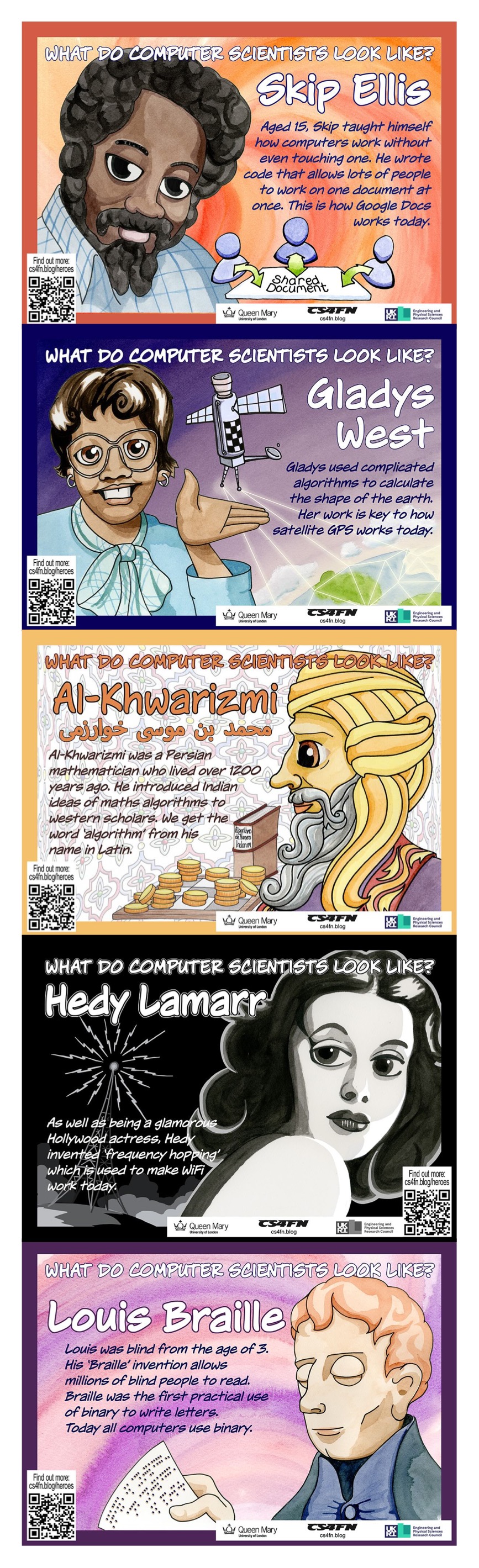
Posters for schools
We have developed a wide range of posters that have been given out to schools, including two sets of diversity posters. These have been sent to schools who requested them. One set is for primary schools one aimed at secondary schools.
These provide role models and help dispel stereotypes as well as highlighting hidden contributions of computer science.
CPD sessions for teachers
We have given CPD sessions to thousands of teachers based on the approach and pedagogy we have developed in our public engagement work. Whilst this work peaked prior to the National Centre for Computing Education being set up when we also ran as CAS London annual conferences for teachers, we have continued to give talks on pedagogy and approaches to teaching to teachers, around, for example, unplugged teaching and semantic waves, for example.
Mentoring researchers
We have supported and mentored research staff, PhD students and undergraduate and graduate students.
This has come from supporting them to do public engagement, including helping them prepare for science festivals, giving opportunities to take part
I still have very nice memories of the science festival editions in which I took part, they
really gave me a new perspective, and I like to think some of the things
I learned have stayed with me in some way. In fact, I like to think it improved my teaching (though one should probably ask the students about that). If nothing else, it made me aware that it is a performance, and that the way one manages people’s attention matters a lot more than I would have imagined. – academic
I think working with you changed my life too, in particular by introducing me to HCI and the ideas behind it. Sure, in my job – I work as a UX researcher now – but also personally. I honestly think it helped make me better at seeing things through other people’s eyes. Thanks so much for being my gateway into those ideas. – researcher
We have also given talks to academics about our approach to public engagement, including running writing workshops. This has led to a series of articles by others.
We have also been told by one Professor of Computer Science that they read and were inspired by the magazine as an undergraduate.
Our blog and websites
Our small team have written thousands of articles about interdisciplinary research and created hundreds of school activities. In the last 4 years (April 2021 – April 2025) we have posted 400 articles on the CS4FN blog (cs4fn.blog) on a variety of topics around computer science research, diversity and careers, some fun, some more serious some just presenting inspiring research, many including core lessons about computer science. In the 20 years of the project we have written several thousand articles covering the breadth of interdisciplinary Computer Science.
In the last year (2024) the CS4FN blog (cs4fn.blog) gained over 22,000 views from over 14,000 visitors in over 140 countries. Since set up in 2017 (we only started posting regularly to the blog in 2022) it has gained 54,000 views from almost 33,000 visitors, with visitor numbers to the blog doubling annually since then.
In the last year (2024) out Teaching London Computing Website for teachers (teachinglondoncomputing.org) gained over 207,000 views from over 108,000 visitors in over 200 countries. Since launched in 2013 it has gained 2.6 million views from 1.1 million visitors.
We have had visits from virtually every country in the world.
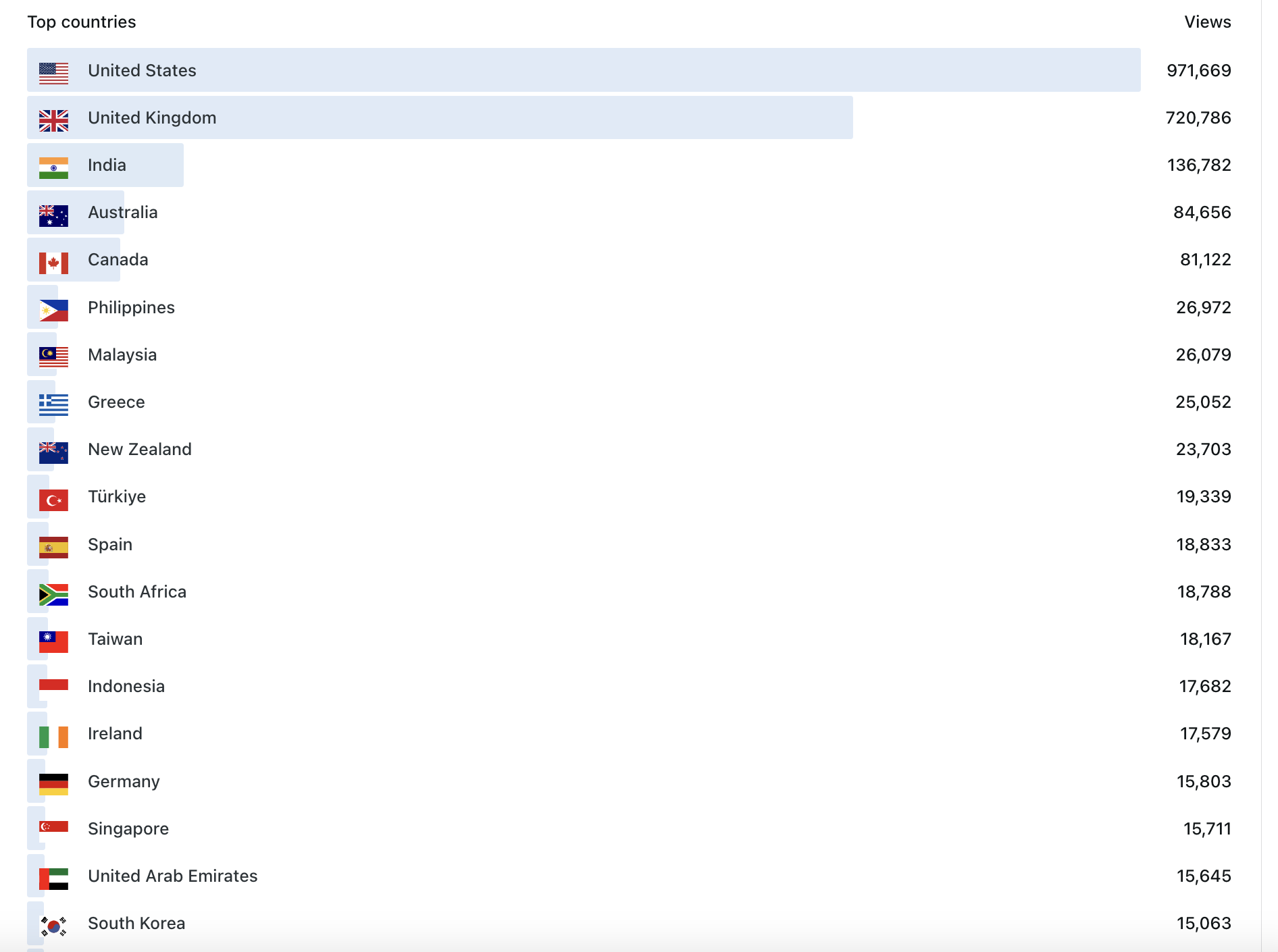
In addition our original CS4FN website (cs4fn.org) which is now used as an archive website has received tens of millions of views (peaking at 16 million views in one year in the early years of the project when there was little other support for computer science). Unfortunately, we no longer have access to reliable data about its visitor numbers.
Increasing interest in Computer Science
We have directly contributed to the increase in interest in Computer Science careers and at university. Initially we helped changed the views and understanding of senior sixth form teachers and careers advisors:
“That day left quite a mark, and the senior leadership team suddenly saw computing in a new light.”
Whilst direct data on our impact is hard to collect, this is shown from the early days of the project directly on QMUL applications for Computer Science. The CS university sector suffered dramatic drops from 2000 to 2004 after the dot-com boom-bust. In 2005/6 when we launched CS4FN, and changed our approach to be altruistic and do public engagement rather than recruitment, there was a 70% increase in applications and this was repeated in subsequent years. We believe the initial change was because we gave careers teachers better insight into the subject to give better advice, as well as resources to pass on to interested students. This increase preceded the turn around across the UK by several years. We supported the increases elsewhere as we increased our impact more widely especially when supported by an EPSRC grant.
Social Media
We promote our work through social media, including through LinkedIn, BlueSky and previously Twitter.
We have over 1400 followers on LinkedIn and approx 600 further followers on BlueSky. We also have over 3500 followers on Twitter though have recently discontinued posting there.
A large proportion of our followers are teachers and other CS Education professionals.
Careers Support
One of our aims is to help give school students a better idea of career choices. CS4FN helps schools in fulfilling three of the Gatsby Foundation’s careers benchmarks:
- Benchmark 2. Learning from career and labour market information: Our allied site TechDevJobs forms a repository of browsable / searchable job adverts, job descriptions and person specifications for tech and computing-adjacent careers organised by theme <https://techdevjobs.wordpress.com/jobs-organised-by-sector-theme/>. These showcase a range of employers, sectors, job types, salaries and application methods. Teachers and careers advisors can use the collected examples in class (without having to wait for a particular job to be advertised).
- Benchmark 4. Linking curriculum learning to careers: Many of our articles about computer scientists also talk about their careers and job titles. We have also gathered computing careers-focused articles into a number of portals (easily findable within our main portal page
- Benchmark 7. Encounters with further and higher education: Curzon and others on the CS4FN team have talked to (literally) thousands of children & teenagers in schools, at events, on QMUL campus as well as through online events, as part of dedicated events, and as a university lecturer visiting schools (see above).
Diversity
We have had a particular focus on promoting diversity in computer science: including promoting the work of women, of different ethnic groups, LGBTQ+, disability and neurodiversity. We firmly believe and embed in our messaging that computer science is for all and is best when by all.
We have done this by distributing diversity posters free to schools, giving talks on Women in Computing, writing blog posts about diversity and creating a series of diversity portals on wide ranging aspects of diversity. We promote these via social media and have particular promotions around days, weeks and months devoted to diversity such as Black History Month, and LGBTQ+ awareness months, neurodiversity awareness months etc. We post several times a week on the theme of computing by all and for all, highlighting the work of different people and groups.
For a large number of role models see our Diversity pages.
Supporting Innovation and research spinout companies
CS4Fn has contributed to innovation and spin outs in a variety of ways. The most notable perhaps is that the company DragonflyAI came about after a connection made at a public engagement talk of Peter McOwan and Hamit Soyel at the Science Museum. It has developed into a highly successful company that now has multinational clients. Various companies and social enterprises have used cs4fn material, including into workshops and a text for teachers. The app, Tunetrace, was also a spinout from CS4FN public engagement work.
We have also promoted the contributions of a a whole series of spin out companies and created a portal page on the blog celebrating entrepreneurs and tech entrepreneurship: cs4fn.blog/tech-entrepreneurship/.
Use by others
A wide range of organisations (in addition to schools) have adopted our resources for their own use. For example STEM learning have adopted our resources and activities. The Royal Institution have also regularly used our puzzle sheets as starter activities at workshops and masterclasses, and have adopted some of our activities. We have agreed for them to adapt our workshops to be “pick up and go” delivered by others.
Policy Impact
We have contributed to policy impact by supporting organisations directly involved in policy change. In particular, we were original members of Computing at School, with both Peter McOwan and Paul Curzon attending the founding meeting as a result of the CS4FN project and having supported its work ever since. Paul was a Board Member of CAS for many years. Working with the BCS, the Royal Society and technology industry CAS lobbied the government and this led to an overhaul in the English school curriculum, replacing ICT with Computing. Peter was involved in helping draft the new national curriculum for computing.
Our work was highlighted by the Royal Society policy group report
We also worked with CAS running CAS London for many years as well as working with the Mayor of London Education team supporting London teachers to teach computing.
Paul was also a member of the Royal Society Computing Education Project Advisory Group (2016-2018) investigating the need for teacher support. This work ultimately led to the UK government allocating £84 million being allocated to set up the National Centre for Computing Education (NCCE) to support teacher professional development to help them teach the new syllabus, and to support work to encourage more girls to take up computing. Paul then served, by government appointment, on the academic advisory board of the NCCE for 6 years.
We also contributed to a Royal Society programme of policy work on Machine Learning (2018) and our work is cited by the final report multiple times in the context of public engagement.
Peter McOwan contributed to the 2017 House of Lords Select Committee on Artificial Intelligence that considered the public narratives surrounding artificial intelligence, and what could be done to improve the wider understanding of the then emerging technology.
Paul also was a member of the BBC Round Table Make it Digital Advisory Group (2014-2017) that gave advice on the BBC’s year long project of programmes focussing on Computing in its television and other output that included the launch of the BBC micro:bit.
Research that came out of our public engagement work on semantic waves applied to computer science has been adopted widely, by the NCCE in its work (resource development and CPD to teachers) and along with appropriate use of unplugged approaches, use of metaphor and storytelling recommended by OFSTED as best practice in computing education when teaching concepts, leading to the take up of our approaches widely. Most recently, UK school websites have started to report using semantic waves as part of their teaching practice. As of November 2025 we identified 29 UK schools doing so after a brief and limited search.
In 2019 we hosted the Norwegian Parliamentary Working Group on Computing Education and Research as part of their fact finding mission to the UK.
Paul was a member of several CAS working groups including the Computational Thinking Working group and Assessment Working Group.
Paul was a member of the Greater London Assembly Roundtable on EdTech and London’s HE Sector: maximising innovation and growth, and a Department for Education matched Funding roundtable in 2015. He was also part of a DfE / Publishers Association Working Group on Guidelines for School Computing Learning Resources
Translations
Many of our resources have been translated into other languages by other groups in some case in collaboration with us. Various of our resources have been translated into Welsh, Spanish, German, Russian. Chinese, Portuguese and Slovenian.
Academic Impact
Our public engagement work and linked Computer Science Education work has also led to a series of academic papers over the 20 years that has had significant real world impact. This has fallen into research into three main areas
- unplugged computing (including games, puzzles, magic, story-telling and role play) to teach concepts
- computational thinking
- Semantic waves as a way to reflect on and improve education
More on our academic impact can be found here.
People involved in CS4FN
CS4FN was founded by Paul Curzon and Peter McOwan in the 2004/5 academic year with the main launch at the 2005 Royal Society Summer Exhibition.
Currently (2025) the team consists of Paul Curzon and Jo Brodie both working part time (the former doing much of the work in his own time). Daniel Gill and Amy Dowse have also provided support in recent years.
A large number of other people have contributed to the project over the years. This includes: Gabriella Kazai who helped us set it up, Jonathan Black, Jo Brodie, Jane Waite, Sue White, Chrystie Myketiak, Daniel Gill, Amy Dowse, Kok Ho Huen, Ella Rice (and many more). Kelly Burrows created the graphic design and did much of the actual design of magazines so gave us our look and feel. Kris Bush helped us get started in terms of graphic design and promotion. We have also been aided and supported by many different marketing and outreach people as well as departmental/school management at QMUL. IN particular Ursula Martin, Edmund Robinson and Jon Rowson, the then management team of the Department gave us the freedom and licence to start the project back in 2004/5 and then strongly supported us throughout.
Subscribe to be notified whenever we publish a new post to the CS4FN blog.
This blog is funded by EPSRC on research agreement EP/W033615/1.

 cs4fn
cs4fn 