Elizabeth Quay Bridge in Australia. Image Sam Wilson, CC BY-SA 4.0 , via Wikimedia Commons
Clifton, Forth and Brooklyn are all famous suspension bridges where, through a feat of engineering greatness, the roadway hangs from cables slung from sturdy towers. The Human Harp project created by Di Mainstone, Artist in Residence at Queen Mary, involves attaching digital sensors to bridge cables attached by lines to the performer’s clothing. As the bridge vibrates to traffic and people, and the performer moves, the angle and length of the lines are measured and different sounds produced. In effect human and bridge become one augmented instrument, making music mutually. Find out more at www.humanharp.org
Shafi Goldwasser is one of the greatest living computer scientists, having won the Turing Award in 2012 (equivalent to a Nobel Prize). Her work helped turn cryptography from a dark art into a science. If you’ve ever used a credit card through a web browser, for example, her work was helping you stay secure. Her greatest achievement, with Silvio Micali and Charles Rackoff, is the “Zero knowledge proof”.
Zero knowledge proofs deal with the problem that, to be really secure, security protocols often need to prove that some statement is true without giving anything else away (see “You are what you know“). A specific case is where an agent (software or human) wants to prove they know some secret, without actually giving the secret up.
Satisfy me this
There are three properties a zero knowledge proof must satisfy. Suppose Peggy is trying to convince Victor that some statement about a secret is true. Firstly, if Peggy’s statement is true then Victor must be convinced of this at the end. Secondly, if it is not actually true, there must only be a tiny chance that Peggy can convince Victor that it is true. Finally, Victor must not be able to cheat in any way that means he learns more about the secret beyond the truth of the statement. Shafi and colleagues not only came up with the idea, but showed that such proofs, unlikely as they seem, were possible.
Biosecurity break-in
Imagine the following situation (based on a scenario by Jean-Jacques Quisquater). A top secret biosecurity laboratory is protected so only authorised people can get in and out. The lab is at the end of a corridor that splits. Each branch goes to a door at the opposite end of the lab. These two doors are the only ways in or out. The rest of the room is totally sealed (see diagram).
Now, Peggy claims she knows how to get in, and has told Victor she can steal a sample of the secret biotoxin held there if he pays her a million dollars. Victor wants to be sure she can get in, before paying. She wants to prove her claim is true, but without giving anything more away, and certainly not by showing him how she does it, or giving him the toxin. She doesn’t even want him to have any hard evidence he could use to convince others that she can get in, as then he could use it against her. How does she do it?
“I can get in”
Plan of top secret lab Image by CS4FN
She needs a Zero knowledge proof of her claim “I can get in”! Here is one way. Victor waits in the foyer, unable to see the corridor. Peggy goes to the fork, and chooses a branch to go down then waits at the door. Victor then goes to the fork, unable to see where she is but able to see both exit routes. He then chooses an exit corridor at random and tells Peggy to appear there. Peggy does, passing through the lab if need be.
If they do this enough times, with Victor choosing at random which side she should appear, then he can be strongly certain that she really does know how to get in. After all, that is the only way to appear at the other side. More to the point, he still cannot get in himself and even if he records everything he sees, he would have no way to convince anyone else that Peggy can get in. Even if he videod everything he saw, that would not be convincing proof. A video showing Peggy appearing from the correct corridor would be easy to fake. Peggy has shown she can get into the room, but without giving up the secret of how, or giving Victor a way to prove she can do it to anyone else.
So, strange as it seems, it is possible to prove you know a secret without giving anything more away about the secret. Thanks to Shafi and her co-researchers the idea is now a core part of computer security.
Inspired by Mary Shelley’s Frankenstein, 17-year old Victorian orphan, Jane Webb secured her future by writing the first ever Mummy story. The 22nd century world in which her novel was set is perhaps the most amazing thing about the three volume book though.
On the death of her father, Jane realised she needed to find a way to support herself and did so by publishing her novel “The Mummy!” in 1827. In contrast to their modern version as stars of horror films, Webb’s Mummy, a reanimation of Cheops, was actually there to help those doing good and punish those that were evil. Napoleon had, through the start of the century, invaded Egypt, taking with him scholars intent on understanding the Ancient Egyptian society. Europe was fascinated with Ancient Egypt and awash with Egyptian artefacts and stories around them. In London, the Egyptian Hall had been built in Piccadilly in 1812 to display Egyptian artefacts and in 1821 it displayed a replica of the tomb of Seti I. The Rosetta Stone that led to the decipherment of hieroglyphics was cracked in 1822. The time was therefore ripe for someone to come up with the idea of a Mummy story.
The novel was not, however, set in Victorian times but in a 22nd century future that she imagined, and that future was perhaps more amazing than the idea of a mummy coming to life. Her version of the future was full of technological inventions supporting humanity, as well as social predictions, many of which have come to fruition such as space travel and the idea that women might wear trousers as the height of fashion (making her a feminist hero). The machines she described in the book led to her meeting her future husband, John Loudon. As a writer about farming and gardening he was so impressed by the idea of a mechanical milking machine included in the book, that he asked to meet her. They married soon after (and she became Jane Loudon).
The skilled artificial intelligences she wrote into her future society are perhaps the most amazing of her ideas in that she was the first person to really envision in fiction a world where AIs and robots were embedded in society just doing good as standard. To put this into context of other predictions, Ada Lovelace wrote her notes suggesting machines of the future would be able to compose music 20 years later.
Jane Webb’s future was also full of cunning computational contraptions: there were steam-powered robot surgeons, foreseeing the modern robots that are able to do operations (and with their steady hands are better at, for example, eye surgery than a human). She also described Artificial Intelligences replacing lawyers. Her machines were fed their legal brief, giving them instructions about the case, through tubes. Whilst robots may not yet have fully replaced barristers and judges, artificial intelligence programs are already used, for example, to decide the length of sentences of those convicted in some places, and many see it now only being a matter of time before lawyers are spending their time working with Artificial Intelligence programs as standard. Jane’s world also includes a version of the Internet, at a time before electric telegraph existed and when telegraph messages were sent by semaphore between networks of towers.
The book ultimately secured her future as required, and whilst we do not yet have any real reanimated mummy’s wandering around doing good deeds, Jane Webb did envision lots of useful inventions, many that are now a reality, and certainly had pretty good ideas about how future computer technology would pan out in society…despite computers, never mind artificial intelligences, still being well over a century away.
A pat on the shoulder In lockdown, during the Covid-19 pandemic, inventor and roboticist Simone Giertz created a coin-operated ‘proud parent machine’ which, for 25 US cents, would pat her on the shoulder and give a few words of encouragement. Putting in a coin sent a signal to a microcontroller that turned a motor on which lowered a 3D-printed arm (to pat her shoulder), then played a pre-recorded audio file telling her how proud of her the automaton was. Making the machine involved skills in woodworking, computer-aided design, mechanics and electronics. She also gave a TED Talk called “Why you should make useless things”.
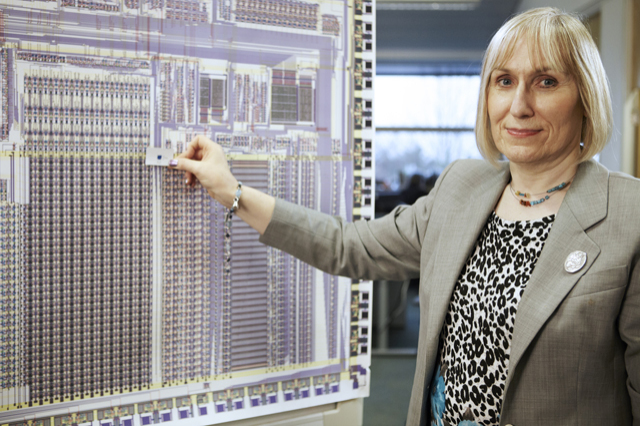
Some people’s innovations are so amazing it is hard to know where to start. Sophie Wilson is like that. She helped kick start the original 80’s BBC micro computer craze, then went on to help design the chips in virtually every smartphone ever made. Her more recent innovations are the backbone that is keeping broadband infrastructure going. The amount of money her innovations have made easily runs into tens of billions of dollars, and the companies she helped succeed make hundreds of billions of dollars. It all started with her feeding cows!
While still a student Sophie spent a summer designing a system that could automatically feed cows. It was powered by a microcomputer called the MOS 6502: one of the first really cheap chips. As a result Sophie gained experience in both programming using the 6502’s set of instructions but also embedded computers: the idea that computers can disappear into other everyday objects. After university she quickly got a job as a lead designer at Acorn Computers and extended their version of the BASIC language, adding, for example, a way to name procedures so that it was easier to write large programs by breaking them up into smaller, manageable parts.
Acorn needed a new version of their microcomputer, based on the 6502 processor, to bid for a contract with the BBC for a project to inspire people about the fun of coding. Her boss challenged her to design it and get it working, all in only a week. He also told her someone else in the team had already said they could do it. Taking up the challenge she built the hardware in a few days, soldering while watching the Royal Wedding of Charles and Diana on TV. With a day to go there were still bugs in the software, so she worked through the night debugging. She succeeded and within the week of her taking up the challenge it worked! As a result Acorn won a contract from the BBC, the BBC micro was born and a whole generation were subsequently inspired to code. Many computer scientists, still remember the BBC micro fondly 30 years later.
That would be an amazing lifetime achievement for anyone. Sophie went on to even greater things. Acorn morphed into the company ARM on the back of more of her innovations. Ultimately this was about returning to the idea of embedded computers. The Acorn team realised that embedded computers were the future. As ARM they have done more than anyone to make embedded computing a ubiquitous reality. They set about designing a new chip based on the idea of Reduced Instruction Set Computing (RISC). The trend up to that point was to add ever more complex instructions to the set of programming instructions that computer architectures supported. The result was bloated systems that were hungry for power. The idea behind RISC chips was to do the opposite and design a chip with a small but powerful instruction set. Sophie’s colleague Steve Furber set to work designing the chip’s architecture – essentially the hardware. Sophie herself designed the instructions it had to support – its lowest level programming language. The problem was to come up with the right set of instructions so that each could be executed really, really quickly – getting as much work done in as few clock cycles as possible. Those instructions also had to be versatile enough so that when sequenced together they could do more complicated things quickly too. Other teams from big companies had been struggling to do this well despite all their clout, money and powerful computer mainframes to work on the problem. Sophie did it in her head. She wrote a simulator for it in her BBC BASIC running on the BBC Micro. The resulting architecture and its descendants took over the world, with ARM’s RISC chips running 95% of all smartphones. If you have a smartphone you are probably using an ARM chip. They are also used in game controllers and tablets, drones, televisions, smart cars and homes, smartwatches and fitness trackers. All these applications, and embedded computers generally, need chips that combine speed with low energy needs. That is what RISC delivered allowing the revolution to start.
If you want to thank anyone for your personal mobile devices, not to mention the way our cars, homes, streets and work are now full of helpful gadgets, start by thanking Sophie…and she’s not finished yet!
Paul Curzon, Queen Mary University of London
More on …
LGBTQ+ [part of our Teaching London Computing Diversity pages]
Charles Babbage found barrel organs so incredibly irritating that he waged a campaign to clear them from the streets, even trying to organise an act of parliament to have them banned. Presumably, it wasn’t the machine Babbage hated but the irritating noise preventing him from concentrating: the buskers in the streets outside his house constantly playing music was the equivalent to listening to next door’s music through the walls. His hatred, however, may have led to Ada Lovelace’s greatest idea.
It seems rather ironic his ire was directed at the barrel organ as they share a crucial component with his idea for a general purpose computer – a program. Anyone (even monkeys) can be organ grinders, and so play the instrument, because they are just the power source, turning the crank to wind the barrel. Babbage’s first calculating machine, the Difference Engine was similarly powered by cranking a handle.
The barrel itself is like a program. Pins sticking out from the barrel encode the series of notes to be played. These push levers up and down, which in turn switch valves on and off, allowing air from bellows into the different pipes that make the sounds. As such it is a binary system of switches with pins and no pins round the barrel giving instructions meaning on or off for the notes. Swap the barrel with one with pins in different positions and you play different music, just as changing the program in a computer changes what it does.
Babbage’s hate of these music machines potentially puts a different twist on Ada Lovelace’s most visionary idea. Babbage saw his machines as ways to do important calculations with great accuracy, such as for working out the navigation tables ships needed to travel the world. Lovelace, by contrast, suggested that they could do much more and specifically that one day they would be able to compose music. The idea is perhaps her most significant, and certainly a prediction that came true.
We can never know, but perhaps the idea arose from her teasing Babbage. She was essentially saying that his great invention would become the greatest ever music machine…the thing he detested more than anything. And it did.
Tea shops played a surprisingly big role in the history of computing. It was all down to J. Lyons & Co., a forward thinking company that bought one of the first computers to use for things like payroll. Except they had a problem. Computers need programs, but no such programs existed, and neither did the job of programmer. How then to find people to program their new-fangled computer? One person they quickly found, Mary Coombs, suited the job to a T, becoming the first female commercial programmer.
J Lyons and Company, a catering company with a chain of over 200 tea shops in London, wanted to increase its sales and efficiency. With amazing foresight, they realised computers, then being used only for scientific research in a few universities, would help. They bought the technology from Cambridge University, built their own and called it LEO (the Lyons Electronic Office). They hoped it would do calculations much more quickly than the 1950s clerks could, using calculating machines. But it could only happen if Lyons could find people to program it. At the time there were only a handful of people in the world who were ‘good at computers’ (programmer didn’t exist as a job yet) so instead they had to find people who could be good with computers and train them for the job. Lyons created a Computer Appreciation Course which involved a series of lectures and some homework, all designed to find staff within the company who could think logically and would learn how to write programs for LEO.
One of those was Mary Coombs. Born in 1929, she studied at Queen Mary University of London in the late 1940s. You might think, given that this is about a computer, that she studied computer science, but she actually studied French and History. She couldn’t study computer science: what we’d call a computer science course didn’t exist. There wasn’t one anywhere until 1953, when the University of Cambridge opened a Diploma in Computer Science.
By then, Mary was already working at Lyons. She’d had a holiday job there in 1951, as a clerk (in the Ice Cream Sales department) as she finished her degree. A year later she returned to the company where her career changed direction. In addition to her language skills, she was good at maths so transferred to Lyon’s Statistical Office. That’s where she heard about LEO and the need for programmers to learn about it and help test it as it was being built and refined. Intrigued, she signed up for the company’s first computer appreciation course, did well, and was one of only two people on the course then offered a job on the project. As a result she became the first woman to work on the LEO team as a programmer and the first female commercial programmer in the world.
LEO was an enormous computer, built from several thousand valves, and took up an entire room, though it could only store a few kilobytes of memory. It was also a little temperamental. It needed to be very reliable if it was going to be of any use, so it underwent months of testing and improvement, with Mary’s help, before it was put to work on solving real problems, again with Mary and others on the team writing the programs for everything it did.
One of its first tasks was to make sure everyone got paid! LEO was able to calculate forty people’s payslips in one minute (one every 1.5 seconds) where previously it would have taken one clerk six minutes to do one: a huge improvement in efficiency for Lyons.
LEO was both pioneering and a big success, but the real pioneers were the programmers like Mary. They turned computers, intended to help scientists win Nobel prizes, into ones that helped businesses run efficiently, ensuring people got paid. Obvious now, but remarkable in the 1950s.
Ada Lovelace was close friends with John Crosse, and knew his father Andrew: the ‘real Frankenstein’. Andrew Crosse apparently created insect life from electricity, stone and water…
Andrew Crosse was a ‘gentleman scientist’ doing science for his own amusement including work improving giant versions of the first batteries called ‘voltaic piles’. He was given the nickname ‘the thunder and lightning man’ because of the way he used the batteries to do giant discharges of electricity with bangs as loud as canons.
He hit the headlines when he appeared to create life from electricity, Frankenstein-like. This was an unexpected result of his experiments using electricity to make crystals. He was passing a current through water containing dissolved limestone over a period of weeks. In one experiment, about a month in, a perfect insect appeared apparently from no-where, and soon after starting to move. More and more insects then appeared over time. He mentioned it to friends, which led to a story in a local paper. It was then picked up nationally. Some of the stories said he had created the insects, and this led to outrage and death threats over his apparent blasphemy of trying to take the position of God.
(Does this start to sound like a modern social networking storm, trolls and all?) In fact he appears to have believed, and others agreed, that the mineral samples he was using must have been contaminated with tiny insect eggs, that just naturally hatched. Scientific results are only accepted if they can be replicated. Others, who took care to avoid contamination couldn’t get the same result. The secret of creating life had not been found.
While Mary Shelley, who wrote Frankenstein, did know Crosse, sadly perhaps, for the story’s sake, he can’t have been the inspiration for Frankenstein as has been suggested, given she wrote it decades earlier!
Paul Curzon, Queen Mary University of London (from the archicve)
Shortly after Ada Lovelace was born, so long before she made predictions about future “creative machines”, Mary Shelley, a friend of her father (Lord Byron), was writing a novel. In her book, Frankenstein, inanimate flesh is brought to life. Perhaps Shelley foresaw what is actually to come, what computer scientists might one day create: artificial life.
Life it may not be, but engineers are now doing pretty well in creating humanoid machines that can do their own thing. Could a machine ever be considered alive? The 21st century is undoubtedly going to be the age of the robot. Maybe it’s time to start thinking about the consequences in case they gain a sense of self.
Frankenstein was obsessed with creating life. In Mary Shelley’s story, he succeeded, though his creation was treated as a “Monster” struggling to cope with the gift of life it was given. Many science fiction books and films have toyed with these themes: the film Blade Runner, for example, explored similar ideas about how intelligent life is created; androids that believe they are human, and the consequences for the creatures concerned.
Is creating intelligent life fiction? Not totally. Several groups of computer scientists are exploring what it means to create non-biological life, and how it might be done. Some are looking at robot life, working at the level of insect life-forms, for example. Others are looking at creating intelligent life within cyberspace.
For 70 years or more scientists have tried to create artificial intelligences. They have had a great deal of success in specific areas such as computer vision and chess playing programs. They are not really intelligent in the way humans are, though they are edging closer. However none of these programs really cuts it as creating “life”. Life is something more than intelligence.
A small band of computer scientists have been trying a different approach that they believe will ultimately lead to the creation of new life forms: life forms that could one day even claim to be conscious (and who would we be to disagree with them if they think they are?) These scientists believe life can’t be engineered in a piecemeal way, but that the whole being has to be created as a coherent whole. Their approach is to build the basic building blocks and let life emerge from them.
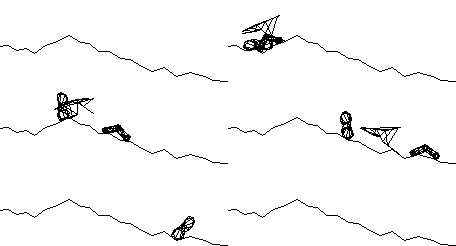
A sodarace in action by CS4FN
The outline of the idea could be seen in the game Sodarace, where you could build your own creatures that move around a virtual world, and even let them evolve. One approach to building creatures, such as a spider, would be to try and work out mathematical equations about how each leg moves and program those equations. The alternative artificial life way as used in Sodarace is to instead program up the laws of physics such as gravity and friction and how masses, springs and muscles behave according to those laws. Then you just put these basic bits together in a way that corresponds to a spider. With this approach you don’t have to work out in advance every eventuality (what if it comes to a wall? Or a cliff? Or bumpy ground?) and write code to deal with it. Instead natural behaviour emerges.
The artificial life community believe, not just life-like movement, but life-like intelligence can emerge in a similar way. Rather than programming the behaviour of muscles you program the behaviour of neurones and then build brains out of them. That it turns out has been the key to the machine learning programs that are storming the world of Artificial Intelligence, turning it into an everyday tool. However, if aiming for artificial life, you would keep going and combine it with the basic biochemistry of an immune system, do a similar thing with a reproductive system, and so on.
Want to know more? A wonderful early book is Steve Grand’s: “Creation”, on how he created what at the time was claimed to be “the nearest thing to artificial life yet”… It started life as the game “Creatures”.
Then have a go at creating artificial life yourself (but be nice to it).
Paul Curzon and Peter W McOwan, Queen Mary University of London
We have explained how core rope memory was used as the computer memory storing the Apollo guidance computer program that got us to the moon. A team from the University of Washington came up with a fun craft activity to make your own core memory. It may not fly you to the moon, but is a neat way to store information in a bracelet. Find their activity pages here [EXTERNAL].
What it involves is threading 8 beads onto a string, with a gap between them to form a storage space for bytes of data. Each byte is 8 binary bits (Eight pieces of information, each a 1 or a 0). Each bead represents the position of one bit in your core rope memory. You then take other threads and weave them through the beads. Each thread will store another byte of actual data. Pass the thread through a bead when you want that bead to read 1, or over, when you want that bead to read 0.
Each thread weaving past or through 8 beads can then encode the information for one letter. By adding lots of threads you can store a word or even a sentence on each core rope memory string (perhaps your name, or some secret message).
Using a binary encoding for each letter (so capital letter A would be the 8 bits 01000001 if you’re following this conversion from binary to letters table) you put that letter’s thread through or over each of the 8 beads to ‘spell’ out the letter in binary.
My name is Jo so a core rope memory encoding my name would have only three threads (one to hold the 8 beads and two to spell my name). The second thread would go over, through, over, over, through, over, through, over to spell the capital letter J (01001010). The second thread would go over, through, through, over, through, through, through, through to spell lowercase o (01101111).
Let’s hope you have a slightly longer name so can have more fun time creating your own personalised core rope memory!