Join the crowd with swarm intelligence

A shoal of fish crammed into a cylindrical tank.
Image by Paul Sloane from Pixabay

Next time you are in a large crowd, look around you: all those people moving together, and mostly not bumping into each other. How does it happen? Flocks of birds and schools of fish are also examples of this ‘swarm intelligence’. Computer Scientists have been inspired by this behaviour to come up with new solutions to really difficult problems.

Swarming behaviour requires the individuals (birds, fish or people) to have a set of rules about how to interact with the individuals nearest to them. These so-called ‘local’ rules are all that’s needed to give rise to the overall or ‘global’ behaviour of the swarm. We adjust our individual behaviour according to our current state but also the current state of those around us. If I want to turn left then I do it slowly so that others in the crowd can be aware of it and also start to turn. I know what I am doing and I know what they are doing. This is how information makes its way from the edges of the crowd to the centre and vice versa.

A swarm is born

The way a crowd or swarm interacts can be explained with simple maths. This maths is a way of approximating the complex psychological behaviour of all the individuals on the basis of local and global rules. Back in 1995 James Kennedy, a research psychologist, and Computer Scientist Russ Eberhart, having been inspired by the study of bird flocking behaviour by biologist Frank Heppner, realised that this swarm intelligence could be used to solve difficult computer problems. The result was a technique called Particle Swarm Optimisation (PSO).

Travel broadens the mind

An optimisation problem is one where you have a range of options to choose from and you want to know the best solution. One of the classic problems is called ‘The travelling salesperson’ problem. You work for a company and have to deliver packages to say 12 towns. You look at the map. There are many different routes to take, but which is the one that will let you visit all 12 towns using the least petrol? Here the choices are the order in which you visit the towns, and the constraint is that you want to do the least driving. You could have a guess, select the towns in a random order and work out how far you’d have to travel to visit them in this order. You then try another route through all 12 and see if it takes less mileage, and so on. Phew! It could take a long time to work out all the possible routes for 12 towns to see which was best. Now imagine your company grows and you have to deliver to 120 towns or 1200 towns. You would spend all your time with the maps trying to come up with the cheapest solutions. There must be a better way? Well actually simple as this problem seems it’s an example of a set of computational problems known as NP-Complete problems and it’s not easy to solve! You need some guidance to help you through and that’s where swarm optimisation come in. It’s an example of a so-called metaheuristic algorithm: a sort of ‘general rule of thumb’ to help solve these types of problem. It won’t always work unless you have infinite time but it’s better than just trying random solutions. So how does swarm optimisation work here?

State space: the final frontier

First we need to turn the problem into something called a state space. You probably use state spaces all the time but just don’t know it. Think about yourself. What are the characteristic you would use to tell people about your current state: age, height, weight and so on. You can identify yourself by a list of say 3 numbers – one for age, one for height, one for weight. It’s not everything about you of course but it does define your state to some extent. Your numbers will be different to other people’s numbers, if you take all the numbers for your friends you would have a state space. It would be a 3-dimensional space with axes: age, height and weight, and each person would be a point in that space at some coordinate (X, Y, Z).

So state spaces are just a way of representing the possible variations in some problem. With the 12 towns problem, however, you couldn’t draw this space: it would be 12 dimensional! It would have one axis for each town, with the position on the axis an indication of where in the route it was. Every point in that space would be a different route through the 12 towns, so each point in the space would have coordinates (x1, x2, x3, … x11, x12). For each point there would also be a mileage associated with the route, and the task is to find the coordinate point (route) with the lowest mileage.

Where no particle has swarmed before

Enter swarm optimisation. We create a set of ‘particles’ that will be like birds or fish, and will fly and swarm through our state space. Each particle starts with a random starting location in the state space and calculates the mileages involved for the coordinates (route) they are at. The particles remember (store) this coordinate and also the value of the mileage at that position. Each particle therefore has it’s own known ‘local’ best value (where the lowest mileage was) but can compare this with other neighbouring particles to see if they have found any even better solutions. The particles then move onwards randomly in a direction that tends to move them towards their own local best and the best value found by their neighbours. The particles ‘fly’ around the state space in a swarm homing in on even better solutions until they all converge on the best they can find: the answer.

It may be that somewhere in a part of the space where no particle has been there is an even better solution, perhaps even the best solution possible. Our swarm will have missed it! That’s why this algorithm is a heuristic, a best guess to a tough problem. We can always add some more particles at the start to fill more of the state space and reduce the chance of missing a good solution, but we cant ever be 100% sure.

Swarm optimisation has been applied to a whole range of tough problems in computing, electronic engineering, medicinal chemistry and economics. All it needs is for you to create an appropriate state space for your problem and let the particles fly and swarm to a good solution.

It’s yet another example of clever computing based on behaviours found in the natural world. So next time you’re in a crowd, look around and appreciate all that collective interacting swarm intelligence…but make sure you remember to watch where you are stepping.

by Peter W. McOwan, Queen Mary University of London. From the archive.

More on …

Related Magazines …

cs4fn issue 4 cover
A hoverfly on a leaf

Our Books …


Subscribe to be notified whenever we publish a new post to the CS4FN blog.


This page is funded by EPSRC on research agreement EP/W033615/1.

QMUL CS4FN EPSRC logos

Hoverflies: comin’ to get ya

(from the archive)

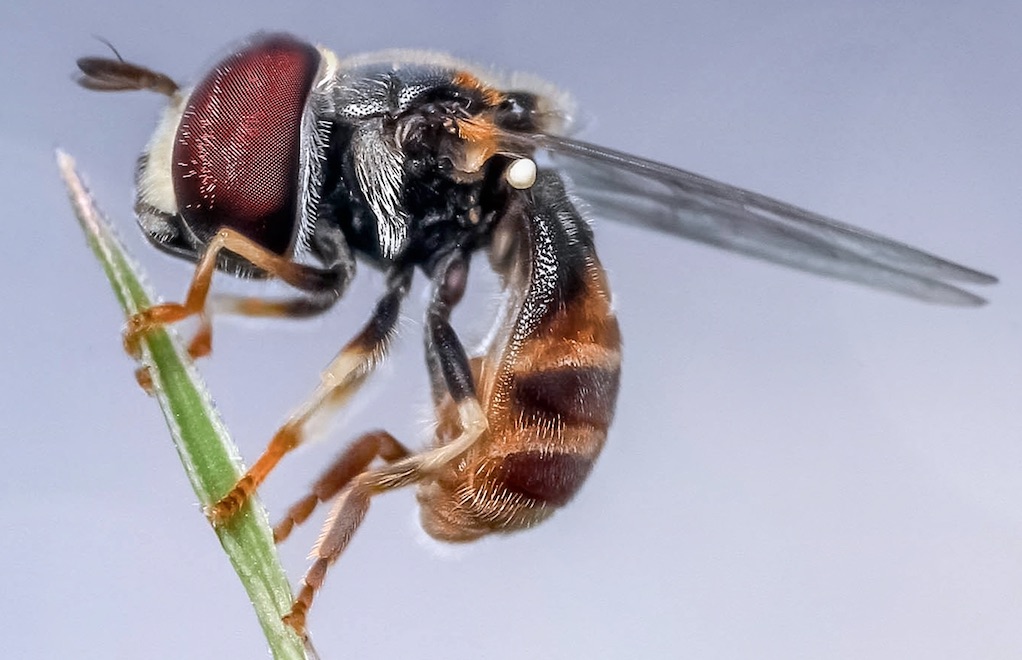
A hoverfly on a blade of grass
Image by Ronny Overhate from Pixabay (cropped)

By understanding the way hoverflies mate, computer scientists found a way to sneak up on humans, giving a way to make games harder.

When hoverflies get the hots for each other they make some interesting moves. Biologists had noticed that as one hoverfly moves towards a second to try and mate, the approaching fly doesn’t go in a straight line. It makes a strange curved flight. Peter and his student Andrew Anderson thought this was an interesting observation and started to look at why it might be. They came up with a cunning idea. The hoverfly was trying to sneak up on its prospective mate unseen.

The route the approaching fly takes matches the movements of the prospective mate in such a way that, to the mate, the fly in the distance looks like it’s far away and ‘probably’ stationary.

Tracking the motion of a hoverfly and its sightlines
Image by Paul Curzon

How does it do this? Imagine you are walking across a field with a single tree in it, and a friend is trying to sneak up on you. Your friend starts at the tree and moves in such a way that they are always in direct line of sight between your current position and the tree. As they move towards you they are always silhouetted against the tree. Their motion towards you is mimicking the stationary tree’s apparent motion as you walk past it… and that’s just what the hoverfly does when approaching a mate. It’s a stealth technique called ‘active motion camouflage’.

By building a computer model of the mating flies, the team were able to show that this complex behaviour can actually be done with only a small amount of ‘brain power’. They went on to show that humans are also fooled by active motion camouflage. They did this by creating a computer game where you had to dodge missiles. Some of those missiles used active motion camouflage. The missiles using the fly trick were the most difficult to spot.

It just goes to show: there is such a thing as a useful computer bug.

– Peter W McOwan and Paul Curzon, Queen Mary University of London


More on …

Related Magazines …

cs4fn issue 4 cover
A hoverfly on a leaf

EPSRC supports this blog through research grant EP/W033615/1, and through EP/K040251/2 held by Professor Ursula Martin. 

QMUL CS4FN EPSRC logos

Ant Art

The close up head of an ant staring at you
Image by Virvoreanu Laurentiu from Pixabay 

There are many ways Artificial Intelligences might create art. Breeding a colony of virtual ants is one of the most creative.

Photogrowth from the University of Coimbra does exactly that. The basic idea is to take an image and paint an abstract version of it. Normally you would paint with brush strokes. In ant paintings you paint with the trails of hundreds of ants as they crawl over the picture, depositing ink rather than the normal chemical trails ants use to guide other ants to food. The colours in the original image act as food for the ants, which absorb energy from its bright parts. They then use up energy as they move around. They die if they don’t find enough food, but reproduce if they have lots. The results are highly novel swirl-filled pictures.

The program uses vector graphics rather than pixel-based approaches. In pixel graphics, an image is divided into a grid of squares and each allocated a colour. That means when you zoom in to an area, you just see larger squares, not more detail. With vector graphics, the exact position of the line followed is recorded. That line is just mapped on to the particular grid of the display when you view it. The more pixels in the display, the more detailed the trail is drawn. That means you can zoom in to the pictures and just see ever more detail of the ant trails that make them up.

You become a breeder of a species of ant
that produce trails, and so images,
you will find pleasing

Because the virtual ants wander around at random, each time you run the program you will get a different image. However, there are lots of ways to control how ants can move around their world. Exploring the possibilities by hand would only ever uncover a small fraction of the possibilities. Photogrowth therefore uses a genetic algorithm. Rather than set all the options of ant behaviour for each image, you help design a fitness function for the algorithm. You do this by adjusting the importance of different aspects like the thickness of trail left and the extent the ants will try and cover the whole canvas. In effect you become a breeder of a species of ant that produce trails, and so images, you will find pleasing. Once you’ve chosen the fitness function, the program evolves a colony of ants based on it, and they then paint you a picture with their trails.

The result is a painting painted by ants bred purely to create images that please you.

– Paul Curzon, Queen Mary University of London (from the archive)


More on …

Related Magazines …

Cover issue 18
cs4fn issue 4 cover

EPSRC supports this blog through research grant EP/W033615/1, and through EP/K040251/2 held by Professor Ursula Martin. 

QMUL CS4FN EPSRC logos

Ant Track Algorithms

A single ant on a rock
Image by vlada11 from Pixabay

Ants communicate by leaving trails of chemicals that other ants can follow to sources of food they’ve found. Very quickly after a new source of food is found ants from the nest are following the shortest path to get to it, even if the original ant trail was not that direct and wiggled around. How do they do that? And how come computers are copying them?

Bongo playing physicist, Richard Feynman, better known for his Nobel Prize for Physics, wondered about this one day watching ants in his bath. The marvellous thing about science is it can be done anywhere! He grabbed some crayons and started marking the paths each ant followed by drawing a line behind it. He quickly discovered from the trails that what was happening was that each ant was following earlier trails but hurriedly so not sticking to it exactly. Instead it was leaving its own trail. As this was done over and over again the smooth direct route emerged as having the strongest line from the superimposed hurried trails. It’s a bit like when you sketch – you do a series of rough lines to start, but as you do that over and over the final line is much smoother.

From very simple behaviour the ants are able to achieve complex things that might otherwise need complex geometrical skills. As a result, Computer Scientists have been inspired by the ants. Marco Dorigo, Université Libre de Bruxelles first came up with the idea of ‘ant algorithms’: ways of programming separate software agents to do complex things that otherwise would bog down even fast computers. They are part of a more general idea of swarm computing. Finding shortest routes, whether for taxi drivers or for messages sent over networks, is a very common problem of the kind ant algorithms can solve. An ant algorithm solution involves programming lots of software agents to behave a bit like ants leaving digital trails for other agents to pick up. Over time, their simple individual behaviour yields a good solution to the otherwise complex problem of finding the shortest route. Another use is to detect the edges of objects in images – the first step in understanding a picture. Here the virtual ants wander from pixel to pixel based on the differences between nearby pixels, with the result that the strongest trail is left along edges of things shown in the image.

So ants are helping to solve real problems. Not bad for such a tiny brain.

– Peter W McOwan and Paul Curzon, Queen Mary University of London

(Updated from the archive)


More on …

Related Magazines …

cs4fn issue 4 cover

EPSRC supports this blog through research grant EP/W033615/1, and through EP/K040251/2 held by Professor Ursula Martin. 

QMUL CS4FN EPSRC logos

Sabine Hauert: Swarm Engineer

Based on a 2016 talk by Sabine Hauert at the Royal Society

Sabine Hauert is a swarm engineer. She is fascinated by the idea of making use of swarms of robots. Watch a flock of birds and you see that they have both complex and beautiful behaviours. It helps them avoid predators very effectively, for example, so much so that many animals behave in a similar way. Predators struggle to fix on any one bird in all the chaotic swirling. Sabine’s team at the University of Bristol are exploring how we can solve our own engineering problems: from providing communication networks in a disaster zone to helping treat cancer, all based on the behaviours of swarms of animals.

A murmuration of starlings against a dramatic sky
Image by greg seed from Pixabay (cropped)

Sabine realised that flocks of birds have properties that are really interesting to an engineer. Their ability to scale is one. It is often easy to come up with solutions to problems that work in a small ‘toy’ system, but when you want to use it for real, the size of the problem defeats you. With a flock, birds just keep arriving, and the flock keeps working, getting bigger and bigger. It is common to see thousands of Starlings behaving like this – around Brighton Pier most winter evenings, for example. Flocks can even be of millions of birds all swooping and swirling together, never colliding, always staying as a flock. It is an engineering solution that scales up to massive problems. If you can build a system to work like a flock, you will have a similar ability to scale.

Flocks of birds are also very robust. If one bird falls out of the sky, perhaps because it is caught by a predator, the flock itself doesn’t fail, it continues as if nothing happened. Compare that to most systems humans create. Remove one component from a car engine and it’s likely that you won’t be going anywhere. This kind of robustness from failure is often really important.

Swarms are an example of emergent behaviour. If you look at just one bird you can’t tell how the flock works as a whole. In fact, each is just following very simple rules. Each bird just tracks the positions of a few nearest neighbours using that information to make simple decisions about how to move. That is enough for the whole complex behaviour of the flock to emerge. Despite all that fast and furious movement, the birds never crash into each other. Fascinated, Sabine started to explore how swarms of robots might be used to solve problems for people.

Her first idea was to create swarms of flying robots to work as a communications network, providing wi-fi coverage in places it would otherwise be hard to set up a network. This might be a good solution in a disaster area, for example, where there is no other infrastructure, but communication is vital. You want it to scale over the whole disaster area quickly and easily, and it has to be robust. She set about creating a system to achieve this.

The robots she designed were very simple, fixed wing, propellor-powered model planes. Each had a compass so it knew which direction it was pointing and was able to talk to those nearest using wi-fi signals. It could also tell who its nearest neighbours were. The trick was to work out how to design the behaviour of one bird so that appropriate swarming behaviour emerged. At any time each had to decide how much to turn to avoid crashing into another but to maintain the flock, and coverage. You could try to work out the best rules by hand. Instead, Sabine turned to machine learning.

“Throwing those flying robots
and seeing them flock
was truly magical”

The idea of machine learning is that instead of trying to devise algorithms that solve problems yourself, you write an algorithm for how to learn. The program then learns for itself by trial and error the best solution. Sabine created a simple first program for her robots that gave them fairly random behaviour. The machine learning program then used a process modelled on evolution to gradually improve. After all evolution worked for animals! The way this is done is that variations on the initial behaviour are trialled in simulators and only the most successful are kept. Further random changes are made to those and the new versions trialled again. This is continued over thousands of generations, each generation getting that little bit better at flocking until eventually a behaviour of individual robots results that leads to them swarming together.

Sabine has now moved on to to thinking about a situation where swarms of trillions of individuals are needed: nanomedicine. She wants to create nanobots that are each smaller than the width of a strand of hair and can be injected into cancer patients. Once inside the body they will search out and stick themselves to tumour cells. The tumour cells gobble them up, at which point they deliver drugs directly inside the rogue cell. How do you make them behave in a way that gives the best cancer treatment though? For example, how do you stop them all just sticking to the same outer cancer cells? One way might be to give them a simple swarm behaviour that allows them to go to different depths and only then switch on their stickiness, allowing them to destroy all the cancer cells. This is the sort of thing Sabine’s team are experimenting with.

Swarm engineering has all sorts of other practical applications, and while Sabine is leading the way, some time soon we may need lots more swarm engineers, able to design swarm systems to solve specific problems. Might that be you?

by Paul Curzon, Queen Mary University of London

Explore swarm behaviour using the Oxford Turtle system [EXTERNAL] (click the play button top centre) to see how to run a flocking simulation as well as program your own swarms.

More on …

Related Magazines …

cs4fn issue 4 cover
A hoverfly on a leaf

Our Books …


Subscribe to be notified whenever we publish a new post to the CS4FN blog.


EPSRC supports this blog through research grant EP/W033615/1. 

QMUL CS4FN EPSRC logos