Jerry Elliot High Eagle: Saving Apollo 13

Apollo 13 Mission patch of three golden horses travelling from Earth to the moon
Image by NASA Public domain via Wikimedia Commons

Jerry Elliot High Eagle was possibly the first Native American to work in NASA mission control. He worked for NASA for over 40 years, from the Apollo moon landings up until the space shuttle missions. He was a trained physicist with both Cherokee and Osage heritage and played a crucial part in saving the Apollo 13 crew when an explosion meant they might not get back to Earth alive.

The story of Apollo 13 is told in the Tom Hanks film Apollo 13. The aim was to land on the moon for a third time following the previous two successful lunar missions of Apollo 11 and Apollo 12. That plan was aborted on the way there, however, after pilot James Swigert radioed his now famous if misquoted words “Okay, Houston … we’ve had a problem here”. It was a problem that very soon seemed to mean they would die in space: an oxygen tank had just exploded. Instead of being a moon landing the mission turned into the most famous rescue attempt in history – could the crew of James Lovell, Jack Swigert and Fred Haise get back to Earth before their small space craft turned into a frozen, airless and lifeless space coffin. 

While the mission control team worked with the crew on how to keep the command and lunar modules habitable for as long as possible (they were rapidly running out of breathable air, water and heat and had lost electircal power), Elliot worked on actually getting the craft back to Earth. He was the “retrofire officer” for the mission which meant he was an expert in, and responsible for, the trajectory Apollo 13 took from the Earth to the moon and back. He had to compute a completely new trajectory from where they now were, which would get them back to Earth as fast and as safely as possible. It looked impossible given the limited time the crew could possibly stay alive. Elliot wasn’t a quitter though and motivated himself by telling himself:

“The Cherokee people had the tenacity to persevere on the Trail of Tears … I have their blood and I can do this.” 

The Trail of Tears was the forced removal of Native Americans from their ancestral homelands by the US government in the 19th century to make way for the gold rush . Now we would call this ethnic cleansing and genocide. 60, 000 Native American people were moved with the Cherokee forcibly marched a 1000 miles to an area to the West of the Mississippi, thousands dying along the way.

The best solution for Apollo 13, was to keep going and slingshot round the dark side of the moon, using the forces arising from its gravity, together with strategic use of the boosters to push the space craft on back to Earth more quickly than on those boosters alone. The trajectory he computed had to be absolutely accurate or the crew would not get home and he has suggested the accuracy needed was like “threading a needle from 70 feet away!” Get it wrong and the space craft could miss the Earth completely, or arrive too fast to reenter earth’s orbit and return through the atmosphere.

Jerry Elliot High Eagle, of course, famously got it right: the crew survived, safely returning to Earth and Elliot was awarded the President’s Medal of Freedom, the highest American honour possible, for the role he played. The Native American people also gave him the name High Eagle for his contributions to space exploration.

Paul Curzon, Queen Mary University of London

More on …


Subscribe to be notified whenever we publish a new post to the CS4FN blog.


This page is funded by EPSRC on research agreement EP/W033615/1.

QMUL CS4FN EPSRC logos

Margaret Hamilton: Apollo Emergency! Take a deep breath, hold your nerve and count to 5

Buzz Aldrin standing on the moon
Buzz Aldrin standing on the moon. Image by Neil Armstrong, NASA via Wikimedia Commons – Public Domain

You have no doubt heard of Neil Armstrong, first human on the moon. But have you heard of Margaret Hamilton? She was the lead engineer, responsible for the Apollo mission software that got him there, and ultimately for ensuring the lunar module didn’t crash land due to a last minute emergency.

Being a great software engineer means you have to think of everything. You are writing software that will run in the future encountering all the messiness of the real world (or real solar system in the case of a moon landing). If you haven’t written the code to be able to deal with everything then one day the thing you didn’t think about will bite back. That is why so much software is buggy or causes problems in real use. Margaret Hamilton was an expert not just in programming and software engineering generally, but also in building practically dependable systems with humans in the loop. A key interaction design principle is that of error detection and recovery – does your software help the human operators realise when a mistake has been made and quickly deal with it? This, it turned out, mattered a lot in safely landing Neil Armstrong and Buzz Aldrin on the moon.

As the Lunar module was in its final descent dropping from orbit to the moon with only minutes to landing, multiple alarms were triggered. An emergency was in progress at the worst possible time. What it boiled down to was that the system could only handle seven programs running at once but Buzz Aldrin had just set an eighth running. Suddenly, the guidance system started replacing the normal screens by priority alarm displays, in effect shouting “EMERGENCY! EMERGENCY”! These were coded into the system, but were supposed never to be shown, as the situations triggering them were supposed to never happen. The astronauts suddenly had to deal with situations that they should not have had to deal with and they were minutes away from crashing into the surface of the moon.

Margaret Hamilton was in charge of the team writing the Apollo in-flight software, and the person responsible for the emergency displays. She was covering all bases, even those that were supposedly not going to happen, by adding them. She did more than that though. Long before the moon landing happened she had thought through the consequences of if these “never events” did ever happen. Her team had therefore also included code in the Apollo software to prioritise what the computer was doing. In the situation that happened, it worked out what was actually needed to land the lunar module and prioritised that, shutting down the other software that was no longer vital. That meant that despite the problems, as long as the astronauts did the right things and carried on with the landing, everything would ultimately be fine.

Margaret Hamilton
Margaret Hamilton Image by Daphne Weld Nichols, CC BY-SA 3.0 via Wikimedia Commons

There was still a potential problem though, When an emergency like this happened, the displays appeared immediately so that the astronauts could understand the problem as soon as possible. However, behind the scenes the software itself that was also dealing with them, by switching between programs, shutting down the ones not needed. Such switchovers took time In the 1960s Apollo computers as computers were much slower than today. It was only a matter of seconds but the highly trained human astronauts could easily process the warning information and start to deal with it faster than that. The problem was that, if they pressed buttons, doing their part of the job continuing with the landing, before the switchover completed they would be sending commands to the original code, not the code that was still starting up to deal with the warning. That could be disastrous and is the kind of problem that can easily evade testing and only be discovered when code is running live, if the programmers do not deeply understand how their code works and spend time worrying about it.

Margaret Hamilton had thought all this through though. She had understood what could happen, and not only written the code, but also come up with a simple human instruction to deal with the human pilot and software being out of synch. Because she thought about it in advance, the astronauts knew about the issue and solution and so followed her instructions. What it boiled down to was “If a priority display appears, count to 5 before you do anything about it.” That was all it took for the computer to get back in synch and so for Buzz Aldrin and Neil Armstrong to recover the situation, land safely on the moon and make history.

Without Margaret Hamilton’s code and deep understanding of it, we  would most likely now be commemorating the 20th July as the day the first humans died on the moon, rather than being the day humans first walked on the moon.

– Paul Curzon, Queen Mary University of London

More on …

Subscribe to be notified whenever we publish a new post to the CS4FN blog.


This page is funded by EPSRC on research agreement EP/W033615/1.

QMUL CS4FN EPSRC logos

Annie Easley: putting rockets into space

Annie Easley head and shoulders portrait
Annie Easley. NASA, Public domain, via Wikimedia Commons

Annie Easley was a pioneer both as a computer programmer but also as a champion of women and minorities into computer science. She went from being a human computer doing calculations for the rocket scientists (in the days before computers were machines), to becoming a programmer whose programs were integral to many NASA projects. Here work has helped us explore the planets and beyond, to put satellites into space and help humans leave the Earth. She also contributed to early battery technology as well as the alternative energy sources we now need to transition away from oil and gas. Throughout her career, despite being repeatedly discriminated against herself as an African-american woman, she encouraged, supported and mentored others like her.

Annie was a maths graduate so when she saw that computers were needed by NACA, the predecessor of NASA, she jumped at the chance. At the time a computer was a human who did calculations, as no machine at that point had been created to take over the job. She was one of only four African-american employees out of several thousand. Her job was to do the calculations researchers needed for their work. However, as digital computers started to be introduced – machines were now able to do large numbers of tedious calculations much more quickly than humans so took over the job…but now needed people who could program them for each task. To do so still needed mathematical ability to understand the task, as well as the ability to write code. She learnt both low level assembly language and the high level language, Fortran, invented for such scientific programming work and transitioned to being a programmer mathematician.

Much of her work involved or supported simulation, so writing programs that model aspects of the real world to test whether scientists predictions are correct, or to help make new predictions. Ultimately, this work would help provide the data to make choices of which technologies to use. Today computer simulation is a completely standard way of doing both engineering and science and has actually provided a completely new way to do science complementing theory and experiment. It allows us to probe everyday science questions but also big questions like exploring the origins of the universe or probing the long term consequences of our actions on the climate. Back then it was totally novel though, as computers were completely new. She was involved in simulation work that prefigured important work today around the environment, investigating systems to convert energy between different forms and so hybrid battery technology. It allows vehicles (whether a rocket, satellite, car or planetary rover) to switch between electric power and other sources of energy – an idea that has provided an important bridge from petrol to electric cars. She was also part of teams exploring alternative fuel sources like wind power and solar power (important of course now in space for satellites and planetary rovers, as well as a fossil fuel alternatives on Earth).

An Atlas rocket with centaur final stage launching
An Atlas rocket with centaur final stage. NASA, Public domain, via Wikimedia Commons

One of her major areas of work, that has had a lasting impact, was on the Centaur rocket. Rocket launches involve multiple fuel tanks to get the payload (eg a satellite) into space. The tanks of each stage are ejected when their fuel runs out with the next stage taking over. Centaur was the final upper stage which used the then novel fuel of liquid hydrogen and liquid oxygen to propel the payload in the final step into space. Centaur became a mainstay for satellite launches as well as for probes sent to visit other planets – like Voyager (which visited the outer planets and is now in interstellar space heading away from the solar system having visited ) and CassiniHuygens  (which sent back stunning images of Saturn’s rings). Newer versions of Centaur are still used today,

At the same time as doing all this work she was also heavily involved in NASAs public engagement with science programmes, visiting schools and giving talks about the work, inspiring girls and those from ethnic minorities that STEM careers were for them. She also worked as equal employment opportunity counselor. This involved her helping sort out discrimination complaints (whether over age or race or gender) in a positive and cooperative way.

Space travel has opened up not only a new ability to explore our solar system, but made lots of other technologies from SatNav to remote monitoring possible as well has helped in the development of other technology such as battery technology and alternative energy sources. We all owe a lot to the pioneers like Annie Easley, and none more so than the private companies now aiming to further commercialise space.

– Paul Curzon, Queen Mary University of London

More on …

Magazines …

Subscribe to be notified whenever we publish a new post to the CS4FN blog.


This page is funded by EPSRC on research agreement EP/W033615/1.

QMUL CS4FN EPSRC logos

Maria Cunitz: astronomer and algorithmic thinker

When did women first contribute to the subject we now call Computer Science: developing useful algorithms, for example? Perhaps you would guess Ada Lovelace in the Victorian era so the mid 1800s? She corrected one of Charles Babbage’s algorithms for the computer he was trying to build. Think earlier. Two centuries or so earlier! Maria Cunitz improved an algorithm published by the astronomer Kepler and then applied it to create a work more accurate than his.

A stary sky with the milky way
Image by Rene Tittmann from Pixabay

Very few women, until the 20th century were given the opportunities to take part in any kind of academic study. They did not get enough education, and even if they did were not generally welcome in the circles of mathematicians and natural philosophers. Maria, who was Polish from an educated family of doctors and scientists, was tutored and supported in becoming a polymath with an interest in lots of subjects from history to mathematics. Her husband was a doctor who also was interested in astronomy something that became a shared passion with him teaching her the extra maths she needed. They lived at the time of the 30 years war that was waged across most of Europe. It was a spat turned into a war about religion between catholic and protestant countries. In Poland, where they lived, it was not safe to be a protestant. The couple had a choice of convert or flee, so left their home taking sanctuary in a convent.

This actually gave Cunitz a chance to pursue an astronomical ambition based on the work of Johannes Kepler. Kepler was famous for his three Laws of Planetary Motion published in the early 1600s on how the planets orbit the sun. It was based on the new understanding from Copernicus that the planets rotated around the sun and so the Earth was not the centre of everything. Kepler’s work gave a new way to compute the positions of the planets,

Cunitz had a detailed understanding of Kepler’s work and of the mathematics behind it, She therefore spent her time in the convent computing tables that gave the positions of all the planets in the sky. This was based on a particular work of Kepler called the Rudolphine Tables. It was one of his great achievements stemming from his planetary laws. Such astronomical tables became vital for navigating ships at sea, as the planetary positions could be used to determine longitude. However, at the time, the main use was for astrology as casting someone’s horoscope required knowledge of the precise positions of the planets. In creating the tables, Cunitz was acting as an early human computer, following an algorithm to compute the table entries. It involved her doing a vast amount of detailed calculation.

Kepler himself spent years creating his version of the tables. When asked to hurry up and complete the work he said: “I beseech thee, my friends, do not sentence me entirely to the treadmill of mathematical computations…” He couldn’t face the role of being a human computer! And yet a whole series of women who came after him dedicated their lives to doing exactly that, each pushing forward astronomy as a result. Maria herself took on the specific task he had been reluctant to complete in working out tables of planetary positions.

Kepler had published his algorithm for computing the tables along with the tables. Following his algorithm though was time consuming and difficult, making errors likely. Maria realised it could be improved upon, making it simpler to do the calculations for the tables and making it more likely they were correct. In particular, Kepler was using logarithms for the calculations. but she realised that was not necessary. Sacrificing some accuracy in the results for the sake of the avoidance of larger errors, the version she followed was even simpler. By the use of algorithmic thinking she had avoided at least some of the chore that Kepler himself had dreaded. This is exactly the kind of thing good programmers do today, improving the algorithms behind their programs so the programs are more efficient. The result was that Maria produced a set of tables that was more accurate than Kepler’s, and in fact the most accurate set of planetary tables ever produced to that point in time. She published them privately as a book “Urania Propitia’ in 1650. Having a mastery of languages as well as maths and science, she, uniquely, wrote it in both German and Latin.

Women do not figure greatly in the early history of science and maths just because societal restrictions, prejudices and stereotypes meant few were given the chance. Those who were like Maria Cunitz, showed their contributions could be amazing. It just took the right education, opportunities, and a lot of dedication. That applies to modern computer science too, and as the modern computer scientist, Karen Spärck Jones, responsible for the algorithm behind search engines said: “Computing is too important to be left to men.”

– Paul Curzon, Queen Mary University of London

More on …

Magazines …

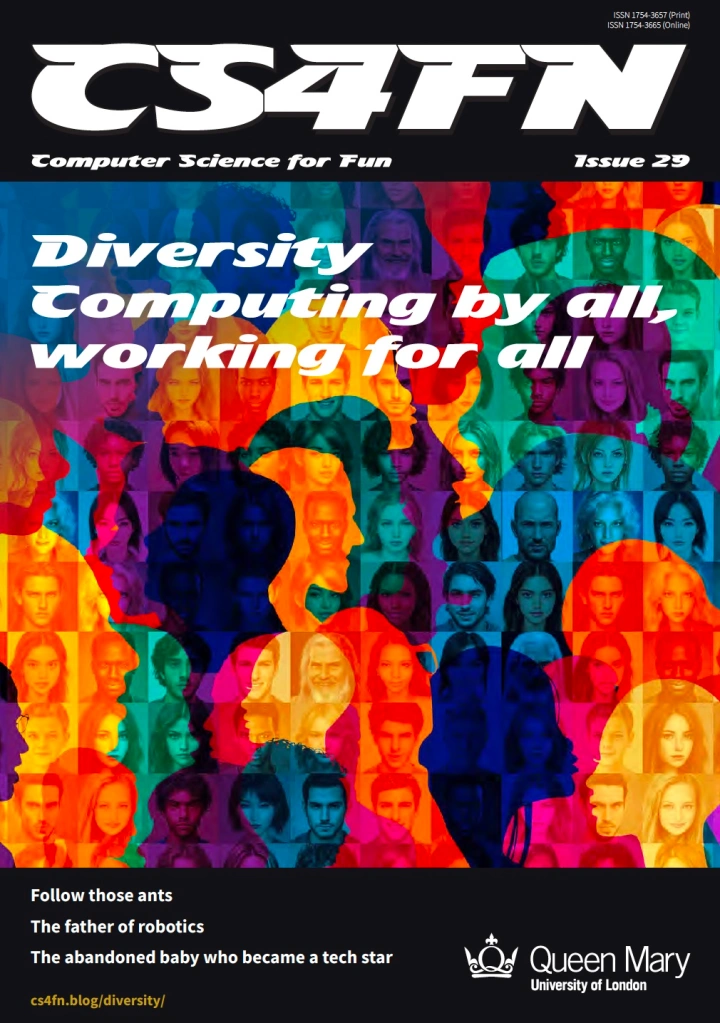
Front cover of CS4FN issue 29 - Diversity in Computing

Our Books …


Subscribe to be notified whenever we publish a new post to the CS4FN blog.


This page and talk are funded by EPSRC on research agreement EP/W033615/1.

Maria Kirch: human computer of the 1600s and 1700s

Maria Kirch was a very early female human computer. Working in the late 1600s into the early 1700s, with her husband, she created astronomical tables that while mainly used for astrological purposes were also useful for navigation. They computed the future times of sunrises, the phases of the moon, the positions of planets, eclipses and the like for calendars. This was part of his job as astronomer for the Royal Academy of Sciences in Berlin. Along the way she became the first woman to discover a comet. When her husband died, she asked to take over his job – it was common for widows to take over a family business in this way. Having done the work with her husband she was of course eminently qualified. However, she was refused, despite having support from the great mathematician and scientist, Gottfried Leibnitz. A less qualified man was given the job instead. She did continue her work, however, doing astronomical observations and calculations almost to her death in 1720

Phases of the moon
Image by Sergio Serjão from Pixabay

20th century human computers (working for NASA, for example) moved on to become programmers once they were invented so capable of doing the actual calculations, However, no computers existed in the 1600s and 1700s. If they had perhaps Maria would have naturally become a programmer, too, coding the computations needed to take over her work. She certainly had the skills. Charles Babbage who also worked as a human computer a century or so later computing similar tables for shipping navigation, went on to try to create a mechanical computer to do the job for him. Mathematician Ada Lovelace, of course, then became interested in writing algorithms for it and is sometimes called “the first programmer”. In fact, Kirch’s supporter, Leibnitz, did actually design a computer. It worked using a Binary system of marble runs. However, it was really only a thought experiment and he did not, as far as we know, attempt to build it. He did create mechanical calculators including the first massed produced one. They would have helped take some of the tedium of this kind of calculation, but they were not programmable. If only he had built his computer maybe Maria Kirch would have become the first programmer…

by Paul Curzon, Queen Mary University of London

More on …

Magazines …

Front cover of CS4FN issue 29 - Diversity in Computing

Our Books …


Subscribe to be notified whenever we publish a new post to the CS4FN blog.


This page and talk are funded by EPSRC on research agreement EP/W033615/1.

Double or nothing: an extra copy of your software, just in case

by Paul Curzon, Queen Mary University of London

Ariane 5 on the launchpad
Ariane 5 on the launch pad. Photo Credit: (NASA/Chris Gunn) Public Domain via Wikimedia Commons.

If you spent billions of dollars on a gadget you’d probably like it to last more than a minute before it blows up. That’s what happened to a European Space Agency rocket. How do you make sure the worst doesn’t happen to you? How do you make machines reliable?

A powerful way to improve reliability is to use redundancy: double things up. A plane with four engines can keep flying if one fails. Worried about a flat tyre? You carry a spare in the boot. These situations are about making physical parts reliable. Most machines are a combination of hardware and software though. What about software redundancy?

You can have spare copies of software too. Rather than a single version of a program you can have several copies running on different machines. If one program goes wrong another can take over. It would be nice if it was that simple, but software is different to hardware. Two identical programs will fail in the same way at the same time: they are both following the same instructions so if one goes wrong the other will too. That was vividly shown by the maiden flight of the Ariane 5 rocket. Less than 40 seconds from launch things went wrong. The problem was to do with a big number that needed 64 bits of storage space to hold it. The program’s instructions moved it to a storage place with only 16 bits. With not enough space, the number was mangled to fit. That led to calculations by its guidance system going wrong. The rocket veered off course and exploded. The program was duplicated, but both versions were the same so both agreed on the same wrong answers. Seven billion dollars went up in smoke.

Can you get round this? One solution is to get different teams to write programs to do the same thing. The separate teams may make mistakes but surely they won’t all get the same thing wrong! Run them on different machines and let them vote on what to do. Then as long as more than half agree on the right answer the system as a whole will do the right thing. That’s the theory anyway. Unfortunately in practice it doesn’t always work. Nancy Leveson, an expert in software safety from MIT, ran an experiment where different programmers were given programs to write. She found they wrote code that gave the same wrong answers. Even if it had used independently written redundant code it’s still possible Ariane 5 would have exploded.

Redundancy is a big help but it can’t guarantee software works correctly. When designing systems to be highly reliable you have to assume things will still go wrong. You must still have ways to check for problems and to deal with them so that a mistake (whether by human or machine) won’t turn into a disaster.


Related Magazine …


Further reading


Subscribe to be notified whenever we publish a new post to the CS4FN blog.


This page is funded by EPSRC on research agreement EP/W033615/1.

QMUL CS4FN EPSRC logos

Even the dolphins use pocket switched networks!

(from the archive)

Dolphin leaping in waves off Panama City
Image by Heather Williams from Pixabay

Email, texting, Instant Messaging, Instant response…one of the things about modern telecoms is that they fuel our desire to “talk” to people anytime, anywhere, instantly. The old kind of mail is dismissed as “snail mail”. A slow network is a frustrating network. So why would anyone be remotely interested in doing research into slow networks? Surprisingly, slow networks deserve study. Professor Jon Crowcroft of the University of Cambridge and his team were early researchers of this area, and this kind of network could be the network of the future. The idea is already being used by the dolphins (not so surprising I suppose given according to Douglas Adams’ “The HitchHiker’s Guide to the Galaxy” they are the second most intelligent species on Earth…after the mice).

From node to node

Traditional networks rely on having lots of fixed network “nodes” with lots of fast links between them. These network nodes are just the computers that pass on the messages from one to the other until the messages reach their destinations. If one computer in the network fails, it doesn’t matter too much because there are enough connections for the messages to be sent a different way.

There are some situations where it is impractical to set up a network like this though: in outer space for example. The distances are so far that messages will take a long time – even light can only go so fast! Places like the Arctic Circle are another problem: vast areas with few people. Similarly, it’s a problem under the sea. Signals don’t carry very well through water so messages, if they arrive at all, can be muddled. After major disasters like Hurricane Katrina or a Tsunami there are also likely to be problems.

It is because of situations like these that computer scientists started thinking about “DNTs”. The acronym can mean several similar things: Delay Tolerant Networks (like in space the network needs to cope with everything being slow), Disruption Tolerant Networks (like in the deep sea where the links may come and go) or Disaster tolerant networks (like a Tsunami where lots of the network goes down at once). To design networks that work well in these situations you need to think in a different way. When you also take into account that computers have gone mobile – they no longer just sit on desks but are in our pockets or handbags, this leads to the idea of a “ferrying network” or as Jon Crowcroft calls them: “Pocket Switched Network”. The idea is to use the moving pocket computers to make up a completely new kind of network, where some of the time messages move around because the computers carrying them are moving themselves, not because the message itself is moving. As they move around they pass near other computers and can exchange messages, carrying a message on for someone else until it is near another computer it can jump to.

From Skidoo to you

A skiddo with driver standing next to it
Image by raul olave from Pixabay

How might such networks be useful in reality? Well one was set up for the reindeer farmers in the Arctic Circle. They roam vast icy wastelands on skidoos, following their reindeer. They are very isolated. There are no cell phone masts or internet nodes and for long periods they do not meet other people at all. The area is also too large to set up a traditional network cheaply. How could they communicate with others?

They set up a form of pocket switched network. Each carried a laptop on their skidoo. A series of computers were also set up sitting in tarns spread around the icy landscape. When the reindeer farmers using the network want a service, like delivering a message, the laptop stores the request until they pass within range of one of the other computers perhaps on someone else’s skidoo. The computer then automatically passes the message on. The new laptop takes the message with it and might later pass a tarn, where the message hops again then waits till someone else passes by heading in the right direction. Eventually it makes a hop to a computer that passes within range of a network point connected to the Internet. It may take a while but the mail eventually gets through – and much faster than waiting for the farmer to be back in net contact directly.

Chatting with Dolphins

Even the dolphins got in on the act. US scientists wanted to monitor coastal water quality. They hit on the idea of strapping sensors onto dolphins that measure the quality wherever they go. Only problem is dolphins spend a lot of time in deep ocean where the results can’t easily be sent back. The solution? Give them a normal (well dolphin adapted) cell phone. Their phone stores the results until it is in range of their service provider off the coast. By putting a receiver in the bays the dolphins return to most frequently, they can call home to pass on the data whenever there.

The researchers encountered an unexpected problem though. The dolphin’s memory cards kept inexplicably filling up. Eventually they realised this was because the dolphins kept taking trips across the Atlantic where they came in range of the European cell networks. The European telecom companies, being a friendly bunch, sent lots of text messages welcoming these newly appeared phones to their network. The memory cards were being clogged up with “Hellos”!

The Cambridge team investigated how similar networks might best be set up and used for people on the move, even in busy urban environments. To this end they designed a pocket switched network called Haggle. Using networks like Haggle, it is possible to have peer-to-peer style networks that side-step the commercial networks. If enough people join in then messages can just hop from phone to phone, using bluetooth links say, as they passed near each other. They might eventually get to the destination without using any long distance carriers at all.

The more the merrier

With a normal network, as more people join the network it clogs up as they all try to use the same links to send messages at the same time. Some fundamental theoretical results have shown that with a pocket switched network, the capacity of the network can actually go up as more people join – because of the way the movement of the people constantly make new links.

Pocket switched networks are a bit like gases – the nodes of the network are like gas molecules constantly moving around. A traditional network is like a solid – all the molecules, and so nodes, are stationary. As more people join a gaseous network it becomes more like a liquid, with nodes still moving but bumping into other nodes more often. The Cambridge team explored the benefits of networks that can automatically adapt in this way to fit the circumstances: making phase transitions just like water boiling or freezing.

One of the important things to understand to design such a network is how people pass others during a typical day. Are all people the same when it comes to how many people they meet in a day? Or are there some people that are much more valuable as carriers of messages. If so those are the people the messages need to get to to get to the destination the fastest!

To get some hard data Jon and his students handed out phones. In one study a student handed out adapted phones at random on a Hong Kong street, asking that they be returned a fixed time later. The phones recorded how often they “met” each other before being returned. In another similar experiment the phones were given out to a large number of Cambridge students to track their interactions. This and other research shows that to make a pocket switched network work well, there are some special people you need to get the messages to! Some people meet the same people over and over, and very few others. They are “cliquey” people. Other more “special” people regularly cross between cliques – the ideal people to take messages across groups. Social Anthropology results suggest there are also some unusual people who rather than just networking with a few people, have thousands of contacts. Again those people would become important message carriers.

So the dolphins may have been the “early adopters” of pocket switched networks but humans may follow. If we were to fully adopt them it could completely change the way the telecom industry works…and if we (or the dolphins) ever do decide to head en-mass for the far reaches of the solar system, pocket switched networks like Haggle will really come into their own.

– Paul Curzon, QMUL, based on a talk given by Jon Crowcroft at Queen Mary in Jan 2007.

More on …


Subscribe to be notified whenever we publish a new post to the CS4FN blog.


This blog is funded through EPSRC grant EP/W033615/1.

NASA’s interstellar probe Voyager 1 went silent until computer scientists transmitted a fix that had to travel 15 billion miles!

by Jo Brodie, Queen Mary University of London

In 1977 NASA scientists at the Jet Propulsion Laboratory launched the interstellar probe Voyager 1 into space – and it just keeps going. It has now travelled 15 BILLION miles (24 billion kilometres), which is the furthest any human-made thing has ever travelled from Earth. It communicates with us here on Earth via radiowaves which can easily cross that massive distance between us. But even travelling at the speed* of light (all radiowaves travel at that speed) each radio transmission takes 22.5 hours, so if NASA scientists send a command they have to wait nearly two days for a response. (The Sun is ‘only’ 93 million miles away from Earth and its light takes about 8 minutes to reach us.)

FDS – The Flight Data System

The Voyager 1 probe has sensors to detect things like temperature or changes in magnetic fields, a camera to take pictures and a transmitter to send all this data back to the scientists on Earth. One of its three onboard computers (the Flight Data System, or FDS) takes that data, packages it up and transmits it as a stream of 1s and 0s to the waiting scientists back home who decode it. Voyager 1 is where it is because NASA wanted to send a probe out beyond the limits of our Solar System, into ‘interstellar space’ far away from the influence of our Sun to see what the environment is like there. It regularly sends back data updates which include information about its own health (how well its batteries are doing etc) along with the scientific data, packaged together into that radio transmission. NASA can also send up commands to its onboard computers too. Computers that were built in 1977!

The pale blue dot

‘The Pale Blue Dot’. In the thicker apricot-coloured band on the right you might be able to see
a tiny dot about halfway down. That’s the Earth! Full details of this famous 1990 photo here.

Although its camera is no longer working its most famous photograph is this one, the Pale Blue Dot, a snapshot of every single person alive on the 14th of February 1990. However as Voyager 1 was 6 billion miles from home by then when it looked back at the Earth to take that photograph you might have some difficulty in spotting anyone! But they’re somewhere in there, inside that single pixel (actually less than a pixel!) which is our home.

As Voyager 1 moved further and further away from our own planet, visiting Jupiter and Saturn before travelling to our outer Solar System and then beyond, the probe continued to send data and receive commands from Earth. 

The messages stopped making sense

All was going well, with the scientists and Voyager 1 ‘talking’ to one another, until November 2023 when the binary 1s and 0s it normally transmitted no longer had any meaningful pattern to them, it was gibberish. The scientists knew Voyager 1 was still ‘alive’ as it was able to send that signal but they didn’t know why its signal no longer made any sense. Given that the probe is nearly 50 years old and operating in a pretty harsh environment people wondered if that was the natural end of the project, but they were determined to try and re-establish normal contact with the probe if they could. 

Searching for a solution

They pored over almost-50 year old paper instruction manuals and blueprints to try and work out what was wrong and it seemed that the problem lay in the FDS. Any scientific data being collected was not being correctly stored in the ‘parcel’ that was transmitted back to Earth, and so was lost – Voyager 1 was sending empty boxes. At that distance it’s too far to send an engineer up to switch it off and on again so instead they sent a command to try and restart things. The next message from Voyager 1 was a different string of 1s and 0s. Not quite the normal data they were hoping for, but also not entirely gibberish. A NASA scientist decoded it and found that Voyager 1 had sent a readout of the FDS’ memory. That told them where the problem was and that a damaged chip meant that part of its memory couldn’t be properly accessed. They had to move the memory from the damaged chip.

That’s easier said than done. There’s not much available space as the computers can only store 68 kilobytes of data in total (absolutely tiny compared to today’s computers and devices). There wasn’t one single place where NASA scientists could move the memory as a single block, instead they had to break it up into pieces and store it in different places. In order to do that they had to rewrite some of the code so that each separated piece contained information about how to find the next piece. Imagine if a library didn’t keep a record of where each book was, it would make it very hard to find and read the sequel! 

Earlier this year NASA sent up a new command to Voyager 1, giving it instructions on how to move a portion of its memory from the damaged area to its new home(s) and waited to hear back. Two days later they got a response. It had worked! They were now receiving sensible data from the probe.  

Voyager team celebrates engineering data return, 20 April 2024 (NASA/JPL-Caltech). “Shown are Voyager team members Kareem Badaruddin, Joey Jefferson, Jeff Mellstrom, Nshan Kazaryan, Todd Barber, Dave Cummings, Jennifer Herman, Suzanne Dodd, Armen Arslanian, Lu Yang, Linda Spilker, Bruce Waggoner, Sun Matsumoto, and Jim Donaldson.”

For a while they it was just basic ‘engineering data’ (about the probe’s status) but they knew their method worked and didn’t harm the distant traveller. They also knew they’d need to do a bit more work to get Voyager 1 to move more memory around in order for the probe to start sending back useful scientific data, and…

Success!

… …in May, NASA announced that scientific data from two of Voyager 1’s instruments was finally being sent back to Earth and in June the probe was fully operational. You can follow Voyager 1’s updates on Twitter / X via @NASAVoyager.

Did you know?

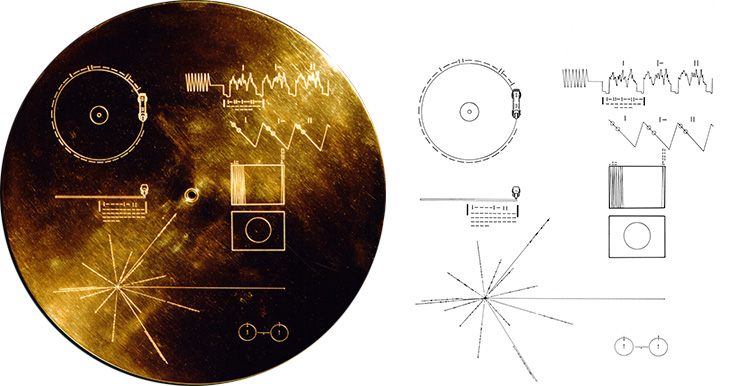
Both Voyager 1 and Voyager 2 carry with them a gold-plated record called ‘The Sounds of Earth‘ containing “sounds and images selected to portray the diversity of life and culture on Earth”. Hopefully any aliens encountering it will have a record player (but the Voyager craft do carry a spare needle!) Credit: NASA/JPL

References

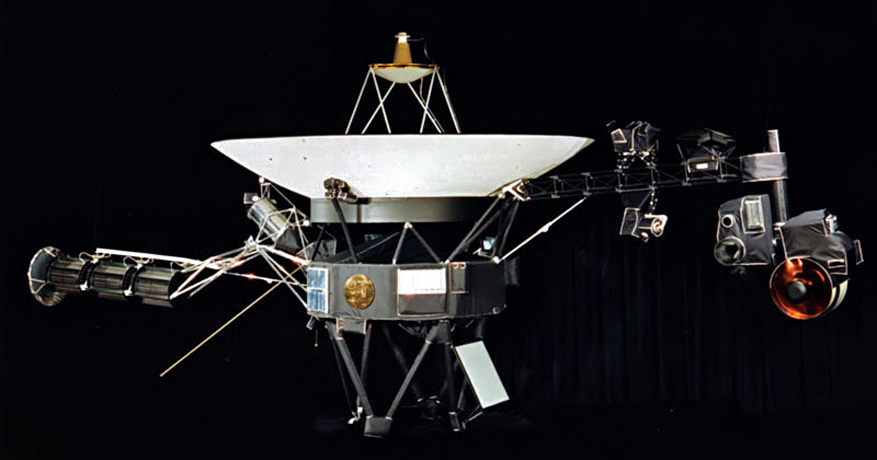
Lots of articles helped in the writing of this one and you can download a PDF of them here. Featured image credit showing the Voyager spacecraft: NASA/JPL.

*radiowaves and light are part of the electromagnetic or ‘EM’ spectrum along with microwaves, gamma rays, X-rays, ultraviolet and infra red. All these waves travel at the same speed in a vacuum, the speed of light (300,000,000 metres per second, sometimes written as 3 x 10⁸ m/s or (m s-1)), but the waves differ by their frequency and wavelength.


Subscribe to be notified whenever we publish a new post to the CS4FN blog.


EPSRC supports this blog through research grant EP/W033615/1.

In space no one can hear you …

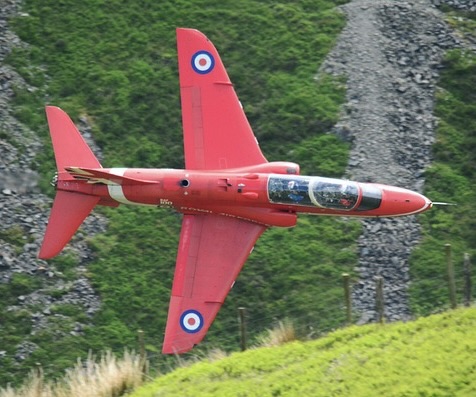
Red arrows aircraft flying close to the ground.
Image by Bruno Albino from Pixabay 

Johanna Lucht could do maths before she learned language. Why? Because she was born deaf and there was little support for deaf people where she lived. Despite, or perhaps because of, that she became a computer scientist and works for NASA. 

Being deaf can be very, very disabling if you don’t get the right help. As a child, Johanna had no one to help her to communicate apart from her mother. She tried to teach Johanna sign language from a book. Throughout most of her primary school years she couldn’t have any real conversations with anyone, never mind learn. She got the lifeline she needed, when the school finally took on an interpreter, Keith Wann, to help her. She quickly learned American Sign Language working with him. Learning your first language is crucial to learning other things and suddenly she was able to learn in school like other children. She caught up remarkably quickly, showing that an intelligent girl had been locked in that silent, shy child. More than anything though, from Keith, she learned never to give up. 

Her early ability in maths, now her favourite subject, came to the fore as she excelled at science and technology. By this point her family had moved from Germany where she grew up to Alaska where there was much more support, an active deaf community for her to join and lots more opportunities that she started to take. She signed up for a special summer school on computing specifically for deaf people at the University of Washington, learning the programming skills that became the foundation for her future career at NASA. At only 17 she even returned to help teach the course. From there, she signed up to do Computer Science at university and applied for an internship at NASA. To her shock and delight she was given a place. 

Hitting the ground running 

A big problem for pilots especially of fighter aircraft is that of “controlled flight into terrain”: a technical sounding phrase that just means flying the plane into the ground for no good reason other than how difficult flying a fighter aircraft as low as possible in hazardous terrain is. The solution is a ground collision avoidance system: basically the pilots need a computer to warn them when hazardous terrain is coming up and when they are too close for comfort, and so should take evasive action. Johanna helped work on the interface design, so the part that pilots see and interact with. To be of any use in such high-pressure situations this communication has to be slick and very clear. 

She impressed those she was working with so much that she was offered a full time job and so became an engineer at NASA Armstrong working with a team designing, testing and integrating new research technology into experimental aircraft. She had to run tests with other technicians, the first problem being how to communicate effectively with the rest of the team. She succeeded twice as fast as her bosses expected, taking only a couple of days before the team were all working well together. Her experience from the challenges she had faced as a child were now providing her with the skills to do brilliantly in a job where teamwork and communication skills are vital. 

Mission control 

Eventually, she gained a place in Mission Control. There, slick comms are vital too. The engineers have to monitor the flight including all the communication as it happens, and be able to react to any developing situation. Johanna worked with an interpreter who listened directly to all the flight communications, signing it all for her to see on a second monitor. Working with interpreters in a situation like this is in itself a difficult task and Johanna had to make sure not only that they could communicate effectively but that the interpreter knew all the technical language that might come up in the flight. Johanna had plenty of experience dealing with issues like that though, and they worked together well, with the result that in April 2017 Johanna became the first deaf person to work in NASA mission control on a live mission … where of course she did not just survive the job, she excelled. 

As Johanna has pointed out it is not deafness itself that disables people, but the world deaf people live in that does. When in a world that wasn’t set up for deaf people, she struggled, but as soon as she started to get the basic help she needed that all changed. Change the environment to one that does not put up obstacles and deaf people can excel like anyone else. In space no one can hear anyone scream or for that matter speak. We don’t let it stop our space missions though. We just invent appropriate technology and make the problems go away. 

– Paul Curzon, Queen Mary University of London

More on …

Read more about Johanna Lucht:

Related Magazines …

Subscribe to be notified whenever we publish a new post to the CS4FN blog.


This page is funded by EPSRC on research agreement EP/W033615/1.

QMUL CS4FN EPSRC logos

Hidden Figures: NASA’s brilliant calculators

Full Moon with a blue filter
Full Moon image by PIRO from Pixabay

NASA Langley was the birthplace of the U.S. space program where astronauts like Neil Armstrong learned to land on the moon. Everyone knows the names of astronauts, but behind the scenes a group of African-American women were vital to the space program: Katherine Johnson, Mary Jackson and Dorothy Vaughan. Before electronic computers were invented ‘computers’ were just people who did calculations and that’s where they started out, as part of a segregated team of mathematicians. Dorothy Vaughan became the first African-American woman to supervise staff there and helped make the transition from human to electronic computers by teaching herself and her staff how to program in the early programming language, FORTRAN.

The women switched from being the computers to programming them. These hidden women helped put the first American, John Glenn, in orbit, and over many years worked on calculations like the trajectories of spacecraft and their launch windows (the small period of time when a rocket must be launched if it is to get to its target). These complex calculations had to be correct. If they got them wrong, the mistakes could ruin a mission, putting the lives of the astronauts at risk. Get them right, as they did, and the result was a giant leap for humankind.

See the film ‘Hidden Figures’ for more of their story (trailer below).

– Paul Curzon, Queen Mary University of London

from the archive

More on …

Magazines …

Front cover of CS4FN issue 29 - Diversity in Computing

See more in ‘Celebrating Diversity in Computing

We have free posters to download and some information about the different people who’ve helped make modern computing what it is today.

Screenshot showing the vibrant blue posters on the left and the muted sepia-toned posters on the right

Or click here: Celebrating diversity in computing

Subscribe to be notified whenever we publish a new post to the CS4FN blog.


This page is funded by EPSRC on research agreement EP/W033615/1.

QMUL CS4FN EPSRC logos