Ada (the language), is not the big player on the programming block these days. In 1997 the DoD1 cancelled their rule that you had to use Ada when working for them. Developers in commerce had always found Ada hard to work with and often preferred other languages. There are hundreds of other languages used in industry and by researchers. How many can you name?
Here are some fun clues about different languages. Can you work out their names? (Answers at the end.)
A big snake that will squash you dead.
A famous Victorian woman who worked with Babbage.
A, B, __
A, B, __ (ouch)
A precious, but misspelled, thing inside a shell.
A tiny person chatting.
A beautiful Indonesian island.
A french mathematician and inventor famous for triangles.
Today, the most popular programming languages are, well we don’t know, because it depends when you are reading this! Because what is fashionable, what is new is always changing. Plus it’s hard to agree what ‘the most popular’ means for languages (and pop stars!). Is it the most lines of code in use today? The favorite language of developers? The language everyone is learning? In July 2015 one particular website rated programing languages using features such as number of skilled software engineers who can use the language; number of courses to learn the language; search engine queries on the language and came up with the order.
1) Java
2) C
3) C++
4) C#
5) Python
Where is Ada? 30th out of 100s! The same website had shown Ada (the language) as 3rd top in 1985! What a fall from grace.
But have no fear, Ada still survives and lives on in millions of lines of avionics2, radar systems, space, shipboard, train, subway, nuclear reactors and DoD systems. Plus Ada is perhaps making a comeback. Ada 2012 is just being finalised, heralded by some as the next generation of engineering software with its emphasis on safety, security and reliability. So Ada meet Ada, it looks like you will be remembered and used for a long time still.
Github is a place where lots of programmers now develop and save their code. It encourages programmers to share their work. A kind of modern day, crowd sourced ‘mass of shared facts’ but coders would probably not say they did this just to ‘amuse their idle hours’. Popular coding tools on this platform are JavaScript. Java, Python, CSS, PHP, Ruby, C++. Ada doesn’t really feature, well not yet.
Image by Paul Curzon taken at Tate Modern London at Olafur Eliasson’s “The cubic structural evolution project” exhibition, 2019.
My absolute favourite example of interactive art is Olafur Eliasson‘s “The cubic structural evolution project” back in 2019 at Tate Modern. It was “just” two piles of standard white Lego bricks piled on two tables (but a tonne of Lego between the two …so a LOT of Lego). Anyone visiting the exhibit was invited to sit down and help create a city by building a building … and it was joyfully creative. Kids and adults mixed together building great architectural wonders, big and small, out of the bricks. Sometimes intentionally, but often accidentally, an existing building was demolished, but that was just an opportunity for new amazing buildings to emerge from the rubble. We visited twice that summer, and each time a totally different city was there that had emerged from this constant evolution of building. On each visit we built something new ourselves to add to the ever changing city.
The exhibit took Lego back to its roots – no instructions, no specific creation to reproduce, just the bare building blocks of creativity. You can still buy generic lego sets of course (if not with the same scope as a tonne of bricks). However, the high profile modern Lego sets are now used to build a specific thing designed by someone else, like a Star Wars Tie fighter, a Death Star, a Ferrari, a parrot or perhaps Notre Dame. This is one form of creativity – you are definitely creating something, and doing so gives you an amazing feeling of accomplishment and well-being. I strongly recommend it and of doing similar activities whether doing a tapestry, or building a jigsaw, or … It is good for your happiness and mental health more generally. But you are creating just by following instructions. In computer science terms, you are acting as a computational agent, following an algorithm that if followed precisely guarantees the same result every time (an exact copy of the lighthouse on the box perhaps…). A computer (with a suitably good robotic arm and vision system) could do it. That is the point of algorithms! They take no thought just an ability to follow instructions precisely: the thing computers are good at.
There is another sense we mean when we talk about creativity though and that was the original Lego idea. You have the bricks. You can build anything. It is down to you. Create something new! According to an exhibition on the history of play I went to early construction kits like the original Lego inspired a whole generation of architects to do completely new things with buildings (if you know your architecture think especially Frank Lloyd Wright whose mother bought him educational blocks called the Froebel Gifts, or perhaps Denys Lasdun – I lived in one of his “Lasdun building” block like buildings for a year in my younger days).
This kind of pure creativity is what being a programmer is about. Not just following instructions to create someone else’s creation, but creating your own totally novel, wondrous things from simple building blocks (and you don’t have to be part of the Lego design team to do it either). That is the lesson that collaboratively emerged in Olafur Eliasson’s exhibit over and over again. Just as the inventor of Lego, Ole Kirk Christiansen, in creating the toy went to yet another level of creativity in doing so, Olafur Eliasson did so to in creating the exhibition. They both created the opportunities for others to be creative.
Programming languages are very much like Lego in this sense. They just provide the building blocks to create any program you want. Learn how to use them and you you can do anything if you have the imagination as well as having built the skill. The different constructs are like different kinds of Lego bricks. Put them together in different ways and you create different things. You can stick with the basics and still build amazing creations even without learning about all the libraries methods that act like specialist bricks designed for specialist purposes. And of course the early Computer Scientists who invented the idea of programming languages were being creative in the way Ole Kirk Christiansen and Olafur Eliasson were, creating the possibility for others. Creating possibilities for you.
The Arts are about pure creativity but so is Computer Science…(and when they are brought together by creative people even more amazing things can be created (by everyone).
Programming languages have lots of control structures, like if-statements and while loops, case-statements and for loops, method call and return, … but a famous research result in theoretical computer science (now called the structured program theorem) says you can do everything that it is possible to do with only three. All those alternatives are just for convenience. All you need is one way each to do sequence; one way to do selection, and one way to do iteration. If you have those you can build the structure needed to do any computation. In particular, you do not need a goto statement! We can explore what that means by just thinking about instructions to build Lego.
What do we mean by a control structure? Just some mechanism to decide the order that instructions must be done for an algorithm to work. Part of what makes a set of instructions an algorithm is that the order of instructions are precisely specified. Follow the instructions in the right order and the algorithm is guaranteed to work.
Goto
First of all, Lego instructions are designed to be really clear and easy to follow. The nice folk at Lego want anyone to be able to follow them, even a small child and manage to accurately build exactly the model shown on the box.
What they do not make use of is a Goto instruction, an arbitrary jump to another place, where you are told, for example, to move to Page 14 for the next instruction. That kind of jump from place to place is reserved for Fighting Fantasy Adventure Books, where you choose the path through the story. They jump you about precisely because the aim is for you to be lost in the myriad of potential stories that are possible. You just don’t do that if you want instructions to be easy to follow.
The structured program theorem provided the ammunition for arguing that goto should not be used in programming and instead structured programming (hence the theorem’s name) should be used instead. All it actually does is show it is not needed though, not that its use is worse, though the argument was eventually won, with some exceptions. For programs to be human-readable and maintainable it is best that they use forms of structured programming, and avoid the spaghetti programming structures that goto leads to..
Sequencing
The main kind of control structure in a booklet of Lego instructions is instead sequencing. Instructions follow one after the other. This is indicated by the pages of the booklet. On each page though the instructions are split into boxes that are numbered. The boxes and numbers are the essential part of the control structure. You build the Lego model in the order of the numbered boxes. The numbering provides a sequencing control structure. Programming languages usually just use the order of instructions down a page to indicate sequencing, sometimes separated by punctuation (like a semi-colon), though early languages used this kind of numbering. The point is the same, however it is done, it is just a mechanism to make clear the order that the instructions are followed one after another, i.e., sequencing.
Parallelism and time-slicing
However, with lego there is another control structure within those boxes that is not quite sequencing. Each box normally has multiple pieces to place with the position of each shown. The lego algorithm isn’t specifying the order those pieces are placed (any order will do). This is a kind of non-deterministic sequencing control structure. It is similar to a parallelism control structure in programming languages, as if you like building your Lego model together with others, then a different person could choose each piece and all place the piece together (parallelism). Alternatively, they could place the pieces one after the other in some random order (time-slicing) and always end up with the same final result once the box is completed.
Is this necessary though? The structured program theorem says not, and in this case it is relatively easy to see that it isn’t. The people writing the instruction booklet could have decided an order themselves and enforced it. Which order they chose wouldn’t matter. Any Lego instruction booklet could be converted to one using only sequencing without parallelism or time-slicing.
Iteration
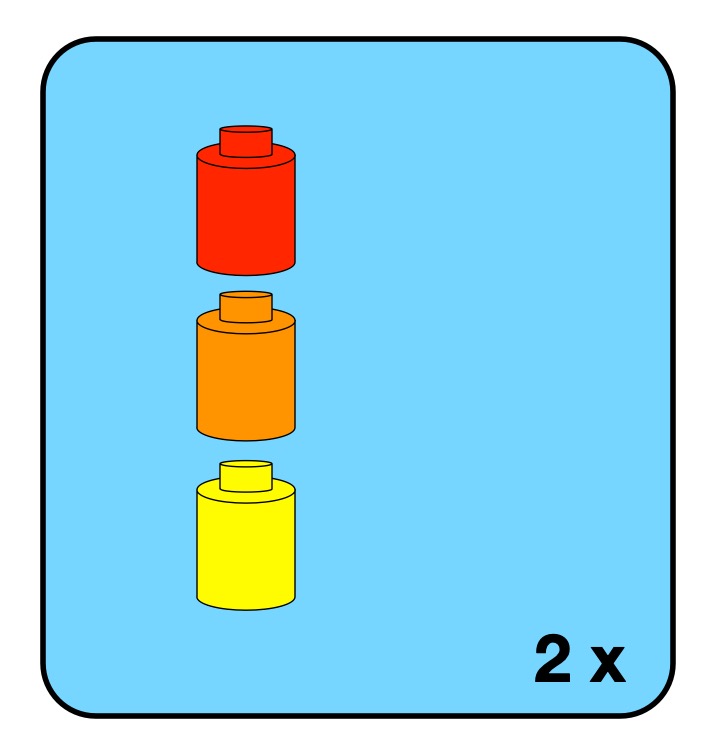
Image by CS4FN after Lego instruction iteration
Iteration is just a way to repeat instructions or sub-programs. Lego instructions have a simplified form of repetition which is the equivalent of a simple for loop in programming. It just says that a particular box of instructions should be followed a fixed number of times (like 3 x meaning make this lego sub-build three times). With only this way of doing iteration lego instructions are not a totally general form of computation. There are algorithms that can’t be specified in Lego instructions. To be good enough to play the full role in the theorem, the iteration control structure has to have the capability to be unbounded. The decision to continue or not is made at the end of each iteration, You follow the instructions once, then decide if they should be followed again (and keep doing that). Having such a control structure would mean that at the point when you started to build the lego construct to be repeated, you would not necessarily know how many times that Lego construct was to be built. It’s possible to imagine Lego builds like this. For example, you might be building a fairytale castle made of modular turreted towers, where you can keep deciding whether to build another tower after each new tower is completed. until the castle is big enough. That would be an unbounded loop. An issue with unbounded loops is they could never terminate…you could be eternally damned to build Lego towers to eternity!
Selection
The final kind of control structure needed is selection. Selection involves having a choice of what instruction or subprogram to do next. This allows an algorithm to do different things depending on data input or the results of computation. As most lego sets involve building one specific thing, there isn’t much use of selection in Lego booklets.
However, some lego sets do have a simple form of selection. There are “3 in 1” sets where you can, for example, choose to make one of three animals by choosing one of three instruction booklets to follow at the start.
To be fully computationally general there would need to be choice possible at any point, in the way repetition can appear at any point in the booklet. It would need to be possible for any instruction or block of instructions to be prefigured by a test of whether they should be followed or not, with that test and arbitrary true/false question.
Again, such a thing is conceivable if more complex Lego builds were wanted. Building a fairytale castle you might include options to choose to build different kinds of turret on top of the towers, or choose different colours of bricks to make rainbow towers, or… If this kind of totally general choice was provided then no other kind of selection control structure would be needed. Having such instructions would provide a level of creativity between those of fixed sets to build one thing and the origianl idea of Lego as just blocks you could build anything from (the sets would need more bricks though!)
Sequence, Selection and Iteration is enough (but only if powerful enough)
So Lego instruction booklets do include the three kinds of control structure needed of sequence, selection and iteration. However, the versions used are not actually general enough for the structured control theorem to apply. Lego instructions with the control structures discussed are not powerful enough to be computationally complete, and describe all possible algorithms. More general forms are needed than found in normal Lego instructions to do that. In particular, a more general version of iteration is needed, as well as a verion of selection that can be used anywhere, and that includes a general purpose test. All programming languages have some powerful version of all three control structures. If they did not they could not be used as general purpose languages. There would be algorithms that could not be implemented in the language.
Just like programming languages, Lego instructions also use an extra kind of control structures that is not actually needed, It is there just for convenience, just like programming languages have lots of extra control structures just for convenience too.
Sadly then, Lego instructions, as found in the normal instruction booklets are not as general as a programming language. They do still provide a similar amount of fun though. Now, I must get back to building Notre Dame.
Computer Scientists talk about “Syntactic Sugar” when talking about programming languages. But in what way might a program be made sweet? It is all about how necessary a feature of a language is, and the idea and phrase was invented by Computer Scientist and gay activist, Peter Landin. He realised it made it easier to define the meaning of languages in logic and made the definitions more elegant.
Peter Landin was involved in the development of several early and influential programming languages but also a pioneer of the use of logic to define exactly what each construct of a programming language did: the language’s “semantics”. He realised there was a fundamental difference between different parts of a language. Some were absolutely fundamental to the language. If you removed them then programs would have to be written in a different way, if at all, as a result. Remove the assignment construct that allows a program to change the value of variables, for example, and there are things your programs can no longer do, or at least it would need to do it in very different way. Remove the feature that allows someone to write i++ instead of i = i + 1, on the other hand, and nothing much changes about how you write code. They were just abbreviations for common uses of the more core things.
As another example, suppose you didn’t like using curly brackets to start and end blocks of code (perhaps having learnt to program using Pascal) then if programming in C or Java you could add a layer of syntactic sugar by replacing { by BEGIN and } by END. Your programs might look different and make you feel happier, but were not really any different.
Peter called these kinds of abbreviations “syntactic sugar”. They were superficial, just there to make the syntax (the way things were written at the level of spelling and punctuation) a little bit nicer for the programmers: sometimes more readable, sometimes just needing less typing.
It is now recognised, of course, that writing readable code is a critically important part of programming. Code has to be maintainable: easily understood and modified by others long after it was written. Well thought out syntactic sugar can help with this as well as making it easier to avoid mistakes when writing code in the first place. For example, syntactic sugar is used in many languages to give special syntax to core datatypes, where they are called sugared types. Common example include using quotes to represent a String value like “abc” or square brackets like [1,2,3] to stand for an array value, rather than writing out the underpinning function calls of the core language to construct a value.
People now sometimes deride the idea of syntactic sugar, but it had a clear use for Peter beyond just readability. He was interested in logically defining languages: saying in logic exactly what each construct meant. The syntactic sugar distinction made his life doing that easier. The fundamental things were the things that he had to define directly in logic. He had to work out exactly what the semantics of each was and how to say what they meant mathematically. Syntactic sugar could be defined just by adding rewrite rules that convert the syntactic sugar to the core syntax. i++, for example does not need to be defined logically, just converted to i = i + 1 to give its meaning. If assignment was defined in terms of logic then the abbreviation is ultimately too as a result.
Peter discussed this in relation to treating a kind of logic called the lambda calculus as the basis for a language. Lambda Calculus is a logic based on functions. Everything consists of lambda expressions, though he was looking at a version which included arithmetic too. For example, in this logic, the expression:
(λn.2+n)
defines a function that takes a value n and returns the value resulting from adding 2 to that value. Then the expression:
(λn.2+n) [5]
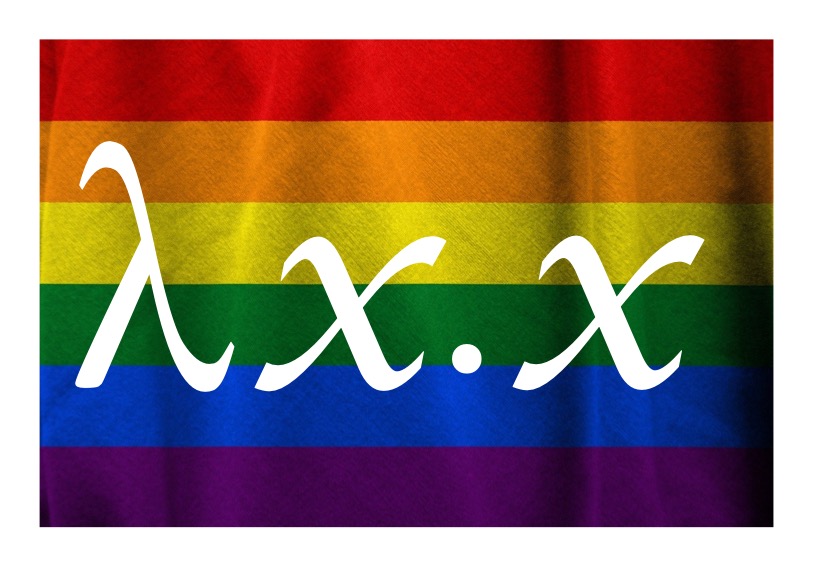
applies that function to the value 5, meaning 5 is substituted for the n that comes after the lambda, so it simplifies to 2+5 or further to 7. Lambda expressions, therefore, have a direct equivalence to function call in a programming language. The lambda calculus has a very simple and precise mathematical meaning too, in that any expression is just simplified by substituting values for variables as we did to get the answer 7 above. It could be used as a programming language in itself. Logicians (and theoretical computer scientists) are perfectly happy reading lambda calculus statements with λ’s, but Peter realised that as a programming language it would be unreadable to non-logicians. However with a simple change, adding syntactic sugaring, it could be made much more readable. This just involved replacing the Greek letter λ by the word “where” and altering the order and throwing in an = sign..
Now instead of writing
(λn.2+n) [5]
in his programming language you would write
2 + n where n = 5
Similarly,
(λn.3n+2) [a+1]
became
3n+2 where n = a + 1
This made the language much more readable but did not complicate the task of defining the semantics. It is still just directly equivalent to the lambda calculus so the lambda calculus can still be used to define its semantics in a simple way (just apply those transformations backwards). Overall this work showed that the group of languages called functional programming languages could be defined in terms of lambda calculus in a very elegant way.
Syntactic sugar is at one level a fairly trivial idea. However, in introducing it in the context of defining the semantics of languages it is very powerful. Take the idea to its extreme and you define a very small and elegant core to your language in logic. Then everything else is treated as syntactic sugar with minimal work to define it as rewrite rules. That makes a big difference in the ease of defining a programming language as well as encouraging simplicity in the design. It was just one of the ways that Peter Landin added elegance to Computer Science.
Thousands of programming languages have been invented in the many decades since the first. But what makes a good language? A key idea behind language design is that they should make it easy to write complex algorithms in simple and elegant ways. It turns out that logic is key to that. Through his work on programming language design, Peter Landin as much as anyone, promoted both elegance and the linked importance of logic in programming.
Peter was an eminent Computer Scientist who made major contributions to the theory of programming languages and especially their link to logic. However, he also made his mark in his stand against war, and support of the nascent LGBTQ+ community in the 1970s as a member of the Gay Liberation Front. He helped reinvigorate the annual Gay Pride marches as a result of turning his house into a gay commune where plans were made. It’s as a result of his activism as much as his computer science that an archive of his papers has been created in the Oxford Bodleian Library.
However, his impact on computer science was massive. He was part of a group of computing pioneers aiming to make programming computers easier, and in particular to move away from each manufacturer having a special programming language to program their machines. That approach meant that programs had to be rewritten to work on each different machine, which was a ridiculous waste of effort! Peter’s original contribution to programming languages was as part of the team who developed the programming language, ALGOL which most modern programming languages owe a debt to.
ALGOL included the idea of recursion, allowing a programmer to write procedures and functions that call themselves. This is a very mathematically elegant way to code repetition in an algorithm (the code of the function is executed each time it calls itself). You can get an idea of what recursion is about by standing between two mirrors. You see repeated versions of your reflection, each one smaller than the last. Recursion does that with problem solving. To solve a problem convert it to a similar but smaller version of the same problem (the first reflection). How do you solve that smaller problem? In the same way, as a smaller version of the same problem (the second reflection)… You keep solving those similar but smaller problems in the same way until eventually the problem is small enough to be trivial and so solved. For example, you can program a factorial method (multiplying all numbers from 1 to n together),in this way. You write that to compute factorial of a number, n, it just calls itself and computes the factorial of (n-1). It just multiply that result by n to get the answer. In addition you just need a trivial case eg that factorial of 1 is just 1.
Peter was an enthusiastic and inspirational teacher and taught ALGOL to others. This included teaching one of the other, then young but soon to be great, pioneers of Programming Theory, Tony Hoare. Learning about recursion led Hoare to work out a way, using recursion, to finally explain the idea that made his name in a simple and elegant way: the fast sorting algorithm he invented called Quicksort. The ideas included in ALGOL had started to prove their worth.
The idea of including recursion in a programming language was part of the foundation for the idea of functional programming languages. They are mathematically pure languages that use recursion as the way to repeat instructions. The mathematical purity makes them much easier to understand and so write correct programs in. Peter ran with the idea of programming in this way. He showed the power that could be derived from the fact that it was closely linked to a kind of logic called the Lambda Calculus, invented by Alonso Church. The Lambda Calculus is a logic built around mathematical functions. One way to think about it is that it is a very simple and pure way to describe in logic what it means to be a mathematical function – as something that takes arguments and does computation on them to give results. This Church showed was a way to define all possible computation just as Turing’s Turing machine is. It provides a simple way to express anything that can be computed.
Peter showed that the Lambda Calculus could be used as a way to define programming languages: to define their “semantics” (and so make the meaning of any program precise).
Having such a precise definition or “semantics” meant that once a program was written it would be sure to behave the same way whatever actual computer it ran on. This was a massive step forward. To make a new programming language useful you had to write compilers for it: translators that convert a program written in the language to a low level one that runs on a specific machine. Programming languages were generally defined by the compiler up till then and it was the compiler that determined what a program did. If you were writing a compiler for a new machine you had to make sure it matched what the original compiler did in all situations … which is very hard to do.
So having a formal semantics, a mathematical description of what a compiler should do, really makes a difference. It means anyone developing a new compiler for a different machines can ensure the compiler matches that semantics. Ultimately, all compilers behave the same way and so one program running on two different manufacturer’s machines are guaranteed to behave the same way in all situations too.
Peter went on to invent the programming language ISWIM to illustrate some of his ideas about the way to design and define a programming language. ISWIM stands for “If you See What I Mean”. A key contribution of ISWIM was that the meaning of the language was precisely defined in logic following his theoretical work. The joke of the name meant it was logic that showed what he meant, very precisely! ISWIM allowed for recursive functions, but also allowed recursion in the definition of data structures. For example, a List is built from a List with a new node on the end. A Tree is built from two trees forming the left and right branches of a new node. They are defined in terms of themselves so are recursive.
Building on his ideas around functional programming, Peter also invented something he called the SECD machine (named after its components: a Stack, Environment, Control and Dump). It effectively implements the Lambda calculus itself as though it is a programming language.ISWIM provided a very simple but useful general-purpose low level language. It opened up a much easier way to write compilers for functional programming languages for different machines. Just one program needed to be written that compiled the language into SECD. Then you had a much simpler job of writing a compiler to convert from the low level SECD language to the low level assembly language of each actual computer. Even better, once written, that low level SECD compiler could be used for different functional programming languages on a single machine. In SECD, Peter also solved a flaw in ALGOL that prevented functions being fully treated as data. Functions as Data is a powerful feature of the best modern programming languages. It was the SECD design that first provided a solution. It provided a mechanism that allowed languages to pass functions as arguments and return them as results just as you could do with any other kind of data without problem.
In the later part of his life Peter focussed much more on his work supporting the LGBTQ+ community having decided that Computer Science was not doing the good for humanity he once hoped. Instead, he thought it was just supporting companies making profit, ahead of the welfare of people. He decided that he could do more good as part of the LGBTQ+ community. Since his death there has been an acceleration in the massing of wealth by technology companies, whereas support for diversity has made a massive difference for good, so in that he was prescient. His contributions have certainly, though, provided a foundation for better software, that has changed the way we live in many ways for the better. Because of his work they are less likely to cause harm because of programming mistakes, for example, so in that at least he has done a great deal of good.







 cs4fn
cs4fn 