When did women first contribute to the subject we now call Computer Science: developing useful algorithms, for example? Perhaps you would guess Ada Lovelace in the Victorian era so the mid 1800s? She corrected one of Charles Babbage’s algorithms for the computer he was trying to build. Think earlier. Two centuries or so earlier! Maria Cunitz improved an algorithm published by the astronomer Kepler and then applied it to create a work more accurate than his.
Very few women, until the 20th century were given the opportunities to take part in any kind of academic study. They did not get enough education, and even if they did were not generally welcome in the circles of mathematicians and natural philosophers. Maria, who was Polish from an educated family of doctors and scientists, was tutored and supported in becoming a polymath with an interest in lots of subjects from history to mathematics. Her husband was a doctor who also was interested in astronomy something that became a shared passion with him teaching her the extra maths she needed. They lived at the time of the 30 years war that was waged across most of Europe. It was a spat turned into a war about religion between catholic and protestant countries. In Poland, where they lived, it was not safe to be a protestant. The couple had a choice of convert or flee, so left their home taking sanctuary in a convent.
This actually gave Cunitz a chance to pursue an astronomical ambition based on the work of Johannes Kepler. Kepler was famous for his three Laws of Planetary Motion published in the early 1600s on how the planets orbit the sun. It was based on the new understanding from Copernicus that the planets rotated around the sun and so the Earth was not the centre of everything. Kepler’s work gave a new way to compute the positions of the planets,
Cunitz had a detailed understanding of Kepler’s work and of the mathematics behind it, She therefore spent her time in the convent computing tables that gave the positions of all the planets in the sky. This was based on a particular work of Kepler called the Rudolphine Tables. It was one of his great achievements stemming from his planetary laws. Such astronomical tables became vital for navigating ships at sea, as the planetary positions could be used to determine longitude. However, at the time, the main use was for astrology as casting someone’s horoscope required knowledge of the precise positions of the planets. In creating the tables, Cunitz was acting as an early human computer, following an algorithm to compute the table entries. It involved her doing a vast amount of detailed calculation.
Kepler himself spent years creating his version of the tables. When asked to hurry up and complete the work he said: “I beseech thee, my friends, do not sentence me entirely to the treadmill of mathematical computations…” He couldn’t face the role of being a human computer! And yet a whole series of women who came after him dedicated their lives to doing exactly that, each pushing forward astronomy as a result. Maria herself took on the specific task he had been reluctant to complete in working out tables of planetary positions.
Kepler had published his algorithm for computing the tables along with the tables. Following his algorithm though was time consuming and difficult, making errors likely. Maria realised it could be improved upon, making it simpler to do the calculations for the tables and making it more likely they were correct. In particular, Kepler was using logarithms for the calculations. but she realised that was not necessary. Sacrificing some accuracy in the results for the sake of the avoidance of larger errors, the version she followed was even simpler. By the use of algorithmic thinking she had avoided at least some of the chore that Kepler himself had dreaded. This is exactly the kind of thing good programmers do today, improving the algorithms behind their programs so the programs are more efficient. The result was that Maria produced a set of tables that was more accurate than Kepler’s, and in fact the most accurate set of planetary tables ever produced to that point in time. She published them privately as a book “Urania Propitia’ in 1650. Having a mastery of languages as well as maths and science, she, uniquely, wrote it in both German and Latin.
Women do not figure greatly in the early history of science and maths just because societal restrictions, prejudices and stereotypes meant few were given the chance. Those who were like Maria Cunitz, showed their contributions could be amazing. It just took the right education, opportunities, and a lot of dedication. That applies to modern computer science too, and as the modern computer scientist, Karen Spärck Jones, responsible for the algorithm behind search engines said: “Computing is too important to be left to men.”
Maria Kirch was a very early female human computer. Working in the late 1600s into the early 1700s, with her husband, she created astronomical tables that while mainly used for astrological purposes were also useful for navigation. They computed the future times of sunrises, the phases of the moon, the positions of planets, eclipses and the like for calendars. This was part of his job as astronomer for the Royal Academy of Sciences in Berlin. Along the way she became the first woman to discover a comet. When her husband died, she asked to take over his job – it was common for widows to take over a family business in this way. Having done the work with her husband she was of course eminently qualified. However, she was refused, despite having support from the great mathematician and scientist, Gottfried Leibnitz. A less qualified man was given the job instead. She did continue her work, however, doing astronomical observations and calculations almost to her death in 1720
20th century human computers (working for NASA, for example) moved on to become programmers once they were invented so capable of doing the actual calculations, However, no computers existed in the 1600s and 1700s. If they had perhaps Maria would have naturally become a programmer, too, coding the computations needed to take over her work. She certainly had the skills. Charles Babbage who also worked as a human computer a century or so later computing similar tables for shipping navigation, went on to try to create a mechanical computer to do the job for him. Mathematician Ada Lovelace, of course, then became interested in writing algorithms for it and is sometimes called “the first programmer”. In fact, Kirch’s supporter, Leibnitz, did actually design a computer. It worked using a Binary system of marble runs. However, it was really only a thought experiment and he did not, as far as we know, attempt to build it. He did create mechanical calculators including the first massed produced one. They would have helped take some of the tedium of this kind of calculation, but they were not programmable. If only he had built his computer maybe Maria Kirch would have become the first programmer…
Chatbots are now everywhere. You seemingly can’t touch a computer without one offering its opinion, or trying to help. This explosion is a result of the advent of what are called Large Language Models: sophisticated programs that in part copy the way human brains work. Chatbots have been around far longer than the current boom, though. The earliest successful one, called ELIZA, was, built in the 1960s by Joseph Weizenbaum, who with his Jewish family had fled Nazi Germany in the 1930s. Despite its simplicity ELIZA was very effective at fooling people into treating it as if it were a human.
Weizenbaum was interested in human-computer interaction, and whether it could be done in a more human-like way than just by typing rigid commands as was done at the time. In doing so he set the ball rolling for a whole new metaphor for interacting with computers, distinct from typing commands or pointing and clicking on a desktop. It raised the possibility that one day we could control computers by having conversations with them, a possibility that is now a reality.
His program, ELIZA, was named after the character in the play Pygmalion and musical My Fair Lady. That Eliza was a working class women who was taught to speak with a posh accent gradually improving her speech, and part of the idea of ELIZA was that it could gradually improve based on its interactions. At core though it was doing something very simple. It just looked for known words in the things the human typed and then output a sentence triggered by that keyword, such as a transformation of the original sentence. For example, if the person typed “I’m really unhappy”, it might respond “Why are you unhappy?”.
In this way it was just doing a more sophisticated version of the earliest “creative” writing program – Christopher Strachey’s Love Letter writing program. Strachey’s program wrote love letters by randomly picking keywords and putting them into a set of randomly chosen templates to construct a series of sentences.
The keywords that ELIZA looked for were built into its script written by the programmer and each allocated a score. It found all the keywords in the person’s sentence but used the one allocated the highest score. Words like “I” had a high score so were likely to be picked if present. A sentence starting “I am …” can be transformed into a response “Why are you …?” as in the example above. to make this seem realistic, the program needed to have a variety of different templates to provide enough variety of responses, though. To create the response, ELIZA broke down the sentence typed into component parts, picked out the useful parts of it and then built up a new response. In the above example, it would have pulled out the adjective, “happy” to use in its output with the template part “Why are you …”, for example.
If no keyword was found, so ELIZA had no rule to apply, it could fall back on a memory mechanism where it stored details of the past statements typed by the person. This allowed it to go back to an earlier thing the person had said and use that instead. It just moved on to the next highest scoring keyword from the previous sentence and built a response based on that.
ELIZA came with different “characters” that could be loaded in to it with different keywords and templates of how to respond. The reason ELIZA gained so much fame was due to its DOCTOR script. It was written to behave like a psychotherapist. In particular, it was based on the ideas of psychologist Carl Rogers who developed “person-centred therapy”, where a therapist, for example, echos back things that the person says, always asking open-ended questions (never yes/no ones) to get the patient talking. (Good job interviewers do a similar thing!) The advantage of it “pretending” to be a psychotherapist like this is that it did not need to be based on a knowledge bank of facts to seem realistic. Compare that with say a chatbot that aims to have conversations about Liverpool Football Club. To be engaging it would need to know a lot about the club (or if not appear evasive). If the person asked it “Who do you think the greatest Liverpool manager was?” then it would need to know the names of some former Liverpool managers! But then you might want to talk about strikers or specific games or … A chatbot aiming to have conversations about any topic the person comes up with convincingly needs facts about everything! That is what modern chatbots do have: provided by them sucking up and organising information from the web, for example. As a psychotherapist, DOCTOR never had to come up with answers, and echoing back the things the person said, or asking open-ended questions, was entirely natural in this context and even made ti seem as though it cared about what the people were saying.
Because Eliza did come across as being empathic in this way, the early people it was trialled on were very happy to talk to it in an uninhibited way. Weizenbaum’s secretary even asked him to leave while she chatted with it, as she was telling it things she would not have told him. That was despite the fact, or perhaps partly because, she knew she was talking to a machine. Others were convinced they were talking to a person just via a computer terminal. As a result it was suggested at the time that it might actually be used as a psychotherapist to help people with mental illness!
Weizenbaum was clear though that ELIZA was not an intelligent program, and it certainly didn’t care about anyone, even if it appeared to be. It certainly would not have passed the Turing Test, set previously by Alan Turing that if a computer was truly intelligent people talking to it would be indistinguishable from a person in its answers. Switch to any knowledge-based topic and the ELIZA DOCTOR script would flounder!
ELIZA was also the first in a less positive trend, to make chatbots female because this is seen as something that makes men more comfortable. Weizenbaum chose a female character specifically because he thought it would be more believable as a supportive, emotional female. The Greek myth Pygmalion from which the play’s name derives is about a male sculptor falling in love with a female sculpture he had carved, that then comes to life. Again this fits a trend of automaton and robots in films and reality being modelled after women simply to provide for the whims of men. Weizenbaum agreed he had made a mistake, saying that his decision to name ELIZA after a woman was wrong because it reinforces a stereotype of women. The fact that so many chatbots have then copied this mistake is unfortunate.
Because of his experiences with ELIZA he went on to become a critic of Artificial Intelligence (AI). Well before any program really could have been called intelligent (the time to do it!), he started to think about the ethics of AI use, as well as of the use of computers more generally (intelligent or not). He was particularly concerned about them taking over human tasks around decision making. He particularly worried that human values would be lost if decision making was turned into computation, beliefs perhaps partly shaped by his experiences escaping Germany where the act of genocide was turned into a brutally efficient bureaucratic machine, with human values completely lost. Ultimately, he argued that computers would be bad for society. They were created out of war and would be used by the military as a a tool for war. In this, given, for example, the way many AI programs have been shown to have built in biases, never mind the weaponisation of social media, spreading disinformation and intolerance in recent times, he was perhaps prescient.
by Paul Curzon, Queen Mary University of London
Fun to do
If you can program why not have a go at writing an ELIZA-like program yourself….or perhaps a program that runs a job interview for a particular job based on the person specification for it.
Back in its early days, after the war, women played a pivotal role in the computing industry, originally as skilled computer operators. Soon they started to be taken on as skilled computer programmers too. The myth that programming is boys thing came much later. Originally it was very much a job for women too. Dina St Johnston was one such early programmer. And she personally went on to kick-start the whole independent UK software industry!
On leaving school, interested in maths, science and machines, she went to work for a metallurgy research company, and in parallel gained a University of London external Maths degree, but eventually moved on to get a job ultimately as a programmer at an early computer manufacturer, Elliot Brothers in 1053. Early software she was involved in writing was very varied, but whatever the application she excelled. For example, she was responsible for writing an in-house payroll program, as well as code for a dedicated direction finding computer of the Royal Navy. The latter was a system that used the direction of radio signals picked up by receivers at different listening stations to work out where the source was (whether friend or foe). She also wrote software for the first computer to be used by a local government, Norwich City Council. She had the kind of attention to detail and logical thinking skills that meant she quickly became an incredibly good programmer, able to write correct code. Bugs for others to find in her code were rare. “Whereas the rest of us tested programs to find the faults, she tested them to demonstrate that they worked.”
Towards the end of the 1960s though she realised there was a big opportunity, a gap in the market, for someone with programming skills and a strong entrepreneurial spirit like her. All UK application software at the time was developed either by computer manufacturers like Elliot Brothers, by service companies selling time on their computers, by consultancy firms or in-house by people working directly for the companies who bought the computers. There was, she saw, potential to create a whole new industry: an applications software industry. What there was a need for, were independent software companies whose purpose was to write bespoke application programs that were just what a client company needed, for any who needed it, big or small. She therefore left Elliot Brothers and founded her own company (named after her maiden name), Vaughan Programming Services, to do just that.
Despite starting out working from her dining room table, it was a big success, working in a lot of different application areas over the subsequent decades, with clients including massive organisations such as the BBC, BAA, Unilever, GEC, the nuclear industry (she wrote software for what is now called Sellafield, then the first ever industrial nuclear power plant), the RAF and British Rail. Part of the reason she made it work was she was a programmer who was “happy to go round a steel works in a hard hat”, She made sure she understood her clients needs in a direct hands-on way.
Eventually, Dina’s company started to specialise in transport information systems and that is where it really made its name…with early work for example on the passenger display boards at London Bridge, but eventually to hundreds of stations, driven from a master timetable system. So next time you are in a train station or airport, looking at the departure board, think of Dina, as it was her company that wrote the code driving the forerunner of the display you are looking at.
More than that though, the whole idea of a separate software industry to create whatever programs were needed for whoever needed them, started with her. If you are a girl wondering about whether a software industry job is for you, as she showed, there is absolutely no reason why it should not be. Dina excelled, so can you.
Thousands of programming languages have been invented in the many decades since the first. But what makes a good language? A key idea behind language design is that they should make it easy to write complex algorithms in simple and elegant ways. It turns out that logic is key to that. Through his work on programming language design, Peter Landin as much as anyone, promoted both elegance and the linked importance of logic in programming.
Peter was an eminent Computer Scientist who made major contributions to the theory of programming languages and especially their link to logic. However, he also made his mark in his stand against war, and support of the nascent LGBTQ+ community in the 1970s as a member of the Gay Liberation Front. He helped reinvigorate the annual Gay Pride marches as a result of turning his house into a gay commune where plans were made. It’s as a result of his activism as much as his computer science that an archive of his papers has been created in the Oxford Bodleian Library.
However, his impact on computer science was massive. He was part of a group of computing pioneers aiming to make programming computers easier, and in particular to move away from each manufacturer having a special programming language to program their machines. That approach meant that programs had to be rewritten to work on each different machine, which was a ridiculous waste of effort! Peter’s original contribution to programming languages was as part of the team who developed the programming language, ALGOL which most modern programming languages owe a debt to.
ALGOL included the idea of recursion, allowing a programmer to write procedures and functions that call themselves. This is a very mathematically elegant way to code repetition in an algorithm (the code of the function is executed each time it calls itself). You can get an idea of what recursion is about by standing between two mirrors. You see repeated versions of your reflection, each one smaller than the last. Recursion does that with problem solving. To solve a problem convert it to a similar but smaller version of the same problem (the first reflection). How do you solve that smaller problem? In the same way, as a smaller version of the same problem (the second reflection)… You keep solving those similar but smaller problems in the same way until eventually the problem is small enough to be trivial and so solved. For example, you can program a factorial method (multiplying all numbers from 1 to n together),in this way. You write that to compute factorial of a number, n, it just calls itself and computes the factorial of (n-1). It just multiply that result by n to get the answer. In addition you just need a trivial case eg that factorial of 1 is just 1.
Peter was an enthusiastic and inspirational teacher and taught ALGOL to others. This included teaching one of the other, then young but soon to be great, pioneers of Programming Theory, Tony Hoare. Learning about recursion led Hoare to work out a way, using recursion, to finally explain the idea that made his name in a simple and elegant way: the fast sorting algorithm he invented called Quicksort. The ideas included in ALGOL had started to prove their worth.
The idea of including recursion in a programming language was part of the foundation for the idea of functional programming languages. They are mathematically pure languages that use recursion as the way to repeat instructions. The mathematical purity makes them much easier to understand and so write correct programs in. Peter ran with the idea of programming in this way. He showed the power that could be derived from the fact that it was closely linked to a kind of logic called the Lambda Calculus, invented by Alonso Church. The Lambda Calculus is a logic built around mathematical functions. One way to think about it is that it is a very simple and pure way to describe in logic what it means to be a mathematical function – as something that takes arguments and does computation on them to give results. This Church showed was a way to define all possible computation just as Turing’s Turing machine is. It provides a simple way to express anything that can be computed.
Peter showed that the Lambda Calculus could be used as a way to define programming languages: to define their “semantics” (and so make the meaning of any program precise).
Having such a precise definition or “semantics” meant that once a program was written it would be sure to behave the same way whatever actual computer it ran on. This was a massive step forward. To make a new programming language useful you had to write compilers for it: translators that convert a program written in the language to a low level one that runs on a specific machine. Programming languages were generally defined by the compiler up till then and it was the compiler that determined what a program did. If you were writing a compiler for a new machine you had to make sure it matched what the original compiler did in all situations … which is very hard to do.
So having a formal semantics, a mathematical description of what a compiler should do, really makes a difference. It means anyone developing a new compiler for a different machines can ensure the compiler matches that semantics. Ultimately, all compilers behave the same way and so one program running on two different manufacturer’s machines are guaranteed to behave the same way in all situations too.
Peter went on to invent the programming language ISWIM to illustrate some of his ideas about the way to design and define a programming language. ISWIM stands for “If you See What I Mean”. A key contribution of ISWIM was that the meaning of the language was precisely defined in logic following his theoretical work. The joke of the name meant it was logic that showed what he meant, very precisely! ISWIM allowed for recursive functions, but also allowed recursion in the definition of data structures. For example, a List is built from a List with a new node on the end. A Tree is built from two trees forming the left and right branches of a new node. They are defined in terms of themselves so are recursive.
Building on his ideas around functional programming, Peter also invented something he called the SECD machine (named after its components: a Stack, Environment, Control and Dump). It effectively implements the Lambda calculus itself as though it is a programming language.ISWIM provided a very simple but useful general-purpose low level language. It opened up a much easier way to write compilers for functional programming languages for different machines. Just one program needed to be written that compiled the language into SECD. Then you had a much simpler job of writing a compiler to convert from the low level SECD language to the low level assembly language of each actual computer. Even better, once written, that low level SECD compiler could be used for different functional programming languages on a single machine. In SECD, Peter also solved a flaw in ALGOL that prevented functions being fully treated as data. Functions as Data is a powerful feature of the best modern programming languages. It was the SECD design that first provided a solution. It provided a mechanism that allowed languages to pass functions as arguments and return them as results just as you could do with any other kind of data without problem.
In the later part of his life Peter focussed much more on his work supporting the LGBTQ+ community having decided that Computer Science was not doing the good for humanity he once hoped. Instead, he thought it was just supporting companies making profit, ahead of the welfare of people. He decided that he could do more good as part of the LGBTQ+ community. Since his death there has been an acceleration in the massing of wealth by technology companies, whereas support for diversity has made a massive difference for good, so in that he was prescient. His contributions have certainly, though, provided a foundation for better software, that has changed the way we live in many ways for the better. Because of his work they are less likely to cause harm because of programming mistakes, for example, so in that at least he has done a great deal of good.
We take the Internet for granted now, but it is not that long ago that it did not exist at all. Disabled from birth with spina bifida, Adrian Stokes, OBE was one of the people who helped build it: a celebrated “Internet pioneer”. He was, for example, responsible for setting up the first email service in the UK and so the first transatlantic email system, as well as providing the service linking other universities in the UK to the network making it work as a network of networks in different countries.
He worked on ARPANET, the precursor to the Internet. It was a research project funded by the US department of defence exploring the future of communication networks. Up to that point there were global networks but they were based on what is called circuit switching. Think of an old fashioned telephone exchange, Each person had a direct line – an electrical circuit – connecting them to the operator. When you talked to the operator and asked to talk to someone over the phone, the operator would plug a wire that connected your line to theirs, making a new direct circuit from you to them. When you talked, your voice was converted to an analogue signal (a changing electrical signal) which passed down that wire – along the circuit. Transatlantic telephone cables even allowed circuits, so phone calls, to be set up between countries. Early computers connected to each other, sending data over phone lines in this way by converting them into sounds.
ARPANET worked differently to a circuit-based system. It was a packet switched network. It worked by treating data sent over a network as binary, just as the computer itself does internally. This contrasted with the analogue system then used to send sound over early phones. Importantly, the binary data being sent was divided up into fixed size groups of bits called packets. Each packet was then sent separately over the network. In this system there is no fixed circuit from source to destination that the data travels down, just lots of different computers connected to each other, On receiving packets of data each computer or node of the network passes it on to another until eventually it arrives at the target computer. A key advantage to this is that each of those packets can go by a different route, travelling between different computers. They can even arrive out of order, The data no longer travels along a single circuit. The packets are put back together (in the right order) on reaching the destination, reconstructing the original so that the fact it was ever split up is invisible to the person receiving the data. Extra information is added to the packets beyond the actual data to make the system work: such as a destination address to indicate where it is going to and the number of the packet so the order can be reconstructed if they do arrive out of order. Managing the packets and their journey to the destination is done by software implementing a protocol (a set of communication rules agreed between the computers on the network, that allows them to interpret the streams of bits arriving from other computers).
So ARPANET consisted of a series of computers that acted as nodes of the network. Each had to be programmed with software to run the protocol, passing packets on in their journey to the destination and pulling the original data out and reconstructing it if that computer was their destination. UCL were working with the ARPANET team, exploring how to make it work across continents, so had to program one of their computers to make it an ARPANET node. Once done it could connect to the ARPANET via a satellite link in Norway.
At first, the ARPANET was set up as a way just to access data on other computers as though it was on your own local computer. However, other services could be provided on top of the basic protocols. It just amounts to writing code for your node’s computer to turn data into packets and interpret the data in packets arriving in the way needed for the new application. For example, a way to access files on other computers as though they were on yours were added. Much, much later of course code to allow communication through a web page service was written and the world wide web was born to sit on top of the Internet.
This was one of the jobs Adrian Stokes did. He wrote code for the UCL computers that could treat packets of data as email messages rather than just files. Users could write messages and send them to people on other computers on ARPANET without them needing to know where they actually were. It was the first UK email service.
Once UCL had a link to the ARPANET, they could also extend ARPANET. One of Adrian’s other jobs was in managing onward links around the UK, creating a UK ARPANET network. Researchers in other UK universities could set up their own computers as ARPANET nodes (write and run the software on their computer) and then connect their computers to the UCL one. Networks their computers were linked to could then also connect to the ARPANET. In doing so they created a UK ARPANET network but one that was also connected to the full ARPANET via the UCL computer. It meant, for example, that anyone on the ARPANET in the US could (with permission as UCL added password protection to their node – the first on the ARPANET!) access the powerful IBM System 360/195 computer at the Rutherford and Appleton Labs in Oxfordshire. ARPANET became a transatlantic network of connected networks. Any of those UK universities could also then connect to any computer anywhere on the ARPANET. Their packets just went to the UCL one and then to the US via the satellite link, before being forwarded onwards to other US computers. If these UK university computers had the programs for the file transfer or email services, for example, then they could seamlessly use them to access files anywhere else or send messages to anyone else connected to the ARPANET anywhere.
ARPANET ultimately turned into what we now call the Internet. No single person invented the Internet, it was a massive team effort with lots of people involved each responsible for getting some part of it to work. Those like Adrian who played a critical part in making it work, however, have been recognised as “Internet pioneers”: those who can justifiably claim they were part of the team that invented the Internet, and transformed all our lives as a result.
Victorian, William Stanley Jevons was born in Liverpool in 1835. He was famous in his day as an economist and his smashhit book ‘The Coal Question’ drew the nation’s attention to the reduction in Britain’s coal supplies. He was the first economist to raise the issue of the ecological impact of economics.Jevons had other strings to his bow though and one of the strangest for the time if also incredibly forward thinking was his 1869 “logic piano”: a device that looked a little like a piano but that “played” logic.
Jevons was fascinated with logic and reasoning. He believed you could start with one thing (a premise) and from this work through a chain of reasoning to the conclusion. He thought that this could be done for everything. This was based on a principle he espoused of “the substitution of similars”: essentially reasoning based on the idea that “Whatever is true of a thing is true of its like”, For example, If Pharaohs are gods and Rameses is a Pharaoh (so is one of the things “like” a Pharaoh) then you can conclude Rameses is a god. He built on, and combined the ideas of, the Ancient Greeks with the then new ideas of George Boole, that we now call Boolean logic.
Boolean logic is based on a system of algebra using only the values of true and false (or 1 and 0), with operations corresponding to logical operations such as AND and OR that turn true/false values into new true/false values. This is the logic upon which computers are founded. A key idea was that you can abstract away from actual statements about truth in the real world and just replace them with variables that can stand for anything. Boole had laboriously shown using his logic how new abstract facts could be deduced from existing ones. Jevons realised that when reasoning was thought of like this, it became a mechanical process…and that meant a machine could do it.
His contemporary, Charles Babbage had been working on the idea of building mechanical “computers” but Babbage’s fundamental idea was that machines could do calculation. Jevon’s idea was slightly different and more fundamental: that machines could do logical reasoning, deducing new facts from existing ones. This was an idea that eventually came to fruition in the 20th century with the development of theorem provers where computers were programmed to do complex logical reasoning, even working on building up the whole of mathematics by proving ever more theorems from a few starting facts.
So, (with the help of an unknown craftsperson), Jevons set about designing and building his wooden Logic Piano. The idea was that you could put in the premises, the basic facts, by playing the keys of the “piano”. It would then mechanically apply his reasoning rules to discover all conclusions that could be deduced, altering its conclusion with each new fact added, The keys moved rods and levers that made logical facts appear on (or disappear from) the “display” of the machine – essentially facts on the rods appeared in slots cut into the back of the piano.
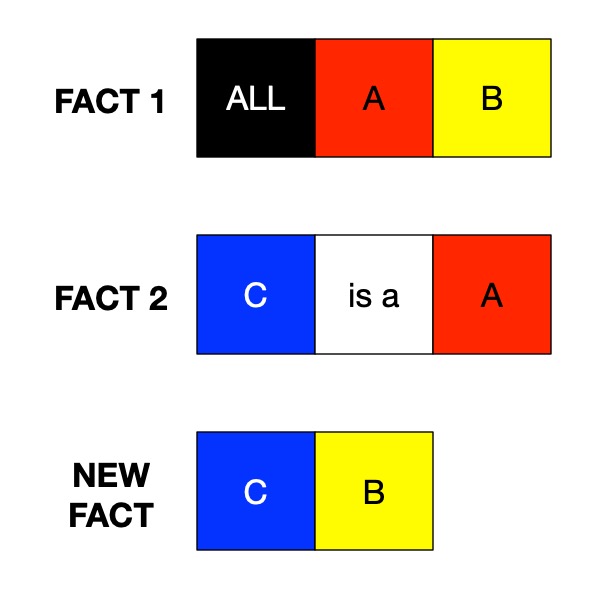
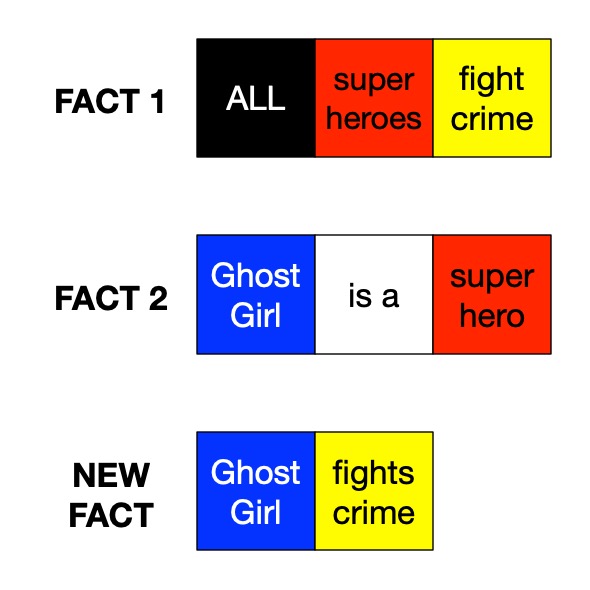
The kind of logical problem his machine worked with are Syllogisms (see Superhero Syllogisms). They were invented by the Ancient Greeks who were very good at logic. A syllogism is just a common pattern that combines facts where you figure out a conclusion only using the facts supplied, slotted into a template. For example, if we know facts 1 and 2 in the following template (where you can swap in anything for A, B and C) then we can create a new fact as shown.
Image by Paul Curzon
So let’s replace A with the word superheroes, B with fight crime and C with my favourite superhero, Ghost Girl. If we put them in to the template above we get a new “fact” deduced from two existing ones:
Image by Paul Curzon
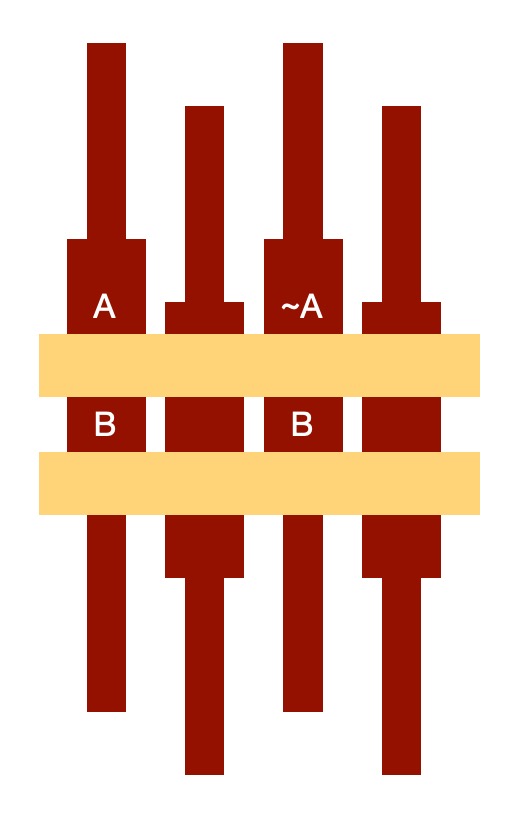
In the piano, a set of rods acted as truth tables, each one giving a true or false values for each variable. So imagine a piano that could deal with two variables A and B. Each of A and B can have two different values true and false, so there are four possibilities (so four rods):
(A, B);
(A, NOT B);
(NOT A, B);
(NOT A, NOT B)
where we write A to mean the assertion A is true and NOT A (or ~A in the picture) to mean A is false. Each rod represents a possible state of the world.
Let’s look at a simple example. Suppose A stands for the statement “Paul is a programmer” and B stands for “Safia is a programmer”, then the possibilities (if we know no specific facts) are
(Paul is a programmer, Safia is a programmer) : (A, B)
(Paul is a programmer, Safia is NOT a programmer) : (A, NOT B)
(Paul is NOT a programmer, Safia is a programmer) : (NOT A, B)
(Paul is NOT a programmer, Safia is NOT a programmer) : (NOT A, NOT B)
Image by Paul Curzon
Each rod in Jevon’s piano had one of the possibilities on, so each rod represented a possible state of the world being reasoned about. At the start all the rods were visible, showing that nothing specific was yet known.
The point is that these represent all possible states of the world about Paul and Safia and whether they are programmers or not. If we know nothing more then all we can say is that all the pairs of facts are a possibility: all are possible states of the world.
The piano worked by essentially leaving displayed or hiding each rod’s state as new facts were keyed in. (See the video at the end which includes a detailed explanation by expert David E Dunning on the detail of how it did this step by step). Initially all the possibilities are displayed as above. If we add a new fact that we have discovered or wish to assume, say that “Safia IS a programmer” (in terms of the piano, press the B key corresponding to the fact B is true), then doing so removes all states of the world where Safia is NOT a programmer. The piano, therefore, hides all the rods that include the assertion representing “Safia is NOT a programmer” (all those with (NOT B) on them) . We are left with two alternatives:
Image by Paul Curzon
(Paul is a programmer, Safia is a programmer) : (A, B)
(Paul is NOT a programmer, Safia is a programmer) : (NOT A, B)
The mechanics of the machine meant that those facts would remain a possibilities (reading down the rods) but pushing the keys for that assertion would have moved the other rods, so hide their state. In doing so, the piano has deduced from the fact B that the possible conclusions are A AND B is true or NOT A AND B is true.
With three variables instead of two the machine would be able to deal with more complex situations – there are then 8 possibilities so 8 rods representing the 8 different states. .
Image by Paul Curzon
Let A represent superheroes, (so NOT A represents those people who are not superheroes), B represents those people who fight crime and C with a person being Ghost Girl. Suppose we are considering some, at the moment, random person we know nothing about. The possibilities about them are:
(Is a superhero, does fight crime, is Ghost Girl) : (A, B, C)
(Is a superhero, does fight crime, is NOT Ghost Girl) : (A, B, NOT C)
(Is a superhero, does NOT fights crime, is Ghost Girl) : (A, NOT B, C)
(Is a superhero, does NOT fight crime, is NOT Ghost Girl) : (A, NOT B, NOT C)
(Is NOT a superhero, does fight crime, is Ghost Girl) : (NOT A, B, C)
(Is NOT a superhero, does fight crime, is NOT Ghost Girl) : (NOT A, B, NOT C)
(Is NOT a superhero, does NOT fights crime, is Ghost Girl) : (NOT A, NOT B, C)
(Is NOT a superhero, does NOT fight crime, is NOT Ghost Girl) : (NOT A, NOT B, NOT C)
If we put the fact about them into the piano that ALL superheroes fight crime (ALL A are B) then we remove all rods where A is true but B is different so false (a superhero who doesn’t fight crime) as in this world, that is impossible.
Image by Paul Curzon
(Is a superhero, does fight crime, is Ghost Girl) : (A, B, C)
(Is a superhero, does fight crime, is NOT Ghost Girl) : (A, B, NOT C)
(Is NOT a superhero, does fight crime, is Ghost Girl) : (NOT A, B, C)
(Is NOT a superhero, does fight crime, is NOT Ghost Girl) : (NOT A, B, NOT C)
(Is NOT a superhero, does NOT fights crime, is Ghost Girl) : (NOT A, NOT B, C)
(Is NOT a superhero, does NOT fight crime, is NOT Ghost Girl) : (NOT A, NOT B, NOT C)
Then we add the fact that Ghost Girl is a superhero (C is a A) so remove all those rods where Ghost Girl is not a superhero (ie NOT A, C):
Image by Paul Curzon
(Is a superhero, does fight crime, is Ghost Girl) : (A, B, C)
(Is a superhero, does fight crime, is NOT Ghost Girl) : (A, B, NOT C)
(Is NOT a superhero, does fight crime, is NOT Ghost Girl) : (NOT A, B, NOT C)
(Is NOT a superhero, does NOT fight crime, is NOT Ghost Girl) : (NOT A, NOT B, NOT C)
We have deduced (the first possible state) that if the person we are interested in is Ghost girl then she is a superhero. We are also left with other possibilities too. If the person we are considering is not actually Ghost Girl then they may or may not fight crime and may or may not be a superhero!
If we add in an additional fact that the person we are thinking of IS actually Ghost Girl then we remove those extra rods so possibilities and get
Image by Paul Curzon
(Is a superhero, does fight crime, is Ghost Girl) : (A, B, C)
Ghost Girl is a superhero who does fight crime! We knew she was Ghost Girl and was a superhero but using the piano we have now deduced that she does fight crime. The machine has deduced the syllogism we gave at the start.
IF ALL superheroes fight crime AND
Ghost girl is a superhero
THEN
Ghost girl fights crime.
The actual piano dealt with 4 variables (A, B, C, D) so had 16 rods representing the 16 different combinations. It also included keys to indicate the end of a conjecture, a key for IS A, and more to allow specific assertions to be input. The mechanism then hid rods automatically based on the facts entered. To use it, you did as we did: create a table of what A, B, C and D stand for (this is done outside the machine), enter the facts you want to reason about, and it then displayed all the possible states that remained in terms of A, B, C and D. Then, by seeing what each of the variables stood for in the table, you could convert that answer back into a deduced fact about the real world that you were interested in.
Amazingly, (after a first failed attempt) it did work. It is similar in idea to modern day theorem provers which are used to verify properties of safety-critical computer designs that must npot have bugs. Of course, being small and woody, the logic piano couldn’t solve every thing but then it turns out that was always an impossible dream. Even modern computers (and human mathematicians) have fundamental limits in what they can do (which is another story). The logic piano was a rather amazing, if woody, start to the area of automated theorem proving, though.
– Paul Curzon, Queen Mary University of London
Make a paper logic piano
Here is a kit to make a paper or card logic piano of your own (actually more like Jonons’ logic abacus the piano was a mechanised version of):
A Talk by David E Dunning at the Imagining AI conference about William Stanley Jevons and the logic piano including at the end a more detailed explanation of how pressing keys actually caused rods to by hidden in a series of steps. See also his article about it for the Computer History Museum.
Mike Lynch was one of Britain’s most successful entrepreneurs. An electrical engineer, he built his businesses around machine learning long before it was a buzz phrase. He also drew heavily on a branch of maths called Bayesian statistics which is concerned with understanding how likely, even apparently unlikely, things are to actually happen. This was so central to his success that he named his super yacht, Bayesian, after it. Tragically, he died on the yacht, when Bayesian sank in a freak, extremely unlikely, accident. The gods of the sea are cruel.
Mike started his path to becoming an entrepreneur at school. He was interested in music, and especially the then new but increasingly exciting, digital synthesisers that were being used by pop bands, and were in the middle of revolutionising music. He couldn’t afford one of his own, though, as they cost thousands. He was sure he could design and build one to sell more cheaply. So he set about doing it.
He continued working on his synthesiser project as a hobby at Cambridge University, where he originally studied science, but changed to his by-then passion of electrical engineering. A risk of visiting his room was that you might painfully step on a resistor or capacitor, as they got everywhere. That was not surprising giving his living room was also his workshop. By this point he was also working more specifically on the idea of setting up a company to sell his synthesiser designs. He eventually got his first break in the business world when chatting to someone in a pub who was in the music industry. They were inspired enough to give him the few thousand pounds he needed to finance his first startup company, Lynett Systems.
By now he was doing a PhD in electrical engineering, funded by EPSRC, and went on to become a research fellow building both his research and innovation skills. His focus was on signal processing which was a natural research area given his work on synthesisers. They are essentially just computers that generate sounds. They create digital signals representing sounds and allow you to manipulate them to create new sounds. It is all just signal processing where the signals ultimately represent music.
However, Mike’s research and ideas were more general than just being applicable to audio. Ultimately, Mike moved away from music, and focussed on using his signal processing skills, and ideas around pattern matching to process images. Images are signals too (resulting from light rather than sound). Making a machine understand what is actually in a picture (really just lots of patches of coloured light) is a signal processing problem. To work out what an image shows, you need to turn those coloured blobs into lines, then into shapes, then into objects that you can identify. Our brains do this seamlessly so it seems easy to us, but actually it is a very hard problem, one that evolution has just found good solutions to. This is what happens whether the image is that captured by the camera of a robot “eye” trying to understand the world or a machine trying to work out what a medical scan shows.
This is where the need for maths comes in to work out probabilities, how likely different things are. Part of the task of recognising lines, shapes and objects is working out how likely one possibility is over another. How likely is it that that band of light is a line, how likely is it that that line is part of this shape rather than that, and so on. Bayesian statistics gives a way to compute probabilities based on the information you already know (or suspect). When the likelihood of events is seen through this lens, things that seem highly unlikely, can turn out to be highly probably (or vice versa), so it can give much more accurate predictions than traditional statistics. Mike’s PhD used this way of calculating probabilities even though some statisticians disdained it. Because of that it was shunned by some in the machine learning community too, but Mike embraced it and made it central to all his work, which gave his programs an edge.
While Lynett Systems didn’t itself make him a billionaire, the experience from setting up that first company became a launch pad for other innovations based on similar technology and ideas. It gave him the initial experience and skills, but also meant he had started to build the networks with potential investors. He did what great entrepreneurs do and didn’t rest on his laurels with just one idea and one company, but started to work on new ideas, and new companies arising from his PhD research.
He realised one important market for image pattern recognition, that was ripe for dominating, was fingerprint recognition. He therefore set about writing software that could match fingerprints far faster and more accurately than anyone else. His new company, Cambridge Neurodynamics, filled a gap, with his software being used by Police Forces nationwide. That then led to other spin-offs using similar technology
He was turning the computational thinking skills of abstraction and generalisation into a way to make money. By creating core general technology that solved the very general problems of signal processing and pattern matching, he could then relatively easily adapt and reuse it to apply to apparently different novel problems, and so markets, with one product leading to the next. By applying his image recognition solution to characters, for example, he created software (and a new company) that searched documents based on character recognition. That led on to a company searching databases, and finally to the company that made him famous, Autonomy.
One of his great loves was his dog, Toby, a friendly enthusiastic beast. Mike’s take on the idea of a search engine was fronted by Toby – in an early version, with his sights set on the nascent search engine market, his search engine user interface involved a lovable, cartoon dog who enthusiastically fetched the information you needed. However, in business finding your market and getting the right business model is everything. Rather than competing with the big US search engine companies that were emerging, he switched to focussing on in-house business applications. He realised businesses were becoming overwhelmed with the amount of information they held on their servers, whether in documents or emails, phone calls or videos. Filing cabinets were becoming history and being replaced by an anarchic mess of files holding different media, individually organised, if at all, and containing “unstructured data”. This kind of data contrasts with the then dominant idea that important data should be organised and stored in a database to make processing it easier. Mike realised that there was lots of data held by companies that mattered to them, but that just was not structured like that and never would be. There was a niche market there to provide a novel solution to a newly emerging business problem. Focussing on that, his search company, Autonomy, took off, gaining corporate giants as clients including the BBC. As a hands-on CEO, with both the technical skills to write the code himself and the business skills to turn it into products businesses needed, he ensured the company quickly grew. It was ultimately sold for $11 billion. (The sale led to an accusation of fraud in hte US, but, innocent, he was acquitted of all the charges).
Investing
From firsthand experience he knew that to turn an idea into reality you needed angel investors: people willing to take a chance on your ideas. With the money he made, he therefore started investing himself, pouring the money he was making from his companies into other people’s ideas. To be a successful investor you need to invest in companies likely to succeed while avoiding ones that will fail. This is also about understanding the likelihood of different things, obviously something he was good at. When he ultimately sold Autonomy, he used the money to create his own investment company, Invoke Capital. Through it he invested in a variety of tech startups across a wide range of areas, from cyber security, crime and law applications to medical and biomedical technologies, using his own technical skills and deep scientific knowledge to help make the right decisions. As a result, he contributed to the thriving Silicon Fen community of UK startup entrepreneurs, who were and continue to do exciting things in and around Cambridge, turning research and innovation into successful, innovative companies. He did this not only through his own ideas but by supporting the ideas of others.
Mike was successful because he combined business skills with a wide variety of technical skills including maths, electronic engineering and computer science, even bioengineering. He didn’t use his success to just build up a fortune but reinvested it in new ideas, new companies and new people. He has left a wonderful legacy as a result, all the more so if others follow his lead and invest their success in the success of others too.
Just because you start a start-up doesn’t mean you have to be the boss (the CEO) running the company… Hamit Soyel didn’t and his research-based company, DragonFlyAI is flourishing.
Hamit’s computer science research (with Peter McOwan) at Queen Mary concerns understanding human (and animal) vision systems. Building on the research of neuroscientists they created computational models of vision systems. These are just programs that work in the way we believe our brains process what we see. If our understanding is correct then the models should see as we see. For example, one aspect of this is how our attention is drawn to some things and not others. If the model is accurate, it should be able to predict things we will definitely notice, and predict things we probably won’t. It turned out their models were really good at this.
They realised that their models had applications in marketing and advertising (an advert that no one notices is a waste of money). They therefore created a startup company based on their research. Peter sadly died not long after the company was founded leaving Hamit to make it a success. He had a choice to make though. Often people who start a startup company set themselves up as the CEO: it is their company so they want control. To do this you need good business skills though and also to be willing to devote the time to make the business a success. You got to this point though because of your technical and creative skills,
When you start a company you want to make a difference, but to actually do that you need a strong team and that team doesn’t have to be “behind” you, they can be “with” you – after all the best teams are made up of specialists who work to their strengths as well as supporting and working well with each other. Perhaps your strengths lie elsewhere, rather than in running a business,
With support from Queen Mary Innovations who helped him set up DragonflyAI and have supported it through its early years, Hamit decided his strengths were in the creative and technical side of the business, so he became the Chief Scientist and Inventor rather than the CEO. That role was handed to an expert as were the other senior leadership roles such as Marketing and Sales, Operations and Customer Success. That meant Hamit could focus on what he did best in further developing the models, as well as in innovating new ideas. This approach also gives confidence to investors that the leadership team do know what they are doing and that if they like the ideas then the company will be a success.
As a result, Hamit’s business is now a big success having helped a whole series of global companies improve their marketing, including Mars and Coca-Cola. DragonflyAI also recently raised $6m in funding from investors to further develop the business.
As Hamit points out:
By delegating operations to a professional leadership team, you can concentrate on areas you truly enjoy that fuel your passion and creativity, ultimately enhancing your fulfilment and contribution to your company and driving collective success.”
To be the CEO or not be the CEO depends on your skills and ambition, but you must also think about what is best for the company, as Hamit has pointed out. It is important to realise though that you do not have to be the CEO just because you founded the company.
Paul Curzon, Queen Mary University of London,
based on an interview between Hamit Soyel and Queen Mary Innovations
Becoming a successful entrepreneur often starts with seeing a need: a problem someone has that needs to be fixed. For David Ronan, the need was for anyone to mix and master music but the problem was that of how hard it is to do this. Now his company RoEx is fixing that problem by combining signal processing ans artificial intelligence tools applied to music. It is based on his research originally as a PhD student
Musicians want to make music, though by “make music” they likely mean playing or composing music. The task of fiddling with buttons, sliders and dials on a mixing desk to balance the different tracks of music may not be a musician’s idea of what making music is really about, even though it is “making music” to a sound engineer or producer. However, mixing is now an important part of the modern process of creating professional standard music.
This is in part a result of the multitrack record revolution of the 1960s. Multitrack involves recording different parts of the music as different tracks, then combining them later, adding effects, combining them some more … George Martin with the Beatles pioneered its use for mainstream pop music in the 1960s and the Beach Boys created their unique “Pet Sounds” through this kind of multitrack recording too. Now, it is totally standard. Originally, though, recording music involved running a recording machine while a band, orchestra and/or singers did their thing together. If it wasn’t good enough they would do it all again from the beginning (and again, and again…). This is similar to the way that actors will act the same scene over and over dozens of times until the director is happy. Once happy with the take (or recording) that was basically it and they moved on to the next song to record.
With the advent of multitracking, each musician could instead play or sing their part on their own. They didn’t have to record at the same time or even be in the same place as the separate parts could be mixed together into a single whole later. Then it became the job of engineers and the producer to put it all together into a single whole. Part of this is to adjust the levels of each track so they are balanced. You want to hear the vocals, for example, and not have them drowned out by the drums. At this point the engineer can also fix mistakes, cutting in a rerecording of one small part to replace something that wasn’t played quite right. Different special effects can also be applied to different tracks (playing one track at a different speed or even backwards, with reverb or auto-tuned, for example). You can also take one singer and allow them to sing with multiple versions of themselves so that they are their own backing group, and are singing layered harmonies with themselves. One person can even play all the separate instruments as, for example, Prince often did on his recordings. The engineers and producer also put it all together and create the final sound, making the final master recording. Some musicians, like Madonna, Ariana Grande and Taylor Swift do take part in the production and engineering parts of making their records or even take over completely, so they have total control of their sound. It takes experience though and why shouldn’t everyone have that amount of creative control?
Doing all the mixing, correction and overdubbing can be laborious and takes a lot of skill, though. It can be very creative in itself too, which is why producers are often as famous as the artists they produce (think Quincy Jones or Nile Rogers, for example). However, not everyone wanting to make their own music is interested in spending their time doing laborious mixing, but if you don’t yet have the skill yourself and cant afford to pay a producer what do you do?
That was the need that David spotted. He wanted to do for music what instagram filters did for images, and make it easy for anyone to make and publish their own professional standard music. Based in part on his PhD research he developed tools that could do the mixing, leaving a musician to focus on experimenting with the sound itself.
David had spent several years leading the research team of an earlier startup he helped found called AI Music. It worked on adaptive music: music that changes based on what is happening around it, whether in the world or in a video game being played. It was later bought by Apple. This was the highlight of his career to that point and it helped cement his desire to continue to be an innovator and entrepreneur.
With the help of Queen Mary, where he did his PhD, he therefore decided to set up his new company RoEx. It provides an AI driven mixing and mastering service. You choose basic mixing options as well as have the ability to experiment with different results, so still have creative control. However, you no longer need expensive equipment, nor need to build the skills to use it. The process becomes far faster too. Mixing your music becomes much more about experimenting with the sound: the machine having taken over the laborious parts, working out the optimum way to mix different tracks and produce a professional quality master recording at the end.
David didn’t just see a need and have an idea of how to solve it, he turned it into something that people want to use by not only developing the technology, but also making sure he really understood the need. He worked with musicians and producers through a long research and development process to ensure his product really works for any musician.