Manufacturing Magic

by Howard Williams, Queen Mary University of London

(From the archive)

A cartoon of an egyptian god
Image from PIXABAY

Can computers lend a creative hand to the production of new magic tricks? That’s a question our team, led by Peter McOwan at Queen Mary, wrestled with.

The idea that computers can help with creative endeavours like music and drawing is nothing new – turn the radio on and the song you are listening to will have been produced with the help of a computer somewhere along the way, whether it’s a synthesiser sound, or the editing of the arrangement, and some music is created purely inside software. Researchers have been toiling away for years, trying to build computer systems that actually write the music too! Some of the compositions produced in this way are surprisingly good! Inspired by this work, we decided to explore whether computers could create magic.

The project to build creative software to help produce new magic tricks started with a magical jigsaw that could be rearranged in certain ways to make objects on its surface disappear. Pretty cool, but what part did the computer play? A jigsaw is made up of different pieces, each with four sides – the number of different ways all these pieces can be put together is very large; for a human to sit down and try out all the different configurations would take many hours (perhaps thousands, if not millions!). Whizzing through lots of different combinations is something a computer is very good at. When there are simply too many different combinations for even a computer to try out exhaustively, programmers have to take a different approach.

Evolve a jigsaw

A genetic algorithm is a program that mimics the biological process of natural selection. We used one to intelligently search through all the interesting combinations that the jigsaw might be made up from. A population of jigsaws is created, and is then ‘evolved’ via a process that evaluates how good each combination is in each generation, gradually weeding out the combinations that wouldn’t make good jigsaws. At the end of the process you hope to be left with a winner; a jigsaw that matches all the criteria that you are hoping for. In this particular case, we hoped to find a jigsaw that could be built in two different ways, but each with a different number of the same object in the picture, so that you could appear to make an object disappear and reappear again as you made and remade it. The idea is based on a very old trick popularised by Sam Lloyd, but our aim was to create a new version that a human couldn’t, realistically, have come up with, without a lot of free time on their hands!

To understand what role the computer played, we need to explore the Genetic Algorithm mechanism it used to find the best combinations. How did the computer know which combinations were good or bad? This is something creative humans are great at – generating ideas, and discarding the ones they don’t like in favour of ones they do. This creative process gradually leads to new works of art, be they music, painting, or magic tricks. We tackled this problem by first running some experiments with real people to find out what kind of things would make the jigsaw seem more ‘magical’ to a spectator. We also did experiments to find out what would influence a magician performing the trick. This information was then fed into the algorithm that searched for good jigsaw combinations, giving the computer a mechanism for evaluating the jigsaws, similar to the ones a human might use when trying to design a similar trick.

More tricks

We went on to use these computational techniques to create other new tricks, including a card trick, a mind reading trick on a mobile phone, and a trick that relies on images and words to predict a spectator’s thought processes. You can find out more including downloading the jigsaw at www.Qmagicworld.wordpress.com

Is it creative, though?

There is a lot of debate about whether this kind of ‘artificial intelligence’ software, is really creative in the way humans are, or in fact creative in any way at all. After all, how would the computer know what to look out for if the researchers hadn’t configured the algorithms in specific ways? Does a computer even understand the outputs that it creates? The fact is that these systems do produce novel things though – new music, new magic tricks – and sometimes in surprising and pleasing ways, previously not thought of.

Are they creative (and even intelligent)? Or are they just automatons bound by the imaginations of their creators? What do you think?

Related Magazines and a new book…


EPSRC supports this blog through research grant EP/W033615/1. 
Hoverflies: comin’ to get ya

(from the archive)

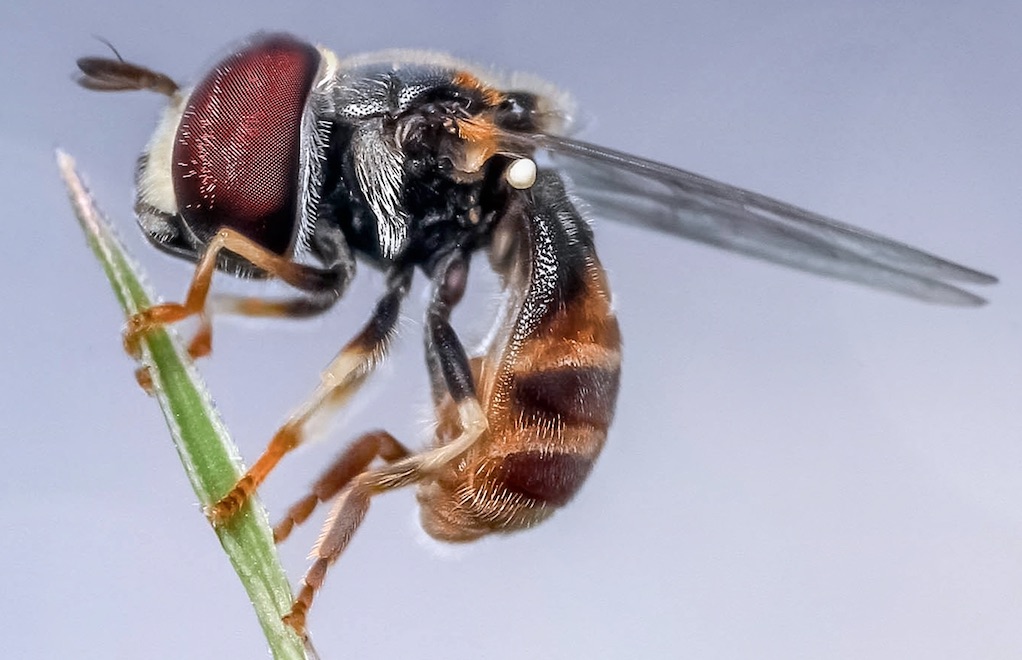
A hoverfly on a blade of grass
Image by Ronny Overhate from Pixabay (cropped)

By understanding the way hoverflies mate, computer scientists found a way to sneak up on humans, giving a way to make games harder.

When hoverflies get the hots for each other they make some interesting moves. Biologists had noticed that as one hoverfly moves towards a second to try and mate, the approaching fly doesn’t go in a straight line. It makes a strange curved flight. Peter and his student Andrew Anderson thought this was an interesting observation and started to look at why it might be. They came up with a cunning idea. The hoverfly was trying to sneak up on its prospective mate unseen.

The route the approaching fly takes matches the movements of the prospective mate in such a way that, to the mate, the fly in the distance looks like it’s far away and ‘probably’ stationary.

Tracking the motion of a hoverfly and its sightlines
Image by Paul Curzon

How does it do this? Imagine you are walking across a field with a single tree in it, and a friend is trying to sneak up on you. Your friend starts at the tree and moves in such a way that they are always in direct line of sight between your current position and the tree. As they move towards you they are always silhouetted against the tree. Their motion towards you is mimicking the stationary tree’s apparent motion as you walk past it… and that’s just what the hoverfly does when approaching a mate. It’s a stealth technique called ‘active motion camouflage’.

By building a computer model of the mating flies, the team were able to show that this complex behaviour can actually be done with only a small amount of ‘brain power’. They went on to show that humans are also fooled by active motion camouflage. They did this by creating a computer game where you had to dodge missiles. Some of those missiles used active motion camouflage. The missiles using the fly trick were the most difficult to spot.

It just goes to show: there is such a thing as a useful computer bug.

– Peter W McOwan and Paul Curzon, Queen Mary University of London


More on …

Related Magazines …

cs4fn issue 4 cover
A hoverfly on a leaf

EPSRC supports this blog through research grant EP/W033615/1, and through EP/K040251/2 held by Professor Ursula Martin. 

QMUL CS4FN EPSRC logos

Ant Art

The close up head of an ant staring at you
Image by Virvoreanu Laurentiu from Pixabay 

There are many ways Artificial Intelligences might create art. Breeding a colony of virtual ants is one of the most creative.

Photogrowth from the University of Coimbra does exactly that. The basic idea is to take an image and paint an abstract version of it. Normally you would paint with brush strokes. In ant paintings you paint with the trails of hundreds of ants as they crawl over the picture, depositing ink rather than the normal chemical trails ants use to guide other ants to food. The colours in the original image act as food for the ants, which absorb energy from its bright parts. They then use up energy as they move around. They die if they don’t find enough food, but reproduce if they have lots. The results are highly novel swirl-filled pictures.

The program uses vector graphics rather than pixel-based approaches. In pixel graphics, an image is divided into a grid of squares and each allocated a colour. That means when you zoom in to an area, you just see larger squares, not more detail. With vector graphics, the exact position of the line followed is recorded. That line is just mapped on to the particular grid of the display when you view it. The more pixels in the display, the more detailed the trail is drawn. That means you can zoom in to the pictures and just see ever more detail of the ant trails that make them up.

You become a breeder of a species of ant
that produce trails, and so images,
you will find pleasing

Because the virtual ants wander around at random, each time you run the program you will get a different image. However, there are lots of ways to control how ants can move around their world. Exploring the possibilities by hand would only ever uncover a small fraction of the possibilities. Photogrowth therefore uses a genetic algorithm. Rather than set all the options of ant behaviour for each image, you help design a fitness function for the algorithm. You do this by adjusting the importance of different aspects like the thickness of trail left and the extent the ants will try and cover the whole canvas. In effect you become a breeder of a species of ant that produce trails, and so images, you will find pleasing. Once you’ve chosen the fitness function, the program evolves a colony of ants based on it, and they then paint you a picture with their trails.

The result is a painting painted by ants bred purely to create images that please you.

– Paul Curzon, Queen Mary University of London (from the archive)


More on …

Related Magazines …

Cover issue 18
cs4fn issue 4 cover

EPSRC supports this blog through research grant EP/W033615/1, and through EP/K040251/2 held by Professor Ursula Martin. 

QMUL CS4FN EPSRC logos

Sabine Hauert: Swarm Engineer

Based on a 2016 talk by Sabine Hauert at the Royal Society

Sabine Hauert is a swarm engineer. She is fascinated by the idea of making use of swarms of robots. Watch a flock of birds and you see that they have both complex and beautiful behaviours. It helps them avoid predators very effectively, for example, so much so that many animals behave in a similar way. Predators struggle to fix on any one bird in all the chaotic swirling. Sabine’s team at the University of Bristol are exploring how we can solve our own engineering problems: from providing communication networks in a disaster zone to helping treat cancer, all based on the behaviours of swarms of animals.

A murmuration of starlings against a dramatic sky
Image by greg seed from Pixabay (cropped)

Sabine realised that flocks of birds have properties that are really interesting to an engineer. Their ability to scale is one. It is often easy to come up with solutions to problems that work in a small ‘toy’ system, but when you want to use it for real, the size of the problem defeats you. With a flock, birds just keep arriving, and the flock keeps working, getting bigger and bigger. It is common to see thousands of Starlings behaving like this – around Brighton Pier most winter evenings, for example. Flocks can even be of millions of birds all swooping and swirling together, never colliding, always staying as a flock. It is an engineering solution that scales up to massive problems. If you can build a system to work like a flock, you will have a similar ability to scale.

Flocks of birds are also very robust. If one bird falls out of the sky, perhaps because it is caught by a predator, the flock itself doesn’t fail, it continues as if nothing happened. Compare that to most systems humans create. Remove one component from a car engine and it’s likely that you won’t be going anywhere. This kind of robustness from failure is often really important.

Swarms are an example of emergent behaviour. If you look at just one bird you can’t tell how the flock works as a whole. In fact, each is just following very simple rules. Each bird just tracks the positions of a few nearest neighbours using that information to make simple decisions about how to move. That is enough for the whole complex behaviour of the flock to emerge. Despite all that fast and furious movement, the birds never crash into each other. Fascinated, Sabine started to explore how swarms of robots might be used to solve problems for people.

Her first idea was to create swarms of flying robots to work as a communications network, providing wi-fi coverage in places it would otherwise be hard to set up a network. This might be a good solution in a disaster area, for example, where there is no other infrastructure, but communication is vital. You want it to scale over the whole disaster area quickly and easily, and it has to be robust. She set about creating a system to achieve this.

The robots she designed were very simple, fixed wing, propellor-powered model planes. Each had a compass so it knew which direction it was pointing and was able to talk to those nearest using wi-fi signals. It could also tell who its nearest neighbours were. The trick was to work out how to design the behaviour of one bird so that appropriate swarming behaviour emerged. At any time each had to decide how much to turn to avoid crashing into another but to maintain the flock, and coverage. You could try to work out the best rules by hand. Instead, Sabine turned to machine learning.

“Throwing those flying robots
and seeing them flock
was truly magical”

The idea of machine learning is that instead of trying to devise algorithms that solve problems yourself, you write an algorithm for how to learn. The program then learns for itself by trial and error the best solution. Sabine created a simple first program for her robots that gave them fairly random behaviour. The machine learning program then used a process modelled on evolution to gradually improve. After all evolution worked for animals! The way this is done is that variations on the initial behaviour are trialled in simulators and only the most successful are kept. Further random changes are made to those and the new versions trialled again. This is continued over thousands of generations, each generation getting that little bit better at flocking until eventually a behaviour of individual robots results that leads to them swarming together.

Sabine has now moved on to to thinking about a situation where swarms of trillions of individuals are needed: nanomedicine. She wants to create nanobots that are each smaller than the width of a strand of hair and can be injected into cancer patients. Once inside the body they will search out and stick themselves to tumour cells. The tumour cells gobble them up, at which point they deliver drugs directly inside the rogue cell. How do you make them behave in a way that gives the best cancer treatment though? For example, how do you stop them all just sticking to the same outer cancer cells? One way might be to give them a simple swarm behaviour that allows them to go to different depths and only then switch on their stickiness, allowing them to destroy all the cancer cells. This is the sort of thing Sabine’s team are experimenting with.

Swarm engineering has all sorts of other practical applications, and while Sabine is leading the way, some time soon we may need lots more swarm engineers, able to design swarm systems to solve specific problems. Might that be you?

by Paul Curzon, Queen Mary University of London

Explore swarm behaviour using the Oxford Turtle system [EXTERNAL] (click the play button top centre) to see how to run a flocking simulation as well as program your own swarms.

More on …

Related Magazines …

cs4fn issue 4 cover
A hoverfly on a leaf

Our Books …


Subscribe to be notified whenever we publish a new post to the CS4FN blog.


EPSRC supports this blog through research grant EP/W033615/1. 

QMUL CS4FN EPSRC logos