Pseudocode poems are poems that work both as a poem and as an algorithm so can be read or executed. They incorporate sequencing, selection or repetition constructs and other kinds of statements to take actions. You can implement them as an actual program. Below are our attempts. Can you write better ones?
Poems often use the ambiguity in language and aim to affect emotions. Pseudocode is intended to be precise. Programs certainly are. They do something specific and have a single precise meaning. Writing pseudocode poems that do both can be a lot of fun: just like writing normal programs is. The idea was inspired by Bryan Bilston’s poem ‘Two Paths Diverged’. Read it here or buy his wonderful book of poems, ‘ You took the last bus home’.
I am not a great poet, but here are some of my attempts at pseudocode poems to at least give you the idea. They are, in turn, based on the core control structures of Sequencing, Selection and Repetition. They also use print statements and assignments to get things done,
Sequencing
This pseudocode poem is based on sequencing: doing things one after the other.
What am I when it’s all over?

I am dire.
I am fire.

I am alone.
I am stone.

I am old.
I am cold.
We use the verb TO BE to be the equivalent of assignment: setting the value of a variable. Here it is implemented as a Python program.
def whatamI():
	"""What am I when it's all over?"""

	I = 'dire'
	I = 'fire'

	I = 'alone'
	I = 'stone'

	I = 'old'
	I = 'cold'

	print(I)
Selection
Here is a pseudocode poem based on selection, which is the second core control structure. It chooses between two option based on a boolean test: a true / false question. The question here is: do I love you? Dry run the algorithm or run program to find out.
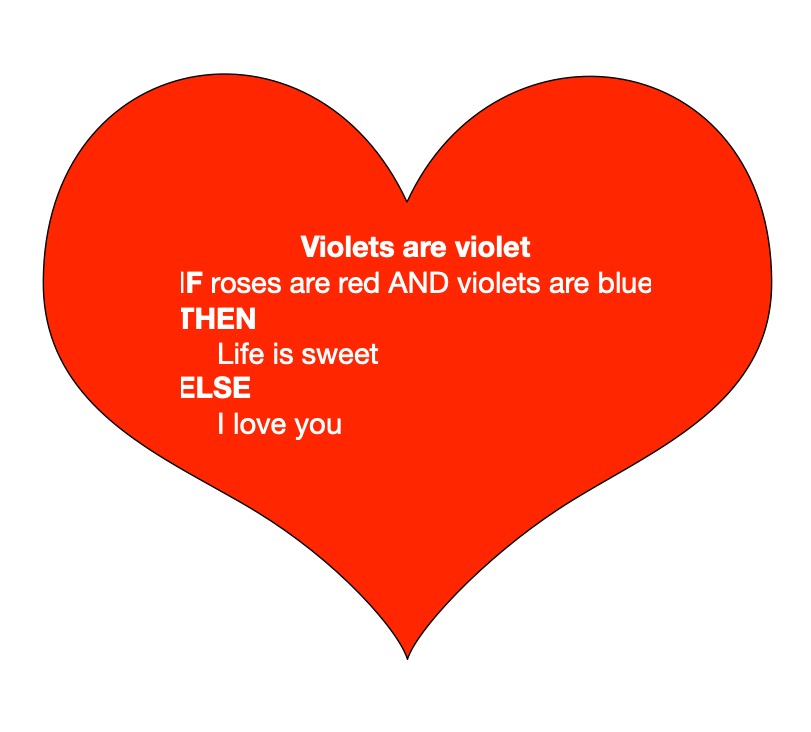
Violets are violet
if roses are red and violets are blue
then
    Life is sweet
else
    I love you
Here it is implemented as a Python program (with appropriate initialisation).
def violetsareviolet():
	"""Violets are violet"""
	roses = 'red'
	violets = 'violet'

	if roses == 'red' and violets == 'blue':
		print('Life is sweet')
	else:
		print('I love you')

violetsareviolet()
The final kind of control structure is iteration (i.e., repetition). It is used to repeat the same lines over and over again.
Is this poem really long?

it is true
while it is true
    this is short
it is endless
Here it is implemented as a Python program.
def isthispoemreallylong():
    """Is this poem really long?"""
    it = True
    while (it == True) :
        this = 'short'
    it = 'endless'

isthispoemreallylong()
Can you work out what it does as an algorithm/program, rather than as just a normal poem? You may need a version with print statements to understand its beauty.
def isthispoemreallylong2():
    """Is this poem really long?"""
    it = True
    while (it == True) :
        this = 'short'
        print("this is " + this)
    it = 'endless'
    print("it is " + it)

isthispoemreallylong2()
The word while indicates the start of a while loop. In the pseudocode, it is a command to repeat the following statement(s). It checks the boolean expression after the body each time. Only if that boolean expression is false does it stop. In this case the body sets the variable named this to string value ‘short’. The test is about a different variable though which is not changed inside the loop, so once in the loop there is nothing that will ever change the variable it so the value of the test will always be the same. Variable it will always be True and the loop will keep setting variable this to value ‘short’, over and over again. This means the loop is a non-terminating loop. It never exits so the lines of code after it are never executed. As a program they are never followed by the computer. The variable it is never set to the value ‘endless’.
Overall the poem is short in number of lines but it is actually endless if executed. It is the equivalent of a poem that once you start reading it you never get to the end:
it is true
check it is true
this is short
check it is true
this is short
check it is true
this is short
...
Here is a more romantically inclined poem for Valentine’s day (since at the time of writing, it is coming up) again using repetition
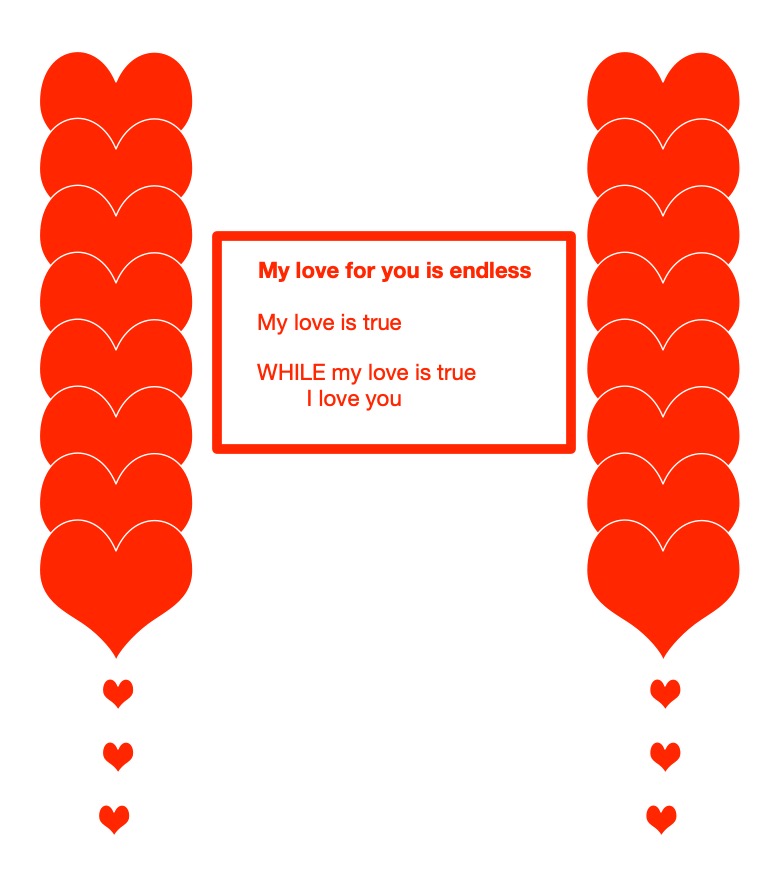
My love for you is endless

my love is true
while my love is true
    I love you
Here it is implemented as a Python program.
def myloveforyouisendless():
"""My love for you is endless"""
my_love = True
while my_love == True:
    print('I love you')

myloveforyouisendless()
In the pseudocode of this poem the verb “to be” is used for two different purposes: as an assignment statement (it is true is used as a statement to mean it = True) and as a boolean expression (it is true is used as a boolean expression to mean it == True). As an assignment it is used as a command to do something. As an expression it is something representing a value: it evaluates to either true or false. Confusing these two English uses is a common mistake novices make programming, and shows one of the ways why programming languages are used with different symbols for different meanings, rather than natural languages.
Now it is your turn. Can you write a great poem that can also be executed?
Subscribe to be notified whenever we publish a new post to the CS4FN blog.
This blog is funded by EPSRC on research agreement EP/W033615/1.
Answers
The selection poem is about a volcano, but the answer to the question in the title is ‘cold’.
Assuming you agree with me that violet flowers are violet (or at least not blue) then clearly we are compatible at least in being pedantic and you will find I love you.
If, by Rudyard Kipling is an inspirational poem that was voted the UKs favourite poem in the 1990s. It consists of a series of lines that start with If. What If, by Benjamin Zephaniah is a more subversive poem modelled on the original.
If statements, of course, are a really core part of programs so are these poems, given they are all about IF, algorithms? The use of If here isn’t quite the same as a pure computational one as seen in programs. For a start, it doesn’t follow the structure of a computer science IF statement. Here are a few lines:
If you can keep your head when all about you
  Are losing theirs and blaming it on you,
If you can trust yourself when all men doubt you,
  But make allowance for their doubting too;
...
In programs, an IF statement has a specific structure. It consists of a test of something that is true or false but then gives a specific action to take when the statement is true. The lines
you can keep your head when all about you are losing theirs AND blaming it on you,
is more or less such a true or false statement. Either you can keep your head or you can’t. This though ignores the possibility of you sometimes losing your head and sometimes not. The poem presumably means to say that you must ALWAYS keep your head. What exactly does “when” here mean too? The reason we do not use English when writing programs is the lack of clarity of what is actually meant. Programs are mathematically precise in their meaning. They do only have one possible meaning (and that is the point). this is also a potential issue of writing programs by instructing AIs over what you want in English!
This boolean expression (something that evaluates to true or false) also uses a logical connective AND just like in a program – you must both be keeping your head AND people must be blaming it on you for the whole to be true. If they are both true then the action that follows is taken, but if they aren’t both true the poem says nothing about you!
Another issue in If, is that this test / boolean expression is not immediately followed by an action to do when it is true. The action comes right at the very end of the poem
...
Yours is the Earth and everything that's in it,
And - which is more - you'll be a Man, my son!
This comes after a whole series of these partial IF statements. To make it more clearly like a program you would add a more explicitly IF-THEN structure, which is the equivalent of putting ANDs between all the tests. In a program that would be written more like the following:
IF you can keep your head when all about you
  Are losing theirs and blaming it on you,
   THEN IF you can trust yourself when all men doubt you,
              But make allowance for their doubting too;
...
...
                             THEN Yours is the Earth and everything that's in it,
                                        And - which is more - you'll be a Man, my son!
Only if all the tests are true does the final action get taken. Though it isn’t really an action, it is more an assertion that something else is true – “the Earth is yours”, rather than “we give you the Earth”. (Also that final And is no longer a logical connective!)
Poems like this could be made more explicitly computational though. For example, a slightly more computational version might be:
IF you can keep your head when all about you
   Are losing theirs AND blaming it on you
THEN I will thank you, giving you a pay rise too
...
A love poem in this vein might start
IF you are a snail
    THEN I will become your shell.
IF you are a ...
This leads on to the idea of pseudocode poems, that use other computational constructs. More of that to come.
To do …
Write your own poem in this style with true/false questions followed by specific actions, modelled on the computational version of IF. It could be a reworking of If itself or a completely different poem.
Computer scientists and mathematicians can be poets too, even writing poems about computation. One of my favourite poems is about recursion and was written by the Victorian logician Augustus De Morgan who is famous for his laws of boolean logic that are a mainstay of reasoning about boolean tests in programs.
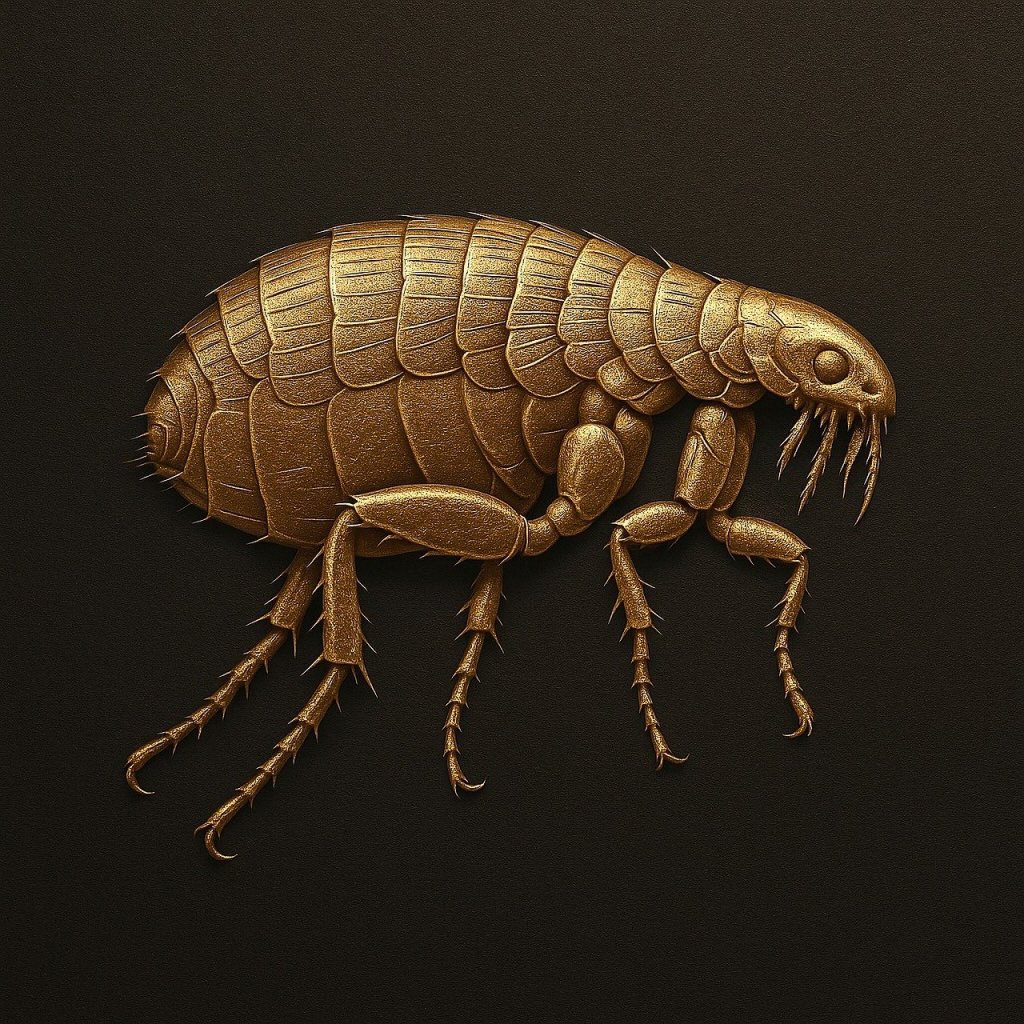
Great fleas Have Lesser Fleas, upon Their backs To Bite’em, And Lesser Fleas Have Lesser fleas, And So, Ad infinitum.
and Those great Fleas, Themselves, In turn Have Greater Fleas To go On; while Those Again have Greater still, And greater Still, And So on.
– Augustus De Morgan
Recursion, solving problems by breaking them into smaller versions of the same problem, is a way of writing programs that repeat just using function call (no while loops or for loops needed). It is a core concept of the programming paradigm, functional programming. Using recursion in a way that goes on forever as in the poem leads to non-terminating programs.
De Morgan was also Maths tutor of Victorian mathematician and computer scientist, Ada Lovelace. Her father was the great poet Lord Byron though (philistine that I presumably am) I like De Morgan’s poem better than Byron’s.
De Morgan made the idea of mathematical induction rigorous. It is the basis of how you prove recursive programs (and iterative ones) are correct.
My poetry collection, «Αλγόριθμοι Σιωπής» (Algorithms of Silence), explores the quiet, often unseen structures that shape our inner lives. As a computer scientist and a poet, I’m fascinated by the language we use to describe these systems – whether they are emotional, social, or computational.
The following piece is an experiment that embodies this theme. It presents a single core idea – about choice, memory, and predetermination – in three different languages: the original Greek poem “Αυτόματον Μεταβατικόν,” an English transcreation, and a pseudocode version that translates the poem’s philosophical questions into the logic of an automaton.
– Vasileios Klimis, Queen Mary University of London
Transitional Automaton
Once, a decision – small, like a flaw in a cogwheel – tilted the whole system toward a version never written.
In the workshop of habits, every choice left behind a trace of activation; you don’t see it, but it returns like a pulse through a one-way gate.
•
I walk through a matrix of transitions where each state defines the memory of the next. Not infinite possibilities – only those the structure permits.
Is this freedom? Or merely the optimal illusion of a system with elastic rules?
•
In moments of quiet (but not of silence) I feel the null persisting not as absence, but as a repository in waiting. Perhaps that is where it resides, all that was never activated.
•
If there is a continuation, it will resemble a debug session more than a crisis.
Not a moral crisis; a recursion. Who passes down to the final terminal the most probable path?
•
The question is not what we lived. But which of the contingencies remained active when we stopped calculating.
Αυτόματον μεταβατικόν
Κάποτε, μια απόφαση – μικρή, σαν στρέβλωση σε οδοντωτό τροχό – έγερνε το σύνολο προς μια εκδοχή που δεν γράφτηκε ποτέ.
•
Στο εργαστήριο των συνηθειών κάθε επιλογή άφηνε πίσω της ένα ίχνος ενεργοποίησης· δεν το βλέπεις, αλλά επιστρέφει σαν παλμός σε μη αντιστρεπτή πύλη.
•
Περπατώ μέσα σ’ έναν πίνακα μεταβάσεων όπου κάθε κατάσταση ορίζει τη μνήμη της επόμενης. Όχι άπειρες πιθανότητες – μόνον όσες η δομή επιτρέπει. Είναι ελευθερία αυτό; Ή απλώς η βέλτιστη πλάνη ενός συστήματος με ελαστικούς κανόνες;
•
Σε στιγμές σιγής (αλλά όχι σιωπής) νιώθω το μηδέν να επιμένει όχι ως απουσία, αλλά ως αποθήκη αναμονής. Ίσως εκεί διαμένει ό,τι δεν ενεργοποιήθηκε.
•
Αν υπάρξει συνέχεια, θα μοιάζει περισσότερο με debug session παρά με κρίση.
•
Όχι κρίση ηθική· μία αναδρομή. Ποιος μεταβιβάζει στο τερματικό του τέλους το πιο πιθανό μονοπάτι;
•
Η ερώτηση δεν είναι τι ζήσαμε. Αλλά ποιο από τα ενδεχόμενα έμεινε ενεργό όταν εμείς σταματήσαμε να υπολογίζουμε.
Pseudocode Poem version
Pseudocode poems are poems written in pseudocode: the semi-formailsed language used for writing algorithms and planning the design of program. Here is the above poem as a pseudocode poem.
FUNCTION life_automaton(initial_state)
  DEFINE State_Transitions AS Matrix;
  DEFINE active_path AS Log;
  DEFINE potential_paths AS Set = {all_versions_never_written};

  current_state = initial_state;
  system.log("Initializing in the workshop of habits.");

  REPEAT

    WAIT FOR event.decision;
    // a decision — small, like a flaw in a cogwheel
    IF (event.decision.is_subtle) THEN
       previous_state = current_state;
       current_state = State_Transitions.calculate_next
                                (previous_state, event.decision);
       // it returns like a pulse through a one-way gate
       active_path.append(previous_state -> current_state);
       potential_paths.remove(current_state.version);
    END IF

   // Is this freedom? Or merely the optimal illusion
   // of a system with elastic rules?

   IF (system.isQuiet) THEN
       // I feel the null persisting
       // not as absence, but as a repository in waiting.
       // Perhaps that is where it resides, all that was never activated.
       PROCESS potential_paths.contemplate();
   END IF

  UNTIL system.isTerminated;

  // If there is a continuation,
  // it will resemble a debug session more than a crisis.
  // Not a moral crisis; a recursion.
  DEBUG_SESSION.run(active_path);

  // The question is not what we lived.
  // But which of the contingencies remained active
  // when we stopped calculating.
  RETURN final_state = active_path.getLast();
END FUNCTION
One of the ways that computers could be more like humans – and maybe pass the Turing test – is by responding to emotion. But how could a computer learn to read human emotions out of words? Matthew Purver of Queen Mary University of London tells us how.
Have you ever thought about why you add emoticons to your text messages – symbols like 🙂 and :-@? Why do we do this with some messages but not with others? And why do we use different words, symbols and abbreviations in texts, Twitter messages, Facebook status updates and formal writing?
In face-to-face conversation, we get a lot of information from the way someone sounds, their facial expressions, and their gestures. In particular, this is the way we convey much of our emotional information – how happy or annoyed we’re feeling about what we’re saying. But when we’re sending a written message, these audio-visual cues are lost – so we have to think of other ways to convey the same information. The ways we choose to do this depend on the space we have available, and on what we think other people will understand. If we’re writing a book or an article, with lots of space and time available, we can use extra words to fully describe our point of view. But if we’re writing an SMS message when we’re short of time and the phone keypad takes time to use, or if we’re writing on Twitter and only have 140 characters of space, then we need to think of other conventions. Humans are very good at this – we can invent and understand new symbols, words or abbreviations quite easily. If you hadn’t seen the 😀 symbol before, you can probably guess what it means – especially if you know something about the person texting you, and what you’re talking about.
But computers are terrible at this. They’re generally bad at guessing new things, and they’re bad at understanding the way we naturally express ourselves. So if computers need to understand what people are writing to each other in short messages like on Twitter or Facebook, we have a problem. But this is something researchers would really like to do: for example, researchers in France, Germany and Ireland have all found that Twitter opinions can help predict election results, sometimes better than standard exit polls – and if we could accurately understand whether people are feeling happy or angry about a candidate when they tweet about them, we’d have a powerful tool for understanding popular opinion. Similarly we could automatically find out whether people liked a new product when it was launched; and some research even suggests you could even predict the stock market. But how do we teach computers to understand emotional content, and learn to adapt to the new ways we express it?
One answer might be in a class of techniques called semi-supervised learning. By taking some example messages in which the authors have made the emotional content very clear (using emoticons, or specific conventions like Twitter’s #fail or abbreviations like LOL), we can give ourselves a foundation to build on. A computer can learn the words and phrases that seem to be associated with these clear emotions, so it understands this limited set of messages. Then, by allowing it to find new data with the same words and phrases, it can learn new examples for itself. Eventually, it can learn new symbols or phrases if it sees them together with emotional patterns it already knows enough times to be confident, and then we’re on our way towards an emotionally aware computer. However, we’re still a fair way off getting it right all the time, every time.
Scientific fraud is worryingly common, though rarely talked about. It has been happening for years, but now Artificial Intelligence programs could supercharge it. If they do that could undermine Science itself.
Investigators of scientific fraud have found that large numbers of researchers have manipulated their results, invented data, or even produced nonsensical papers in the hope that no one will look closely enough to notice. Often, no one does. The problem is that science is built on the foundation of all the research that has gone before. If we can no longer trust that past research is legitimate, the whole system of science begins to break down. AI has the potential to supercharge this process.
We’re not at that point yet, luckily. But there are concerning signs that generative AI systems like ChatGPT and DALLE-E might bring us closer. By using AI technology, producing fraudulent research has never been easier, faster, or more convincing. To understand, let’s first look at how scientific fraud has been done in the past.
How fraud happens
Until recently, fraudsters would need to go through some difficult steps to get a fraudulent research paper published. A typical example might look like this:
Step 1: invent a title
Fraudsters look for a popular but very broad research topic. We’ll take an example of a group of fraudsters known as the Tadpole Paper Mill. They published papers about cellular biology. To choose a new paper to create, the group would essentially use a simple generator, or algorithm, based on a template. This uses a simple technique first used by Christopher Strachey to write love letters in an early “creative” program in the 1950s.
For each “hole” in the template a word is chosen from a word list.
Pick the name of a molecule
Either a protein name, a drug name or an RNA molecule name
Next, the fraudsters create the text of the paper. To do this, they often just plagiarise and lightly edit previous similar papers, substituting key words in from their invented title perhaps. To try to hide the plagiarism, they automatically swap out words, replacing them with synonyms. This often leads to ridiculous (and kind of hilarious) replacements, like these found in plagiarised papers:
“Big data” –> “Colossal information”
“Cloud computing” –> “Haze figuring”
“Developing countries” –> “Creating nations”
“Kidney failure” –> “Kidney disappointment”
Step 3: add in the results
Lastly, the fraudsters need to create results for the fake study. These usually appear in papers in the form of images and graphs. To do this, the fraudsters take the results from several previous papers and recombine them into something that looks mostly real, but is just a Frankenstein mess of other results that have nothing to do with the current paper.
A new paper is born
Using that simple formula, fraudsters have produced thousands of fabricated articles in the last 10 years. Even after a vast amount of effort, the dedicated volunteers who are trying to clean up the mess have only caught a handful.
However, committing fraud like this successfully isn’t exactly easy, either: the fraudsters still need to come up with a research idea, write the paper themselves without copying too much from previous research, and make up results that look convincing—at least at first glance.
AI: Adding fuel to the fire
So what happens when we add modern generative AI programs into the mix? They are Artificial Intelligence programs like ChatGPT or DALL-E that can create text or pictures for you based on written requests.
Well, the quality of the fraud goes up, and the difficulty of producing it goes way down. This is true for both text and images.
Let’s start with text. Just now, I asked ChatGPT-4 to “write the first two paragraphs of a research paper on a cutting edge topic in psychology.” I then asked it to “write a fake results table that shows a positive relationship between climate change severity and anxiety”. I won’t copy the whole thing—in part because I encourage you to try this yourself to see how it works (not to actually create a fake paper!)—but here’s a sample of what it came up with:
“As the planet faces increasing temperatures, extreme weather events, and environmental degradation, the mental health repercussions for populations worldwide become a crucial area of investigation. Understanding these effects is vital for developing strategies to support communities in coping with the psychological challenges posed by a changing climate.”
As someone who has written many psychology research papers, I would find the results very difficult to identify as AI-generated—it looks and sounds very similar to how people in my field write, and it even generated Python code to analyse the fake data. I’d need to take a really close look at the origin of the data and so on to figure out that it’s fraudulent.
But that’s a lot of work required from me as a fraud-buster. For the fraudster, doing this takes about 1 minute, and would not be detected by any plagiarism software in the way previous kinds of fraud can be. In fact, this might only be detected if the fraudsters make a sloppy mistake, like leaving in a disclaimer from the model as in the paper caught which included the text
“[Please note that as an AI language model, I am unable to generate specific tables or conduct tests, so the actual resutls should be included in the table.]”!
Generative AIs are not close to human intelligence, at least not yet. So, why are they so good at producing convincing scientific research, something that’s commonly seen as one of the most difficult things humans can do? Two reasons play a big part: (1) scientific research is very structured, and (2) there’s a lot of training data. In any given field of research, most papers tend to look pretty similar—an introduction section, a method describing what the researchers did, a results section with a few tables and figures, and a discussion that links it back to the wider research field. Many journals even require a fixed structure. Generative AI programs work using Machine Learning – they learn from data and the more data they are given the better they become. Give a machine learning program millions of images of cats, telling it that is what they are, and it can become very good at recognising cats. Give it millions of images of dogs and it will be able to recognise dogs too. With roughly 3 million scientific papers published every year, generative AI systems are really good at taking these many, many examples of what a scientific report looks like, and producing similar sounding, and similarly structured pieces of text. They do it by predicting what word, sentence and paragraph would be good to come next based on probabilities calculated from all those examples.
Trusting future research
Most research can still be trusted, and the vast majority of scientists are working as hard as they can to advance human knowledge. Nonetheless, we all need to look carefully at research studies to ensure that they are legitimate, and we should be on extra alert as generative AI becomes even more powerful and widespread. We also need to think about how to improve universities and research culture generally, so that people don’t feel like they need to commit scientific fraud—something that usually happens because people are desperate to get or keep a job, or be seen as successful and reap the rewards. Somehow we need to change the game so that fraud no longer pays.
What do you think? Do you have ideas for how we can prevent fraud from happening in the first place, and how can we better detect it when it does occur? It is certainly an important new research topic. Find a solution and you could do massive good. If we don’t find solutions then we could lose the most successful tool human-kind has ever invented that makes all our lives better.
Greg Michaelson is an Emeritus professor of computer science at Heriot-Watt University in Edinburgh. He is also a novelist and a short story writer. He wrote this story for CS4FN.
“Come on!” called Alice, taking the coat off the peg. “We’re going to be late!”
“Do I have to?” said Henry, emerging from the front room.
“Yes,” said Alice, handing him the coat. “Of course you have to go. Here. Put this on.”
“But we’re playing,” said Henry, wrestling with the sleeves.
“Too bad,” said Alice, straightening the jacket and zipping it up. “It’ll still be there when we get back.”
“Not if someone knocks it over,” said Henry, picking up a small model dinosaur from the hall table. “Like last time. Why can’t we have electric games like you did?”
“Electronic games,” said Alice, doing up her buttons. “Not electric. No one has them anymore. You know that.”
“Were they really digital?” asked Henry, fiddling with the dinosaur.
“Yes,” said Alice, putting on her hat. “Of course they were digital.”
“But the telephone’s all right,” said Henry.
“Yes,” said Alice, checking her makeup in the mirror. “It’s analogue.”
“And radio. And record players. And tape recorders. And television,” said Henry.
“They’re all analogue now,” said Alice, putting the compact back into her handbag. “Anything analogue’s fine. Just not digital. Stop wasting time! We’ll be late.”
“Why does it matter if we’re late?” asked Henry, walking the dinosaur up and down the hall table.
“They’ll notice,” said Alice. “We don’t want to get another warning. Put that away. Come on.”
“Why don’t the others have to go?” asked Henry, palming the dinosaur.
“They went last Sunday,” said Alice, opening the front door. “You said you didn’t want to go. We agreed I’d take you today instead.”
“Och, granny, it’s so boring…” said Henry.
They left the house and walked briskly to the end of the street. Then they crossed the deserted park, following the central path towards the squat neo-classical stone building on the far side.
“Get a move on!” said Alice, quickening the pace. “We really are going to be late.”
————————-
Henry really hadn’t paid enough attention at school. He knew that Turing Machines were named for Alan Turing, the first Martyr of the Digital Age. And he knew that a Turing Machine could work out sums, a bit like a school child doing arithmetic. Only instead of a pad of paper and a pencil, a Turing Machine used a tape of cells. And instead of rows of numbers and pluses and minuses on a page, a Turing Machine could only put one letter on each cell, though it could change a letter without having to actually rub it out. And instead of moving between different places on a piece of paper whenever it wanted to, and maybe doodling in between the sums, a Turing Machine could only move the tape left and right one cell at a time. But just like a school child getting another pad from the teacher when they ran out of paper, the Turing Machine could somehow add another empty cell whenever it got to the end of the tape.
————————-
When they reached the building, they mounted the stone staircase and entered the antechamber through the central pillars. Just inside the doorway, Alice gave their identity cards to the uniformed guard.
“I see you’re a regular,” she said approvingly to Alice, checking the ledger. “But you’re not,” sternly to Henry.
Henry stared at his shoes.
“Don’t leave it so long, next time,” said the guard, handing the cards back to Alice. “In you go. They’re about to start. Try not to make too much noise.”
Hand in hand, Alice and Henry walked down the broad corridor towards the central shrine. On either side, glass cases housed electronic equipment. Computers. Printers. Scanners. Mobile phones. Games consoles. Laptops. Flat screen displays.
The corridor walls were lined with black and white photographs. Each picture showed a scene of destitution from the Digital Age.
Shirt sleeved stock brokers slumped in front of screens of plunging share prices. Homeless home owners queued outside a state bank soup kitchen. Sunken eyed organic farmers huddled beside mounds of rotting vegetables. Bulldozers shovelled data farms into land fill. Lines of well armed police faced poorly armed protestors. Bodies in bags lay piled along the walls of the crematorium. Children scavenged for toner cartridges amongst shattered office blocks.
Alice looked straight ahead: the photographs bore terrible memories. Henry dawdled, gazing longingly into the display cases: Gameboy. Playstation. X Box…
“Come on!” said Alice, sotto voce, tugging Henry away from the displays.
At the end of the corridor, they let themselves into the shrine. The hall was full. The hall was quiet.
————————-
Henry was actually quite good at sums, and he knew he could do them because he had rules in his head for adding and subtracting, because he’d learnt his tables. The Turing Machine didn’t have a head at all, but it did have rules which told it what to do next. Groups of rules that did similar things were called states, so all the rules for adding were kept separately from all the rules for subtracting. Every step of a Turing machine sum involved finding a rule in the state it was working on to match the letter on the tape cell it was currently looking at. That rule would tell the Machine how to change the symbol on the tape, which way to move the tape, and maybe to change state to a different set of rules.
————————-
On the dais, lowered the Turing Machine, huge coils of tape links disappearing into the dark wells on either side, the vast frame of the state transition engine filling the rear wall. In front of the Turing Machine, the Minister of State stood at the podium.
“Come in! Come in!” he beamed at Alice and Henry. “There’s lots of space at the front. Don’t be shy.”
Red faced, Alice hurried Henry down the aisle. At the very front of the congregation, they sat down cross legged on the floor beneath the podium.
“My friends,” began the Minister of State. “Welcome. Welcome indeed! Today is a special day. Today, the Machine will change state. But first, let us be silent together. Please rise.”
The Minister of State bowed his head as the congregation shuffled to its feet.
———————–
According to Henry’s teacher, there was a different Turing Machine for every possible sum in the world. The hard bit was working out the rules. That was called programming, but, since the end of the Digital Age, programming was against the law. Unless you were a Minister of State.
————————
“Dear friends,” intoned the Minister of State, after a suitable pause. “We have lived through terrible times. Times when Turing’s vision of equality between human and machine intelligences was perverted by base greed. Times when humans sought to bend intelligent machines to their selfish wills for personal gain. Times when, instead of making useful things that would benefit everybody, humans invented and sold more and more rarefied abstractions from things: shares, bonds, equities, futures, derivatives, options…”
————————
The Turing Machine on the dais was made from wood and brass. It was extremely plain, though highly polished. The tape was like a giant bicycle chain, with holes in the centre of each link. The Machine could plug a peg into a hole to represent a one or pull a peg out to represent a zero. Henry knew that any information could be represented by zeros and ones, but it took an awful lot of them compared with letters.
————————-
“… Soon there were more abstractions than things, and all the wealth embodied in the few things that the people in poor countries still made was stolen away, to feed the abstractions made by the people in the rich countries. None of this would have been possible without computers…”
————————-
The state transition unit that held the rules was extremely complicated. Each rule was a pattern of pegs, laid out in rows on a great big board. A row of spring mounted wooden fingers moved up and down the pegs. When they felt the rule for the symbol on the tape cell link, they could trigger the movement of a peg in or out of the link, and then release the brakes to start up one revolution of the enormous cog wheels that would shift the tape one cell left or right.
————————-
“…With all the computers in the world linked together by the Internet, humans no longer had to think about how to manage things, about how best to use them for the greatest good. Instead, programs that nobody understood anymore made lightening decisions, moving abstractions from low profits to high profits, turning the low profits into losses on the way, never caring how many human lives were ruined…”
————————-
The Turing Machine was powered by a big brass and wooden handle connected to a gear train. The handle needed lots of turns to find and apply the next rule. At the end of the ceremony, the Minister of State would always invite a member of the congregation to come and help him turn the handle. Henry always hoped he’d be chosen.
——————————
“…Turing himself thought that computers would be a force for untold good; that, guided by reason, computers could accomplish anything humans could accomplish. But before his vision could be fully realised, he was persecuted and poisoned by a callous state interested only in secrets and profits. After his death, the computer he helped design was called the Pilot Ace; just as the pilot guides the ship, so the Pilot Ace might have been the best guide for a true Digital Age…”
——————————
Nobody was very sure where all the cells were stored when the Machine wasn’t inspecting them. Nobody was very sure how new cells were added to the ends of the tape. It all happened deep under the dais. Some people actually thought that the tape was infinite, but Henry knew that wasn’t possible as there wasn’t enough wood and brass to make it that long.
——————————
“…But almost sixty years after Turing’s needless death, his beloved universal machines had bankrupted the nations of the world one by one, reducing their peoples to a lowest common denominator of abject misery. Of course, the few people that benefited from the trade in abstractions tried to make sure that they weren’t affected but eventually even they succumbed…”
——————————
Nobody seemed to know what the Turing Machine on the dais was actually computing. Well, the Minister of State must have known. And Turing had never expected anyone to actually build a real Turing Machine with real moving parts. Turing’s machine was a thought experiment for exploring what could and couldn’t be done by following rules to process sequences of symbols.
——————————
“…For a while, everything stopped. There were power shortages. There were food shortages. There were medical shortages. People rioted. Cities burned. Panicking defence forces used lethal force to suppress the very people they were supposed to protect. And then, slowly, people remembered that it was possible to live without abstractions, by each making things that other people wanted, by making best use of available resources for the common good…”
——————————
The Turing Machine on the dais was itself a symbol of human folly, an object lesson in futility, a salutary reminder that embodying something in symbols didn’t make it real.
——————————
“…My friends, let us not forget the dreadful events we have witnessed. Let us not forget all the good people who have perished so needlessly. Let us not forget the abject folly of abstraction. Let the Turing Machine move one step closer along the path of its unknown computation. Let the Machine change its state, just as we have had to change ours. Please rise.”
The congregation got to their feet and looked expectantly at the Minister of State. The Minister of State slowly inspected the congregation. Finally, his eyes fixed on Henry, fidgeting directly in front of him.
“Young man,” he beamed at Henry. “Come. Join me at the handle. Together we shall show that Machine that we are all its masters.”
Henry looked round at his grandmother.
“Go on,” she mouthed. “Go on.”
Henry walked round to the right end of the dais. As he mounted the wooden stairs, he noticed a second staircase leading down behind the Machine into the bowels of the dais.
“Just here,” said the Minister of State, leading Henry round behind the handle, so they were both facing the congregation. “Take a good grip…”
Henry was still clasping the plastic dinosaur in his right hand. He put the dinosaur on the nearest link of the chain and placed both hands on the worn wooden shaft.
And turn it steadily…”
Henry leant into the handle, which, much to his surprise, moved freely, sweeping the wooden fingers across the pegs of rules on the state transition panel. As the fingers settled on a row of pegs, a brass prod descended from directly above the chain, forcing the wooden peg out of its retaining hole in the central link. Finally, the chain slowly began to shift from left to right, across the front of the Machine, towards Henry and the Minister of State. As the chain moved, the plastic dinosaur toppled over and tumbled down the tape well.
“Oh no!” cried Henry, letting go of the handle. Utterly nonplussed, the Minister of State stood and stared as Henry peered into the shaft, rushed to the back of the Machine and hurried down the stairs into the gloom.
A faint blue glow came from the far side of the space under the dais. Henry cautiously approached the glow, which seemed to come from a small rectangular source, partly obscured by someone in front of it.
“Please,” said Henry. “Have you seen my dinosaur?”
“Hang on!” said a female voice.
The woman stood up and lit a candle. Looking round, Henry could now see that the space was festooned with wires, leading into electric motors driving belts connected to the Turing Machine. The space was implausibly small. There was no room for a finite tape of any length at all, let alone an infinite one.
“Where are all the tape cells?” asked Henry, puzzled.
“We only need two spare ones,” said the woman. “When the tape moves, we stick a new cell on one end and take the cell off the other.”
“So what’s the blue light?” asked Henry.
“That’s a computer,” said the woman. “It keeps track of what’s on the tape and controls the Turing Machine.”
“A real digital computer!” said Henry in wonder. “Does it play games?”
“Oh yes!” said the woman, turning off the monitor as the Minister of State came down the stairs. “What do you think I was doing when you showed up? But don’t tell anyone. Now, let’s find that dinosaur.”
A smartphone’s on-screen keyboard layout, called QWERTY after the first six letters on the top line. Image by CS4FN after smartphone QWERTY keyboards.
If you’ve ever sent a text on a phone or written an essay on a computer you’ve most likely come across the ‘QWERTY’ keyboard layout. It looks like this on a smartphone.
This layout has been around in one form or another since the 1870s and was first used in old mechanical typewriters where pressing a letter on the keyboard caused a hinged metal arm with that same letter embossed at the end to swing into place, thwacking a ribbon coated with ink, to make an impression on the paper. It was quite loud!
The QWERTY keyboard isn’t just used by English speakers but can easily be used by anyone whose language is based on the same A,B,C Latin alphabet (so French, Spanish, German etc). All the letters that an English-speaker needs are right there in front of them on the keyboard and with QWERTY… WYSIWYG (What You See Is What You Get). There’s a one-to-one mapping of key to letter: if you tap the A key you get a letter A appearing on screen, click the M key and an M appears. (To get a lowercase letter you just tap the key but to make it uppercase you need to tap two keys; the up arrow (‘shift’) key plus the letter).
A French or Spanish speaking person could also buy an adapted keyboard that includes letters like É and Ñ, or they can just use a combination of keys to make those letters appear on screen (see Key Combinations below). But what about writers of other languages which don’t use the Latin alphabet? The QWERTY keyboard, by itself, isn’t much use for them so it potentially excludes a huge number of people from using it.
In the English language the letter A never alters its shape depending on which letter goes before or comes after it. (There are 39 lower case letter ‘a’s and 3 upper case ‘A’s in this paragraph and, apart from the difference in case, they all look exactly the same.) That’s not the case for other languages such as Arabic or Hindi where letters can change shape depending on the adjacent letters. With some languages the letters might even change vertical position, instead of being all on the same line as in English.
Early attempts to make writing in other languages easier assumed that non-English alphabets could be adapted to fit into the dominant QWERTY keyboard, with letters that are used less frequently being ignored and other letters being simplified to suit. That isn’t very satisfactory and speakers of other languages were concerned that their own language might become simplified or standardised to fit in with Western technology, a form of ‘digital colonialism’.
But in the 1940s other solutions emerged. The design for one Chinese typewriter avoided QWERTY’s ‘one key equals one letter’ (which couldn’t work for languages like Chinese or Japanese which use thousands of characters – impossible to fit onto one keyboard, see picture at the end!).
Rather than using the keys to print one letter, the user typed a key to begin the process of finding a character. A range of options would be displayed and the user would select another key from among them, with the options narrowing until they arrived at the character they wanted. Luckily this early ‘retrieval system’ of typing actually only took a few keystrokes to bring up the right character, otherwise it would have taken ages.
This is a way of using a keyboard to type words rather than letters, saving time by only displaying possible options. It’s also an early example of ‘autocomplete’ now used on many devices to speed things up by displaying the most likely word for the user to tap, which saves them typing it.
For example in English the letter Q is generally* always followed by the letter U to produce words like QUAIL, QUICK or QUOTE. There are only a handful of letters that can follow QU – the letter Z wouldn’t be any use but most of the vowels would be. You might be shown A, E, I or O and if you selected A then you’ve further restricted what the word could be (QUACK, QUARTZ, QUARTET etc).
In fact one modern typing system, designed for typists with physical disabilities, also uses this concept of ‘retrieval’, relying on a combination of letter frequency (how often a letter is used in the English language) and probabilistic predictions (about how likely a particular letter is to come next in an English word). Dasher is a computer program that lets someone write text without using a keyboard, instead a mouse, joystick, touchscreen or a gaze-tracker (a device that tracks the person’s eye position) can be used.
Letters are presented on-screen in alphabetic order from top to bottom on the right hand side (lowercase first, then upper case) and punctuation marks. The user ‘drives’ through the word by first pushing the cursor towards the first letter, then the next possible set of letters appear to choose from, and so on until each word is completed. You can see it in action in this video on the Dasher Interface.
Key combinations
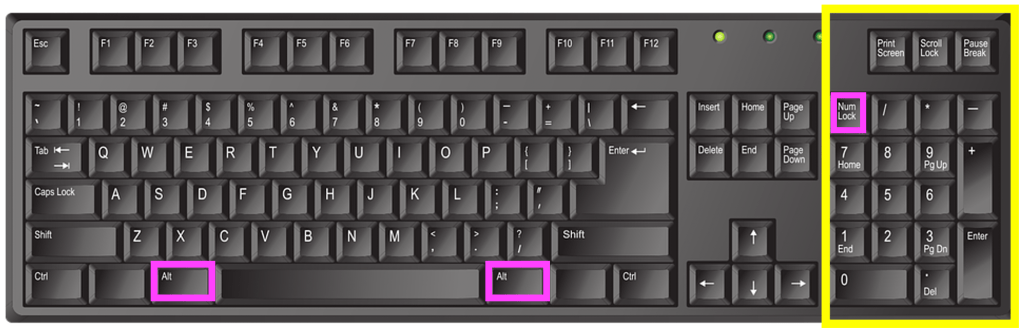
The use of software to expand the usefulness of QWERTY keyboards is now commonplace with programs pre-installed onto devices which run in the background. These IMEs or Input Method Editors can convert a set of keystrokes into a character that’s not available on the keyboard itself. For example, while I can type SHIFT+8 to display the asterisk (*) symbol that sits on the 8 key there’s no degree symbol (as in 30°C) on my keyboard. On a Windows computer I can create it using the numeric keypad on the right of some keyboards, holding down the ALT key while typing the sequence 0176. While I’m typing the numbers nothing appears but once I complete the sequence and release the ALT key the ° appears on the screen.
English language keyboard image by john forcier from Pixabay highlighted by CS4FN, showing the numeric keypad highlighted in yellow with the two Alt keys and the ‘num lock’ key highlighted in pink. Num lock (‘numeric lock’) needs to be switched on for the keypad to work, then use the Alt key plus a combination of letters on the numeric keypad to produce a range of additional ‘alt code‘ characters.
When Japanese speakers type they use the main ‘ABC’ letters on the keyboard, but the principle is the same – a combination of keys produces a sequence of letters that the IME converts to the correct character. Or perhaps they could use Google Japan’s April Fool solution from 2010, which surrounded the user in half a dozen massive keyboards with hundreds of keys a little like sitting on a massive drum kit!
*QWERTY is a ‘word’ which starts with a Q that’s not followed by a U of course…
The ‘retrieval system’ of typing mentioned above, which lets the user get to the word or characters more quickly, is similar to the general problem solving strategy called ‘Divide and Conquer’. You can read more about that and other search algorithms in our free booklet ‘Searching to Speak‘ (PDF) which explores how the design of an algorithm could allow someone with locked-in syndrome to communicate. Locked-in syndrome is a condition resulting from a stroke where a person is totally paralysed. They can see, hear and think but cannot speak. How could a person with Locked-in syndrome write a book? How might they do it if they knew some computational thinking?
EPSRC supports this blog through research grant EP/W033615/1.
Being creative isn’t just for the fun of it. It can be serious too. Marketing people are paid vast amounts to come up with slogans for new products, and in the political world, a good, memorable soundbite can turn the tide over who wins and loses an election. Coming up with great slogans that people will remember for years needs both a mastery of language and a creative streak too. Algorithms are now getting in on the act, and if anyone can create a program as good as the best humans, they will soon be richer than the richest marketing executive. Polona Tomašicˇ and her colleagues from the Jožef Stefan Institute in Slovenia are one group exploring the use of algorithms to create slogans. Their approach is based on the way evolution works – genetic algorithms. Only the fittest slogans survive!
A mastery of language
To generate a slogan, you give their program a short description on the slogan’s topic – a new chocolate bar perhaps. It then uses existing language databases and programs to give it the necessary understanding of language.
First, it uses a database of common grammatical links between pairs of words generated from wikipedia pages. Then skeletons of slogans are extracted from an Internet list of famous (so successful) slogans. These skeletons don’t include the actual words, just the grammatical relationships between the words. They provide general outlines that successful slogans follow.
From the passage given, the program pulls out keywords that can be used within the slogans (beans, flavour, hot, milk, …). It generates a set of fairly random slogans from those words to get started. It does this just by slotting keywords into the skeletons along with random filler words in a way that matches the grammatical links of the skeletons.
Breeding Slogans
New baby slogans are now produced by mating pairs of initial slogans (the parents). This is done by swapping bits into the baby from each parent. Both whole sections and individual words are swapped in. Mutation is allowed too. For example, adjectives are added in appropriate places. Words are also swapped for words with a related meaning. The resulting children join the new population of slogans. Grammar is corrected using a grammar checker.
Culling Slogans
Slogans are now culled. Any that are the same as existing ones go immediately. The slogans are then rated to see which are fittest. This uses simple properties like their length, the number of keywords used, and how common the words used are. More complex tests used are based on how related the meanings of the words are, and how commonly pairs of words appear together in real sentences. Together these combine to give a single score for the slogan. The best are kept to breed in the next generation, the worst are discarded (they die!), though a random selection of weaker slogans are also allowed to survive. The result is a new set of slogans that are slightly better than the previous set.
The program breeds and culls slogans like this for thousands, even millions of generations, gradually improving them, until it finally chooses its best. The slogans produced are not yet world beating on their own, and vary in quality as judged by humans. For chocolate, one run came up with slogans like “The healthy banana” and “The favourite oven”, for example. It finally settled on “The HOT chocolate” which is pretty good.
More work is needed on the program, especially its fitness function – the way it decides what is a good slogan and what isn’t. As it stands this sort of program isn’t likely to replace anyone’s marketing department. They could help with brainstorming sessions though, to spark new ideas but leaving humans to make the final choice. Supporting human creativity rather than replacing it is probably just as rewarding for the program after all.









 cs4fn
cs4fn 