by Paul Curzon, Queen Mary University of London, from June 2011
At first sight nothing could be more different than textiles and electronics. Put opposites together and you can maybe even bring historical yarns to life. That’s what Queen Mary’s G.Hack team helped do. They are an all-woman group of electronic engineering and computer science research students and they helped build an interactive art installation combining textiles and personal stories about health.
In June 2011 the G.Hack team was asked by Jo Morrison and Rebecca Hoyes from Central Saint Martins College of Art and Design to help make their ‘Threads & Yarns‘ artwork interactive. It was commissioned by the Wellcome Trust as a part of their 75th Anniversary celebrations. They wanted to present personal accounts about the changes that have taken place in health and well-being over the 75 years since they were founded.
A flower from a Threads and Yarns event Photo credit: Jo Morrison.
You pull a cloak around you and disappear! Reality or science fiction? Harry Potter’s invisibility cloak is surely Hogwarts’ magic that science can’t match. Even in Harry Potter’s world it takes powerful magic and complicated spells to make it work. Turns out even that kind of magic can be done with a combination of materials science and computer science. Professor Susumu Tachi of the University of Tokyo has developed a cloak made of thousands of tiny beads. Cameras video what is behind you and a computer system then projects the appropriate image onto the front of the cloak. The beads are made of a special material called retro-reflectrum. It is vital to give the image a natural feel – normal screens give too flat a look, losing the impression of seeing through the person. Now you see me, now you don’t at the flick of a switch.
But could an invisibility cloak, without tiny screens on it, ever be a reality? It sounds impossible especially if you understand how light behaves. It bounces off the things around us, travelling in straight lines. You see them when that reflected light eventually reaches your eyes. I can see the red toy over there because red light bounced from it to me. For it to be invisible, no light from it must reach my eyes, while at the same time light from everything else around should. How could that be possible? Akram Alomainy of Queen Mary, University of London, tells us more.
Well maybe things aren’t quite that simple…halls of mirrors, rainbows, polar bears and desert mirages all suggest some odd things can happen with light! They show that manipulating light is possible and that we may even be able to bend it in a way that alters the way things look – even humans.
Light fantastic
Have you ever wondered how the hall of mirrors in a fun fair distorts your reflection? Some make us look short and fat while others make us tall and slim! It’s all about controlling the behaviour of light. The light rays still travel in straight lines, but the mirrors deceive the eye. The light seems to arrive from a different place to reality because the mirrors are curved, not flat, making the light bounce at odd angles.
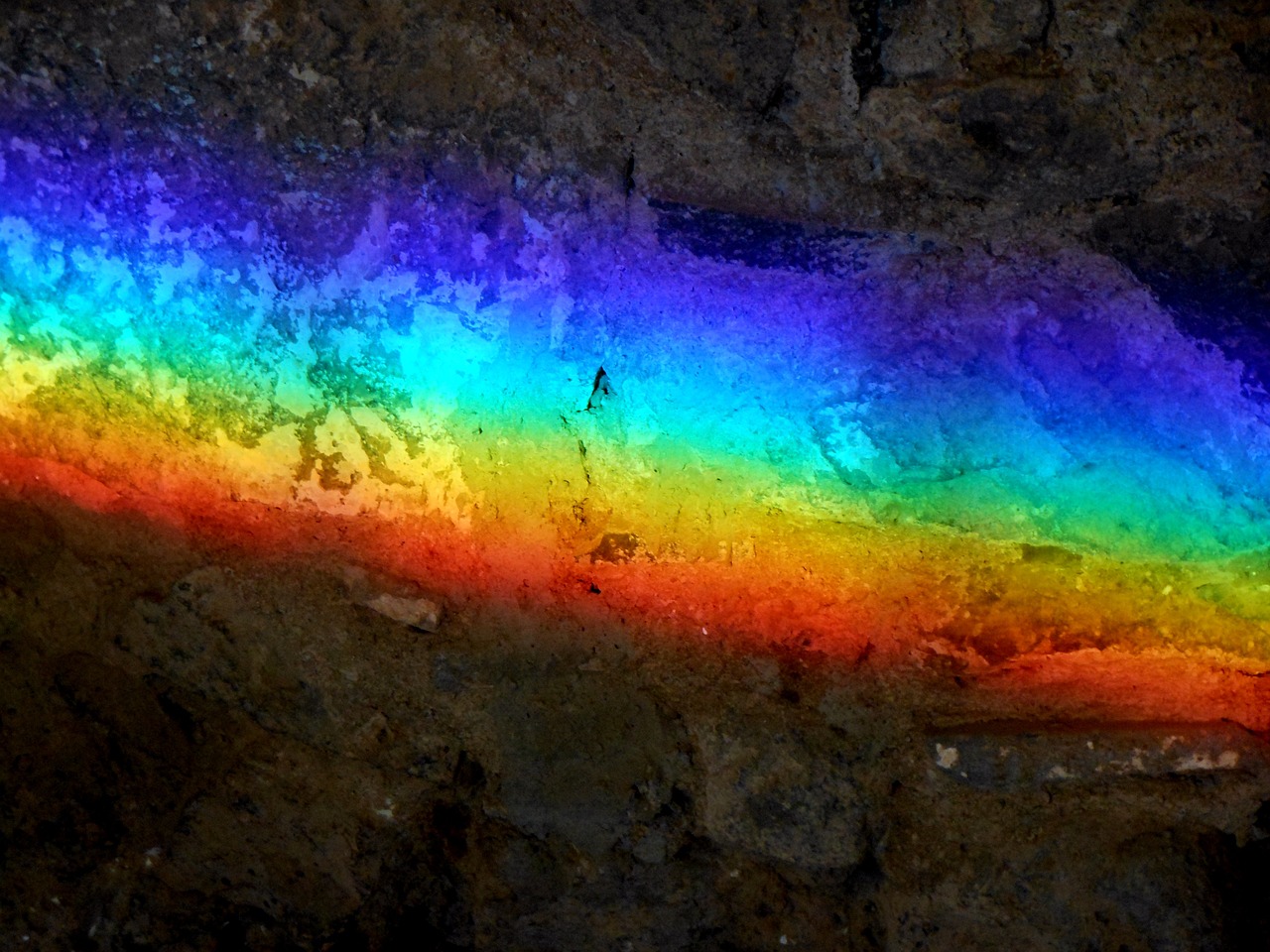
A rainbow is an object we see that isn’t really there. They occur because white light doesn’t actually exist. It is just coloured light all mixed up. When it hits a surface it separates back into individual colours. The colour of an object you see depends on which colours pass through or get reflected, and which get absorbed. The light is white when it hits the raindrops, but then comes out as the whole spectrum of colours. They head off at slightly different angles, which is why they appear in the different rainbow positions.
What about polar bears? Did you know that they have black skins and semi-transparent hair? You see them as white because of the way the hollow hairs reflect sunlight.
So what does this have to do with invisibility? Well, it suggests that with light all is not as it seems. Perhaps we can manipulate it to do anything we want.
Now for the clincher – mirages! They show that invisibility cloaks ought to be a possibility. Light from the sun travels in a straight line through the sky. That means we see everything as it is. Except not quite. In places like deserts where the temperature is very high at noon, apparently weird things happen to the light. The difference between the temperature, and thus the difference in density between the higher air layers and the levels closer to the ground can be quite large. That temperature difference makes light coming from the sky change direction as it passes through each layer. It bends rather than just travelling in a straight line to us. It is that image of the sky that looks like the pool of water – the mirage. Our brains assume the light travelled in a straight line, so they misinterpret its location. Now, to make something invisible we just need to make light bend round it. That invisibility cloak is a possibility if we can just engineer what mirages do – bend light!
Nano-machines
That is the basic idea and it is an area of science called ‘transformation optics’ that makes it possible. The science tells us about the properties that each point of an object must have to make light waves travel in any particular way we wish through it. To make it happen engineers must then create special materials with those properties. These materials are known as metamaterials. Their properties are controlled using electromagnetism, which is where the electronic engineers come in! You can think of them as being made of vast numbers of tiny electrical machines built into big human-scale structures. Each tiny machine is able to control how light passes through it, even bending light in a way no natural material could. If the machines are small enough – ‘nanotechnology’ as small as the wavelength of light – and their properties can be controlled really precisely to match the science’s prediction, then we can make light passing through them do anything we want. For invisibility, the aim is to control those properties so the light bends as it passes through a metamaterial cloak. If the light comes out the other side of the cloak unchanged and travelling in the same direction as it entered, while avoiding objects in the middle, then those objects will be invisible.
Simple cloaking devices that work this way have already been created but they are still very limited. One of the major challenges is the range of light they can work with. At the moment it’s possible to make a cloak that bends a single colour frequency, but not all light. As Yang Hao, a professor working in this area at Queen Mary, notes: “The obstacle engineers face is the complex manufacturing techniques needed to build devices that can bend light across the whole visible light spectrum. However, with the progress being made in nanotechnologies this could become a possibility in the near future”.
Perhaps we should leave the last word to J.K. Rowling: “A suspicious object like that, it was clearly full of Dark Magic.” So while we should appreciate the significance of such an invention we should perhaps be careful about the negative consequences!
This article is a composite of an article originally published on the CS4FN website and from one published on pages 10 and 11 of the first issue of EE4FN magazine (download from the panel below). The topic is also part of The Magic of Computer Science and a new book on ‘Conjuring with Computation’ which is coming soon.
Suppose you want to send messages as fast as possible. What’s the best way to do it? That is what Polina Bayvel, a Professor at UCL has dedicated her research career to: exploring the limits of how fast information can be sent over networks. It’s not just messages that it’s about nowadays of course, but videos, pictures, money, music, books – anything you can do over the Internet.
Send a text message and it arrives almost instantly. Sending message hasn’t always been that quick, though. The Greeks used runners – in fact the Marathon athletic event originally commemorated a messenger who supposedly ran from a battlefield at Marathon to Athens to deliver the message “We won” before promptly dying. The fastest woman in the world at the time of writing, 2011, Paula Radcliffe, at her quickest could deliver a message a marathon distance away in 2 hours 15 minutes and 25 seconds (without dying!) … ( now in 2020, Brigid Kosgei, a minute or so faster).
Horses improved things (and the Greeks in fact normally used horseback messengers, but hey it was a good story). Unfortunately, even a horse can’t keep up the pace for hundreds of miles. The Pony Express pushed horse technology to its limits. They didn’t create new breeds of genetically modified fast horses, or anything like that. All it took was to create an organised network of normal ones. They set up pony stations every 10 miles or so right across North America from Missouri to Sacramento. Why every 10 miles? That’s the point a galloping horse starts to give up the ghost. The mail came thundering in to each station and thundered out with barely a break as it was swapped to a new fresh pony.
The pony express was swiftly overtaken by the telegraph. Like the switch to horses, this involved a new carrier technology – this time copper wire. Now the messages had to be translated first though, here into electrical signals in Morse code. The telegraph was followed by the telephone. With a phone it seems like you just talk and the other person just hears but of course the translation of the message into a different form is still happening. The invention of the telephone was really just the invention of a way to turn sound into an electrical code that could be sent along copper cables and then translated back again.
The Internet took things digital – in some ways that’s a step back towards Morse code. Now, everything, even sound and images, are turned into a code of ones and zeros instead of dots and dashes. In theory images could of course have been sent using a telegraph tapper in the same way…if you were willing to wait months for the code of the image to be tapped in and then decoded again. Better to just wait for computers that can do it fast to be invented.
In the early Internet, the message carrier was still good old copper wire. Trouble is, when you want to send lots of data, like a whole movie, copper wire and electricity are starting to look like the runners must have done to horse riders: slow out-of-date technology. The optical fibre is the modern equivalent of the horse. They are just long thin tubes of glass. Instead of sending pulses of electricity to carry the coded messages, they now go on the back of a pulse of light.
Up to this point it’s been mainly men taking the credit, but this is where Polina’s work comes in. She is both exploring the limits of what can be done with optical fibres in theory and building ever faster optical networks in practice. How much information can actually be sent down fibres and what is the best way to do it? Can new optical materials make a difference? How can devices be designed to route information to the right place – such ‘routers’ are just like mail sorting depots for pulses of light. How can fibre optics best be connected into networks so that they work as efficiently as possible – allowing you and everyone else in your street to be watching different movies at the same time, for example, without the film going all jerky? These are all the kinds of questions that fascinate Polina and she has built up an internationally respected team to help her answer them.
Why are optical fibres such a good way to send messages? Well the obvious answer is that you can’t get much faster than light! Well actually you can’t get ANY faster than light. The speed of light is the fastest anything, including information, can travel according to Einstein’s laws. That’s not the end of the story though. Remember the worn out Marathon runner. It turns out that signals being sent down cables do something similar. Well, not actually getting out of breath and dying but they do get weaker the further they travel. That means it gets harder to extract the information at the other end and eventually there is a point where the message is just garbled noise. What’s the solution? Well actually it’s exactly the one the Pony Express came up with. You add what are called ‘repeaters’ every so often. They extract the message from the optical fibre and then send it down the next fibre, but now back at full strength again. One of the benefits of fibre optics is that signals can go much further before they need a repeater. That means the message gets to its destination faster because those repeaters take time extracting and resending the message. That, in turn, leaves scope for improvement. The Pony Express made their ‘repeaters’ faster by giving the rider a horn to alert the stationmaster that they were arriving. He would then have time to get the next horse ready so it could leave the moment the mail was handed over. Researchers like Polina are looking for similar ways to speed up optical repeaters.
You can do more than play with repeaters to speed things up though. You can also bump up the amount of information you carry in one go. In particular you can send lots of messages at the same time over an optical fibre as long as they use different wavelengths. You can think of this as though one person is using a torch with a blue bulb to send a Morse code message using flashes of blue light (say), while someone else is doing the same thing with a red torch and red light. If two people at the other end are wearing tinted sunglasses then depending on the tint they will each see only the red pulses or only the blue ones and so only get the message meant for them. Each new frequency of light used gives a new message that can be sent at the same time.
The tricky bit is not so much in doing that but in working out which people can use which torch at any particular time so their aren’t any clashes, bearing in mind that at any instant messages could be coming from anywhere in the network and trying to go anywhere. If two people try to use the same torch on the same link at the same time it all goes to pot. This is complicated further by the fact that at any time particular links could be very busy, or broken, meaning that different messages may also travel by different routes between the same places, just as you might go a different way to normal when driving if there is a jam. All this, and together with other similar issues, means there are lots of hairy problems to worry about if coming up with a the best possible optical network as Polina is aiming to do.
Polina’s has been highly successful working in this area. She has been made a Fellow of the Royal Academy of Engineering for her work and is also a Royal Society Wolfson Research Merit Award holder. It is only given to respected scientists of outstanding achievement and potential. She has also won the prestigious Patterson Medal awarded for distinguished research in applied physics. It’s important to remember that modern engineering is a team game, though. As she notes she has benefited hugely by having inspiring and supporting mentors, as well as superb students and colleagues. It is her ability to work well with other people that allowed her build a critical mass in her research and so gain all the accolades. All that achieved and she is a mother of two boys to boot. Bringing up children is, of course, a team game too.
– Paul Curzon, Queen Mary University of London, Autumn 2011