The algorithm that could not speak its name

Two hearts interlocked as jigsaw pieces
Image by PIRO4D from Pixabay (cropped)

The first program that was actually creative was probably written by Christopher Strachey, in 1952. It wrote love letters…possibly gay ones.

The letters themselves weren’t particularly special. They wouldn’t make your heart skip a beat if they were written to you, though they are kind of quaint. They actually have the feel of someone learning English doing their best but struggling with the right words! It’s the way the algorithm works that was special. It would be simple to write a program that ‘wrote’ love letters thought up and then pre-programmed by the programmer. Strachey’s program could do much more than that though – it could write letters he never envisaged. It did this using a few simple rules that despite their simplicity gave it the power to write a vast number of different letters. It was based on lists of different kinds of words chosen to be suitable for love letters. There was a list of nouns (like ‘affection’, ‘ardour’, …), a list of adjectives (like ‘tender’, ‘loving’, …), and so on.

It then just chose words from the appropriate list at random and plugged them into place in template sentences, a bit like slotting the last pieces into a jigsaw. It only used a few kinds of sentences as its basic rules such as: “You are my < adjective > < noun >”. That rule could generate, for example, “You are my tender affection.” or “You are my loving heart”, substituting in different combinations of its adjectives and nouns. It then combined several similar rules about different kinds of sentences to give a different love letter every time.

Strachey knew Alan Turing, who was a key figure in the creation of the first computers, and they may have worked on the ideas behind the program together. As both were gay it is entirely possible that the program was actually written to generate gay love letters. Oddly, the one word the program never uses is the word ‘love’ – a sentiment that at the time gay people just could not openly express. It was a love letter algorithm that just could not speak its name!

You can try out Strachey’s program [EXTERNAL] and the Twitter Bot loveletter_txt is based on it [EXTERNAL] Better still why not write your own version. It’s not too hard.

Here is one of the offerings from my attempt to write a love letter writing program:

Beloved Little Cabbage,

I cling to your anxious fervour. I want to hold you forever. You are my fondest craving. You are my fondest enthusiasm. My affection lovingly yearns for your loveable passion.

Yours, keenly Q

The template I used was:

salutation1 + ” ” + salutation2 + “,”

“I ” + verb + ” your ” + adjective + ” ” + noun + “.”

“You are my ” + noun + “.”

“I want ” + verb + ” you forever.”

“I ” + verb + ” your ” + adjective + ” ” + noun + “.”

“My ” + noun1 + ” ” + adverb + ” ” + verb  + ” your ” + adjective + ” ” + noun2 + “.”

“Yours, ” + adverb + ” Q”

Here characters in double quotes stay the same, whereas those that are not in quotes are variables: place holders for a word from the word associated word list.

Experiment with different templates and different word lists and create your own unique version. If you can’t program yet, you can do it on paper by writing out the template and putting the different word lists on different coloured small post-it notes. Number them and use dice to choose one at random.

Of course, you don’t have to write love poems. Perhaps, you could use the same idea for a post card writing program this summer holiday…

Paul Curzon, Queen Mary University of London (Updated from the archive)


More on …

Related Magazines …

Subscribe to be notified whenever we publish a new post to the CS4FN blog.


This blog is funded by EPSRC on research agreement EP/W033615/1.

QMUL CS4FN EPSRC logos

Only the fittest slogans survive!

Being creative isn’t just for the fun of it. It can be serious too. Marketing people are paid vast amounts to come up with slogans for new products, and in the political world, a good, memorable soundbite can turn the tide over who wins and loses an election. Coming up with great slogans that people will remember for years needs both a mastery of language and a creative streak too. Algorithms are now getting in on the act, and if anyone can create a program as good as the best humans, they will soon be richer than the richest marketing executive. Polona Tomašicˇ and her colleagues from the Jožef Stefan Institute in Slovenia are one group exploring the use of algorithms to create slogans. Their approach is based on the way evolution works – genetic algorithms. Only the fittest slogans survive!

A mastery of language

To generate a slogan, you give their program a short description on the slogan’s topic – a new chocolate bar perhaps. It then uses existing language databases and programs to give it the necessary understanding of language.

First, it uses a database of common grammatical links between pairs of words generated from wikipedia pages. Then skeletons of slogans are extracted from an Internet list of famous (so successful) slogans. These skeletons don’t include the actual words, just the grammatical relationships between the words. They provide general outlines that successful slogans follow.

From the passage given, the program pulls out keywords that can be used within the slogans (beans, flavour, hot, milk, …). It generates a set of fairly random slogans from those words to get started. It does this just by slotting keywords into the skeletons along with random filler words in a way that matches the grammatical links of the skeletons.

Breeding Slogans

New baby slogans are now produced by mating pairs of initial slogans (the parents). This is done by swapping bits into the baby from each parent. Both whole sections and individual words are swapped in. Mutation is allowed too. For example, adjectives are added in appropriate places. Words are also swapped for words with a related meaning. The resulting children join the new population of slogans. Grammar is corrected using a grammar checker.

Culling Slogans

Slogans are now culled. Any that are the same as existing ones go immediately. The slogans are then rated to see which are fittest. This uses simple properties like their length, the number of keywords used, and how common the words used are. More complex tests used are based on how related the meanings of the words are, and how commonly pairs of words appear together in real sentences. Together these combine to give a single score for the slogan. The best are kept to breed in the next generation, the worst are discarded (they die!), though a random selection of weaker slogans are also allowed to survive. The result is a new set of slogans that are slightly better than the previous set.

Many generations later…

The program breeds and culls slogans like this for thousands, even millions of generations, gradually improving them, until it finally chooses its best. The slogans produced are not yet world beating on their own, and vary in quality as judged by humans. For chocolate, one run came up with slogans like “The healthy banana” and “The favourite oven”, for example. It finally settled on “The HOT chocolate” which is pretty good.

More work is needed on the program, especially its fitness function – the way it decides what is a good slogan and what isn’t. As it stands this sort of program isn’t likely to replace anyone’s marketing department. They could help with brainstorming sessions though, to spark new ideas but leaving humans to make the final choice. Supporting human creativity rather than replacing it is probably just as rewarding for the program after all.

(From the archive)


More on …

Related Magazines …

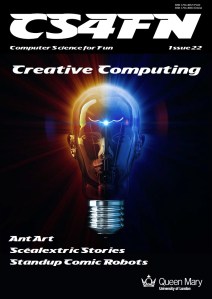
Issue 22 Cover Creative Computing

Subscribe to be notified whenever we publish a new post to the CS4FN blog.


This blog is funded by EPSRC on research agreement EP/W033615/1.
QMUL CS4FN EPSRC logos

Stopping sounds getting left behind: the Bela computer

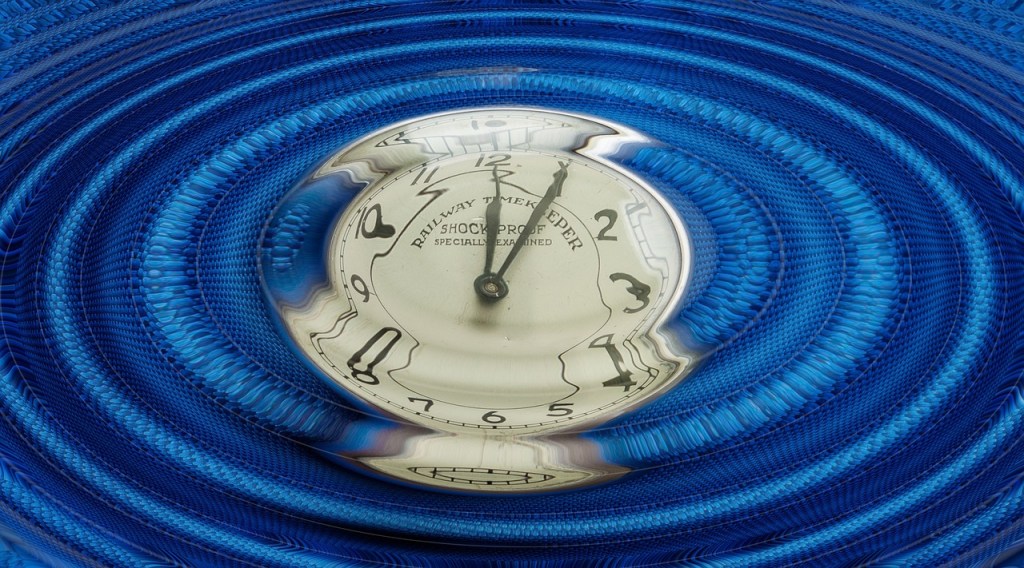
Clock submerged under blue ripples of sound
Clock Waves Image by Gerd Altmann from Pixabay

Computer-based musical instruments are so flexible and becoming more popular. They have had one disadvantage though. The sound could drag behind the musician in a way that made some digital instruments seem unplayable. Thanks to a new computer called Bela, that problem may now be a thing of the past.

If you pluck a guitar string or thwack a drum the sound you hear is instantaneous. Well, nearly. There’s a tiny delay. The sound still has to leave the instrument and travel to your ear. The vibration of the string or drum skin pushes the air back and forth, and vibrating air is all a sound is. Your ear receives the sound as soon as that vibrating air gets to you. Then your brain has to recognise it as a sound (and tell you what kind of sound it is, which direction it came from, which instrument produced it and so on!). The time it takes for sound and then your brain to do all that is measured in tens of milliseconds – thousandths of a second. It is called ‘latency‘, not because the delay makes it ‘late’ (though it does!), but from the Latin word latens which means hidden or concealed, because the time between the signal being created and being received, it is hidden from us.

Digital instruments take slightly longer than physical instruments, however, because electronic circuitry and computer processing is involved. It’s not just the sound going through air to ear but a digital signal whizzing through a circuit, or being processed by a computer, first to generate the sound which then goes through air to ear.

Your ear (actually your brain) will detect two sounds as being separate if there’s a gap of around 30 milliseconds between them. Drop that gap down to around 10 milliseconds between the sounds and you’ll hear them as a single sound. If that circuit-whizzing adds 10-20 milliseconds then you’re going to notice that the instrument is lagging behind you, making it feel unplayable. Reducing a digital instrument’s latency is therefore a very important part of improving the experience for the musician.

In 2014 Andrew McPherson and colleagues at Queen Mary University of London aimed to solve this problem. They developed Bela, a tiny computer, similar in size to a Raspberry Pi or Arduino, that can be used in a variety of digital instruments but which is special because it has an ultra-low latency of only around 2 milliseconds – super fast.

How does it do it? A computer can seem to run slowly if it is trying to do lots of things at the same time (e.g. lots of apps running or too many windows open at once). That is when the experience for the user can be a bit glitchy. Bela works by prioritising the audio signal above ALL other activities to ensure that, no matter what else the computer is doing, the gap between input (pressing a key) and output (hearing a sound) is barely noticeable. The small size of Bela also makes it completely portable and so easy to use in musical performances without needing the performer to be tethered to a large computer.

There is definitely a demand for such a computer amongst musicians. Andrew and the team wanted to make Bela available, so began fundraising through Kickstarter to create more kits. Their fundraiser reached £5,000 within four hours and within a month they’d raised £54,000, so production could begin and they launched a company, Augmented Instruments Ltd, to sell the Bela hardware kits.

Bela allows musicians to stop worrying about the sounds getting left behind. Instead, they can just get on with playing and creating amazing sounds.

Jo Brodie and Paul Curzon, Queen Mary University of London

Watch…


Subscribe to be notified whenever we publish a new post to the CS4FN blog.


This blog is funded by EPSRC on research agreement EP/W033615/1.

QMUL CS4FN EPSRC logos

Ada Lovelace: Visionary

It is 1843, Queen Victoria is on the British throne. The industrial revolution has transformed the country. Steam, cogs and iron rule. The first computers won’t be successfully built for a hundred years. Through the noise and grime one woman sees the future. A digital future that is only just being realised.

Ada Lovelace is often said to be the first programmer. She wrote programs for a designed, but yet to be built, computer called the Analytical Engine. She was something much more important than a programmer, though. She was the first truly visionary person to see the real potential of computers. She saw they would one day be creative.

Charles Babbage had come up with the idea of the Analytical Engine – how to make a machine that could do calculations so we wouldn’t need to do it by hand. It would be another century before his ideas could be realised and the first computer was actually built. As he tried to get the money and build the computer, he needed someone to help write the programs to control it – the instructions that would tell it how to do calculations. That’s where Ada came in. They worked together to try and realise their joint dream, jointly working out how to program.

Ada also wrote “The Analytical Engine has no pretensions to originate anything.” So how does that fit with her belief that computers could be creative? Read on and see if you can unscramble the paradox.

Ada was a mathematician with a creative flair and while Charles had come up with the innovative idea of the Analytical Engine itself, he didn’t see beyond his original idea of the computer as a calculator, she saw that they could do much more than that.

The key innovation behind her idea was that the numbers could stand for more than just quantities in calculations. They could represent anything – music for example. Today when we talk of things being digital – digital music, digital cameras, digital television, all we really mean is that a song, a picture, a film can all be stored as long strings of numbers. All we need is to agree a code of what the numbers mean – a note, a colour, a line. Once that is decided we can write computer programs to manipulate them, to store them, to transmit them over networks. Out of that idea comes the whole of our digital world.

Ada saw even further though. She combined maths with a creative flair and so she realised that not only could they store and play music they could also potentially create it – they could be composers. She foresaw the whole idea of machines being creative. She wasn’t just the first programmer, she was the first truly creative programmer.

Paul Curzon, Queen Mary University of London

More on …

Magazines

Subscribe to be notified whenever we publish a new post to the CS4FN blog.


This blog is funded by EPSRC on research agreement EP/W033615/1.

QMUL CS4FN EPSRC logos


Standup Robots

‘How do robots eat pizza?’… ‘One byte at a time’. Computational Humour is real, but it’s not jokes about computers, it’s computers telling their own jokes.

Computers can create art, stories, slogans and even magic tricks. But can computers perform themselves? Can robots invent their own jokes? Can they tell jokes?

Combining Artificial Intelligence, computational linguistics and humour studies (yes you can study how to be funny!) a team of Scottish researchers made an early attempt at computerised standup comedy! They came up with Standup (System to Augment Non Speakers Dialogue Using Puns): a program that generates riddles for kids with language difficulties. Standup has a dictionary and joke-building mechanism, but does not perform, it just creates the jokes. You will have to judge for yourself as to whether the puns are funny. You can download the software from here. What makes a pun funny? It is a about the word having two meanings at exactly the same time in a sentence. It is also about generating an expectation that you then break: a key idea about what is at the core of creativity too.

A research team at Virginia Tech in the US created a system that started to learn about funny pictures. Having defined a ‘funniness score’ they created a computational model for humorous scenes, and trained it to predict funniness, perhaps with an eye to spotting pics for social media posting, or not.

But are there funny robots out there? Yes! RoboThespian programmed by researchers at Queen Mary University of London, and Data, created by researchers at Carnegie Mellon University are both robots programmed to do stand-up comedy. Data has a bank of jokes and responds to audience reaction. His developers don’t actually know what he will do when he performs, as he is learning all the time. At his first public gig, he got the crowd laughing, but his timing was poor. You can see his performance online, in a TED Talk.

RoboThespian did a gig at the London Barbican alongside human comedians. The performance was a live experiment to understand whether the robot could ‘work the audience’ as well as a human comedian. They found that even relatively small changes in the timing of delivery make a big difference to audience response.

What have these all got in common? Artificial Intelligence, machine learning and studies to understand what humour actually is, are being combined to make something that is funny. Comedy is perhaps the pinnacle of creativity. It’s certainly not easy for a human to write even one joke, so think how hard it is distill that skill into algorithms and train a computer to create loads of them.

You have to laugh!

Jane Waite, Queen Mary University of London, Summer 2017

Watch …

More on …

Magazines

Subscribe to be notified whenever we publish a new post to the CS4FN blog.


This blog is funded by EPSRC on research agreement EP/W033615/1.
QMUL CS4FN EPSRC logos