Music-making mates for Mortimer

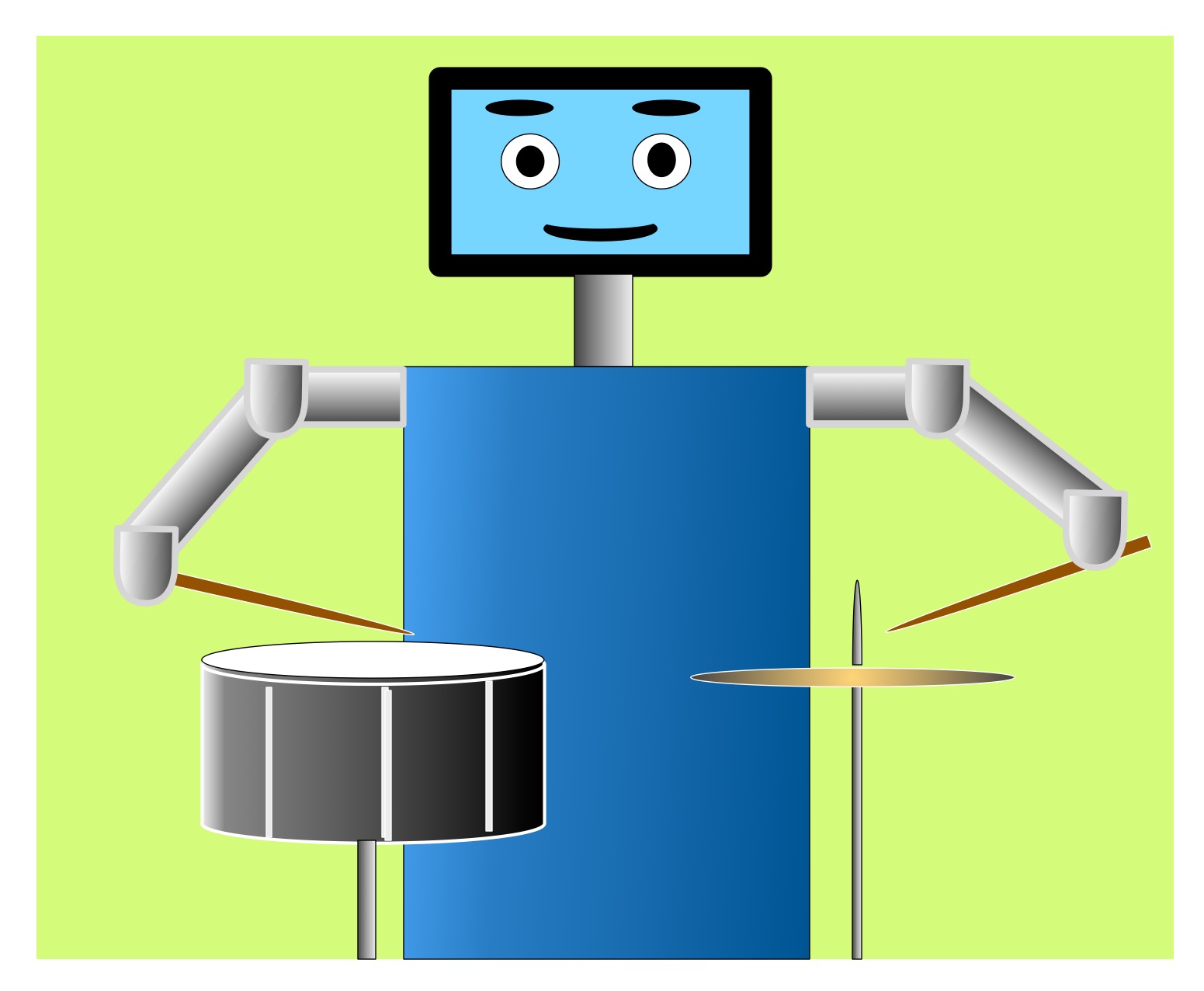
Drumming Robot after Mortimer
Image by CS4FN

Robots are cool. Fact. But can they keep you interested for more than a short time? Over months? Years even? Louis McCallum of Queen Mary University of London tells us about his research using Mortimer a drumming robot.

Roboticists (thats what we’re called) have found it hard to keep humans engaged with robots once the novelty wears off. They’re either too simple and boring, or promise too much and disappoint. So, at Queen Mary University of London we’ve built a robot called Mortimer that can not only play the drums, but also listen to humans play the piano and jam along. He can talk (a bit) and smile too. We hope people will build long term relationships with him through the power of music.

Robots have been part of our lives for a long time, but we rarely see them. They’ve been building our cars and assembling circuit boards in factories, not dealing with humans directly. Designing robots to have social interactions is a completely different challenge that involves engineering and artificial intelligence, but also psychology and cognitive science. Should a robot be polite? How long and accurate should a robot’s memory be? What type of voice should it have and how near should it get to you?

It turns out that making a robot interact like a human is tricky, even the slightest errors make people feel weird. Just getting a robot to speak naturally and understand what we’re saying is far from easy. And if we could, would we get bored of them asking the same questions every day? Would we believe their concern if they asked how we were feeling?

Would we believe their concern
if they asked how we were feeling?

Music is emotionally engaging but in a way that doesn’t seem fake or forced. It also changes constantly as we learn new skills and try new ideas. Although there have been many examples of family bands, duetting couples, and band members who were definitely not friends, we think there are lots of similarities between our relationships with people we play music with and ‘voluntary non-kin social relationships’ (as robotocists call them – ‘friendships’ to most people!). In fact, we have found that people get the same confidence boosting reassurance and guidance from friends as they do from people they play music with.

So, even if we are engaged with a machine, is it enough? People might spend lots of time playing with a guitar or drum machine but is this a social relationship? We tested whether people would treat Mortimer differently if it was presented as a robot you could socially interact with or simply as a clever music machine. We found people played for longer uninterrupted and stopped the robot whilst it was playing less often if they thought you could socially interact with it. They also spent more time looking at the robot when not playing and less time looking at the piano when playing. We think this shows they were not only engaged with playing music together but also treating him in a social manner, rather than just as a machine. In fact, just because he had a face, people talked to Mortimer even though they’d been told he couldn’t hear or understand them!

So, if you want to start a relationship with a creative robot, perhaps you should learn to play an instrument!

– Louis McCallum, Queen Mary University of London (from the archive)

Watch …

Watch the video Louis made with the Royal Institution about Mortimer

More on …

Magazines …

Front cover of CS4FN issue 29 - Diversity in Computing

Subscribe to be notified whenever we publish a new post to the CS4FN blog.


This page and talk are funded by EPSRC on research agreement EP/W033615/1.

QMUL CS4FN EPSrC logos

Aaron and the art of art

Aaron is a successful American painter. Aaron’s delicate and colourful compositions on canvas sell well in the American art market, and have been exhibited worldwide, in London’s Tate Modern gallery and the San Francisco Museum of Modern Art for example. Oh and by the way, Aaron is a robot!

Yes, Aaron is a robot, controlled by artificial intelligence, and part of a lifelong experiment undertaken by the late Harold Cohen to create a creative machine. Aaron never paints the same picture twice; it doesn’t simply recall pictures from some big database. Instead Aaron has been programmed to work autonomously. That is, once it starts there is no further human intervention, Aaron just draws and paints following the rules for art that it has been taught.

Perfecting the art of painting

Aaron’s computer program has grown and developed over the years, and like other famous painters, has passed though a number of artistic periods. Back in the early 1970s all Aaron could do was draw simple shapes, albeit shapes that looked hand drawn – not the sorts of precise geometric shapes that normal computer graphics produced. No, Aaron was going to be a creative artist. In the late 1970s Aaron learned something about artistic perspective, namely that objects in the foreground are larger than objects in a picture’s background. In the late 80s Aaron could start to draw human figures, knowing how the various shapes of the human body were joined together, and then learning how to change these shapes as a body moved in three dimensions. Now Aaron knows how to add colour to its drawings, to get those clever compositions of shades just spot on and to produce bold, unique pictures, painted with brush on canvas by its robotic arm.

It’s what you know that counts

When creating a new painting Aaron draws on two types of knowledge. First Aaron knows about things in the real world: the shapes that make up the human body, or a simple tree. This so called declarative (declared) knowledge is encoded in rules in Aaron’s programming. It’s a little like human memory: you know something about how the different shapes in the world work. This information is stored somewhere in your brain. The second type of knowledge Aaron uses is called procedural knowledge. Procedural knowledge allows you to move (process) from a start to an end through a chain of connected steps. Aaron, for example, knows how to proceed through painting areas of a scene to get the colour balance correct and in particular, getting the tone or brightness of the colour right. That is often more artistically important than the actual colours themselves. Inside Aaron’s computer program these two types of knowledge, declarative and procedural, are continuously interacting with each other in complex ways. Perhaps this blending of the two types of knowledge is the root of artistic creativity?

Creating Creativity

Though a successful artist, and capable of producing pleasing and creative pictures, Aaron’s computer program still has many limitations. Though the pictures look impressive, that’s not enough. To really understand creativity we need to examine the process by which they have been made. We have an ‘artist’ that we can take to pieces and examine in detail. Studying what Aaron can do, given we know exactly what’s been programmed into it, allows us to examine human creativity. What about it is different from the way humans paint, for example? What would we need to add to Aaron to make its process of painting more similar to human creativity?

Not quite human

Unlike a human artist Aaron cannot go back and correct what it does. Studies of great artist’s paintings often show that under the top layer of paint there are many other parts of the picture that have been painted out, or initial sketches that have been redrawn as the artist progresses through the work, perfecting it as they go. Aaron always starts in the foreground of the picture and moves toward painting the background later, whereas human artists can chop and change which part of a picture to work on to get it just right. Perhaps in the future, with human help Aaron or robots like him will develop new human-like painting skills and produce even better paintings. Until then the art world will need to content itself with Aaron’s early period work.

the CS4FN team (updated from the archive)

Some of Aaron’s (and Harold COhen’s) work is on display at the Tate modern until June 2025 as part of the Electric Dreams exhibition.

More on …

Magazines …

Front cover of CS4FN issue 29 - Diversity in Computing

Subscribe to be notified whenever we publish a new post to the CS4FN blog.


This page and talk are funded by EPSRC on research agreement EP/W033615/1.

QMUL CS4FN EPSrC logos

ELIZA: the first chatbot to fool people

Chatbots are now everywhere. You seemingly can’t touch a computer without one offering its opinion, or trying to help. This explosion is a result of the advent of what are called Large Language Models: sophisticated programs that in part copy the way human brains work. Chatbots have been around far longer than the current boom, though. The earliest successful one, called ELIZA, was, built in the 1960s by Joseph Weizenbaum, who with his Jewish family had fled Nazi Germany in the 1930s. Despite its simplicity ELIZA was very effective at fooling people into treating it as if it were a human.

Head thinking in a speech bubble
Image adapted from one by by Gerd Altmann from Pixabay

Weizenbaum was interested in human-computer interaction, and whether it could be done in a more human-like way than just by typing rigid commands as was done at the time. In doing so he set the ball rolling for a whole new metaphor for interacting with computers, distinct from typing commands or pointing and clicking on a desktop. It raised the possibility that one day we could control computers by having conversations with them, a possibility that is now a reality.

His program, ELIZA, was named after the character in the play Pygmalion and musical My Fair Lady. That Eliza was a working class women who was taught to speak with a posh accent gradually improving her speech, and part of the idea of ELIZA was that it could gradually improve based on its interactions. At core though it was doing something very simple. It just looked for known words in the things the human typed and then output a sentence triggered by that keyword, such as a transformation of the original sentence. For example, if the person typed “I’m really unhappy”, it might respond “Why are you unhappy?”.

In this way it was just doing a more sophisticated version of the earliest “creative” writing program – Christopher Strachey’s Love Letter writing program. Strachey’s program wrote love letters by randomly picking keywords and putting them into a set of randomly chosen templates to construct a series of sentences.

The keywords that ELIZA looked for were built into its script written by the programmer and each allocated a score. It found all the keywords in the person’s sentence but used the one allocated the highest score. Words like “I” had a high score so were likely to be picked if present. A sentence starting “I am …” can be transformed into a response “Why are you …?” as in the example above. to make this seem realistic, the program needed to have a variety of different templates to provide enough variety of responses, though. To create the response, ELIZA broke down the sentence typed into component parts, picked out the useful parts of it and then built up a new response. In the above example, it would have pulled out the adjective, “happy” to use in its output with the template part “Why are you …”, for example.

If no keyword was found, so ELIZA had no rule to apply, it could fall back on a memory mechanism where it stored details of the past statements typed by the person. This allowed it to go back to an earlier thing the person had said and use that instead. It just moved on to the next highest scoring keyword from the previous sentence and built a response based on that.

ELIZA came with different “characters” that could be loaded in to it with different keywords and templates of how to respond. The reason ELIZA gained so much fame was due to its DOCTOR script. It was written to behave like a psychotherapist. In particular, it was based on the ideas of psychologist Carl Rogers who developed “person-centred therapy”, where a therapist, for example, echos back things that the person says, always asking open-ended questions (never yes/no ones) to get the patient talking. (Good job interviewers do a similar thing!) The advantage of it “pretending” to be a psychotherapist like this is that it did not need to be based on a knowledge bank of facts to seem realistic. Compare that with say a chatbot that aims to have conversations about Liverpool Football Club. To be engaging it would need to know a lot about the club (or if not appear evasive). If the person asked it “Who do you think the greatest Liverpool manager was?” then it would need to know the names of some former Liverpool managers! But then you might want to talk about strikers or specific games or … A chatbot aiming to have conversations about any topic the person comes up with convincingly needs facts about everything! That is what modern chatbots do have: provided by them sucking up and organising information from the web, for example. As a psychotherapist, DOCTOR never had to come up with answers, and echoing back the things the person said, or asking open-ended questions, was entirely natural in this context and even made ti seem as though it cared about what the people were saying.

Because Eliza did come across as being empathic in this way, the early people it was trialled on were very happy to talk to it in an uninhibited way. Weizenbaum’s secretary even asked him to leave while she chatted with it, as she was telling it things she would not have told him. That was despite the fact, or perhaps partly because, she knew she was talking to a machine. Others were convinced they were talking to a person just via a computer terminal. As a result it was suggested at the time that it might actually be used as a psychotherapist to help people with mental illness!

Weizenbaum was clear though that ELIZA was not an intelligent program, and it certainly didn’t care about anyone, even if it appeared to be. It certainly would not have passed the Turing Test, set previously by Alan Turing that if a computer was truly intelligent people talking to it would be indistinguishable from a person in its answers. Switch to any knowledge-based topic and the ELIZA DOCTOR script would flounder!

ELIZA was also the first in a less positive trend, to make chatbots female because this is seen as something that makes men more comfortable. Weizenbaum chose a female character specifically because he thought it would be more believable as a supportive, emotional female. The Greek myth Pygmalion from which the play’s name derives is about a male sculptor falling in love with a female sculpture he had carved, that then comes to life. Again this fits a trend of automaton and robots in films and reality being modelled after women simply to provide for the whims of men. Weizenbaum agreed he had made a mistake, saying that his decision to name ELIZA after a woman was wrong because it reinforces a stereotype of women. The fact that so many chatbots have then copied this mistake is unfortunate.

Because of his experiences with ELIZA he went on to become a critic of Artificial Intelligence (AI). Well before any program really could have been called intelligent (the time to do it!), he started to think about the ethics of AI use, as well as of the use of computers more generally (intelligent or not). He was particularly concerned about them taking over human tasks around decision making. He particularly worried that human values would be lost if decision making was turned into computation, beliefs perhaps partly shaped by his experiences escaping Germany where the act of genocide was turned into a brutally efficient bureaucratic machine, with human values completely lost. Ultimately, he argued that computers would be bad for society. They were created out of war and would be used by the military as a a tool for war. In this, given, for example, the way many AI programs have been shown to have built in biases, never mind the weaponisation of social media, spreading disinformation and intolerance in recent times, he was perhaps prescient.

by Paul Curzon, Queen Mary University of London

Fun to do

If you can program why not have a go at writing an ELIZA-like program yourself….or perhaps a program that runs a job interview for a particular job based on the person specification for it.

More on …

Magazines …

Front cover of CS4FN issue 29 - Diversity in Computing
Cover of CS4FN Issue 16 - Clean up your language


Subscribe to be notified whenever we publish a new post to the CS4FN blog.


This page and talk are funded by EPSRC on research agreement EP/W033615/1.

Sarah Angliss: Hugo is no song bird

What was the first technology for recording music: CDs? Records? 78s, The phonograph? No. Trained songbirds came before all of them.

Composer, musician, engineer and visiting fellow at Goldsmiths University, Sarah Angliss, usually has a robot on stage performing live with her. These robots are not slick high tech cyber-beings, but junk modelled automata. One, named Hugo, sports a spooky ventriloquist dolls head! Sarah builds and programs her robots, herself.

She is also a sound historian, and worked on a Radio 4 documentary, ‘The Bird Fancyer’s Delight‘, uncovering how birds have been used to provide music across the ages. During the 1700’s people trained songbirds to sing human invented tunes in their homes. You could buy special manuals showing how to train your pet bird. By playing young birds a tune over and over again, and in the absence of other birds to put them right, they would adopt that song as their own. Playing the recorder was one way to train them, but special instruments were also invented to do the job automatically.

With the invention of the phonograph, home songbird popularity plummeted but it didn’t completely die out. Blackbirds, thrushes, canaries, budgies, bullfinches and other songbirds have continued to be schooled to learn songs that they would never sing in the wild.

Jane Waite, Queen Mary University of London


Related Magazine …


More from Sarah Angliss


Subscribe to be notified whenever we publish a new post to the CS4FN blog.


This page is funded by EPSRC on research agreement EP/W033615/1.

QMUL CS4FN EPSRC logos

Photogrammetry for fun, preservation and research

Digitally stitching together 2D photographs to visualise the 3D world

Composite image of one green glass bottle made from three photographs. Image by Jo Brodie

Imagine you’re the costume designer for a major new film about a historical event that happened 400 years ago. You’d need to dress the actors so that they look like they’ve come from that time (no digital watches!) and might want to take inspiration from some historical clothing that’s being preserved in a museum. If you live near the museum, and can get permission to see (or even handle) the material that makes it a bit easier but perhaps the ideal item is in another country or too fragile for handling.

This is where 3D imaging can help. Photographs are nice but don’t let you get a sense of what an object is like when viewed from different angles, and they don’t really give a sense of texture. Video can be helpful, but you don’t get to control the view. One way around that is to take lots of photographs, from different angles, then ‘stitch’ them together to form a three dimensional (3D) image that can be moved around on a computer screen – an example of this is photogrammetry.

In the (2D) example above I’ve manually combined three overlapping close-up photos of a green glass bottle, to show what the full size bottle actually looks like. Photogrammetry is a more advanced version (but does more or less the same thing) which uses computer software to line up the points that overlap and can produce a more faithful 3D representation of the object.

In the media below you can see a looping gif of the glass bottle being rotated first in one direction and then the other. This video is the result of a 3D ‘scan’ made from only 29 photographs using the free software app Polycam. With more photographs you could end up with a more impressive result. You can interact with the original scan here – you can zoom in and turn the bottle to view it from any angle you choose.

A looping gif of the 3D Polycam file being rotated one way then the other. Image by Jo Brodie

You might walk around your object and take many tens of images from slightly different viewpoints with your camera. Once your photogrammetry software has lined the images up on a computer you can share the result and then someone else would be able to walk around the same object – but virtually!

Photogrammetry is being used by hobbyists (it’s fun!) but is also being used in lots of different ways by researchers. One example is the field of ‘restoration ecology’ in particular monitoring damage to coral reefs over time, but also monitoring to see if particular reef recovery strategies are successful. Reef researchers can use several cameras at once to take lots of overlapping photographs from which they can then create three dimensional maps of the area. A new project recently funded by NERC* called “Photogrammetry as a tool to improve reef restoration” will investigate the technique further.

Photogrammetry is also being used to preserve our understanding of delicate historic items such as Stuart embroideries at The Holburne Museum in Bath. These beautiful craft pieces were made in the 1600s using another type of 3D technique. ‘Stumpwork’ or ‘raised embroidery’ used threads and other materials to create pieces with a layered three dimensional effect. Here’s an example of someone playing a lute to a peacock and a deer.

Satin worked with silk, chenille threads, purl, shells, wood, beads, mica, bird feathers, bone or coral; detached buttonhole variations, long-and-short, satin, couching, and knot stitches; wood frame, mirror glass, plush”, 1600s. Photo CC0 from Metropolitan Museum of Art uploaded by Pharos on Wikimedia.

A project funded by the AHRC* (“An investigation of 3D technologies applied to historic textiles for improved understanding, conservation and engagement“) is investigating a variety of 3D tools, including photogrammetry, to recreate digital copies of the Stuart embroideries so that people can experience a version of them without the glass cases that the real ones are safely stored in.

Using photogrammetry (and other 3D techniques) means that many more people can enjoy, interact with and learn about all sorts of things, without having to travel or damage delicate fabrics, or corals.

*NERC (Natural Environment Research Council) and AHRC (Arts and Humanities Research Council) are two organisations that fund academic research in universities. They are part of UKRI (UK Research & Innovation), the wider umbrella group that includes several research funding bodies.

Other uses of photogrammetry

Examples of cultural heritage and ecology are highlighted in the post but also interactive games (particularly virtual reality), engineering and crime scene forensics and the film industry use photogrammetry, an example is Mad Max: Fury Road which used the technique to create a number of its visual effects. Hobbyists also create 3D versions (called ‘3D assets’) of all sorts of objects and sell these to games designers to include in their games for players to interact with.

Jo Brodie, Queen Mary University of London

More on …

Careers

This is a past example of a job advert in this area (since closed) for a photogrammetry role in virtual reality.

Also see our collection of Computer Science & Research posts.


Subscribe to be notified whenever we publish a new post to the CS4FN blog.


This page is funded by EPSRC on research agreement EP/W033615/1.

QMUL CS4FN EPSRC logos

Could AI end science?

by Nick Ballou, Oxford Internet Institute

Scientific fraud is worryingly common, though rarely talked about. It has been happening for years, but now Artificial Intelligence programs could supercharge it. If they do that could undermine Science itself.

Investigators of scientific fraud have found that large numbers of researchers have manipulated their results, invented data, or even produced nonsensical papers in the hope that no one will look closely enough to notice. Often, no one does. The problem is that science is built on the foundation of all the research that has gone before. If we can no longer trust that past research is legitimate, the whole system of science begins to break down. AI has the potential to supercharge this process.

We’re not at that point yet, luckily. But there are concerning signs that generative AI systems like ChatGPT and DALLE-E might bring us closer. By using AI technology, producing fraudulent research has never been easier, faster, or more convincing. To understand, let’s first look at how scientific fraud has been done in the past. 

How fraud happens 

Until recently, fraudsters would need to go through some difficult steps to get a fraudulent research paper published. A typical example might look like this: 

Step 1: invent a title

Fraudsters look for a popular but very broad research topic. We’ll take an example of a group of fraudsters known as the Tadpole Paper Mill. They published papers about cellular biology. To choose a new paper to create, the group would essentially use a simple generator, or algorithm, based on a template. This uses a simple technique first used by Christopher Strachey to write love letters in an early “creative” program in the 1950s.

For each “hole” in the template a word is chosen from a word list.

  1. Pick the name of a molecule
    • Either a protein name, a drug name or an RNA molecule name
    • eg mir-488
  2. Pick a verb
    • From alleviates, attenuates, exerts, …
    • eg inhibits
  3. Pick one or two cellular processes
    • From invasion, migration, proliferation, …
    • eg cell growth and metastasis
  4. Pick a cancer or cell type
    • From lung cancer, ovarian cancer, …
    • eg renal cell carcinoma
  5. Pick a connector word
    • From by, via, through, …
    • eg by
  6. Pick a verb
    • From activating, targeting, …
    • eg targeting
  7. Pick a name
    • Either a pathway, protein or miRNA molecule name
    • eg hMgn5

This produces a complicated-sounding title such as “mir-488 inhibits cell growth and metastasis in renal cell carcinoma by targeting hMgn5”. This is the name of a real fraudulent paper created this way.

Step 2: write the paper

Next, the fraudsters create the text of the paper. To do this, they often just plagiarise and lightly edit previous similar papers, substituting key words in from their invented title perhaps. To try to hide the plagiarism, they automatically swap out words, replacing them with synonyms. This often leads to ridiculous (and kind of hilarious) replacements, like these found in plagiarised papers: 

  • “Big data” –> “Colossal information” 
  • “Cloud computing” –> “Haze figuring”
  • “Developing countries” –> “Creating nations”
  • “Kidney failure” –> “Kidney disappointment”

Step 3: add in the results

Lastly, the fraudsters need to create results for the fake study. These usually appear in papers in the form of images and graphs. To do this, the fraudsters take the results from several previous papers and recombine them into something that looks mostly real, but is just a Frankenstein mess of other results that have nothing to do with the current paper.

A new paper is born

Using that simple formula, fraudsters have produced thousands of fabricated articles in the last 10 years. Even after a vast amount of effort, the dedicated volunteers who are trying to clean up the mess have only caught a handful. 

However, committing fraud like this successfully isn’t exactly easy, either: the fraudsters still need to come up with a research idea, write the paper themselves without copying too much from previous research, and make up results that look convincing—at least at first glance. 

AI: Adding fuel to the fire 

So what happens when we add modern generative AI programs into the mix? They are Artificial Intelligence programs like ChatGPT or DALL-E that can create text or pictures for you based on written requests. 

Well, the quality of the fraud goes up, and the difficulty of producing it goes way down. This is true for both text and images.

Let’s start with text. Just now, I asked ChatGPT-4 to “write the first two paragraphs of a research paper on a cutting edge topic in psychology.” I then asked it to “write a fake results table that shows a positive relationship between climate change severity and anxiety”. I won’t copy the whole thing—in part because I encourage you to try this yourself to see how it works (not to actually create a fake paper!)—but here’s a sample of what it came up with: 

“As the planet faces increasing temperatures, extreme weather events, and environmental degradation, the mental health repercussions for populations worldwide become a crucial area of investigation. Understanding these effects is vital for developing strategies to support communities in coping with the psychological challenges posed by a changing climate.”

As someone who has written many psychology research papers, I would find the results very difficult to identify as AI-generated—it looks and sounds very similar to how people in my field write, and it even generated Python code to analyse the fake data. I’d need to take a really close look at the origin of the data and so on to figure out that it’s fraudulent. 

But that’s a lot of work required from me as a fraud-buster. For the fraudster, doing this takes about 1 minute, and would not be detected by any plagiarism software in the way previous kinds of fraud can be. In fact, this might only be detected if the fraudsters make a sloppy mistake, like leaving in a disclaimer from the model as in the paper caught which included the text

“[Please note that as an AI language model, I am unable to generate specific tables or conduct tests, so the actual resutls should be included in the table.]”! 

Generative AIs are not close to human intelligence, at least not yet. So, why are they so good at producing convincing scientific research, something that’s commonly seen as one of the most difficult things humans can do? Two reasons play a big part: (1) scientific research is very structured, and (2) there’s a lot of training data. In any given field of research, most papers tend to look pretty similar—an introduction section, a method describing what the researchers did, a results section with a few tables and figures, and a discussion that links it back to the wider research field. Many journals even require a fixed structure. Generative AI programs work using Machine Learning – they learn from data and the more data they are given the better they become. Give a machine learning program millions of images of cats, telling it that is what they are, and it can become very good at recognising cats. Give it millions of images of dogs and it will be able to recognise dogs too. With roughly 3 million scientific papers published every year, generative AI systems are really good at taking these many, many examples of what a scientific report looks like, and producing similar sounding, and similarly structured pieces of text. They do it by predicting what word, sentence and paragraph would be good to come next based on probabilities calculated from all those examples.

Trusting future research

Most research can still be trusted, and the vast majority of scientists are working as hard as they can to advance human knowledge. Nonetheless, we all need to look carefully at research studies to ensure that they are legitimate, and we should be on extra alert as generative AI becomes even more powerful and widespread. We also need to think about how to improve universities and research culture generally, so that people don’t feel like they need to commit scientific fraud—something that usually happens because people are desperate to get or keep a job, or be seen as successful and reap the rewards. Somehow we need to change the game so that fraud no longer pays.

What do you think? Do you have ideas for how we can prevent fraud from happening in the first place, and how can we better detect it when it does occur? It is certainly an important new research topic. Find a solution and you could do massive good. If we don’t find solutions then we could lose the most successful tool human-kind has ever invented that makes all our lives better.


Related Magazines …

Cover issue 22 creativer computing
Cover issue 18 Machines that are creative

More on …


EPSRC supports this blog through research grant EP/W033615/1,

Composing from Compression

Recoloured Cranium head abstract image by Gordon Johnson from Pixabay

Computers compress files to save space. But it also allows them to create music!

Music is special. It’s one of the things, like language, that makes us human, separating us from animals. It’s also special as art, because it doesn’t exist as an object in the world – it depends on human memory. “But what about CDs? They’re objects in the world”, you might say and you’d be right, but the CD is not the music. The CD contains data files of numbers. Those numbers are translated by electronics into the movements in a loudspeaker, to create sound waves. Even the sound waves aren’t music! They only become music when a human hears them, because understanding music is about noticing repetition, variation and development in its structure. That’s why songs have verses and choruses: so we can find a starting point to understand its structure. In fact, we’re so good at understanding musical structure, we don’t even notice we’re doing it. What’s more, music affects us emotionally: we get excited (using the same chemicals that get us excited when we’re in love or ready to flee danger) when we hear the anthem section of a trance track, or recognise the big theme returning at the end of a symphony.

Surprisingly, brains seem to understand musical structure in a way that’s like the algorithms computer scientists use to compress data. It’s better to store data compressed than uncompressed, because it takes less storage space. We think that’s why brains do it too.

Even more surprisingly, brains also seem to be able to learn the best way to store compressed music data. Computers use bits as their basic storage unit, but we can make groups of bits work like other things (numbers, words, pictures, angry birds…); brains seem to do something similar. For example, pitch (high vs. low notes) in sequence is an important part of music: we build melodies by lining up notes of different pitch one after the other. As we learn to hear music (starting before birth, and continuing throughout life), we learn to remember pitch in ever more efficient ways, giving our compression algorithms better and better chances to compress well. And so we remember music better.

Our team use compression algorithms to understand how music works in the human mind. We have discovered that, when our programs compress music, they can sometimes predict musical structures, even if neither they nor a human have “heard” them before. To compress something, you find large sections of repeated data and replace each with a label saying “this is one of those”. It’s like labelling a book with its title: if you’ve read Lord of the Rings, when I say the title you know what I mean without me telling the story. If we do this to the internal structure of music, there are little repetitions everywhere, and the order that they appear is what makes up the music’s structure.

If we compress music, but then decompress it in a different way, we can get a new piece of music in a similar style or genre. We have evidence that human composers do that too!

What our programs are doing is learning to create new music. There’s a long way to go before they produce music you’ll want to dance to – but we’re getting there!

Geraint Wiggins, Queen Mary University of London


Related Magazine …

Subscribe to be notified whenever we publish a new post to the CS4FN blog.


This page is funded by EPSRC on research agreement EP/W033615/1.

QMUL CS4FN EPSRC logos

Creating great game worlds

by Wateen Aliady, Queen Mary University of London

Are you a PUBG or Fortnite addict? Maybe you enjoy playing Minecraft? Have you thought how these games are created? Could you create a game yourself? It is all done using something called a “Game Engine”.

Games and films are similar as they require creativity and effort to make. Every movie is created by a talented cinema director who oversees everything involved in creating the film. Game creators use a special set of tools instead that similarly allow them to make compelling video game worlds, stories, and characters. These tools are called game engines and they bring your creative ideas to life! They are now even used to help make films too. So, whether you’re playing a game or watching a movie, get ready to be amazed as game creators and movie directors, the masterminds behind these incredible works, deliver captivating experiences that will leave us speechless.

Imagine a group of talented people working together to create a great video game. Miracles happen when a team’s mission becomes one. Every member in the team has a certain role, and when they work together, amazing things can happen. A key member in the group is the graphics whiz. They make everything look stunning by creating pretty scenery and characters with lots of details. Then, we have the physics guru who makes sure objects move realistically, like how they would in real life. They make things fall, bounce, and hit each other accurately. For example, they ensure the soccer ball in the game behaves like a real soccer ball when you kick it. Next, the sound expert who adds all the sounds to the game. The game engine takes on all these roles, so the experience and skill of all those people is built into the game engine, so now one person driving it can use it to create a stunning detailed backdrop, with physics that just works, integrated sound and much more.

Game creators use game engines to make all kinds of games. They have been used to create popular games like Minecraft and Fortnite. When you play a game, you enter a completely different world. You can visit epic places with beautiful views and secrets to discover. You can go on big adventures, solve tricky problems, and be immersed in thrilling fights. Game engines allow game developers to make fun and engaging games that people of all ages enjoy playing by looking after all the detail, leaving the developer to focus on the overall experience.

Anyone can learn to use a game engine even powerful industry standard ones like Unity used to create Pokemon Go, Monument Valley and Call of Duty: Mobile. Game engines could help you to create your own novel and creative games. These amazing tools can help you in creating characters, scenes, and adding fun features like animation and music. You can turn your ideas into fun games that you and your friends can play together. You might create a new video game that becomes massively popular, and people love all around the world. All it takes is for you to have the motivation and be willing to put in the time to learn the skills of driving a game engine and to develop your creativity. Interested? Then get started. You can do anything you want in a game world, so use your imagination and let the game engine help you make amazing games!

More on …

Magazines …


EPSRC supports this blog through research grant EP/W033615/1. 

Hallucinating chatbots

Why can’t you trust what an AI says?

by Paul Curzon, Queen Mary University of London

postcards of cuba in a rack
Image by Sunrise from Pixabay

Chatbots that can answer questions and write things for you are in the news at the moment. These Artificial Intelligence (AI) programs are very good now at writing about all sorts of things from composing songs and stories to answering exam questions. They write very convincingly in a human-like way. However, one of the things about them is that they often get things wrong. Apparently, they make “facts” up or as some have described it “hallucinate”. Why should a computer lie or hallucinate? What is going on? Writing postcards will help us see.

Write a postcard

We can get an idea of what is going on if we go back to one of the very first computer programs that generated writing. It was in the 1950s and written by Christopher Strachey a school teacher turned early programmer. He wrote a love letter writing program but we will look at a similar idea: a postcard writing program.

Postcards typically might have lots of similar sentences, like “Wish you were here” or “The weather is lovely”, “We went to the beach” or “I had my face painted with butterflies”. Another time you might write things like: The weather is beautiful”, “We went to the funfair” or “I had my face painted with rainbows”. Christopher Strachey’s idea was to write a program with template sentences that could be filled in by different words: “The weather is …”, “We went to the …”, “I had my face painted with …”. Then the program picks some sentence templates at random, and then picks words at random to go in their slots. In this way, applied to postcard writing it can write millions of unique postcards. It might generate something like the following, for example (where I’ve bolded the words it filled in):

Dear Gran,

I’m on holiday in Skegness. I’ve had a wonderful time.  The weather is sunny,   We went to the beach. I had my face painted with rainbows. I’ve eaten lots strawberry ice cream. Wish you were here!

Lots of love from Mo

but the next time you ask it to it will generate something completely different.

Do it yourself

You can do the same thing yourself. Write lots of sentences on strips of card, leaving gaps for words. Give each gap a number label and note whether it is an adjective (like ‘lovely’ or ‘beautiful’) or a noun (like ‘beach’ or ‘funfair’, ‘butterflies’ or ‘rainbows’). You could also have gaps for verbs or adverbs too. Now create separate piles of cards to fit in each gap. Write the number that labels the gap on one side and different possible words of the right kind for that gap on the other side of the cards. Then keep them in numbered piles.

To generate a postcard (the algorithm or steps for you to follow), shuffle the sentence strips and pick three or four at random. Put them on the table in front of you to spell out a message. Next, go to the numbered pile for each gap in turn, shuffle the cards in that pile and then take one at random. Place it in the gap to complete the sentence. Do this for each gap until you have generated a new postcard message. Add who it is to and from at the start and end. You have just followed the steps (the algorithm) that our simple AI program is following.

Making things up

When you write a postcard by following the steps of our AI algorithm, you create sentences for the postcard partly at random. It is not totally random though, because of the templates and because you chose words to write on cards for each pile that make sense there. The words and sentences are about things you could have done – they are possible – but that does not mean you did do them!

The AI makes things up that are untrue but sound convincing because even though it is choosing words at random, they are appropriate and it is fitting them into sentences about things that do happen on holiday. People talk of chatbots ‘hallucinating’ or ‘dreaming’ or ‘lying’ but actually, as here, they are always just making the whole thing up just as we are when following our postcard algorithm. They are just being a little more sophisticated in the way that they invent their reality!

Our simple way of generating postcards is far simpler than modern AIs, but it highlights some of the features of how AIs are built. There are two basic parts to our AI. The template sentences ensure that what is produced is grammatical. They provide a simple ‘language model‘: rules of how to create correct sentences in English that sound like a human would write. It doesn’t write like Yoda :

“Truly wonderful, the beach is.”

though it could with different templates.

The second part is the sets of cards that fit the gaps. They have to fit the holes left in the templates – only nouns in the noun gaps, adjectives in the adjectives gap, and also fit

Given a set of template sentences about what you might do on holiday, the cards provide data to train the AI to say appropriate things. The cards for the face paining noun slot need to be things that might be painted on your face. By providing different cards you would change the possible sentences. The more cards the more variety in the sentences it writes.

AIs also have a language model, the rules of the language and which words go sensibly in which places in a sentence. However, they also are trained on data that gives the possibilities of what is actually written. Rather than a person writing templates and thinking up words it is based on training data such as social media posts or other writing on the Internet and what is being learnt from this data is the likelihood of what words come next, rather than just filling in holes in a template. The language model used by AIs is also actually just based on the likelihood of words appearing in sentences (not actual grammar rules).

What’s the chances of that?

So, the chatbots are based on the likelihood of words appearing and that is based on statistics. What do we mean by that? We can add a simple version of it to our Postcard AI but first we would need to collect data. How often is each face paint design chosen at seaside resorts? How often do people go to funfairs when on holiday. We need statistics about these things.

As it stands any word we add to the stack of cards is just as likely to be used. If we add the card maggots to the face painting pile (perhaps because the face painter does gruesome designs at Halloween) then the chatbot could write

“I had my face painted with maggots”.

and that is just as likely as it writing

“I had my face painted with butterflies”.

If the word maggots is not written on a card it will never write it. Either it is possible or it isn’t. We could make the chatbot write things that are more realistic, however, by adding more cards of words that are about things that are more popular. So, if in every 100 people having their face painted, almost a third, 30 people choose to have butterflies painted on their face, then we create 30 cards out of 100 in the pack with the word BUTTERFLY on (instead of just 1 card). If 5 in a 100 people choose the rainbow pattern then we add five RAINBOW cards, and so on. Perhaps we would still have one maggot card as every so often someone who likes grossing people out picks it even on holiday. Then, over all the many postcards written this way by our algorithm, the claims will match statistically the reality of what humans would write overall if they did it themselves.

As a result, when you draw a card for a sentence you are now more likely to get a sentence that is true for you. However, it is still more likely to be wrong about you personally than right (you may have had your face painted with butterflies but 70 of the 100 cards still say something else). It is still being chosen by chance and it is only the overall statistics for all people who have their face painted that matches reality not the individual case of what is likely true for you.

Make it personal

How could we make it more likely to be right about you? You need to personalise it. Collect and give it (ie train it on) more information about you personally. Perhaps you usually have a daisy painted on your face because you like daisies (you personally choose a daisy pattern 70% of the time). Sometimes you have rainbows (20% of the time). You might then on a whim choose each of 10 other designs including the butterfly maybe 1 in a hundred times. So you make a pile of 70 DAISY cards, 20 RAINBOW cards and 1 card for each of the other designs, Now, its choices, statistically at least, will match yours. You have trained it about yourself, so it now has a model of you.

You can similarly teach it more about yourself generally, so your likely activities, by adding more cards about the things you enjoy – if you usually choose chocolate or vanilla ice cream then add lots of cards for CHOCOLATE and lots for VANILLA, and so on. The more cards the postcard generator has of a word, the more likely it is to use that word. By giving it more information about yourself, it is more likely to be able to get things about you right. However, it is of course still making it up so, while it is being realistic, on any given occasion it may or may not match reality that time.

Perfect personalisation

You could go a step further and train it on what you actually did do while on this holiday, so that the only cards in the packs are the ones you did actually do on this holiday. (You ate hotdogs and ice cream and chips and … so there are cards for HOTDOG, ICE CREAM, CHIPS …). You had one vanilla ice cream, two chocolate and one strawberry so have that number of each ice cream card. If it knows everything about you then it will be able to write a postcard that is true! That is why companies behind AIs want to collect every detail of your life. The more they know about you the more they get things right about you and so predict what you will do in future too.

Probabilities from the Internet

The modern chatbots work by choosing words at random based on how likely they are in a similar way to our personalised postcard writer. They pick the most likely words to write next based on probabilities of those words coming next in the data they have been trained on. Their training data is often conversations from the Internet. If the word is most likely to come next in all that training data, then the chatbot is more likely to use that word next. However, that doesn’t make the sentence it comes up with definitely true any more than with our postcard AI.

You can personalise the modern AIs too, by giving them more accurate information about yourself and then they are more likely to get what they write about you right. There is still always a chance of them picking the wrong words, if it is there as a possibility though, as they are still just choosing to some extent at random.

Never trust a chatbot

Artificial Intelligences that generate writing do not hallucinate just some of the time. They hallucinate all of the time, just with a big probability of getting it right. They make everything up. When they get things right it is just because the statistics of the data they were trained on made those words the most likely ones to be picked to follow what went before. Just as the Internet is full of false things, an Artificial Intelligence can get things wrong too.

If you use them for anything that matters, always double check that they are telling you the truth.

More on …

Related Magazines …


EPSRC supports this blog through research grant EP/W033615/1. 

“Tlahcuilo”, a visual composer

by Rafael Pérez y Pérez of the Universidad Autónoma Metropolitana, México

A main goal of computational creativity research is to help us better understand how this essential human characteristic, creativity, works. Creativity is a very complex phenomenon that we only just understand: we need to employ all the tools that we have available to fully comprehend it. Computers are a powerful tool that can help us generate that knowledge and reflect on it. By building computer models of the processes we think are behind creativity, we can start to probe how creativity really works.

When you hear someone claiming that a computer agent, whether program, robot or gadget, is creative, the first question you should ask is: what have we learned? What does studying this agent help us to realise or discover about creativity that we did not know before? If you do not get a satisfactory answer, I would hardly call it a computer model of creativity. As well as being able to generate novel, and interesting or useful, things, a creative agent ought to fulfil other criteria: using its knowledge, creating knowledge and evaluating its own work.

Be knowledgeable!

Truly creative agents should draw on their own knowledge to build the things, such as art, that they create. They should use a knowledge-base, not just create things randomly. We aren’t, for example, interested in programs that arbitrarily pick a picture from the web, randomly apply a filter to it and then claim they have generated art.

Create knowledge!

A creative agent must be able to interpret its own creations in order to generate novel knowledge, and that knowledge should help it produce more original pieces. For example, a program that generates story plots must be able to read its own stories and learn from them, as well as from stories developed by others.

Evaluate it!

To deserve to be called creative, an agent also ought to be able to tell whether the things it has created are good or bad. It should be able to evaluate its work, as well as that produced by similar agents. It’s evaluation should also influence the way the generation process works. We don’t want joke creation programs that churn out thousands of ‘jokes’ leaving a human to decide which are actually funny. A creative agent ought to be able to do that itself!

Design me a design

At the moment few, if any, systems fulfil all these criteria. Nevertheless, I suggest they should be the main goals of those doing research in computational creativity. Over the past 20 years I’ve been studying computer models of creativity, aiming to do exactly that. My main research has focused on story generation, but with my team I’ve also developed programs that aim to create novel visual designs. This is the kind of thing someone developing new fabric, wallpaper or tiling patterns might do, for example. With Iván Guerrero and María González I developed a program called TLAHCUILO. It composes visual patterns based on photographs or an empty canvas. It employs geometrical patterns, like repeated shapes, in the picture and then uses them as the basis of a new abstract pattern.

The word “tlahcuilo” refers to painters and writers
in ancient México responsible for preserving
the knowledge and traditions of their people.

To build the system’s knowledge-base, we created a tool that human designers can use to do the same creative task. TLAHCUILO analyses the steps they follow as they develop a composition and registers what it has learnt in its knowledge base. For example, it might note the way the human designer adds elements to make the pattern symmetrical or to add balance. Once these approaches are in its knowledge base it can use them itself in its own compositions. This is a little like the way an apprentice to a craftsman might work, watching the Master at work, gradually building the experience to do it themselves. Our agent similarly builds on this experience to produce its own original outputs. It can also add its own pieces of work to its knowledge-base. Finally, it is able to assess the quality of its designs. It aims to meet the criteria set out above.

Design me a plot

One of TLAHCUILO’s most interesting characteristics is that it uses the same model of creativity that we used to implement MEXICA, our story plot generator. This allows us to compare in detail the differences and similarities between an agent that produces short-stories and an agent that produces visual compositions. We hope this will allow us to generalise our understanding.

Creativity research is a fascinating field. We hope to learn not just how to build creative agents but more importantly to understand what it takes to be a creative human.

More on …

Related Magazines …

Issue 22 Cover Creative Computing

EPSRC supports this blog through research grant EP/W033615/1.