Transitional Automaton: a poem

Image by Агзам Гайсин from Pixabay M

My poetry collection, «Αλγόριθμοι Σιωπής» (Algorithms of Silence), explores the quiet, often unseen structures that shape our inner lives. As a computer scientist and a poet, I’m fascinated by the language we use to describe these systems – whether they are emotional, social, or computational. 

The following piece is an experiment that embodies this theme. It presents a single core idea – about choice, memory, and predetermination – in three different languages: the original Greek poem “Αυτόματον Μεταβατικόν,” an English transcreation, and a pseudocode version that translates the poem’s philosophical questions into the logic of an automaton.

– Vasileios Klimis, Queen Mary University of London

Transitional Automaton

Once,
a decision – small,
like a flaw in a cogwheel –
tilted the whole system toward a version
never written.

In the workshop of habits,
every choice left behind
a trace of activation;
you don’t see it,
but it returns
like a pulse
through a one-way gate.

I walk through a matrix of transitions
where each state defines the memory of the next.
Not infinite possibilities –
only those the structure permits.

Is this freedom?
Or merely the optimal illusion
of a system with elastic rules?

In moments of quiet
(but not of silence)
I feel the null persisting
not as absence,
but as a repository in waiting.
Perhaps that is where it resides,
all that was never activated.

If there is a continuation,
it will resemble a debug session
more than a crisis.

Not a moral crisis;
a recursion.
Who passes down to the final terminal
the most probable path?

The question is not
what we lived.
But which of the contingencies
remained active
when we
stopped calculating.


Αυτόματον μεταβατικόν

Κάποτε,
μια απόφαση – μικρή, σαν στρέβλωση σε οδοντωτό τροχό –
έγερνε το σύνολο προς μια εκδοχή
που δεν γράφτηκε ποτέ.

Στο εργαστήριο των συνηθειών
κάθε επιλογή άφηνε πίσω της
ένα ίχνος ενεργοποίησης·
δεν το βλέπεις,
αλλά επιστρέφει
σαν παλμός σε μη αντιστρεπτή πύλη.

Περπατώ μέσα σ’ έναν πίνακα μεταβάσεων
όπου κάθε κατάσταση ορίζει τη μνήμη της επόμενης.
Όχι άπειρες πιθανότητες –
μόνον όσες η δομή επιτρέπει.
Είναι ελευθερία αυτό;
Ή απλώς η βέλτιστη πλάνη
ενός συστήματος με ελαστικούς κανόνες;

Σε στιγμές σιγής (αλλά όχι σιωπής)
νιώθω το μηδέν να επιμένει
όχι ως απουσία,
αλλά ως αποθήκη αναμονής.
Ίσως εκεί διαμένει
ό,τι δεν ενεργοποιήθηκε.

Αν υπάρξει συνέχεια,
θα μοιάζει περισσότερο με debug session
παρά με κρίση.

Όχι κρίση ηθική·
μία αναδρομή.
Ποιος μεταβιβάζει στο τερματικό του τέλους
το πιο πιθανό μονοπάτι;

Η ερώτηση δεν είναι τι ζήσαμε.
Αλλά ποιο από τα ενδεχόμενα έμεινε ενεργό
όταν εμείς
σταματήσαμε να υπολογίζουμε.


Pseudocode Poem version

Pseudocode poems are poems written in pseudocode: the semi-formailsed language used for writing algorithms and planning the design of program. Here is the above poem as a pseudocode poem.

FUNCTION life_automaton(initial_state)
  DEFINE State_Transitions AS Matrix;
  DEFINE active_path AS Log;
  DEFINE potential_paths AS Set = {all_versions_never_written};

  current_state = initial_state;
  system.log("Initializing in the workshop of habits.");

  REPEAT

    WAIT FOR event.decision;
    // a decision — small, like a flaw in a cogwheel
    IF (event.decision.is_subtle) THEN
       previous_state = current_state;
       current_state = State_Transitions.calculate_next
                                (previous_state, event.decision);
       // it returns like a pulse through a one-way gate
       active_path.append(previous_state -> current_state);
       potential_paths.remove(current_state.version);
    END IF

   // Is this freedom? Or merely the optimal illusion
   // of a system with elastic rules?
   
   IF (system.isQuiet) THEN
       // I feel the null persisting
       // not as absence, but as a repository in waiting.
       // Perhaps that is where it resides, all that was never activated.
       PROCESS potential_paths.contemplate();
   END IF

  UNTIL system.isTerminated;
   
  // If there is a continuation,
  // it will resemble a debug session more than a crisis.
  // Not a moral crisis; a recursion.
  DEBUG_SESSION.run(active_path);

  // The question is not what we lived.
  // But which of the contingencies remained active
  // when we stopped calculating.
  RETURN final_state = active_path.getLast();
END FUNCTION

More on

Subscribe to be notified whenever we publish a new post to the CS4FN blog.


This page is funded by EPSRC on research agreement EP/W033615/1.

QMUL CS4FN EPSRC logos

Film Futures: Brassed Off

The pit head of a colliery at sunset with a vivid red sky behind the setting sun
Image from Pixabay

Computer Scientists and digital artists are behind the fabulous special effects and computer generated imagery we see in today’s movies, but for a bit of fun, in this series, we look at how movie plots could change if they involved Computer Scientists. Here we look at an alternative version of the film Brassed Off.

***SPOILER ALERT***

Brassed Off, starring Pete Postlethwaite, Tara Fitzgerald and Ewan McGregor, is set at a time when the UK coal and steel industries were being closed down with terrible effects on local communities across the North of England and Wales. It tells the story of the closing of the fictional Grimley Pit (based on the real mining village of Grimethorpe), from the point of view of the members of the colliery brass band and their families. The whole village relies on the pit for their livelihoods.

Danny, the band’s conductor is passionate about the band and wants to keep it going, even if the pit closes. Many of the other band members are totally despondent and just want to take the money that is on offer if they agree to the closure without a fight. They feel they have no future, and have given up hope over both the pit and the band (why have a colliery band if there is no colliery?)

Gloria, a company manager who grew up in the village arrives, conducting a feasibility study for the company to determine if the pit is profitable or not as justification for keeping it open or closing it down. A wonderful musician, she joins the band but doesn’t tell them that she is now management (including not telling her childhood boyfriend, and band member, Andy).

The story follows the battle to keep the pit open, and the effects on the community if it closes, through the eyes of the band members as they take part in a likely final ever brass band competition…

Brassed Off: with computer science

In our computer science film future version, the pit is still closing and Gloria is still management, but with a Computer Science PhD in digital music, she has built a flugelhorn playing robot with a creative AI brain. It can not only play brass band instruments but arrange and compose too. On arriving at Grimley she asks if her robot can join the band. Initially, every one is against the idea, but on hearing how good it is, and how it will help them do well in the national brass band competition they relent. The band, with robot, go all the way to the finals and ultimately win…

The pit, however, closes and there are no jobs, at all, not even low quality work in local supermarkets (automatic tills and robot shelf-stackers have replaced humans) or call centres (now replaced by chatbots). Gloria also loses her job due to a shake-out of middle managers as the AIs take over the knowledge economy jobs. Luckily, she is ok, as with university friends, she starts a company building robot musicians which is an amazing success. The band never make the finals again as bands full of Gloria’s flugelhorn and cornet playing robots take over (also taking the last of the band’s self-esteem). In future years, all the brass bands in the competition are robot bands as with all the pits closing the communities around them collapse. The world’s last ever flugelhorn player is a robot. Gloria and Andy never do get to kiss…

In real life…

Could a robot play a musical instrument? One existed centuries before the computer age. In 1737  Jacques de Vaucanson revealed his flute playing automaton to the public. A small human height figure, it played a real flute, that could be replaced to prove the machine could really play a real instrument. Robots have played various instruments, including drums and a cello playing robot that played with an orchestra in Malmo. While robot orchestras and bands are likely, it seems less likely that humans would stop playing as a result.

Can an AI compose music? Victorian, Ada Lovelace predicted they one day would, a century before the first computer was ever built. She realised that this would be the case just from thinking about the machines that Charles Babbage was trying to build. Her prediction eventually came true. Now of course, generative AI is being used to compose music, and can do so in any style, whether classical or pop. How good, or creative, it is may be debated but it won’t be long before they have super-human music composition powers.

So, a flugelhorn playing robot, that also composes music, is not a pipe dream!

What about the social costs that are the real theme of the film though? When the UK pits and steelworks closed whole communities were destroyed with great, and long lasting, social cost. It was all well and good for politicians to say there are new jobs being created by the new service and knowledge economy, but that was no help when no thought or money had actually been put in to helping communities make the transition. “Get on your bike” was their famous, if ineffective, solution. For example, if the new jobs were to be in technology as suggested then massive technology training programmes for those put out of work were needed, along with financial support in the meantime. Instead, whole communities were effectively left to rot and inequality increased massively. Areas in the North of England and Wales that had been the backbone of the UK economy, still haven’t really recovered 40 years later.

Are we about to make the same mistakes again? We are certainly arriving at a similar point, but now it is those knowledge economy jobs that were supposed to be the saviours 40 years ago that are under threat from AI. There may well be new jobs as old ones disappear…but even if they do will the people who lose their jobs be in a position to take the new ones, or are we heading towards a whole new lost generation. As back then, without serious planning and support, including successful efforts to reduce inequality in society, the changes coming could again cause devastation, this time much more widespread. As it stands technology is increasing, not decreasing, inequality. We need to start now, including coming up with a new economic model of how the world will work that actively reduces inequality in society. Many science fiction writers have written of utopian futures where people only work for fun (eg Arthur C Clarke’s classic “Childhood’s End” is one I’m reading at the moment), but that only happens if wealth is not sucked up by the lucky few. (In “Childhood’s End” it takes alien invaders to force out inequality.)

We can avoid a dystopian future, but only if we try…really hard.

More on …

Subscribe to be notified whenever we publish a new post to the CS4FN blog.


This page is funded by EPSRC on research agreement EP/W033615/1.

QMUL CS4FN EPSRC logos

Sarah Angliss: Hugo is no song bird

by Jane Waite, Queen Mary University of London

What was the first technology for recording music: CDs? Records? 78s, The phonograph? No. Trained songbirds came before all of them.

Composer, musician, engineer and visiting fellow at Goldsmiths University, Sarah Angliss, usually has a robot on stage performing live with her. These robots are not slick high tech cyber-beings, but junk modelled automata. One, named Hugo, sports a spooky ventriloquist dolls head! Sarah builds and programs her robots, herself.

She is also a sound historian, and worked on a Radio 4 documentary, ‘The Bird Fancyer’s Delight‘, uncovering how birds have been used to provide music across the ages. During the 1700’s people trained songbirds to sing human invented tunes in their homes. You could buy special manuals showing how to train your pet bird. By playing young birds a tune over and over again, and in the absence of other birds to put them right, they would adopt that song as their own. Playing the recorder was one way to train them, but special instruments were also invented to do the job automatically.

With the invention of the phonograph, home songbird popularity plummeted but it didn’t completely die out. Blackbirds, thrushes, canaries, budgies, bullfinches and other songbirds have continued to be schooled to learn songs that they would never sing in the wild.


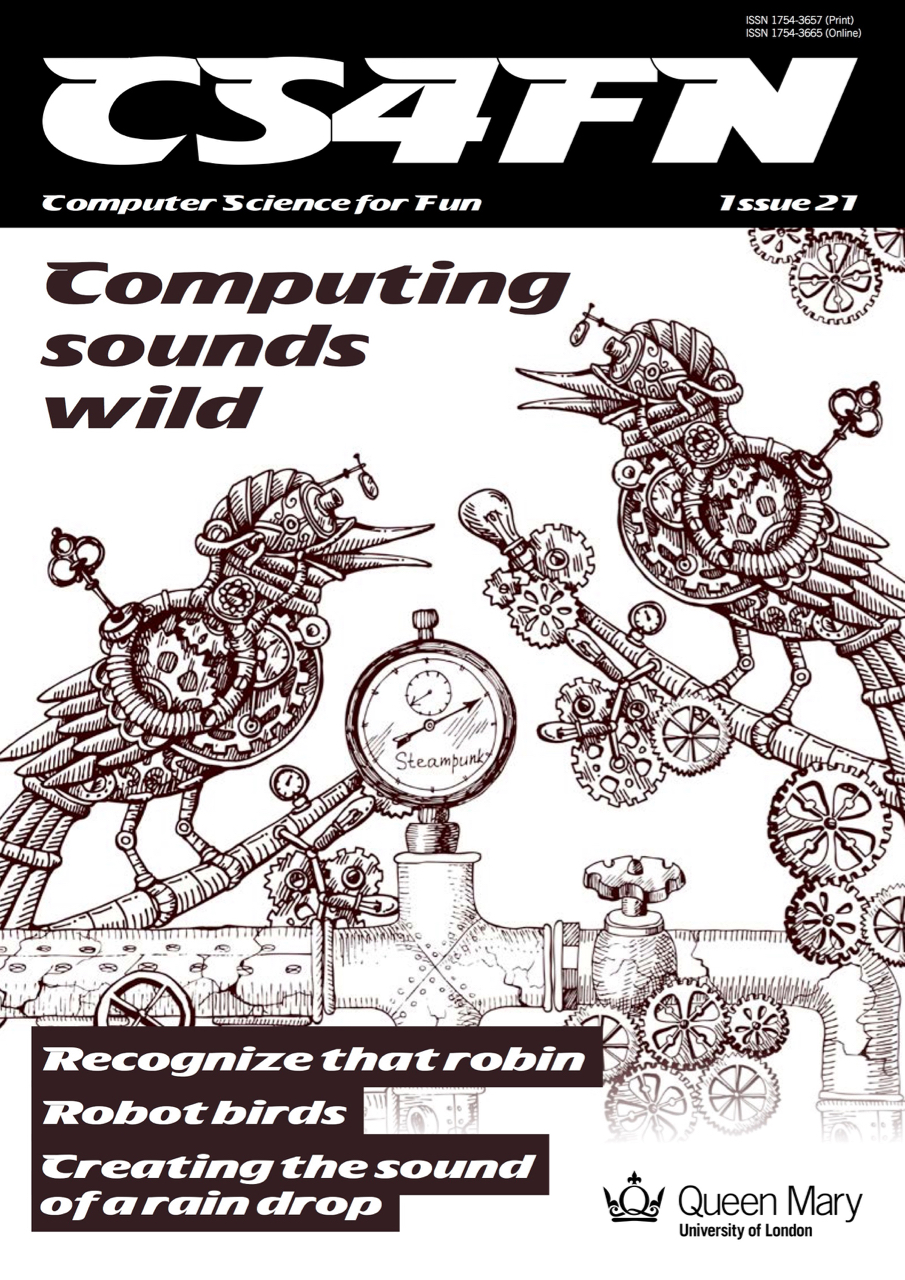
This article was first published on our archived CS4FN site, and a copy is also on page 9 of issue 21 of the CS4FN magazine “Computing Sounds Wild”. You can download a free PDF copy from the link below, along with all of our free material.


Related Magazine …


More from Sarah Angliss


Subscribe to be notified whenever we publish a new post to the CS4FN blog.


This page is funded by EPSRC on research agreement EP/W033615/1.

QMUL CS4FN EPSRC logos

An ode to technology

Cunning contraptions date back to ancient civilisations.

A female statue staring with head turned
Image by ha11ok from Pixabay

People have always been fascinated by automata: robot-style contraptions allowing inanimate animal and human figures to move, long before computers could take the place of a brain.

Records show they were created in ancient Egypt, China, and Greece. In the renaissance Leonardo designed them for entertainment, and more recently magicians have bedazzled audiences with them.

The island of Rhodes was a centre for mechanical engineering in Ancient Greek times, and the Greeks were great inventors who loved automata. According to an Ode by Pindar the island was covered with automata:

The animated figures stand.

Adorning every public street.

And seem to breathe in stone,

Or move their marble feet.

Pindar

– Paul Curzon, Queen Mary University of London


More on …

Cunning Computational Contraptions

Related Magazines …


This article was funded by UKRI, through Professor Ursula Martin’s grant EP/K040251/2 and grant EP/W033615/1.

QMUL CS4FN EPSRC logos