The escape character is a rather small and humble thing, often ignored, easily misunderstood but vital in programming languages. It is used simply to say symbols that follow should be treated differently. The n in \n is no longer just an n but a newline character, for example. It is the escape character \ that makes the change. The escape character has a long history dating back to at least Ancient Egypt and probably earlier.
The Ancient Egyptians famously used a language of pictures to write:hieroglyphs. How to read the language was lost for thousands of years, and it proved to be fiendishly difficult to decipher. The key to doing this turned out to be the Rosetta Stone, discovered when Napoleon invaded Egypt. It contained the same text in three different languages: the Hieroglyphic script, Greek and also an Egyptian script called Demotic.
A whole series of scholars ultimately contributed, but the final decipherment was done by Jean-François Champollion. Part of the difficulty in decipherment, even with a Greek translation of the Rosetta Stone text available, was because it wasn’t, as commonly thought, just a language where symbolic pictures represented words (a picture of the sun, meaning sun, for example). Instead, it combined several different systems of writing but using the same symbols. Those symbols could be read in different ways. The first way was as alphabetic letters that stood for consonants (like b, d and p in our alphabet). Words could be spelled out in this alphabet. The second was phonetically where symbols could stand for groups of such sounds. Finally, the picture could stand not for a sound but for a meaning. A picture of a duck could mean a particular sound or it could mean a duck!
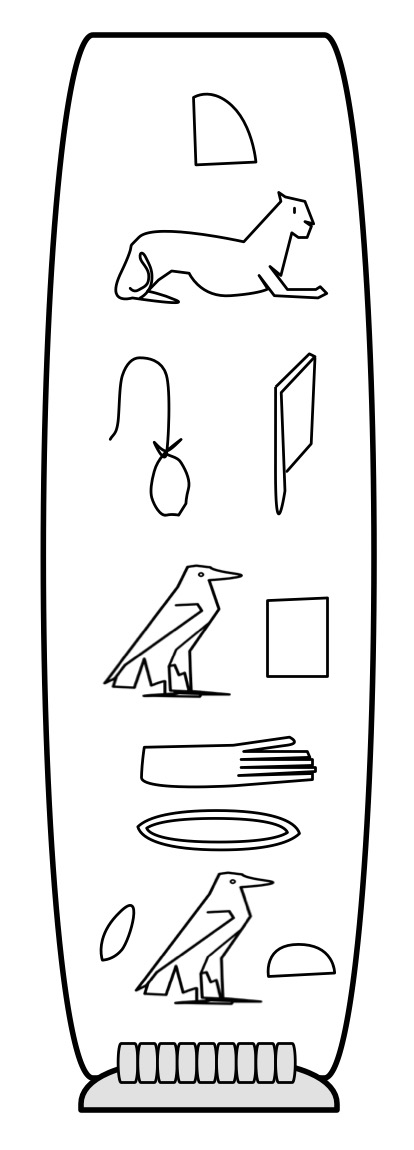
A cartouche for Cleopatra. Image by CS4FN
Part of the reason it took so long to decipher the language was that it was assumed that all the symbols were pictures of the things they represented. It was only when eventually scholars started to treat some as though they represented sounds that progress was made. Even more progress was made when it was realised the same symbol meant different things and might be read in a different way, even in the same phrase.
However, if the same symbol meant different things in different places of a passage, how on earth could even Egyptian readers tell? How might you indicate a particular group of characters had a special meaning?
One way the Egyptians used specifically for names is called a cartouche: they enclosed the sequence of symbols that represented a name in an oval-like box, like the one shown for Cleopatra. This was one of the first keys to unlocking the language as the name of pharaoh Ptolemy appeared several times in the Greek of the Rosetta Stone. Once someone had the idea that the cartouches might be names, the symbols used to spell out Ptolemy a letter at a time could be guessed at.
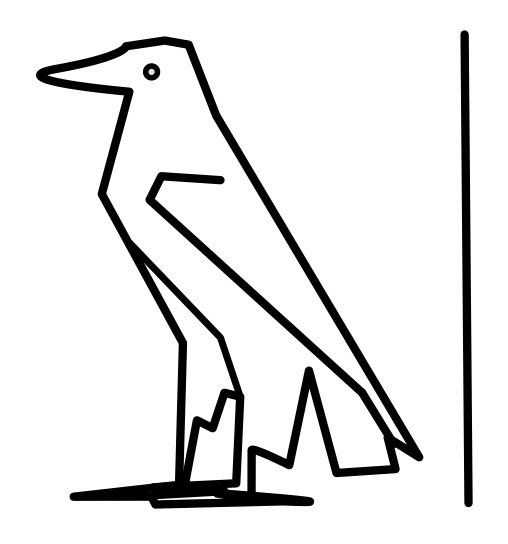
Putting things in boxes works for a pictorial language, but it isn’t so convenient as a more general way of indicating different uses of particular symbols or sequences of them. The Ancient Egyptians therefore had a much simpler way too. The normal reading of a symbol was as a sound. A symbol that was to be treated as a picture of the word it represented was followed by a line (so despite all the assumptions of the translators and the general perception of them, a hieroglyph as picture is treated as the exception not the norm!)
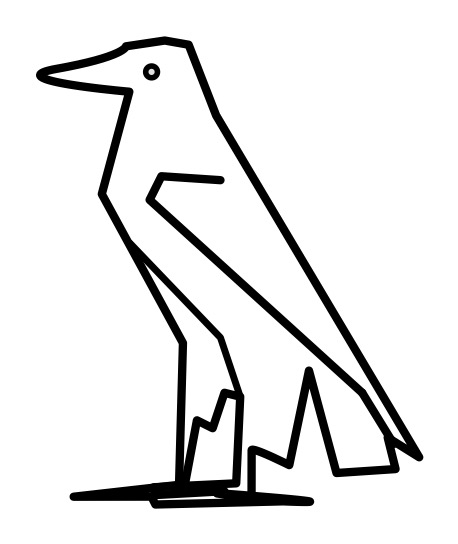
The Egyptian hieroglyph for aleph, Image by CS4FN
For example, the hieroglyph that is a picture of the Egyptian eagle stands for a single consonant sound, aleph. We would pronounce it ‘ah’ and it can be seen in the cartouche for Cleopatra that sounds out her name. However, add the line after the picture of the eagle (as shown) and it just means what it looks like: the Egyptian eagle.
The Egyptian hieroglyph for the Egyptian Eagle. Image by CS4FN
Cartouches actually included the line at the end too indicating in itself their special meaning, as can be seen on the Cleopatra cartouche above
The Egyptian line hieroglyph is what we would now call an escape character: its purpose is to say that the symbol it is paired with is not treated normally, but in a special way.
Computer Scientists use escape characters in a variety of ways in programming languages as well as in scripting languages like HTML. Different languages use a different symbol as the escape character, though \ is popular (and very reminiscent of the Egyptian line!). One place escapes are used is to represent special characters in strings (sequences of characters like words or sentences) so they can be manipulated or printed. If I want my program to print a word like “not” then I must pass an appropriate string to the print command. I just put the three characters in quotation marks to show I mean the characters n then o then t. Simple.
However, the string “\no\t” does not similarly mean five characters \, n, o, \ and t. It still represents three characters, but this time \n, o and \t. \ is an escape character saying that the n and the t symbols that follow it are not really representing the n or t characters but instead stand for a newline (\n : which jumps to the next line) and a tab character (\t : which adds some space). “\no\t” therefore means newline o tab.
This begs the question what if you actually want to print a \ character! If you try to use it as it is, it just turns what comes after it into something else and disappears. The solution is simple. You escape it by preceding it with a \. \\ means a single \ character! So “n\\t” means n followed by an actual \ character followed by a t. The normal meaning of \ is to escape what follows. Its special meaning when it is escaped is just to be a normal character! Other characters’s meanings are inverted like this too, where the more natural meaning is the one you only get with an escape character. For example what if you want a program to print a quotation so use quotation marks. But quotation marks are used to show you are starting and ending a String. They already have another meaning. So if you want a string consisting of the five characters “, n, o, t and ” you might try to write “”not”” but that doesn’t work as the initial “” already makes a string, just one with no characters in it. The string has ended before you got to the n. Escape characters to the rescue. You need ” to mean something other than its “normal” meeting of starting or ending a string so just escape it inside the string and write “\”not\””.
Once you get used to it, escaping characters is actually very simple, but is easy to find confusing when first learning to program. It is not surprising those trying to decipher hieroglyphs struggled so much as escapes were only one of the problems they had to contend with.
Strictly Come Dancing, has been popular for a long time. It’s not just the celebs, the pros, or the dancing that make it must see TV – it’s having the right mix of personalities in the judges too. Craig Revel Horwood has made a career of being rude, if always fair. By contrast, Darcey Bussell was always far more supportive. Bruno Tonioli is supportive but always excited. Len Goodman was similarly supportive but calm. Shirley Ballas aims for supportive but strict while Motsi Mabuse was always supportive and enthusiastic. It’s often the tension between the judges that makes good TV (remember those looks that Darcy always gave Craig, never mind when they started actually arguing). However, if you believe Dr Who, the future of judges will be robots like AnneDroid in the space-age version of The Weakest Link…let’s look at the Bot future. How might you go about designing computer judges, and how might objects help?
Write the code
We need to write a program. We will use a pseudocode (a mix of code and English) here rather than any particular programming language to make things easier to follow.
The first thing to realise is we don’t want to have to program each judge separately. That would mean describing the rules for every new judge from scratch each time they swap. We want to do as little as possible to describe each new one. Judges have a lot in common so we want to pull out those common patterns and code them up just once.
What makes a judge?
First let’s describe a basic judge. We will create a plan, a bit like an architect’s plan of a building. Programmers call these a ‘class’. The thing to realise about classes is that a class for a Judge is NOT the code of any actual working judge just the code of how to create one: a blueprint. This blueprint can be used to build as many individual judges as you need.
What’s the X-factor that makes a judge a judge? First we need to decide on some basic properties or attributes of judges. We can make a list of them, and what the possibilities for each are. The things common to all judges is they have names, personalities and they make judgements on people. Let’s simply say a judge’s personality can be either supportive or rude, and their judgements are just marks out of 10 for whoever they last watched.
We have just created some new ‘types’ in programming terminology. A type is just a grouping of values. The type CharacterTrait has two values possible (SUPPORTIVE or RUDE), whereas the type Judgement has 10 possible values. We also used one common, existing type: String. Strings are just sequences of letters, numbers or symbols, so we are saying something of type Name is any such sequence. (This allows both for futuristic judges and for hip hop and rapper judges- perhaps one day, in retirement C3P0 will become a judge, but also for the likes of 50 Cent one day to become one.)
Let’s start to describe Judges as people with a name, personality and capable of thinking of a mark.
DESCRIPTION OF A Judge:
    Name name
    CharacterTrait personality
    Judgement mark
This says that each judge will be described by three variables, one called name, one called personality and one called mark. This kind of variable is called an instance variable – because each judge we create from this blueprint will have their own copy, or instance, of the instance variables that describes that judge. So we might originally have created a Len judge and so on, but many series later find we need Mostsi one and then an Anton one. Each new judge needs their own copies of the variables that describe them.
All we are saying here in the class (the blueprint) is whenever we create a Judge it will have a name, a personal character (it will be either RUDE or SUPPORTIVE) and a potential mark.
For any given judge we will always refer tco their name using variable name and their character trait using variable personality. Each new judge will also have a current judgement, which we will refer to as mark: a number between 1 and 10. Notice we use the types we created, Name, Character and Judgment to specify the possible values each of these variables can hold.
Best behaviour
We are now able to say in our judge blueprint, our class, whether a judge is rude or supportive, but we haven’t actually said what that means. We need to set out the actual behaviours associated with being rude and supportive. We will do this here in a fairly simple way, just to illustrate. Let’s assume that the personality shows in the things they say when they give their judgement. A rude judge will say “It was a disaster” unless they are awarding a mark above 8/10. For high marks they will grudgingly say “You were ok I suppose”. We translate this into commands of how to give a judgment.
IF (personality IS RUDE) AND (mark <= 8) THEN SAY “It was a disaster” IF (personality IS RUDE) AND (mark > 8)
THEN SAY “You were ok I suppose”
It would be easy for us to give them lots more things to choose to say in a similar way, it’s just more rules. We can do a similar thing for a supportive judge. They will say “You were stunning” if they award more than 5 out of 10 and otherwise say “You tried really hard”.
TO GiveJudgement:
    IF (personality IS RUDE) AND (mark <= 8)
    THEN SAY “It was a disaster”

    IF (personality IS RUDE) AND (mark > 8)
    THEN SAY “You were ok I suppose”

    IF (personality IS SUPPORTIVE) AND (mark > 5)
    THEN SAY “You were stunning”

    IF (personality IS SUPPORTIVE) AND (mark <= 5)
    THEN SAY “You tried hard”
A ten from Len
The other thing that judges do is actually come up with their judgement, their mark. For real judges it would be based on rules about what they saw – a lack of pointed toes pulls it down, lots of wiggle at the right times pushes it up… We will assume, to keep it simple here, that they actually just think of a random number – essentially throw a 10 sided dice under the desk with numbers 1-10 on!
TO MakeJudgement:
    mark = RANDOM (1 TO 10)
Finally, judges can reveal their mark.
TO RevealMark:
    SAY mark
Notice this doesn’t mean they say the word “mark”. mark is a variable so this means say whatever is currently stored in that judge’s mark.
Putting that all together to make our full judge class we get:
DESCRIPTION OF A Judge:
    Name name
    CharacterTrait personality
    Judgement mark

    TO GiveJudgement:
        IF (personality IS RUDE) AND (mark <= 8)
        THEN SAY “It was a disaster”

        IF (personality IS RUDE) AND (mark > 8)
        THEN SAY “You were ok I suppose

        IF (personality IS SUPPORTIVE) AND (mark > 5)
        THEN SAY “You were stunning”

        IF (personality IS SUPPORTIVE) AND (mark <= 5)
        THEN SAY “You tried hard”

    TO MakeJudgement:
        mark = RANDOM (1 TO 10)

    TO RevealMark
        SAY mark
What is a class?
So what is a class? A class says how to build an object. It defines properties or attributes (like name, personality and current mark) but it also defines behaviours: it can speak, it can make a judgement and it can reveal the current mark. These behaviours are defined by methods – mini-programs that specify how any Judge should behave. Our class says that each Judge will have its own set of the methods that use that Judge’s own instance variables to store its properties and decide what to do.
So a class is a blueprint that tells us how to make particular things: objects. It defines their instance variables – what the state of each judge consists of and some rules to apply in particular situations. We have so far made a class definition for making Judges. It is important to realise that we haven’t made any actual objects (no actual judge) so far though – defining a class does not in itself give you any actual objects – no actual Judges (no Bruno, no Motsi, …) exist to judge anything yet. We need to write specific commands to create them as we will see.
We can store away our blueprint and just pull it out to make use of it when we need to create some actual judges (eg once a year in the summer when this year’s judges are announced).
Kind words for our contestants?
Suppose Strictly is starting up (as it is as I write, but let’s suppose all the judges will be androids this year) so we want to create some judges, starting with a rude judge, called Craig Devil Droidwood. We can use our class as the blueprint to do so. We need to say what its personality is (Judges just think of a mark when they actually see an act so we don’t have to give a mark now.)
CraigDevilDroidwood IS A NEW Judge
                    WITH name “Craig Devil Droidwood”
                    AND personality RUDE
This creates a new judge called Craig Devil Droidwood and makes it Rude. We have instantiated the class to give a Judge object. We store this object in a variable called CraigDevilDroidwood.
For a supportive judge that we decide to call Len Goodroid we would just say (instantiating the class in a different way):
LenGoodroid IS A NEW Judge
            WITH name “Len Goodroid”
            AND personality SUPPORTIVE
Another supportive judge DarC3PO BussL would be created with
DarC3POBussL IS A NEW Judge
             WITH name “DarC3PO BussL”
             AND personality SUPPORTIVE
Whereas in the class we are describing a blueprint to use to create a Judge, here we are actually using that blueprint and making different Judges from it. So this way we can quickly and easily make new judge clones without copying out all the description again. These commands executed at the start of our program (and TV programme) actually create the objects. They create instances of class Judge, which just means they create actual virtual judges with their own name and personality. They also each have their own copy of the rules for the behaviour of judges.
Execute them
Once actual judges are created, they can execute commands to start the judging. First the program tells them to make judgements using their judgement method. We execute the MakeJudgement method associated with each separate judge object in turn. Each has the same instructions but those instructions work on the particular judges instance variables, so do different things.
EXECUTE MakeJudgement OF CraigDevilDroidwood
EXECUTE MakeJudgement OF DarC3POBussL
EXECUTE MakeJudgement OF LenGoodroid
Then the program has commands telling them to say what they think,
EXECUTE GiveJudgement OF CraigDevilDroidwood
EXECUTE GiveJudgement OF DarC3POBussL
EXECUTE GiveJudgement OF LenGoodroid
and finally give their mark.
EXECUTE RevealMark OF CraigDevilDroidwood
EXECUTE RevealMark OF DarC3POBussL
EXECUTE RevealMark OF LenGoodroid
In our actual program this would sit in a loop so our program might be something like:
CraigDevilDroidwood IS A NEW Judge
                    WITH name “Craig Devil Droidwood”
                    AND personality RUDE
DarC3POBussL        IS A NEW Judge
                    WITH name “DarC3PO BussL”
                    AND personality SUPPORTIVE
LenGoodroid         IS A NEW Judge
                    WITH name “Len Goodroid”
                    AND personality SUPPORTIVE

FOR EACH contestant DO THE FOLLOWING
    EXECUTE MakeJudgement OF CraigDevilDroidwood
    EXECUTE MakeJudgement OF DarC3POBussL
    EXECUTE MakeJudgement OF LenGoodroid

    EXECUTE GiveJudgement OF CraigDevilDroidwood
    EXECUTE GiveJudgement OF DarC3POBussL
    EXECUTE GiveJudgement OF LenGoodroid

    EXECUTE RevealMark OF CraigDevilDroidwood
    EXECUTE RevealMark OF DarC3POBussL
    EXECUTE RevealMark OF LenGoodroid
So we can now create judges to our heart’s content, fixing their personalities and putting the words in their mouths based on our single description of what a Judge is. Of course our behaviours so far are simple. We really want to add more kinds of personality like strict judges (Shirley) and excited ones (Bruno). Ideally we want to be able to do different combinations making perhaps excited rude judges as well as excited supportive ones. This really just takes more rules.
A classless society?
Computer Scientists are lazy beings – if they can find a way to do something that involves less work, they do it, allowing them to stay in bed longer. The idea we have been using to save work here is just that of describing classes of things and their properties and behaviour. Scientists have been doing a similar thing for a long time:
Birds have feathers (a property) and lay eggs (a behaviour).
Spiders have eight legs (a property) and make silk (a behaviour)
We can say something is a particular instance of a class of thing and that tells us a lot about it without having to spell it all out each time, even for fictional things: eg Hedwig is a bird (so feathers and eggs). Charlotte is a spider (so legs and silk). The class is capturing the common patterns behind the things we are describing. The difference when Computer Scientists write them is because they are programs they can then come alive!
All change
We have specified what it means to be a robotic judge and we’ve only had to specify the basics of Judgeness once to do it. That means that if we decide to change anything in the basic judge (like giving them a better way to come up with a mark than doing it randomly or having them choose things to say from a big database of supportive or rude comments) changing it in the plan will apply to all the judges of whatever kind. That is one of the most powerful reasons for programming in this way.
We could create robot performers in a similar way (after all don’t all the winners seem to merge into one in the long run?). We would then also have to write some instructions about how to work out who won – does the audience have a vote? How many get knocked out each week? … and so on.
Of course we’ve not written a full program, even for judges, just sketched a program in pseudocode. The next step is to convert this into a program in an object-oriented programming language like Python or Java. Is that hard? Why not give it a try and judge for yourself?
Paul Curzonand Peter W. McOwan, Queen Mary University of London
The first rule of humans when around robots is apparently that they should not do anything too unexpected near a robot…
A 7-year old child playing chess in a chess tournament has had his finger broken by a chess-playing robot which grabbed it as the boy made his move. The child was blamed by one of the organisers, who claimed that it happened because the boy “broke the safety rules”! The organisers also apparently claimed that the robot itself was perfectly safe!
What seems to have happened is, after the robot played its move, the boy played his own move very quickly before the robot had finished. Somehow this triggered the wrong lines of code in the robot’s program: instructions that were intended for some other situation. In the actual situation of the boy’s hand being over the board at the wrong time it led the robot to grab his finger and not let go.
Spoiler Alert
The situation immediately brings to mind the classic science fiction story “Moxon’s Master” by Ambrose Bierce published way back in 1899. It is the story of a chess playing automaton (ie robot) and what happens when it is check-mated when playing a game with its creator Moxon. It flies into a dangerous rage. However, there the problems are apparently because the robot has developed emotions and so emotional reactions. In both situations however a robot intended simply to play chess is capable of harming a human as a result.
The three laws of robotics
Isaac Asimov is famous for his laws of robotics: fundamental unbreakable rules built in to the ‘brain’ of all robots in his fictional world precisely to stop this sort of situation. The rules he formulated were:
A robot may not injure a human being or, through inaction, allow a human being to come to harm.
A robot must obey the orders given to it by human beings except where such orders would conflict with the First Law.
A robot must protect its own existence as long as such protection does not conflict with the First or Second Law.
Clearly, had they been in place, the chess robot would not have harmed the boy, and Moxon’s automaton would not have been able to do anything too bad as a result of its temper either.
Asimov devised his rules as a result of a discussion with the Science Fiction magazine editor John W. Campbell, Jr. He then spent much of his Science Fiction career writing robot stories around how humans could end up being hurt despite the apparently clear rules. That aside their key idea was that, to ensure robots were safe around people, they would need built-in logic that could not be circumvented to stop them hurting them. They needed a fail-safe system monitoring their actions that would take over when breaches were possible. Clearly this chess-playing robot was not “perfectly safe” and not even fail-safe as if it was the boy would not have been harmed whatever he did. The robot did not have anything at all akin to a working, unbreakable First Law programmed into it.
Dangerous Machines
Asimov’s robots were intelligent and able to think for themselves in a more general sense than any that currently exist. The First Law essentially prevented them from deciding to harm a human not just do so by accident. However, perhaps the day will soon come when they can start to think for themselves, so perhaps a first law will soon be important. In any case, machines can harm humans without being able to think. That humans need to be wary around robots is obvious from the fact that there have been numerous injuries and even fatalities in factories using industrial robots in the decades since they were introduced. They are dangerous machines. Fortunately, the carnage inflicted on children is at least not quite that of the industrial accidents in the Industrial Revolution. It is still a problem though. People do have to take care and follow safety rules around them!
Rather than humans having to obey safety laws, we perhaps ought to be taking Asimov’s Laws more seriously for all robots, therefore. Why can’t those laws just be built in? It is certainly an interesting research problem to think about. The idea of a fail-safe is standard in engineering, so its not that general idea that is the problem. The problem is that, rather than intelligence being needed for robots to harm us, intelligence is needed to avoid them doing so.
Implementing the First Law
Let’s imagine building in the first law to chess playing robots and in particular the one that hurt the boy. For starters the chess playing robot would have needed to have recognised that the boy WAS a human so should not be harmed. It would also need to be able to recognise that his finger was a part of him and that gripping its finger would harm him. It would also need to know that it was gripping his finger (not a piece) at the time. It would then need a way to stop before it was too late, and do no harm in the stopping. It clearly needs to understand a lot about the world to be able to avoid hurting people in general.
Some of this is almost within our grasp. Computers can certainly do a fairly good job of recognising humans now through image recognition code. They can even recognise individuals, so actually that first fundamental part of knowing what is and isn’t a human is more or less possible now, just not perfectly yet. Recognising objects in general is perhaps harder. The chess robot presumably has code for recognising pieces already though a finger perhaps even looks like a piece at least to a robot. To generally, avoid causing harm in any situation it needs to be able to recognise what lots of objects are not just chess pieces. It also needs to differentiate them from what is part of a human not just what is a human. Object recognition like this is possible at least in well-defined situations. It is much harder to manage it in general, even if the precise objects have never been encountered before. Even harder though is probably recognising all the ways that would constitute doing harm to the human identified in front of it including with any of those objects that are around.
Staying in control
The code to do all this would also have to be in some sense at a higher level of control than that making the robot take actions as it has to overrule them ALWAYS. For the chess robot, there was presumably a bug that allowed it to grip a human’s finger as no programmer will have intended that, so it isn’t about monitoring the code itself. The fail-safe code has to be monitoring what is actually happening in the world and be in a position to take over. It also can’t just make the robot freeze as that may be enough to do the damage of a broken finger if already in the robot’s grip (and that may have been part of the problem for the boy’s finger). It also can’t just move its arm back suddenly as what if another child (a toddler perhaps) has just crawled up behind it! It has to monitor the effects of its own commands too! A simple version of such a monitor is probably straightforward though. The robot’s computer architecture just needs to be designed accordingly. One way robots are designed is for new modules to build on top of existing ones giving new more complex behaviour as a result, which possibly fits what is needed here. Having additional computers acting as monitors to take over when others go wrong is also not really that difficult (bugs in their own code aside) and a standard idea for mission-critical systems.
So it is probably all the complexity of the world with unexpected things happening in it that is the problem that makes a general version of the First Law hard at the moment… If Asimov’s laws in all their generalness are currently a little beyond us, perhaps we should just think about the problem in another more limited way (at least for now)…
Can a chess playing robot be safe?
In the chess game situation, if anything is moving in front of the robot then it perhaps should just be keeping well out of the way. To do so just needs monitoring code that can detect movement in a small fixed area. It doesn’t need to understand anything about the world apart from movement versus non-movement. That is easily in the realms of what computers can do – even some simple toy robots can detect movement. The monitoring code would still need to be able to override the rest of the code of course, bugs included.
Why also could the robot grip a finger with enough pressure to break it, anyway. Perhaps it just needed more accurate sensors in its fingers to avoid doing harm, together with a sensor that just let go if it felt too much resistance back. After all chess pieces don’t resist much!
And one last idea, if a little bit more futuristic. A big research area at the moment is soft robotics: robots that are soft and squidgy not hard and solid, precisely so they can do less harm. Perhaps if the chess robot’s robotic claw-like fingers had instead been totally soft and squishy it would not have harmed him even if it did grab his finger.
Had the robot designers tried hard enough they surely could have come up with solutions to make it safer, even if they didn’t have good enough debugging skills to prevent the actual bug that caused the problem. It needs safety to be a very high priority from the outset though: and certainly safety that isn’t just pushed onto humans to be responsible for as the organisers did.
We shouldn’t be blaming children for not obeying safety rules when they are given what is essentially a hard, industrial robot to play with. Doing so just lets the robot makers off the hook from even trying to make their robots safer, when they clearly could do more. When disasters happen don’t blame the people, improve the system. On the other hand perhaps we should be thinking far more about doing the research that will allow us one day to actually implement Asimov’s Laws in all robots and so have a safety culture in robotics built-in. Then perhaps people would not have to be quite so wary around robots and certainly not have to follow safety rules themselves. That surely is the robot’s job.
Even though most robots still walk around naked, the Swedish Institute of Computer Science (SICS) in Stockholm explored how to produce fashion conscious robots.
The applied computer scientists there were looking for ways to make the robots of today easier for us to get along with. As part of the LIREC project to build the first robot friends for humans they examined how our views of simple robots change when we can clothe and customise them. Does this make the robots more believable? Do people want to interact more with a fashionable robot?
How do you want it?
These days most electronic gadgets allow the human user to customise them. For example, on a phone you can change the background wallpaper or colour scheme, the ringtone or how the menus work. The ability of the owner to change the so-called ‘look and feel’ of software is called end-user programming. It’s essentially up to you how your phone looks and what it does.
Dinosaurs waking and sleeping
The Swedish team began by taking current off-the-shelf robots and adding dress-up elements to them. Enter Pleo, a toy dinosaur ‘pet’ able to learn as you play with it. Now add in that fashion twist. What happens when you can play dress up with the dinosaur? Pleo’s costumes change its behaviour, kind of like what happens when you customise your phone. For example, if you give Pleo a special watchdog necklace the robot remains active and ‘on guard’. Change the costume from necklace to pyjamas, and the robot slowly switches into ‘sleep’ mode. The costumes or accessories you choose communicate electronically with the robot’s program, and its behaviour follows suit in a way you can decide. The team explored whether this changed the way people played with them.
Clean sweeps
In another experiment the researchers played dress up with a robot vacuum cleaner. The cleaner rolls around the house sweeping the floor, and had already proven a hit with many consumers. It bleeps happily as its on-board computer works out the best path to bust your carpet dust. The SICS team gave the vacuum a special series of stick-on patches, which could add to its basic programming. They found that choosing the right patch could change the way the humans perceive the robot’s actions. Different patches can make humans think the robot is curious, aggressive or nervous. There’s even a shyness patch that makes the robot hide under the sofa.
What’s real?
If humans are to live in a world populated by robots there to help them, the robots need to be able to play by our rules. Humans have whole parts of their brains given over to predicting how other humans will react. For example, we can empathise with others because we know that other beings have thoughts like us, and we can imagine what they think. This often spills over into anthropomorphism, where we give human characteristics to non-human animal or non-living things. Classic examples are where people believe their car has a particular personality, or think their computer is being deliberately annoying – they are just machines but our brains tend to attach motives to the behaviours we see.
Real-er robots?
Robots can produce very complex behaviours depending on the situations they are in and the ways we have interacted with them, which creates the illusion that they have some sort of ‘personality’ or motives in the way they are acting. This can help robots seem more natural and able to fit in with the social world around us. It can also improve the ways they provide us with assistance because they seem that bit more believable. Projects like the SICS’s ‘actDresses’ one help us by providing new ways that human users can customise the actions of their robots in a very natural way, in their case by getting the robots to dress for the part.
Peter W McOwan and the CS4FN team, Queen Mary University of London (Updated from the archive)
Inspired by Mary Shelley’s Frankenstein, 17-year old Victorian orphan, Jane Webb secured her future by writing the first ever Mummy story. The 22nd century world in which her novel was set is perhaps the most amazing thing about the three volume book though.
On the death of her father, Jane realised she needed to find a way to support herself and did so by publishing her novel “The Mummy!” in 1827. In contrast to their modern version as stars of horror films, Webb’s Mummy, a reanimation of Cheops, was actually there to help those doing good and punish those that were evil. Napoleon had, through the start of the century, invaded Egypt, taking with him scholars intent on understanding the Ancient Egyptian society. Europe was fascinated with Ancient Egypt and awash with Egyptian artefacts and stories around them. In London, the Egyptian Hall had been built in Piccadilly in 1812 to display Egyptian artefacts and in 1821 it displayed a replica of the tomb of Seti I. The Rosetta Stone that led to the decipherment of hieroglyphics was cracked in 1822. The time was therefore ripe for someone to come up with the idea of a Mummy story.
The novel was not, however, set in Victorian times but in a 22nd century future that she imagined, and that future was perhaps more amazing than the idea of a mummy coming to life. Her version of the future was full of technological inventions supporting humanity, as well as social predictions, many of which have come to fruition such as space travel and the idea that women might wear trousers as the height of fashion (making her a feminist hero). The machines she described in the book led to her meeting her future husband, John Loudon. As a writer about farming and gardening he was so impressed by the idea of a mechanical milking machine included in the book, that he asked to meet her. They married soon after (and she became Jane Loudon).
The skilled artificial intelligences she wrote into her future society are perhaps the most amazing of her ideas in that she was the first person to really envision in fiction a world where AIs and robots were embedded in society just doing good as standard. To put this into context of other predictions, Ada Lovelace wrote her notes suggesting machines of the future would be able to compose music 20 years later.
Jane Webb’s future was also full of cunning computational contraptions: there were steam-powered robot surgeons, foreseeing the modern robots that are able to do operations (and with their steady hands are better at, for example, eye surgery than a human). She also described Artificial Intelligences replacing lawyers. Her machines were fed their legal brief, giving them instructions about the case, through tubes. Whilst robots may not yet have fully replaced barristers and judges, artificial intelligence programs are already used, for example, to decide the length of sentences of those convicted in some places, and many see it now only being a matter of time before lawyers are spending their time working with Artificial Intelligence programs as standard. Jane’s world also includes a version of the Internet, at a time before electric telegraph existed and when telegraph messages were sent by semaphore between networks of towers.
The book ultimately secured her future as required, and whilst we do not yet have any real reanimated mummy’s wandering around doing good deeds, Jane Webb did envision lots of useful inventions, many that are now a reality, and certainly had pretty good ideas about how future computer technology would pan out in society…despite computers, never mind artificial intelligences, still being well over a century away.
Why are so many film robots naked? We take it for granted that robots don’t wear clothes, and why should they?
They are machines, not humans, after all. On the other hand, the quest to create artificial intelligence involves trying to create machines that share the special ingredients of humanity. One of the things that is certainly special about humans in comparison to other animals is the way we like to clothe and decorate our bodies. Perhaps we should think some more about why we do it but the robots don’t!
Shame or showoff?
The creation story in the Christian Bible suggests humans were thrown out of the Garden of Eden when Adam and Eve felt the need to cover up – when they developed shame. Humans usually wear more than just the bare minimum though, so wearing clothing can’t be all about shame. Nor is it just about practicalities like keeping warm. Turn up at an interview covering your body with the wrong sort of clothes and you won’t get the job. Go to a fancy dress party in the clothes that got you the job and you will probably feel really uncomfortable the moment you see that everyone else is wearing costumes. Clothes are about decorating our bodies as much as covering them.
Our urge to decorate our bodies certainly seems to be a deeply rooted part of what makes us human. After all, anthropologists consider finds like ancient beads as the earliest indications of humanity evolving from apehood. It is taken as evidence that there really was someone ‘in there’ back then. Body painting is used as another sign of our emerging humanity. We still paint our bodies millennia later too. Don’t think we’re only talking about children getting their faces painted – grownups do it too, as the vast make-up industry and the popularity of tattoos show. We put shiny metal and stones around our necks and on our hands too.
The fashion urge
Whatever is going on in our heads, clearly the robots are missing something. Even in the movies the intelligent ones rarely feel the need to decorate their bodies. R2D2? C3PO? Wall-E? The exceptions are the ones created specifically to pass themselves off as human like in Blade Runner.
You can of course easily program a robot to ‘want’ to decorate itself, or to refuse to leave its bedroom unless it has managed to drape some cloth over its body and shiny wire round its neck, but if it was just following a programmed rule would that be the same as when a human wears clothes? Would it be evidence of ‘someone in there’? Presumably not!
We do it because of an inner need to conform more than an inner need to wear a particular thing. That is what fashion is really all about. Perhaps programming an urge to copy others would be a start. In Wall-E, the robot shows early signs of this as he tries to copy what he sees the humans doing in the old films he watches. At one point he even uses a hubcap as a prop hat for a dance. Human decoration may have started as a part of rituals too.
Where to now?
Is this need to decorate our bodies something special, something linked to what makes us human? Should we be working on what might lead to robots doing something similar of their own accord? When archaeologists are hunting through the rubble in thousands of years’ time, will there be something other than beads that would confirm their robot equivalent to self-awareness? If robots do start to decorate and cover up their bodies because they want to rather than because it was what some God-like programmer coded them to do, surely something special will have happened. Perhaps that will be the point when the machines have to leave their Garden of Eden too.
Paul Curzon, Queen Mary University of London (from thearchive)
Continuing a series of blogs on what to do with all that lego scattered over the floor: learn some computer science…what is computation? Using binary.
We’ve been focussing on representing data so far but data on its own doesn’t do a lot. It is when you combine it with computation that things get exciting and suddenly you have something that can change the world. But what is computation? We will start to explore computation using something called cellular automata. They are just one simple way to do computation (of many).
We have seen that a data representation is just a way of storing information using symbols. It just gives meaning to otherwise arbitrary symbols. Those 1s and 0s, red blocks and blue blocks, Xs, Vs and Is could mean anything. Indeed at different times they mean different things: sometimes a particular group of 1s and 0s stand for a number, sometimes the colour of a pixel, sometimes a letter. So symbols become interesting when we give them meanings (and that is an important point to remember).
Computation is also about symbols, but about manipulating them using sets of rules. What do the rules do? Given one or more symbols they tell you to swap those symbols for new symbols. To do computation you just repeatedly apply a given set of rules, starting with some starting symbols and the symbols change and then change again and then change again …
Elementary Cellular Automata
Cellular automata are just a particular kind of rules that apply to grids of symbols (called cells). They were invented by one of the great original computer scientists, John von Neumann along with Stanislaw Ulam in the 1940s.
Elementary cellular automata, which we will look at here, are a simple version where you just have a row of cells (so a row of symbols). There are only two symbols allowed, usually 1 and 0. We will of course use lego blocks as our two symbols instead: a red brick for 1 and a blue brick for 0. A particular row of red and blue bricks is called the state. The rules change the colour of the bricks in the row and so change the state of the cellular automata. Here is an example state of such a ‘machine’ where the rows are 16 bricks (symbols) long (essentially the memory of the machine will be 16 bits long):
An example cellular automaton state consisting of 16 symbols. Traditionally cellular automata have symbols 0 and 1. We use a red block to mean a 1 and a blue block to mean a 0. Image by CS4FN
Rules
A rule that says if we have RED-BLUE-BLUE then change the middle cell to a RED block. Image by CS4FN
Now if we are going to do computation, we need rules (essentially a program) to apply that changes the state. The rules of an elementary cellular automaton like this are applied to each lego brick, changing it to a new lego brick. To do so they take the brick on either side into account though. Each rule therefore looks at three bricks at a time and changes (or not) the middle brick.
We can write out the rules using lego bricks too – saying what to do for each pattern of three lego blocks. So we could have a rule that if we have a triple RED-BLUE-BLUE then we change the middle of that triple to RED so that the triple becomes RED-RED-BLUE instead. In lego we could represent this rule as shown right, where we show the new value for the middle cell that changes. (Notice we are now using lego bricks, so symbols, to represent rules: a rule is just data too!)
Now a vital thing about rules for computation is that you MUST give a rule for every possibility. Our above rule only tells us what to do for one of the eight possibilities of those triples of bricks that might occur in each position. We must give 8 different rules, so that whatever pattern we come across we have a rule that says what to do.
Here is one possible set of 8 rules we could use:
A set of rules to define how a cellular automaton will behave. Image by CS4FN
Altogether, there are 256 different possible sets of rules like this.
Notice that we have ordered our rules using a binary pattern of the triples counting from 0 to 7 as a way to make sure we have covered every possible pattern exactly once and to make it easier to find the right rule. We could write then in any order of course. It would make no difference to what the rules do.
Doing Computation
Now to do computation we just apply the rules we have chosen to every position in an initial state – an initial pattern of red and blue blocks. We start at one end of the row and apply the set of rules in each position finding the one that matches the pattern at that position. Once we find the rule that matches that position, we note the new middle block accordingly, then move on to the next position. Once we get to the end of the row, we know what the whole new state for the automaton will be: we have done one step of computation. For the cell at either end of the row, assume its adjacent value off the end is 0 (so blue for us). At every position the rule applies to the original triple of bricks in the current state, not ones changed by rules applied to other positions: the rules are applied to every position at the same time.
The easiest way to do this with lego is to line up a row of red and blue lego blocks as the initial state and apply our rules as above to get a new pattern of red and blue lego blocks placed below it. That new pattern is the new state of the machine, Here is a step as applied to our random state we gave above.
Image by CS4FN
Calculating Number Sequences
We seem to be just replacing patterns by new patterns. Are we doing anything useful? Of course we could give some simple meaning to these patterns. Interpret the pattern as a binary number and what is happening? We are generating a number sequence. To see this use the above rules on a shorter pattern, starting with a single red lego block at the left hand end, with the rest blue. This is the binary for the number 1 (00001). Apply the rules and we get the number 2 (00010). Apply the rules again and the pattern of lego turns into the binary for 5 (00101), then 8 (01000) and then 20 (10100) and so on…
Image by CS4FN
We have created a machine that does a calculation on a number to create a new number. Let it run and it calculates the whole number sequence. Different rules will compute different number sequences: some perhaps more interesting than others.
Images from numbers
If you think numbers are a bit boring, then instead just give a different meaning to the patterns – as giving the colour of pixels, with each new state giving the next row of an infinite lego pixel picture. Now our rules are generating art. Each rule set will compute a different image as will different starting states (again some images generated will be more interesting than others). Here is what our above rules generate if we start with a single red brick in the centre:
The image generated by our rule if we see it as rules to generate the next line of a lego art image. Image by CS4FN
This is actually a fractal pattern called the Sierpiński triangle. It contains the same triangular pattern over and over again, and If you create a massive version of it on a large lego board you will see that each triangle has the same pattern within it. It is a beautiful recursive pattern.
Apply the rules and create a Lego pixel version yourself.
Explore the different rules
Stephen Wolfram has exhaustively explored all the elementary cellular automata, categorising them and describing their properties. However, that is no reason not to explore them yourself, whether with lego, on graph paper or by writing a program to apply the rules for you.
Of course you do not have to stick to only automata with 2 symbols. Add more symbols / colours of lego blocks (so you will need lots more rules in each set) and explore some more.
There is one cellular automaton, so one rule set (with only two symbols) that is very intriguing. It turns out that, rather than just generate a particular number sequences or pattern as the one above does, it can do absolutely any computation – it is a general purpose machine that can do anything that a modern computer can do…but that is another story.
Part of a series featuring featuring pixel puzzles, compression algorithms, number representation, gray code, binary, logic and computation.
Subscribe to be notified whenever we publish a new post to the CS4FN blog.
This blog is funded by EPSRC on research agreement EP/W033615/1.
This post was funded by UKRI, through grant EP/K040251/2 held by Professor Ursula Martin, and forms part of a broader project on the development and impact of computing.
When you are watching a sport in person, a quick glance at the scoreboard should tell you everything you need to know about what’s going on. But why not try to put that information right in the action? How much better would it be if all the players’ shirts could display not just the score, but how well each individual is doing?
Light up, light up
An Australian research group from the University of Sydney has made it happen. They rigged up two basketball teams’ shirts with displays that showed instant information as they played one another. The players (and everyone else watching the game) could see information that usually stays hidden, like how many fouls and points each player had. The displays were simple coloured bands in different places around the shirt, all connected up with tiny wires sewn into the shirts like thread. For every point a player got, for example, one of the bands on the player’s waist would light up. Each foul a player got made a shoulder band light up. There was also a light on players’ backs reserved for the leading team. Take the lead and all your team’s lights turned on, but lose it again and they went dark with defeat.
Sweaty but safe
All those displays were controlled by an on-board computer that each player harnessed to his or her body. That computer, in turn, was wirelessly connected to a central computer that kept track of winners, losers, fouls and baskets. The designers had to be careful about certain things, though. In case a player fell over and crushed their computer, the units were designed with ‘weak spots’ on purpose so they would detach rather than crumple underneath the player. And, since no one wants to get electrocuted while playing their favourite sport, the designers protected all the gear against moisture and sweat.
Keeping your head in the game
In the end, it was the audience at the game who got the most out of the system. They were able to track the players more closely than they normally would, and it helped those in the crowd who didn’t know much about basketball to understand what was going on. The players themselves had less time to think about what was on everyone’s clothes, as they were busy playing the game, but the system did help them a few times. One player said that she could see when her teammate had a high score, “and it made me want to pass to her more, as she had a ‘hot hand'”. Another said that it was easier to tell when the clock was running down, so she knew when to play harder. Plus, just seeing points on their shirts gave the players more confidence. There’s so much information available to you when you watch a game on television that, in a weird way, actually being in the stadium could make you less informed. Maybe in the future, the fans in the stands will see everything the TV audience does as well, when the players wear all their statistics on their shirts! We’ll see what the sponsors think of that…
the CS4FN team, Queen Mary University of London (From the archive)
Whilst using a code so that a message is unreadable is cryptography, hiding information like this so that no one knows there is a message to be read is called steganography
Serious model making is of course something that needs a steady hand, patience and a good eye…so useful practice for the basic skills for electronics too.
Kok Ho HuenandPaul Curzon, Queen Mary University of London
Industrialist Tony Stark always dresses for the occasion, even when that particular occasion happens to be a fight with the powers of evil.His clothes are driven by computer science: the ultimate in wearable computing.
In the Iron Man comic and movie franchise Anthony Edward Stark, Tony to his friends, becomes his crime fighting alter ego by donning his high tech suit. The character was created by Marvel comic legend Stan Lee and first hit the pages in 1963. The back story tells how industrial armaments engineer and international playboy Stark is kidnapped and forced to work to develop new forms of weapons, but instead manages to escape by building a flying armoured suit.
Though the escape is successful Stark suffers a major heart injury during the kidnap ordeal, becoming dependant on technology to keep him alive. The experience forces him to reconsider his life, and the crime avenging Iron Man is born. Lee’s ‘businessman superhero’ has proved extremely popular and in recent years the Iron Man movies, starring Robert Downey Jr, have been box office hits. But as Tony himself would be the first to admit, there is more than a little computer science supporting Iron Man’s superhero standing.
Suits you
The Iron Man suit is an example of a powered exoskeleton. The technology surrounding the wearer amplifies the movement of the body, a little like a wearable robot. This area of research is often called ‘human performance augmentation’ and there are a number of organisations interested in it, including universities and, unsurprisingly, defence companies like Stark Industries. Their researchers are building real exoskeletons which have powers uncannily like those of the Iron Man suit.
To make the exoskeleton work the technology needs to be able to accurately read the exact movements of the wearer, then have the robot components duplicate them almost instantly. Creating this fluid mechanical shadow means the exoskeleton needs to contain massive computing power, able to read the forces being applied and convert them into signals to control the robot servo motors without any delay. Slow computing would cause mechanical drag for the wearer, who would feel like they were wading through treacle. Not a good idea when you’re trying to save the world.
Pump it up
Humans move by using their muscles in what are called antagonistic pairs. There are always two muscles on either side of the joint that pull the limb in different directions. For example, in your upper arm there are the muscles called the biceps and the triceps. Contracting the biceps muscle bends your elbow up, and contracting your triceps straightens your elbow back. It’s a clever way to control biological movement using just a single type of shortening muscle tissue rather than needing one kind that shortens and another that lengthens.
In an exoskeleton, the robot actuators (the things that do the moving) take the place of the muscles, and we can build these to move however we want, but as the robot’s movements need to shadow the person’s movements inside, the computer needs to understand how humans move. As the human bends their elbow to lift up an object, sensors in the exoskeleton measure the forces applied, and the onboard computer calculates how to move the exoskeleton to minimise the resulting strain on the person’s hand. In strength amplifying exoskeletons the actuators are high pressure hydraulic pistons, meaning that the human operators can lift considerable weight. The hydraulics support the load, the humans movements provide the control.
I knew you were going to do that
It is important that the human user doesn’t need to expend any effort in moving the exoskeleton; people get tired very easily if they have to counteract even a small but continual force. To allow this to happen the computer system must ensure that all the sensors read zero force whenever possible. That way the robot does the work and the human is just moving inside the frame. The sensors can take thousands of readings per second from all over the exoskeleton: arms, legs, back and so on.
This information is used to predict what the user is trying to do. For example, when you are lifting a weight the computer begins by calculating where all the various exoskeleton ‘muscles’ need to be to mirror your movements. Then the robot arm is instructed to grab the weight before the user exerts any significant force, so you get no strain but a lot of gain.
Flight suit?
Exoskeleton systems exist already. Soldiers can march further with heavy packs by having an exoskeleton provide some extra mechanical support that mimics their movements. There are also medical applications that help paralysed patients walk again. Sadly, current exoskeletons still don’t have the ability to let you run faster or do other complex activities like fly.
Flying is another area where the real trick is in the computer programming. Iron Man’s suit is covered in smart ‘control surfaces’ that move under computer control to allow him to manoeuvre at speed. Tony Stark controls his suit through a heads-up display and voice control in his helmet, technology that at least we do have today. Could we have fully functional Iron Man suits in the future? It’s probably just a matter of time, technology and computer science (and visionary multi-millionaire industrialists too).
Peter W McOwanandPaul Curzon, Queen Mary University of London









 cs4fn
cs4fn 