Always check the text before sending to print!

One of our tasks here at CS4FN is to proofread our magazines before we put them in the post and send them out to our subscribers. We’re not just checking for spelling (although obviously we check for that too) but we need to make sure that any links will be clickable for the online version of the magazine, that images don’t hide any text, that the text makes sense and that we’ve not used a long complicated word or phrase when a more quotidian* one would do. In short we want you to be able to read, understand and interact with the magazine whether you’re holding it in your hands or turning the pages with a finger-press or mouse-click. And hopefully enjoy it!

Last week we posted about That Time When I Did Not Proofread a change I made to the list of names and addresses to post the magazine to. Today’s post involves a couple of ridiculous examples where people haven’t paid much attention to what a computer is sending to a printer.

Mislabelled jeans

broken counterfeit jeans
Image credit: “broken counterfeit jeans” (CC BY-SA 2.0) by Ben.

Our first example is this pair of probably counterfeit jeans spotted at a market in Thailand. The label is supposed to have a logo on it and it’s likely that the stallholder has an Excel spreadsheet or similar with information about the logos and which labels to print them on.

Unfortunately a bug has meant that instead of printing the actual logo the printer has instead printed the instructions and so the logo, in red at the bottom, is now just this line of code

=IIf(Label="","RMA","?")

Most people’s favourite example of this sort of thing is the cake baked to wish someone’s Aunt Elsa a happy birthday. It didn’t quite go to plan.

But before we meet the cake let’s have a brief detour into how text on a computer can be formatted. If I want to make a word italicised or have it stand out in bold I can do this very easily by selecting the word and pressing an i for italic or b for bold button. On a web page this puts a tiny invisible bit of code on either side of the word, it’s not difficult to see how it works.

One way to write this is to put an < em > code around a word I want to italicise (’em’ for emphasise). Note that I have to write it as < space em space > because if I write it without the spaces then your browser will assume that I want to italicise whatever comes next. I can write it correctly in the display box below though as the browser now knows that I just want to show the bit of code and not run it.

<em>italic</em>

The first < em > means “make everything after this italic” and the final < em > means “end the italic command”.

Ditto for bold.

<strong>bold</strong>

This is HTML or HyperText Markup Language and is one of the tools web designers use to make text on web pages work. HTML code can also be used to add non-standard characters like é or ç to the text too.

This cake takes the biscuit

There are printers that use edible-ink to print text or photographs onto icing to decorate a cake. The intended birthday-cake message was written using Microsoft Word and had a variety of headings, bold words, non-standard characters and so on. Word ‘coded’ these using its own proprietary add-ons for HTML (these are normally invisible and you’d never notice) but unfortunately the printer struggled to make sense of the instructions, as you can see in this image of the cake. Presumably the cake tasted just as delicious either way.

It might seem quite surprising that the bakery didn’t check the message before printing or, once they’d seen the output, consider re-printing and covering up the odd message. However, as the (probably slightly stressed) owner said “We just cut and paste from the email to the program we use for printing the edible images, we are usually in such a hurry that we really don’t have time to check. And if we do the customers yell at us for bothering them.

But sometimes it can be really, really important to check and double-check before pressing that OK button. Here’s a story about how a full stop (when used as a decimal point) could be the difference between getting the right dose of medicine versus a dangerous overdose.

Find out more and come to our birthday party!

If you’re in London on Tuesday 6th May you can come to Queen Mary University of London to hear its author (and CS4FN’s co-founder) Paul Curzon give a lecture on The illusion of Good Software Design at CS4FN’s 20th birthday celebration – free! The event is aimed at 11+ (and adults) and features some table magic too. Get yourself a ticket and come along.

There will be cake but we promise to proofread any printed icing first!

*quotidian means ordinary, everyday, mundane


Part of a series of ‘whimsical fun in computing’ to celebrate April Fool’s (all month long!).
Find out about some of the rather surprising things computer scientists have got up to when they're in a playful mood.

Subscribe to be notified whenever we publish a new post to the CS4FN blog.


This blog is funded by EPSRC on research agreement EP/W033615/1.

QMUL CS4FN EPSRC logos

Language-mangling rude word filters

A large green plastic barrel with thick walls in a garden, against an outdoor wall and next to a wooden fence with foliage growing on it. This is used to store rainwater and has a capacity of about 200 litres.
“Rainwater tank, about 200 litres” by Jeuwre, available under a CC-BY-SA 4.0 licence, via Wikimedia.

What we have here on the right is a water butt also known as a rainwater tank. These are large containers which collect rainwater so are an environmentally friendly way for people to save water so that they can water the plants in their garden during a dryer season. A very clever idea and totally inoffensive.

Context is everything

However… the word ‘butt’ can also refer to your bottom. Well not your bottom of course, I wouldn’t be so rude as to make any comment about your own bottom, I mean bottoms in general.

In the United States a less polite word for bottom is ‘ass’ (which also means ‘donkey’ in the UK) but there are times when saying or writing the word ‘ass’ wouldn’t be so polite and for those situations you might use another word, like butt.

Well that’s probably just making it worse

In an effort to make online communications politer people have tried a variety of tactics. Sometimes a word is on a banned list so if you were to type it into your message it wouldn’t send and you have to come up with a different way of saying it. Or your system could use regular expressions (‘regex’) to find all instances of a word or phrase in published text and replace it with something deemed more appropriate and less offensive.

If you were to replace all instances of ‘ass’ with ‘butt’ in a piece of text you’d increase the politeness of your communication, but you wouldn’t necessarily increase its readability. It’s a clbuttic mistake, produce by a software filter that’s a little too broad in its reach. In that last sentence you can see what happens when I replace the ‘ass’ in classic with ‘butt’ – absolute gibberish.

Of course, people noticed

If you had to write, politely, about clothing you might prefer to put ‘trousers’ rather than ‘pants’ (in the US meaning, rather than underwear) but you might be a bit irritated if your other article on housing referenced ‘occutrousers’ rather than ‘occupants’…

My favourite (real-world) example of this silliness was when a newspaper article referenced the fact that a historical American president had been ‘buttbuttinated’ instead of ‘assassinated’.

Although that really happened and a few other pages on the internet were filled with nonsense words* people did notice pretty quickly (I mean you would, wouldn’t you?!) and rapidly solved it by tweaking their filters to make sure that unwanted words that are found within a word were left alone, and perhaps they did a bit of proofreading to double-check too.

[*mostly it’s now articles like this drawing attention to the problem!]

I’ve made this mistake too

I wish I’d done a bit of proofreading when I did what I thought was a clever ‘find and replace’. A couple of thousand schools and home educators in the UK receive free copies of our printed CS4FN magazine (if your school would like to sign up…) and I keep all the addresses stored in a password-protected spreadsheet with different columns for the name, lines of the address, post code etc.

One day I had the brilliant idea of tidying up the ‘Country’ column in my database so that if someone had typed ‘UK’ it would now say ‘United Kingdom’.

Unfortunately I did this as a ‘global’ (across the entire spreadsheet) find and replace instead of specifying more clearly what should be changed. I didn’t realise until a few magazines came back as undeliverable because the address made absolutely no sense. If your teacher’s name was Luke or your school name or address had a ‘Duke’ in it I had now managed to turn these into “LUnited Kingdome” or “DUnited Kingdome”.

Oops!

The makers of Trivial Pursuit apparently globally replaced all occurrences of “km” to “kilometres” leading to, for example, a question about film star Hugh Jackilometresan.

Oops! again.

– Jo Brodie, Queen Mary University of London


Share this post


Part of a series of ‘whimsical fun in computing’ to celebrate April Fool’s (all month long!).

Find out about some of the rather surprising things computer scientists have got up to when they're in a playful mood.

Subscribe to be notified whenever we publish a new post to the CS4FN blog.


This blog is funded by EPSRC on research agreement EP/W033615/1.

QMUL CS4FN EPSRC logos

Google’s “PigeonRank” and arty-pigeon intelligence

pigeon
Pigeon, possibly pondering people’s photographs.
Image by Davgood Kirshot from Pixabay

On April Fool’s Day in 2002 Google ‘admitted’ to its users that the reason their web search results appeared so quickly and were so accurate was because, rather than using automated processes to grab the best result, Google was actually using a bank of pigeons to select the best results. Millions of pigeons viewing web pages and pecking picking the best one for you when you type in your search question. Pretty unlikely, right?

In a rather surprising non-April Fool twist some researchers decided to test out how well pigeons can distinguish different types of information in hospital photographs.

Letting the pigeons learn from training data
They trained pigeons by getting them to view medical pictures of tissue samples taken from healthy people as well as pictures taken from people who were ill. The pigeons had to peck one of two coloured buttons and in doing so learned which pictures were of healthy tissue and which were diseased. If they pecked the correct button they got an extra food reward.

Seeing if their new knowledge is ‘generalisable’ (can be applied to unfamiliar images)
The researchers then tested the pigeons with a fresh set of pictures, to see if they could apply their learning to pictures they’d not seen before. Incredibly the pigeons were pretty good at separating the pictures into healthy and unhealthy, with an 80 per cent hit rate. Doctors and pathologists* probably don’t have to worry too much about pigeons stealing their jobs though as the pigeons weren’t very good at the more complex cases. However this is still useful information. Researchers think that they might be able to learn something, about how humans learn to distinguish images, by understanding the ways in which pigeons’ brains and memory works (or don’t work). There are some similarities between pigeons’ and people’s visual systems (the ways our eyes and brains help us understand an image).

[*pathology means the study of diseases. A pathologist is a medical doctor or clinical scientist who might examine tissue samples (or images of tissue samples) to help doctors diagnose and treat diseases.]

How well can you categorise?

This is similar to a way that some artificial intelligences work. A type of machine learning called supervised learning gives an artificial intelligence system a batch of photographs labelled ‘A’, e.g. cats, and a different batch of photographs labelled ‘B’, e.g. dogs. The system makes lots of measurements of all the pictures within the two categories and can use this information to decide if a new picture is ‘CAT’ or ‘DOG’ and also how confident it is in saying which one.

Can pigeons tell art apart?

Pigeons were also given a button to peck and shown artworks by Picasso or Monet. At first they’d peck the button randomly but soon learned that they’d get a treat if they pecked at the same time they were shown a Picasso. When a Monet appeared they got no treat. After a while they learned to peck when they saw the Picasso artworks and not peck when shown a Monet. But what happened if they were shown a Monet or Picasso painting that they hadn’t seen before? Amazingly they were pretty good, pecking for rewards when the new art was by Picasso and ignoring the button when it was a new Monet. Art critics can breathe a sigh of relief though. If the paintings were turned upside down the pigeons were back to square one and couldn’t tell them apart.

Like pigeons, even humans can get this wrong sometimes. In 2022 an art curator realised that a painting by Piet Mondrian had been displayed upside down for 75 years… I wonder if the pigeons would have spotted that.

– Jo Brodie, Queen Mary University of London

Share this post


Part of a series of ‘whimsical fun in computing’ to celebrate April Fool’s (all month long!).

Find out about some of the rather surprising things computer scientists have got up to when they're in a playful mood.

Subscribe to be notified whenever we publish a new post to the CS4FN blog.


This blog is funded by EPSRC on research agreement EP/W033615/1.

QMUL CS4FN EPSRC logos

I’m (not) a little teapot

A large sculpture of the Utah teapot, given a dark and light grey chequered pattern.
‘Smithfield Utah’ teapot created by Alan Butler, 2021, photographed by John Flanagan and made available under a CC 4.0 licence, via Wikipedia’s page on the Utah teapot.

My friends and I had just left the cinema after seeing Jurassic Park (in 1993, so a long time ago!) when one of the group pointed out that it was a shame the film didn’t have any dinosaurs in. We all argued that it was full of dinosaurs… until the penny dropped. Of course, obviously, the film couldn’t have contained any real dinosaurs, it was all done with animatronics* and (the relatively new at that time) CGI or computer-generated imagery.

The artist Rene Magritte had the same idea with his famous painting called ‘The treachery of images‘ but mostly known as ‘This is not a pipe’ (or ‘Ceci n’est pas une pipe’ in French). His creation represents a pipe but as Magritte said – “could you stuff my pipe? No, it’s just a representation, is it not? So if I had written on my picture “This is a pipe”, I’d have been lying!”

How do you represent something on a computer screen (that’s not actually real) but make it look real?

[*animatronics = models of creatures (puppets) with hidden motors and electronic controls that allow the creatures to move or be moved]

Let’s talk teapots

Computers now assist film and television show makers to add incredible scenes into their productions, that audiences usually can’t tell apart from what’s actually ‘real’ (recorded directly by the camera from live scenes). All these amazing graphics are created by numbers and algorithms inside a computer that encode the instructions for what the computer should display, describing the precise geometry of the item to create. A mathematical formula takes data points and creates what’s known as a series of ‘Bezier curves‘ from them, forming a fluid 3D shape on-screen.

In the 1970s Martin Newell, a computer graphics researcher studying at the University of Utah, was working on algorithms that could display 3D shapes on a screen. He’d already used these to render in 3D the five simple geometric shapes known as the Platonic solids** and he wanted to test his algorithms further with a slightly more complex (but not too much!) familiar object. Over a cup of tea his wife Sandra Newell suggested using their teapot – an easily recognisable object with curved surfaces, a hole formed by the handle and, depending on where you put the light, parts of it can be lit or in shadow.

Martin created on graph paper a representation of the co-ordinates of his teapot (you can see the original here). He then entered those co-ordinates into the computer and a 3D virtual teapot appeared on his screen. Importantly he shared his ‘Utah teapot’ co-ordinates with other researchers so that they could also use the information to test and refine their computer graphic systems.

[**the teapot is also jokingly referred to as the sixth Platonic solid and given the name ‘teapotahedron’]

Bet you’ve seen the Utah teapot before

Over time the teapot became a bit of an in-joke among computer graphic artists and versions of it have appeared in films and TV shows you might have seen. In a Hallowe’en episode of The Simpsons***, Homer Simpson (usually just a 2D drawing) is shown as a 3D character with a small Utah teapot in the background. In Toy Story Buzz Lightyear and Woody pour a cup of tea from a Utah teapot and a teapot template is included in many graphics software packages (sometimes to the surprise of graphic designers who might not know its history!)

[***”The Simpsons Halloween Special VI”, Series 7 Episode 6]

Here’s one I made earlier

Image by Jo Brodie

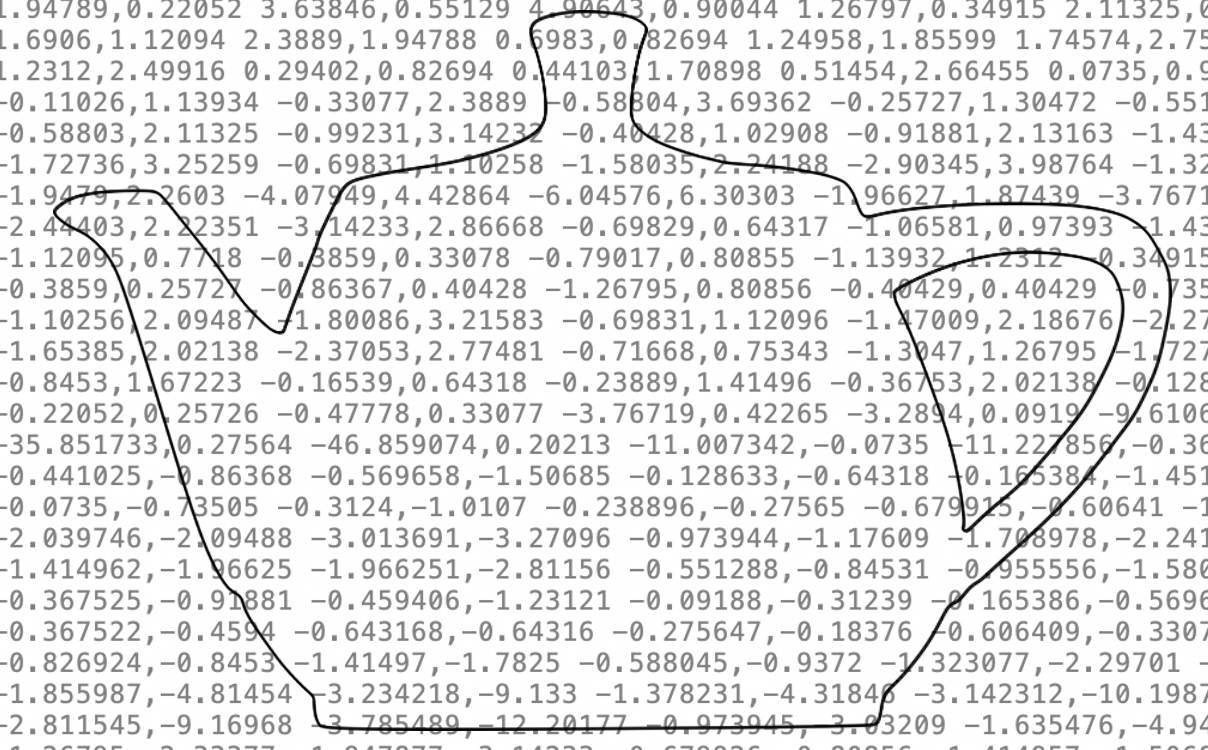
On the left is a tracing I made, of this photograph of a Utah teapot, using Inkscape’s pen tool (which lets me draw Bezier curves). Behind it in grey text is the ‘under the bonnet’ information about the co-ordinates. Those tell my computer screen about the position of the teapot on the page but will also let me resize (scale) the teapot to any size while always keeping the precise shape the same.

Create your own teapot, or other graphics

Why not have a go yourself, Inkscape is free to download (and there are lots of instructional videos on YouTube to show you how to use it). Find out more about Vector Graphics with our Coordinate conundrum puzzles and Vector dot-to-dot puzzles.

Do make yourself a nice cup of tea first though!

Jo Brodie, Queen Mary University of London

More on …

Watch …


Part of a series of ‘whimsical fun in computing’ to celebrate April Fool’s (all month long!).

Find out about some of the rather surprising things computer scientists have got up to when they're in a playful mood.

Subscribe to be notified whenever we publish a new post to the CS4FN blog.


This blog is funded by EPSRC on research agreement EP/W033615/1.

QMUL CS4FN EPSRC logos

Broadband, by carrier pigeon

The beautiful (and quite possibly wi-fi ready, with those antennas) Victoria Crowned Pigeon. Not a carrier pigeon admittedly, but much more photogenic.
Image by Foto-Rabe from Pixabay

There’s a joke, about a Victorian football newspaper reporter, who takes a homing pigeon with him to the match so that he can swiftly return the score to his editor in order to make the evening paper. Both teams score a goal early on in the match but nothing much has happened for the last half hour and things are dragging on. With minutes to go and an eye on the pub the reporter writes “one all” on a slip of paper, scrolls it up and attaches it to the leg of his pigeon, releasing it to fly back to the office. And then, suddenly, with seconds to go before the whistle’s final blow one side scores another goal. Our reporter is seen calling pitifully after the bird “two one… TWO one!!” but alas the bird’s message is beyond editing.

Carrier pigeons have been used since ancient times to send messages and during World War 2 messages delivered by pigeons saved human lives (some of the pigeons were even awarded medals!). The speed of data transmission is a combination of how fast they can fly home and how quickly the human reading the message can get it to its final destination.

The internet, but made of pigeons

The IETF (Internet Engineering Task Force) regularly publishes documents on various internet standards and protocols (the way computers communicate with each other to send and receive information). These are called ‘Requests for Comments’, or RFC, and are an invitation for experts to comment on and contribute to the document. The IETF also publishes an annual joke RFC for April Fools’ Day and in 1990 it published one called “A Standard for the Transmission of IP (Internet Protocol) Datagrams on Avian* Carriers (RFC 1149)”. The document (you can read it here) considers the pros and cons of carrier pigeons for data transmission, noting that “bandwidth is limited to the leg length”. [*avian means ‘of or relating to birds’]

I bet you won’t be remotely surprised to learn that some people have tried to implement it!

Eleven years later a group in Norway attempted to send a packet of data via a carrier pigeon noting the amount of data transmitted and the time taken to send it. Despite the pigeon being distracted by other homing pigeons also in flight, and then deciding to rest on a roof for a bit instead of returning promptly to the home point, the experiment was a success (sort of) and the pigeon returned 64 bytes in around 6,000 seconds (6 million milliseconds!), about an hour and 40 minutes.

Not great in terms of broadband speeds but not bad as a proof of principle.

A few years later, in 2009, an employee at an IT company in South Africa complained that internet speeds were too slo-o-o-w and joked that it would be quicker to send the data by carrier pigeon. So a bet was made to see if a pigeon could beat the broadband upload speeds of the time and the company gamely, and perhaps somewhat bravely, tested this out. Unfortunately it turned out to be true and the pigeon promptly ‘pinged’ the packet of data by flying 60 miles in just over an hour while the computer-based version got a bit stuck and had sent less than 5% of the data. Oops.

Holiday snaps delivered and developed before you get back

A company in the US which offers adventure holidays including rafting used homing pigeons to return rolls of films (before digital film took over) back to the company’s base. Instead of attaching the film to the birds’ legs the pigeons wore customised backpacks. The guides and their guests would take loads of photos while having fun rafting on the river and the birds would speed the photos back to the base, where they could be developed, so that when the adventurous guests arrived later their photos were ready for them.

Watch out for data loss though, just make sure you’re not standing beneath one in case they drop any ‘packets’ on you… Happy April Fools’ Day (though everything in this post is actually true!).

– Jo Brodie, Queen Mary University of London


Share this post


Part of a series of ‘whimsical fun in computing’ to celebrate April Fool’s (all month long!).

Find out about some of the rather surprising things computer scientists have got up to when they're in a playful mood.

Subscribe to be notified whenever we publish a new post to the CS4FN blog.


This blog is funded by EPSRC on research agreement EP/W033615/1.
QMUL CS4FN EPSRC logos

I wandered lonely as a mass of dejected vapour – try some AI poetry

Ever used an online poem generator, perhaps to get started with an English assignment? They normally have a template and some word lists you can fill in, with a simple algorithm that randomly selects from the word lists to fill out the template. “I wandered lonely as a cloud” might become “I zoomed destitute as a rainbow” or I danced homeless as a tree”. It would all depend on those word lists. Artificial Intelligence and machine learning researchers are aiming to be more creative.

Stanford University, the University of Massachusetts and Google have created works that look like poems, by accident. They were using a machine learning Artificial Intelligence they had previously ‘trained’ on romantic novels to research the creation of captions for images, and how to translate text into different languages. They fed it a start and end sentence, and let the AI fill in the gap. The results made sense though were ‘rather dramatic’: for example

“he was silent for a long moment
he was silent for a moment
it was quiet for a moment
it was dark and cold
there was a pause
it was my turn”

Is this a real poem? What makes a poem a poem is in itself an area of research, with some saying that to create a poem, you need a poet and the poet should do certain things in their ‘creative act’. Researchers from Imperial College London and University College Dublin used this idea to evaluate their own poetry system. They checked to see if the poems they generated met the requirements of a special model for comparing creative systems. This involved things like checking whether the work formed a concept, and including measures such as flamboyance and lyricism.

Read some poems written by humans and compare them to poems created by online poetry generators. What makes it creativity? Maybe that’s up to you!

Jane Waite, Queen Mary University of London


More on …

  • The algorithm that could not speak its name
    • See also this article about Christopher Strachey, who came up with the first example of a computer program that could create lines of text (from lists of words) to make up love poems.

Related Magazine …


Subscribe to be notified whenever we publish a new post to the CS4FN blog.


This blog is funded by EPSRC on research agreement EP/W033615/1.

QMUL CS4FN EPSRC logos

From a handful of sand to a fistful of dollars

Where computer chips come from

Sitting at the heart of your computer, mobile phone, smart TV (or even smart toaster) is the microprocessor that makes it all work. These electronic ‘chips’ have millions of tiny electronic circuits on them allowing the calculations needed to make your gizmos work. But it may be surprising to learn that these silicon chips, now a billion pound industry worldwide are in fact mostly made of the same stuff that you find on beaches, namely sand.

A transistor is just like a garden hose with your foot on it

Sand is mostly made of silicon dioxide, and silicon, the second most abundant substance in the earth’s crust, has useful chemical properties as well as being very cheap. You can easily ‘add’ other chemicals to silicon and change its electrical properties, and it’s by using these different forms of silicon that you can make mini switches, or transistors, in silicon chips.

House Hose

A transistor on a chip can be thought of like a garden hose, water flows from the tap (the source) through the hose and out onto the garden (the drain), but if you were to stand on the hose with your foot and block the water flow the watering would stop. An electronic transistor on a chip in its most basic form works like this, but electrical charge rather than water runs through the transistor (in fact the two parts of a transistor are actually called the source and drain). The ‘gate’ plays the part of your foot; this is the third part of the transistor. Applying a voltage to the gate is like putting your foot on and off the hose, it controls whether charge flows through the transistor.

Lots of letter T’s

A billion pound industry made of sand

If you look at a transistor on a chip it looks like a tiny letter T, the top crossbar on the T is the source/drain part (hose) and the upright part of the T is the gate (the foot part). Using these devices you can start to build up logic functions. For example, if you connect the source and drain of two transistors together one after another it can work out the logic AND function. How? Well think of this as a long hose with you and a friend’s foot available. If you stand on the hose no water will flow. If your friend stands on the hose no water will flow. If you both stand on the hose defiantly no water will flow. It is only when you don’t stand on the hose AND your friend also doesn’t stand on the hose that the water flows. So you’ve build a simple logical function.

Printing chips

From such simple logic functions you can build very complex computers, if you have enough of them, and that’s again where silicon comes in. You can ‘draw’ with silicon down to very small sizes. In fact a silicon chip is printed with many different layers. For example, one layer has the patterns for all the sources and drains, the next layer chemically printed on top are the gates, the next the metallic connections between the transistors and so on. These chips take millions of pounds to design and test, but once the patterns are correct it’s easy to stamp out millions of chips. It’s just a big chemical printing press. It’s the fact that you can produce silicon chips efficiently and cheaply with more and more transistors on them each year that drives the technology leaps we see today.

Beautiful silicon

Finally you might wonder how the chip companies protect their chip designs? They in fact protect them by registering the design of the masks they use in the layer printing process. Design registration is normally used to protect works of artistic merit, like company logos. Whether chip masks are quite as artistic doesn’t seem to matter. What does matter is that the chemical printing of silicon and lots of computer scientists have made all today’s computer technology possible. Now there is a beautiful thought to ponder when next on the beach.

– Paul Curzon, Queen Mary University of London


More on …

Magazines …

Watch …

  • Computational Lithography promo [EXTERNAL]
    • You probably won’t be surprised to learn that computer science can now also help improve the creation of computer chips. Computational lithography (literally ‘stone writing’) improves the resolution needed to etch the design of these tiny components onto the wafer thin silicon, using ultraviolet light (photoglithography = ‘stone writing with light’). Here’s a promotional video from ASML about computational lithography.

Subscribe to be notified whenever we publish a new post to the CS4FN blog.


This blog is funded by EPSRC on research agreement EP/W033615/1.

QMUL CS4FN EPSRC logos

Why is your Internet so slow?

Red and white lights of cars on a a motorway at night
Image from Pixabay

The Internet is now so much a part of life that, unless you are over 50, it’s hard to remember what the world was like without it. Sometimes we enjoy really fast Internet access, and yet at other times it’s frustratingly slow! So the question is why, and what does this have to do with posting a letter, or cars on a motorway? And how did electronic engineers turn the problem into a business opportunity?.

The communication technology that powers the Internet is built of electronics. The building blocks are called routers, and these convert the light-streams of information that pass down the fibre-optic cables into streams of electrons, so that electronics can be used to switch and re-route the information inside the routers.

Enormously high capacities are achievable, which is necessary because the performance of your Internet connection is really important, especially if you enjoy online gaming or do a lot of video streaming. Anyone who plays online games would be familiar with the problem: opponents apparently popping out of nowhere, or stuttery character movement.

So the question is – why is communicating over a modern network like the Internet so prone to odd lapses of performance when traditional land-line telephone services were (and still are) so reliable? The answer is that traditional telephone networks send data as a constant stream of information, while over the Internet, data is transmitted as “packets”. Each packet is a large group of data bits stuck inside a sort of package, with a header attached giving the address of where the data is going. This is why it is like posting a letter: a packet is like a parcel of data sent via an electronic “postal service”.

But this still doesn’t really answer the question of why Internet performance can be so prone to slow down, sometimes seeming almost to stop completely. To see this we can use another analogy: the flow of packet data is also like the flow of cars on a motorway. When there is no congestion the cars flow freely and all reach their destination with little delay, so that good, consistent performance is enjoyed by the car’s users. But when there is overload and there are too many cars for the road’s capacity, then congestion results. Cars keep slowing down then speeding up, and journey times become horribly delayed and unpredictable. This is like having too many packets for the capacity in the network: congestion builds up, and bad delays – poor performance – are the result.

Typically, Internet performance is assessed using broadband speed tests, where lots of test data is sent out and received by the computer being tested and the average speed of sending data and of receiving it is measured. Unfortunately, speed tests don’t help anyone – not even an expert – understand what people will experience when using real applications like an online game.

Electronic engineering researchers at Queen Mary, University of London have been studying these congestion effects in networks for a long time, mainly by using probability theory, which was originally developed in attempts to analyse games of chance and gambling. In the past ten years, they have been evaluating the impact of congestion on actual applications (like web browsing, gaming and Skype) and expressing this in terms of real human experience (rather than speed, or other technical metrics). This research has been so successful that one of the Professors at Queen Mary, Jonathan Pitts, co-founded a spinout company called Actual Experience Ltd so the research could make a real difference to industry and so ultimately to everyday users.

For businesses that rely heavily on IT, the human experience of corporate applications directly affects how efficiently staff can work. In the consumer Internet, human experience directly affects brand perception and customer loyalty. Actual Experience’s technology enables companies to manage their networks and servers from the perspective of human experience – it helps them fix the problems that their staff and customers notice, and invest their limited resources to get the greatest economic benefit.

So Internet gaming, posting letters, probability theory and cars stuck on motorways are all connected. But to make the connection you first need to study electronic engineering.

– Paul Curzon, Queen Mary University of London.

This article was originally published on the CS4FN website. It was also published in our 2023 Advent Calendar.

More on …


Magazines …

Front cover of CS4FN issue 29 - Diversity in Computing

Our Books …


Subscribe to be notified whenever we publish a new post to the CS4FN blog.


This blog is funded by EPSRC on research agreement EP/W033615/1.

QMUL CS4FN EPSRC logos

Global Entrepreneurship Week

Global Entrepreneurship Week is in November each year and to celebrate we’ve put together a portal resource page on Tech Entrepreneurs to inspire you. It features, for example, Jacquie Lawson (who created a digital greetings card enterprise), Freddie Figgers (who runs the first Black-owned telecoms company in the US), Dragonfly AI (a computer vision company founded at QMUL) and Sophie Wilson (who designed the chip for the BBC Micro). We will keep adding more people and companies. There are also links to careers resources.

– Jo Brodie, Queen Mary University of London

More on…


Subscribe to be notified whenever we publish a new post to the CS4FN blog.


This blog is funded by EPSRC on research agreement EP/W033615/1.

QMUL CS4FN EPSRC logos

Claude Shannon: Inventing for the fun of it

Image by Paul Curzon

Claude Shannon, inventor of the rocket powered Frisbee, gasoline powered pogo stick, a calculator that worked using roman numerals, and discoverer of the fundamental equation of juggling! Oh yeah, and founder of the most important theory underpinning all digital communication: information theory.

Claude Shannon is perhaps one of the most important engineers of the 20th century, but he did it for fun. Though his work changed the world, he was always playing with and designing things, simply because it amused him. Like his contemporary Richard Feynman, he did it for ‘the pleasure of finding things out.’

As a boy, Claude liked to build model planes and radio-controlled boats. He once built a telegraph system to a friend’s house half a mile away, though he got in trouble for using the barbed wires around a nearby pasture. He earned pocket money delivering telegrams and repairing radios.

He went to the University of Michigan, and then worked on his Masters at MIT. While there, he thought that the logic he learned in his maths classes could be applied to the electronic circuits he studied in engineering. This became his Masters thesis, published in 1938. It was described as ‘one of the most important Master’s theses ever written… helped to change digital circuit design from an art to a science.’

Claude Shannon is known for his serious research, but a lot of his work was whimsical. He invented a calculator called THROBAC (Thrifty Roman numerical BACkward looking computer), that performs all its operations in the Roman numeral system. His home was full of mechanical turtles that would wander around, turning at obstacles; a gasoline-powered pogostick and rocket-powered Frisbee; a machine that juggled three balls with two mechanical hands; a machine to solve the Rubik’s cube; and the ‘Ultimate Machine’, which was just a box that when turned on, would make an angry, annoyed sound, reach out a hand and turn itself off. As Claude once explained with a smile, ‘I’ve spent lots of time on totally useless things.’

A lot of the early psychology experiments used to involve getting a mouse to run through a maze to reach some food at the end. By performing these experiments over and over in different ways, they could figure out how a mouse learns. So Claude built a mouse-shaped robot called Theseus. Theseus could search a maze until he solved it, and then use this knowledge to find its way through the maze from any starting point.

Oh, and there’s one other paper of his that needs mentioning. No, not the one on the science of juggling, or even the one describing his ‘mind reading’ machine. In 1948 he published ‘A mathematical theory of communication.’ Quite simply, this changed the world, and changed how we think about information. It laid the groundwork for a lot of important theory used in developing modern cryptography, satellite navigation, mobile phone networks… and the internet.

– Paul Curzon, Queen Mary University of London.


More on …


Related Magazine …


Subscribe to be notified whenever we publish a new post to the CS4FN blog.


This blog is funded by EPSRC on research agreement EP/W033615/1.

QMUL CS4FN EPSRC logos