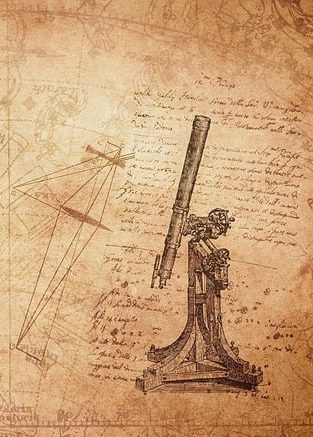
There are lots of fears about Artificial Intelligence, but are we witnessing, with AI, a new epoch in maths and science, and our understanding of reality… a step forward, equivalent to that of Galileo and the invention of the telescope?
When Galileo built the first telescope, old astronomy died. The previous astronomers could only use the human eye and yet that had produced amazing results thanks to the pure genius of the Ancient Greeks. That was no more, however. Notwithstanding the deductive and mathematical genius of Aristarchus of Samos, Eratosthenes et al., without telescopes our knowledge would forever be lacking and bound to a small part of our solar system. We couldn’t know anything much about the planets; of stars outside our solar system; of galaxies, and black holes, white dwarfs, the big bang and the rest of it. In fact we wouldn’t have modern physics, as we know it, given it was developed based on detailed observations of planetary movements using telescopes.
In recent months a new tool, AI mathematics, may be having a similar effect. Only a few years ago AIs famously struggled to even add numbers. In recent months, mathematicians working for AI companies have used AI tools to solve a series of previously unsolved maths problems, that human researchers have failed to prove despite many trying. The most amazing, so far, is perhaps the proof of a generalised version of the ‘Riemann hypothesis’ which dates back to 1859. it was considered one of the most important unsolved problems in Maths because its truth has consequences across mathematics.
Mathematicians often set challenges based on hunches. They assert something to be true, even when they have not worked out a proof that it is definitely true. Their hunch is that it is true, and they may have shown it holds in some cases, but not all. Riemann, for example, “hoped” his hypothesis was true but was clear that he was not sure. Other mathematicians then do maths that is based on the claimed hypothesis being true. All that follow-on work then falls if the original hunch turns out to be wrong. The hardest of these challenges have stood for decades or even centuries. Some are really vital. Certain unproved theorems linked to encryption, for example, if proved false could mean our whole global financial system is flawed … and their are rumours that those hypotheses could be about to fall.
AIs just hallucinate, though. They make things up to please us. So how can we be sure they aren’t just doing the AI equivalent of wishful thinking, just like humans do. Fermat, famously, wrote a note in a margin of a book about what is called ‘Femat’s Last Therorem’, that “I have discovered a truly marvelous proof of this, which this margin is too narrow to contain.” The theorem was eventually proved by Andrew Wiles with help from others, though even his original proof turned out to have a flaw. His proof’s massive complexity suggests Fermat may well have been thinking wishfully too. So how can we trust these AI proofs especially if they are hundreds or thousands of pages long?
The secret is that Computer Scientists have developed other tools called proof checkers that can check machine-created proofs very precisely. The AI mathematicians do not just generate human proofs they output small step proofs (generally millions of steps long). This series of steps can be input to a proof checker (one called ‘Lean’ is used by AIs) that checks that each small step does logically follow on from the previous ones. If all the millions of steps are checked to be correct then the theorem is validated to be true. This is even better, more detailed, checking than human mathematicians do on human proofs, so arguably AI maths is not only proving things we have been unable to prove, those proofs are even more solid and trustworthy, than old-fashioned human maths ones.
Advanced mathematics has always been seen as one of the most “intelligent” of human endeavours and we have made massive progress through use of the human brain alone. Now we are at a potentially exciting time in history, given hard, long unsolved problems are now dropping like flies because of the use of these new tools.
So maybe, hopefully, what we are living through now is the opening of a new era of knowledge advancement, that takes us way beyond what was possible in the past just using our “naked eye”.
All this is not meant to minimise the rightful fears of and concerns about the future. We are talking about “the sunny side of the moon”, but the moon also has a dark side.
We are certainly living in exciting times.
– Pasquale Malacaria and Paul Curzon, Queen Mary University of London
More on …
Subscribe to be notified whenever we publish a new post to the CS4FN blog.


