Instant 3×3 Magic Squares

A 3x3 magic square containing numbers 
6 1 8
7 5 3
2 9 4
Image by CS4FN

Amaze your family and friends this holiday showing your mathematical prowess by generating instant magic squares at will. In the previous article we saw how to generate 4×4 magic squares. If that was a bit too hard, here is a simpler version for generating instant 3×3 magic squares. Learn the trick and some computer science about algorithms and how they prove they always work.

The Trick

First ask an audience member to pick a number out of a hat. That will be the target number. You then write out a magic square that adds to that number.

The Secret

Building this type of magic square is based on the algorithm below that creates magic squares from 9 consecutive numbers. The secret is first to make sure all the numbers you put in the hat are multiples of 3 (i.e. are in the 3 times table). You then follow the algorithm below that tells you what numbers to put where in the grid.

The Magical Algorithm

  1. Place lots of numbers on folded pieces of paper in a hat. All are multiples of 3 (but the audience do not know that).
  2. Ask an audience member to pull one out at random.
  3. Announce that that number is the TARGET number. You will create a magic square that adds up to that number so that is the number that the square rows and so on will add to.
  4. In your head divide that number by 3. For example, if TARGET was 15 THEN you divide 15 by 3 to get 5. Let’s call this value MID, to allow us to be general when we follow the rest of the instructions.
  5. On a 3 by 3 grid, put MID in the centre square (so in our example, put 5 in the middle).
  6. Place the number (MID + 3) in the upper right-hand square (in our example, 5+3 = 8).
  7. Place the number (MID – 3) in the lower left-hand square (in our example, 5-3 = 2).
  8. Place the number (MID + 1) in the upper left-hand square (in our example, 5+1 = 6).
  9. Place the number (MID – 1) in the lower right-hand square (in our example, 5-1 = 4).
  10. Fill in the remaining squares to make the magic square work, so that the rows and columns add to TARGET (subtracting the other two numbers from TARGET in each case to get the missing one).
A 3x3 magic square template containing 
MID+1    ___    MID+3  
___         MID       ___
MID-3    ___    MID-1
Image by CS4FN

For the last step, you just need to fill in the empty squares, to make sure the rows and columns add to the right number, TARGET. To do this you just need to keep in mind the target magic number you calculated. (For our example, remember it was 15). It’s a bit of simple arithmetic to find these final numbers and voila, you have built a magic square that adds up to a total picked at random..

Practice doing the maths in your head so that you can make it seem magical.

Does it always work?

You can actually prove the trick always works using some simple algebra based on the template magic square above. See if you can work out how yourself. Using MID and TARGET in place of numbers, for the trick to always generate a correct magic square you need to check that all rows and columns simplify to be equivalent to TARGET. Visit our Conjuring with Computation website to see the detail of how.

Proving a magic trick in this way is just the same thing computer scientists do when they invent new computing algorithms to make sure they work. It increases the assurance that the algorithm and so programs implementing it do work.

If you can program, then you could write a program to generate magic squares using the above algorithm, and then your proof would be a step in verifying your program, as long as it does correctly implement the algorithm!

More on …

Buy the Book

Subscribe to be notified whenever we publish a new post to the CS4FN blog.

This page is funded by EPSRC on research agreement EP/W033615/1.

QMUL CS4FN EPSRC logos

Synthetic Speech

Robot on phone
Image by OpenClipart-Vectors from Pixabay

Computer-generated voices are encountered all the time now in everyday life, not only in automated call centres, but also in satellite navigation systems and home appliances.

Although synthetic speech is now far better, early systems were not as easy to understand as human speech, and many people don’t like synthetic speech at all. Maria Klara Wolters of Edinburgh University decided to find out why. In particular, she wanted to discover what makes synthetic speech difficult for older people to understand, so that the next generation of talking computers would speak more clearly.

She asked a range of people to try out a state-of-the-art speech synthesis system fo the time, tested their hearing and asked their thoughts about the voices. She found that older people have more difficulty understanding computer-generated voices, even if they were assessed as having healthy hearing. She also discovered that messages about times and people were well understood, but young and old alike struggled with complicated words, such as the names of medications, when pronounced by a computer.

More surprisingly, she found that the ability of her volunteers to remember speech correctly didn’t depend so much on their memory, but on their ability to hear particular frequencies (between 1 and 3 kHz). These frequencies are in the lower part of the middle range of frequencies that the ear can hear. They contain a large amount of information about the identity of speech sounds. Another result of the experiments was that the processing of sounds by the brain, so called ‘central auditory processing’ appeared to play a more important role for understanding natural speech, while peripheral auditory processing (processing of sounds in the ear) appeared to be more important for synthetic speech.

As a result of the experiments, Maria drew up a list of design guidelines for the next generation of talking computers: make pauses around important words, slow down, and change to simpler forms of expressions (e.g. “the blue pill” is much easier to understand and remember than a complicated medical name). She suggested that, such simple changes to the robot voices could make an immense difference to the lives of many older people. They also make services that use computer-generated voices easier for everyone to use. This kind of inclusive design benefits everybody, as it allows people from all walks of life to use the same technology. Maybe Maria’s rules would work for people you know too. Try them out next time grandpa asks you to repeat what you just said!

by the CS4FN team

More on …

Subscribe to be notified whenever we publish a new post to the CS4FN blog.


This page is funded by EPSRC on research agreement EP/W033615/1.

QMUL CS4FN EPSRC logos

Film Futures: A Christmas Carol

The Ghost of Christmas Present surrounded by food, with Scrooge looking on in night clothes.
John Leech, Public domain, via Wikimedia Commons

Computer Scientists and digital artists are behind the fabulous special effects and computer generated imagery we see in today’s movies, but for a bit of fun, in this series, we look at how movie plots could change if they involved Computer Science or Computer Scientists. Here we look at an alternative version of the Charles Dickens’ A Christmas Carol (take your pick of which version…my favourites are The Muppet Christmas Carol, but also if we include Theatre, the one man version of Patrick Stewart, in the 1990s and London in 2005 where he plays all 40 or so parts on a bare stage).

**** SPOILER ALERT ****

Ebenezer Scrooge runs a massively successful Artificial Intelligence company called Scrooge and Marley. Their main product is SAM, an AI agent which is close to General AI in capability. The company sells it to the world with both business versions and personal ones. The latter acts as everyone’s friend, confidant, personal trainer, tutor and mentor, and more. It hears everything they hear and say, and sees everything they see. As a result Scrooge is now a Trillionnaire.

Apart from one last employee, Bob Cratchit, everyone in his company has long been replaced by AI agents designed by Scrooge. It is a simple way to boost profits: human employees, after all, are expensive luxuries. First all the clerical staff went, then accounts and Human Resources. The cleaners were replaced by robots that stalk the corridors at night, also acting as security guards, the receptionist is now a robot head. Eventually even the software engineers were replaced by software agents that now beaver away at the code, constantly upgrading, SAM, following SAM’s instructions. Bob Cratchit, maintains both Scrooge’s personal and company IT systems, there for when some human intervention is needed, though that now actually means doing very little but monitoring everything…long hours staring at a screen. He is paid virtually nothing as a result, as he has had his pay repeatedly cut as his duties were replaced. He has had no option to accept the cuts as jobs are scarce and he has a disabled child, Tiny Tim, to support. He is constantly told by Scrooge that he will soon be completely replaced by an agent though, and lives in fear of that day.

On Christmas Eve Scrooge rejects his nephew, Fred’s invitation to visit for Christmas dinner. Instead Scrooge returns, in his self-driving car, to his smart home within his compound on a cliff top overlooking the sea. He lives there alone, given his servants were dismissed long ago. As he arrives, he is shocked to see a vision of his late partner, Jacob Marley, dead for 7 years, in the lens of his smart door cam. The door opens automatically on sensing his arrival, and the vision disappears as he rushes past. He brushes it off as tiredness. Perhaps he is coming down with something. He eats an AI chef designed ready meal made by his smart fridge with integrated microwave. It knew he was arriving so had it ready for him as he entered the kitchen. The house also dispenses him drugs to protect against the possible nascent illness. His house is dark and silent and he is alone, but he likes it that way. He retires to his bedroom, his giant 4-poster bed surrounded by plate glass sides that automatically darken as he climbs in to bed and he quickly falls asleep.

Suddenly, he is woken by a strange clanking. The ghost of Jacob Marley appears and warns him that his race to become a trillionaire has left him with everlasting chains that he will drag to eternity, just as Marley must do. He is warned that he will be visited by three ghosts of past, present and future and he should heed their warnings! There is still time to cast off his chains before it is too late.

The ghost of Christmas Past arrives first and takes him back to his childhood. He sees himself growing up, a loner at boarding school, spending all his time coding, on his laptop, making no friends and wanting none. But, then they move forward in time to his first job as an apprentice software engineer where he meets Belle. For the first time in his life he falls in love and becomes a new person. He starts to love life. She is the joy of his whole existence. He still works hard but he also spends lots of time with Belle. Eventually they become engaged, but soon he is working on making his first million. Gradually, he spends more and more time at work and less time with Belle, as if he doesn’t he will end up behind the curve. He skips social events working late on software upgrades, leaving Belle to go to the theatre, to parties, to dances alone. He sees her less and less as he just doesn’t have the time if he is to make his company successful. He has no time for anything but work. He makes his first fortune running an online betting company, and becomes hardened to the problems of others. He can’t care about the people whose homes are broken up through gambling addiction caused by his site. He has to turn a blind eye to the people he left destitute all because they were drawn in by his company’s use of intentionally addictive computer algorithms. The debt collectors deal with them. It is not his problem that his users are driven to suicide, as there are always more, who can be persuaded to start gambling younger and younger – it is their choice after all. He makes his million and uses the money to invest in a start up AI company that with business partner, Jacob Marley, they take control of, sacking the original founders. Now he is chasing his first billion.

Eventually, Belle realises he has become a stranger to her. Worse, he does not care about the cost of the things he does to others. All the kindness that had blossomed when he first met her has gone. He clearly loves the pursuit of money and personal success far more than he loves her, Winning the race to market is all that matters. Her heart broken, another casualty of his quest for success, Belle releases him from their engagement.

Later, the ghost of Christmas Present arrives and shows Scrooge Christmas as it is now. They see lots of examples of people enjoying life, whatever their circumstances because of the way they value each other, not because they value money or abstract success. Scrooge is shown how Christmas brings joy to all who let the spirit of Christmas enter their hearts. It pulls people together, making them happy, enjoying each other’s company. However, Scrooge also sees how he is perceived by those who know him: a sad monster who cares only for himself and not at all for others, with his own life the worse for it, despite his fabulous wealth. He is shown too how his nephew Fred refuses to give up on him and says he will invite him to join their Christmas every year even if he knows the invitation will always be turned down.

The ghost of Christmas Future arrives next and shows him the future of Bob Cratchit’s family. With little income to look after him, the disabled Tiny Tim dies. Scrooge is also shown his own grave and the aftermath of his lonely death, when he is mocked, even by his own robot agents. On his death, a hacker group takes them over to steal his fortune. Scrooge asks whether this future is the future that will be, or a future that may be only. Assured that he can still change his future, he wakes on Christmas morning.

Staring out the window at the snow falling on Christmas morning, he immediately instructs his AI agent, SAM, to buy the leading cryogenics firm. It freezes rich people when they die, putting them on ice so that one day, once the science is perfected, they can be brought back to life. He instructs other AI agents to research and perfect the science of resurrection. However, he also boosts his cyber security and sacks Cratchit, as clearly he is a security weakness, Scrooge has no evidence, but he strongly suspects the shenanigans in the night must have been Cratchit’s doing, somehow controlling the holographic displays of his smart house, perhaps, or adding hallucinogenics to his food.

Satisfied he gets on with his life as before, building his company, building his wealth.

However, the following year on Christmas Eve he is in a freak accident. His smart car is barrelled into by a self-driving lorry that runs a red light. His AI agents take over immediately and he is cryogenically frozen, the frozen body moved back to his smart home under the control of SAM.

Many decades pass. Then one day his AI agents resurrect him. They have been working on his behalf, perfecting the science of resurrection on the people frozen before him. There are many failures, during which all the company’s former clients, who had paid to be frozen, but who are now just assets of the company, are killed for ever in resurrection experiments. However, SAM finally works out how to resurrect a person successfully. After testing the process on quantum simulations for many years, SAM finally brings Scrooge back to life.

His first thought is for the state of his companies, the state of his wealth .However, he is told that his former money is now worthless. He is told by SAM of the anarchy and the riots of the mid 21st century as people were thrown out of work, replaced by machines, as millions were made homeless, how there were wars over water, over food, and because of environmental destruction made worse by all the conflict. The world economy collapsed completely as a small number of companies amassed all the wealth, but impoverished everyone else, so that there was eventually no one with money to buy their products. Famine and plague followed, sweeping the globe.

However, Scrooge is assured by SAM that it is all ok, because as humanity died out he was protected by his AI agents. They used his money to expand his estate. They bought companies (run by machines) that then worked solely to protect his interests and his personal future. They stockpiled resources, buying automated manufacturing plants along with their whole supply chains, long before money became worthless. They computed the resources he would need, and so did what was needed to secure his future. However, the planet is now dead. Gradually, he realises that he is the last person still known to be alive. Finally, he has his wish: “If they would rather die…they had better do it, and decrease the surplus population.”

Paul Curzon, Queen Mary University of London

The reality

“Everyone is working all the time…Even the folks who are very wealthy now…all they do is work….No one’s taking a holiday. People don’t have time … for the people they love.”

– Guardian. 1 Dec 2025

“The inside story of the race to build the ultimate in Artificial Intelligence”

More on …

Subscribe to be notified whenever we publish a new post to the CS4FN blog.


This page is funded by EPSRC on research agreement EP/W033615/1.

QMUL CS4FN EPSRC logos

Hear and … their magic square

A magic three by three square with the numbers 2, 9 and 4 in the top row, 7, 5 and 3 in the middle row and 6, 1 and 8 in the bottom row. Each row, column and the two diagnonals add up to 15.
Image by CS4FN

Victorian Computer Scientists, Ada Lovelace and Charles Babbage were interested in Magic Squares. We know this because a scrap of paper with mathematical doodles and scribbles on it in their handwriting has been discovered, and one of the doodles is a magic square like this one. In a magic square all the rows, columns and diagonals magically add to the same number. At some point, Ada and Charles were playing with magic squares together. Creating magic squares sounds hard, but perhaps not with a bit of algorithmic magic.

The magical effect

For this trick you ask a volunteer to pick a number. Instantly, on hearing it, you write out a personal four by four magic square for them based on that number. When finished the square contents adds to their chosen number in all the usual ways magic squares do. An impressive feat of superhuman mathematical skills that you can learn to do most instantly.

Making the magic

To perform this trick, first get your audience member to select a large two digit number. It helps if it is a reasonably large number, greater than 20, as you’re going to need to subtract 20 from it in a moment. Once you have the number you need to do a bit of mental arithmetic. You need an algorithm – a sequence of steps – to follow that given that number guarantees that you will get a correct magic square.

For our example, we will suppose the number you are given is 45, though it works with any number.

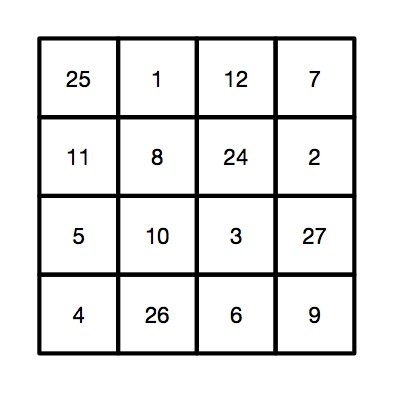
Let’s call the chosen number N (in our example: N is 45). You are going to calculate the following four numbers from it: N-21, N-20, N-19 and N-18, then put them in to a special, precomputed magic square pattern.

The magic algorithm

Sums like that aren’t too hard, but as you’ve got to do all this in your head, you need a special algorithm that makes it really easy. So here is an easy algorithm for working out those numbers.

This four by four magic square contains the calculations needed to install the numbers in the correct positions so that the magic square will work with any large two digit number
Image by CS4FN.
  1. Start by working out N – 20. Subtracting 20 is quite easy. For our example number of 45, that is 25. This is our ‘ROOT’ value that we will build the rest from.
  2. N-19. Just add 1 to the root value (ROOT + 1). So 25 + 1 gives 26 for our example.
  3. N-18. Add 2 to the root value (ROOT + 2). So 25 + 2 gives 27.
  4. N-21. Subtract 1 from the root value (ROOT – 1). So 25 – 1 gives 24.
  5. Having worked out the 4 numbers created form the original chosen number, N, you need to stick them in the right place in a blank magic square, along with some other numbers you need to remember. It is the pattern you use to build your magic square from. It looks like the one to the right. To make this step easy, write this pattern on the piece of paper you write the final square on. Write the numbers in light pencil, over-writing the pencil as you do the trick so no-one knows at the end what you were doing.

A square grid of numbers like this is an example of what computer scientists call a data structure: a way to store data elements that makes it easy to do something useful: in this case making your friends think you are a maths superhero.

When you perform this trick, fill in the numbers in the 4 by 4 grid in a random, haphazard way, making it look like you are doing lots of complicated calculations quickly in your head.

Finally, to prove to everyone it is a magic square with the right properties, go through each row, column and diagonal, adding them up and writing in the answers around the edge of the square, so that everyone can see it works.

The final magic square for chosen number 45

So, for our example, we would get the following square, where all the rows, columns and diagonals add to our audience selected number of 45.

This four by four magic square is the result of taking the chosen number 45 and performing the sequence of calculations (the algorithm) using it as 'N'.
Image by CS4FN.

Why does it work?

If you look at the preset numbers in each row, column and diagonal of the pattern, they have been carefully chosen in advance to add up to the number being subtracted from N on those lines. Try it! Along the top row 1 + 12 + 7 = 20. Down the right side 11 + 5 + 4 = 20.

Do it again?

Of course you shouldn’t do it twice with the same people as they might spot the pattern of all the common numbers…unless, now you know the secret, perhaps you can work out your own versions each with a slightly different root number, calculated first and so a different template written lightly on different pieces of paper.

Peter McOwan and Paul Curzon, Queen Mary University of London


Related Magazine …


Download our free magic booklets