
Victorian volunteers needed – the start of citizen science

What was Ada Lovelace thinking about when she wrote:
“If amateurs of either sex would amuse their idle hours with experiments on this subject, and would keep an accurate journal of their daily observations, we should have in a few years a mass of registered facts to compare with the observation of the scientific”.

Yes, crowdsourcing science experiments! Now we call it Citizen Science. She had just read a book by a Baron von Reichenbach on magnetism in which he had suggested a whole host of experiments, such as moving magnets up and down a person’s body, showing people magnets in the dark, and holding heavy and light magnets and asking them if they felt any sensations. She could see that he had some great ideas, but she was not convinced by his examples alone.

Ada was not the only Victorian to ask the general public for help collecting data. Charles Darwin, the Origin of Species man, wrote to gardeners, diplomats, army officers and scientists across the world asking for information about the plants they grew and the animals (including people) they saw. This all helped him build up the concrete evidence that natural selection was the way evolution works. People even sent him gifts of live animals in the post. A Danish gentleman sent him a parcel of live barnacles. When they did not arrive on time, Darwin, desperate to dissect the species, panicked and got ready to offer a reward in the Times newspaper. Luckily they arrived intact, fresh and not too smelly!

Today we might take part in the RSPB’s Big Garden Bird Watch1, contribute to a blog, ‘favourite’ or ‘like’ a post on social media or vote for your favorite performer in a talent show. We participate, and ‘amuse our idle hours’ sometimes in the pursuit of science, sometimes not. Public research is a big new topic, with governments and companies looking to use people power. Innovations such as shared mapping systems ask users to upload details about a place, add photographs, rectify mistakes. Wikipedia is sourced by volunteers, with other volunteers checking accuracy. Galaxy Zoo volunteers even found a whole new planet that orbits four stars!

What would Ada be asking us to research? Test your own DNA and send in the results? Measure air quality and keep a record on a central database? Build your own ‘find a barnacle’ app? But rather than writing a journal or sending a parcel of barnacles, you would log it on line, click a link or design your own survey. Ada’s computers are in on the act again.

Why not find a Citizen Science project on something you are interested in. Sometimes called public science or science outreach projects they might be run by local universities, museums, your council, charities or through crowdsourced internet projects such as www.zooniverse.org. Share what you do with others and spread Ada’s word to be a modern day volunteer.

Jane Waite, Queen Mary University of London

  1. 23-25 January 2026: RSPB Big Garden Birdwatch – “Spend an hour watching the birds in your patch, between 23 and 25 January, and record the birds t allhat land.” You can also get your school involved in the Big School’s Birdwatch 2026. If you’re reading this after 25 January 2026 make a note in your diary to remind you to check next year! ↩︎


Related Magazine …

This article was originally published on page 13 of issue 20 of the CS4FN magazine. You can download a copy at the link below, and all of our previous magazine issues (free) here.


Subscribe to be notified whenever we publish a new post to the CS4FN blog.

Letters from the Victorian Smog: Braille: binary, bits & bytes

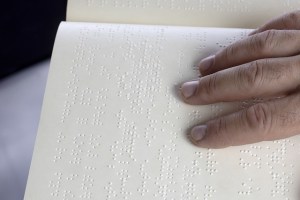
We take for granted that computers use binary: to represent numbers, letters, or more complicated things like music and pictures…any kind of information. That was something Ada Lovelace realised very early on. Binary wasn’t invented for computers though. Its first modern use as a way to represent letters was actually invented in the first half of the 19th century. It is still used today: Braille.

Braille is named after its inventor, Louis Braille. He was born 6 years before Ada though they probably never met as he lived in France. He was blinded as a child in an accident and invented the first version of Braille when he was only 15 in 1824 as a way for blind people to read. What he came up with was a representation for letters that a blind person could read by touch.

Choosing a representation for the job is one of the most important parts of computational thinking. It really just means deciding how information is going to be recorded. Binary gives ways of representing any kind of information that is easy for computers to process. The idea is just that you create codes to represent things made up of only two different characters: 1 and 0. For example, you might decide that the binary for the letter ‘p’ was: 01110000. For the letter ‘c’ on the other hand you might use the code, 01100011. The capital letters, ‘P’ and ‘C’ would have completely different codes again. This is a good representation for computers to use as the 1’s and 0’s can themselves be represented by high and low voltages in electrical circuits, or switches being on or off.

He was inspired by an earlier ‘Night Writing’ system developed by Charles Barbier to allow French soldiers in the 1800s to read military messages without using a lamp (which gave away their position, putting them at risk).

The first representation Louis Braille chose wasn’t great though. It had dots, dashes and blanks – a three symbol code rather than the two of binary. It was hard to tell the difference between the dots and dashes by touch, so in 1837 he changed the representation – switching to a code of dots and blanks.

He had invented the first modern
form of writing based on binary.

Braille works in the same way as modern binary representations for letters. It uses collections of raised dots (1s) and no dots (0s) to represent them. Each gives a bit of information in computer science terms. To make the bits easier to touch they’re grouped into pairs. To represent all the letters of the alphabet (and more) you just need 3 pairs as that gives 64 distinct patterns. Modern Braille actually has an extra row of dots giving 256 dot/no dot combinations in the 8 positions so that many other special characters can be represented. Representing characters using 8 bits in this way is exactly the equivalent of the computer byte.

Modern computers use a standardised code, called Unicode. It gives an agreed code for referring to the characters in pretty well every language ever invented including Klingon! There is also a Unicode representation for Braille using a different code to Braille itself. It is used to allow letters to be displayed as Braille on computers! Because all computers using Unicode agree on the representations of all the different alphabets, characters and symbols they use, they can more easily work together. Agreeing the code means that it is easy to move data from one program to another.

The 1830s were an exciting time to be a computer scientist! This was around the time Charles Babbage met Ada Lovelace and they started to work together on the analytical engine. The ideas that formed the foundation of computer science must have been in the air, or at least in the Victorian smog.

Paul Curzon and Jo Brodie, Queen Mary University of London


More on…

Magazines

Subscribe to be notified whenever we publish a new post to the CS4FN blog.


This blog is funded by EPSRC on research agreement EP/W033615/1.

QMUL CS4FN EPSRC logos
