
The Knights Templar were a 12th century order of catholic warrior monks, more accurately if convolutedly called “The Poor Fellow-Soldiers of Christ and of the Temple of Solomon” though they weren’t exactly poor. In addition to their original role of protecting catholic pilgrims heading to Jerusalem from robbery and murder, they also acted as a kind of international banker to support their main role. They laid some important foundations of modern international banking in the process. In particular, they invented a way to move money (or gold) around safely, without ever actually moving it anywhere. That sounds like a magic trick! Did they use some supposed mystical magic powers to do this? No, they kept the actual money given to them in the nearest of their large network of 1000 or so headquarters and forts around the continent. The money didn’t have to move anywhere. They then gave the person a note to hand in at their headquarters in another country. It promised that the Knights there would give them the equivalent amount from their money store when asked and given the note. The Knights there just swapped them the money for that note. This worked as long as they had a suitable store of money in each location, which of course would be topped up each time someone wanted to move money from that point. This is a simple version of how international banking works now. A British 20 pound note just promises to pay the bearer an equivalent amount, and without that promise (and people’s belief in it) it is just a piece of paper. It is just a similar promissory note, except people now just swap notes, treating it as money in its own right. Similarly, the banks don’t actually move any gold or other physical form of money about when you pay a shop with your debit card or banking app. They just move information equivalent to those promissory notes embodied in the transaction, around a network (though a computer one rather than a network of forts connected by roads).
There is a problem though with moving money from one person to another in this way using notes. If someone steals the note then it is potentially as valuable to them as actually stealing the chest of gold left in the original fort (just as stealing a 20 pound note is). In the Templar’s time the thief would just need to take it to a Templar headquarters and swap it for money just as the original owner would have done (a bit risky perhaps, given how fearsome the Templars were, but potentially possible!). Worse though, without a system to protect from this kind of attack, a thief could copy the note and then ask for the money repeatedly!
However, the Templars are know to have used encryption in their communications. The notes may therefore have been encrypted too and if so that would have made them useless if stolen. Banks now encrypt all those messages that move money about computer networks for the same reason. If only the Templar’s could read their notes (as only the Templar’s knew the key to their code), then only they could know it even was promising money. That doesn’t fully make it secure though, perhaps a thief could guess it was such a note, and if so what is to stop them then trying to cash it in (apart from the risk of being wrong). You would need something more. A simple possibility is the person with the note would need to know the encrypted amount that was contained somewhere within it. If they didn’t ask for the right amount then they couldn’t have handed over the money in the first place. They would reveal themselves as a thief!
Modern banks have to deal with similar problems even though modern financial transactions are all encrypted. Simple encryption alone is still not enough, protocols (special algorithms) are needed to prevent wide ranging kinds of attack being possible. Banks also need to use better ciphers than those from the Middle Ages, as today we can quickly crack ciphers as simple as the Templar Cipher. Banking is all done differently in detail today, but the ideas behind what is done and why are the same.
Can you crack the Templars’ cipher and decrypt the message below? One way might be using frequency analysis. The most common letters in English are likely (if not definitely) the most common in the message. E is most frequent in English, so which symbol might stand for E? Frequency analysis had been known for several hundred years before the Templars used ciphers (at least by the Arabs, though the Templars weren’t exactly their friends!), so it is actually possible even then that the Templars’ messages might be cracked, unknown to them. It was an Arabian scholar called Al Kindi, who actually invented frequency analysis (or at least was the earliest known person to write about it in his manuscript “On Deciphering Cryptographic Messages”.) Another way to crack the code might be to look for cribs – what words might be included in the message if it is a promissory note? Using both together may give you a good chance of decrypting the message. If you can’t crack their code (there is a big clue in this article), the key is given at the end if you scroll down. Use it to then decrypt the message.

More on …
- Cyber Security
- Downloadable activity sheets of this message to crack [On our sister TLC site]
Magazines …
Subscribe to be notified whenever we publish a new post to the CS4FN blog.
This blog is funded by EPSRC on research agreement EP/W033615/1.

Scroll down for the solutions
Solutions: The Key
The Templar’s cipher uses symbols based on their flag’s triangles. To encrypt a message swap letters for symbols. (They had no J).
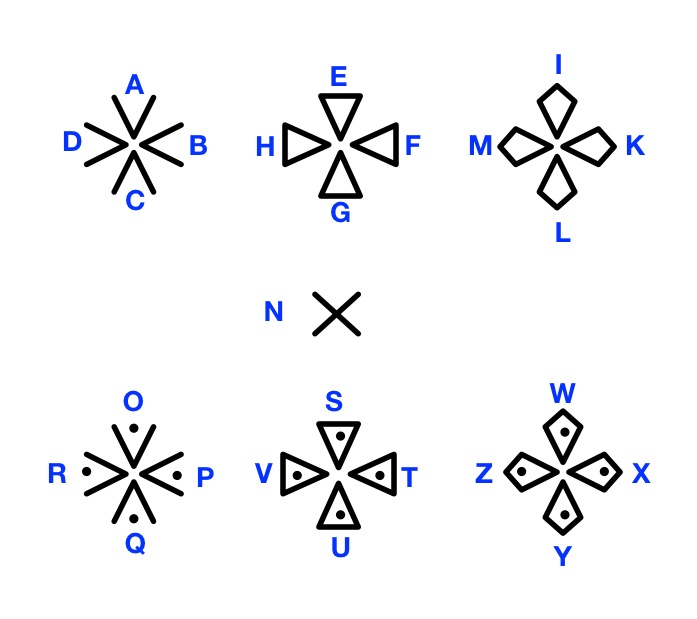
Can you decrypt the message given the above key? Here is an example – the message HELLO as encrypted in this cipher.

Scroll down further for what the message says…
Solutions: The Message
The message reads …
GIVE KING PHILIP OF FRANCE ONE HUNDRED GOLD PIECES
 cs4fn
cs4fn 