Gutta-Percha: how a tree launched a global telecom revolution

CS4FN Banner

by Paul Curzon, Queen Mary University of London

(from the archive)

Rubber tree being tapped
Image  from Pixabay

Obscure plants and animals can turn out to be surprisingly useful. The current mass extinction of animal and plant species needs to be stopped for lots of reasons but an obvious one is that we risk losing forever materials that could transform our lives. Gutta-percha is a good example from the 19th century. It provided a new material with uses ranging from electronic engineering to bioengineering. It even transformed the game of golf. Perhaps its greatest claim to fame though is that it kick-started the worldwide telecoms boom of the 19th century that ultimately led to the creation of global networks including the Internet.

Gutta-percha trees are native to South East Asia and Australia. Their sap is similar to rubber. It’s actually a natural polymer: a kind of material made of gigantic molecules built up of smaller structures that are repeated over and over again. Plastics, amber, silk, rubber and wool are all made of polymers. Though very similar to it, unlike rubber, Gutta-percha is biologically inert – it doesn’t react with biological materials – and that was the key to its usefulness. It was discovered by Western explorers in the middle of the 17th century, though local Malay people already knew about it and used it.

Chomping wires

So how did it play a part in creating the first global telecom network? Back in the 19th century, the telegraph was revolutionising the way people communicated. It meant messages could be sent across the country in minutes. The trouble was when the messages got to the coast they ground to a halt. Messages could only travel across an ocean as fast as a boat could take them. They could whiz from one end of America to the other in minutes but would then take several weeks to make it to Europe. The solution was to lay down undersea telegraph cables. However, to carry electricity an undersea cable needs to be protected and no one had succeeded in doing that. Rubber had been tried as an insulating layer for the cables but marine animals and plants just attacked it, and once the cable was open to the sea it became useless for sending signals. Gutta-percha on the other hand is a great insulator too but it doesn’t degrade in sea-water.

As it was the only known material that worked, soon all marine cable used Gutta-percha and as a result the British businessmen who controlled its supply became very rich. Soon telegraph cables were being laid everywhere – the original global telecoms network. To start with the network carried telegraph signals then was upgraded to voice and now is based on fibre-optics – the backbone of the Internet.

Rotting teeth

Gutta-percha has also been used by dentists – just as marine animals don’t attack it, it doesn’t degrade inside the human body either. That together with it being easy to shape makes it perfect for dental work. For example, it is used in root canal operations. The pulp and other tissue deep inside a rotting tooth are removed by the dentist leaving an empty chamber. Gutta-percha turns out to be an ideal material to fill the space, though medical engineers and materials scientists are trying to develop synthetic materials like Gutta-percha, but that have even better properties for use in medicine and dentistry.

Dimpled balls

That just leaves golf! Early golf balls were filled with feathers. In 1848 Robert Adams Paterson came up with the idea of making them out of Gutta-percha since it was much easier to make than the laborious process of sewing balls of feathers. It was quickly realised, if by accident, that after they had been used a few times they would fly further. It turned out this was due to the dimples that were made in the balls each time they were hit. The dimples improved the aerodynamics of the ball. That’s why modern golf balls are intentionally covered in dimples.

So gutta-percha has revolutionised global communications, changed the game of golf and even helped people with rotting teeth. Not bad for a tree.

More on …


Subscribe to be notified whenever we publish a new post to the CS4FN blog.


This blog is funded through EPSRC grant EP/W033615/1.
Who invented Morse code?

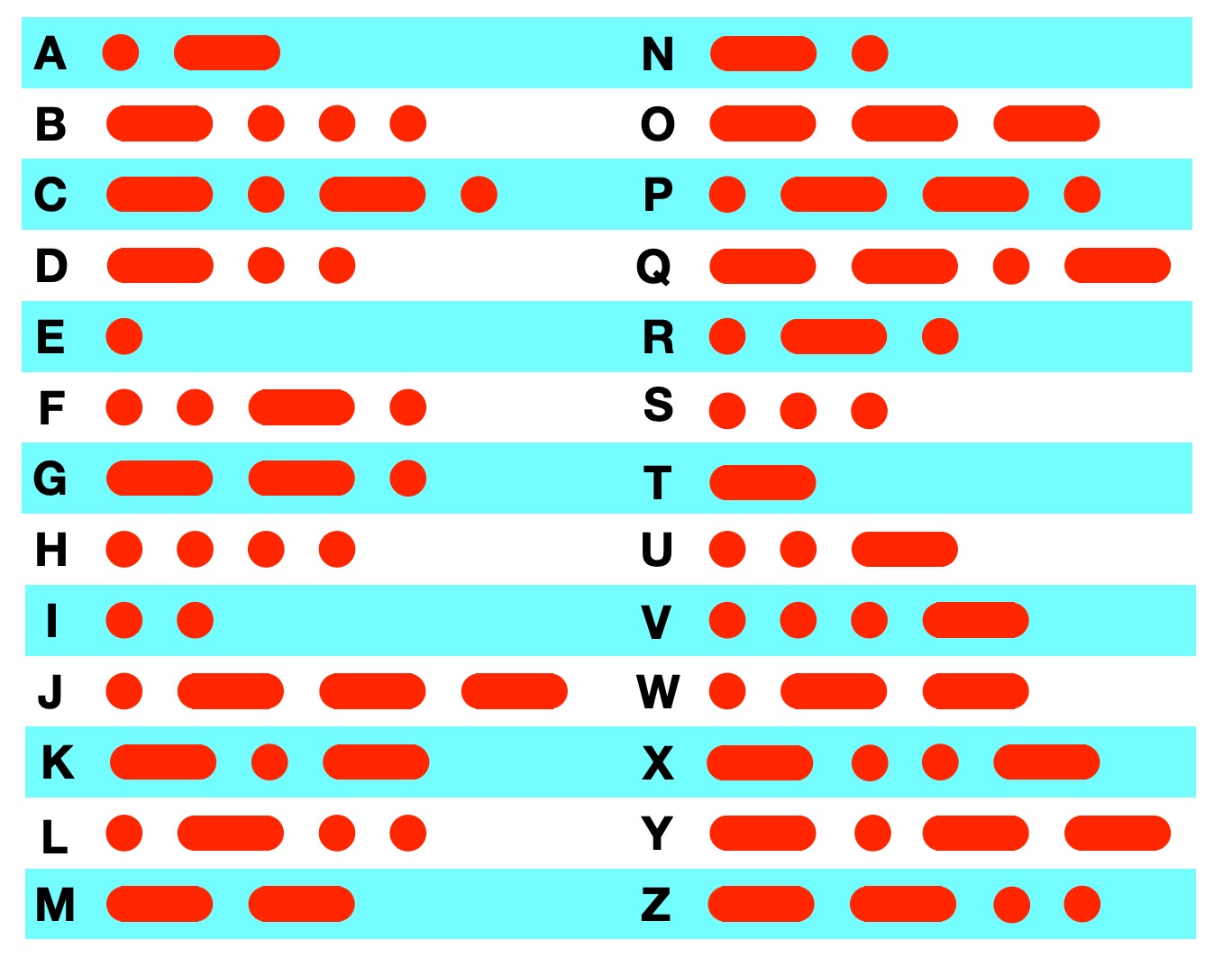
Morse Code
Morse Code: Image by CS4FN

Who invented Morse code? Silly question, surely! Samuel Morse, of course. He is one of the most celebrated inventors on the planet as a result. Morse code helped revolutionise global communications. It was part of the reason the telegraph made fast, world-wide communication a practical reality. Morse did invent a code to use for the telegraph, but not Morse code. His code was, by comparison, a poor, inflexible solution. He was a great businessman, focussed on making his dream a reality, but perhaps not so good at computational thinking! The code that bears his name was largely invented by his partner Alfred Vail.

Samuel Morse was originally a painter. However, his life changed when his wife died suddenly. He was away doing a portrait commission at the time. On hearing of his wife’s illness he rushed home, but the message, delivered by a horse rider had taken too long to reach him and she died and was buried before he got there. He dedicated his life to giving the world a better way of communicating as a result. Several different people were working on the idea of a way to send messages by electricity over wires, but no one had really come up with a usable, practical system. The physics had largely been sorted, but the engineering was still lacking.

Morse came up with a basic version of an electrical telegraph system and he demonstrated it. Alfred Vail saw the demonstration and persuaded Morse to take him on as a partner. His father built a famous ironworks, and so he had worked as a machinist. He improved Morse’s system enormously including making the tapping machine used to send messages.

He wasn’t just good at engineering though. He was good at computational thinking, so he also worked on the code used for sending messages. Having a machine that can send taps down a wire is no use unless you can also invent a simple, easy to use algorithm that turns words into those taps, and back again once it arrives. Morse came up with a code based on words not letters. It was a variation of the system already used by semaphore operators. It involved a code book: essentially a list of words. Each word in the book was given a number. A second code turned numbers in to taps – in to dots and dashes. The trouble with this system is it is not very general. If the word you want to send isn’t in the code book you are stuffed! To cover every possibility it has to be the size of a dictionary, with every word numbered. But that would make it very slow to use. Vail came up with a version where the dots and dashes represented letters instead of numbers, allowing any message to be sent letter by letter.

He also realised that some letters are more common than others. He therefore included the results of what we now call “frequency analysis” to make the system faster, working out the order of letters based on how common they are. He found a simple way to do it. He went to his local newspaper offices! To print a page of text, printing presses used metal letters called movable type. Each page was built up out of the individual metal letters slotted in to place. Vail realised that the more common a letter was, the more often it appeared on any page, and the more metal versions the newspaper office would therefore need if they weren’t to keep running out of the right letters before the page was done. He therefore counted how many of each “movable type” letter the newspaper printers had in their trays. He gave the letters that were most common the shortest codes. So E, for example, is just a single dot as it is the most common letter in American English. T, which is also common, is a single dash. It is this kind of attention to detail that made Morse code so successful. Vail was really good at computational thinking!

Morse and Vail worked really well as a team, though Morse then took all the credit because the original idea to solve the problem had been his, and their agreement meant the main rights were with Morse. They almost certainly worked together to some extent on everything to do with the telegraph. It is the small details that meant their version of the telegraph was the one that took over the world though and that was largely down to Vail. Morse may be the famous one but the invention of the telegraph needed them both working together.

Paul Curzon, Queen Mary University of London

More on …


Subscribe to be notified whenever we publish a new post to the CS4FN blog.


This blog is funded by EPSRC on research agreement EP/W033615/1.

QMUL CS4FN EPSRC logos
