For Star Wars Day (May 4th), here is a Star Wars inspired research from the archive…
Virtual reality can give users an experience that was previously only available a long time ago in a galaxy far, far away. Josh Holtrop, a graduate of Calvin College in the USA, constructed a Jedi training environment inspired by the scene from Star Wars in which Luke Skywalker goes up against a hovering droid that shoots laser beams at him. Fortunately, you don’t have to be blindfolded in the virtual reality version, like Luke was in the movie. All you need to wear over your eyes is a pair of virtual reality goggles with screens inside.
When you’re wearing the goggles, it’s as though you’re encased in a cylinder with rough metal walls. A bumpy metallic sphere floats in front of the glowing blade of your lightsaber – which in the real world is a toy version with a blue light and whooshy sound effects, though you see the realistic virtual version. The sphere in your goggles spins around, shooting yellow pellets of light toward you as it does. It’s up to you to bring your weapon around and deflect each menacing pulse away before it hits you. If you do, you get a point. If you don’t, your vision fills with yellow and you lose one of your ten lives.
Tracking movement with magnetism
It takes more than just some fancy goggles to make the Jedi trainer work, though. A computer tracks your movement in order to translate your position into the game. How does it know where you are? In their system, because the whole time you’re playing the game, you’re also wandering through a magnetic field. The field comes from a small box on the ceiling above you and stretches for about a metre and a half in all directions. Sixty times every second, sensors attached to the headset and lightsaber check their position in the magnetic field and send that information to the computer. As you move your head and your sabre the sensors relay their position, and the view in your goggles changes. What’s more, each of your eyes receives a slightly different view, just like in real life, creating the feeling of a 3D environment.
Once the sensors have gathered all the information, it’s up to the software to create and animate the virtual 3D world – from the big cylinder you’re standing in to the tiny spheres the droid shoots at you. It controls the behaviour of the droid, too, making it move semi-randomly and become a tougher opponent as you go through the levels. Most users seem to get the hang of it pretty quickly. “Most of them take about two minutes to get used to the environment. Once they start using it, they get better at the game. Everybody’s bad at it the first sixty seconds,” Josh says. “My mother actually has the highest score for a beginner.”
The atom smasher
Much as every Jedi apprentice needs to find a way to train, there are uses for Josh’s system beyond gaming too. Another student, Jess Vriesma, wrote a program for the system that he calls the “atom smasher”. Instead of a helmet and lightsaber, each sensor represents a virtual atom. If the user guides the two atoms together, a bond forms between them. Two new atoms then appear, which the user can then add to the existing structure. By doing this over and over, you can build virtual molecules. The ultimate aim of the researchers at Calvin College was to build a system that lets you ‘zoom in’ to the molecule to the point where you could actually walk round inside it.
The team also bought themselves a shiny new magnetic field generator, that lets them generate a field that’s almost nine metres across. That’s big enough for two scientists to walk round the same molecule together. Or, of course, two budding Jedi to spar against one another.
To become a Jedi Knight you must have complete control of your thoughts. As you feel the force you start to control your surroundings and make objects move just by thinking. Telekinesis is clearly impossible, but could technology give us the same ability? The study of brain-computer interfaces is an active area of research. How can you make a computer sense and react to a person’s brain activity in a useful way?
Imagine the game of Mindball. Two competitors face each other across a coffee table. A ball sits at the centre. The challenge is to push the ball to your opponent’s end before they push it down to you. The twist is you can use the power of thought alone.
Sound like science fiction? It’s not! I played it at the Dundee Sensation Science Centre many, many years ago where it was a practical and fun demonstration of the then nascent area of brain-computer interfaces.
Each player wears a headband containing electrodes that pick up your brain waves – specifically alpha and theta waves. They are shown as lines on a monitor for all to see. The more relaxed you are, the more you can shut down your brain, the more your brain wave lines fall to the bottom of the screen and start to flatline together. This signals are linked to a computer that drives competing magnets in the table. They pull the metal ball more strongly towards the most agitated person. The more you relax the more the ball moves away from you…unless of course your opponent can out relax you.
Of course it’s not so easy to play. All around the crowd heckle, cheering on their favourite and trying to put off the opponent. You have to ignore it all. You have to think of nothing. Nothing but calm.
The ball gradually edges away from you. You see you are about to win but your excitement registers, and that makes it all go wrong! The ball hurtles back towards you. Relax again. See nothing. Make everything go black around you. Control your thoughts. Stay relaxed. Millimetre by millimetre the ball edges away again until finally it crosses the line and you have won.
Its not just a game of course. There are some serious uses. It is about learning to control your brain – something that helps people trying to overcome stress, addiction and more. Similar technology can also be used by people who are paralysed, and unable to speak, to control a computer. The most recent systems, combining this technology with machine learning to learn what thoughts correspond to different brain patterns can pick up words people are thinking.
For now though it’s about play. It’s a lot of fun, just moving a ball apparently by telekinesis. Imagine what mind games will be like when embedded in more complex gaming experiences!
– Paul Curzon, Queen Mary University of London (updated from the archive)
In a galaxy far, far away cyber security matters. So much so, that the whole film Rogue One is about it. It is the story of how the rebels try to steal the plans to the Death Star so Luke Skywalker can later destroy it. Protecting information is everything. The key is good authentication. The Empire screws up!
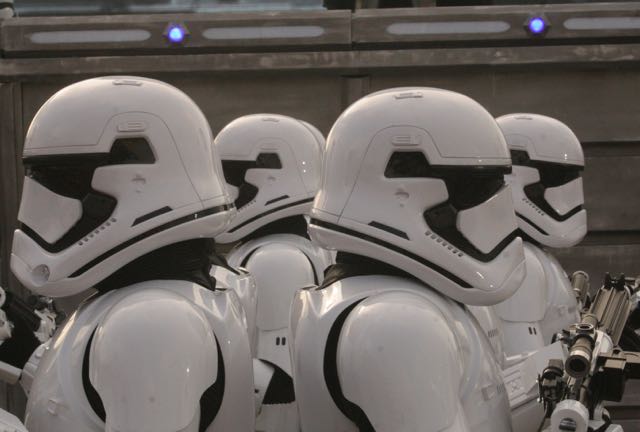
The Empire have lots of physical security to protect their archive: big hefty doors, Stormtroopers, guarded perimeters (round a whole planet), not to mention ensuring their archive is NOT connected to the galaxy-wide network…but once Jyn and Cassian make it past all that physical security, what then? They need to prove they are allowed to access the data. They need to authenticate! Authentication is about how you tell who a person is and so what they are, and are not, allowed to do. The Empire have a high-tech authentication system. To gain access you have to have the right handprint. Luckily, for the rest of the series, Jyn easily subverts it.
Sharing a secret
Authentication is based on the idea that those allowed in (a computer, a building, a network,…) possess something that no one else has: a shared secret. That is all a password is: a secret known to only you and the computer. The PIN you use to lock your phone is a secret shared between you and your phone. The trouble is that secrets are hard to remember and if we write them down or tell them to someone else they no longer work as a secret.
A secure token
A different kind of authentication is based on physical things or ‘tokens’. You only get in if you have one. Your door key provides this kind of check on your identity. Your bank card provides it too. Tokens work as long as only people allowed them actually do possess them. They have to be impossibly hard to copy to be secure. They can also be stolen or lost (and you can forget to take them with you when you set off to save the Galaxy).
Biometrics
Biometrics, as used by the Empire, avoids these problems. They rely on a feature unique to each person like their fingerprint. Others rely on the uniqueness of the pattern in your iris or your voice print. They have the advantage that you can’t lose them or forget them. They can’t be stolen or inadvertently given to someone else. Of course for each galactic species, from Ewok to Wookie, you need a feature unique to each member of that species.
Just because Biometrics are high-tech, doesn’t mean they are foolproof, as the Empire found out. If a biometric can be copied, and a copy can fool the system, then it can be broken. The rebels didn’t even need to copy the hand print. They just killed a person who had access and put their hand against the reader. If it works when the person is dead they are just a token that someone else can possess. In real life 21st century Japan, at least one unfortunate driver had his finger cut off by thieves stealing his car as it used his fingerprint as the key! Biometric readers need to be able to tell whether the thing being read is part of a living person.
The right side of the door
Of course if the person with access can be coerced, biometrics are no help. Perhaps all Cassian needed to do was hold a blaster to the archivist’s head to get in. If a person with access is willing to help it may not matter whether they have to be alive or not (except of course to them). Part of the flaw in the Empire’s system is that the archivist was outside the security perimeter. You could get to him and his console without any authentication. Better to have him working on the other side of the door, the other side of the authentication system.
Anything one can do …
The Empire could have used ‘Multi-factor authentication’: ask for several pieces of evidence. Your bank cashpoint asks for a shared secret (something you know – your PIN) and a physical token (something you possess – your bank card). Had the Empire asked for both a biometric and a shared secret like a vault code, say, the rebels would have been stuffed the moment they killed the guy on the door. You have to be careful in your choice of factors too. Had the two things been a key and handprint, the archive would have been no more secure than with the handprint alone. Kill the guard and you have both.
We’re in!
A bigger problem is once in they had access to everything. Individual items, including the index, should have been separately protected. Once the rebels find the file containing the schematics for the Death Star and beam it across the Galaxy, anyone can then read it without any authentication. If each file had been separately protected then the Empire could still have foiled the rebel plot. Even your computer can do that. You can set individual passwords on individual files. The risk here is that if you require more passwords than a person can remember, legitimate people could lose access.
Level up!
Levels help. Rather than require lots of passwords, you put documents and people into clearance levels. When you authenticate you are given access to documents of your clearance level or lower. Only if you have “Top Secret” clearance are you able to access “Top Secret” documents. The Empire would still need a way to ensure information can never be leaked to a lower clearance level area though (like beaming it across the galaxy).
So if you ever invent something as important to your plans as a Death Star, don’t rely on physical security and a simple authentication system. For that matter, don’t put your trust in your mastery of the Force alone either, as Darth Vader discovered to his cost. Instead of a rebel planet, your planet-destroying-planet may just be destroyed itself, along with your plans for galactic domination.
In a galaxy far, far away cyber security matters quite a lot. So much so, in fact, that the whole film Rogue One is about it. The plot is all about the bad guys trying to keep their plans secret, and the good guys trying to steal them.
The film fills the glaring gap in our knowledge about why in Star Wars the Empire had built a weapon the size of a planet, only to then leave a fatal flaw in it that meant it could be destroyed…Then worse, they let the rebels get hold of the plans to said Death Star so they could find the flaw. Protecting information is everything.
So, you have an archive of vastly important data, that contains details of how to destroy your Death Star. What do you do with it to keep the information secure? Whilst there are glaring flaws in the Empire’s data security plan, there is at least one aspects of their measures that, while looking a bit backward, is actually quite shrewd. They use physical security. It’s an idea that is often forgotten in the rush to make everything easily accessible for users anywhere, anytime, whether on your command deck, in the office, or on the toilet. That of course applies to hackers too. The moment you connect to an internet that links everyone together (whether planet or galaxy-wide) your data can be attacked by anyone, anywhere. Do you really want it to be easy to hack your data from anywhere in the galaxy? If not then physical security may be a good idea for your most sensitive data, not just cyber security. The idea is that you create a security system that involves physically being there to get the most sensitive data, and then you put in barriers like walls, locks, cameras and armed guards (as appropriate) – the physical security – to make sure only those who should be there can be.
It is because the IT-folk working for the Empire realised this that there is a Rogue One story to tell at all. Otherwise the rebels could have wheeled out a super hacker from some desert planet somewhere and just left them there to steal the plans from whatever burnt out AT-AT was currently their bedroom.
Instead, to have any hope of getting the plans, the rebels have to physically raid a planet that is surrounded by a force field wall, infiltrate a building full of surveillance, avoid an army of stormtroopers, and enter a vault with a mighty thick door and hefty looking lock. That’s quite a lot of physical security!
It gets worse for the rebels though. Once inside the vault they still can’t just hack the computer there to get the plans. It is stored in a tower with a big gap and massive drop between you and it. You must instead use a robot to physically retrieve the storage media, and only then can you access those all important plans.
Pretty good security on paper. Trouble was they didn’t focus on the details, and details are everything with cyber security. Security is only as strong as the weakest link. Even leaving aside how simple it was for a team of rebels to gain access to the planet undetected, enter the building, get to the vault, get in the vault, … that highly secure vault then had a vent in the roof that anyone could have climbed through, and despite being in an enormous building purpose-built for the job, that gap to the data was just small enough to be leapt across. Oh well. As we said detail is what matters with security. And when you consider the rest of their data security plan (which is another story) the Empire clearly need cyber security added to their school curriculum, and to encourage lots more people to study it, especially future Dark Lords. Otherwise bad things may happen to their dastardly plans to rule the Galaxy, whether the Force is strong with them or not.
Lots of people think that Computer Science and IT are strictly for men only. That’s really bizarre given that right from the start women like Grace Hopper and Ada Lovelace played pivotal roles in the development of computers, and women are still at the leading edge today. To be a successful modern IT Pro you have to be a good team player, not to mention good at dealing with clients, which are skills women are generally good at.
‘Geeky male computer scientist’ is of course just a stereotype, like ‘helpless female in need of rescue by male hunk’, ‘scientist as mad eccentric in white coat’, or ‘evil robot wanting to take over the world’.
Where do false stereotypes come from? Films play a part in the way their (usually male, non-scientist) directors decide to represent characters.
Students on a ‘Gender in Computer Science’ course at Siena College in the US watched lots of films with Computer Science plots from as far back as 1928 to see how the way women, computers and computer scientists are portrayed has changed over time. Here are their views on some of those films.
Do you agree – when you are done read what the real IT Pros think of their jobs…and remember stereotypes are fiction, careers are what you make of them and real robots are (usually) nice!
1928: Metropolis
In a city of the future the ruling class live lavishly while the workers live poorly in the underworld. An evil scientist substitutes a robot for a female worker activist. It purposely starts a riot as an excuse so reprisals can be taken. All hell breaks loose until the male hero comes to the rescue…
X Computers: Evil
X Women as IT Pros: Helpless
X Computer Scientists: Evil
“Women are more or less portrayed as helpless … The computer scientist … as evil”
1956: Forbidden Planet
An all-male crew travel to Altair-4 to discover the fate of the colony there. They discover all that is left is scientist Dr Morbius, his beautiful daughter Altaira and a servant robot called Robby, programmed to be unable to harm humans. But what have Morbius’ machines and experiments to do with the colony’s fate?
✓ Computers: Helpful & Harmless
X Women as IT Pros: love interest
X Computer Scientists: Evil
“Altaira plays a typical woman’s role…helpless…unintelligent …Barbie-like”
1971: THX 1138
In an Orwellian future, an android controlled police state where everyone is made to take drugs that suppress emotion. LUH 3417 and THX 1138 stop taking their drugs, fall in love and try to escape…
X Computers: Evil Police
X Women as IT Pros: Few
X Computer Scientists: Heartless
“The computer scientists are depicted as boring, heartless and easily confused”
1982: Blade Runner
In the industrial wastelands of a future Los Angeles, large companies have all the power. Robotic ‘Replicants’ are almost indistinguishable from humans but have incredible strength and no emotions. Deckard (Harrison Ford) must find and destroy a group of Replicants that have developed emotions and so threaten humanity as they rebel against being ‘slaves’.
X Computers: Evil
X Women as IT Pros: None
X Computer Scientists: Caused the problem
“A woman plays the minor role of a replicant…but is portrayed as a topless dancer”
1986: Short Circuit
A comedy adventure about a robot that comes ‘alive’ after a power surge in a lightening storm. The robot, called ‘Number 5’ built for use by the US military and tries to escape its creators as it doesn’t want to ‘die’. It is helped by Stephanie Speck (Ally Sheedy) who realises, that like the animals she loves, it is sentient and helps it escape from the scientists of company Nova that built it.
✓ Computers: Nice
X Women as IT Pros: None
X Computer Scientists: Thick-headed
“The male computer scientists are often thick-headed… introverted…no life skills…There were no female computer scientists”
1995: Hackers
A group of genius teenage hackers become the target of the FBI after they unknowingly tap into a high-tech embezzling scheme that could cause a horrific environmental disaster. Dade Murphy and Kate Libby (Angelina Jolie) square off in a battle of the sexes and computer skills.
X Computers: Used illegally
✓ Women as IT Pros: Elite…but illegal
X Computer Scientists: Criminals
“Angelina plays a hard hitting, elite hacker who is better than everyone in her group except Dane who is her equal”
So it wasn’t great. Robots were killers, scientists evil. Computer scientist’s were introverted and thickheaded. Women were either sexbots or helpless love interest to be rescued by the hunky male star. 1995’s film Hackers was about as good as it got. At last a woman had expert computing skills. It’s hardly surprising some girls were led to believe computing isn’t for them with a century-long “conspiracy” aiming to convince them their role in life is to be helpless.
As our area on women in computing shows the truth is far more interesting. Women have always played a big part in the development of modern technology. So have things improved in films in the 21st century? There are more films with strong action-heroine stars now, though until very recently few films passed the Bechdel test: do two women ever talk together about anything other than a man? So can we at least find any 21st century films with realistic main character roles for women as computer experts? Here goes…
1999-2003: Matrix Trilogy
Hero Neo discovers reality isn’t what it seems. It is all a virtual reality. Trinity is there to be his romantic interest – she’s been told by the Oracle that she will fall in love with the “One” (that’s him). It’s not looking good. In film 2 Neo has to save her. Oh dear. At least she is supposed to be a super-hacker famous for cracking an uncrackable database. Oh well.
X Computers: Enslaving humanity
✓ Women as IT Pros: Elite…but illegal (there to be saved)
✓ Computer Scientists: The resistance
2009: The Girl With the Dragon Tattoo
This is the story of super-hacker Lisbeth Salander. Both emotionally and sexually abused as a child she looks after herself, and that includes teaching herself to be an expert with computers. She uses her immense skills to get what she wants. She is cool and clever and absolutely not willing to let the men treat her as a victim. Wonderful.
X Computers: used for hacking
✓ Women as IT Pros: Elite…but illegal look after themselves)
X Computer Scientists: hackers
2014: Captain America: The Winter Soldier
This film is all about a male hunk, so it’s not looking good, but then early on we see Agent Natasha Romanoff, (also known as superheroine the Black Widow). She is the brains to Captain America’s brawn and from the start she is clearly the expert with computers. While Captain America beats people up, her mission is to collect data. And she even gets her own film series…eventually!
X Computers: used for hacking
✓ Women as IT Pros: Elite…superheroes
X Computer Scientists: hackers
2015: Star Wars: Episode VII – the Force Awakens
Rey is a scavenger with engineering skills. She is very smart, and can look after herself without expecting men to save her. She’s not a hacker! Instead, she creates and mends things. She repurposes parts she finds on wrecked spaceships to sell to survive. She learnt her engineering skills tinkering in old ships and fixes the Millennium Falcon’s electro-mechanical problems. She is even the main character of the whole film!
✓ Computers: make the universe work
✓ Women as IT Pros: Elite, scavenges and fixes things
✓ Computer Scientists: at least some build and fix things
There are plenty of moronic films, made by men who can’t portray women in remotely realistic ways, but at least things are a bit better than they were last century. The women are already here in the real world. They are slowly getting there in the movies. Let’s just hope the trend speeds up, and we have more female leads who create things, like the real female computer scientists.





 cs4fn
cs4fn 