
Pseudocode Poems

A purple flower with dew drops
Image by AdelinaZw from Pixabay

Pseudocode poems are poems that work both as a poem and as an algorithm so can be read or executed. They incorporate sequencing, selection or repetition constructs and other kinds of statements to take actions. You can implement them as an actual program. Below  are our attempts. Can you write better ones?

Poems often use the ambiguity in language and aim to affect emotions. Pseudocode is intended to be precise. Programs certainly are. They do something specific and have a single precise meaning. Writing pseudocode poems that do both can be a lot of fun: just like writing normal programs is. The idea was inspired by Bryan Bilston’s poem ‘Two Paths Diverged’. Read it here or buy his wonderful book of poems, ‘ You took the last bus home’.

I am not a great poet, but here are some of my attempts at pseudocode poems to at least give you the idea. They are, in turn, based on the core control structures of Sequencing, Selection and Repetition. They also use print statements and assignments to get things done,

Sequencing

This pseudocode poem is based on sequencing: doing things one after the other.

What am I when it’s all over?

I am dire.
I am fire.

I am alone.
I am stone.

I am old.
I am cold.

We use the verb TO BE to be the equivalent of assignment: setting the value of a variable. Here it is implemented as a Python program.

def whatamI():
	"""What am I when it's all over?"""

	I = 'dire'
	I = 'fire'
	
	I = 'alone'
	I = 'stone'
	
	I = 'old'
	I = 'cold'
	
	print(I)

Selection

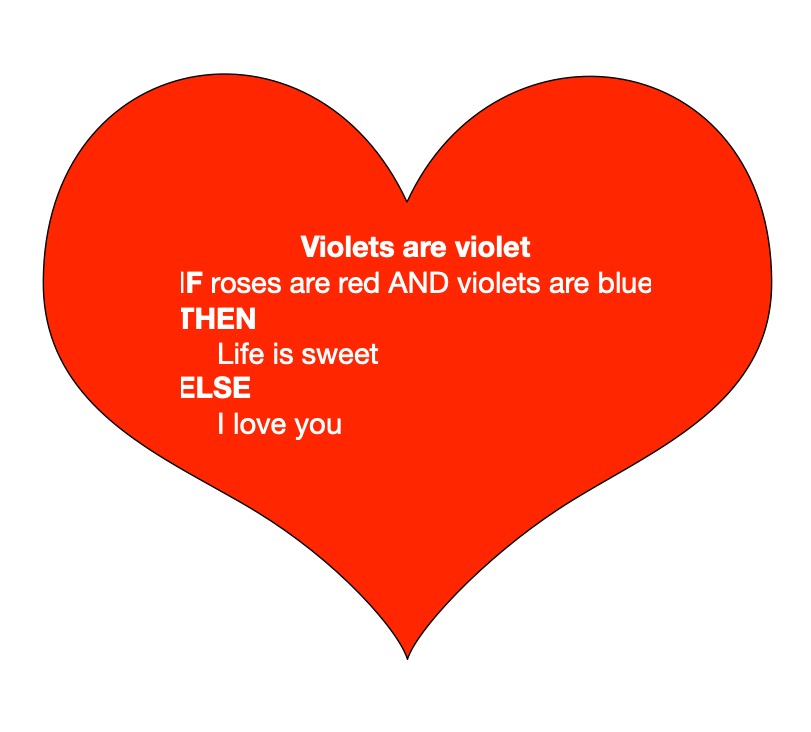
Here is a pseudocode poem based on selection, which is the second core control structure. It chooses between two option based on a boolean test: a true / false question. The question here is: do I love you? Dry run the algorithm or run program to find out.

Violets are violet
if roses are red and violets are blue
then
Life is sweet
else
I love you

Here it is implemented as a Python program (with appropriate initialisation).

def violetsareviolet():
	"""Violets are violet"""
	roses = 'red'
	violets = 'violet'
	
	if roses == 'red' and violets == 'blue':
		print('Life is sweet')
	else:
		print('I love you')

violetsareviolet()
Find out more about Selection based pseudocode programs via our computational literary criticism of Rudyard Kipling’s poem “If”.

Iteration or Repetition

The final kind of control structure is iteration (i.e., repetition). It is used to repeat the same lines over and over again.

Is this poem really long?

it is true
while it is true
    this is short
it is endless

Here it is implemented as a Python program.

def isthispoemreallylong():
    """Is this poem really long?"""
    it = True
    while (it == True) :
        this = 'short'
    it = 'endless'

isthispoemreallylong()

Can you work out what it does as an algorithm/program, rather than as just a normal poem? You may need a version with print statements to understand its beauty.

def isthispoemreallylong2():
    """Is this poem really long?"""
    it = True
    while (it == True) :
        this = 'short'
        print("this is " + this)
    it = 'endless'
    print("it is " + it)

isthispoemreallylong2()

The word while indicates the start of a while loop. In the pseudocode, it is a command to repeat the following statement(s). It checks the boolean expression after the body each time. Only if that boolean expression is false does it stop. In this case the body sets the variable named this to string value ‘short’. The test is about a different variable though which is not changed inside the loop, so once in the loop there is nothing that will ever change the variable it so the value of the test will always be the same. Variable it will always be True and the loop will keep setting variable this to value ‘short’, over and over again. This means the loop is a non-terminating loop. It never exits so the lines of code after it are never executed. As a program they are never followed by the computer. The variable it is never set to the value ‘endless’.

Overall the poem is short in number of lines but it is actually endless if executed. It is the equivalent of a poem that once you start reading it you never get to the end:

it is true 
check it is true 
this is short
check it is true 
this is short
check it is true 
this is short
...

Here is a more romantically inclined poem for Valentine’s day (since at the time of writing, it is coming up) again using repetition

My love for you is endless

my love is true
while my love is true
    I love you

Here it is implemented as a Python program.

def myloveforyouisendless():
"""My love for you is endless"""
my_love = True
while my_love == True:
    print('I love you')

myloveforyouisendless()
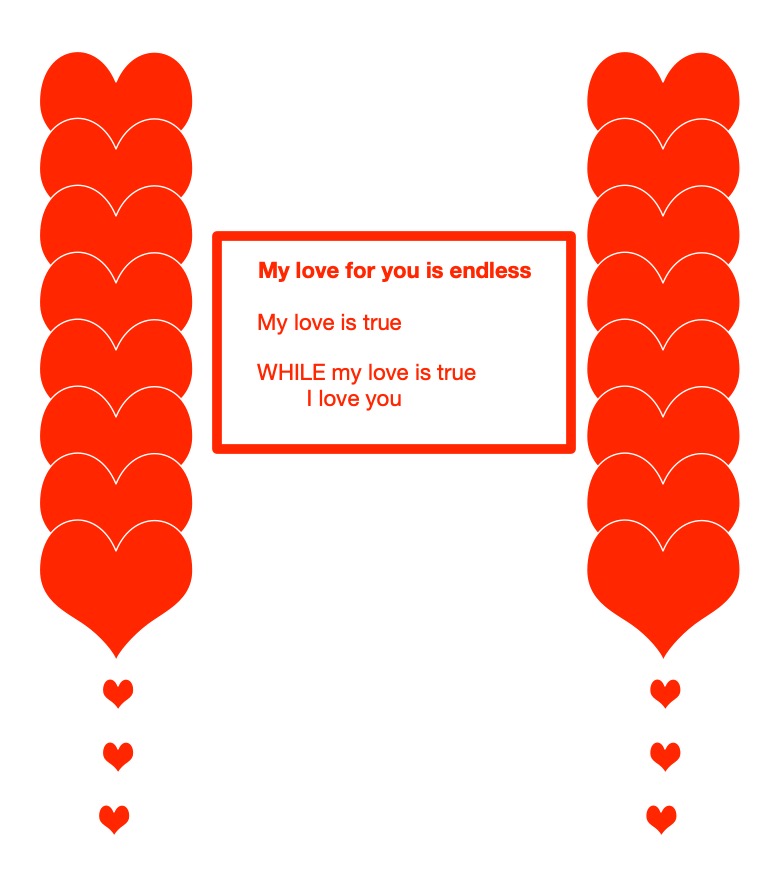
In the pseudocode of this poem the verb “to be” is used for two different purposes: as an assignment statement (it is true is used as a statement to mean it = True) and as a boolean expression (it is true is used as a boolean expression to mean it == True). As an assignment it is used as a command to do something. As an expression it is something representing a value: it evaluates to either true or false. Confusing these two English uses is a common mistake novices make programming, and shows one of the ways why programming languages are used with different symbols for different meanings, rather than natural languages.

Now it is your turn. Can you write a great poem that can also be executed?

Paul Curzon, Queen Mary University of London

More on …

Subscribe to be notified whenever we publish a new post to the CS4FN blog.


This blog is funded by EPSRC on research agreement EP/W033615/1.

QMUL CS4FN EPSRC logos

Answers

  1. The selection poem is about a volcano, but the answer to the question in the title is ‘cold’.
  2. Assuming you agree with me that violet flowers are violet (or at least not blue) then clearly we are compatible at least in being pedantic and you will find I love you.

Lego Computer Science: sequence, selection and iteration

Children following a lego instruction booklet
Image by Thomas G. from Pixabay

Programming languages have lots of control structures, like if-statements and while loops, case-statements and for loops, method call and return, … but a famous research result in theoretical computer science (now called the structured program theorem) says you can do everything that it is possible to do with only three. All those alternatives are just for convenience. All you need is one way each to do sequence; one way to do selection, and one way to do iteration. If you have those you can build the structure needed to do any computation. In particular, you do not need a goto statement! We can explore what that means by just thinking about instructions to build Lego.

We have seen that you can think of a set of instructions to build Lego an algorithm. So do those instructions have everything needed to describe the structure of any computation?

What do we mean by a control structure? Just some mechanism to decide the order that instructions must be done for an algorithm to work. Part of what makes a set of instructions an algorithm is that the order of instructions are precisely specified. Follow the instructions in the right order and the algorithm is guaranteed to work.

Goto

First of all, Lego instructions are designed to be really clear and easy to follow. The nice folk at Lego want anyone to be able to follow them, even a small child and manage to accurately build exactly the model shown on the box.

What they do not make use of is a Goto instruction, an arbitrary jump to another place, where you are told, for example, to move to Page 14 for the next instruction. That kind of jump from place to place is reserved for Fighting Fantasy Adventure Books, where you choose the path through the story. They jump you about precisely because the aim is for you to be lost in the myriad of potential stories that are possible. You just don’t do that if you want instructions to be easy to follow.

The structured program theorem provided the ammunition for arguing that goto should not be used in programming and instead structured programming (hence the theorem’s name) should be used instead. All it actually does is show it is not needed though, not that its use is worse, though the argument was eventually won, with some exceptions. For programs to be human-readable and maintainable it is best that they use forms of structured programming, and avoid the spaghetti programming structures that goto leads to..

Sequencing

The main kind of control structure in a booklet of Lego instructions is instead sequencing. Instructions follow one after the other. This is indicated by the pages of the booklet. On each page though the instructions are split into boxes that are numbered. The boxes and numbers are the essential part of the control structure. You build the Lego model in the order of the numbered boxes. The numbering provides a sequencing control structure. Programming languages usually just use the order of instructions down a page to indicate sequencing, sometimes separated by punctuation (like a semi-colon), though early languages used this kind of numbering. The point is the same, however it is done, it is just a mechanism to make clear the order that the instructions are followed one after another, i.e., sequencing.

Parallelism and time-slicing

However, with lego there is another control structure within those boxes that is not quite sequencing. Each box normally has multiple pieces to place with the position of each shown. The lego algorithm isn’t specifying the order those pieces are placed (any order will do). This is a kind of non-deterministic sequencing control structure. It is similar to a parallelism control structure in programming languages, as if you like building your Lego model together with others, then a different person could choose each piece and all place the piece together (parallelism). Alternatively, they could place the pieces one after the other in some random order (time-slicing) and always end up with the same final result once the box is completed.

Is this necessary though? The structured program theorem says not, and in this case it is relatively easy to see that it isn’t. The people writing the instruction booklet could have decided an order themselves and enforced it. Which order they chose wouldn’t matter. Any Lego instruction booklet could be converted to one using only sequencing without parallelism or time-slicing.

Iteration

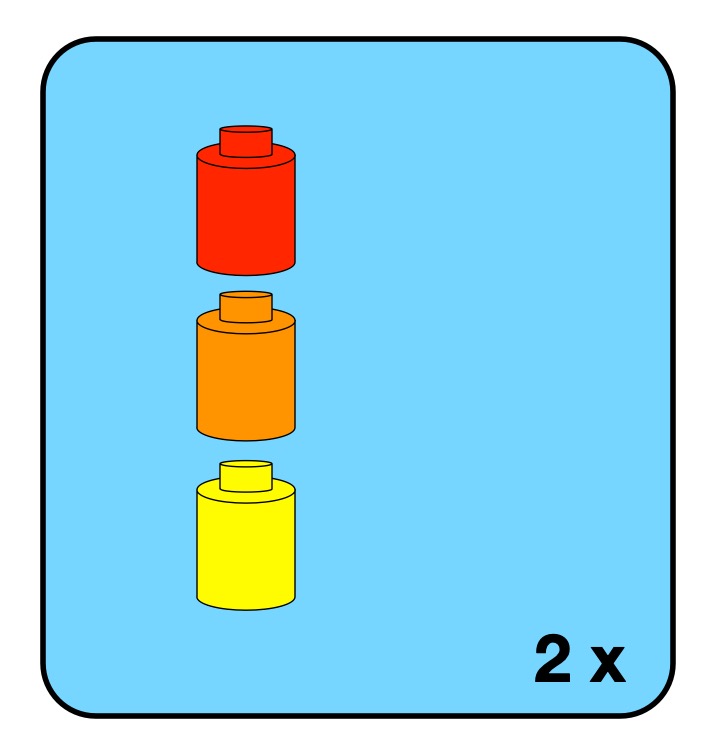
A Lego 2x instruction  showing to put three tower bricks on top of one another, but to do this twice
Image by CS4FN after Lego instruction iteration

Iteration is just a way to repeat instructions or sub-programs. Lego instructions have a simplified form of repetition which is the equivalent of a simple for loop in programming. It just says that a particular box of instructions should be followed a fixed number of times (like 3 x meaning make this lego sub-build three times). With only this way of doing iteration lego instructions are not a totally general form of computation. There are algorithms that can’t be specified in Lego instructions. To be good enough to play the full role in the theorem, the iteration control structure has to have the capability to be unbounded. The decision to continue or not is made at the end of each iteration, You follow the instructions once, then decide if they should be followed again (and keep doing that). Having such a control structure would mean that at the point when you started to build the lego construct to be repeated, you would not necessarily know how many times that Lego construct was to be built. It’s possible to imagine Lego builds like this. For example, you might be building a fairytale castle made of modular turreted towers, where you can keep deciding whether to build another tower after each new tower is completed. until the castle is big enough. That would be an unbounded loop. An issue with unbounded loops is they could never terminate…you could be eternally damned to build Lego towers to eternity!

Selection

The final kind of control structure needed is selection. Selection involves having a choice of what instruction or subprogram to do next. This allows an algorithm to do different things depending on data input or the results of computation. As most lego sets involve building one specific thing, there isn’t much use of selection in Lego booklets.

However, some lego sets do have a simple form of selection. There are “3 in 1” sets where you can, for example, choose to make one of three animals by choosing one of three instruction booklets to follow at the start.

To be fully computationally general there would need to be choice possible at any point, in the way repetition can appear at any point in the booklet. It would need to be possible for any instruction or block of instructions to be prefigured by a test of whether they should be followed or not, with that test and arbitrary true/false question.

Again, such a thing is conceivable if more complex Lego builds were wanted. Building a fairytale castle you might include options to choose to build different kinds of turret on top of the towers, or choose different colours of bricks to make rainbow towers, or… If this kind of totally general choice was provided then no other kind of selection control structure would be needed. Having such instructions would provide a level of creativity between those of fixed sets to build one thing and the origianl idea of Lego as just blocks you could build anything from (the sets would need more bricks though!)

Sequence, Selection and Iteration is enough (but only if powerful enough)

So Lego instruction booklets do include the three kinds of control structure needed of sequence, selection and iteration. However, the versions used are not actually general enough for the structured control theorem to apply. Lego instructions with the control structures discussed are not powerful enough to be computationally complete, and describe all possible algorithms. More general forms are needed than found in normal Lego instructions to do that. In particular, a more general version of iteration is needed, as well as a verion of selection that can be used anywhere, and that includes a general purpose test. All programming languages have some powerful version of all three control structures. If they did not they could not be used as general purpose languages. There would be algorithms that could not be implemented in the language.

Just like programming languages, Lego instructions also use an extra kind of control structures that is not actually needed, It is there just for convenience, just like programming languages have lots of extra control structures just for convenience too.

Sadly then, Lego instructions, as found in the normal instruction booklets are not as general as a programming language. They do still provide a similar amount of fun though. Now, I must get back to building Notre Dame.

Paul Curzon, Queen Mary University of London


More on …

  • Lego Computer Science
    • Part of a series featuring featuring pixel puzzles,
      compression algorithms, number representation,
      gray code, binary and computation.

Subscribe to be notified whenever we publish a new post to the CS4FN blog.