
SPOILER ALERT
In a galaxy far, far away cyber security matters. So much so, that the whole film Rogue One is about it. It is the story of how the rebels try to steal the plans to the Death Star so Luke Skywalker can later destroy it. Protecting information is everything. The key is good authentication. The Empire screws up!
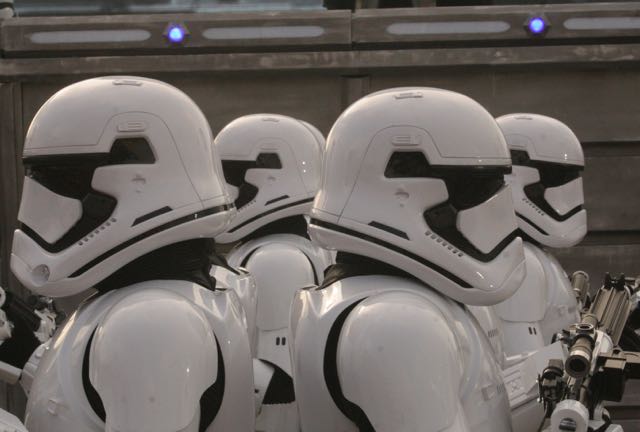
The Empire have lots of physical security to protect their archive: big hefty doors, Stormtroopers, guarded perimeters (round a whole planet), not to mention ensuring their archive is NOT connected to the galaxy-wide network…but once Jyn and Cassian make it past all that physical security, what then? They need to prove they are allowed to access the data. They need to authenticate! Authentication is about how you tell who a person is and so what they are, and are not, allowed to do. The Empire have a high-tech authentication system. To gain access you have to have the right handprint. Luckily, for the rest of the series, Jyn easily subverts it.
Sharing a secret
Authentication is based on the idea that those allowed in (a computer, a building, a network,…) possess something that no one else has: a shared secret. That is all a password is: a secret known to only you and the computer. The PIN you use to lock your phone is a secret shared between you and your phone. The trouble is that secrets are hard to remember and if we write them down or tell them to someone else they no longer work as a secret.
A secure token
A different kind of authentication is based on physical things or ‘tokens’. You only get in if you have one. Your door key provides this kind of check on your identity. Your bank card provides it too. Tokens work as long as only people allowed them actually do possess them. They have to be impossibly hard to copy to be secure. They can also be stolen or lost (and you can forget to take them with you when you set off to save the Galaxy).
Biometrics
Biometrics, as used by the Empire, avoids these problems. They rely on a feature unique to each person like their fingerprint. Others rely on the uniqueness of the pattern in your iris or your voice print. They have the advantage that you can’t lose them or forget them. They can’t be stolen or inadvertently given to someone else. Of course for each galactic species, from Ewok to Wookie, you need a feature unique to each member of that species.
Just because Biometrics are high-tech, doesn’t mean they are foolproof, as the Empire found out. If a biometric can be copied, and a copy can fool the system, then it can be broken. The rebels didn’t even need to copy the hand print. They just killed a person who had access and put their hand against the reader. If it works when the person is dead they are just a token that someone else can possess. In real life 21st century Japan, at least one unfortunate driver had his finger cut off by thieves stealing his car as it used his fingerprint as the key! Biometric readers need to be able to tell whether the thing being read is part of a living person.
The right side of the door
Of course if the person with access can be coerced, biometrics are no help. Perhaps all Cassian needed to do was hold a blaster to the archivist’s head to get in. If a person with access is willing to help it may not matter whether they have to be alive or not (except of course to them). Part of the flaw in the Empire’s system is that the archivist was outside the security perimeter. You could get to him and his console without any authentication. Better to have him working on the other side of the door, the other side of the authentication system.
Anything one can do …
The Empire could have used ‘Multi-factor authentication’: ask for several pieces of evidence. Your bank cashpoint asks for a shared secret (something you know – your PIN) and a physical token (something you possess – your bank card). Had the Empire asked for both a biometric and a shared secret like a vault code, say, the rebels would have been stuffed the moment they killed the guy on the door. You have to be careful in your choice of factors too. Had the two things been a key and handprint, the archive would have been no more secure than with the handprint alone. Kill the guard and you have both.
We’re in!
A bigger problem is once in they had access to everything. Individual items, including the index, should have been separately protected. Once the rebels find the file containing the schematics for the Death Star and beam it across the Galaxy, anyone can then read it without any authentication. If each file had been separately protected then the Empire could still have foiled the rebel plot. Even your computer can do that. You can set individual passwords on individual files. The risk here is that if you require more passwords than a person can remember, legitimate people could lose access.
Level up!
Levels help. Rather than require lots of passwords, you put documents and people into clearance levels. When you authenticate you are given access to documents of your clearance level or lower. Only if you have “Top Secret” clearance are you able to access “Top Secret” documents. The Empire would still need a way to ensure information can never be leaked to a lower clearance level area though (like beaming it across the galaxy).
So if you ever invent something as important to your plans as a Death Star, don’t rely on physical security and a simple authentication system. For that matter, don’t put your trust in your mastery of the Force alone either, as Darth Vader discovered to his cost. Instead of a rebel planet, your planet-destroying-planet may just be destroyed itself, along with your plans for galactic domination.
– Paul Curzon, Queen Mary University of London,
More on …
- Cyber Security at the movies: Rogue one (Part I: Physical Security)
- The Cyber-security Honey pot
- Computer Science at the Movies
Magazines …
Subscribe to be notified whenever we publish a new post to the CS4FN blog.
This blog is funded by EPSRC on research agreement EP/W033615/1.

 cs4fn
cs4fn 