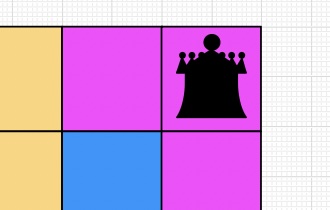
Queens is a fairly simple kind of logic puzzle found for example on LinkedIn as a way to draw you back to the site. Doing daily logic puzzles is good both for mental health and to build logical thinking skills. As with programming, solving logic puzzles is mostly about pattern matching (also a useful skill to practice daily) rather than logic per se. The logic mainly comes in working out the patterns.
Let’s explore this with Queens. The puzzle has simple rules. The board is divided into coloured territories and you must place a Queen in each territory. However, no two Queens can be in the same row or column. Also no two Queens can be adjacent, horizontally, vertically or diagonally.
If we were just to use pure logic on these puzzles we would perhaps return to the rules themselves constantly to try and deduce where Queens go. That is perhaps how novices try to solve puzzles (and possibly get frustrated and give up). Instead, those who are good at puzzles create higher level rules that are derived from the basic rules. Then they apply (ie pattern match against) the new rules whenever the situation applies. As an aside this is exactly how I worked when using machine-assisted proof to prove that programs and hardware correctly met their specification, doing research into better ways to ensure the critical devices we create are correct.
Let’s look at an example from Queens. Here is a puzzle to work on. Can you place the 8 Queens?
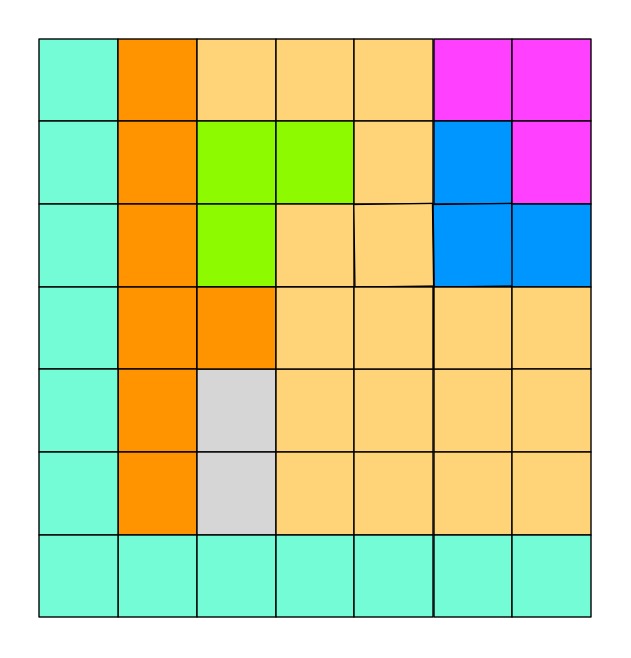
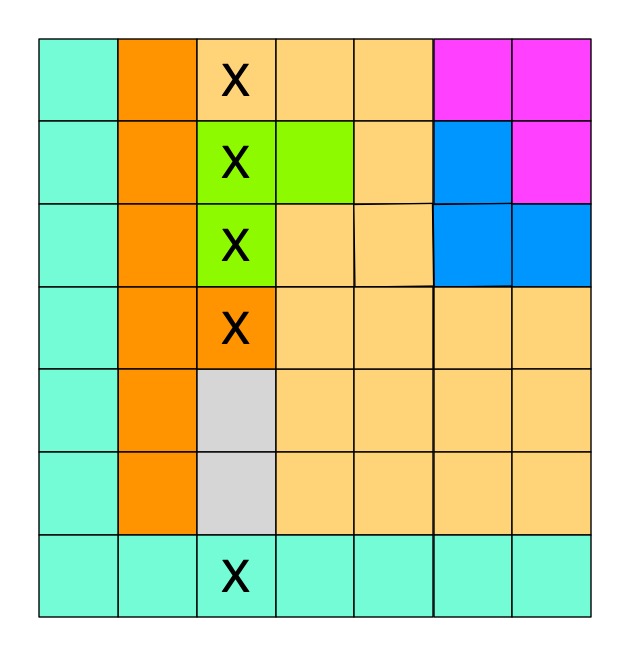
Where to start? Well notice the grey territory near the bottom. It is a territory that lives totally in one column. If we go to the rules of Queens we know that there must be a Queen in this territory. That means that Queen must be in that column. We also know that only one Queen can be in a column. That means none of the other territories in that column can possibly hold a Queen there. We can cross them all out as shown.
In effect we have created a new derived inference rule.
IF a territory only has squares available in one column

THEN cross out all squares of other territories in that column
By similar logic we can create a similar rule for rows.
Now we can just pattern match against the situation described in that rule. If ever you see a territory contained completely in a row or column, you can cross out everything else in that row/column.
In our case in doing that it creates new situations that match the rule. You may also be able to work out other rules. One obvious new rule is the following:
IF a territory only has one free space left and no Queens

THEN put a Queen in that free space
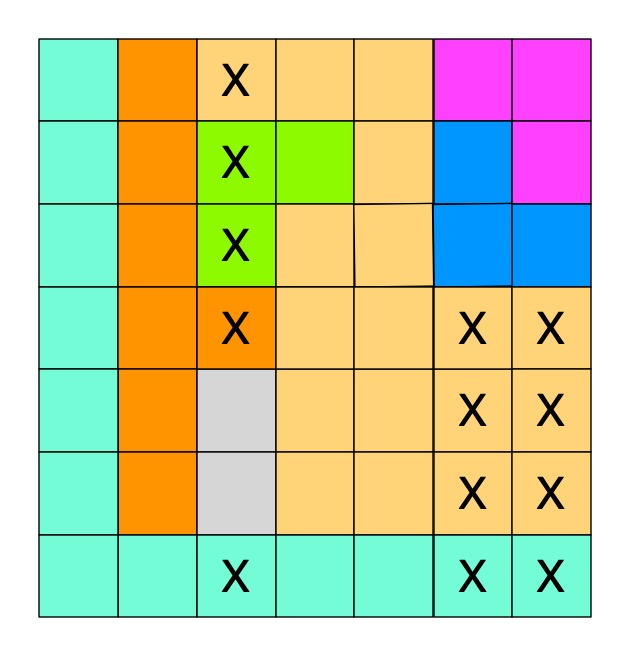
We can derive more complicated rules too. For example, we can generalise our first rule to two columns. Can you find a pair of territories that reside in the same two columns only? There is such a pair in the top right corner of our puzzle. If there is such a situation then as both must have a Queen, between them they must be the territories that provide the Queens for both those two columns. That means we can cross out all the squares from other territories in those two columns. We get the rule:
IF two territories only have squares available in two columns

THEN cross out all squares of other territories in both columns
Becoming good at Queens puzzles is all about creating more of these rules that quickly allow you to make progress in all situations. As you apply rules, new rules become applicable until the puzzle is solved.
Can you both apply these rules and if need be derive some more to pattern match your way to solving this puzzle?
It turns out that programming is a lot like this too. For a novice, writing code is a battle with the details of the semantics (the underlying logical meaning) of the language finding a construct that does what is needed. The more expert you become the more you see patterns where you have a rule you can apply to provide the code solution: IF I need to do this repeatedly counting from 1 to some number THEN I use a for loop like this… IF I have to process a 2 dimensional matrix of possibilities THEN I need a pair of nested for loops that traverse it by rows and columns… IF I need to do input validation THEN I need this particular structure involving a while loop… and so on.
Perhaps more surprisingly, research into expert behaviour suggests that is what all expert behaviour boils down to. Expert intuition is all about subconscious pattern matching for situations seen before turned into subconscious rules whether expert fire fighters or expert chess players. Now machine learning AIs are becoming experts at things we are good at. Not suprisingly, what machine learning algorithms are good at is spotting patterns to drive their behaviour.
Paul Curzon, Queen Mary University of London
More on …
Magazines …

Subscribe to be notified whenever we publish a new post to the CS4FN blog.
This blog is funded by EPSRC on research agreement EP/W033615/1.

 cs4fn
cs4fn 