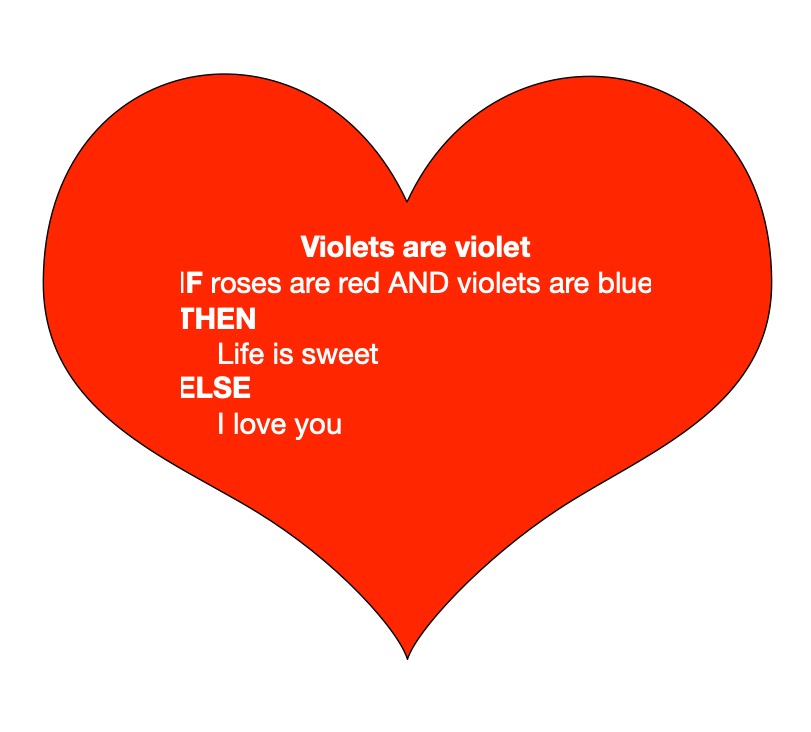
For Valentine’s day we created this card with a pseudocode love poem. But what does it mean? Is it a statement of love or not? Now that Valentines Day is gone and logic and rational thinking are starting to reassert themselves, here is a logical argument of what it means: an informal proof of love.
We are using our own brand of poetic pseudocode here, and what matters is the formal semantics of the language (ie mathematical meaning).
What we will do is simplify the code to code that is mathematically equivalent but far simpler, explaining the semantics as we do. We will by reasoning in a similar way to doing algebra, just replacing equals with equals.
First let’s write the poem out in more program looking notation, making clearer what are statements (actions) and expressions (things that evaluate to a value. In the English reading version we are using the verb TO BE in both ways which confuses things a little.
Let’s make clear the difference between variables (that hold values and values). The colours are all values (data that can be stored) – so we will write them in capitals: RED, BLUE, VIOLET. The flowers are variables (places to store values) so we will leave them as lowercase: violets, roses. Then the title becomes an assignment (written more formally as :=). It sets the value of variable violets to value VIOLET. (We are pedantic and believe the colour of violet flowers is violet not blue!)
What comes after the keyword IF is an expression – it evaluates to a boolean (TRUE value or FALSE value) so is referred to as a boolean expression. You can think of boolean expressions as tests – true or false questions. We will use == to indicate a true/false question about whether two things are the same value.
The other two lines are statements – think of them as print statements that print a message as the action they do.
The algorithm of the poem then is:
violets := VIOLET;
IF ((roses == RED) AND (violets == BLUE))
THEN
    PRINT "Life is Sweet"
ELSE
    PRINT "I love you"
Now let us simplify the algorithm to an equivalent version a step at a time. In the assignment of the first line, the variable violets is set to value VIOLET and then not changed, so we can substitute the value (a colour in uppercase) VIOLET for variable violets (in lowercase) where it appears, and remove the assignment. This gives a simpler version of the algorithm that does exactly the same:
IF ((roses == RED) AND (VIOLET == BLUE))
THEN
    PRINT "Life is Sweet"
ELSE
    PRINT "I love you"
Now in the boolean expression, we have the subexpression
(VIOLET==BLUE)
but these are two different values and this is asking whether they are the same or not. It evaluates to true if they are the same and FALSE if they are different. It is therefore equivalent to FALSE so the whole expression becomes:
(roses==RED) AND FALSE
The original algorithm is equivalent to
IF ((roses == RED) AND FALSE)
THEN
    PRINT "Life is Sweet"
ELSE
    PRINT "I love you"
Now whatever X is a boolean expression (X & FALSE) will always evaluate to FALSE because it needs both to be TRUE for the whole to be TRUE. The whole boolean expression therefore simplifies to FALSE and the algorithm to:
IF (FALSE)
THEN
    PRINT "Life is Sweet"
ELSE
    PRINT "I love you"
Notice how this means it does not matter what colour the roses are at all. Whether roses are red, white, blue or something else, the algorithm result will not be affected.
The semantics of an IF statement is that it evaluates exactly one of its two statements. Where its test (boolean expression) evaluates to TRUE, it executes the first THEN branch (here the Life is Sweet branch) and ignores the other ELSE branch (the I love you branch). Where its test evaluates to FALSE it instead ignores the THEN branch completely and executes the ELSE branch.
Here the test is FALSE, so it ignores the THEN branch and is equivalent to the ELSE branch. The algorithm as a whole is exactly equivalent to the far simpler algorithm:
PRINT "I love you"
Going back to the poem, it is therefore logically completely equivalent to a poem
I Love You
We have given a mathematical proof of love! The idea though is that only computer scientists with a formal semantics (ie maths meaning) of the pseudocode language used would see it!
More on …
- Pseudocode Poems
- Poetry and Computer Science
- Computer Science and Poetry ideas for teaching [Teaching London Computing]
Paul Curzon, Queen Mary University of London
Subscribe to be notified whenever we publish a new post to the CS4FN blog.




 cs4fn
cs4fn 