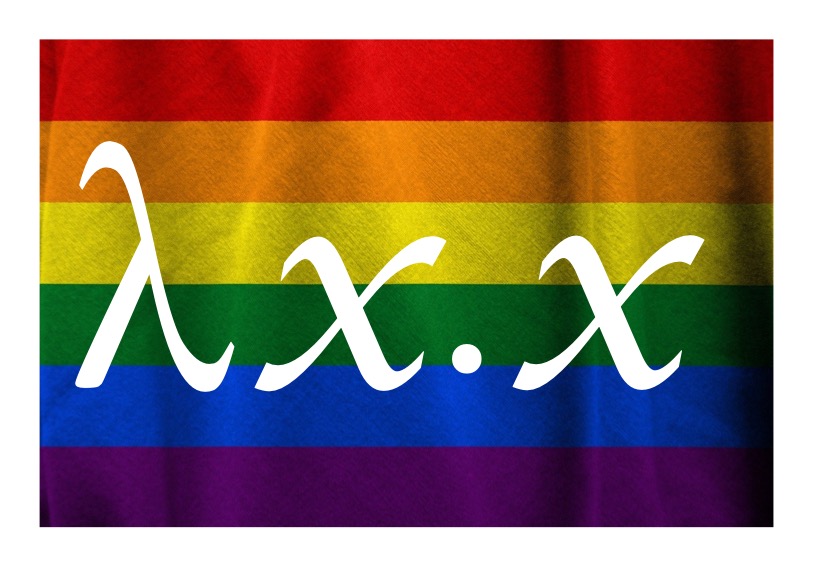
Computer Scientists talk about “Syntactic Sugar” when talking about programming languages. But in what way might a program be made sweet? It is all about how necessary a feature of a language is, and the idea and phrase was invented by Computer Scientist and gay activist, Peter Landin. He realised it made it easier to define the meaning of languages in logic and made the definitions more elegant.

Peter Landin was involved in the development of several early and influential programming languages but also a pioneer of the use of logic to define exactly what each construct of a programming language did: the language’s “semantics”. He realised there was a fundamental difference between different parts of a language. Some were absolutely fundamental to the language. If you removed them then programs would have to be written in a different way, if at all, as a result. Remove the assignment construct that allows a program to change the value of variables, for example, and there are things your programs can no longer do, or at least it would need to do it in very different way. Remove the feature that allows someone to write i++ instead of i = i + 1, on the other hand, and nothing much changes about how you write code. They were just abbreviations for common uses of the more core things.
As another example, suppose you didn’t like using curly brackets to start and end blocks of code (perhaps having learnt to program using Pascal) then if programming in C or Java you could add a layer of syntactic sugar by replacing { by BEGIN and } by END. Your programs might look different and make you feel happier, but were not really any different.
Peter called these kinds of abbreviations “syntactic sugar”. They were superficial, just there to make the syntax (the way things were written at the level of spelling and punctuation) a little bit nicer for the programmers: sometimes more readable, sometimes just needing less typing.
It is now recognised, of course, that writing readable code is a critically important part of programming. Code has to be maintainable: easily understood and modified by others long after it was written. Well thought out syntactic sugar can help with this as well as making it easier to avoid mistakes when writing code in the first place. For example, syntactic sugar is used in many languages to give special syntax to core datatypes, where they are called sugared types. Common example include using quotes to represent a String value like “abc” or square brackets like [1,2,3] to stand for an array value, rather than writing out the underpinning function calls of the core language to construct a value.
People now sometimes deride the idea of syntactic sugar, but it had a clear use for Peter beyond just readability. He was interested in logically defining languages: saying in logic exactly what each construct meant. The syntactic sugar distinction made his life doing that easier. The fundamental things were the things that he had to define directly in logic. He had to work out exactly what the semantics of each was and how to say what they meant mathematically. Syntactic sugar could be defined just by adding rewrite rules that convert the syntactic sugar to the core syntax. i++, for example does not need to be defined logically, just converted to i = i + 1 to give its meaning. If assignment was defined in terms of logic then the abbreviation is ultimately too as a result.
Peter discussed this in relation to treating a kind of logic called the lambda calculus as the basis for a language. Lambda Calculus is a logic based on functions. Everything consists of lambda expressions, though he was looking at a version which included arithmetic too. For example, in this logic, the expression:
(λn.2+n)
defines a function that takes a value n and returns the value resulting from adding 2 to that value. Then the expression:
(λn.2+n) [5]
applies that function to the value 5, meaning 5 is substituted for the n that comes after the lambda, so it simplifies to 2+5 or further to 7. Lambda expressions, therefore, have a direct equivalence to function call in a programming language. The lambda calculus has a very simple and precise mathematical meaning too, in that any expression is just simplified by substituting values for variables as we did to get the answer 7 above. It could be used as a programming language in itself. Logicians (and theoretical computer scientists) are perfectly happy reading lambda calculus statements with λ’s, but Peter realised that as a programming language it would be unreadable to non-logicians. However with a simple change, adding syntactic sugaring, it could be made much more readable. This just involved replacing the Greek letter λ by the word “where” and altering the order and throwing in an = sign..
Now instead of writing
(λn.2+n) [5]
in his programming language you would write
2 + n where n = 5
Similarly,
(λn.3n+2) [a+1]
became
3n+2 where n = a + 1
This made the language much more readable but did not complicate the task of defining the semantics. It is still just directly equivalent to the lambda calculus so the lambda calculus can still be used to define its semantics in a simple way (just apply those transformations backwards). Overall this work showed that the group of languages called functional programming languages could be defined in terms of lambda calculus in a very elegant way.
Syntactic sugar is at one level a fairly trivial idea. However, in introducing it in the context of defining the semantics of languages it is very powerful. Take the idea to its extreme and you define a very small and elegant core to your language in logic. Then everything else is treated as syntactic sugar with minimal work to define it as rewrite rules. That makes a big difference in the ease of defining a programming language as well as encouraging simplicity in the design. It was just one of the ways that Peter Landin added elegance to Computer Science.
by Paul Curzon, Queen Mary University of London
More on …
Magazines …

Subscribe to be notified whenever we publish a new post to the CS4FN blog.

EPSRC supports this blog through research grant EP/W033615/1.
 cs4fn
cs4fn 