
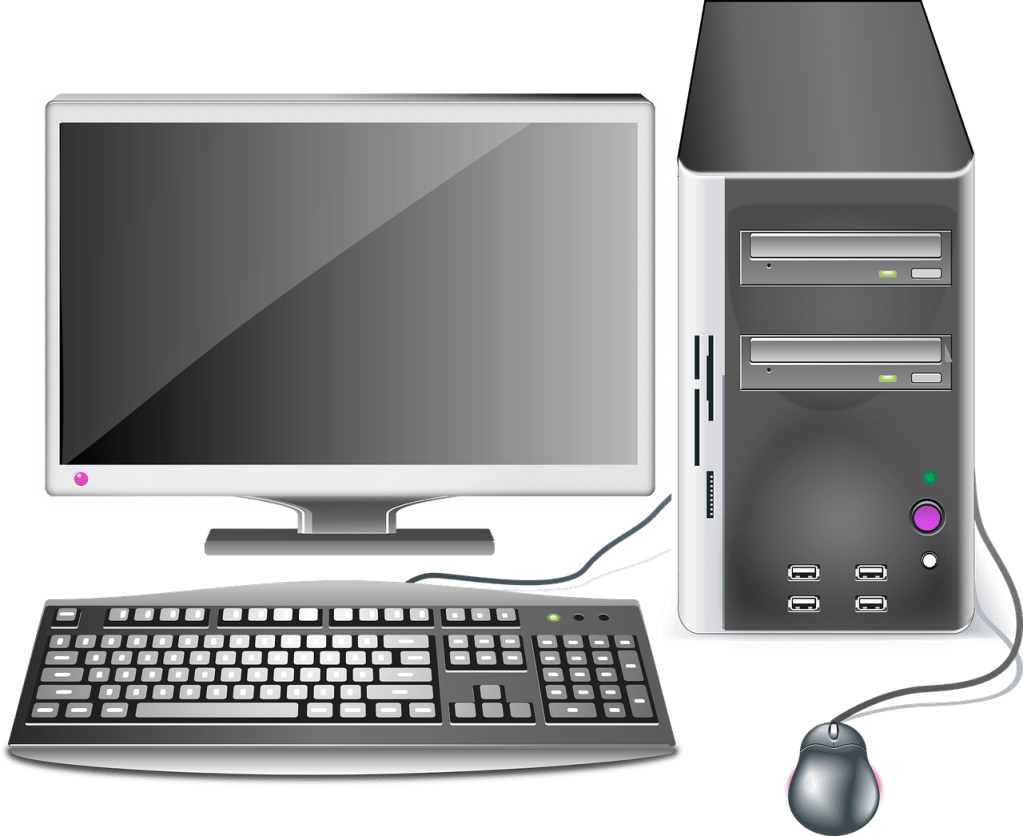
Image by Gerd Altmann from Pixabay (cropped)
We have moved on to smartphones, tablets and smartwatches, but for 30 years the desktop computer ruled, and originally not just any desktop computer, the IBM PC. A key person behind its success was African American computer scientist, Mark Dean.
IBM is synonymous with computers. It became the computing industry powerhouse as a result of building large, room-sized computers for businesses. The original model of how computers would be used followed IBM’s president, Thomas J Watson’s, supposed quote that “there is a world market for about five computers.” They produced gigantic computers that could be dialled into by those needed computing time. That prediction was very quickly shown to be wrong, though, as computer sales boomed.
Becoming more personal
Mark Dean was the first African American
to receive IBM’s highest honour.
By the end of the 1970s the computing world was starting to change. Small, but powerful, mini-computers had taken off and some companies were pushing the idea of computers for the desktop. IBM was at risk of being badly left behind… until they suddenly roared back into the lead with the IBM personal computer and almost overnight became the world leaders once more, revolutionising the way computers were seen, sold and used. Their predictions were still a little off with initial sales of the IBM PC 8 times more than they expected! Within a few years they were selling many hundreds of thousands a year and making billions of dollars. Soon every office desk had one and PC had become an everyday word used to mean computer.
Get on the bus
So who was behind this remarkable success? One of the design team who created the IBM PC was Mark Dean. As a consequence of his work on the PC, he became the first African American to be made an IBM fellow (IBM’s highest honour). One of his important contributions was in leading the development of the PC’s bus. Despite the name, a computer bus is more like a road than a vehicle, so its other name of data highway is perhaps better. It is the way the computer chip communicates with the outside world. A computer on its own is not really that useful to have on your desktop. It needs a screen, keyboard and so on. A computer bus is a bit like your nervous system used to send messages from your brain around your body. Just as your brain interacts with the world receiving messages from your senses, and allowing you to take action by sending messages to your muscles, all using your nervous system, a computer chip sends signals to its peripherals using the bus. Those peripherals include things like mouse, keyboard, printers, monitors, modems, external memory devices and more; the equivalents of its way of sensing the world and interacting with it. The bus is in essence just a set of connectors into the chip so wires out with different allocated uses and a set of rules about how they are used. All peripherals then follow the same set of rules to communicate to the computer. It means you can easily swap peripherals in and out (unlike your body!) Later versions of the PC bus, that Mark designed, ultimately became an industry standard for desktop computers.
Mark can fairly be called a key member of that PC development team, given he was responsible for a third of the patents behind the PC. He didn’t stop there though. He has continued to be awarded patents, most recently related to artificial neural networks inspired by neuroscience. He has moved on from making computer equivalents of the nervous system to computer equivalents of the brain itself.
Paul Curzon, Queen Mary University of London
More on …
Related Magazines …

EPSRC supports this blog through research grant EP/W033615/1.
 cs4fn
cs4fn 