Mary and Eliza Edwards: the mother and daughter human computers

The globe with lines of longitude marked
Lines of Longitude. Image from wikimedia, Public Domain.

Mary Edwards was a computer, a human computer. Even more surprisingly for the time (the 1700s), she was a female computer (and so was her daughter Eliza).

In the early 1700s navigation at sea was a big problem. In particular, if you were lost in the middle of the Atlantic Ocean, there was no good way to determine your longitude, your position east to west. There was of course no satnavs at the time not least because there would be no satellites for 300 years! 

It could be done based on taking sightings of the position of the sun, moon or planets, at different times of the day, but only if you had an accurate time. Unfortunately, there was no good way to know the precise time when at sea. Then in the mid 1700s, an accurate clock that could survive a rough sea voyage and still be highly accurate was invented by clockmaker John Harrison. Now the problem moved to helping mariners know where the moon and planets were supposed to be at any given time so they could use the method.

As a result, the Board of Longitude (set up by the UK government to solve the problem) with the Royal Greenwich Observatory started to publish the Nautical Almanac from 1767. It consisted lots of information of such astronomical data for use by navigators at sea. For example, it contained tables of the position of the moon (or specifically its angle in the sky relative to the sun and planets (known as lunar distances). But how were these angles known years in advance to create the annual almanacs? Well, basic Newtonian physics allow the positions of planets and the moon to be calculated based on how everything in the solar system moves together with their positions at a known time. From that their position in the sky at any time can be calculated. That answers would be in the Nautical Almanac. Each year a new table was needed, so the answers also needed to be constantly recomputed.

But who did the complex calculations? No calculators, computers or other machines that could do it automatically would exist for several hundred years. It had to be done by human mathematicians. Computers then were just people, following algorithms, precisely and accurately, to get jobs like this done. Astronomer Royal, Nevil Maskelyne recruited 35 male mathematicians to do the job. One was the Revd John Edwards (well-educated clergy were of course perfectly capable of doing maths in their spare time!). He was paid for calculations done at home from 1773 until he died in 1884.

However, when he died Maskelyne received a letter from his wife Mary, revealing officially that in fact she had been doing a lot of the calculations herself, and with no family income any more she asked if she could continue to do the work to support herself and her daughters. Given the work had been of high enough quality that John Edwards had been kept on year after year so Mary was clearly an asset to the project, (and given he had visited the family several times so knew them, and was possibly even unofficially aware who was actually doing the work towards the end) Maskelyne was open-minded enough to give her a full time job. She worked as a human computer until her death 30 years later. Women doing such work was not at all normal at the time and this became apparent when Maskelyne himself died and the work stated to dry up. The quality of the work she did do, though, eventually persuaded the new Astronomer Royal  to continue to give her work.

Just as she helped her husband, her daughter Eliza helped her do the calculations, becoming proficient enough herself that when Mary died, Eliza took over the job, continuing the family business for another 17 years. Unfortunately, however, in 1832, the work was moved to a new body called ‘His Majesty’s Nautical Almanac Office’ At that point, despite Mary and Eliza having proved they were at least as good as the men for half a century or more, government imposed civil service rules came into force that meant women could no longer be employed to do the work.

Mary and Eliza, however had done lots of good, helping mariners safely navigate the oceans for very many years through their work as computers.

More on …

Subscribe to be notified whenever we publish a new post to the CS4FN blog.


This blog is funded by EPSRC on research agreement EP/W033615/1.

QMUL CS4FN EPSRC logos

The very first computers

Victorian engineer Charles Babbage designed, though never built the first mechanical computer. The first computers had actually existed for a long time before he had his idea, though. The British superiority at sea and ultimately the Empire was already dependent on them. They were used to calculate books of numbers that British sailors relied on to navigate the globe. The original meaning of the word computer was actually a person who did these calculations. The first computers were humans.

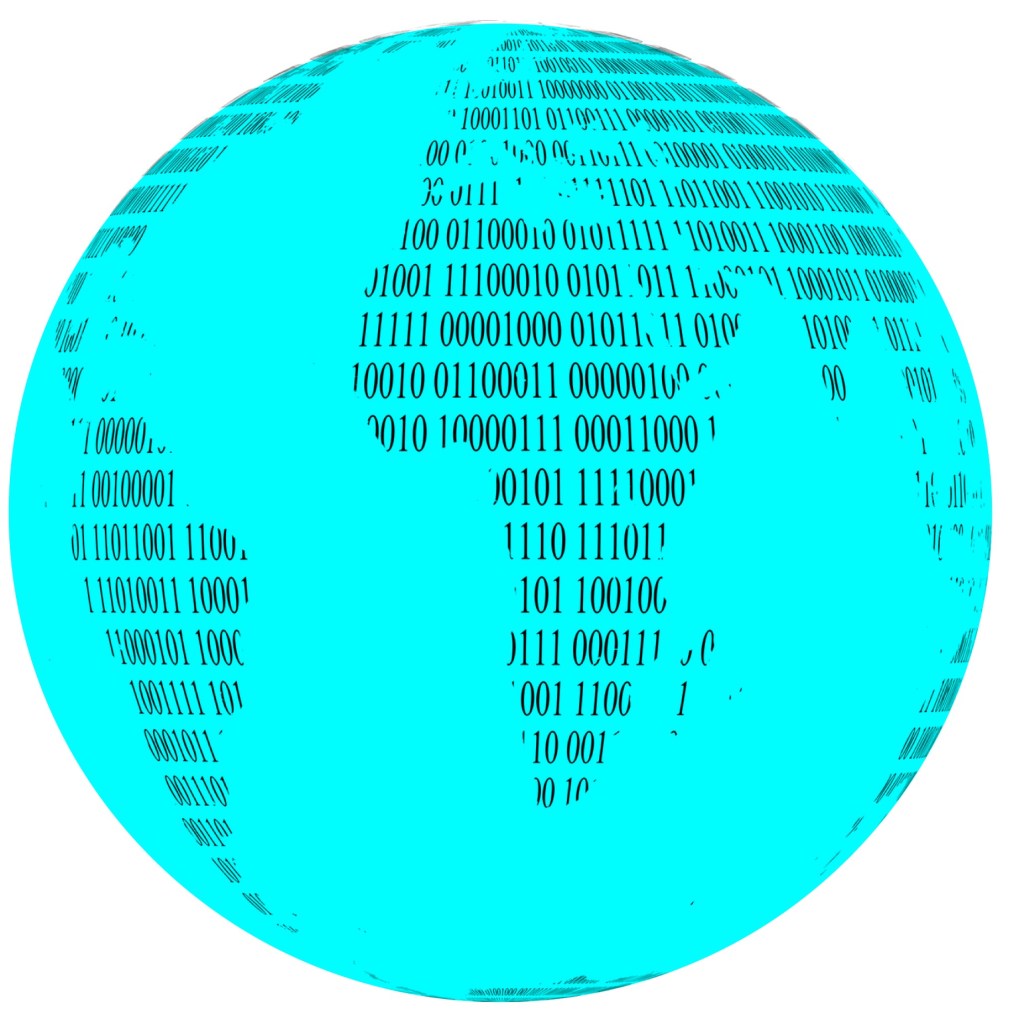
Globe with continents in binary
Image by Gordon Johnson from Pixabay (colour by CS4FN)

Babbage became interested in the idea of creating a mechanical computer in part because of computing work he did himself, calculating accurate versions of numbers needed for a special book: ‘The Nautical Almanac’. It was a book of astronomical tables, the result of an idea of Astronomer Royal, Nevil Maskelyne. It was the earliest way ships had to reliably work out their longitudinal (i.e., east-west) position at sea. Without them, to cross the Atlantic, you just set off and kept going until you hit land, just as Columbus did. The Nautical Almanac gave a way to work out how far west you were all the time.

Maskelyne’s idea was based on the fact that the angle from the moon’ to a person on the Earth and back to a star was the same at the same time wherever that person was looking from (as long as they could see both the star and moon at once). This angle was called the lunar distance.

The lunar distance could be used to work out where you were because as time passed its value changed but in a predictable way based on Newton’s Laws of motion applied to the planets. For a given place, Greenwich say, you could calculate what that lunar distance would be for different stars at any time in the future. This is essentially what the Almanac recorded.

Now the time changes as you move East or West: Dawn gradually arrives later the further west you go, for example, as the Earth rotates the sun comes into view at different times round the planet). That is why we have different time zones. The time in the USA is hours behind that in Britain which itself is behind that in China. Now suppose you know your local time, which you can check regularly from the position of the sun or moon, and you know the lunar distance. You can look up in the Almanac the time in Greenwich that the lunar distance occurs and that gives you the current time in Greenwich. The greater the difference that time is to your local time, the further West (or East) you are. It is because Greenwich was used as the fixed point for working the lunar distances out, that we now use Greenwich Mean Time as UK time. The time in Greenwich was the one that mattered!

This was all wonderful. Sailors just had to take astronomical readings, do some fairly simple calculations and a look up in the Almanac to work out where they were. However, there was a big snag. it relied on all those numbers in the tables having been accurately calculated in advance. That took some serious computing power. Maskelyne therefore employed teams of human ‘computers’ across the country, paying them to do the calculations for him. These men and women were the first industrial computers.

Before pocket calculators were invented in the 1970s the easiest way to do calculations whether big multiplication, division, powers or square roots was to use logarithms. The logarithm of a number is just the number of times you can divide it by 10 before you get to 1. Complicated calculations can be turned in to simple ones using logarithms. Therefore the equivalent of the pocket calculator was a book containing a table of logarithms. Log tables were the basis of all other calculations including maritime ones. Babbage himself became a human computer, doing calculations for the Nautical Almanac. He calculated the most accurate book of log tables then available for the British Admiralty.

The mechanical computer came about because Babbage was also interested in finding the most profitable ways to mechanise work in factories. He realised a machine could do more than weave cloth but might also do calculations. More to the point such a machine would be able to do them with a guaranteed accuracy, unlike people. He therefore spent his life designing and then trying to build such a machine. It was a revolutionary idea and while his design worked, the level of precision engineering needed was beyond what could be done. It was another hundred years before the first electronic computer was invented – again to replace human computers working in the national interest…but this time at Bletchley Park doing the calculations needed to crack the German military codes and so win the World War II.

More on …

Related Magazines …

Cover of Issue 20 of CS4FN, celebrating Ada Lovelace

Subscribe to be notified whenever we publish a new post to the CS4FN blog.


This blog is funded by EPSRC on research agreement EP/W033615/1.
QMUL CS4FN EPSRC logos