Skip to content

cs4fn

Computer Science for Fun

Tag: multimodal computing

The Tactful Watch

by Paul Curzon, Queen Mary University of London

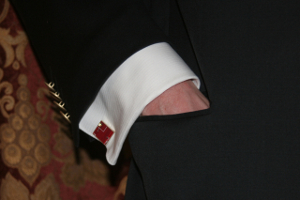
Hand with cufflink in jacket pocket
Image by Paul Curzon

These days art and high technology don’t mix much. Personal gadgets are one thing, jewellery quite another. That hasn’t always been the case though and hopefully it won’t be in the future. The tactful watch also shows how tech accessible to blind people can have other uses too.

In the 18th century there was a mobile revolution just like the current one. Back then the technology wasn’t the smart watch or MP3 player but the pocket watch. The 18th century watchmakers weren’t just innovators though they were also artists and craftsmen. The result was truly exquisite jewellery that was also highly functional.

One of the absolute masters was Abraham Louis Breguet. Born in Switzerland, he set up business in Paris and was to become one of the greatest innovators ever. His clients included the likes of Marie-Antoinette, King George IV of Britain, the Sultan of the Ottoman Empire and the Tsar Alexander I of Russia. Rather than build lots of identical watches he constantly tinkered with the designs. The result was that he is responsible for some of the most important innovations in clock technology. Many of his inventions were technical advances such as the first self-winding watch. He realised the importance of making his designs easy to use too though. A Breguet watch, made for the Queen of Naples, for example, was the first to be worn on the wrist!

In the 21st century we are just getting to grips with new ways of interacting with our personal gadgets. People have realised that basing mobile device designs on what works for a desktop PC is not so sensible. When on the move it’s not that convenient to have to look at a screen. Consequentially we are undergoing a revolution in multimodal computing. It involves finding ways of using our other senses not just sight to interact with computers. The way your phone vibrates in your pocket is one simple example – tactile computing, delivering information through your sense of touch.

Clever as we are Breguet was way ahead of us though. At the turn of the 18th century it was not considered polite to look at your watch in public. Breguet’s solution was the tact watch: a watch that allowed you to check the time without taking it out of your pocket. Tactile and tactful computing! His solution was of course (in all senses) incredibly elegant. It would also have been a great design for the blind and partially sighted – showing how designing for one use can have others too.

Round the edge were 12 evenly spaced diamond studs, with larger ones at the 3, 6, 9 and 12 positions. On the outside was an arrow. It did not move on its own like a normal clock hand, though. That wouldn’t really work inside a pocket without a glass case and then it couldn’t be touched. Hidden inside the case was an actual clock. When the owner wanted to tactfully check the time they would just spin the arrow until they felt resistance. That meant the arrow was now back in synchrony with the real hour hand. They could then count round the diamond studs to work out its position and so the time.

One of the most stunningly beautiful tact watches was made for Josephine Bonaparte, Empress of France in 1800. Two centuries later it sold at Chrysties for over $1.3 million.. The best we seem to be able to do in the 21st century is to just dip an iPod in gold and coat it with diamonds. The result: not 18th century elegance, just very expensive 21st century bling.

Artists and jewellers are starting to work with scientists and engineers again though so maybe our modern gadgets can follow the path of the watch and become elegant jewellery too.

More on …

  • Tech Entrepreneurship
  • Mobile computing: Gadgets that Change the World
  • Design for all – help us all

Magazines …

  • Issue 29 – Diversity
  • Issue 23- The women are (still) here
Front cover of CS4FN issue 29 - Diversity in Computing

Our Books …

  • The Power of Computational Thinking:
    • Games Magic and Puzzles to help you become a computational thinker
  • Conjuring with Computation
    • Learn the basics of computer science through magic tricks
Subscribe to be notified whenever we publish a new post to the CS4FN blog.


This page and talk are funded by EPSRC on research agreement EP/W033615/1.

Paul Curzon Computer History, Wearable computing Leave a comment May 8, 2017March 9, 2025 3 Minutes

Click below to find out more…

Search our site

Image showing concentric luminous green circles and radial lines on a black background which converge into a central dip in the middle, to evoke a gravity well or black hole. Overlaid is white text saying Portals.
Adapted spacetime image by Johnson Martin from Pixabay
Find out about some of the rather surprising things computer scientists have got up to when they're in a playful mood.
Banner for LGBTQ+ Computer Science Greats with white text on the rainbow pride flag
LGBTQ+ Computer Science Greats portal

Click to read our Lego-themed series featuring pixel puzzles, compression algorithms, number representation, gray code, binary and computation.

Recent Posts

  • Instant 3×3 Magic Squares
  • Synthetic Speech
  • Film Futures: A Christmas Carol
  • Hear and … their magic square
  • Sounding out a Sensory Garden

All previous posts

Recent Comments

Unknown's avatarGatsby Benchmarks fo… on Finding work experience, or a…
BBC Sound Effects li… on AMPER: AI helping future you r…
Unknown's avatarPEEECS Bulletin Augu… on Involving disabled people in t…
Unknown's avatarRecently added to th… on Finding work experience, or a…
Unknown's avatarRecently added to th… on Involving disabled people in t…

Archives

  • December 2025
  • November 2025
  • October 2025
  • September 2025
  • August 2025
  • July 2025
  • June 2025
  • May 2025
  • April 2025
  • March 2025
  • February 2025
  • January 2025
  • December 2024
  • November 2024
  • October 2024
  • September 2024
  • August 2024
  • July 2024
  • June 2024
  • May 2024
  • April 2024
  • March 2024
  • February 2024
  • January 2024
  • December 2023
  • November 2023
  • October 2023
  • September 2023
  • August 2023
  • July 2023
  • June 2023
  • May 2023
  • April 2023
  • March 2023
  • February 2023
  • January 2023
  • December 2022
  • November 2022
  • October 2022
  • September 2022
  • August 2022
  • July 2022
  • June 2022
  • May 2022
  • April 2022
  • March 2022
  • January 2022
  • December 2021
  • November 2021
  • October 2021
  • July 2021
  • June 2021
  • May 2021
  • April 2021
  • September 2017
  • June 2017
  • May 2017
  • April 2017

Categories

  • Advent Calendar
  • Algorithmic thinking
  • algorithms
  • Ancient History
  • Animal Welfare
  • Anthropology
  • April Fools & Tech Whimsy
  • Archeology
  • Art and Craft
  • Artificial Intelligence
  • Artificial Life
  • astronomy
  • Audio Engineering
  • Augmented Reality
  • Automata
  • Aviation & Aerospace
  • Bayesian Networks
  • Bias
  • Big Data
  • Biologically-inspired computing
  • Biology
  • Black History Month
  • Brain-computer interfaces
  • Careers
  • Cellular Automata
  • Cloud Computing
  • Complexity
  • Compression Algorithms
  • Computation
  • Computational Thinking
  • Computer Architecture
  • Computer Graphics
  • Computer History
  • Computer memory
  • Computer Science
  • Computer Science & Research
  • Computer Vision
  • Computers and Society
  • Creative Computing
  • cs4fn issues
    • annual 2
    • EE4FN – Issue 2
    • ee4fn1
    • issue 10 – Computing goes mobile
    • issue 11 – Computer animation proudly presents
    • Issue 12 – Computing on the Catwalk
    • issue 13 – Facing Up To Faces
    • issue 14 – Alan Turing – The Genius Who Gave Us The Future
    • issue 15 – Does your computer understand you?
    • issue 16 – Clean Up Your Language
    • issue 17 – Machines Making Medicine Safer
    • issue 18 – Machines That Are Creative
    • issue 19 – Touch it feel it hear it
    • Issue 2 – The Magic of Computer SCIENCE
    • issue 20 – Ada Lovelace
    • issue 21 – Computing Sounds Wild
    • issue 22 – Creative Computing
    • issue 23 – The Women are (still) here
    • issue 24 – Cyber Security
    • issue 25 – Wearable Technology
    • issue 26 – Serious Fun – Peter McOwan
    • issue 27 – Smart Health: Decisions decisions decisions…
    • Issue 28 – Cunning Computational Contraptions
    • issue 3 – Computer science and entertainment
    • issue 4 – Computer Science and BioLife
    • issue 5 – The Perception Deception
    • issue 6 – Computer science everywhere
    • issue 8 – Computer Science In Space
    • issue 9 – Programmed to save the world
  • Cyber security
  • Data Representation
  • Data Visualisation
  • Dependable Computing
  • Design for All
  • Digital Signal Processing
  • Diversity
    • disability
  • Education
  • Electronic Engineering
  • electronics
  • emotion
  • Encryption
  • English and Computing
  • Entertainment
  • Entrepreneurship
  • Fiction
  • Finance
  • Formal Verification
  • from around the web
  • games
  • Genetic Algorithms
  • Geography
  • Healthcare
  • History
  • Human-human communication
  • Humour
  • Image Representation
  • Information Retrieval
  • Interaction Design
  • Internet of Things
  • Issue 29 – Diversity
  • Law
  • Lego Computer Science
  • LGBTQ+
  • Linguistics
  • Logic and Proof
  • Machine Learning
  • magic
  • mathematics
  • Media Arts Technology
  • Microprocessor design
  • Mistakes and errors
  • Mobile Computing
  • Movies
  • Music
  • Natural Language Processing
  • nature
  • Networking and Communications
  • Networks
  • Neuroscience
  • Number Representation
  • Operating Systems
  • Optics
  • People
  • Philosophy
  • Physics
  • Privacy
  • Programming
  • Programming Languages
  • puzzles
  • Quantum computing
  • Regular Expressions
  • Robotics
  • Safety-critical systems
  • Science
  • Sensor Technology
  • Sentiment Analysis
  • Simulation
  • Social Networks
  • Sonification
  • Sound and acoustics
  • Space
  • Sport
    • Basketball
    • Football
    • Motor racing
  • Steganography
  • swarm intelligence
  • Theory
  • Time
  • Uncategorized
  • Verification and Validation
  • Veterinary Science
  • Wearable computing
  • weather
  • Women in Computing
  • zoology

Meta

  • Create account
  • Log in
  • Entries feed
  • Comments feed
  • WordPress.com

Blog Stats

  • 74,456 hits

Blog at WordPress.com.
  • Subscribe Subscribed
    • cs4fn
    • Join 127 other subscribers
    • Already have a WordPress.com account? Log in now.
    • cs4fn
    • Subscribe Subscribed
    • Sign up
    • Log in
    • Report this content
    • View site in Reader
    • Manage subscriptions
    • Collapse this bar
 

Loading Comments...