
In school we learn about the maths that others have invented: results that great mathematicians like Euclid, Pythagoras, Newton or Leibniz worked out. We follow algorithms for getting results they devised. Ada Lovelace was actually taught by one of the great mathematicians, Augustus De Morgan, who invented important laws, ‘De Morgan’s laws’ that are a fundamental basis for the logical reasoning computer scientists now use. Real maths is about discovering new results of course not just using old ones, and the way that is done is changing.
We tend to think of maths as something done by individual geniuses: an isolated creative activity, to produce a proof that other mathematicians then check. Perhaps the greatest such feat of recent years was Andrew WIles’ proof of Fermat’s Last Theorem. It was a proof that had evaded the best mathematicians for hundreds of years. Wiles locked himself away for 7 years to finally come up with a proof. Mathematics is now at a remarkable turning point. Computer science is changing the way maths is done. New technology is radically extending the power and limits of individuals. “Crowdsourcing” pulls together diverse experts to solve problems; computers that manipulate symbols can tackle huge routine calculations; and computers, using programs designed to verify hardware, check proofs that are just too long and complicated for any human to understand. Yet these techniques are currently used in stand-alone fashion, lacking integration with each other or with human creativity or fallibility.
‘Social machines’ are a whole new paradigm for viewing a combination of people and computers as a single problem-solving entity. The idea was identified by Tim Berners-Lee, inventor of the world-wide web. A project led by Ursula Martin at the University of Oxford explored how to make this a reality, creating a mathematics social machine – a combination of people, computers, and archives to create and apply mathematics. The idea is to change the way people do mathematics, so transforming the reach, pace, and impact of mathematics research. The first step involves social science rather than maths or computing though – studying what working mathematicians really do when working on new maths, and how they work together when doing crowdsourced maths. Once that is understood it will then be possible to develop tools to help them work as part of such a social machine.
The world changing mathematics results of the future may be made by social machines rather than solo geniuses. Team work, with both humans and computers is the future.
– Ursula Martin, University of Oxford
and Paul Curzon, Queen Mary University of London

Related Magazine …

Related Magazine …
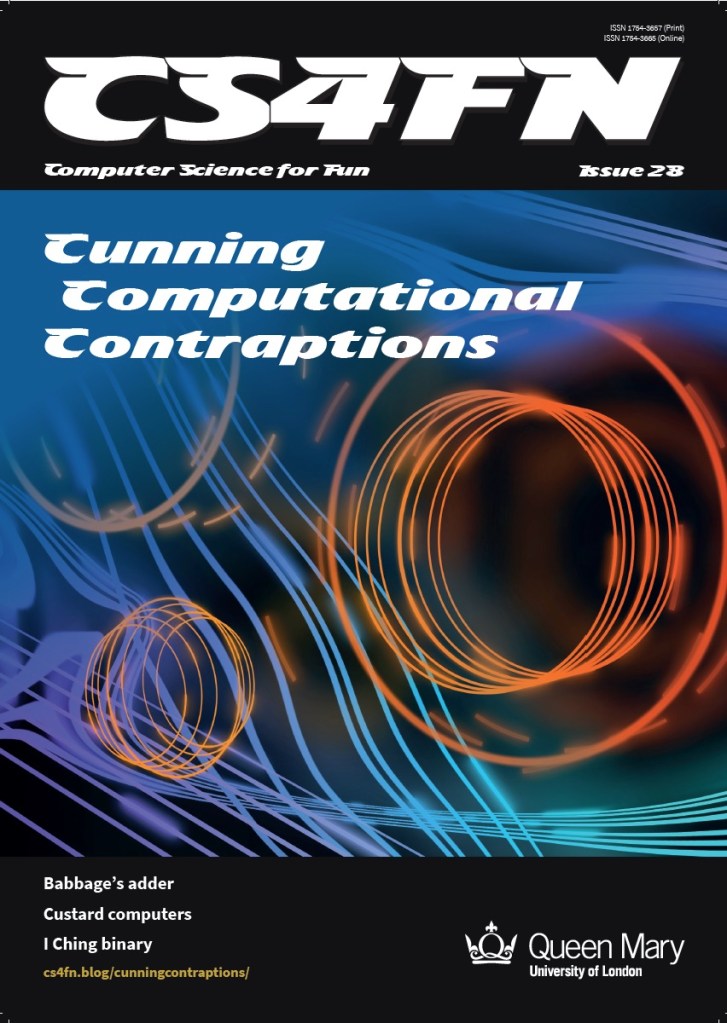
The history of computational devices: automata, core rope memory (used by NASA in the Moon landings), Charles Babbage’s Analytical Engine (never built) and Difference Engine made of cog wheels and levers, mercury delay lines, standardising the size of machine parts, Mary Coombs and the Lyons tea shop computer, computers made of marbles, i-Ching and binary, Ada Lovelace and music, a computer made of custard, a way of sorting wood samples with index cards and how to work out your own programming origin story.
Subscribe to be notified whenever we publish a new post to the CS4FN blog.
This blog is funded by EPSRC on research agreement EP/W033615/1.




 cs4fn
cs4fn 