CS4FN Advent 2023 – Day 2: Pairs: mittens, gloves, pair programming, magic tricks

Welcome to the second ‘window’ of the CS4FN Christmas Computing Advent Calendar. The picture on the ‘box’ was a pair of mittens, so today’s focus is on pairs, and a little bit on gloves. Sadly no pear trees though.
A pair of cyan blue Christmas mittens with a black and white snowflake pattern on each. Image drawn and digitised by Jo Brodie.

1. i-pickpocket

In this article, by a pair (ho ho) of computer scientists (Jane Waite and Paul Curzon), you can find out how paired devices can be used to steal money from people, picking pockets at a distance.

A web card for the i-pickpocket article on the CS4FN website.
Click to read the article

2. Gestural gloves

Working with scientists musician Imogen Heap developed Mi.Mu gloves, a wearable musical instrument in glove form which lets the wearer map hand movements (gestures) to a particular musical effect (pairing a gesture to an action). The gloves contain sensors which can measure the speed and position of the hands and can send this information wirelessly to a controlling computer which can then trigger the sound effect that the musician previously mapped to that hand movement.

You can watch Imogen talk about and demo the gloves here and in the video below, which also looks at the ways in which the gloves might help disabled people to make music.

Further reading

The glove that controls your cords… (a CS4FN article by Jane Waite)

3. Pair programming

‘Pair programming’ involves having two people working together on one computer to write and edit code. One person is the ‘Driver’ who writes the code and explains what it’s going to do, the other person is the ‘Navigator’ who observes and makes suggestions and corrections. This is a way to bring two different perspectives on the same code, which is being edited, reviewed and debugged in real-time. Importantly, the two people in the mini-team switch roles regularly. Pair programming is widely used in industry and increasingly being used in the classroom – it can really help people who are learning about computers and how to program to talk through what they’re doing with someone else (you may have done this yourself in class). However, some people prefer to work by themselves and pair programming takes up two people’s time instead of one, but it can also produce better code with fewer bugs. It does need good communication between the two people working on the task though (and good communication is a very important skill in computer science!).

Here’s a short video from Code.org which shows how it’s done.

4. Digital Twins

A digital twin is a computer-based model that represents a real, physical thing (such as a jet engine or car component) and which behaves as closely as possible to the real thing. Taking information from the real-world version and applying it to the digital twin lets engineers and designers test things virtually, to see how the physical object would behave under different circumstances and to help spot (and fix) problems.

5. A magic trick: two cards make a pair

You will need

  • some playing cards
  • your hands (no mittens)
  • another pair of mitten-free hands to do the trick on

Find a pack of cards and take out 15 (doesn’t matter which ones, pick a card, any card, but 15 of them). Ask someone to put their hands on a table but with their fingers spread as if they’re playing a piano. You are going to do a magic trick that involves slotting pairs of cards between their fingers (10 fingers gives 8 spaces). As you do this you’ll ask them to say with you “two cards make a pair”. Take the first pair and slot them between the first space on their left hand (between their little finger and their ring finger) and both of you say “two cards make a pair”.
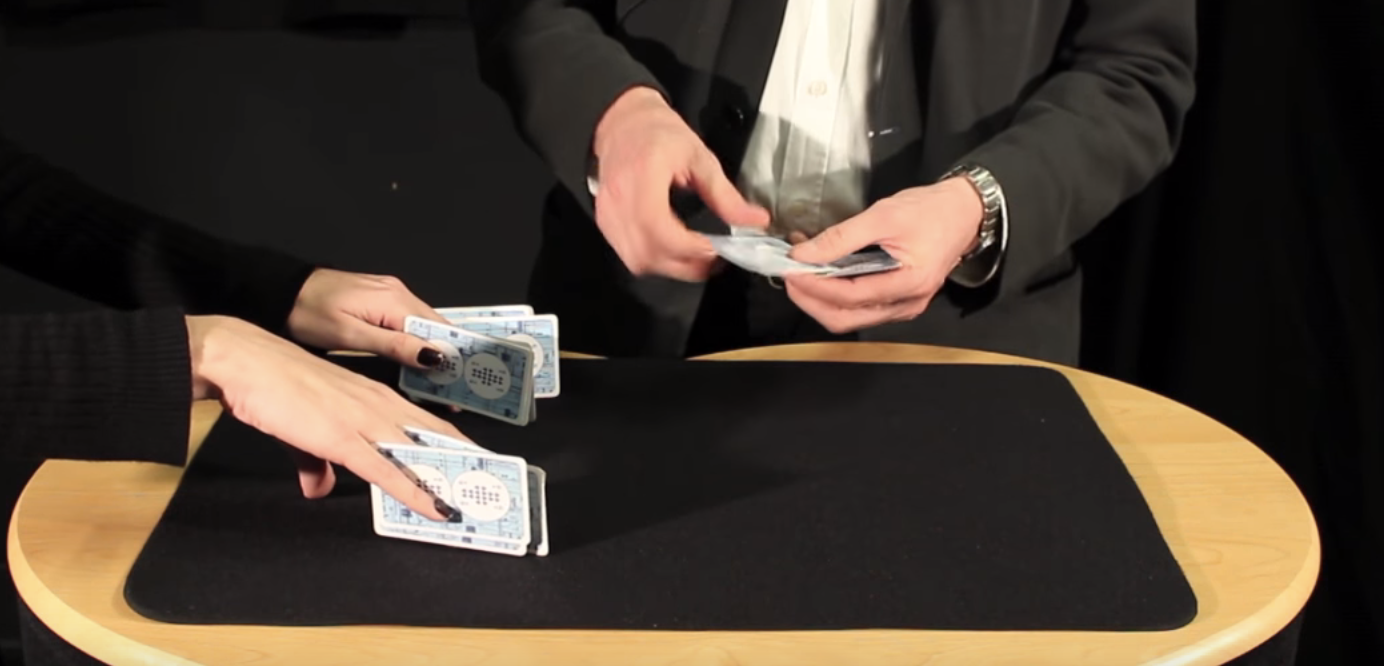
The magician puts pairs of cards between the assistant’s fingers. Image credit CS4FN / Teaching London Computing (from the Invisible Palming video linked below)

Repeat with another pair of cards between ring finger and middle finger (“two cards make a pair”) and twice again between middle and index, and between index and thumb – saying “two cards make a pair” each time you do. You’ve now got 8 cards in 4 pairs in their left hand.

Repeat the same process on their right hand saying “two cards make a pair” each time (but you only have 7 cards left so can only make 3 pairs). There’s one card left over which can go between their index finger and thumb.
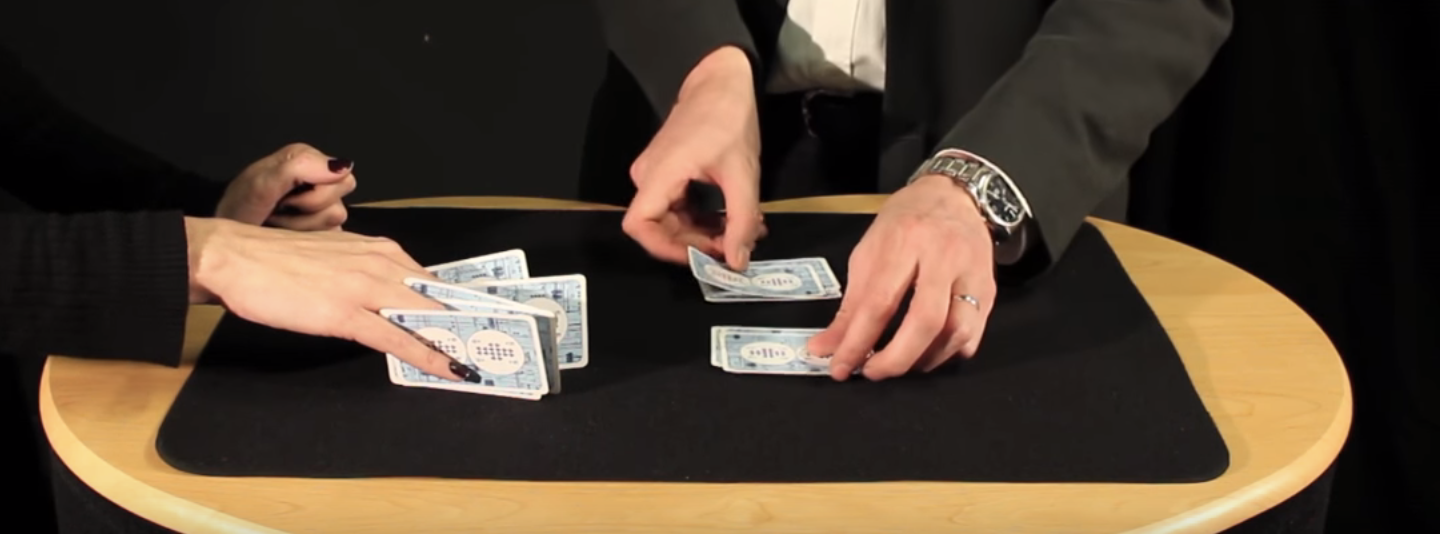
The magician removes the cards and puts them into two piles. Image credit CS4FN / Teaching London Computing (from the Invisible Palming video linked below)

Then you’ll take back each pair of cards and lay them on the table, separating them into two different piles – each time saying “two cards make a pair”. Again you’ll have one left over. Ask the person to choose which pile it goes on. You, the magician, are going to magically move the card from the pile they’ve chosen to the other pile, but you’re going to do it invisibly by hiding the card in your palm (‘palming’). To find out how to do the trick, and how this can be used to think about the ways in which “self-working” magic tricks are like algorithms have a look at the full instructions and video below.

6. Something to print and colour in

Did you work out yesterday’s colour-in puzzle from Elaine Huen? Here’s the answer.

Christmas colour-in puzzle

Today’s puzzle is in keeping with the post’s twins and pairs theme. It’s a symmetrical pixel puzzle so we’ve given you one half and you can use mirror symmetry to fill in the remaining side. This is an example of data compression – you only need half of the numbers to be able to complete all of it. Some squares have a number that tells you the colour to colour in that square. Look up the colours in the key. Other squares have no number. Work out what colour they are by symmetry.

So, for example the colour look up key tells you that 1 is Red and 2 is Orange, so if a row said 11111222 that means colour each of the five ‘1’ pixels in red and each of the three ‘2’ pixels orange. There are another 8 blank pixels to fill in at the end of the row and these need to mirror the first part of the row (22211111), so you’d need to colour the first three in orange and the remaining five in red. Click here to download the puzzle as a printable PDF. Solution tomorrow…


The creation of this post was funded by UKRI, through grant EP/K040251/2 held by Professor Ursula Martin, and forms part of a broader project on the development and impact of computing.


Advert for our Advent calendar
Click the tree to visit our CS4FN Christmas Computing Advent Calendar

EPSRC supports this blog through research grant EP/W033615/1.
Engineering a cloak of invisibility: manipulating light with metamaterials

by Akram Alomainy and Paul Curzon, QMUL

You pull a cloak around you and disappear! Reality or science fiction? Harry Potter’s invisibility cloak is surely Hogwarts’ magic that science can’t match. Even in Harry Potter’s world it takes powerful magic and complicated spells to make it work. Turns out even that kind of magic can be done with a combination of materials science and computer science. Professor Susumu Tachi of the University of Tokyo has developed a cloak made of thousands of tiny beads. Cameras video what is behind you and a computer system then projects the appropriate image onto the front of the cloak. The beads are made of a special material called retro-reflectrum. It is vital to give the image a natural feel – normal screens give too flat a look, losing the impression of seeing through the person. Now you see me, now you don’t at the flick of a switch.

But could an invisibility cloak, without tiny screens on it, ever be a reality? It sounds impossible especially if you understand how light behaves. It bounces off the things around us, travelling in straight lines. You see them when that reflected light eventually reaches your eyes. I can see the red toy over there because red light bounced from it to me. For it to be invisible, no light from it must reach my eyes, while at the same time light from everything else around should. How could that be possible? Akram Alomainy of Queen Mary, University of London, tells us more.

Well maybe things aren’t quite that simple…halls of mirrors, rainbows, polar bears and desert mirages all suggest some odd things can happen with light! They show that manipulating light is possible and that we may even be able to bend it in a way that alters the way things look – even humans.

Light fantastic

Have you ever wondered how the hall of mirrors in a fun fair distorts your reflection? Some make us look short and fat while others make us tall and slim! It’s all about controlling the behaviour of light. The light rays still travel in straight lines, but the mirrors deceive the eye. The light seems to arrive from a different place to reality because the mirrors are curved, not flat, making the light bounce at odd angles.

A rainbow is an object we see that isn’t really there. They occur because white light doesn’t actually exist. It is just coloured light all mixed up. When it hits a surface it separates back into individual colours. The colour of an object you see depends on which colours pass through or get reflected, and which get absorbed. The light is white when it hits the raindrops, but then comes out as the whole spectrum of colours. They head off at slightly different angles, which is why they appear in the different rainbow positions.

What about polar bears? Did you know that they have black skins and semi-transparent hair? You see them as white because of the way the hollow hairs reflect sunlight.

So what does this have to do with invisibility? Well, it suggests that with light all is not as it seems. Perhaps we can manipulate it to do anything we want.

Water! Water!

Now for the clincher – mirages! They show that invisibility cloaks ought to be a possibility. Light from the sun travels in a straight line through the sky. That means we see everything as it is. Except not quite. In places like deserts where the temperature is very high at noon, apparently weird things happen to the light. The difference between the temperature, and thus the difference in density between the higher air layers and the levels closer to the ground can be quite large. That temperature difference makes light coming from the sky change direction as it passes through each layer. It bends rather than just travelling in a straight line to us. It is that image of the sky that looks like the pool of water – the mirage. Our brains assume the light travelled in a straight line, so they misinterpret its location. Now, to make something invisible we just need to make light bend round it. That invisibility cloak is a possibility if we can just engineer what mirages do – bend light!

Nano-machines

That is the basic idea and it is an area of science called ‘transformation optics’ that makes it possible. The science tells us about the properties that each point of an object must have to make light waves travel in any particular way we wish through it. To make it happen engineers must then create special materials with those properties. These materials are known as metamaterials. Their properties are controlled using electromagnetism, which is where the electronic engineers come in! You can think of them as being made of vast numbers of tiny electrical machines built into big human-scale structures. Each tiny machine is able to control how light passes through it, even bending light in a way no natural material could. If the machines are small enough – ‘nanotechnology’ as small as the wavelength of light – and their properties can be controlled really precisely to match the science’s prediction, then we can make light passing through them do anything we want. For invisibility, the aim is to control those properties so the light bends as it passes through a metamaterial cloak. If the light comes out the other side of the cloak unchanged and travelling in the same direction as it entered, while avoiding objects in the middle, then those objects will be invisible.

Now you see it…

Simple cloaking devices that work this way have already been created but they are still very limited. One of the major challenges is the range of light they can work with. At the moment it’s possible to make a cloak that bends a single colour frequency, but not all light. As Yang Hao, a professor working in this area at Queen Mary, notes: “The obstacle engineers face is the complex manufacturing techniques needed to build devices that can bend light across the whole visible light spectrum. However, with the progress being made in nanotechnologies this could become a possibility in the near future”.

Perhaps we should leave the last word to J.K. Rowling: “A suspicious object like that, it was clearly full of Dark Magic.” So while we should appreciate the significance of such an invention we should perhaps be careful about the negative consequences!


This article is a composite of an article originally published on the CS4FN website and from one published on pages 10 and 11 of the first issue of EE4FN magazine (download from the panel below). The topic is also part of The Magic of Computer Science and a new book on ‘Conjuring with Computation’ which is coming soon.

All of our free magazines and booklets, including others on Magic, can be downloaded as PDFs.

More on …

Related Magazines and a new book…


EPSRC supports this blog through research grant EP/W033615/1.